Your ShelfYour Projects

Signs of the Times, Vol. 34, No. 15.

Promises to the Redeemed
Earlier text: Studies in the Book of Daniel

Special to Our Subscribers

Our Bible-Reading Series of twenty-six numbers of the SIGNS OF THE TIMES will soon close. We have received many appreciative letters of this series of which the following is an average sample:
"I can not express in words how pleased I am with the SIGNS. We have reached a time when we can point to the SIGNS as the grandest and greatest missionary paper in all the world, not only in its special numbers, but in its regular issues from week to week."
As the Bible-Reading Series is about finished, our readers will naturally wonder what are the plans for the paper beyond that. We have completed arrangements for

172 SPECIAL ARTICLES

covering all the leading themes of the Gospel. These will be illustrated and presented clearly and attractively. Here are some of the subjects to be considered:
  • The Law of God
  • The Everlasting Gospel
  • Man's Sin and Saviour
  • Man's Nature and Destiny
  • The Holy Spirit
  • Bible Election
  • The Complete Sabbath Question
  • The Coming of the Lord
  • The Signs of the Times
  • Conversion and Regeneration
  • The Church Militant and Triumphant
  • The Great Field of Prophecy
  • Union versus Confederation
  • The World's Ills and Remedies
  • The Great Threefold Message
  • Religious Liberty
  • The Day of the Lord
  • The Earth and Its Future
In addition to the foregoing there will be

50 MISCELLANEOUS ARTICLES

on subjects of practical godliness, true Christian living, etc., which will be very helpful to all.
The series of Bible-Readings just closed have given such general satisfaction that the editors have decided to continue this feature thru the coming year, therefore there will be

52 BIBLE-READINGS

on the subjects presented in the foregoing articles in addition to the articles themselves. These readings will be brief but comprehensive.
Following are the subjects of some of the good things that will appear in

THE HOME DEPARTMENT

  • Breathing
  • Ventilation
  • Blood Circulation
  • Food Combinations
  • Common Sense
  • Absence of Worry
  • Simplicity of Life
  • Few Varieties at Meals
  • Clothing: Effects of Improper Clothing
  • Clothing for the Trunk
  • Clothing for the Limbs
  • Clothing for the Feet
  • The Responsibilities of the Father
  • The Responsibilities of the Mother
  • Responsibilities and Privileges of the Son
  • Responsibilities and Privileges of the Daughter
  • Pernicious Reading
  • Good Reading

THE OUTLOOK DEPARTMENT

The reader knows of the mighty issues that are agitating the world, and how that the bravest men are trembling before what they see coming on with an irresistible force. In the Outlook Department these issues will be considered by the able corps of correspondents that we have scattered thruout the world, and the meaning of the disquieting events will be fully presented in the light of prophecy. No one can afford to miss the important matter that will be found in this department from week to week.

MISSIONS

The SIGNS has always taken a lively interest in missions and missionary enterprises. During the coming year special attention will be given to this department. There will be articles on the great needy fields of China, India, Africa, South America, Korea, Japan, and the Philippine Islands. These articles will be furnished by persons right on the ground, acquainted with all the difficulties and advance steps that are being taken.

QUESTIONS AND ANSWERS

or "Our Inquirers' Department," will be continued, together with the Bible-Reading Band already organized, beginning with 1909, reading the Bible thru in a different way from the present.
During the year the senior editor will spend several weeks in Europe gathering information and material with which to enrich the pages of the SIGNS. He will make a special study of the great problems now agitating the social, religious, and political world, and give the readers of this paper the benefit of his research. His weekly letters, embodying notes of travel, etc., will be of special interest to all.

SUBSCRIPTION PRICE

One year ........................ $1.50 Six months ........................ .75 Three months ........................ .40 In clubs of 5 or more, to one name and address, per copy ... $1.00 To foreign countries ............ 1.75 Address, SIGNS OF THE TIMES, Mountain View, California

Order in the Home

By Mrs. L. D. Avery-Stuttle
WAS it Benjamin Franklin who said, "Have a place for everything, and everything in its place"? Anyway it is excellent advice to follow. But nowhere are the good results of a careful following of this principle more manifest than in the home.
"Well," says Madam Heedless, "for my part, I have no time to spare in putting every single thing in its particular place. The fact is, I think it's wrong to be so precise. Mrs. Slovenly and I were talking the matter over just the other day; and we decided that time was quite too precious and too short to spend in a vain attempt to keep everything just so. There's Mrs. Orderly—I wouldn't be so foolish as she is for anything!"
Now while Madam Heedless was still in the midst of her discourse wherein she was descanting on the follies of Mrs. Orderly, Johnnie Heedless came in, calling loudly for his slate and books, because the school-bell was ringing.
"Why, where did you put them, Johnnie?" asked Mama Heedless in a tone of annoyance, for she knew from past experience that it would probably be some time before the books and slate would materialize.
"I'm sure I don't know," whined Johnnie. "Jack called me to see his kite yesterday after school, and I just laid them down somewhere, I suppose."
"I'm sure I don't see where that child learned to be so careless and thoughtless," sighed Madam Heedless complacently, while certain lines from one of the old poets kept running thru my head, about the ability "to see ourselves as ithers see us." In this particular instance it took Johnnie Heedless, with the help of his mother and sister, fully fifteen minutes to find out that the books had lain out of doors all night in a heavy shower and were ruined.
The next day Madam Heedless spent half an hour trying to find her scissors and thimble; while Mr. Heedless was obliged to call the entire family together to engage in a fruitless search for his hammer and gimlet. All this trouble might easily have been avoided by the exercise of a little order and neatness; and the last I heard of this truly unfortunate family they had not yet changed either their habits or their name, for their neighbors still called them the "Heedless family."
"For my part," exclaims Mrs. Prim, "I have no patience with such slackness. I can tell you plainly that my husband and children know better than to misplace a single thing in my house!" and Mrs. Prim's black eyes snapped ominously. I expected to hear from you, Mrs. Prim; but we must remember that it is quite possible to overdo even a good thing sometimes. Why, your little Mary and Willie, and even your husband, almost tremble for fear of bringing a speck of mud or dust into your immaculate kitchen. (They rarely dare to penetrate as far as the parlor.) Now, Mrs. Prim, your rooms look very nice, indeed almost elegant, but truly they do not look very homelike. I hope you will not feel hurt if I say that your family is to be pitied as much as that of Madam Heedless.
"Well, well," you sigh. "How am I going to be able to draw the line just right between Mrs. Prim and Madam Heedless, so as to avoid the errors of both?"
An important question, indeed, you have asked. Now, while we must remember that order is heaven's first law, we should not forget that it should be one of our first duties to make our homes comfortable and homelike. We should never sacrifice convenience to elegance. When any single room in the house begins to acquire a stiff, majestic appearance, be sure something is wrong. Our homes are made to live in, and the furniture is to be devoted to the use and comfort of the family. The other day Mrs. Prim actually scolded her little boy for sitting on the new sofa. Undoubtedly the child thought that sofas were made to sit upon. But his mother seemed to think that this particular one was made only to look at. Now Mrs. Prim might have a picture of the couch painted to hang upon the wall, but it seems to me that the original was made to use.
But while this is true, let the children be taught to take an interest in keeping the furniture and belongings bright, fresh, and clean. Because there is, or should be, nothing in the house too good, too fine, or too expensive for the full and free use of the entire family, it does not follow that the children shall be taught to have no sense of propriety, or that baby shall be allowed to drum on the keys of Mabel's new piano, when her little fingers are sticky with molasses, or that Willie may be given free access to the family sitting-room with his new set of tools.
Very young children may easily be taught that they must not demolish, mar, or ruin, the furniture. Some foolish mothers allow their little ones to do this until they are almost as destructive to the good order and tidy appearance of the house, as if it had been in the track of a cyclone. Wo be to the poor hostess whose duty it becomes to entertain such a mother and child as this. It is often the work of an hour or two to set things to rights after the departure of the guest; while the housewife carries in her heart a feeling that a grave wrong has been done her, and one that she was utterly powerless to prevent without violating a nice sense of courtesy due to her guest.
And so, Madam Heedless and Mrs. Slovenly, if you have no care to protect your own homes from disorder and damage, at least you ought not to inflict your presence upon your neighbor, until you are unselfish enough to see that your little ones conduct themselves in a proper manner.

The Little Things.

[An Echo from the Mutual Edification Club.]
THE little things of life for you and for me, for our friends and associates, compose the whole. Large joys and large sorrows do not ordinarily enter into the lives of “common people,” but, as one has expressed it, “the little things we do and the little things we say are the warp and woof which when woven and interwoven in the great loom of life come out the finished fabric—character.”
It is demanded of us that into our characters shall be woven certain essential qualities if we attain the goal of every true Christian, which is a Christlike character. It is demanded of us that we be constant in purpose; that we be courteous, thoughtful, cheerful under all circumstances; faithful in the performance of duty—those “little things” which oftentimes we scarcely notice.
These little things of life may often appeal to us as drudgery. To the teacher it may become drudgery to be obliged to appear before her pupils every school-day morning at a certain hour, and to remain at her post of duty until a certain time. To the housewife it may become drudgery to find the same routine of work greeting her morning after morning. To the clerk it may become drudgery to stand behind the same counter, within the same four walls, day after day. To the mechanic it may become drudgery to enter the same shop, to use the same tools, week in and week out, month after month.
But in this very so-called drudgery may be hidden the discipline which is sowing the seed for a bountiful harvest in character, if we do not permit the little things of life which come in to annoy and perplex to crowd out the joy and pleasure of living.
Some of the most essential qualities of character are acquired by attention to small things.
Just because we have to be at a certain place to perform a certain duty at a certain time, day after day, tends to develop promptness and faithfulness—requisites so essential to success in this busy age.
Just because we have to appear cheerful and greet our friends courteously under all trying circumstances, develops genuine, heartfelt cheerfulness and kindliness which bring a store of good things in their trial—health, happiness, contentment, an influence for good over those with whom we come in touch.
To be able to rise above the little things which perplex; to be able to overlook in others the little things—so often really non-essentials—which may annoy us, help us to keep more clearly in view our desired goal. It is our privilege, and duty, too, to rise above such things; for—
“The little worries which we meet each day May lie as stumbling-blocks across our way; Or we may make them stepping-stones to be Of grace, O Christ, to Thee.”
ADA M. LEARNED.

Be Strong.

Be strong! We are not here to play, to dream, to drift, We have hard work to do and loads to lift. Shun not the struggle; face it. 'Tis God's gift.
Be strong! Say not the days are evil,—who's to blame? And fold the hands and acquiesce—O shame! Stand up, speak out, and bravely, in God's name.
Be strong! It matters not how deep entrenched the wrong, How hard the battle goes, the day, how long, Faint not, fight on! To-morrow comes the song.
—Mattie Babcock.

The United States Navy.

Sixteen mammoth battle-ships, the flower of the United States' Navy, are now at target practice in Magdalena Bay.
It is expected that the fleet will enter San Francisco harbor about May 6, 1908, and then will occur one of the grandest naval demonstrations in the history of the world. In addition to this battle-ship fleet, the entire Pacific Coast squadron will be in the harbor.
The mayor of San Francisco has appointed a large representative committee to make preparations to receive this fleet, and a very elaborate program has been arranged.
About twenty thousand men are on these battle-ships, and their arrival will bring together a vast concourse of people.
The attention of the whole country—yes, of the whole world—is now turned toward this event, and their arrival here is being watched with great interest. It is a subject of general conversation.
We have therefore decided to make the SIGNS OF THE TIMES dated May 13 a number devoted especially to this subject.
This number will be beautifully illustrated with splendid half-tone engravings.
On the first page there will be a large portrait of Vice-Admiral Evans, commander of the fleet, surrounded with an illustrated naval border printed in colored ink.
The fourth cover-page will contain a view of the United States battle-ship fleet.
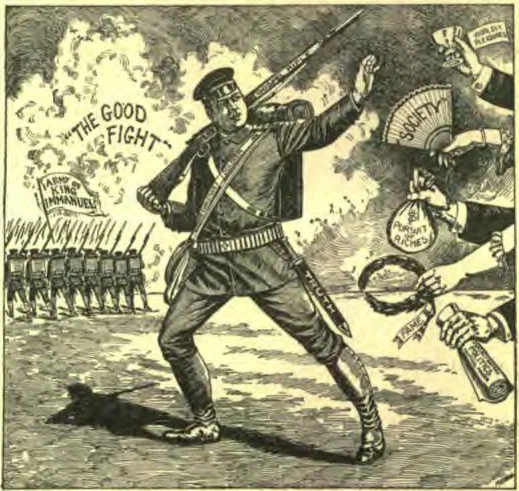
On the first page of the paper, inside the cover, there will be a cartoon by Mr. Maybell, our New York artist, entitled

"CONSECRATED SERVICE."

Here is presented a large figure of a soldier leaving behind the attractions of the world and pressing on to victory.
The whole paper—sixteen pages and cover—will be filled with live articles on the great themes of the Gospel, written with a view not only to interest the reader, but to save souls. Here are some of the subjects:
GOD'S CALL TO SERVICE—The Conflict, the Captain, the Reward.
SIGNS OF THE TIMES—Riches, Intemperance, War Preparations, etc.
THE LAW OF GOD.
BIBLE-READINGS ON IMPORTANT TOP-ICS.
THE OUTLOOK DEPARTMENT, specially illustrated. Here we will give the statistics of the navies of the world, their wonderful growth within the last few years, what all this means, etc.
Altogether it will be one of the most interesting, attractive, and important numbers we have ever issued.

PRICE OF THIS NAVAL NUMBER.

Single copies . . . . . . . . . . . . . . . . . .10 cents 25 to 100 copies . . . . . . . . . . . . . . . . .3 cents 100 copies and over . . . . . . . . . . . .2½ cents Five or more copies mailed direct from this office to individual names and addresses furnished, four cents per copy.
Regular subscription price, one year, 52 numbers, $1.50.
Address SIGNS OF THE TIMES, Mountain View, Cal.
Reduced facsimile of Mr. Maybell's Cartoon "Consecrated Service."

Home for Sale at Mountain View

For Sale—$7,000.—Nice home at Mountain View. House seven rooms and bath, beautiful porches, everything convenient. About nine acres of land, five in full bearing apricots, two in peaches; ten minutes' walk from R. R. station. Only six miles from Stanford University, and twenty minutes' ride from San Jose State Normal School, and Santa Clara College. Property at Mountain View is increasing in value rapidly. $2,000 can remain. W. E. Yeaw, Washington, Cal., or inquire Milner's Clothing Store, Mountain View, Cal.

Beautiful Imported Bible Cardboard Mottoes

All have flowers with silver letters and a cord to hang them upon the wall. Special for 60 days. All sent by mail as follows: 5 for 50 cents; 12, $1.00; 25, $1.75; 50, $3.00; 100, $5.00. More you buy, the less they are. Address,
HAMPTON ART COMPANY Lock Box 257 Hampton, Iowa
Wanted.—An all-round farm hand. Must understand some gardening. Middle age preferred. A Sabbath-keeper, steady work, a good home. E. F. Horning, R.F.D. No. 1, Box. 127, San Jose, Cal.

HALLOWED HYMNS

NEW and OLD
By I. ALLAN Son of IRA D. SANKEY
WORTH WHILE SEEING—EVEN OUT OF CURIOSITY 256 Songs 100 new songs JUST PUBLISHED Scripture Readings
Boards $25—Cloth $30 per 100—35c & 40c postpaid Returnable copies mailed to "earnest inquirers" THE BIGLOW & MAIN CO., New York or Chicago

SUBSCRIPTION RATES.

Four months . . . . . . . . . . . . . . . . . . . . . . . . . .$0.50 Six months . . . . . . . . . . . . . . . . . . . . . . . . . . . . .75 One year . . . . . . . . . . . . . . . . . . . . . . . . . . . . . 1.50 To foreign countries, including Canada . . . . . . . . . . . . 1.75
  1. One new yearly subscription and one renewal, or two new yearly subscriptions, sent at one time, $2.50.
  2. Two new yearly subscriptions and one renewal, or three new yearly subscriptions, sent at one time, $3.25.
  3. Three new yearly subscriptions and one renewal, or four new yearly subscriptions, sent at one time, $4.00.
Sample copies sent on application.

DATE OF EXPIRATION.

THE SIGNS wrapper bears date of last issue due on your subscription. Unless renewed in advance, paper stops with expiration date. If herewith is an order-blank, you will know you have overlooked sending renewal. You will not wish to miss a single issue. Back numbers often can not be furnished.

Subscription and Bible Version Notice

We send no papers from this office to individuals without pay in advance. When persons receive copies without ordering them, they are sent by other parties, and we can give no information in regard to them. Persons thus receiving copies of the Signs are not indebted to the office, and will not be called upon to pay for them. Please read the papers you may receive, and hand them to your friends to read.
Our authority is the Bible, the Holy Scriptures of the Old and New Testaments. When the Common ("King James" or "Authorized") Version, or the American Standard Revised Version is used, quotations will not be designated in reference. Any Bible quotation in this paper, therefore, differing from the Common Version, unless otherwise indicated, will be almost invariably from the American Standard edition of the Revised Bible, copyright 1901, by Thomas Nelson & Sons.

Contained in This Issue.

With Our Inquirers

Questions Nos. 2451 to 2461 - - - - - - - 2

General

Christ the Teacher and Healer - - - - - - 3 "Jesus Stretched forth His Hand" - - - - - 4 The Way of Salvation - - - - - - - - 4 Extravagant Waste in Restaurants and Hotels - - 4 An Inquiry of Infinite Importance - - - - - 5 Moral Integrity without Intellectual Integrity - - 5 The Impatient Man - - - - - - - - 5

Home Bible Studies

The Great Day of the Lord - - - - - - - 6 Our Bible Band - - - - - - - - 16

Editorial

"Have Faith in God" - - - - - - - - 8 Studies in Romans - - - - - - - - 8 Studies in the Book of Daniel (An Unnatural Kingdom) - - - - - - - - - - 9

The Outlook

Mass Meetings and Indignation in China - - - 10 The Kentucky Tobacco War - - - - - - - 10 How They Say It - - - - - - - - 10 Converts to the Roman Catholic Church - - - 10 Sunday-Law Agitation in New York - - - - 10 The Sabbath and the Law - - - - - - - 11

The Home

Order in the Home - - - - - - - - 14 The Little Things - - - - - - - - 14

Poetry

"And, Behold, I Come Quickly" - - - - - 4 Madonna and Child - - - - - - - - 5 Be Strong - - - - - - - - 14
Read our prospectus for the year to come on page 13.

The Isaac Reed Visits Pitcairn Island

The American ship "Isaac Reed," Captain Anderson, master, called at Pitcairn Island on its way from Australia. The "Isaac Reed" and two other ships he names put into Pitcairn Island for supplies, and obtained what they needed in chickens, potatoes, and other vegetables. The island was recently visited by a severe hurricane. Property was damaged, but no lives were lost.

Drink Kills Russia

"Drink kills Russia" is what a member of the duma, the Russian legislative body, declares. The government holds the monopoly and encourages the accursed practise. The government income of last year from the sale of vodka reached more than 339 million dollars, while the wretchedness of peasant and workingman increases in leaps and bounds. The vodka (Russian whisky) is adulterated by the dealers, and sold cheap till "the amount of drunkenness in the empire is appalling." Drink is a worse foe than was Japan.

Our Bible Band.

Schedule for Week Ending April 18, 1908.

Sunday April 12 Judges 18, 19 Psalm 105 Monday " 13 " 20, 21 " 106 Tuesday " 14 Ruth 1 - 4 Wednesday " 15 1 Samuel 1, 2 " 107 Thursday " 16 " 3, 4 " 108 Friday " 17 " 5, 6 " 109 Sabbath " 18 " 7 - 10 " 110

The Closing Chapters of Judges

Chapters 17 to 21 of Judges are pitiful records of backsliding and consequent disgrace and punishment. Conventional hospitality is higher than female virtue, and the clannishness of a tribe of greater importance than rendering justice. We see it to-day. Yet there is never excuse for sin.

The Book of Ruth

The book of Ruth is a beautiful, peaceful, historical romance, a blessed relief from the internecine strife, ruffianism, and bloodshed, recorded in the closing chapters of Judges. How grandly filial obedience and simple faith stand out in the conduct of Ruth, and integrity and Christian manliness in the character of Boaz. The blessing of God upon the poor Moabitess shows that God is no respecter of persons; and in His providence He chooses her to become the ancestress of Christ.

Ruth and the Kinsman Redeemer

One of the objects of the book is shown in chapter 4: 17-22, to note the ancestry of David, and to give a biographical sketch of two noble characters of the simple life. The Redeemer of the world is foreshadowed in the one who makes himself a near kinsman with the right to redeem; even so did the Son of God for us.

The Historical Setting of Ruth

The time of the book is sometime after the close of Judges, written at the time when David began to be prominent in Israel, probably about 150 years after the events occurred; and, as has been pointed out, when the custom of chapter 4:7, of confirming a bargain by drawing off the shoe, had fallen into disuse, or the writer would not take time to explain it. While the book is neither a supplement to Judges nor an introduction to Samuel, it is a needed book historically.
Psalms 105 to 110 speak for themselves: (105) God's Wonderful Works for His People; (106) Israel's Sinning and God's Deliverances; (107) Deliverances from Manifold Troubles; (108) Praise and Plea for Victory; (109) God's Retributive Wrath Predicted upon Evil-Doers; (110) A Prophecy of Christ's Kingdom.

The Most Acutely Sensitive Soul

The most acutely sensitive Soul which this earth ever knew was Jesus Christ, the Son of God. All the superfine faculties of the human soul lived in Him in all the perfection of keenness. The fulness of the Spirit keyed every sense to the most delicate impressions; for thus spake the prophet: 'And the Spirit of Jehovah shall rest upon Him, the spirit of wisdom and understanding, the spirit of counsel and might, the spirit of knowledge and of the fear of Jehovah. And His delight shall be in the fear of Jehovah.' The margin of the last clause is 'He shall be of quick understanding.' The Hebrew is of quick 'scent.' That is, His senses should be divinely quickened. Birds can see farther than men. Dogs can detect odor where men detect nothing. God created man originally superior to all animal creation; and in the restoration of man thru divine grace God would begin by quickening the soul faculties. All the world's needs found sympathy in the sensitive soul of Jesus; and how all the obloquy, scorn, opposition, persecution, He met must have hurt and pained Him! But all that touched Him personally He left with God, and knew that the souls who were thus engaged were hurting themselves more than they could injure Him.

Sensitivity and Selfishness

It is good to have a sensitive soul, because such a soul may be made very useful for God. Hold it open to receive rays of light from the eternal throne. Let those rays print upon the sensitive plate of our soul His own divine character in all its beauty. Let us be sensitive toward the miseries, the wants, the needs, the sorrows, of other souls, quick to respond, not alone to their vocal needs, but to their unspoken heart-cries. But thus to do means that selfishness must be obliterated, crushed, crucified. It will seem almost cruel work to do it. In our sensitiveness we suffer so keenly, we magnify our troubles. Like Jerusalem of old, we stand in the highways and call to the passers-by and ask, "Is it nothing to you, all ye that pass by? behold, and see if there be any sorrow like unto my sorrow?" Some other soul comes to us with perhaps a casual tale of suffering; we hardly wait for its relation before we must needs tell him of our greater sorrow. Mayhap the tale he tells us is of some other soul who has touched his sympathies, but we drown his mission in the flood of our own grievances. O, let us smother the selfishness; let it die; let it be put to death by the Spirit; forgotten in the needs of others.

Supersensitiveness

Supersensitiveness is selfishness. It is keeping self so near to the surface that the least fancied slight or word or criticism hurts. This is a poor, critical old world. Its people are born critics, unjust, abnormal critics, because they are born selfish. They are cast in a different mold than we are. Because they are differently constituted than we are, they will in all probability criticize us if occasion offers. They may have larger views than we do, and their criticism may be of value to us if our sensitive soul will rightly receive it. They may have a narrow, conscious spirit, may know less of us and our work than we know ourselves, and their criticism may be mean and envious. Do not be disturbed by it; let it pass. As the grass bends before the rude blast, so let us bow our head in humility before God, put forth deeper rootlets in the soil of experience, and let the storm roll by. It may have been fierce; but we may have needed all the fierceness. Let us rejoice, and hold no feelings of ill toward the critic.

Introduction to the Books of Samuel

The books of Samuel are one in the Hebrew. The division comes from the Septuagint. They are given the name Samuel because the first part centers around the life of the great prophet and reformer in Israel. The book seems to be a composite piece of literature written by Samuel, Gad, and Nathan. See 1 Chron. 29:29. It opens with Israel as a whole a long way from the instructions by Moses, menaced and harassed by their enemies. There are difficult places in the records, some that never may be clear; but we may learn the great, practical lessons.

Lessons from the Life of Samuel

Beautiful indeed is the motherhood and mother spirit of Hannah. Faithfully true is the little lad to duty in his message to Eli. Kind and benevolent is the old priest, but lacking in strength of character. Bitter is the bondage to Philistia, more bitter the capture of the ark, the glory of the nation, but sadder still, that which they did not appreciate, was their backsliding from God.

You have reached the end of this edition.

Signs of the Times