Heaven’s Court in Session — Great Words Spoken — The King of Kings and Lord of Lords — The Day Is at Hand
By JEAN VUILLEUMIER
This is the third and concluding study by Elijon Vuilleumier on the seventh chapter of the book of Daniel. In previous articles, he has called attention to the four world monarchies that the prophet foresaw; he has spoken of the ten kingdoms into which the prophecy said the fourth or Roman Empire would be broken; he has dwelt upon the prediction that these kingdoms into which Rome was to be broken would never be united again; he has spoken of the ecclesiastical power that Daniel told us would arise among the ten kingdoms, and subdue or pluck up three of them.
This week, the main thought is the eternal kingdom that is soon to succeed all this earthly rulership. Next week, he will present the first of several articles on the eighth and ninth chapters of Daniel. EDITOR.
THE great moving-picture film of prophetic history, twenty-four centuries long, has been rapidly passing before our wondering eyes. Now the inspired dream unveils to us both heavenly scenes occurring now, and earthly scenes to occur in the near future and onward through ceaseless ages. While still gazing at the downfall of papal supremacy, Daniel is suddenly called to behold a scene of surpassing grandeur.
THE HEAVENLY COURT IN OPEN SESSION
“I beheld till thrones were placed, and One that was ancient of days did sit: His raiment was white as snow, and the hair of His head like pure wool; His throne was fiery flames, and the wheels thereof burning fire. A fiery stream issued and came forth from before Him: thousands of thousands ministered unto Him, and ten thousand times ten thousand stood before Him: the Judgment was set, and the books were opened.” Dan. 7:9, 10, A. R. V.
Unknown to the inhabitants of the earth, the Judgment begins “at the house of God.” 1 Peter 4:17. The list is being made up of the loyal subjects of the Son of man, whose kingdom is soon to be ushered in. But while this solemn assembly is sitting in heaven, the prophet again hears the voice of the mysterious horn.
GREAT WORDS THAT THE HORN SPOKE
“I beheld at that time because of the voice of the great words which the horn spake.” Dan. 7:11. Yes, instead of repenting, of humbling herself, of renouncing her past, the papacy goes farther and farther in her guilty course. In 1870, at the Vatican Council the pope is declared infallible, notwithstanding the indignant protest of history voiced by some of the most learned and distinguished members of the council.
Still more, regaining some of its lost prestige, the papacy again seeks to use it for the suppression of the saints. “I beheld, and the same horn made war with the saints, and prevailed against them; until the Ancient of Days came, and judgment was given for [or “in favor of”] the saints of the Most High, and the time came that the saints possessed the kingdom.” Verses 21, 22, A. R. V., margin.
Now the climax has been reached. It only remains for God to take part in the conflict in favor of His downtrodden people and truth.
“I saw in the night visions, and, behold, there came with the clouds of heaven One like unto a son of man, and He came even to the Ancient of Days, and they brought Him near before Him. And there was given Him dominion, and glory, and a kingdom, that all the peoples, nations, and languages should serve Him: His dominion is an everlasting dominion, which shall not pass away, and His kingdom that which shall not be destroyed.” Verses 13, 14.
Again referring to the apostate power, the prophet says: “But the judgment shall be set, and they shall take away his dominion, to consume and to destroy it unto the end. And the kingdom and the dominion, and the greatness of the kingdoms under the whole heaven, shall be given to the people of the saints of the Most High: His kingdom is an everlasting kingdom, and all dominions shall serve and obey Him.” Verses 26, 27.
BUT LITTLE REMAINS
The four kingdoms have come and gone. The ten kings and the royal pontiff have appeared and have followed in their allotted course. So far, all has been fulfilled to the very letter. Little more remains but for the “saints of the Most High” to receive the kingdom,—a kingdom that is to endure “forever, even forever and ever.” Hence Jesus Christ, the blessed Son of God, the Prince of that glorious realm, is soon to appear. His coming is at hand.
THE INVITATION
Dear reader, have you, by faith in Jesus Christ, become a subject of this kingdom? If not, will you not receive Him “who gave Himself for us, that He might redeem us from all iniquity, and purify unto Himself a people for His own possession,” “to the intent that . . . we should live soberly and righteously and godly in this present world; looking for the blessed hope and appearing of the glory of the great God and our Saviour Jesus Christ”? Titus 2:12-14.
WHO IS THE CREATOR?
By Iva F. Cady
Did He Who Made the World, Make the Sabbath?—His Right to Be Its Lord—Which Is the Lord’s Day?
By MRS. IVA F. CADY
THE fourth commandment of the Decalogue says: “Remember the Sabbath day, to keep it holy. Six days shalt thou labor, and do all thy work: but the seventh day is the Sabbath of the Lord thy God: in it thou shalt not do any work, thou, nor thy son, nor thy daughter, thy manservant, nor thy maidservant, nor thy cattle, nor thy stranger that is within thy gates.” Ex. 20: 8-10.
Why are we to remember the Sabbath day, to keep it holy, not doing our own work on that day, but using the six working-days for common labor?—“For in six days the Lord made heaven and earth, the sea, and all that in them is, and rested the seventh day: wherefore the Lord blessed the Sabbath day, and hallowed it.” Verse 11.
We are to keep the Sabbath because the Lord rested upon that day after creating the world, and then after resting, He blessed and sanctified it as a day of holy rest for man. We look back to the first and second chapters of Genesis, and find the record of the institution of the Sabbath in the beginning. Gen. 2: 1-3.
THE AGENT IN CREATION
Jesus Christ was the agent by whom all things were created. “In the beginning was the Word, and the Word was with God, and the Word was God. The same was in the beginning with God. All things were made by Him; and without Him was not anything made that was made.” “He was in the world, and the world was made by Him, and the world knew Him not.” John 1: 1-3, 10.
Verse 14 shows plainly that the Word here spoken of is Christ, who was made flesh, and dwelt among men. And they “beheld His glory, the glory as of the only-begotten of the Father, full of grace and truth.”
Again in Heb. 1: 1, 2, we read, “God, who at sundry times and in divers manners spake in time past unto the fathers by the prophets, hath in these last days spoken unto us by His Son, whom He hath appointed heir of all things, by whom also He made the worlds.” See also Eph. 3: 9 and Col. 1: 13-19.
CHRIST CREATED THE HOLY DAY
We know, then, that Christ instituted the seventh-day Sabbath in the beginning; for the One who created the earth in six days, was also the One who rested upon the seventh, and then after resting, blessed and set it apart for a holy use. Upon that day, man was to lay aside his earthly cares, and spend the time in sacred worship, in prayer and meditation, considering the creative works of God, His promises and blessings, and seeking Him with all the heart.
And since Christ made the Sabbath, He very consistently calls Himself the Lord of the Sabbath. Mark 2: 27, 28. And since He is Lord of the Sabbath, then the Lord’s day mentioned in Rev. 1: 10 must be the seventh-day Sabbath, for that is the only Sabbath of the Bible, and the Lord calls it His day.
Some have substituted the first day of the week for the Sabbath, and say they keep it in honor of Christ; but are we honoring Him if we set aside the day He appointed for us to observe in commemoration of His creative work, and also as a sign of His power and willingness to create us new creatures, and regard a man-made institution instead, which He has never asked us to keep?
ONLY THOSE WHO DO
Can we hope for eternal salvation, if we willfully disregard the will of the Lord as expressed in His word, while we profess to be His followers? Christ Himself has answered this question, if we will but believe that He means what He says. The answer is: “Not every one that saith unto Me, Lord, Lord, shall enter into the kingdom of heaven; but he that doeth the will of My Father which is in heaven.” Matt. 7: 21. This says plainly that a profession of faith will save no one, but only those who do the will of the Father in heaven shall enter the kingdom of God.
In order to be sure, then, that we are entering the strait gate that leads to life, we must look into the word of God, and there learn what is His will concerning us; for He certainly will not require us to do contrary to what He has commanded in His word.
And though the majority may now go the broad way that leads to death, can we not deny ourselves, take up our cross, and follow our Saviour’s example? We can safely trust in the word of God, for every promise given will surely be fulfilled. Those who are faithful and true, may be sure of a glorious reward that will eclipse all the sorrows and trials of this life, when Christ comes again to receive His people to Himself.
Life Interwoven with Its Maker
By Charles H. Anthony
MAN'S life is so interwoven with the grand life of his Maker, that it admits of no adequate or rational interpretation except when the Creator as supreme, and the creatures of His hand as subordinate, are seen working in unison.— Charles H. Anthony.
The Sun of Truth
“THE sun of truth may be obscured, but is never eclipsed.”
From left to right: the maharaja of Bikaner, the maharaja of Patiala, the maharaja of Kapurthala, with his Spanish wife.
Native States of India, and the War
By George F. Enoch
Forces of Sedition and Revolution Held in Check — The Many States of the Empire — Native Princes Supporting the War — The Ominous Cloud Arising
By GEORGE F. ENOCH
Elder Enoch has spent quite a number of years in India as a missionary. At present, he is on a furlough in the United States. His opportunity to know the truth of what he writes is the best.
EDITOR.
It is remarkable to note the way in which divine Providence has been shaping the affairs of even the remote nations so that the finishing of the gospel work might not be hindered, but hastened. No more interesting problem faces the Christian church to-day than that of how these opened doors are to be entered and the message given without delay.
INDIA AND THE PRESENT WAR
Many are inquiring concerning the attitude of the people of India during the present war. Seditionists driven from India for political reasons during the past few years are causing misleading statements to appear in the papers, representing India on the eve of revolt. On the contrary, word comes from our missionaries who are on the ground out among the people, that they feel as little influence of the great war there as any place in the world. Things were never more settled, and the people never more willing to hear the gospel message.
I do not believe that there will be very serious trouble at this time. Doubtless there will be sporadic outbreaks occasioned by political agitators; but this will mean no more than the political outrages of the past few years, beginning with the attempt on the life of Sir Andrew Fraser in 1907, and including such as the murder of Mrs. and Miss Kennedy in 1908, and Mr. A. M. Jackson, a government official, in 1909, and Mr. Ashe, another official, in 1911, culminating in the throwing of the bomb which wounded the viceroy, Lord Hardinge, in 1912, at the time of his royal entry into the new capital, Delhi. However, these outrages do not represent the feelings of the great masses of the Indian peoples, but are perpetrated by irresponsible youths, stirred to fanaticism by a few irreconcilables who manage to keep in the background.
INFLUENCE OF THE NATIVE STATES
In the present war, one of the great factors in holding India loyal to the British “raj,” and thus prolonging the time of peace during which the gospel message can be proclaimed vigorously, is that of the native states.
British dominion in India did not develop according to any plan, but, like Topsy, it just grew. Traders landed in several strategic places, and gradually their influence extended, until the British East India Company became a great political organization as well as a commercial one. It had friendly relations with some of the native princes of India, and made war upon others, until it had developed quite a territory ruled by military power.
CRASH OF THE MUTINY
Then in 1857 came the great crash of the mutiny, when its house almost fell about it like a pack of cards. But the British army saved the day, and India passed under the British crown in name as well as in form. But the purely British territory crystallized just as the mutiny found it. To all native rulers that had not been actively disloyal was granted suzerainty under the paramount power. No encroachment has been made on the territory of these native states since then. The native princes rule as kings in their own right, and excepting over British subjects, are free from the control of the laws of British India. The paramount power acts for them in all external affairs, but except in the case of gross mismanagement, scrupulously respects their internal authority. They are protected by Britain from encroachment from without, and in turn can have no official connection with external governments.
THE BULWARK OF STRENGTH
Recently the paramount power and the native states have been drawing nearer together, and it is believed that closer relations will develop. It is curious to note that these native states, which were supposed by some at the time of the mutiny to be an element of danger which would eventually drive the British flag from India, are now, on the other hand, the bulwark of the stability of the British “raj.” The native rulers know that if Britain should leave, they would be lost in the ensuing chaos, and they do not desire to trade their present overlord for any other.
THE AREA AND THE NUMEROUS STATES
All India has an area of 1,773,168 square miles. An area of 675,266 square miles of this is ruled by native princes with 70,000,000 subjects. These native states are scattered in all parts of the country and are of all sizes, from the premier state, Haidarabad, as large as Italy, with a population of 13,000,000, ruled by the Nizam, to the small state of Lawa in Rajputana, having but 19 square miles. There are 675 native states, 175 being controlled by the viceroy, from Simla, and 500 by the provincial governments.
LOYALTY OF NATIVE RULERS
Some of these states, with their rulers, have been much in the public eye lately. The maharaja of Patiala, a dashing young man of twenty-four years, is reported to have headed a body of his own troops, and to be now fighting on the battle fields of Europe. The maharaja of Bikaner also has seen foreign service under the British flag, serving in the China war in 1898, also in Somaliland at the head of his own troops. The maharaja of Udaipur, one of the prominent Sikh states, promised the king, at the commencement of this war, that India would recruit, equip, and finance an army of 3,000,000 men if needed. Other states, like Mysore, have given millions of dollars to the war chest.
Some of these rajahs have American and European wives. The maharaja of Kapurbala, a native state in the Punjab, has recently attracted attention in this country by his visit with his Spanish wife to the San439Francisco exposition. It is true that she has three queens ahead of her, all living with her husband; but as she has a palatial residence in that queen of Himalayan summer stations, Mussoorie, with all the money at her command that she wants, being the fourth wife seems to her to be of minor importance.
STABILITY NOW, BUT WHAT OF THE FUTURE?
To-day these native states mean the stability of the British rule; but what of to-morrow? While no immediate danger threatens India through the war in Europe, there is a cloud on the horizon, which seems to the writer to be larger than a man’s hand.
That danger is the deep strategy which aspires to the leadership of the Orient against the Occident.
The last few years, India has been sending her best sons in ever increasing numbers to Japan for education and training. The cry, “Asia for the Asiatics,” is more than a remote possibility. Religiously, racially, politically, the combination of the Orient, including the Mohammedan countries, which contains two thirds of the human family, against the Occident, with less than one fourth, seems the logical outcome.
Those familiar with these conditions plead with every lover of the Lord Jesus to press into the Orient now with the gospel message, while peace lingers. Soon it will be too late.
My Guiding Star
By C. P. Bollman
By C. P. BOLLMAN
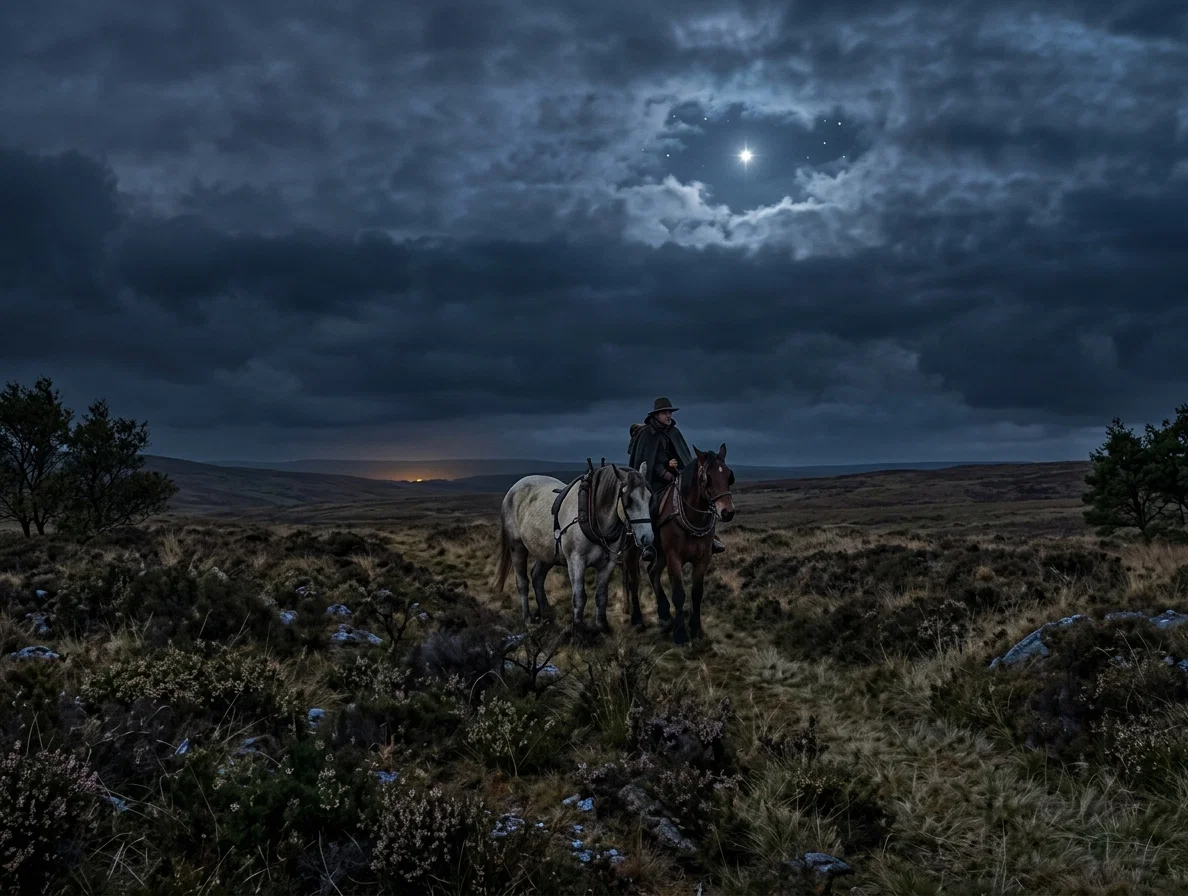
'Twas years ago, on a trackless plain,
And no compass true was there.
The sky with clouds was overcast,
And my soul was filled with care.
There was no sun to guide my steps,
No star to point the way.
I knew not where nor how to go,
Nor where the north course lay.
Thus o’er me fell the shades of night,
And the day was gone, I knew,
When far away, in broken cloud,
A star came peeping through.
Only a moment the star shone there,
And again the cloud closed o’er;
But I knew that star, and set my course
Across the trackless moor.
Once and again I saw that star,
As I trod my lonely way;
And I reached my goal, my humble home,
Ere dawn of the coming day.
The star I could not always see;
But my heart was free from care
As on I pressed, with courage strong,
For the star, I knew, was there.
THE ETERNAL PURPOSE OF GOD
By George W. Reaser
Only Righteous Characters in the Plan—All Have the Power of Choice—God’s Purpose to Succeed
By GEORGE W. REASER
This is the first of several articles by Elder Reaser on the eternal purpose of God as revealed in the Scriptures. Each article will present points that may readily be understood and agreed apart from any of the others, but our readers who follow all of them will enjoy the greater spiritual feast. EDITOR.
There is one theme above all others, which, when fully analyzed, most clearly explains Jehovah’s attitude toward the righteous and the unrighteous; brings the mind to a full justification of the Creator in all His ways; leaves no room for doubt as to “His eternal power and Godhead”; compels reverent recognition of His sovereignty in the universe; reveals the overruling of His omnipotent hand in human history and in shaping the destiny of the earth and of its “elect” inhabitants to a wise, definite, and blissful end; shows the dire necessity for the inauguration of that plan of salvation which called for the gift of the Son of God to our human family; and wholly justifies the divine decision that sin shall perish in “the lake of fire.” This theme is denominated by inspiration “the eternal purpose which He purposed in Christ Jesus our Lord.” Eph. 3: 11.
He who has a clear, firm mental grasp of this subject, has an anchor to hold him fast to the solid rock of eternal principles of truth and righteousness, amidst the whirlpools and quicksands of error, doubt, and unbelief encountered in life’s voyage.
THE ONE TRUE BASIS FOR BIBLE STUDY
It must be manifest to every reasoning mind that if God has an eternal purpose for our world, and in the development of that purpose the eternal destiny of every son and daughter of Adam’s race is involved, then a comprehension of that purpose must form the only true basis for Bible study, and in fact the only true avenue of approach to the investigation of all branches of science, that we may understand how to relate ourselves to Jehovah’s design and to the facts of our own existence. For all truth and all true science must find their center and circumference within the scope of God’s eternal purpose.
THE PURPOSE DEFINED
If we were to select a single text for an inspired definition of this eternal purpose, perhaps we could not make better choice than these words: “Having made known unto us the mystery of His will, according to His good pleasure which He hath purposed in Himself: that in the dispensation of the fullness of times He [God] might gather together in one all things in Christ, both which are in the heavens, and which are on earth; even in Him.” Eph. 1: 9, 10, margin.
To frame a definition of Jehovah’s eternal purpose, in our own language, we might clothe our thought thus: Jehovah, the Creator, the King of the universe, does nothing in vain. Isa. 45: 17, 18. In the creation of our world, He had a definite, a perfect design.
A part of that design was that the earth should “be filled with the knowledge of the glory of the Lord, as the waters cover the sea” (Hab. 2: 14); and that the people who inhabit the land forever would be all righteous, reflecting the image of God in character; and that this development in righteousness, accomplished by the revelation of the character and of the saving power of God in Jesus Christ, will finally result in the glorification of Jehovah in the mind of every intelligent creature in the universe (Isa. 60: 21; Rev. 5: 13), when sin and death shall be no more, and “the kingdoms of this world will have become the kingdoms of our Lord and of His Christ, and He shall reign forever and ever” (Rev. 11: 15).
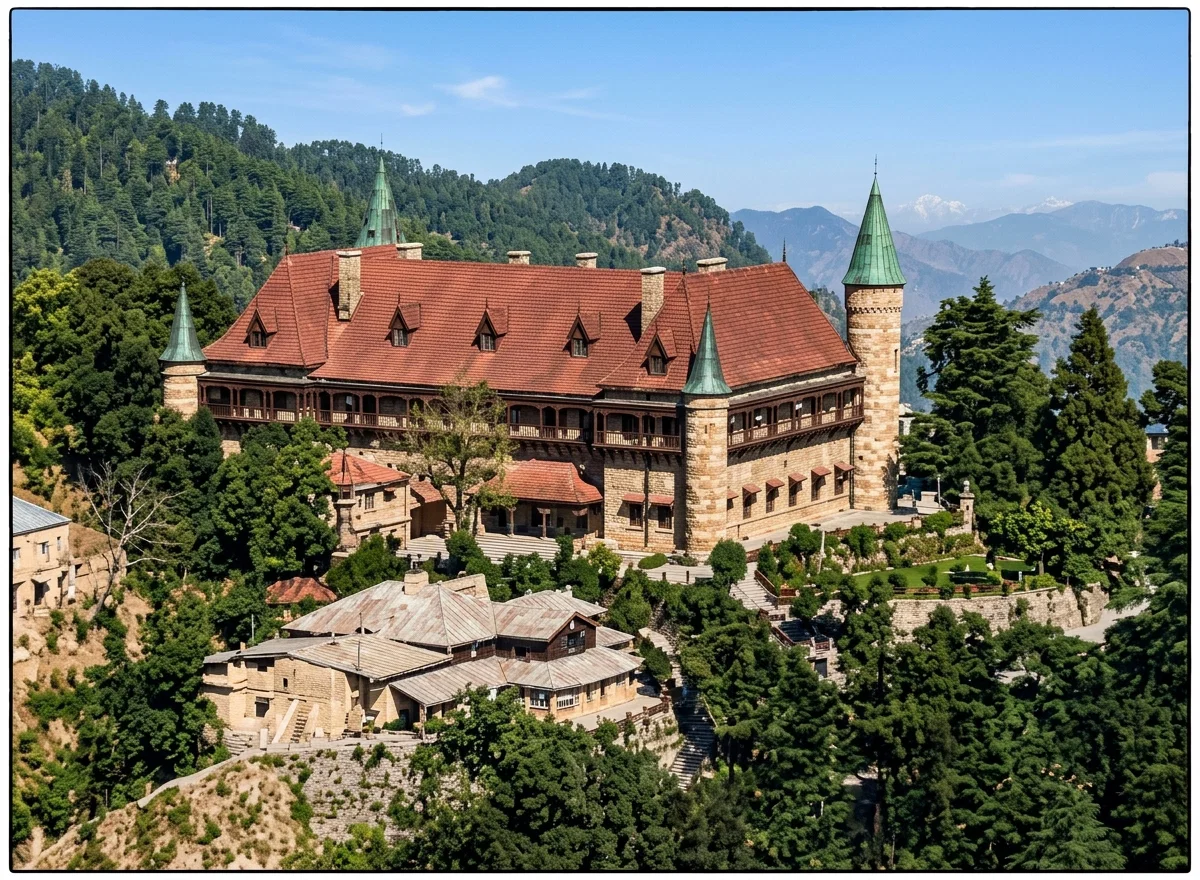
Palace at Mussoorie, in the Himalaya Mountains, of the Spanish wife of the maharaja of Kapurthala. One of our sanitariums is located at Mussoorie, and the maharaja’s family patronize it.
FORECAST OF THE THEME
Godlike character is paramount to everything else in the universe. God’s eternal purpose contemplates the development of such character in every morally responsible creature who, exercising the right of choice, chooses righteousness and consequent life everlasting. All who, accepting God’s plan, His way, through grace develop perfection of character, will finally enjoy immortality. In fact the bestowal of this priceless gift is contingent upon the development of Godlike character. Those who will not avail themselves of the provisions of the plan of salvation to attain to this character development, can have no place in the eternal purpose when it is finally completed.
The perfect design, the eternal purpose, contemplated filling the earth with individuals possessing every beauty and grace of character; and if the reader and the writer meet the design, it will finally appear that we were chosen “in Him [Christ] before the foundation of the world, that we should be holy and without blame before Him in love.” Eph. 1: 4. On the basis of our submission to this character development, we were predestinated to “the adoption of children by Jesus Christ to Himself.” Verse 5. The registry of the names of those who by conversion and regeneration meet God’s design in character development, is made, down through the ages, in “the book of life of the Lamb slain from the foundation of the world.” Rev. 13: 8.
ALL HAVE THE POWER OF CHOICE
Neither angels nor mankind were created upon a plane from which they could not fall. Jude 6; Gen. 1: 27, with Rom. 5: 12. They must therefore develop characters fixed in righteousness before they can fit into a perfect, an eternal design. This character development must be by experience, study, comparison, meditation, self-control; by the exercise of choice in following leadership; by unwavering faith and willing obedience; and by beholding absolute perfection of character in the divine Pattern.
Transgression, and thereby hideousness of character, without the provision of a Saviour, and without repentance accompanied by ardent desire to live in righteousness, places one outside the sphere of God’s eternal purpose, and necessarily consigns him to eternal oblivion.
OPPOSITION TO THE PURPOSE
The development of unrighteous character in an angel who was perfect in his ways in the day he was created (Eze. 28: 11–17), made of him the great adversary of God, and caused him to oppose the filling of the universe with beings of Godlike character. But “in the dispensation of the fullness of times,” God will gather together in one harmonious, ever blessed family, all things in the heavens and in earth; and this gathering together of individuals possessing characters wholly righteous, and the purging of the universe from every stain that sin has made, will constitute the accomplishment of His eternal purpose, the realization of the mystery of His will which He has purposed in Himself.
In our present study, we must confine ourselves to only a sip at this fountain of light and knowledge. May this taste beget in our hearts a burning desire for such development of character that we may survive the overthrow of sin, and fit into Jehovah’s completed purpose. Such desire is not illegitimate nor presumptuous; for the Saviour says, “Blessed are they which do hunger and thirst after righteousness; for they shall be filled.” Matt. 5: 6.
The Mistake They Will Make
By A. S. Booth
THE mistake many will make in the Sabbath question is expressed in the following text: “Her priests have violated [“offered violence to,” margin] My law, and have profaned Mine holy things: they have put no difference between the holy and profane, neither have they showed difference between the unclean and the clean, and have hid their eyes from My Sabbaths, and I am profaned among them.” Eze. 22: 26.
God would have His priests and ministers respect His commands and His Sabbath. Speaking of the attitude that the priests440should sustain to the law, He says: “They shall teach My people the difference between the holy and the profane, and cause them to discern between the unclean and the clean. And in controversy they shall stand in judgment ; and they shall judge it according to My judgments: and they shall keep My laws and My statutes in all Mine assemblies; and they shall hallow My Sabbaths.” Eze. 44: 23, 24.
A. S. BOOTH.
WHO IS AN ISRAELITE?
By Clarence Santee
The Name Stands for Prevailing over Wrong—A Descendant of Abraham May Not Be an Israelite—Trusting a Mere Name, May Ruin Us
By CLARENCE SANTEE
ALL through the ages, God has had a people in the earth. At times, the gloom of sin has settled down until their light has seemed lost in the darkness. But again its bright rays have flashed out over the great sea, giving hope and courage to the mariner who has been seeking landmarks as his bark has been driven toward an unseen shore.
THE BRIGHT OUTLOOK
When the Lord created this earth, He placed over the work of His hands a young man with his wife, who could look out into the eternal years with undimmed assurance. Gen. 1:26. Their every request was anticipated before it was made. “And it shall come to pass, that before they call, I will answer; and while they are yet speaking, I will hear.” Isa. 65:24.
This was God’s ideal as shown in creation. He briefly summed up all in the words, “And God saw everything that He had made, and, behold, it was very good.” Gen. 1:31. The prophet, speaking by the Spirit, has said: “I know that, whatsoever God doeth, it shall be forever: nothing can be put to it, nor anything taken from it.” Eccl. 3:14.
“The perfection of beauty” rested down upon all.
THE PROMISED DELIVERANCE
Over all this, the pall of sin settled so dense and dark that not one ray of light gave hope or courage. Speaking of the entrance of sin, a prominent writer has said, “Sorrow filled heaven as it was realized that man was lost, and the world that God created was to be filled with mortals doomed to misery, sickness, and death, and there was no way of escape for the offender.”
“The wages of sin is death.” Rom. 6:23. “In the day that thou eatest thereof thou shalt surely die.” Gen. 2:17.
Before that first day of disobedience by our first parents came to a close, the “seed of the woman” was promised, and the cloud of sin was lighted by the beams of the Sun of righteousness.
Addressing the serpent, God said: “I will put enmity between thee and the woman, and between thy seed and her seed; it shall bruise thy head, and thou shalt bruise his heel.” Gen. 3:15.
ANOTHER ASSUMES THE SENTENCE
The promise of the “seed” was renewed to Abraham (Gen. 13:15); and Paul, speaking by the Spirit, said that “seed” was Christ. Gal. 3:16.
That day, another took upon Himself the sentence of death, and hope was planted in the sinner’s heart. The margin of 2 Sam. 14:14, last part of verse, reads, “Because God hath not taken away his life, He hath also devised means, that His banished be not expelled from Him.”
Christ became “the Lamb slain from the foundation of the world.” Rev. 13:8. As men multiplied upon the earth, some accepted of the sacrifice of the Lamb of God, and they were called “sons of God.” Gen. 6:2.
The name “Israel” was given to God’s children through Jacob. He had a name among the seed of Abraham; but for many years, self-interest struggled with Christian duty. Not until at the ford of Jabbok, on the night of wrestling, did he learn the lesson of full surrender. There he received the name “Israel.” “And he said, Thy name shall be called no more Jacob, but Israel; for as a prince hast thou power with God and with men, and hast prevailed.” Gen. 32:28. Hosea speaks of that night in which the name “Jacob,” meaning “a supplanter” (Gen. 27:36, margin), was exchanged for “Israel,” meaning, “one who prevails with God.” “Yea, he had power over the angel, and prevailed: he wept, and made supplication unto him.” Hosea 12:4.
THE NAME CANNOT BE ASSUMED
In this way, the name “Israel” became an inherited name. Written into the character with heartfelt supplications, and baptized with tears in its very inception, that name cannot be assumed at will by bodies of people, by creeds, nor by councils.
While the outward name was adopted by a whole people, the true Israel of God have ever been those who have received the name by the crucifixion of self, and laying all upon the altar of God. God has said: “They are not all Israel, which are of Israel: neither, because they are the seed of Abraham, are they all children; but, In Isaac shall thy seed be called. That is, They which are the children of the flesh, these are not the children of God.” Rom. 9:6-8. When the Jews, answering Christ, said, “Abraham is our father,” Jesus said, “If ye were Abraham’s children, ye would do the works of Abraham.” John 8:39.
HOW THE CHILDREN ARE KNOWN
From the above, it is evident that the “Israel” of God are the children of God; and being children of God, they are the true children of Abraham, being known by doing “the works of Abraham.” God said of Abraham’s works, “Abraham obeyed My voice, and kept My charge, My commandments, My statutes, and My laws.” Gen. 26:5.
This is one of the outward evidences of a true Israelite—he keeps the commandments of God.
The Jews looked to Abraham for their right to the name “Israel.” They rested in the outward evidence, circumcision. But while every Jew might boast of outward circumcision, only those whose hearts God had circumcised, were reckoned as the true Israel of God. “For he is not a Jew, which is one outwardly; neither is that circumcision, which is outward in the flesh: but he is a Jew, which is one inwardly; and circumcision is that of the heart, in the spirit, and not in the letter; whose praise is not of men, but of God.” Rom. 2:28, 29.
LIFE FOR THE SINNER
This was no new conception of the operation of God upon the heart. God is ever the same. He says of Himself, “For I am the Lord, I change not.” Mal. 3:6. The same necessity existed in the time of Moses as in Paul’s day. The human heart is the same. The promise of God to the helpless sinner is the same in all ages. “And the Lord thy God will circumcise thine heart, and the heart of thy seed, to love the Lord thy God with all thine heart, and with all thy soul, that thou mayest live.” Deut. 30:6.
TURNED INTO ANOTHER MAN
This is the real change of heart that must be manifest in genuine conversion, the work of the Spirit of God. In another way it is stated, “And the Spirit of the Lord will come upon thee, and thou shalt prophesy with them, and shalt be turned into another man.” 1 Sam. 10:6. This turning “into another man” is explained to be a change of heart. “And it was so, that when he had turned his back to go from Samuel, God gave him another heart.” Verse 9.
The utter weakness of resting our hope in some outward form, or name, when the heart has not been cleansed by divine grace, is further emphasized in Paul’s letter to the Galatians: “For in Christ Jesus neither circumcision availeth anything, nor uncircumcision, but a new creature.” Gal. 6:15. Additional features are given in the fifth chapter, verse 6: “In Jesus Christ neither circumcision availeth anything, nor uncircumcision; but faith which worketh by love.”
Again the same statement is made, with other evidences of the new birth. It reads, “Circumcision is nothing, and uncircumcision is nothing, but the keeping of the commandments of God.” 1 Cor. 7:19.
A NEW CREATURE
Placing these texts side by side, leaving out that which is only the outward index, we have the statement that to be “a new creature” does avail with God; that this new creature will have that “faith which worketh by love”; and that this work will be “the keeping of the commandments of God.” The beloved disciple saw this divine truth when he said, “For this is the love of God, that we keep His commandments.” 1 John 5:3.
That faith which is seen in profession only, has no life, no power. James says: “But wilt thou know, O vain man, that faith without works is dead?” “Faith, if it hath not works, is dead.” James 2:20, 17.
FAITH IS A WORKING POWER
While no man can be saved by his works, as “all have sinned” (Rom. 3:23), if he has faith, it will work. Faith cannot sleep. Its time for growth is in the days of darkness. It is the test of connection with Christ. He says, “Therefore if any man be in Christ, he is a new creature.” 2 Cor. 5:17. Being “a new creature” decides our relation to Christ; and we have seen that if we are “a new creature,” we will have works of love, summed up in keeping the commandments of God.
DANGER IN MERE FORMALITY
Now, as in old time, there is danger in resting in the outward form of church fellowship, and religious association, rather than in the known fact of acceptance with God. And as then, so now, such hope is vain. To be able to say, “Abraham is our father,” never saved any man. Neither can we present before God our claim of a denominational name, to offset our failure to have become in heart one of the Israel of God by willing, heartfelt obedience.
Whether circumcised or uncircumcised, whether having taken one denominational name or another, the inward work of grace, wrought by the Spirit of God, which leads to these outward evidences, alone is reckoned with in the books of God. “For the Lord seeth not as man seeth; for man looketh on the outward appearance, but the Lord looketh on the heart.” 1 Sam. 16:7.