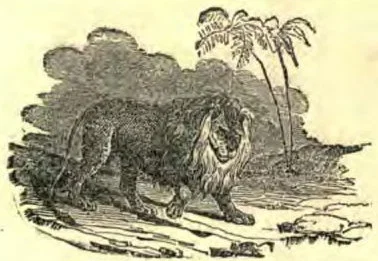
The lion is the strongest of all beasts of prey. A beast of prey is an animal that lives by killing other animals and eating their flesh for food. When a lion thinks there is danger near, he stands erect, with his head high in the air, his eyes glaring, and his teeth shining through his open jaws, while he lashes his sides with his long tail in a fearful way. Would you like to meet such an animal when he is angry?
He is as strong as he is beautiful. One stroke from his paw can break the back of an ox, and he can carry or drag the body of an ox in his teeth almost any distance.
The teeth of a lion are like a cat’s. If you would like to see how it is, catch your kitty and look at her teeth. The tongue of a lion is covered with sharp, horny points, and a few strokes with it will draw blood.
A gentleman owned a little tame lion, which was frolicsome and playful as a kitten. It ran all over the house just as it liked, and was not feared by any one in the family. It had never killed an animal, and had never tasted blood, and all thought he did not have the ferocious, blood-thirsty nature that other lions have.
The gentleman lay down one day to take a nap, and his hand fell over the side of the bed. The little lion was frisking about, enjoying itself upon the floor, when it saw its master’s hand, and like an affectionate dog commenced licking it.
The man did not stir, and the cub drew his file-like tongue across his hand, which drew the blood and awoke the gentleman. The man tried to take away his hand, but the lion claimed it, and growling fiercely, held it between his strong teeth.
The gentleman had a pistol under his pillow. He reached over and took it with his other hand, and shot the little fellow dead on the spot. Thus you see the taste of blood had aroused the blood-thirsty nature of the animal, and he was no longer to be trusted.
The lion, like the cat, has cushions on his toes, and can walk so still that he is not heard till he is ready to spring upon his prey. He has terrible claws hidden in his fore feet; but he can throw them out when he wishes. When he has once fastened his claws in the flesh of an animal, it is impossible to shake him off.
The lions of Southern Africa are very large, measuring eleven feet in length, including tail, and four feet in hight.
When the lions are quite small, their mother never leaves them for a moment. But when they are strong enough to trot by her side, she takes them out into the woods for a walk, and if she can find a young and tender animal, she catches it for their lunch.
The young lions are quick to learn, and are soon hunting as they have seen their mother do, while the father and mother stand by to see that the game does not get away. When a lion is two years old, it has strength enough to attack an ox.
When a lion is about thirty years old, he begins to grow weak, and will not attack strong animals. When he is quite old, he is contented to lie at home, where he half starves, grows weak, and finally dies. This is what Job means when he says, “The old lion perisheth for lack of prey.”
The lion never leaves his den in the daytime, unless he is suffering for water, or from some other cause. Dr. Livingstone says, “He then skulks along, half asleep, looking like the largest dog you ever saw in your life. If he sees you, he stands a second or two, then turns slowly around and walks as slowly away for a dozen paces, looking over his shoulder; then he begins to trot, and when he thinks himself out of sight, bounds off like a greyhound.”
What is compared to “a roaring lion, seeking whom he may devour”?
Do you not want to get to that happy place where “the wolf shall dwell with the lamb, the leopard shall lie down with the kid, and the calf and the young lion and the fatling together; and the cow and the bear shall feed, their young ones shall lie down together, and the lion shall eat straw like the ox”? J. E. WHITE.
THE TWO WAYS.
By R. F. Cottrell
BEFORE you, my youthful friends, there are two ways. You will choose one or the other. One is the way of sin and death, the other is the way of obedience and life. The way of sin may seem to you to be a pleasant way, a way of enjoyment; but this is the deceitfulness of sin. It may look to you pleasant, but it will bite like a rattlesnake and sting like an adder. True pleasure is found only in the other way.
Which will you choose? You must make your choice soon. The Lord has sent us word that the time of choosing will soon be past. You are not to live to old age. The time of probation is soon to close with all. If you are saved in the kingdom of God, you will be soon.
But if you were to live many years, would you be mean enough to wish to spend them in sin, and then, when about to die, call on God for mercy? Would you give your best days to the service of self, sin, and Satan, and offer to God the worthless remnant of a life devoted to sin? I hope the reader of these lines would not be mean enough to cherish such a thought.
Then engage in the service of God at once. You have but little time. Give it all to him. Make the wise choice; and decide at once to give all your days to God, few or many. Choose the good way that leads to eternal life at once. Now is the day of salvation. Alas! how many will put it off until it is too late. Be wise to day.
R. F. COTTRELL.
Invite Friends to Join the Sabbath School
My young friend, whoever you are, if you go to the Sabbath-school and are happy there, and would like to see your school growing larger, just see how often you can find some boy or girl of your acquaintance, or in your neighborhood, or town, or city, who can be easily persuaded to go with you, and take a place in some good class in your school. You will thus do good in three ways. You will make yourself better by seeking to benefit another; you will confer a favor upon the new scholar; and you will be adding to the interest and prosperity of the school. Then go right about this good work. See where and how soon you can find another scholar.
EVIL HABITS GROW.
It is related that an Indian once brought up a young lion, and finding him weak and harmless, never attempted to control him. Every day the lion gained in strength, and became more difficult to manage. At last, when excited by rage, he fell upon the Indian and tore him in pieces. It is thus with evil habits and bad passions. They are like this lion. If indulged in youth, they will cause you much vexation in after life, and may perhaps destroy you. Remember, and beware.
LITTLE MARGARET.
By Young Crusader
LITTLE Margaret had a bad habit of tasting everything that came in her way. Now this was very wrong, for, besides being greedy, it was taking what did not belong to her, and, as the old rhyme says, “It is a sin to steal a pin.”
One day, Margaret’s mother was very busy in the kitchen, and she called to her little daughter, and said, “Maggie, run and bring me a lemon; here is the key of the larder.”
When Margaret came to the place to which she had been sent, she looked eagerly round, to see if there was anything to taste. There, up on a high shelf, she spied a honey pot. She got a chair, and stood on tiptoe, stretching up as high as she could to reach the pot, that she might dip her fingers into the honey.
But suddenly she felt something pinch her finger most terribly. She drew her finger back with a scream, and there hanging to it was a great crab, which had caught hold of her finger with its claw, and would not let go!
It seems that Margaret’s mother had emptied out the honey a day or two before, without Margaret’s knowledge, and had put a few crabs into the pot, as it happened to be empty.
Margaret’s screams brought her mother to the larder in a great hurry. She loosened the poor little pinched finger from the crab’s claw, and said:
“Let this punishment be a warning to you, for this habit of yours might have bad consequences. Many a person who has begun with committing a little fault of this kind in youth, has gone to do much worse, until something terrible has happened. Besides, every child ought to be ashamed of greediness.”—Young Crusader.
“THE ARMOR OF GOD.”
By Levi Turney
“The night is far spent, the day is at hand; let us therefore cast off the works of darkness, and let us put on the armor of light.” The armor of light in the above text is the same as the armor of God in Eph. 6; for that which is a part of the armor in the last instance, David declares to be a light unto his path.
In all emergencies of war, those engaged in the contest are prepared for the battle by having some kind of armor or weapons of defense, as the armor of the giant Philistine; 1 Sam. 17: 5–7, 54; and the armor of the Moabites. 2 Kings 3: 21.
The Bible everywhere represents the Christian life to be a warfare; as in 1 Tim. 6: 12; 2 Tim. 4: 7; Heb. 10: 32; Eph. 6: 12; and in 1 Tim. 1: 18; where Paul commits to Timothy a charge that by certain things he might war a good warfare. Those that are in the Christian warfare are spoken of as being soldiers of Jesus Christ. 2 Tim. 2: 3. Now if we would be good soldiers of Jesus Christ, whom we call Lord and Master, we need to have on the armor of God. We are twice exhorted in Eph. 6: 11, 13 to put on “the armor of God.”
Dear reader, let us have a scriptural view of what the armor of God is, and then put it on; for we shall need it before we shall be able to possess the kingdom. This view is, I think, briefly comprehended in Eph. 6: 14–18; and comprises—if I may be allowed the expression—six parts or pieces of armor; viz.: the girdle of truth, the breastplate of righteousness, the preparation of the gospel of peace, the shield of faith, the helmet of salvation, and the sword of the Spirit. First, we are to have our “loins girt about with truth.” Verse 14. This does away with an error which some hold, that it is no matter what we believe if we are only sincere; and shows the importance of having the truth. It is a part of “the armor of God.”
Second, we are to have on the breastplate of righteousness. Verse 14. Righteousness is right-doing. We cannot have on this part of the armor while living in transgression of any of the precepts of God’s “perfect law” (the ten commandments), which is his rule of right-doing. And if we have not on this part of the armor, we shall fail of eternal life; for the transgression of the law is sin; 1 John 3: 4; and the wages of sin is death. Rom. 6: 23.
Third, we are to have our feet shod with “the preparation of the gospel of peace.” Verse 15. Gospel signifies good news. How essential, then, that we have our feet shod with a preparation or readiness to publish the gospel; for, “how beautiful upon the mountains are the feet of him that bringeth good tidings, that publisheth peace; that bringeth good tidings of good, that publisheth salvation; that saith unto Zion, Thy God reigneth.” Isa. 52: 7; Rom. 10: 15.
Fourth, and above all, we must take the shield of faith, wherewith we shall be able to quench all the fiery darts of the wicked. Verse 16. This part of the armor, then, too, is very essential.
Fifth, the helmet of salvation. Salvation! Precious boon! Who would not have salvation? But that which constitutes a part of the armor of God, is the hope of salvation. 1 Thess. 5: 8. We will realize what salvation is, when we have fought “the good fight” and laid our armor down. If we have a good hope of salvation it will certainly be a helmet to us over the rough sea of life.
And, sixth, we are to take, as a part of “the armor of God” “the sword of the Spirit, which is the word of God.” This will be to us, as it was to one of old, “a lamp unto our feet, and a light unto our path.” Ps. 119: 105. “The sword of the Spirit” is a great weapon; and those who would handle it successfully must have their “loins girt about with truth.” It is a discerner of the thoughts and intents of the heart. Heb. 4: 12. It is that with which the Son of God threatened to fight against those who held the doctrine of the Nicolaitanes. Rev. 2: 16. It is that with which he will “smite the nation.” Rev. 19: 15. We may have it in our hands, even upon our beds. Ps. 149: 6.
Dear reader, whoever you may be, let me invite you again to put on the whole armor of God; and then, praying always with all prayer and supplication, in the Spirit, and watching thereunto with all perseverance and supplication, we may be sure that we shall finally bear the palms of victory. LEVI TURNEY.
MAY AND MIGHT.
OH! thought Anna Markham to herself as she closed the book she had been reading, a history of the mission in Madagascar, “How I wish it were possible for me to do something like this for Christ,” and here Anna lost herself in a sort of heroic dream. She pictured herself teaching, exhorting the heathen in India, or in some far African station, where the gospel had never before been heard. She thought of herself as parting, almost without a regret from her friends, to encounter all the hardships of a mission life, the dangers of fever, wild beasts and persecution, especially the persecution. Anna fancied herself enduring suffering, starvation, imprisonment and torture for her faith, and had just come so far in her romance as to be “led out for execution,” and “forgive her murderers with her last breath,” when her mother called her from the next room.
The rapt ecstatic looks on Anna’s face gave way instantly to a fretful frown. “Oh, dear!” she said sharply to herself, “I never can be let alone a minute.”
She threw down the book and went to her mother.
“Well, what is it?” she said in a most ungracious tone.
“I want you to run over to Mrs. O’Hara and take her the dinner Katy has got ready for her, and Anna, if you can, get her up and make up her bed.”
“Oh, mother!” said Anna, as if she had been asked to perform impossibilities, “I can’t bear to go to Mrs. O’Hara’s, and the house is so dirty and disagreeable.”
“She is an old lady, and all alone,” said her mother in some displeasure. “She cannot do anything for herself now, and it is the duty of her neighbors to take care of her till she is well.”
“She might go to the hospital and let the Sisters of Charity take care of her.”
“She won’t go, as you know very well, and there are some good reasons on her side too, and besides do you think it would be any more agreeable for the Sisters to nurse Mrs. O’Hara than it is for you?”
“Well I don’t like to,” said Anna very crossly.
“I’ll go, Aunt Jane,” said Anna’s cousin, Miss Kent, who was drawing by the window.
“No Milly, Anna will go,” said Mrs. Markham. “I advise you to think what manner of spirit you are of, my daughter.”
Anna made no answer and she obeyed her mother, for she knew she must; but she performed her errand in so ungracious and uncharitable a manner, and assumed such an air of martyrdom, that Mrs. O’Hara, who was by no means reserved in speech, told her rather decidedly, that she’d “never be the lady her mother was,” and Anna went home disgusted, and wishing herself away from a home where “no one understood her.”
By the next day, however, she had forgotten about the matter, and was talking to her cousin Milly about the missionary work of the church.
“Oh,” she said with enthusiasm, “I should like nothing better than to go as missionary to Africa.”
“What would you do there?” asked Milly, rather amused.
“Oh! teach the children, and the women, and take care of the sick, and so forth.”
“You think the heathen savages of Africa would be less disagreeable than Mrs. O’Hara?” said Milly.
Anna was very much vexed for a moment, but then she began to feel a little ashamed.
“Isn’t it rather better on the whole,” said Milly, “to look about us and see what little things we can do if we will, than to spend the time fancying what great things we would do if we only could?”—Child’s World.
Sensible Advice.
A great many boys, as well as men, complain that they cannot get employment. Perhaps it is hard to get such a place as you like, but when you get a place, make yourself useful in it; make yourself so necessary, by your fidelity and good behavior, that they cannot do without you. Be willing to take a low price at first, no matter what the price is, if it is honest work. Do it well—do it the very best you can. Begin on the very lowest round of the ladder, and climb up. The great want anywhere is faithful, capable workers. They are never a drug in the market. Make yourself one of these, and there will always be a good place for you.
Christ's Teachings
FROM everything our Saviour saw
Lessons of wisdom he would draw:
The clouds, the colors in the sky,
The gentle breeze that whispers by,
The fields all white with waving corn,
The lilies that the vale adorn,
The reed that trembles in the wind,
The tree where none its fruit can find,
The little birds that fly in air,
The sheep that need the shepherd's care,
The pearls that deep in ocean lie,
The gold that charms the miser's eye—
All from his lips some truth proclaim,
Or learn to tell their Maker's name.
ONLY A PIN.
Only two or three days ago, an overseer in the mills found a pin which cost the company about three hundred dollars.
“Was it stolen?” asked Susie. “I suppose it must have been very handsome. Was it a diamond pin?”
Oh, no! not by any means. It was just such a pin as people buy every day and use without stint. Here is one upon my dress.
“Such a pin as that cost three hundred dollars?” exclaimed John. “I don’t believe it.”
I know it to be true. And this is the way the pin happened to cost so much:
You know that calicoes, after they are printed and washed, are dried and smoothed by being passed over heated rollers. Well, by some mischance, a pin dropped so as to lie upon the principal roller, and, indeed, became wedged into it, the head standing out a little way from the surface.
Over and over went the roller, and round and round went the cloth, winding at length upon still another roller until the piece was measured off. Then another piece began to be dried and wound; and so on, until a hundred pieces had been counted off. These were not examined immediately, but removed from the machinery, and laid aside.
When, at length, they came to be inspected, it was found that there were holes in every piece throughout the web, and only three-quarters of a yard apart. Now, in each piece, there were from thirty-five to forty-five yards; and, at twelve cents a yard, that would count up to about five hundred dollars.
Of course the goods could not be classed as perfect goods; so they were sold as remnants at less than half the price they would have brought had it not been for the hidden pin.
When a boy takes for his companion a Sabbath-breaker, or a lad who is untruthful, and a little girl has for her playmate one who is unkind or disobedient, or in any way a wicked child, they are like the roller which took to its bosom the pin. Without their being able to help it, often the evil influence clings to them, and leaves its mark upon everybody with whom they come in contact.
That pin damaged irreparably forty hundred yards of new print; but bad company has ruined thousands of souls for whom Christ died. Remember, “one sinner destroyeth much good;” therefore avoid evil companions.—The Child’s Treasure.
THE TRUE GENTLEMAN.
GOVERNOR MORRIS, on being requested to give a definition of a gentleman, wrote in reply the following beautiful stanzas. So great an admirer of these stanzas was Thomas Jefferson, that he carefully copied them in the smallest hand and neatest manner, into his common-place book.
’Tis he who every thought and deed
By rule of virtue moves,
Whose generous tongue disdains to speak
The thing his heart disproves;
Who never did a slander forge,
His neighbor’s fame to wound,
Nor hearken to a false report
By malice whispered round;
Who vice, in all its pomp and power,
Can treat with just neglect;
And piety, though clothed in rags,
Religiously respect;
Who, to his plighted words and trust,
Has ever firmly stood,
And, though he promise to his loss,
Yet makes his promise good;
Whose soul, in usury, disdains
His treasure to employ,
Whom no rewards can ever bribe,
The guiltless to destroy.
Little Acts of Kindness Brighten the World
LITTLE drops of rain brighten the meadows, and little acts of kindness brighten the world.
A HIDDEN FLOWER.
You have seen some little modest flower, half hidden in a garden nook, rising but little way above the ground, yet blossoming sweetly all its life. Its bosom opens to the glad sunbeams, its green leaves rustle softly in the pleasant summer wind, but lowly and content it never strives to push its way to notice. Of all who walk the garden paths and rest in its bowers, few have ever seen the meek-eyed blossom. Its rare, sweet fragrance, sweeter than ever at evening time, alone betrayed its presence to your search.
Just such a life was little Jane's. So lowly that few would miss her if her little feet grew weary and faltered by the way. Yet to the small circle brightened by her presence, she was almost all the cheering that it had. Nearly all day long a little brother and sister were her constant care, while her poor mother went out to earn their food.
I do not know what they would have thought to hear an angry word from her lips, or to receive a push or shake from her kind hands. Such things cause no surprise among some children.
All day she labored for the little ones, making their clothes, preparing their food, and when resting time came, sitting down on the low door stone with them and singing the brightest, sweetest hymns, and reading them such stories as she had in her few books.
She was a blessing too in all that poor neighborhood. The fragrance of even such a lowly flower is often wide spread. Many a careless, gossiping mother has felt rebuked by her tidy room and faithfulness to her little charge, and induced by her example also to improve, many a poor, ignorant soul has blessed her for the precious pages from her little Testament she has taken time to read to them. Many a poor, sick child has had all the weary day brightened by ten minutes' visit from her in the morning. It was rare that she came empty handed, though so poor herself. It is often those who are richest who have nothing to give.
What was the secret of her beautiful life? She was one of Christ's dear children, and he taught her day by day, how to be useful in the world. So he will help all of us, if we will only place our hearts and lives into his hands to guide us as he wills.—Child's World.
The Deer and His Reflection
By La Fontaine
A DEER once saw himself pictured in a clear brook. “Truly,” said he, “I surpass all animals in gracefulness and majesty! How lordly do my horns tower up! But my feet, how long and ugly!”
Hardly had he uttered these words when he saw a lion springing toward him. With the greatest haste his despised feet carried him to the next forest; but suddenly his broad antlers were caught in the overhanging thicket, and he could not tear himself away. The lion overtook him and devoured him.
Learn from this not to value things for their outward appearance, but for their inner worth; otherwise you will often have to repent bitterly your unjust judgment.—La Fontaine.
A BEAUTIFUL INCIDENT.
A YOUNG man recently ran away from the galleys of Toulouse. He was strong and vigorous, and arrived next morning before a cottage, and stopped to get something to eat, and get a refuge while he reposed a little. But he found the inmates of the cottage in the greatest distress. Four little children sat trembling in the corner—their mother sat weeping and tearing her hair, and the father was walking the floor in agony.
The galley-slave asked what was the matter, and the father replied that they were that morning to be turned out of doors, because they could not pay their rent.
“You see me driven to despair,” said the father, “my wife and my little children without food or shelter, and I without means to provide for them.”
The convict listened to the tale, with tears of sympathy, and said:
“I will give you the means. I have just escaped from the galleys. Whosoever brings back an escaped prisoner is entitled to a reward of fifty francs. How much does the rent amount to?”
“Forty francs,” answered the father.
“Well,” said the other, “put a cord around my body. I will follow you to the city, where you will get fifty francs for bringing me back.”
“No, never!” exclaimed the father. “My children should starve before I would do so base a thing.”
The generous man insisted, and declared that he would go and give himself up if the father would not take him, the latter yielded, and taking his preserver by the arm, led him to the city, and to the mayor’s office.
Everybody was surprised to see that a little man had been able to capture such a strong young fellow.
The fifty francs were paid, and the prisoner sent back to the galleys. But after he was gone, the father asked a private interview with the mayor, to whom he told the whole story. The mayor was so much affected, that he not only added francs to the father’s purse, but wrote immediately to the Minister of Justice, begging the noble young prisoner’s release. The minister examined into the affair, and finding it was a comparatively small offense which condemned the young man to the galleys, and that he had already served out half of his term, ordered his release.—Sel.
THE WHITE HEN'S CHICKENS.
“Don’t throw the crumbs so near the door, Nannie. The white hen’s chickens are learning to come into the house.”
“Oh, it won’t make any difference, mother; we shall kill them this fall.”
And so Nannie kept on throwing out the crumbs, and the chickens grew bolder and bolder, and their bad habit got more firmly fixed.
When the chickens were killed the next fall, little Alfred pleaded so hard that one of the white hen’s chickens—a beautiful black pullet—might be given to him, that it was not killed.
“Alfred’s hen is a perfect nuisance,” stoutly affirmed Nannie the next summer. “She torments me nearly to death. There’s that pan full of milk on the floor, by my trying to chase one of her miserable chickens out of doors. I can’t see what makes her act so.”
“Don’t you remember the crumbs, Nannie? She is one of the white hen’s chickens, you know.”
Nannie looked sheepish, as her mother continued, “Remember, my daughter, it’s not best to learn evil if we don’t expect to practice it.”
TO THE LITTLE ONES.
By Editor
AGAIN we are seated at the table in the Children's Corner. We think there are some pieces in this paper that will please the little folks quite as much as their own cosy corner. We would, no doubt, all like to visit the western country; but as we cannot, the next best thing is to read about it. So the Editor will join with the children in making our best bow to Willie C. White, inviting him to favor the INSTRUCTOR with more of a “Trip to California.”
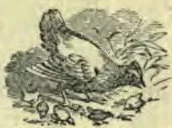
How do you like the little pictures we give you this month? It would not be surprising if the boys should like the sheaf of “Indian Corn” and the “Lion” best, and the little girls may be best pleased with the sweet little girl and the “Hen and Chickens” on this page. There is a good lesson to be learned from this story of the chickens, which we hope you will all remember. If you like these, you may look for more in future.
We welcome the “Letters,” and would say to all, Call again; and bring your friends with you. There is plenty of room in the Corner for you all, and warm hearts to greet you.
Walk Uprightly Before God
Walk uprightly before God.
Lend to the Lord.
Never Go Where God Cannot Go With You
NEVER dare go where you have reason to question whether God will go with you. A Christian should never willingly be where there is not room for his Saviour.
Jesus, Sweetest Name on Mortal Tongue
SWEETEST note in seraph’s song,
Sweetest name on mortal tongue,
Sweetest carol ever sung—
Jesus, Jesus, Jesus!
Sabbath-School Lessons.
By Editor
In all our Sabbath-schools the want of proper lessons for youth and children of different ages has been deeply felt. We are happy to announce that the first volume of “Progressive Bible Lessons for Children, to be used in Sabbath-schools and families—By G. H. Bell,” has been prepared, and is just what is needed. It contains 208 lessons of the greatest interest and importance. It has a full table of contents, and valuable suggestions to superintendents, parents, and teachers. One copy, or more, should be in every family. Price, post-paid, bound, 35 cents; paper covers, 25 cents.
Charity Suffereth Long and Is Kind
CHARITY suffereth long, and is kind.
MONEY RECEIPTED.
Each $1.00. Wm Dawson, P Chaffee, Lizzie B Hayes, Emma Wilson (each 22-1), Eugene Coats 21-1, B S Shaw 21-7, Emma Burgess 22-7, E Wood 22-7, J Matteson 4 copies 21-9.
Each 50 cents. J H Green 22-3, C W Crawford 21-4, M W Rathbun 21-3, Birtie Penney 22-4, Jennie N Jones 21-10, A H Adams 21-4, Andrew Dunlap 21-10, Mary Cushman 21-8, David Putnam 21-8, M M Kenny 22-1, J L Hartford 22-1, C M Washburn 20-10, Miss Belle French 21-13, G B Gantill 21-6, O Macomburg 20-12, M W Thompson 21-10, R W Freer 22-1, Herbert B Varney 22-10, Mary Johnson 21-1, S H Mills 21-6, L Buel 20-10, Miss Etta Kecher 22-10, Amelia Russell 22-1, A Fay 21-10, M T Snyder 21-12, L M Westfall 22-1, E Reisman 21-10, Minnie M Brown 23-3, H Miller 21-7, Frank Rust 21-10, G W Kneeland 22-11, Tilla Hickock 20-10, A E Hafer 21-6, Chas Buck 22-4, R A Worden 21-4, Daniel Andre 22-6, Carrie D Mott 21-10, Frank M Preston 20-8, M M Jordon 22-1, M E Mowry 21-6, Charles Lea 21-10, S B Craig 21-10, Stephen Carpenter 21-4, L J Edson 22-1, Emma Brown 20-10, Stella Brimmer 21-7, Marion Green 21-8, Ellen Walworth 22-7, David Pettis 21-11, T H Lindsay 22-1, Henry Satterlee 21-12, A Roes 21-10, H W Palmiter 21-4, Wm S Lane 21-4, C B Preston 22-1, L M Fish 21-4, May Eggleston 21-7, J Q Fay 21-7, T T Wheeler 21-12, H W Gordon 22-4, Alida M Ernst 21-4, Eva Finch 21-6.
Each 40 cents. M J Shattuck, Mrs David Filoon, Fanny G Arnold, Lucy M Green, Frankie Piper, Wm Ings, C H Blaisdell, Willie Wilcox, Amanda Pixley, Anna Brown, L C Devendorf, Dewitt Danforth, Abraham Condert, Henry L Miner, Augusta McKernan, Eugene Mills (each 21-8), Willie H Baker 21-3, Ezekiel Boylan 21-7, Mary V Belcher 21-1, H O Winslow 20-10, Hannah Chough 21-6, Cortland Green 21-1, Maria West 22-4, Almira Spencer 22-1, Viola Woodin 21-3, Emma Carpenter 21-9, Stephen G Teft 21-1, Dora Daigneau 21-10, J Corliss 21-6, Willie W Swright 21-10, C Fairbanks 21-4, Ida A Howe 21-3, G S Briggs 21-1, Chas D Arnold 21-10, Mason Walker 21-10, P Mangioneer 21-10, Mary Voltar 21-10, Gertie Cartwright 20-1, Mary Hodges 21-10, M E Carrington 21-9, J F Carman 21-7, J S Van Deusen 21-11, Emma Russell 21-4, Willie Smith 21-10, A Eckert 21-1, M S Rogers 21-4, Jane E Moon 21-7, E P Daniels 21-10, Rosa Lunger 22-3, Charlie Lunger 21-1, M E Mann 22-1, Eber De Cow 21-7, B Webber 21-10, Fannie B Lane 21-4, T Wilson 22-5.
Each 25 cents. Lars Christensen, Hattie E Bobst, Charley Simmons, Jennie Johnston, Willie B Crawford, H E Carpenter, George Wilson, Gerty Wilson, Bertha D Belding, Buel M Tallman, Theressa Howell, Ida M Holcomb, Willie Fisher, Altha A Wilson, Willie Upright, Sarah Ann Corey, Linna Mead, Elizabeth Clark, Catherine Blair, G E Burdick, Rosa M Dennison, Ella Burdick, Lillie Leniken (each 21-8), Ella Merriam, Annie Valentine, Willie King, Emma Fish, C I Wilbur, Anna M Beach, C Catherman, S D Stratton, Carrie E Gifford, Amelia O Booker, Laura M Allen, C Tinkham, A B Tinkham, W Edwards, Maria Yallup, Lizzie Eaton, Flora M Fox, Nancy Fisher, Wm M Atkins (each 21-10), H M Utley 21-9, H P Boston 21-7, Milton B Watson 21-7, J Trembley 21-1, Mary Sweet 21-9, B Walker 22-1, Cora Curtis 21-9.
Miscellaneous. Amanda Washbond 30c 21-9, Ettie Holt 30c 21-9, Francis Crawford 30c 21-9, Alonzo Lamora 30c 21-9, H S Guilford 3 copies $1.20 21-10, E M Markillie 1.28 23-7, C Swarthout 65c 22-1, Lettie Finch 2.00 21-1, A & I Rathbun 35c 21-10, Mary Rathbun 1.05 22-5, E P Giles 30c 21-1, A M DeGraw 20c 20-7, Elsa Scott 30c 20-8, O R Cook 57c 22-6, C H Woleott 20c 20-10, C M Edmonds 70c 21-10, J Taber 90c 21-10, J Reed 30c 20-10, H R Svendstrup 3 copies 75c 21-9, Ida Birch 38c 21-8, H L Gardner 20c 21-8, Peter Johnson 20c 21-8, J P Hunt 80c 22-1, W I Simmons 58c 22-1, E C Turner 10c 20-7, George Tripp 10c 20-7, M T Mark 20c 21-1, Mary A Chute 55c 22-1, L E Card 1.70 20-10, Mary Crocker 64c 21-8, A Galutia 80c 22-8, W S Harrington 35c 21-8, Ellen Hake 75c 21-11, M M Parish 65c 21-8, C D Blakelee 60c 20-6, Mrs Louis Conley 30c 21-8, Emory G Rust 76c 20-9, Linnie Mason 75c 20-8, J Martin 1.50 22-10, Geo Fellows 94c 22-1, Julia Munger 65c 21-7, Emma Munger 84c 21-5, Gertrude Fisher 1.18 22-6, J Holenbeck 10c 20-10, Uriah D Jaqua 88c 22-1, E Herbert 80c 20-10, George Drew 24c.
HOW YOU GROW!
By Sel.
How you grow!—how you grow! Everybody tells me so; Friends and relatives all say They see me growing day by day.
'Tis pleasant thus to hear from all That I am growing stout and tall, But pleasanter 't would be to know That I am growing better too.
Does my budding mind improve; Knowledge, truth, and goodness love? Does my heart, enlarged, contain Greater love to God and men?
Do I grow in pure delight Of what is good, and true, and right? Still advance in pious fear, Make God's will my reverent care?
Thus, while friends their praise bestow, And cry in wonder, "How you grow!" I'll ask my conscience, as I should, Tell me, am I growing good?