Your ShelfYour Projects

Review and Herald, Vol. 54, No. 3.

OUR CAMP-MEETINGS

Review and Herald

Jul 10, 1879

Seventh-day Adventist Publishing Association · Battle Creek, Mich. · Jul 10, 1879

OUR CAMP-MEETINGS.

BY MRS. E. G. WHITE.
These annual gatherings are attended with great expense and wearisome labor. They are designed especially for our people, as the best means of reaching the greatest number. And while wisdom should be manifested in locating them where those not of our faith may be benefited by the light of truth presented, great care should be exercised that the object of the meeting be not lost sight of in the desire to make a favorable impression upon the public mind.
I see a marked change for the worse in our camp-meetings. Reporting the meetings through the secular papers, will, if properly conducted, be the means of calling the attention of the people to our faith, and awakening an interest in it; but if not managed in a manner to exalt Jesus and the truth rather than to make a display of what is done, the efforts are thrown away, and time and energy needed to keep up the interest of the meetings are worse than lost. When sincere piety, earnest devotion, and sanctified zeal are manifested by those professing the truth, and our devotional exercises are characterized by the presence of God’s Spirit, impressions will be made upon the outside world that no amount of reporting will produce.
Our camp-meetings greatly fail of being what they should be, and our people do not gain the spiritual benefit from them that they might. Home burdens and worldly thoughts should be laid aside. Every individual should be upon the ground the first day of the meeting, prepared to remain until the closing service. When one family strike their tent a day or two before the close of the meeting, others feel inclined to do the same, and the interest of the meeting is greatly injured. One full week is none too long a time to devote exclusively to the service of God, having the mind withdrawn from worldly interests and concentrated upon spiritual things; but to abridge the one week to two or three days is robbing God of time which should be spent in his service. Some do not get into the spirit of the meeting before they start for their homes. Such show that they value temporal things above spiritual, and they will receive no permanent good.
How must our Lord look upon his people who are thus indifferent and careless when his servants are laboring earnestly to bring them up to the requirements of the Bible, and to awaken in them greater earnestness and devotion in the cause of God. The preaching on Sunday is generally designed more especially for the people outside of our faith, the evidences of our position being dwelt upon. Monday the work commenced on Sabbath for those who are seeking the Lord, is resumed. This, the day for binding off the meetings, is the most important of the series; and our brethren meet with a great loss themselves, and cast a depressing influence upon the meeting, by taking this day for packing, taking down tents, and leaving the grounds. This is a wrong which nearly destroys the good that might be realized from the meetings.
We would appeal to our brethren and sisters to come to the camp-meeting prepared to remain to the close. It is disheartening to your ministers to see a disposition on your part to scatter, as if in haste to get away from the camp. Be on the ground the first day, and feel an individual responsibility to labor for the interest of the meeting from the first day to the last.
As a people, we are backsliding from God. The hearts of his professed children are being estranged from him. While they have a name to live, the true, vital energies of the soul have become spiritually dead. To such, Jesus speaks: “If thou hadst known, even thou, at least in this thy day, the things which belong unto thy peace!” Christ does not say days, but “day,”—“this thy day.” That last meeting may be the very day of the special visitation of Christ,—a day of rare privileges and blessings so much needed by them.
When Christ was upon the earth, attending one of the Jews’ convocations, upon the last day, that great day of the feast, he stood and cried: “If any man thirst, let him come unto me and drink.” His eye of tenderest pity was cast around upon the multitude who were apparently all joy and rejoicing; but he who reads the secrets of the heart saw that there were many in that festive throng who were thirsting for that peace, and comfort, and consolation which he alone can give. They had failed to quench their thirst at earthly fountains, and his voice was heard by the whole temple crowd: “I am the fountain of living waters. If any man thirst, let him come unto me and drink.”
In our camp-meetings Jesus is present with his gracious invitations; and if, on the last day of the feast, he is specially near, and his mercies and blessings are more forcibly brought home to us, how great the loss of those who fail to be present! On the very day of all others when they should be present, they are hasting to their homes; and thus failing to drink of the living waters, their souls are unrefreshed.
One family decide that their farm calls them; but if they had a little more faith and trust in their Heavenly Father, who has said, “Seek ye first the kingdom of God, and his righteousness, and all these things shall be added unto you,” they would be more willing to leave the consequences with God. But very few are willing to make any sacrifice of their temporal things in order to gain eternal riches.
We feel to the very depths the spiritual loss that our people are sustaining in not appreciating their privileges and present blessings. They are not becoming more earnest, devoted, and perfect in character. Their faith is dead, because it is not sustained by works. There is every year a growing tendency to assimilate to the world. Self and the world are becoming a ruling power. I state that which I know. Spiritual death is coming upon us, because of the absence of vital godliness. Says Jesus, “I am the light of the world; he that followeth me shall not walk in darkness, but shall have the light of life.” It is one thing to profess Christ, and another thing to follow him.
Anciently God commanded his people to assemble three times a year, and from every city from Dan to Beersheba the people came to these annual feasts. The one at the commencement of the season was to entreat God’s blessing upon their families, their lands, their flocks, and their herds. The one at the close of harvest was the crowning festal gathering, to bring their offerings to God. The land had yielded its increase, the harvest had been gathered into their granaries, the first-fruits had been stored, and the people came with their tributes of thanksgiving to God, who had thus richly blessed them. Joy and rejoicing were there combined with the solemnities of a holy and sacred convocation.
God directed Moses to say to the children of Israel, “Thou shalt observe the feast of tabernacles seven days, after that thou hast gathered in thy corn and thy wine.” “Seven days shalt thou keep a solemn feast unto the Lord thy God, in the place which the Lord shall choose; because the Lord thy God shall bless thee in all thine increase, and in all the works of thine hands, therefore thou shalt surely rejoice.”
Many sacrifices were made at these feasts; and this profusion of blood shed in connection with the harvest of thanksgiving was significant to them of the fact that even the bounties of the earth could come to them only through the cross of Calvary. By thus assembling and bringing their tithes into the treasury, they ever acknowledged the Lord to be the giver of all their blessings. The children of Israel are our ensamples, that while we should imitate their faithfulness and virtues, we should shun those sins which brought the displeasure of God upon them.
We have our convocation meetings yearly, and all who possibly can attend them should feel under obligation to do so. If they neglect to improve the opportunities to obtain a better knowledge of the truth, and to become more thoroughly in earnest in their efforts to perfect Christian character, they will be held responsible for the light, and privileges, and blessings which they might have had. Their case is nearly as bad in the sight of God as that of those who attend the meetings but fail to improve by the light and blessings there received.
I plead with our brethren and sisters to make the most of their God-given opportunities. Christ, when weeping over Jerusalem, exclaimed, “If thou hadst known, even thou, at least in this thy day, the things which belong unto thy peace! but now they are hid from thine eyes.” Jerusalem’s sin was in abusing past blessings and privileges, and she was sealing her doom in rejecting present mercies and warnings. The weak faith of our people to-day shows that past warnings and reproofs have not been heeded, and hardness of heart, and indifference, and unbelief are the result.
The most solemn and awful period for the Jewish nation was when Jesus was in their midst. It was that generation that was responsible for not accepting the light of the world. For many years God has been pleading with his people by mercies, by judgments, and by the most solemn warnings and entreaties. Blessings have been bestowed, and blessings removed, and yet the people who profess to be in advance of every other people in the light of truth have not responded to these warnings and entreaties of the Spirit of God. The Saviour’s love has been unrequited. Christ looks mournfully upon the individual members of the church, and exclaims, “Ye will not come to me, that ye might have life.”
The hour of probation is fast passing; the cup of God’s indignation is fast filling. Will those who profess to be waiting for the appearing of their Lord from heaven be found wanting in that day, or will they awake from their carnal security, repent of their indifference and hardness of heart, and in this their day give most diligent heed to the things which belong to their peace? Must the fast westering sun of merciful probation set, and the sentence be pronounced, “but now they are hid from thine eyes”?
From the crest of Olivet, Christ overlooked the world. Every soul who has become indifferent to the privileges within his reach, is personally addressed in this appeal. Christ is stooping over his throne to-day, his great heart of love yearning with deep and tender compassion over those who are careless, and neglectful of their eternal interests. Many professed Christians are now only stumbling-blocks,—false way-marks. They do not represent to the world by good works the principles of the doctrines of Christ. They neglect the study of the Scriptures, and secret prayer, and have become, so far as their influence is concerned, traitors to their holy trust. Their hearts have gradually become hardened; they have a name to live, while the vital energies of the soul have become spiritually paralyzed. Of this class our Saviour speaks: “Many will say unto me in that day, Lord, Lord, have we not prophesied in thy name? and in thy name have cast out devils? and in thy name done many wonderful works? And then will I profess unto them, I never knew you; depart from me, ye that work iniquity.”
It is not enough to profess to believe in Christ, saying that we are saved by Christ, when we do not practice the lessons he has given. All such professed Christians are represented by the man who built his house upon the sand; while the hearers and doers of the word are represented by the man who built his house upon the rock, and amid tempest, storm, and flood, it remained unmoved. Thus the true foundation for every soul is represented by those who not only hear the truth but practice it. Those who claim to be children of God and do not his will are hypocrites.
He who is indeed a follower of Jesus Christ, will be assimilated to his image. He will be brought into sympathy with him through the fellowship of his sufferings. Storms of trial and adversity may break upon him, but he is not swayed from his foundation, for his soul is riveted upon the eternal Rock. Indolence in spiritual things will bring moral feebleness; active workers in the cause of God will be men of prayer, and will have success. Every day that they labor to do the will of God they will have increased ability to work efficiently to promote his glory. To such he will say by and by, “Come, ye blessed of my Father, enter thou into the joy of thy Lord.”

THE RESURRECTION.

BY C. W. STONE.
(Continued.)
Isaiah prophesied of the resurrection in the following plain terms: “Thy dead men shall live, together with my dead body shall they arise. Awake and sing, ye that dwell in dust; for thy dew is as the dew of herbs, and the earth shall cast out the dead.” To make this language more clear would be about as difficult as to make a good argument on the proposition that two and two make four. To express the idea more forcibly, that dead men shall be restored to life again, and be brought up out of the grave bodily as they went into it, would be a difficult task. Isaiah’s hope most certainly was in the literal resurrection of dead men. “Thy dead men shall live.” But, according to the views of many, there are no dead men; it is simply the body that dies, while the real man lives on unceasingly. How, then, can dead men live again? That which does not cease to live cannot live again. But, however widely the view may obtain that men do not really die, there is no Bible for it, and no truth in it. It was the first lie ever recorded, and the devil was the author of it. Gen. 3:4. Men ought to know better. We see men die every day. And Isaiah says, “Thy dead men shall live.” Glorious thought! The same loved forms we used to see are to be seen again. The same dear mother that death took from our embrace, the same loved brother that went down into the grave in the morning of life, the innocent little child, the pet of all the household, shall live again. There will be some hearty greetings on the resurrection day. Dear reader, do you wish to be among God’s people then? They will be a happy company. “Awake and sing,” says the prophet. They have been sleeping in the dust; but they shall awake, and join in songs of everlasting joy and ecstatic bliss. Friends long parted shall meet again; and arm in arm, with shouts of victory over death and the grave, they shall ascend, escorted by the Captain of their salvation and the angelic hosts of Heaven, to the gates, the pearly gates, which shall open at the command of the King of glory. Come, my brother, come, my sister; you cannot afford to be left behind.
A very important testimony upon the resurrection is borne by Ezekiel, and is recorded in chapter 37. The Lord caused him to see the vision of dry bones. He saw a valley full of bones, and they were very dry. The Lord said unto him, “Can these bones live?” This was too great a question for Ezekiel to settle, but he knew that with God all things are possible; so he answered, “O Lord God, thou knowest.” The Lord then told him to prophesy upon those bones, and say unto them, “O ye dry bones, hear the word of the Lord. Thus saith the Lord God unto these bones: Behold, I will cause breath to enter into you, and ye shall live; and I will lay sinews upon you, and will bring up flesh upon you, and cover you with skin, and put breath in you, and ye shall live; and ye shall know that I am the Lord.”
Ezekiel continues thus: “So I prophesied as I was commanded; and as I prophesied, there was a noise, and behold a shaking, and the bones came together, bone to his bone. And when I beheld, lo, the sinews and the flesh came up upon them, and the skin covered them above; but there was no breath in them. Then said he unto me, Prophesy unto the wind, prophesy, son of man, and say to the wind, Thus saith the Lord God: Come from the four winds, O breath, and breathe upon these slain, that they may live. So I prophesied as he commanded me, and the breath came into them, and they lived, and stood up upon their feet, an exceeding great army. Then he said unto me, Son of man, these bones are the whole house of Israel: behold they say, Our bones are dried, and our hope is lost; we are cut off for our parts. Therefore prophesy and say unto them, Thus saith the Lord God: Behold, O my people, I will open your graves, and cause you to come up out of your graves, and bring you into the land of Israel. And ye shall know that I am the Lord, when I have opened your graves, O my people, and brought you up out of your graves, and shall put my Spirit in you, and ye shall live, and I shall place you in your own land: then shall ye know that I the Lord have spoken it, and performed it, saith the Lord.”
This is a most vivid representation of the resurrection of the dead. So far as it refers to the resurrection, and declares that it will be a literal event, this scripture is too explicit to need any comment; but there is an idea connected with it that is of real value, which shows absolutely that God’s people are brought to their reward through the resurrection, and that they cannot possibly receive their reward before that event. The Lord promised Abraham the whole world for an inheritance. That promise is found in Gen. 13:14-17. It was renewed to Isaac, and repeated to Jacob. Gen. 26:1-4; 28:13, 14. Paul says it embraces the whole world. Rom. 4:13. Stephen says that Abraham never had that promise fulfilled to him; that he never received by virtue of that promise even enough to set his foot on. Acts 7:5. Paul says that Abraham was to receive the land afterward (Heb. 11:8); that “he sojourned in the land of promise as in a strange country; . . . for he looked for a city which hath foundations, whose builder and maker is God.” Verses 9, 10. Then he states that Abraham and others mentioned “all died in faith, not having received the promises, but having seen them afar off.” Verse 13. What shall we understand by this? That God has made a promise that has failed? No; but that Abraham and all his righteous seed shall have a resurrection from the dead, that God may keep his word to them after the wicked shall have been destroyed. The seed of Abraham includes all that believe in Christ. Gal. 3:29.
This is just what the Lord teaches by the vision of dry bones of Eze. 37. Let us now return to it. The Lord says in verse 11, “These bones are the whole house of Israel.” That would include all of Abraham’s seed, all that are Christ’s, who are “heirs according to the promise.” Gal. 3:29. The Lord proceeds: “Behold they say, Our bones are dried, and our hope is lost: we are cut off for our parts.” He represents these dead as mourning that they have never realized their hope. They are dead, and cut off from their inheritance. They lived in the land of promise as strangers, and now they are dead. Then the Lord speaks the following words of assurance to them: “Behold, O my people, I will open your graves, and cause you to come up out of your graves, and bring you into the land of Israel, . . . and ye shall live, and I shall place you in your own land: then shall ye know that I the Lord have spoken it, and performed it, saith the Lord.” That is the point. God will bring his people from the grave by a resurrection from the dead, to receive the land promised to Israel, the earth renewed. This certainly does show that the time of reward, the time when the rich promises of God shall be realized, is at the resurrection, and that without a resurrection the people of God would forever remain in the grave, their bones dry and their hope lost.
Daniel was informed of the future by the angel Gabriel, that holy being that said to Zacharias, “I am Gabriel, that stand in the presence of God.” Luke 1:19. After directing Daniel’s mind down the course of time, past the rise and fall of nations to the time when Michael, who is Christ, shall “stand up,” or take the kingdom, to reign King of kings and Lord of lords, and after noting the “time of trouble” that immediately precedes the coming of Christ, he says: “And many of them that sleep in the dust of the earth shall awake, some to everlasting life, and some to shame and everlasting contempt.” Dan. 12:2. This teaches us that those who receive eternal life receive it at the resurrection. They awake from the dust, to receive eternal life. The preceding verse proves conclusively that the saints have not been in Heaven enjoying life previous to that time; for it says, “at that time thy people shall be delivered, every one that is found written in the book.” If his people, every one whose name was found written in the book, had been taken right to Heaven at death, pray tell us what they are to be delivered from when Michael shall stand up. Are they to be delivered from the bliss of Heaven? Those who are alive at that time will be changed to immortality, and those who are sleeping shall awake; and “thy people,” “every one” of them, shall be delivered. Then it is plain that they have not been delivered previous to that time, as many have learned to believe. No; they shall all be delivered at the same time; and this is what every prophet who has spoken upon the subject teaches.
And is it strange that we should find a perfect agreement in their teachings? No; for “all Scripture is given by inspiration of God,” and therefore are all the prophets agreed. And for this reason, if we could prove the resurrection by one prophet only, and the rest were all silent upon the subject, the doctrine would be proved just as conclusively as it now is; for one “saith the Lord” is decisive. But the Lord has not left it thus. The matter is of so vital importance that God has repeated the blessed promise of the resurrection to many of his prophets, that by the frequency of the statement in the Scriptures the attention of men might be arrested, and that they might learn how entirely dependent they are for life after death upon Him who died that he might ransom them from the grave.
Adam sinned against God. The penalty was death. From Adam the race have inherited a dying nature. They all go into the grave because Adam sinned. Must they remain there eternally? What a dark picture! But God loved the world; Jesus pitied the fallen race, and he came down to endure in his own person the penalty of God’s righteous law, that he might redeem us from that death which comes upon us as a consequence of Adam’s sin, and place us by a resurrection where we shall stand or fall according to our own works. “They that have done good [shall come forth from the grave] unto the resurrection of life; and they that have done evil, unto the resurrection of damnation.” John 5:29. Christ entered the grave, hades; and when he came from its gates, he took the keys himself. He says, “I am he that liveth, and was dead; and, behold, I am alive for evermore, amen; and have the keys of hell [hades, the grave] and of death.” The saint of God need not fear the tomb; for the day is coming when the bolts shall be thrown back, the portals be opened, and the voice of Jesus shall call his sleeping children forth.
“Asleep in Jesus! Blessed sleep, From which none ever wake to weep,”
The Lord has spoken on this point by the prophet Hosea. “I will ransom them from the power of the grave, I will redeem them from death. O death, I will be thy plagues; O grave, I will be thy destruction.” Hos. 13:14. This testimony proves two things; namely, that persons in death are in the power of the grave, and that they are to be ransomed from that power by a resurrection from the dead. It also teaches a third fact,—that the time shall come when no grave shall ever again open to receive its tenant, and when death itself shall be no more.
Reader, after considering the mass of testimony thus far presented, showing the certainty and importance of the resurrection, can you longer believe that “death is the gate” that opens into Heaven, and that, having gone to their reward at death, the saints have no occasion for a resurrection? Hosea says the saints of God are to be redeemed from death. Then wherever be the place to which death takes us, or whatever be the state in which death leaves us, from it we are to be redeemed. If death opens the gate to Heaven, then the time is coming when we are to be redeemed from Heaven. Let him who breathes upon the quivering air such errors in the hymns he sings, lay his hymn book and Hosea side by side, and see if he wishes to believe both. And then the Lord says, “O death, I will be thy plagues.” Why trouble death, if it perform so friendly service as to open the heavenly portals to all God’s saints?
Ah, Death! poets may sing of thee, blinded theologians may extol thee, the blind whom they lead may repeat the echoing strain; yet I know thee that thou art a monster, an enemy from whom thy victims, even they that sing of thee, all shrink. There is only one thing that robs thee of thy terrors,—Christ has conquered thee, and he will at last give his people a triumphant victory over thee, cast thee into the lake of fire with thine author, the devil, and destroy thee from the universe of God. “And death and hell were cast into the lake of fire.” Rev. 20:14. “The last enemy that shall be destroyed is death.” 1 Cor. 15:26. “And there shall be no more death.” Rev. 21:4. No, our life is not in death. “Your life is hid with Christ in God. When Christ, who is our life, shall appear, then shall ye also appear with him in glory.” Col. 3:3, 4. Christ is our life, and he is the “gate to endless joy.” “I am the way, the truth, and the life; no man cometh unto the Father, but by me.” John 14:6. Christ came to redeem us from death, and to give us life; and he who ascribes His office of infinite love to our enemy, death, robs the Redeemer of the excellency of his purpose in coming into the world, and dishonors God in ascribing to death, which is the result of sin, the infinitely beneficent work which He gave his only begotten Son to accomplish. This work will be accomplished at the resurrection. For this we wait. “For we know that the whole creation groaneth and travaileth in pain together until now. And not only they, but ourselves also, which have the first-fruits of the Spirit, even we ourselves groan within ourselves, waiting for the adoption, to wit, the redemption of our body.” Rom. 8:22, 23.
(To be continued.)

DEAD AND ALIVE.

Till I learned to love thy name, Lord, thy grace denying, I was lost in sin and shame, Dying, dying, dying!
Nothing could the world impart, Darkness held no morrow; In my soul and in my heart Sorrow, sorrow, sorrow!
All the blossoms came to blight; Noon was dull and dreary; Night and day, and day and night, Weary, weary, weary!
When I learned to love thy name, Peace beyond all measure Came, and in the stead of shame, Pleasure, pleasure, pleasure!
Winds may beat and storms may fall; Thou, the meek and lowly, Reignest, and I sing through all, Holy, holy, holy!
Life may henceforth never be Like a dismal story, For beyond its bound I see Glory, glory, glory!
—Alice Cary.

WHICH SHALL WIN?

THE following seems to us a more than ordinarily forcible presentation of the influence and work of that deadly evil, the grog-shop. It is by Frances E. Willard, published in the True Mission of Battle Creek:—
The grog-shop is a two-edged sword, and cuts both ways at once. It catches our young men and boys before they reach the church and Sabbath-school—while they are on their way—and they never reach its doors, or else it catches them as they return, and mars or neutralizes the blessed lessons there imparted. Between the two there is the old “irrepressible conflict” over again. It is war to the knife, and the knife to the hilt, and only one can win. And in the warfare, we of Christ’s army are outnumbered. There are twelve saloons to every church; twelve bar-keepers to every minister. The church opens its blessed doors two or three days in the week; the saloon grinds on and on with its mill of destruction all the days of every week; all the months of every year. That we are outnumbered is not all; we are outgeneraled as well. The people of the rum-shop purpose in their hearts, not only to mar and neutralize, but to obliterate and replace the lessons of church and Sunday school. They have their series of lessons with which our International Series cannot at all compete. They have studied carefully the tastes, tendencies, and preferences of our boys and young men, their natural and innocent taste for variety, fondness for amusement, preference for young company, and they pander to all these in ways that take hold upon death. Whether we educate or not, they appreciate the value of line upon line and precept upon precept. The rum-shop has its literature, of which I would not speak. It has its music and its object-lessons fitted to go with its literature. Said a gentleman who had reformed: “In the rum-shop conscience is a superstition; virtue a jest; the religion of Christ a cunningly devised fable; Christ an exploded myth. The name of God is heard alone in curses there, and immortality is but the feverish fancy of a madman’s brain. There is not a commandment of the decalogue; there is not a precept of the sermon on the mount; there is not a rule of life that ever fell from the lips of Christ, the violation of which is not hailed with plaudits in the saloons.”
So much for the education of the rum-shop. When may we best offset it—where and how? We may do this best in childhood, in the home, and in the public and the Sabbath schools.

ARE WE CONVERTED?

We are a favored people in having the light of the truth for these last days. But the greater the light committed to us, the heavier the responsibility resting upon us. God has graciously given the spirit of prophecy, containing warnings and reproofs suited to our needs; and can we lightly esteem these tokens of his mercy, and not suffer loss?
Some who have loved the truth, and have hoped to be saved by obeying it, will be lost through their own neglect. “Many will say to me in that day, Lord, Lord, have we not prophesied in thy name? and in thy name have cast out devils? and in thy name done many wonderful works!” Shall any of us be among that number?
We may know what it is to be true Christians; too many are but nominally such. Oh, how precious our probationary time! What a privilege to have access to the Father! “For God so loved the world that he gave his only begotten Son, that whosoever believeth in him should not perish, but have everlasting life.”
No soul will ever be lost who rightly estimates present probationary time. Salvation is freely offered to all who will accept it; yet how few appreciate the gift!
Mrs. M. M. Faulkner.

HOW SOME PEOPLE MARRY AND LIVE.

A young man meets a pretty face in a ball-room, falls in love with it, marries it, goes to housekeeping with it, and boasts of having a home and a wife to grace it. The chances are nine to one he has neither. Her pretty face gets to be an old story, or becomes faded, or freckled, or fretted; and as the face was all he wanted, all he paid attention to, all he sat up with, all he bargained for, all he swore to love, honor, and protect, he gets sick of his trade, knows a dozen faces which he likes better, gives up staying at home evenings, consoles himself with cigars, oysters, and politics, and looks upon his home as a very indifferent boarding-house. A family of children grow up about him, but neither he nor his “face” know anything about training them, so they come up helter-skelter; made toys of when babies, dolls when boys and girls, drudges when young men and women; and so passes year after year, and not one quiet, happy, homelike hour is known throughout the entire household.
Another young man becomes enamored of a “fortune.” He waits upon it to parties, dances the polka with it, exchanges billet-doux with it, pops the question to it, gets “yes” from it, takes it to the parson, weds it, calls it “wife,” carries it home, sets up an establishment with it, introduces it to his friends, and says (poor fellow!) that he, too, is married, and has got a home. It is false. He is not married, and has no home; and he soon finds it out. He is in the wrong box, but it is too late to get out of it. He might as well hope to escape his coffin. Friends congratulate him, and he has to grin and bear it. They praise the house, the furniture, the cradle, the new baby, and then bid the “fortune” and he who husbands it good morning! As if he had known a good morning since he and that gilded fortune were falsely declared to be one!
Take another case. A young lady is smitten with a pair of whiskers. Curled hair never had such charms. She sets her cap for them; they take. The delighted whiskers make an offer, proffering themselves both in exchange for one heart. The dear miss is overcome with magnanimity, closes the bargain, carries home the prize, shows it to pa and ma, calls herself engaged to it, thinks there never was such a pair of whiskers before, and in a few weeks they are married. Married! yes, the world calls it so, and we will. What is the result? A short honeymoon, and then they unluckily discover that they are as unlike as chalk and cheese, and not to be made one, though all the priests in Christendom pronounce it so.—Selected.

HOW TO MAKE TENTS.

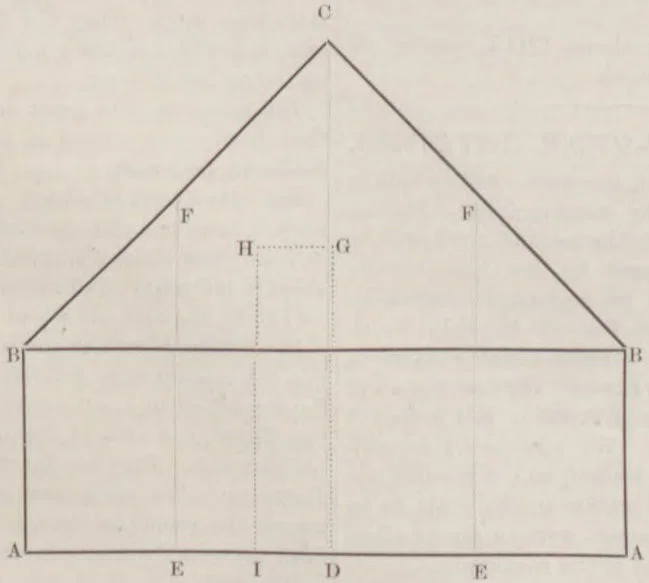
WE have received numerous requests to give in the REVIEW some instructions for making tents, and in compliance with these requests Bro. W. C. Gage has prepared the following diagram, with explanations. It has been used by him in making several tents, and proves very simple and practical. Save this paper for reference, so as not to be obliged to ask for its republication whenever you get ready to make your own tent.
First, Decide on the size you wish. If it is to be made of yard-wide cloth, both the length and breadth should be some multiple of three feet,— as 9, 12, 15, 18, etc. This will greatly simplify the work of making.
Secondly, Draw a diagram of the end of the tent, on the scale of an inch to the foot, as follows:—
We will suppose the tent is to be twelve feet wide, with walls four feet high. First, draw two horizontal lines, A, A, and B, B, twelve inches long and four inches apart. In the center of the line A, A, erect a perpendicular, C, D, ten inches long. Then draw lines from C to B and from B to A on either side. This gives you the design of the ends, the most difficult part of the work, on a scale of one inch to the foot. The line B, B, is of course only imaginary on the tent, being used simply in making the plan. The illustration is on a scale of ¼ inch to the foot.
Measuring the outside of this diagram, on a line A, B, C, B, A, we have twenty-five inches, showing that the strips for the roof and walls must be twenty-five feet long; but, allowing for two-inch hems at A, A, and two-inch tucks at B, B, the cloth must be cut in strips 26 feet long, one strip being required for every three feet of length to your tent. These should be sewed together, with two seams, lapping about half an inch. Take a two-inch hem at each end, and four feet from the ends make a two-inch tuck, through which a strong rope should be run, and eyelet holes worked, inside the rope, at each seam; if greater security is desired, the eyelet holes may be doubled in number.
To cut the ends: The line C, D, is ten inches long; the tent will therefore be ten feet high. The breadth of cloth represented by C, D, E, F, will therefore be ten feet long on one side and seven on the other. Measure off ten feet from your web of cloth, (adding two and a half inches for the bottom hem and top seam) and on the other edge measure three feet less; then draw a line from the two points diagonally, by which to cut, which gives you the necessary angle. The strip A, B, F, E, should then be measured off by placing the shorter side of the piece already cut by the longer side of the whole piece, which is now “cut on the bias,” and cutting it square across. You will then have two patterns from which to cut the rest, requiring four of each kind, and by turning the cloth it can be cut absolutely without waste. The center seam should be sewed down four feet from the top and strongly stayed at G, where a strip six feet long and half a yard wide, G, H, I, D, should be sewed on from G to D, and from G to H, to lap for a door. The putting together is now simple, and by following the above directions a tent of any dimensions may be made.
A fly may be made by sewing together as many strips as are in the roof, and eighteen feet long. Some add another strip, to drop over at each end.
A tent made as above, 12x15, requires 97 yards of yard-wide cloth.
Continue reading: OHIO SABBATH-SCHOOL CONVENTION