The apostle Paul, in speaking of the days in which we live, sets forth the following prediction concerning a large religious class. He does this not as suggestive or presumptive, nor is it a conclusion from certain premises; it is an inspired prediction concerning an apostasy to take place in the church. We read:
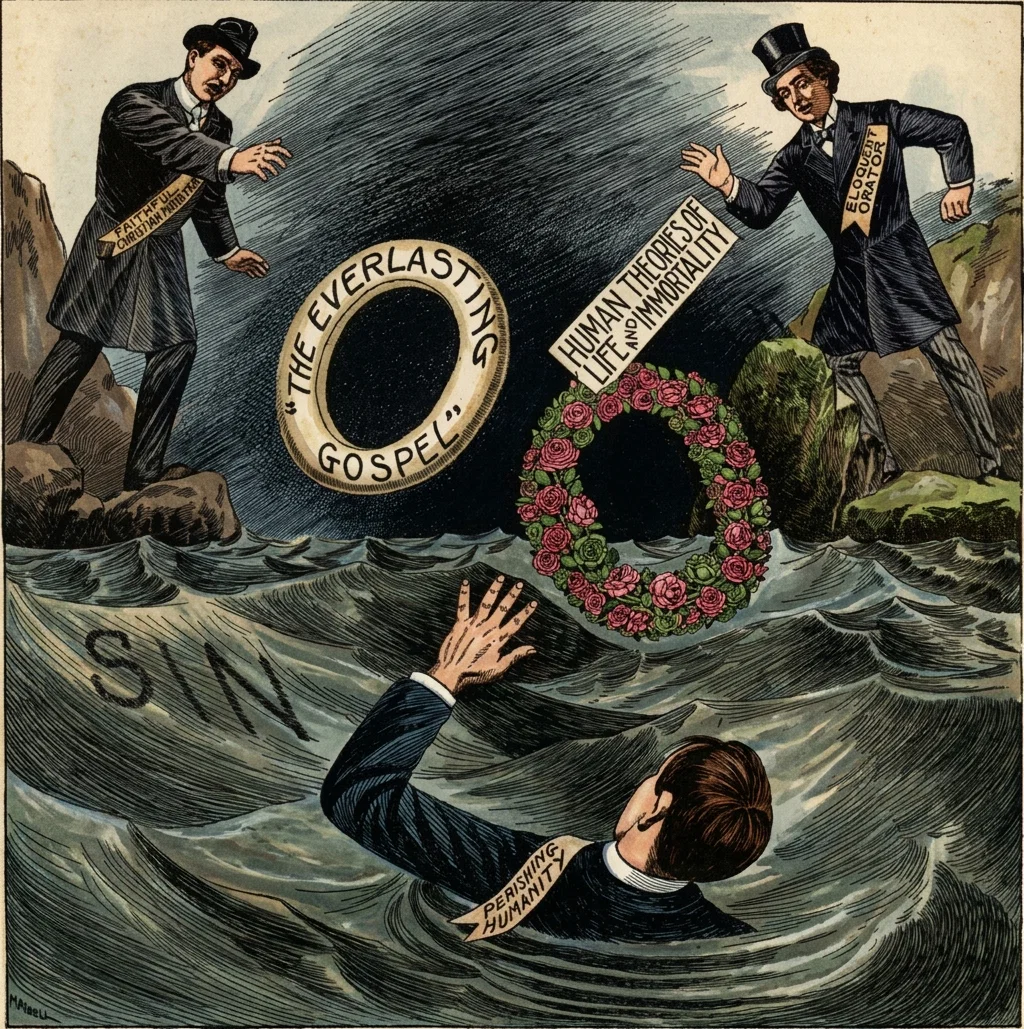
Humanity is perishing in the great sea of sin and vice and sorrow and wretchedness. Humanity is longing for salvation. What a mockery it is to cast to it the beautiful flowers of rhetoric which furnish nothing but human theories, new hypotheses of science, falsely so-called, and dreams of blue ribbon orators! What is needed, as has been recently expressed by Professor Nash, is "men of God who will preach the Gospel of Jesus Christ." There is in that Gospel the power to save. Would to God there were vastly more preaching it!
“This know also, that in the last days perilous times shall come. For men shall be lovers of their own selves, covetous, boasters, proud, blasphemers, disobedient to parents, unthankful, unholy, without natural affection, truce-breakers, false accusers, incontinent, fierce, despisers of those that are good, traitors, heady, high-minded, lovers of pleasures more than lovers of God; having a form of godliness, but denying the power thereof: from such turn away.” 2 Tim. 3:1–5.
Note that these eighteen different sins are among those who have “a form of godliness” but deny the power thereof. That is, they are professedly religious, but the power of godliness is not seen in either life or doctrine. In the same chapter the apostle declares that “evil men and impostors shall wax worse and worse, deceiving and being deceived.” He exhorts Timothy, and through him all the Christian ministers to come, to hold to what he denominates the Sacred Writings, the Holy Scriptures, “which are able to make thee wise unto salvation;” and then of these Scriptures he declares, “Every Scripture inspired of God is also profitable for teaching, for reproof, for correction, for instruction which is in righteousness: that the man of God may be complete, furnished completely unto every good work.”
Then follows the solemn charge which has been repeated thousands upon thousands of times in Christian churches to Christian ministers: “I charge thee therefore before God, and the Lord Jesus Christ, who shall judge the quick and the dead at His appearing and His kingdom: Preach the Word; be instant in season, out of season; reprove, rebuke, exhort with all long-suffering and doctrine.” The reason for this admonition is given in the following verse: “For the time will come when they will not endure the sound doctrine; but, having itching ears, will heap to themselves teachers after their own lusts; and will turn away their ears from the truth, and turn aside unto fables.”
These are solemn truths to him who believes in the inspiration of the Scripture. When “the light of the world” becomes dim, when “the salt of the earth” has lost its savor, then indeed are times perilous. The same degenerate condition of the latter-day church is predicted in many other scriptures. Our Lord tells us that “because iniquity shall be multiplied, the love of the many shall wax cold.” Matt. 24:12. Another apostle writes: “But there were false prophets also among the people, even as there shall be false teachers among you, who privily shall bring in damnable heresies, even denying the Lord that bought them, and bring upon themselves swift destruction. And many shall follow their pernicious ways; by reason of whom the way of truth shall be evil spoken of.” He tells us that these are “presumptuous,” “self-willed,” “wells without water,” “clouds that are carried with a tempest;” “they speak great swelling words of vanity,” and promise liberty, but bring bondage.
Many other passages might be given, but these must suffice. Are they met in these days? Do we see the awful drift there predicted?
“An Epoch in Theologic Thought”
Last week we quoted from an authority on the new departure in the Christian church, “The Independent” of June 24. We refer our readers to that again, on page 7 of that issue. We are there told that the process of criticism beginning with Genesis “had to go on from Genesis to Revelation with no fear of the curse at the end of the last chapter. It could not stop with Moses or Isaiah, it had to include Matthew, and John, and Paul. Every one of them had to be sifted. They had already ceased to be taken as unquestioned final authorities. . . . The miracles of Jesus had to be tested as well as those of Elijah. . . . We have just reached this condition, and there is repeated evidence that it MARKS AN EPOCH, A REVOLUTION IN THEOLOGIC THOUGHT. . . . But this DOUBT, even this QUESTIONING OR DENIAL, CHANGES THE OLD EVANGELISTIC THEOLOGY. It QUESTIONS OR DENIES the TRINITY, the RESURRECTION, the SACRIFICE OF THE CROSS, even ALL MIRACLES, and it DETERMINES ALL AUTHORITY OF INSPIRATION OR EVEN REVELATION and sends us back to HUMAN REASON, with such divine guidance as may be allowed. The authority of the Bible and the authority of the church both to be validated ONLY BY HUMAN REASON.”
That is what “The Independent” said several months ago. It has spoken again. It is probably in touch with more ministers in the United States than any other journal. It has kept in touch with the so-called progressive movement. It has predicted it, fostered it. In its issue of January 6, 1910, it reviews some of the “progress” that has been made. It declares: “We are sometimes surprised [a strange thing] at the rapidity of the theological movement in various denominations.” And then it cites the coming over to that view of “The Congregationalist,” the leading orthodox paper in that denomination. It says:
Wide-Spread Infection
“Doctor Gordon, of the Old South Church in Boston, wrote a book, the purpose of which was to show that belief in the Biblical miracles is not at present particularly useful and is not essential to Christian faith. We might have passed this by as exceptional, altho indicative, if The Congregationalist, the old defender of the faith of its churches, and now the organ of the Congregational publishing society, had not frankly come to support this new view. It somewhat surprised us. We recalled the times when that journal under its earlier names . . . had condemned the succeeding innovations down to the later days when future probation was the militant heresy.”11
“The Congregationalist wrote to a dozen leading professors in theological seminaries and to other teachers and pastors, asking what they thought of the doctrine of Dr. Goodwin’s [Gordon’s] book. While some strongly opposed, it proved that the weight of the majority approved the teachings that the present age is not helped in its faith by a belief in miracles, and that the Christian faith does not need them; that it needs Christ and His teaching, but does not need His miracles. Thereupon The Congregationalist recorded, assented and approved.”
“And this remarkable fact we record as a fresh stage, if not an epoch, in our ecclesiastical history. The same infection, defection, or prefection, whatever it may be called, is visible everywhere. Only this past week a leading Presbyterian pastor in Brooklyn has preached the same new doctrine. It comes naturally out of the new view of Scripture, and the passing away of the doctrine of plenary inspiration, so that in place of it we have a teaching which does not essentially distinguish the inspired authority of the writers of the Bible from that of other wise and good men, and which leaves us to accept our sacred writings for what we find them worth rather than for the special grace of those who wrote them. We can judge the sixty-six books of the Bible, and can accept or reject what we find in them according to the evidence for or against it.”
And this brings us to just what “The Independent” said last year—HUMAN REASON. All the theories that may be presented before us are subject to that one standard, and to the one hope—self salvation.
“Myths” and “Disordered Visions”
“The Independent” continues:
“All this is very radical. It transcends the old Unitarianism and Universalism. . . . It must be understood that with the miracles it denies so important a doctrine as the physical resurrection of Christ, and that it must equally allow belief that it was either a pure myth which very early arose, or that it grew out of more or less disordered visions, like those of the apostle Paul. There can be no sort of historic doubt that the earliest apostles and other disciples fully believed in the resurrection of Jesus, and they, or some of them, believed that they had seen Him. On this belief the church was founded, not on the teachings of the Sermon on the Mount. This is a tremendous fact, of which the new theologians must take account. It was because they believed in the actual and visible resurrection of Jesus Christ, that they had courage to preach immortality, and were willing to die in hope of eternal life. If they had not held this great miracle true they would have held their preaching vain.”
“This they all held, Peter and James and John, as well as Paul and Barnabas. And much more Paul, the scholar and theologian, added, which we have largely allowed to slip out of our faith—the doctrine of the atonement, the penal sacrifice for sin, and the second coming. But all these are matters either of history or philosophy, and so not matters of duty and personal religion.”
Apostles and Disciples Mistaken
And regarding these very things on which the church is founded, “The Independent” says:
“We are no better or worse for believing or not believing so long as we try honestly to follow the evidence.” “While it is very hard to believe that the early disciples, the associates of Jesus before His crucifixion, were mistaken when they testified that they had seen Him risen from the grave, or that the Christian church was founded on an historical mistake, yet we have no right to disfellowship those who doubt, but who yet accept Jesus as Master and Lord, and who follow and obey His teachings of duty to God and man. They are yet brethren, even if they follow not us; good and godly Christians, and are not to be repelled even notwithstanding 2 John 10.”
And here we are. This is in perfect harmony with a sermon preached in the Old South Meeting-house, Boston, by the Rev. C. W. Casson, reported in the Boston “Journal” of November 22: “I accept the Bible as you would a fish, picking out the bones before swallowing it, and I AGREE WITH IT when it agrees with ME.” And the “ME” has come to be the god to direct our faith and to save us from our sins. That perhaps is a statement which the modern theology would not approve; for some of the advanced ones do not believe that we are sinners after all, because the story of the fall is utterly rejected. We are only in a stage of development in which all are progressing. The calmly thinking, reasoning man will naturally inquire, If the stories that have come to us concerning Jesus Christ are not to be believed in respect to His birth, His miracles, His atoning sacrifice, His death upon the cross, why shall we believe Him concerning His teaching? Why should we accept the Sermon on the Mount as His teaching, and not what He says of His second coming?
Either the writers of the New Testament spoke the truth, or they were dishonest men. They not only say that they themselves saw Christ after He was risen from the dead; they not only say that Christ wrought the miracles recorded, and that they saw the miracles; they not only give in their own words what Christ taught; but they also declare that Christ Himself taught the very things which modern theology declares to be myths, falsehoods, vagaries of a disordered mind. Again and again Christ tells us that He is coming again, and that His coming will be a literal coming. The teachings of the later writers are but accounts of what our Lord Himself taught respecting this. If their teaching and conviction is to be laid at the doors of a disordered vision, why not that of the Master also? and then how can we depend upon any of His teaching?
“The church has fallen, the beautiful church, And her shame is her boast and pride.”
What Is Christianity?
This brings us again to the very question, “What Is Christianity?” No better, more comprehensive human definition than that given by the historian of the Reformation: “Christianity is a life sent down from God.” Jesus declares of Himself, the basis of Christianity, “I am the Way, the Truth, and the Life.” The way to life He makes through the atoning sacrifice and His death upon the cross. To reject the atonement, the way of the cross, is to reject Jesus Christ. Everywhere He confirms the Word; everywhere He honors it; sometimes upon one single word alone He builds mighty arguments. To reject that Word which came through Him—for He was but the Incarnate Word—is to reject Jesus Christ. To reject that life, based deep in essential righteousness, and which was manifest in the resurrection from the dead, is to reject Jesus Christ.
We may not accept His moral teaching and call ourselves Christians while rejecting the essential things that will make that moral teaching effective in our lives. We had the moral teaching before Jesus Christ came. He demonstrated the power, the life; and that only is Christianity which takes hold upon that power and that life. If we reject His miracles, we will also fail to grasp that greatest of all miracles—the changing of an unregenerate heart into the likeness of Jesus Christ. For He felt that it was essential that those miracles should be recorded in order that men might believe what is to every soul the greatest of all miracles, the transformation of his life. For we read, “Many other signs therefore did Jesus in the presence of the disciples, which are not written in this book: but THESE ARE WRITTEN, that YE MAY BELIEVE that Jesus is the Christ, the Son of God; and that BELIEVING YE MAY HAVE LIFE in His name.”
Standard Bearers Yet
Thank God, there are yet those in the great denominations, in the various Protestant bodies, who believe the Word; who believe it from Genesis to Revelation; who believe in the fall and the only redemption from that fall—Christ Jesus our Lord; who believe in the virgin birth; in the marvelous teaching; in the mighty miracles; in the resurrection from the dead,—a pledge to God’s church in all time of the glorious eternal victory of righteousness and life over sin and death. We plead with these to be faithful to God and faithful to that Word wherever it may lead. We plead with those who are holding out empty cups to the clouds without water, driven by the tempest of theologic doubt, to turn from these deceptive appearances to the great Fountain of life, opened for sin and uncleanness. Turn from the broken cisterns of men to the cool snow-waters of life’s Lebanon. Turn to Him who entreats us, “If any man thirst, let him come unto Me, and drink.” If a man drinks of these human theories, he will thirst again; but if a man drinks deep of the life of the Lord Jesus Christ, he will find refreshing at no other fountain.
Justice Falls on Minor Employees in Sugar Trust Case
The principal result of the prosecution of the sugar trust seems to fall upon minor employees, the men lowest down. When Samuel J. Tilden was governor of New York he stated that he was called upon often to speak words of encouragement and hope to those who had fallen, as in homes of refuge. He said, “When I have compared their offenses and their nature, temptation, and circumstances, with the crimes of great public delinquents who claim to stand among your best society and are confessedly prominent among your fellow citizens, crimes repeated and continued year after year, I am appalled at the inequality of human justice.” If that was true in Samuel J. Tilden’s day, it is tenfold true at the present time; and yet as of old the law generally finds those lowest down, while those who are highest up escape.
Murder Goes Unpunished: Juries and Leniency in America
The United States stands at the head of civilized countries in the number of its homicides. One of the great difficulties in the trial of murder seems to be in bringing to justice. The Cleveland Leader declares: “There are criminals who escape with a shocking frequency the penalties of their outrages against mankind. They are the brutal murderers who may take children or women for their victims as readily as men. Over and over in Cleveland as in other cities murderers have gone wholly unpunished by the law, and in this municipality alone scores of murderers have escaped capture and conviction within a comparatively short period.” Leniency on the part of juries is said to be one of the greatest factors in failure to mete out justice to the criminal.
Hillsdale Justice Resigns Under Local Option
A news item tells us how prohibition works in Hillsdale, Michigan. The justice of the peace there, it is reported, resigned January 3 because local option had made the town so good that there was nothing for a justice of the peace to do. It seems as if even whisky sellers would see the blessings of temperance. What a country it would be if that were the case all through! One of the mightiest curses upon humanity is its intemperance.
Senator Anselm McLaurin of Mississippi Dies
United States Senator Anselm Joseph McLaurin, of Mississippi, died of heart disease December 22, at the age of 61.
“I Can Not Get Away from God”
Not very many years since, says the Watchword, a coachman was living in a gentleman’s family near London. He had good wages, a kind master, and a comfortable place. But there was one thing which troubled and annoyed. It was that his old mother lived in a village close by, and from her he received frequent visits. You may wonder that this was such a trouble to him. But the reason was that whenever she came, she spoke to him about Christ and the salvation of his soul.
“Mother,” he at last said, “I can stand this any longer. Unless you drop this subject altogether, I shall give up my place and go out of your reach, where I shall hear no more of such cant.”
“My son,” said the mother, “as long as I have a tongue, I will never cease to speak to you about the Lord, and to the Lord about you.”
The young coachman was as good as his word. He wrote to a friend in the Highlands of Scotland, and asked him to find him a place in that part of the world. He knew that his mother could not write and could not follow him, and, tho he was sorry to lose so good a place, he said to himself, “Anything for a quiet life.”
His friend soon got him a place in a gentleman’s stable, and he did not hide from his mother that he was glad and thankful to get out of her way.
You may think it was a pity she thus drove him to a distance. Would it not have been wiser to say less, and thus not lose the opportunity in season? But she believed in her simplicity that she was to keep the directions given her in the Word of God—that she was to be instant, not in season only, but also out of season.
The coachman was ordered to drive out the coach and pair the first day after his arrival in Scotland. His master did not get into the carriage with the rest of the party, but said he intended to go on the box instead of the footman.
“He wishes to see how I drive,” thought the coachman, who was quite prepared to give satisfaction. Scarcely had they driven from the door, when the master spoke to the coachman for the first time. He said,
“Tell me if you are saved.”
Had the Lord come to the coachman direct from heaven, it could scarcely have struck him with greater consternation. He simply felt terrified.
“God has followed me to Scotland,” he said to himself; “I could get away from my mother, but I can not get away from God.”
And at that moment he knew what Adam must have felt when he went to hide himself from the presence of God behind the trees in the garden. He could make no answer to his master, and scarcely could he drive the horses, for he trembled from head to foot.
His master went on to speak of Christ; and again he heard the old, old story so often told him by his mother. But this time it sounded new. It had become a real thing to him. It did not seem then to be glad tidings of great joy, but a message of terror and condemnation. He felt that it was Christ, the Son of God, whom he had rejected and despised.
He felt for the first time that he was a lost sinner. By the time the drive was over, he was so ill from the terrible fear that had come upon him, that he could do nothing else. For some days he could not leave his bed; but they were blessed days to him. His master came to speak to him, to read the Word of God, and to pray; and soon the love and grace of the Saviour he had rejected became13a reality to him, as the terror of the Lord had been at first.
He saw there was mercy for the scoffer and despiser, and he saw that the blood of Christ is the answer before God even for such a sin as this had been; and he now felt in his soul the sweetness of those blessed words, “We love Him because He first loved us.”
He saw that Christ had borne his punishment, and that he had tried to harden his heart against God and against his own mother, and was now without spot or stain in the sight of God, who so loved him as to give for him His only Son. The first letter he wrote to his mother contained the joyful tidings, “God has followed me to Scotland, and has saved my soul!”
“Whither shall I go from Thy Spirit? or whither shall I flee from Thy presence? If I ascend up into heaven, Thou art there: if I make my bed in hell, behold, Thou art there. If I take the wings of the morning, and dwell in the uttermost parts of the sea; even there shall Thy hand lead me, and Thy right hand shall hold me.”—Union Gospel News.
OUR BIBLE BAND
Schedule for Week Ending February 12
Day
Month
Date
Book
Chapters
Sunday
Feb.
6
Exodus
27–29
Monday
"
7
"
30–32
Tuesday
"
8
"
33–35
Wednesday
"
9
"
36–38
Thursday
"
10
"
39, 40
Friday
"
11
Leviticus
1–4
Sabbath
"
12
"
5–7
Notes
OUR readings finish the book of Exodus, beginning at chapter 27, and include seven chapters of the book of Leviticus. The great topics around which the chapters range themselves are as follows: Exodus 27, the building of the altar of sacrifice, the court of the tabernacle, the compounding of the holy oil; chapter 28, the garments of the priest, and the holy breastplate; chapter 29, the consecration of the priests; chapter 30, the building of the altar of incense, the brazen laver, the atonement money, and the anointing oil; chapter 31, men especially fitted of God to do His work; chapter 32, the idolatry of Israel when Moses was in the mount; chapter 33, Moses’ earnest plea for Israel; chapter 34, the meaning of God’s name; chapters 35 to 40, a definite carrying out of the instruction before given concerning the sanctuary.
THE book of Leviticus is so called because it deals with the various laws and ordinances given to the tribe of Levi in the conduct of sacrifice, worship, etc. Chapter 1 deals with the burnt offerings, of herds, flocks, and fowls; chapter 2, the meat-offering, or more properly meal-offering, because no flesh entered into it; chapter 3, the peace-offering; chapter 4, the sin-offering of ignorance for the priest, the congregation, the ruler, and the people; chapters 5 and 6, the trespass-offering, the sins of ignorance and knowledge, and the law of the sin-offering; chapter 7, law of the trespass-offering and of the peace-offering. Some have said, “If I have taken an oath and made a pledge, I must keep the oath even if it is wrong.” That does not necessarily follow at all. Note in chapter 5 that when one makes a promise, if that promise results in wrong-doing he is to turn back from his promise, confess his sin, and forsake it. The duplicating or augmenting of a wrong does not make it right.
Memorial Number Signs of the Times Monthly for February Is Now Ready
By Editor
Washington-Lincoln
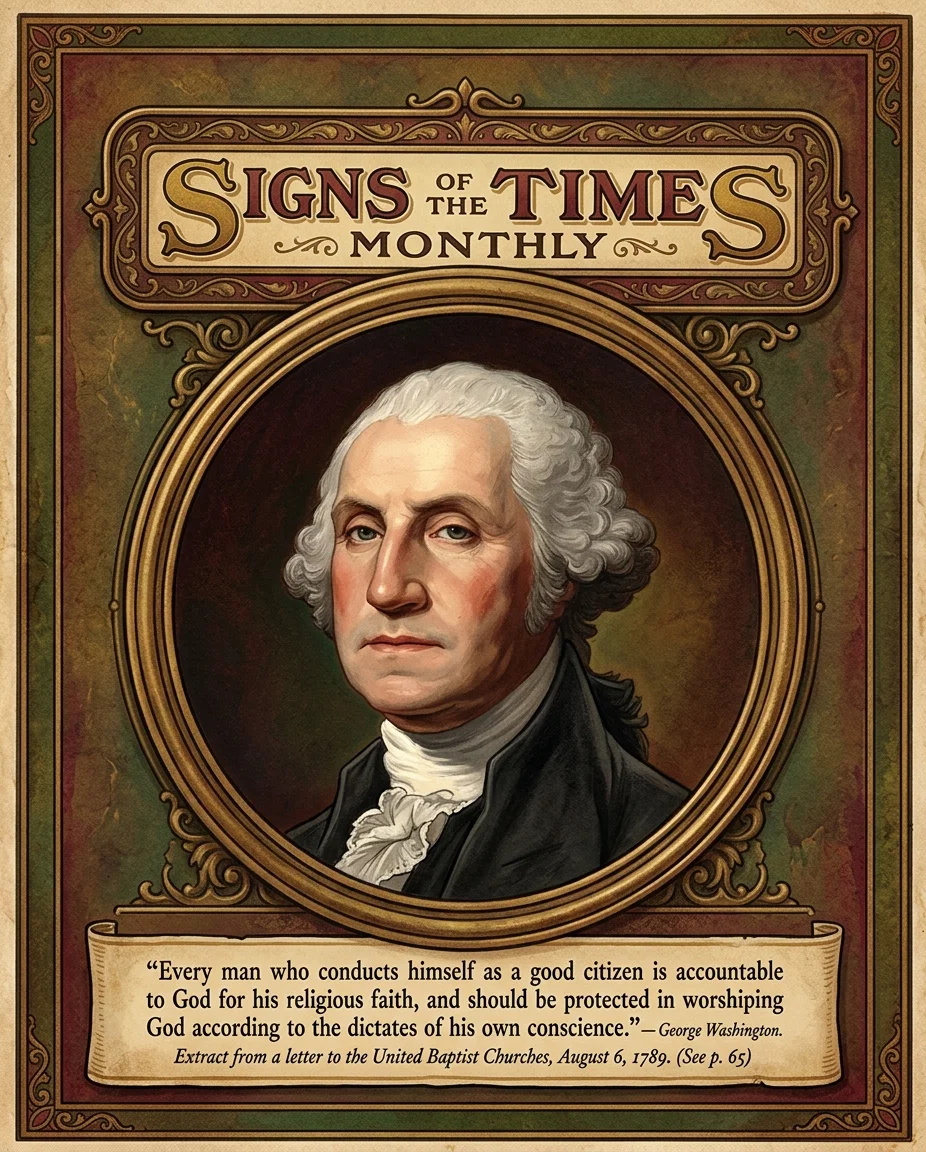
Memorial Number Signs of the Times Monthly for February Is Now Ready
February Cover
CONTENTS
CURRENT TOPICS: More Sugar Frauds; The Great Tariff Fraud; The Fraud of Our Cities; The Meaning of These Frauds; The Banishing of Frauds; Halley's Comet; Situation in England; Is Mars Inhabited?
NOTE AND COMMENT: The New Gigantic Money Trust; King Leopold; Which Bible? Bryan's Objection to Darwinism.
GENERAL ARTICLES: The Significance of Recent Calamities, J. O. Corliss; Washington and Lincoln, M. C. Wilcox; The Apostasy, Mrs. E. G. White; The Disappointment (a story of 1844), A. W. Spaulding; Divine Healing, Dr. Kress; The First Day of the Week in the New Testament, H. W. Cottrell; The Second Coming of Christ (Bible Reading); Why Keep Sunday Every Week? T. E. Bowen; Civil and Uncivil, A. D. Westcott; True Liberty Notes.
This splendid variety of subjects has not been excelled in any former issue of the “Signs Monthly.” A large edition is being printed, for we anticipate unusually large orders. 5 to 50 copies, 5 cents each; 50 or more, 4 cents each.
We Want Agents Everywhere
Why Not Write To-day?
Address orders or inquiries to your tract society, or
SIGNS OF THE TIMES, Mountain View, California
IN THREE DAYS
Overland Limited
TAKES YOU
To Chicago
ACROSS GREAT SALT LAKE
AND
HIGH SIERRA BY DAYLIGHT
Luxurious High-class Equipment
Electric Lighted Throughout
Pullman Drawing-room
Stateroom
Vestibuled Sleeping Cars
Careful and Attentive Dining Service
Parlor Observation Car with Library and Cafe
Ladies’ Reading Room
Gentlemen’s Smoking Room
Daily News Bulletins
Latest Papers and Magazines
SOUTHERN PACIFIC
Wanted: Periodicals for Missionary Purposes
Wanted
For missionary purposes, post-paid, copies of the SIGNS OF THE TIMES, Watchman, Life and Health, Liberty, Life Boat. Address, J. Gregory, Paradise Valley Sanitarium, National City, Cal.; Pauline Kinner, 248 12th Ave., Paterson, N. J.; W. L. Kileen, High Point, N. C.
Free Copies of Our Little Friend Offered
FREE.— Persons desiring nice, clean copies of Our Little Friend for reading-racks, etc., may secure them free of charge and in any quantity, by writing to Our Little Friend, Mountain View, Cal., at once. This offer will hold good for a limited time only.
Wanted: Farm Work by Middle-Aged Sabbath-Keeper
WANTED.—By a middle aged Sabbath-keeper with wife and child, work on farm. Can take full charge, or will rent on shares. Understands farming, orchards, and stock. California preferred, but would not object to other places. Address, J. M. Evans, Livingston, Cal.
Pure Air and Correct Breathing—Their Value
By D. H. Kress
By D. H. Kress, M.D., Director of Washington (D.C.) Sanitarium
I. The Kind of Air
For many years it was considered dangerous to expose the sick to out-of-door air, especially if they had some lung affection. The rooms as a rule were kept sealed. Consequently the mortality rate was very large. During the last few years attention has been called to the importance of pure air in the treatment of tuberculosis and pneumonia. As a result the mortality from these diseases has been greatly reduced.
Much is said about the need of pure air for consumptives; but not enough is said in regard to the need of those who are in health to live in a pure atmosphere. Men, women, and children are often huddled together in churches, theaters, schoolrooms, bedrooms, street-cars, on steam-cars, etc.; and no adequate provision is made for the admission of pure air or for the removal of impurities. Colds, influenza, and other diseases are in this way communicated from one to others.
The importance of air may be estimated by the fact that we can do without food for many days, but to attempt to do without air for only a few minutes results in death. Food we take but twice or three times a day, while breathing is continuous throughout the twenty-four hours. Air is one of Heaven’s choicest gifts to mankind, and should be valued in health as well as in time of sickness. If it is, there will be much less sickness.
There is no more rapid or effective method of introducing poison into the system than through inhalation. If poisons are taken with the food, they pass through the liver before being permitted to enter the general circulation. The liver does its utmost to neutralize or eliminate them. When poison is inhaled, it passes directly into the general circulation and throughout the system. It is therefore of the utmost importance that the air we breathe should be free from impurities.
(To be continued)
What It Costs to Support Rum
It costs men to support the rum business—an awful price. Many liquor dealers do not stop to think of this. Other intelligent ones do. The sad thing is that they do not recoil in horror from the awful business. The sordid love of money holds them. The following is from a paper read by one of the delegates to a meeting of the state liquor dealers of Ohio, held in Wirthwein Hall, Columbus. The subject of the paper was “How to Build Up the Saloon Business”:
“The success of our business is dependent largely upon the creation of appetite for drink. Men who drink liquor, like others, will die, and if there is no new appetite created, our counters will be empty, as will be our coffers.
“The open field for the creation of appetiteis among the boys. After men are grown and their habits are formed, they rarely ever change in this regard. It will be needful, therefore, that missionary work be done among the boys; and I make the suggestion, gentlemen, that nickels expended in treats to the boys now will return in dollars to your tills after the appetite has been formed. Above all things create appetite.”
Shall it be your boy?
Training to Purity
By Mrs. E. J. Hildom
“Unto the pure all things are pure.”
All things that God has created are pure. He pronounced “everything very good.” Then if we can not consider everything of His normal creation pure, it is because of a false education. The first thing to be accomplished in teaching purity, is to replace this false education with the true. The Bible is the criterion by which to judge of truth; therefore let us study to know how it treats this subject.
We find that the Word of God thinks purely of the whole normal body. When we study the body from a scientific standpoint, we can only wonder and adore before our Creator, who has so perfectly adapted every organ of the body to the purpose for which it was designed. This thought may be a help in teaching purity, in using the body for its designed purposes. By various illustrations we may teach our children those simple necessary truths that will fortify them against impurity.
Unless mothers can think purely themselves on these subjects, it will be utterly impossible for them to help their children to purity. A little child always thinks purely on all subjects until taught otherwise. Teach the children to come to you in all matters of sex, and to talk to you freely, fully. Keep them with you as long as possible, but answer their questions in wisdom, in truth, in sincerity, in motherly love and modesty.
Teach them to care properly for their wonderful bodies, and use them to honor God, and that the perversion of the right79use will bring disease, degradation, death. They will soon learn to make these things a matter of conscience. Whatsoever they do, whether they eat or drink, they will realize their responsibility to God, to take good care of this temple which is to be the dwelling of the Holy Spirit. In this way much if not all of the friction which usually comes in between children and their elders, concerning all the habits of life, will never exist, and they will learn early in life not to guide their actions by motives of selfishness.
And this makes all the difference between the children of God and the children of the wicked one. How much easier is this education for the child, than to allow him to learn habits that will all have to be unlearned or he can never enter the kingdom of heaven. Our Saviour’s words that unless we become as little children we can not be fitted to enjoy the peace and purity of heaven, make plain our course of action as parents. Respect the child’s individuality.
We are to study him and aim to develop him into what God intended him to be, and not think we must make him all over. No two are alike. They have come into an unknown world. To enable ourselves to exercise patience, let us for a moment transplant ourselves in imagination into a country where the customs and scenery are entirely unlike anything we have ever seen. Then we can sympathize with a little child; and without sympathy we can neither understand nor help any one. A little child can learn to love Jesus as soon as it can understand language. And even when a babe in its mother’s arms, she can have such a spirit of consecration that the child’s character will be formed in the image of God.
MRS. E. J. HILDOM.
The Fool’s Prayer
By Edward R. Sill
The royal feast was done: the king Sought some new sport to banish care, And to his jester cried, “Sir Fool, Kneel, now, and make for us a prayer.”
The jester doffed his cap and bells, And stood the mocking court before; They could not see the bitter smile Behind the painted grin he wore.
He bowed his head, and bent his knee Upon the monarch’s silken stool; His pleading voice: “O Lord, Be merciful to me, a fool!”
“No pity, Lord, could change the heart From red with wrong to white as wool; The rod must heal the sin; but, Lord, Be merciful to me, a fool!
“’Tis not by guilt the onward sweep Of truth and right, O Lord, we stay; ’Tis by our follies that so long We hold the earth from heaven away.
“These clumsy feet still in the mire Go, crushing blossoms without end; These hard, well-meaning hands we thrust Among the heart-strings of a friend.
“The ill-timed truth we might have kept, Who knows how sharp it pierced and stung? The word we had not sense to say, Who knows how grandly it had rung?
“Our faults no tenderness should ask; The chastening stripes must cleanse them all; But for our blunders—O, in shame Before the eyes of heaven we fall.
“Earth has no balsam for mistakes; Men crown the knave, and scourge the tool That did his will; but Thou, O Lord, Be merciful to me, a fool!”
The room was hushed; in silence rose The king, and sought his garden cool, And walked apart, and murmured low, “Be merciful to me, a fool!”