The Youth’s Instructor, Vol. 49, No. 32.

TWO YELLOW BIRDS

The Youth’s Instructor

Aug 8, 1901

Review and Herald Publishing Company · Battle Creek, Mich. · Aug 8, 1901

TWO YELLOW BIRDS
AMERICAN GOLDFINCH
AMERICAN GOLDFINCH
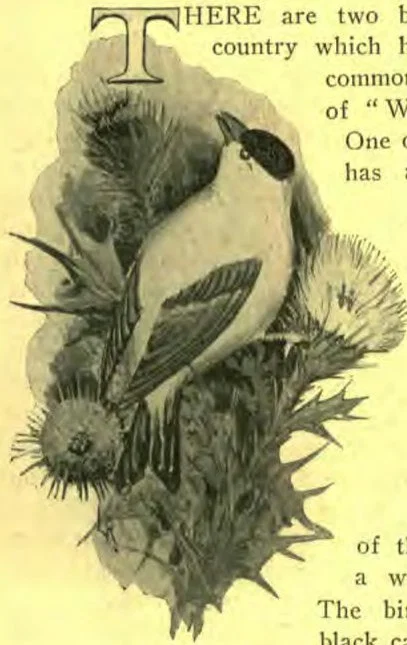
There are two birds in this country which have the one common nickname of “Wild Canary.” One of these birds has a black cap and black wings; the other is yellow or greenish-yellow nearly throughout its plumage. In point of fact, neither of these birds is a wild canary. The bird with the black cap and wings and the bright-yellow plumage is the American Goldfinch, Yellowbird, or Thistlebird, as it is variously called. The other is the Yellow Warbler, or Summer Yellowbird. The two birds are not very much alike, save that both are yellow.
Early in the spring, before the leaves are yet out, you may hear, in the depths of an evergreen tree, the musical question, See-e-me? You may be sure it is the Goldfinch, and his yellow robe will make it an easy matter to see him. Later in the season you will find him swaying on the feathery side of some gay thistle-top. In a moment he is off, winging graceful curves through the air not far in front of you. He is as bright and cheery as his coat. The dotted line in the drawing will help you to understand how he flies through the air. But the bird himself is better than any diagram.
“I wish that every one knew the Goldfinch. His gentle ways and sweet disposition are never-failing antidotes for discontent. One can not be long near a flock of these birds without being impressed with the refinement which seems to mark their every note and action. They show, too, a spirit of contentment, from which we may draw more than a passing lesson. Hear me, hear me, dearie! they call as they feed among the weeds or on the birch buds; and no matter how poorly they fare, they seem thankful for what they have. The seeds of the dandelion, thistle, and sunflower are among their favorites; and if you would attract Goldfinches as well as some other birds, devote a corner of your garden to sunflowers.
“The meal finished, the birds launch out into the air; and to the tune of Per-chic'-o-ree! per-chic'-o-ree! go swinging through the air in long, bounding undulations.”
In the fall you will lose track of the Goldfinches. Gradually they will disappear. But now an unfamiliar bird, yellowish-white beneath, with a greenish-brown back, will attract your attention. It will be hard for you to believe that this soberly dressed bird is the same smart little fellow you saw in summer, all attired in bright-yellow and velvety black; but so it is. He wears two suits each year,—yellow and black for summer, a more plain garb for winter. The birds now remain in flocks, roving here and there to find food. “But in the spring, when the dandelions show yellow, so do they.”
In April the males regain their bright colors, but it is not until June that the birds set up housekeeping. Then the song season reaches its height. Each bird perches near his home, or flies in broad circles about it, and pours forth his bursts of rapturous melody.
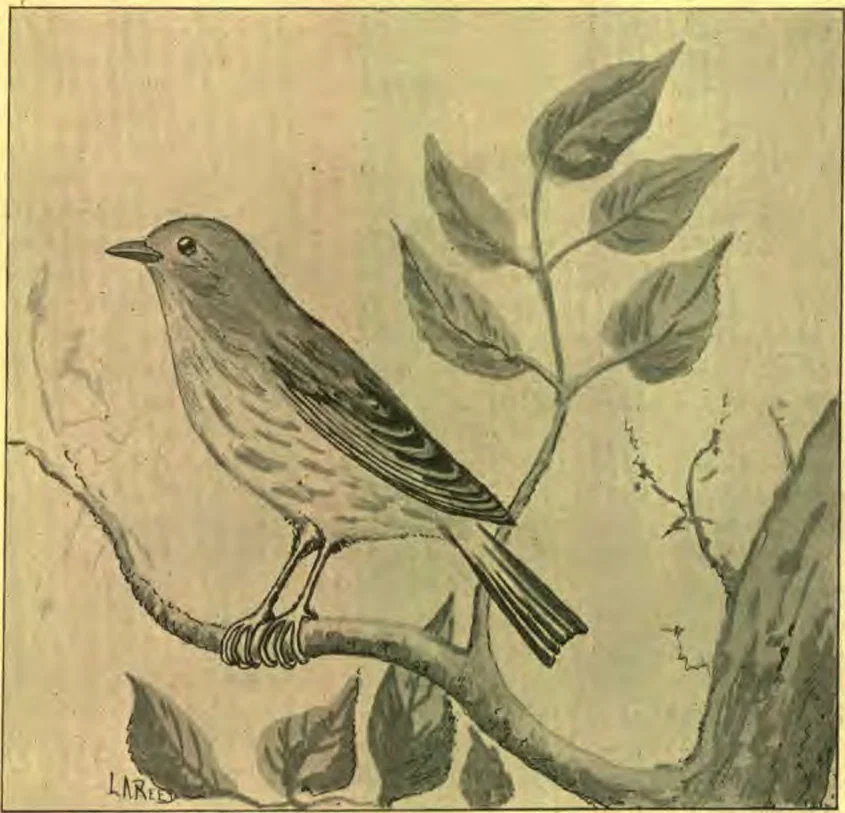
The Yellow Warbler is, as its name indicates, a member of the great, puzzling family of Warblers. There are very many members of this family, and most of them live in close shrubbery or the depths of trees, where it is difficult to study them. Even if you set out to form their acquaintance, it will take several years to find them all, and become in the least familiar with their habits.
But the Yellow Warbler prefers lawns, parks, or orchards to the woodlands, and hence is better known. It is greenish-yellow above; crown and under parts golden, streaked with reddish-brown; wings and tail dusky, somewhat edged with yellow.
The female cowbird is the constant enemy of the Yellow Warbler. She does not build a nest of her own, but seeks, instead, some other bird’s nest in which to deposit her eggs, that of the Yellow Warbler being a favorite. But the Yellow Warbler does not believe in being imposed upon if it is to be avoided. Sometimes when Mother Yellow Warbler is away from home for a few moments for a drink, or a few turns through the air, a cowbird will leave one, two, or three of its large eggs in her nest. When the little bird returns, it sees at once what has happened; but the egg of the cowbird is large and heavy, else the Warbler doubtless would promptly roll it out. There is only one other way to be rid of it,—build a new nest over the old one, and begin again. This the Warbler may be compelled to do twice, and even three times. True, it has to abandon its own eggs as well; but better so than to hatch out an ugly black cowbird, which would gobble all the food, and eventually crowd the little Warblers out of the nest. Thus you see that even the birds have serious troubles. But in one thing they are different from us,—they do not allow these things to sour their tempers, and shortly they forget, and sing as sweetly as ever. In this, as well as in their happy trust for their daily food, they are an example to man.
THE YELLOW WARBLER
THE YELLOW WARBLER
L. A. REED.

MR. CHAT, THE PUNCHINELLO

Once upon a time I happened to find myself in a pasture,—not a tame, every-day, green pasture, tacked on one end of a nice, smooth farm,—not at all! but a pasture on top of a high hill, with beautiful fields stretching out below it, and all pink-and-white with laurel. The cows, which, they say, do not care either for laurel or scenery, may not have liked this pasture, but I did. So when I had climbed the bars, and seated myself on the top one to view the country, I saw at the far edge of the pasture a jungle of trees, and I liked it still more, and determined to explore it. On the way I flushed a brown thrasher in a laurel bush, and he flew into the jungle. There seemed to be but one bird singing in all the neighborhood; and this song, which was a peculiar one, lured me into the thicket. On I went very cautiously till the sound seemed to be directly overhead. I paused, listened, and peered into the tree-tops.
“Caw-caw!” cried the bird, harshly.
“Nothing but an old crow,” said I, in disgust.
I started to go, when from the same spot overhead came a loud, clear, double note, and again I waited.
“Meow! meow!” remarked my new friend.
“How stupid of me!” said I. “I might have known it was Mr. Catbird.” But immediately there came a glorious trill,—first over my head, then almost under my feet, then at my right hand, then at my left; though there was no flutter of wings in all the jungle. At last the fallen branch upon which I had been sitting gave way, and I went into the swamp with a splash of mud. “Look out! look out!” came a sarcastic voice from the tree-top.
“It is an escaped Poll-parrot,” said I, to reassure myself; but I took out my handkerchief and mopped my heated brow. The unknown then proceeded to bark like a dog, quack like a duck, and squeal like a pig, with occasionally a measure of song in between. At last in desperation I seized a young sapling near at hand, and shook it with all my might, thinking to frighten him into showing himself.
“Haw-haw-haw!” rang out clearly from the top of the very sapling itself.
When I neared the bars, and saw my horse grazing patiently on the other side, I saw on an upright stake at the side of the bars, a strange, yellowish bird. I did not know him, for I had not so many bird friends then as I have now. Suddenly he rose in the air with a shriek, his legs dangling helplessly. “Is this a magical pasture,” I said to myself, “where birds are shot without the report of a gun?” and then with legs still dangling, he made a beautiful gyration in the air, and calling out: “That’s it—that’s it—tut—tut—tut!” disappeared in the direction of the thicket. This was my first attendance upon one of the remarkable performances of Mr. Yellow-breasted Chat, and I can without hesitation pronounce it the most wonderful in all birddom.
The next day I invited some skeptical friends to prove the truth of my story. So at the same time of day we drove up the long hills till we spied the pink-and-white of the laurel, and halted at the gray bars. The pasture, which had been deserted the day before, was now spotted with cows; the laurel had begun to fade, and though we waited one long, weary hour, not a sight nor a sound of a bird of any description did we see. The towhee and the shore lark, which I had seen the day before, seemed to have dropped out of existence; and those disagreeable people hinted that even the brown thrasher was a myth. But as I ventured alone into the dark swamp, hoping still to stir up Mr. Chat, I came face to face with the beautiful purple-fringed orchis,—the large, early variety,—blooming alone in the damp thicket, so straight and stately, and of such a delicate, refined beauty, I fell on my knees beside it, and felt it to be ample compensation for any disappointments. So you see there is not wealth enough in all the world to force a bird-song at the moment when you want it; but at the same time and in the same swamp the purple orchis may be blooming for you.—Selected.

Destruction of Birds in France Harms Agriculture

It is averred that the destruction of birds in France has produced disastrous effects upon agriculture, horticulture, and grape-growing. Some birds consume about six hundred insects each daily, and a single insect-eating species, it is estimated, may be the means of saving three thousand two hundred grains of wheat and one thousand one hundred and fifty grapes a day.

WHAT TO CARRY

“If you are going to a neighbor’s, child, carry something worth while,” said the dear old grandmother, looking out from the kitchen window.
I was a very small girl, delighted with a bright little basket which some one had given me, and eager to show it to a playmate next door. I was filling it with hard, green peaches, which the wind had swept from the trees.
“I’m only playing take her something,” I explained; but the wise old grandmother insisted on the basket’s being emptied.
“Think what you can share with her that is worth carrying,” she said. “There are too many folks traveling to and fro with trash that the wind brings to their doors — things fit for nobody’s mouth. Mind what grandma tells you, dearie,—you’ll understand it better when you grow older,—don’t run with every bitter windfall you can gather up, but learn to carry things worth carrying.”
She filled the basket with cookies and rosy apples, and sent me on my way rejoicing. The incident, like the grandmother’s life, is long since past, but many a time I have remembered it when visitors have brought me things worthless, or worse than worthless—flying rumors, inquisitive intermeddlings, articulated bits of somebody’s family skeleton, if not, indeed, positive scandal.
Why should we carry unpleasant things when the world is so full of bright and helpful ones? The sad and sinful things exist, and we can not shut our eyes to them. No law of charity requires us to call black white, and no law of kindness requires us to part with our common sense. The wrong is wrong, and we must face it, and deal with it as best we may; but why treat it as a dainty to be served at the family table, or carry it about for the delectation of our friends?
The beautiful poem we have read, the bright story that brings a healthful laugh, the brave deed that has deepened our faith in humanity, the good tidings that have come to an acquaintance, the wonderful discoveries of science, the mighty forces that are sweeping and changing the world,—surely there is enough of all these to fill the baskets we carry to our neighbors, and to make our visits bring a breath of cheer and inspiration instead of poisoning all the atmosphere.—Forward.

OLD BRASS

YALE University made a discovery the other day, and is now ten thousand dollars the richer because of it. In an unused cellar of the Peabody Museum one of the assistants, by the merest chance, picked up from a rubbish heap a bit of old brass. At least, he thought it was old brass, until he polished it a little with his work-apron. It had a strange look for old brass; and this observing young man took it to the light, and then he took it to the laboratory, and analyzed it. It was pure gold.
In that rubbish heap was a treasure of rarest Aztec jewelry, valued at ten thousand dollars.
The late Prof. O. C. Marsh, the wealthy, learned, generous, and eccentric curator of Yale’s museum, bought this collection years ago, just as he bought hundreds of other collections, paying for them with his own money very often, and piling them up in his treasure-house, then rushing off over the world for other acquisitions, without stopping to catalogue what he had already acquired. Ever since his death, two years ago, just such unexpected discoveries as this have been frequent in the big museum.
The whole performance is too good an illustration not to be utilized; for it shows perfectly well how some folks treat their lives. They are all for getting, and little for making practically available what they have obtained. Full barns merely become warrants for bigger barns. Prosperous business simply incites to wider enterprises. One science mastered suggests the mastery of another. The greediness of the stomach is overmatched constantly by greed for power, or gold, or learning. Few indeed know when to stop.
It is a beautiful thing to have lives in which your friends are constantly finding unexpected treasures—discovering all the while that you are better and wiser and stronger than they had thought you to be. I am not urging you to wear your heart on your sleeve, or display your learning in every conversation, or refrain from patronizing the savings-banks. Just the same, acquisition has its excuse only in utilization, and if you don’t take care to make good use of your gains, whatever they may be, they are sure to go to the rubbish heap, and ten to one they may stay there forever.—Christian Endeavor World.

CORAL

THE psalmist said, “O Lord, how manifold are thy works! in wisdom hast thou made them all: the earth is full of thy riches. So is this great and wide sea, wherein are things creeping innumerable, both small and great beasts.”
Coral, which we have all seen and admired for its varied and graceful forms and delicate beauty, is the product of one class of the marvelous little workers of the sea. They are called “coral animals,” or, in scientific language, Actinozoa, which means ray animals. They all have the power of “secreting hard structures of the nature of a skeleton,” and it is wonderful what beautiful things they make down beneath the quiet waters of the ocean; for they love best the still waters of tropical climes.
The Mediterranean Sea is the great storehouse of the red coral so prized for the manufacture of ornaments. “The beds are generally from two to ten miles from the land, and in water of about thirty to a hundred and thirty fathoms deep; but the most favorable conditions are found in water eighty fathoms deep. The most important fisheries extend along the coasts of Tunis, Algeria, and Morocco;” but coral is found in other parts of the sea. “It is attached to rocks embedded in a muddy sea bottom, in which it flourishes more than in a clear or sandy bed. In color it varies through all shades of red, from a deep-crimson to a delicate rose-pink or flesh-color, fine tints of which are very rare and highly prized.” Some specimens are milk-white, and still others are black.
E. J. BURNHAM.

’TIS THE KINDLY THOUGHT THAT COUNTS

Oft afflictions press upon us, Into which no light has shone; Others no relief can bring us, We must struggle on alone; But a helping hand, extended Where the path so rugged mounts, Comforts, if it can not help us: ’Tis the kindly thought that counts.
Sometimes grief our sunshine darkens; Sorrows mar the pleasant day; Spirits droop beneath their burden, Tears and sighing all the way. When a kind word falls, like sunlight, On the weight our soul surmounts, Though it vanish not, it lightens: ’Tis the kindly thought that counts.
Friends can’t always share our burdens, Offered help is often vain; But, though forced to still refuse it, We are grateful just the same; And within the heart’s recesses, Storing love’s untold amounts, Cherished as a priceless treasure, Is the kindly thought that counts.
MINNIE ROSILLA STEVENS.

WHAT CAN YOUNG PEOPLE DO?

“NONE of us liveth to himself.” Rom. 14:7. One of the first things which those who love Jesus should do is to have a care for the influence which their lives have upon the lives of those about them. As the blossom can not tell what becomes of its perfume, so we are unconscious of the extent of the power which we exert over others by our thoughts, words, and actions. Whether we wish it so or not, the silent influence of each life goes on unceasingly. Every word that falls thoughtfully or thoughtlessly from our lips is filling up the measure of blessing or cursing in this world. Every act of our lives is fraught with weal or woe to others, as well as to ourselves. We shall as certainly reap the harvest of the seed sown by our unconscious influence, or by our influence carelessly exerted, as we shall harvest the seed planted with a careful hand. We must meet again the influence of that which we do. Longfellow most beautifully expresses this truth in these lines:—
“I shot an arrow in the air, It fell to earth I knew not where. I breathed a song into the air, It fell on earth I knew not where. Long, long afterward, in an oak I found the arrow still unbroke; And the song from beginning to end, I found again in the heart of a friend.”
There is no young person who reads these lines but may, if he will, from this time forth exert a powerful personal influence in favor of the gospel of Jesus Christ. The text that says that God has appointed to every man his work, is not simply an assertion that all may work. It is the statement that to each is assigned special service. It is always a solemn thought to me when I think of our great army of professed Sabbath-keeping young people going about in the world, some doing one thing, some another, that to each one God has assigned some definite part of his glorious work. All the time the Spirit of God strives with each, to persuade him to do the work. Some refuse. Some do not hear the voice; for their ears are filled with the noise of the world, and to them the sound is sweetest music. Some gladly yield to the call, and to them the Spirit is a Counselor and Guide, and it is to these that the power of the Spirit is given.
The influence with which each person is endowed of God, is so distinctly his own that we have the following statement in Special Testimony, No. 7, page 16: “No one can stand in our place, and do our individual work.” A similar sentence from the same author is this: “God has given to every man his work, and no one else can do that work for him.” What becomes of my work, then, if for any reason I do not do it? Can other people do it?—No, not even the angels in heaven can do my work. “Angels are surveying the ground occupied by the individual members of the church. They see the advantages gained by Satan when men and women neglect their God-appointed work. They see this work neglected or done in a bungling manner by those who claim to be Christians, and they sorrow over souls that are lost in consequence of this neglect. They can not take your place or discharge your duty. Could they do this, they would do it gladly.”—Appeal for Home Missionary Work.
What can young people do?—They can yield their hearts to the divine influence. Controlled by that, each one can do a work which no other can do.
MRS. L. FLORA PLUMMER.

THE TEST OF DISCIPLESHIP

Read “Steps to Christ,” Pages 70-82
(August 11-17)
1. Though the work of the Spirit can not be seen (John 3:8), are its effects manifest? 2 Cor. 5:17.
2. What always accompanies genuine repentance? 1 John 1:9; Eze. 33:15; 1 John 3:14.
3. Against what two errors must the young disciple especially guard? Eph. 2:9; James 2:14, 17, 20, 26.
4. What is the unfailing test of discipleship? 1 Sam. 15:22; Acts 5:29; John 14:15, 21.
5. Read the experience of Nadab and Abihu (Lev. 10:1, 2); of Saul (1 Sam. 15:1-23); and of the three Hebrew princes (Daniel 3) for examples of disobedience and obedience and the results.
6. Through whom alone can any one render acceptable obedience to God’s law, and form a perfect character? Rom. 5:19; Gal. 2:20.
7. Explain the distinction between faith and belief.
8. Are any to be discouraged because of their mistakes and failures? 1 John 2:1; John 16:27; 2 Cor. 8:12.
9. As the true disciple sees more and more of the beauty of Christ’s character, how will his own life appear? What will his great sense of need lead him to do?
10. Name some of the changes that will appear in the life of one who allows the Spirit of God to do its work in the heart. Gal. 5:19-23.

THOUGHTS ON THE TOPIC

1. God’s methods of working differ as greatly from men’s as his works are different from theirs. When men have a great task to perform, they go about it noisily: the sound of ax and hammer, the roar and rush of machinery, the roll of drums and the blare of trumpets,—these mark what men regard as their mightiest achievements. But note how God works. The miracles of nature are performed in silence: the forests put forth their leaves; the grain springs up, grows, and ripens in the field; the fruit comes to exquisite maturity on the branch—all without sound. In the stillness of the night, as quietly as the falling dew, God spread about the camp of his sleeping people the bread that was to feed them the coming day. Not by whirlwind nor earthquake nor fire, but by a still, small voice, did he encourage his disheartened prophet. As in ancient days, so to-day does he work for men, and speak peace to their hearts. “I will be as the dew unto Israel,”—what more beautiful symbol could have been chosen to represent his gracious provision for refreshing the weary, thirsting soul? Nothing more gentle than dew—nothing more reviving. The same quietness and peace that distinguish the working of God’s Spirit will also appear in the lives of his disciples. “In quietness and in confidence shall be your strength.”
2. Confession, Reformation, and Love—these always accompany genuine repentance. “Being sorry” for wrong-doing, and at the same time clinging to the sin, avails nothing in the sight of God. True repentance will work a change in the life. Sins will be confessed and put away, restoration will be made, and the heart will overflow with love to others.
3. God’s power is infinite,—think for a moment what that means,—and it is for every repentant soul. No sin so great but it can cleanse, no temptation so grievous that it can not overcome, no habit so strong that it can not break its bonds. But in order to have this power, one must first put his will on God’s side.
4. God requires one thing of every human soul, and that is obedience. “If ye be willing and obedient,” is the condition on which the promises are given. Here Adam failed; here our Elder Brother, learning “obedience by the things which he suffered,” stood the test and gained the victory; and by his obedience we, too, may render acceptable service to God.

GROWING UP INTO CHRIST

Read “Steps to Christ,” Pages 83-95
  • (August 18-24)*
1. How do we become the children of God? John 3:3, margin.
2. Is it expected that newborn babes will always remain such? 1 Peter 2:2.
3. Illustrate from nature the true idea of growth. Luke 12:27. What is the attitude of the plant?
4. In what way is the growth of the Christian represented? Hosea 14:5-7.
5. Show that Christ is to his child what the sun, the dew, and the rain are to the growing plants. Isa. 60:19; Ps. 84:11; 72:6; Hosea 14:5.
6. How dependent is the Christian upon God? and how alone may he expect to live? John 15:4, 5.
7. In what way can he abide in Christ? Col. 2:6; Rom. 11:17.
8. Describe the life of the individual who thus abides. Matt. 11:28, 29; Isa. 26:3, 4; Phil. 4:7.
9. Upon what should the mind be trained to dwell that this peace may be maintained? Heb. 3:1; Phil. 4:8.
10. Will the life of the one who rests most fully upon Christ be found inactive? Matt. 11:28, 29; John 14:12.
11. With what sure promises may every temptation of the enemy to divert the thoughts to one’s own sinful condition, his weakness and inability to stand firm, be met? Phil. 1:6; 2 Tim. 1:12.
12. In what way did the early disciples become like their Master?—By constant association with him. See 2 Cor. 3:18.
13. Give the promises from God’s own word which show that we may be just as intimately associated with him. Matt. 28:20; Ps. 16:8.
14. Into what perfection of growth will this constant companionship develop? Eph. 4:14, 15.

THOUGHTS ON THE TOPIC

1. One thought in this chapter should especially engage the attention of every young Christian, and that is the blessed truth that “In the matchless gift of his Son, God has encircled the whole world with an atmosphere of grace as real as the air which circulates around the globe;” and that “All who choose to breathe this life-giving atmosphere will live and grow up to the stature of men and women in Christ Jesus.” No one is forced to breathe this atmosphere; but he who chooses to do so will grow, and his life will eventually measure with the life of God.
2. The idea of growth can never be separated from the Christian experience. But the fact that the Christian must continually grow should not for one moment lead one to think that perfection is all future. It is first the blade, then the ear, then the full corn in the ear. In each stage, perfection is reached; but each day that which is growing to a final perfection, becomes more mature.
So with the Christian. To-day he may be born again, and be only a babe in Christ; yet as far as he has developed, he is a perfect babe. Each day God’s word causes him to grow, and each day he reaches a higher stage of development, pressing always toward the mark for the prize of the high calling of God in Christ Jesus, growing unto a perfect man, unto the measure of the stature of the fullness of Christ.
3. To abide in Christ is not the work of a moment. It is an every-day experience. “Each day consecrate yourself to God for that day. Surrender all your plans to him, to be carried out or given up as his providence may indicate. Thus day by day you may be giving your life into the hands of God, and thus your life will be molded more and more after the life of Christ.” To grow is a daily work. “Our growth in grace, our joy, our usefulness, all depend upon our union with Christ. It is by communion with him, daily, hourly,—by abiding in him,—that we are to grow in Christ.”
4. The fact that the disciples—“men subject to like passions as we are”—became like the Saviour by constant association with him, breathes courage. The character of John previously to his conversion, and the marked change by contact with the Master; the life of Peter before subdued by the Spirit of God, and his later submission to the Saviour and likeness to him—should beget hope in every heart. “There hath no temptation taken you but such as is common to man.” What God did for these men he will do for the veriest sinner. By constant submission to him, passive in his hand, the weakest soul may grow into the stature of him who said, “Lo, I am with you alway, even unto the end of the world.”

A PRAYER FOR A DAY

O Lord, I pray That for this day I may not swerve By foot or hand From thy command, Not to be served, but to serve.
This, too, I pray: That from this day No love of ease Nor pride prevent My good intent, Not to be pleased, but to please.
And if I may, I'd have this day Strength from above To set my heart In heavenly art, Not to be loved, but to love.
— Maltbie D. Babcock, D. D.

ORDINARY AND EXTRAORDINARY CONVERSIONS

“A PERSON may not be able to tell the exact time or place, or to trace all the chain of circumstances in the process of conversion; but this does not prove him to be unconverted.”—“Steps to Christ, page 70.
To thousands of truly converted young people it is a source of great discouragement that they have never had such an experience as they have read about, or heard others relate. Consequently, in some dark hour, the enemy uses this to lead them to doubt the genuineness of their conversion and the reality of their Christian growth.
There are no two leaves alike, even upon the same tree or the same twig; so there are never two persons who have precisely the same experience. It is important for every Christian to know that progressive growth is just as really of divine origin as if it were all immediately accomplished. A Kansas wheat field is as much a multiplying of bread as was the miracle of loaves in the Master’s hands. The invalid who requires three months for ultimate recovery is just as much healed of God as the one who springs instantly out of bed.
So, in the Christian life, there are those for whom the complete work is apparently accomplished in an instant, while there are others who must “grow up into him in all things;” and these, if at any moment they get their eyes fastened on what is yet unaccomplished in their cases, will sometimes be tempted to feel, as the convalescent invalid frequently feels, that they are never to become sound. Such must be careful not to worry themselves out of the hand of God, but, rather, to cultivate a calm confidence that he who “hath begun a good work” in them will complete it.
“To such I would say, Do not draw back in despair. We shall often have to bow down and weep at the feet of Jesus because of our shortcomings and mistakes; but we are not to be discouraged.”—Id., page 80. Bear in mind that our failures are not regarded by a loving Father in the same light that sins are. The little child who stumbles when being led by its mother through the tangled grass, will be tenderly helped to its feet again by its loving parent. In such an act the mother is only manifesting a little of that great ocean of divine love that the Father is exercising every moment toward his faulty and erring children. DAVID PAULSON, M. D.

AUGURS

The Romans had implicit faith in the supposed interposition by their god, Jupiter, in their daily affairs, and that he manifested his approval or disapproval by occult signs appearing in the heavens, mainly by flashes of lightning. The interpretation of these, and other signs adduced from the flight of birds, was intrusted to a body of men who were called “augurs,” and who held office for life.
Lightning from left to right was a favorable sign, and the cunning augurs were in the habit of repeating to the king the discovery of lightning flashing from left to right when a new consul or other high officer entered upon his duties. The observation of lightning by any augur from an unfavorable direction was sufficient to postpone meetings of the Public Assembly, or to lead to deferring action on important business. It is hardly necessary to say that the augurs abused their privileges; this abuse finally went so far that laws were passed curtailing them.
The observation of lightning was resorted to in all public affairs; but for action upon matters of ordinary life, signs from birds, with reference to the direction of their flight, singing, and the sounds they uttered, were considered when counsel from their god was prayed for. A very simple and therefore popular test was to feed a bird grain, and watch if it let any fall. If it did, their god was supposed to approve their undertaking. Particular fowls for this purpose were kept in cages by servants of the augurs.
The observations of signs from animals and serpents were discontinued as the nation grew in power, and had passed away in the days of Cicero. Lucky and unlucky signs, in the character of warnings, were not a matter for interpretation by the augurs, but individuals decided them according to rules laid down in the sibylline books or the Etruscan haruspices. Examples of these unlucky signs are the meeting of a raven on leaving a house, and the death of a person from epilepsy in a public meeting. Another favorite augury was the examination of the entrails of animals. Anything abnormal was submitted to the augurs for interpretation, or the Etruscan haruspices were employed.
The auspicia publica were always taken upon the election of a new magistrate, the holding of an assembly to pass decrees, or the setting out of an army for war. They could be taken only in Rome. The time for observing the auspices, was, as a rule, between midnight and dawn of the day. No fixed spot was set apart for the ceremony, the place being selected to suit the occasion. If a consul refused to accept the decision of the augurs, he could not, while in office, be compelled to do so; but as soon as he retired from authority, he could be prosecuted.
W. S. Chapman.

THE MAKING OF KAPA, OR ANCIENT HAWAIIAN CLOTH

The following article was written by a Hawaiian boy, James Apao, and printed in Blue and White, a four-page paper edited and published by the students of the Kamehameha Manual School, Honolulu. It describes an industry formerly extensively carried on by the natives:—
“When Hawaii nei was unknown by the foreigners, clothing such as we now have was unknown to the natives. The men wore what was called malo, and pau was worn by women. The cloth, or kapa as they called it, was made from the bark of Wauke and Mamaki plants.
“The Wauke plant was grown with great care, and grew upright to the height of from ten to fifteen feet, while the Mamaki is a spreading plant. But the Wauke was the better of the two. The manufacturing of the cloth was one of the household duties, and was left to women, who enjoyed their work.
“The tall, fine, and young Waukes were called poaha. These were cut down, and the bark was peeled off, beginning from the bottom.
“Again, the greenest parts were peeled from the whitish inside parts. These strips were laid one upon the other; till piles called moomoo were made. They were then beaten with a wooden club called ahoahoa upon a smooth stone, and were laid out to dry.
“After drying for some time they were taken to be soaked in the sea, and this soaking process was called kuka. It lasted about ten days.
“The peles were then washed with water, and the remaining greenish parts were scraped off, and again were laid out to dry.
“When dried, they were laid on lai or ti leaves, sprinkled with water, and covered with banana leaves; this process lasted about a week. The wahine-kuku, or the woman who was to beat these strips, knew when it was time to beat them. She always pressed the banana leaves down to know whether it was time to take them out, or tested them by striking her fingers into them.
“When it was time to take the moomoo, or strips, out, they were kneaded. Each moomoo was torn, rolled, and pressed, and was in a big round cake, and resembled soaked paper. This round cake was then taken to the kua to be beaten. The wahine-kuku, with a basin of water at her side, sat down, and began beating it with a heavy club held in both hands.
“When this beating was finished, she folded it in two, and beat it again into one, and the edges were straightened.
“When this was correctly done, the product, called kapa, resembled flexible paper.
“If you visit the Bishop Museum, you will be sure to see several varieties of kapa, in different colors.”
Continue reading: BOYS