The Youth’s Instructor, Vol. 30, No. 24.

BLUE JAYS

The Youth’s Instructor

Jun 14, 1882

S. D. A. Publishing Association · Battle Creek, Mich. · Jun 14, 1882

BLUE JAYS.
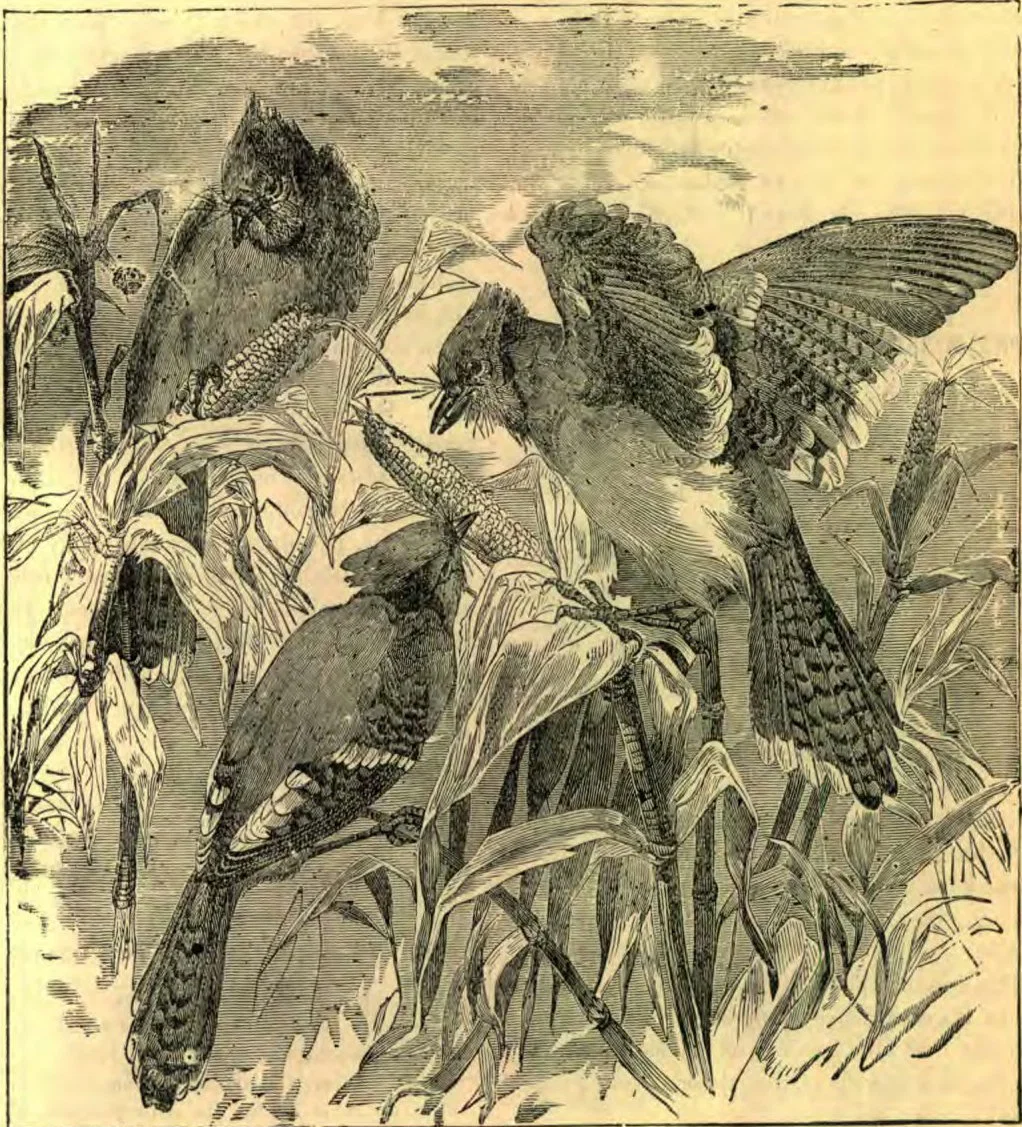
A few need to be told the names of the birds seen in the picture, for blue jays are common in all parts of North America. To those who are ignorant of their mischievous pranks and cruel habits, their appearance is very beautiful; but on a close acquaintance, as is the case with many people, their good looks are spoiled by their bad actions. The upper part of the body is a light, bluish purple, the lower part or breast is pure white, and the throat bluish white. On the head is a pretty crest of light blue or purplish feathers, which the bird can raise or lower as it pleases. The neck is adorned with a jet black collar, while the eyes are hazel. The prettiest parts of the bird are its wings and tail. These are part azure and part light blue, crossed by black bars, and most of the wing feathers and all but the two middle ones of the tail, are tipped with white.
Having now described their handsome clothes, let us learn some of these birds’ naughty tricks. While gracefully hopping from branch to branch, tossing up their little heads, and singing and chattering, the little hypocrites are all the while on the watch for some other bird to stray too far from its nest, when one or a half-dozen of the jays will dart over to the deserted home and seize the eggs to devour. Or if the eggs are hatched, and the little ones are reaching up their open mouths for the food which they think their parents have brought them, the heartless robbers will carry them off bodily and pick their bones. They seem to expect from other birds the same treatment of which they themselves are guilty, for they build their own nests in the tops of the loftiest trees, the cedar being their favorite home.
To this retreat they glide very secretly and silently, though in all other places they are very noisy and boisterous. But one day Mr. Jay came to his home and found Mrs. Jay folded in the embrace of a great black snake. He immediately sent up a scream that sounded through the woods and brought to his aid two fellow-jays. All three attacked Mr. Snake with open beaks, but before they succeeded in killing him the poor mother-bird died. The grief of the bereaved jay was very intense, and perhaps as he viewed her lifeless body, and the five unhatched eggs in the nest, he learned a practical lesson from the text, “With what measure ye mete it shall be measured to you again.”
Although cruel and without pity, yet the blue jay is no coward. Besides waging battle with the mole, the mink, the weasel, the owl, and scores of other tribes, it even attacks the lightning winged and lordly hawk. A dozen jays are often seen at the opening of some hollow stump, whither some trembling flying-squirrel has taken refuge. There they will watch for hours, and should the captive trust to his regained strength to escape their power, he no sooner emerges from his prison than his eyes are plucked out, and his quivering flesh becomes food for a dozen mouths.
The blue jay is hated and feared not only by the animals which it attacks and robs, but by the hunter and farmer as well. A hunter’s form among the trees is the signal for a wild scream of alarm on the part of the jay, which often starts the deer at whose heart the hunter’s rifle is being aimed; and oftentimes the bullet intended for the deer, takes revenge in the body of the jay. But if the hunter has succeeded in obtaining his game, he is not sure of keeping it. If he leaves it hung up in camp until the hunt is over, he may come in any time to find it torn in pieces and half consumed by jays; and they even become so audacious as to snatch the meat from the boiling kettle, and take it out on the snow to cool before eating. The pine-log cutters of the north are often robbed so seriously by flocks of these persevering birds as to be reduced to suffering. But the jay does not confine its diet to animal food. No sooner does the farmer sow his grain or plant his corn than does the jay “raise” it in a very different manner than was intended by the owner of the soil. They often take upon themselves the task of harvesting the farmer’s crop, too, as they are seen doing in the picture. Yet the bird is not wholly without use, for in carrying nuts of all kinds to supply its winter’s need, it often drops them in its passage and thus plants many a useful tree. Indeed, one careful observer says that in a few years’ time the jays alone would in this manner replant all the cleared lands.
In one thing the blue jay shows better judgment than the ant or squirrel. Instead of heaping his provisions in one place where some accident might deprive him of all, he hides them here and there in a thousand different spots. One would think that he would forget where he had put them. But this he is never known to do, and will even remember their location from one winter to another. Blue jays are often tamed, and come to think very much of their owners. They will also learn to talk, and are very proud of their accomplishment, being extremely anxious to exhibit their skill to every one who will listen. Like many orators, the larger their audience the greater their eloquence.
After all that we have found that is bad about the bird, yet certainly there is much about him to admire and interest. C. H. G.

A LEGEND.

Have you heard the story, children, Of the wisest earthly king, To whom the queen of Sheba, Her offerings did bring?
How she ordered brought before him Two vases rich and rare, Filled with flowers of such rich beauty, Than which none were known more fair?
One had come in all its freshness, From the Master Artist’s hand; The others, though strangely like them, By a mortal man were planned.
“Now tell us, O king, with thy wisdom,”— Commanded fair Sheba’s queen, “Which of these is man’s, which his Maker’s, When their beauty you have seen.”
It was useless—the task she set him. No eye could the difference see; But he gently opened the window, And admitted a little bee.
The bee flew around the vases, While humming a drowsy song; By one he passed in a moment, At the other he tarried long.
Then the king could answer the question— I do not know ’tis true, But I thought it a pleasant story, And so I give it you.
Man may draw the lightning from the sky, And the rod bloom by his power; But with all his skill can never make The tiniest natural flower.
Mary Martin.

THE MISSION OF THE WHEAT-STALK.

A YELLOW stalk of wheat early one summer was rocking its young kernels back and forth in the breeze, and thinking how happy it would be when its little ones were full grown. “How much comfort I will have in them when they are large and solid!” said the stalk. “How proud I will be when people look at me and see that each little pocket has in it a fine, plump grain of wheat! What a pleasure it will be, when I am old and stiff and unable to rock them any more, to feel that my kernels are able to care for themselves! How good I will feel when the farmer gathers me and my grain with others in the barn! I am of use.”
Days went by, and the stalk became hard and stiff; the young grains, fully grown, gradually hardened too. Wrapped in their close-fitting, soft covering, they were contented and happy as could be.
“This is a nice place to be,” said one to another. “When it’s cold the covering keeps us warm, and when the rain falls, we are as dry as can be; nor does the sun scorch us, for these coverings shelter us.”
“Yes,” said another, “we could find no better place than this. Mother keeps us from the cold, wet, dirty ground; she rocks us to sleep at night; she holds us all the day, and lives to make us happy.”
“I hope we may always stay with mother,” said another.
“So do I,” “and I,” said others.
One day, when they had become thoroughly ripe and hard, a great bird came swooping down, and, pulling the wheat-stalk up by the roots, carried it away.
“Oh dear! oh dear!” cried the stalk as it was swiftly borne through the air, “where will the bird take me, and what will become of my little grains of wheat? Oh, there goes one! and there another! They are slipping out. I must not lose them. I can’t spare my wheat;” and the mother-stalk clasped them more tightly, yet two or three more dropped down and were lost.
On and on the bird flew, carrying the wheat-stalk with it. At length the poor stalk grew so faint and weak that it could no longer hold the grains, and one by one they dropped out and fell to the ground. The last kernel had fallen before the bird reached its nest. Here the lonely straw, robbed of all its grains, was woven into the nest of the bird.
Poor straw! It felt that its life had been a sad and useless one. Many a day it spent in mourning for its wheat-grains, thinking it would never see them again—that all were lost.
The summer went by; the young birds that had been born in the nest went with others to a warmer climate; then cold winter ended and spring came; then another summer followed. The storms had broken up the nest and loosened the straw from its fastening. The strong wind caught it up, now broken and light, and carried it back over the same way that the bird had borne it a year before. Slowly it settled in the air until the wind dropped it near a large, strong stalk of ripe wheat. The old wheat-stalk asked the new how it came there, and who it was. The answer told the mother-stalk that this was one of her own that had grown from a kernel she had dropped that day when borne away.
“But I am not the only one,” said the ripened wheat. “Farther back and farther on there are others just as fine and large as I, and as heavily loaded with wheat.”
“All my children!” said the old stalk. “I thought they were lost—that something would devour them, or that, dropping to the earth uncared for, they would be destroyed. Instead, I find that each one is a strong stalk, loaded with ripe wheat just as good as I bore. Some one cared for them when I could not. It is the same One who cared for me and helped me ripen my grain. I see it all now. It was my work to produce and care for the kernels until they were grown and ripe, and then let God take care of the rest.”
Boys, girls, you are like the growing wheat-stalk—growing, ripening. No doubt many of you, like that wheat-stalk, have your heads full of—not wheat, but—plans for good to others. Be not disappointed if God makes you work—drop your wheat—when and where you do not wish. Just work wherever you have a chance, and then, when you have done the best you can—dropped good wheat—leave it to God; he will take care of it. Get ready for good work; do the best you can; leave all to God; and some day you will see that your work has done good.—S. S. Visitor.

THE ROMANCE OF THE DELLS.

In the old Wisconsin River, Where the red man's bow and quiver Shot the wild deer in the forest, Where the wild duck swam the faster When she saw the arrow pass her, Are the far-famed Dells of Kilbourn.
Deep the river's narrow bed is, And around the abrupt turning Rush the waters, madly foaming; And the bare rocks, rising upward From the bosom of the waters, Seem one solid wall of stone-work, Built by mason's plumb and chisel,— Summits crowned with waving verdure, Evergreen, and birch, and maple. And a rustic bridge of branches Spans the awful chasm's thunder, As the waters, dashing onward Through the channel deep and narrow, Weep and moan, then waxing bolder, Send their crashing grandeur upward.
Suddenly there sounds a war-whoop, And it echoes through the forest; Over on the other summit, See a red man swifter running Than an eagle in its flying. Ah! the bridge affords a refuge; Haste his flying footsteps thither, And his enemies behind him See him leaping o'er the branches Of the bridge across the river.
But where is he? Has he fallen? Has he 'scaped the death of lances But to drown amid the surges Of the cruel, fateful river? Not at all! for well the red man Knows the secrets of his country. In the side of yonder mountain, Just below the bridge of branches, Seems an entrance to a cavern, And the red man, swinging downward From the boughs above the river, Enters through the darkened portal. And 'tis said that his pursuers Thought a spirit 'twas they followed To the margin of the river; For they dreamed not that a cavern Took their prey and gave no token.
Long he lived in deep seclusion; Dared not tell his dark-faced brothers Where his wild and sure retreat was. Far within the cavern's chambers Sustenance he found in plenty. Through one room of glittering brightness Ran a river full of fishes; And the wild birds came to know him As a friend, and trusted in him. But his foes that wandered o'er him Dreamed not of the cave beneath them.
Many changes had come o'er them. None remembered now the brother They had driven to the river. But their good old chief was dying. In his wigwam lay the old man With his dusky brothers round him, When the furry curtain lifting, Showed a stranger at the entrance. As he saw the keen light fading From the eyes, and heard the moaning Of the women that were wailing, Lightly stepped he to the pallet, And in tenderness bent o'er him. How he soothed the old man's pathway To the dim and silent river, Blessings gave instead of curses, Only they can tell who saw him.
Turning then, he bade them listen While he told of his adventures In the cavern 'neath their dwellings; How he'd come to them at midnight, When they slept, and could not know him. And in joy for his returning, They forgot their old-time hatred, Blessed and praised him till the twilight Passed away in early dawning. “Our old chief is dead,” they whispered. “Why not make our brother chieftain, For none better could be chosen From our band of bravest hunters.” Long he lived, and ruled in kindness, Till the pale-face stole his freedom, Then amid the din of battle Yielded up the life God gave him. And his tribe, so deeply mourning, Buried him, their loved commander; And the mound heaped high above him Is oft visited by strangers.
MARY A. STEWARD.

WORK AND PLAY.

Don't loiter, boys and girls. When you know what you ought to do, then go about it promptly, work at it diligently, and finish it. Work first and play afterward. Work first and rest afterward. Never dawdle. Is there a garden to be weeded, corn to be hoed, hay to be raked, coal to be brought up, an errand to be done, a lesson to be learned; make that the first thing, and, if possible, the only thing, until it is finished. Your comfort and your success in life depend very much upon the habits you form in this matter.

SCENES IN THE LIFE OF CHRIST.

LESSON 73.—A LESSON ON KINDNESS AND TRUE GENEROSITY.

As Jesus sat at the feast, he saw that many of the guests chose the chief rooms; so he began to instruct them, saying, “When thou art bidden of any man to a wedding, sit not down in the highest room, lest a more honorable man than thou be bidden of him; and he that bade thee and him come and say to thee, Give this man place; and thou begin with shame to take the lowest room. But when thou art bidden, go and sit down in the lowest room; that when he that bade thee cometh, he may say unto thee, Friend, go up higher: then shalt thou have worship in the presence of them that sit at meat with thee. For whosoever exalteth himself shall be abased, and he that humbleth himself shall be exalted.”
From this teaching we may all learn a useful lesson. We should none of us appear anxious to get into places of honor, or to be set above other people. We are told in one place in the Word of God that we should prefer to have others honored rather than ourselves. We may learn to take more pleasure in being kind and generous, and in seeing other people enjoy good things, than we could take in having those things ourselves. We should never keep a seat while older or feebler people have to remain standing; but should rise at once, and offer our seat to some one who needs it more than we do. We should never hold to the best place in a pew, compelling ladies, or persons older than ourselves, to crowd by us. Indeed, these lessons which our Saviour taught are meant for us as much as for the people to whom he was then talking. The principles of kindness, of thoughtfulness for the comfort and happiness of others, of loving our neighbor as ourselves,—these things are taught everywhere in the Bible.
After giving this lesson to those who had been bidden to the feast, our Lord turned to the master of the feast, the man who had bidden him and the other guests, and said, “When thou makest a dinner or a supper, call not thy friends, nor thy brethren, neither thy kinsmen, nor thy rich neighbors; lest they also bid thee again, and a recompense be made thee. But when thou makest a feast, call the poor, the maimed, the lame, the blind: and thou shalt be blessed; for they cannot recompense thee: for thou shalt be recompensed at the resurrection of the just.” Of course our Lord did not mean to teach that we should never invite our friends or relatives to eat with us; but we do not deserve praise for making such a feast, since we expect the same favor in return. God is especially pleased with that feeling of love and kindness which causes us to delight in doing good to others, even when we do not expect anything in return. If we should do such things just because the Lord has promised a reward, the reward would never be given us; for selfishness would be at the bottom of our actions, and God can never approve of such a principle. That would not be the principle which rules in heaven; it would not be the principle which Christ had when he came from glory to die for mankind. Love is the principle that rules in heaven, and the principle that should rule in our hearts.
When one of the men who sat at the table with Jesus, heard these sayings of our Lord, he said, “Blessed is he that shall eat bread in the kingdom of God.” Then Jesus went on to show him by a parable how the great God of heaven has sent out an invitation to all the world to come and attend a feast in heaven. That feast is called the Marriage Supper of the Lamb. It will be held in the New Jerusalem, when Jesus shall have come to the earth, and gathered all his saints, and taken them with him in the clouds of heaven to the glorious city above. But in the parable, the ones who were bidden did not care to come to the feast, but began to make excuses. Just so it is with many of us. The Lord has given us all an invitation to the supper of the Lamb. If we would attend that supper, we must prepare for it; yet how many of us begin to make excuses. We talk as though we would like to be Christians, but there are so many reasons why we can not. God is displeased with these excuses. He has not asked us to do anything we can not do, and if we continue to excuse ourselves, he will by and by say to us as it was said to the men in the parable; that none who thus slight his invitation shall taste of the supper, so graciously prepared for all the redeemed.

QUESTIONS.

  1. What did Jesus notice as he sat at the feast? Luke 14:7.
  2. What did he then begin to do?
  3. What did he tell them they must not do when they were bidden to a wedding?
  4. Why might it not be for their interest to take the highest room?
  5. What course did he advise them to pursue on such occasions?
  6. Who did he say should be exalted? Who will be abased, or brought low?
  7. For whom does this teaching contain a useful lesson?
  8. What should we never appear anxious to do?
  9. What does the Word of God tell us about this?
  10. If we follow this precept, what may we learn to do?
  11. How do some youth and children violate this precept?
  12. What ought they to do in such cases?
  13. For whom are these lessons of our Saviour meant?
  14. What principles are everywhere taught in the Bible?
  15. To whom did Jesus turn, after having given this lesson to those who had been invited to the feast? Verse 12.
  16. Whom did he tell the man he should not invite, if he wished to receive a blessing for it?
  17. Why should he not invite these?
  18. Whom should he invite? Why?
  19. What promise is made to such as follow this advice?
  20. Does our Lord mean to teach that it is wrong to invite our friends or relatives to come and take dinner or supper with us?
  21. Why would it not be especially praiseworthy for us to get up a dinner for our friends or wealthy neighbors?
  22. With what feeling is God especially pleased?
  23. Why could not God reward us if we should do such acts of kindness just because we hoped to get a reward for it?
  24. To what would such a spirit be contrary?
  25. What principle must reign in our hearts, if we are to find a home in heaven? Why?
  26. What was said by a man who sat at the feast, and heard these words of Jesus?
  27. What did Jesus then show by a parable?
  28. What is that feast called?
  29. Where will it be held?
  30. When will it be held?
  31. What did many of those do, who, in the parable, were invited to come to the feast?
  32. What invitation has the Lord given us?
  33. How do some treat that invitation?
  34. How do some talk?
  35. How does God regard these excuses?
  36. If we continue to excuse ourselves, what will by and by be said to us?
  37. If we would attend that feast, what must we do?

NEW-TESTAMENT HISTORY.

LESSON 86.—MARRIAGE OF THE KING’S SON.

“And Jesus answered and spake unto them again by parables, and said, The kingdom of heaven is like unto a certain king, which made a marriage for his son, and sent forth his servants to call them that were bidden to the wedding: and they would not come. Again, he sent forth other servants, saying, Tell them which are bidden, Behold, I have prepared my dinner: my oxen and my fatlings are killed, and all things are ready; come unto the marriage. But they made light of it, and went their ways, one to his farm, another to his merchandise; and the remnant took his servants, and entreated them spitefully, and slew them. But when the king heard thereof, he was wroth: and he sent forth his armies, and destroyed those murderers, and burned up their city. Then saith he to his servants, The wedding is ready, but they which were bidden were not worthy. Go ye therefore into the highways, and as many as ye shall find, bid to the marriage. So those servants went out into the highways, and gathered together all as many as they found, both bad and good: and the wedding was furnished with guests. And when the king came in to see the guests, he saw there a man which had not on a wedding garment: and he saith unto him, Friend, how camest thou in hither not having a wedding garment? And he was speechless. Then said the king to the servants, Bind him hand and foot, and take him away, and cast him into outer darkness; there shall be weeping and gnashing of teeth. For many are called, but few are chosen.
“Then went the Pharisees, and took counsel how they might entangle him in his talk. And they sent out unto him their disciples with the Herodians, saying, Master, we know that thou art true, and teachest the way of God in truth, neither carest thou for any man: for thou regardest not the person of men. Tell us, therefore, what thinkest thou? Is it lawful to give tribute unto Cæsar, or not? But Jesus perceived their wickedness, and said, Why tempt ye me, ye hypocrites? Show me the tribute money. And they brought unto him a penny. And he saith unto them, Whose is this image and superscription? They say unto him, Cæsar’s. Then saith he unto them, Render therefore unto Cæsar the things which are Cæsar’s; and unto God the things that are God’s. When they had heard these words, they marvelled, and left him, and went their way.”
“Then came to him certain of the Sadducees, which deny that there is any resurrection; and they asked him, saying, Master, Moses wrote unto us, If any man’s brother die, having a wife, and he die without children, that his brother should take his wife, and raise up seed unto his brother. There were therefore seven brethren: and the first took a wife, and died without children. And the second took her to wife, and he died childless. And the third took her; and in like manner the seven also: and they left no children, and died. Last of all the woman died also. Therefore in the resurrection whose wife of them is she? for seven had her to wife. And Jesus answering said unto them, The children of this world marry, and are given in marriage: but they which shall be accounted worthy to obtain that world, and the resurrection from the dead, neither marry nor are given in marriage; neither can they die any more; for they are equal unto the angels; and are the children of God, being the children of the resurrection. Now that the dead are raised, even Moses showed at the bush, when he calleth the Lord the God of Abraham, and the God of Isaac, and the God of Jacob. For he is not a God of the dead, but of the living: for all live unto him. Then certain of the scribes answering said, Master, thou hast well said.

QUESTIONS.

  1. When Jesus again began to speak to the people in parables, to what did he compare the kingdom of heaven? Matt. 22: 1.
  2. On what errand did this king send out his servants?
  3. How was the invitation received?
  4. How did the king then make a more urgent appeal?
  5. How did they treat this second invitation?
  6. How did some of them treat the king’s servants?
  7. How did the king bring retribution upon those who had thus shown contempt for his authority and for the gracious invitations which he had given them?
  8. How was the wedding furnished with guests?
  9. When the king came in to see the guests, what did he notice?
  10. What question did he ask the man?
  11. Why was the man speechless?
  12. Why could he make no excuse?
  13. What orders did the king then give?
  14. What remark did he make?
  15. Who is meant by the king in this parable?
  16. Who are the servants that give the invitation?
  17. What people were destroyed and had their city burned? 2 Chron. 36.
  18. Why were they so punished? Ibid.
  19. Who finally subdued the Jews, destroyed their city, and burned their temple?—The Romans under Titus.
  20. Who are they that are called from the highways?
  21. What is the wedding garment?
  22. By whom is it furnished?
  23. How may it be put on?
  24. When and how does the king come in to see the guests?
  25. Of the many who are called, who will be chosen?
  26. What plot was laid to bring Jesus into condemnation? Matt. 22: 15.
  27. Whom did they send on this errand? Luke 20: 20; Mark 12: 13.
  28. How did these messengers try to flatter and deceive the Lord? Matt. 22: 16.
  29. What question did they ask him? Verse 17.
  30. When Jesus perceived their wickedness, what did he say to them?
  31. What did he ask them?
  32. What answer were they compelled to give?
  33. What significant admonition did he then give them?
  34. What effect had these words of Jesus?
  35. What peculiar doctrine did the Sadducees hold? Luke 20: 27.
  36. To what saying of Moses did some of the Sadducees call our Lord’s attention?
  37. What improbable case did they then suppose?
  38. What question did they ask? Verse 33.
  39. How did Jesus answer them?
  40. How did he, from the words of Moses, in whom they professed to believe, prove that the dead are to be raised?
  41. What was said by certain of the scribes who had listened to this conversation?
THE "FIRST HAUL."

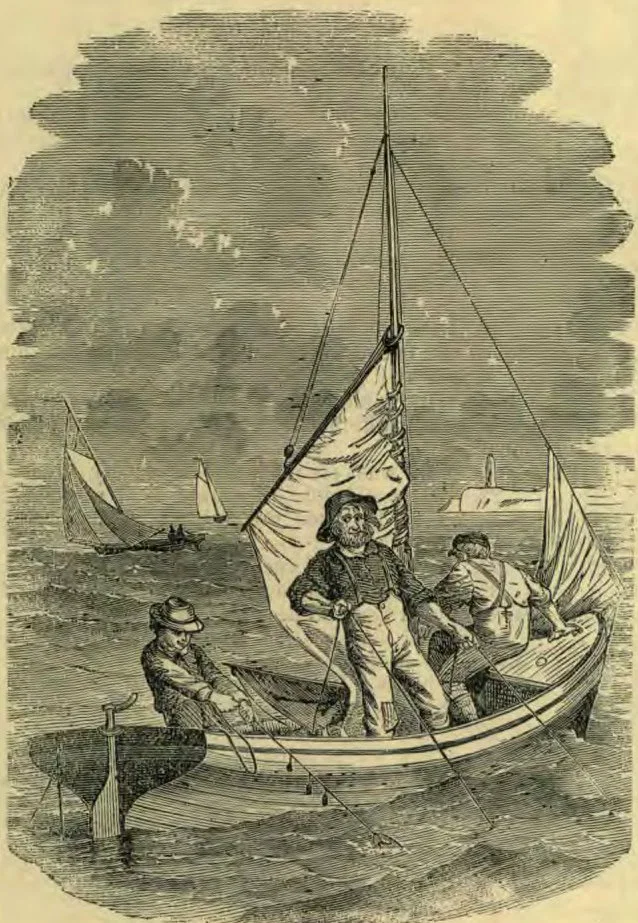
WHEW! what fun! Don't I wish I was there?" This is what I hear the boys saying as they look with envious eyes at the little fellow in the picture. His father, too, seems to enjoy the scene, for he is looking proudly at his boy who is perhaps “hauling in” his first salt-water fish. But perhaps, boys, the fun would wear off after you had been out in the boat, tugging at the lines day after day, during all the long summer months. And probably the boy who is making his first capture will wait until he is as large as his brother in the bow of the boat, before he will leave the shore every day for a fishing trip. For you see these men make their living by fishing, and have to go out from their homes in stormy as well as in pleasant weather, and until late in the fall, so as to lay up money enough to keep them comfortable during the winter.
But you are getting anxious to know what kind of fish they are catching, and where they are. Well, these men are in Cape Cod Bay. How many can find the place on the map? You will see that it has a long, narrow neck of land reaching around it, with a light-house on the point. It may be the very light-house that is seen in the picture. As you may have already guessed from the name of the place, the father and his boys are fishing for cod. They have sailed out six or eight miles from shore, though it doesn't seem to a landsman's eye that the light-house is that far away, does it? Well, when they find themselves among a school of cod, they let the sails drop down a little and throw out several lines, with three or four hooks on each one. These hooks are baited with pieces of clam, or lobster, or crab. Then they keep going around from one line to another “feeling for a bite.” You see the father has a line in each hand, trying them to see if any fish have been fastened to them yet. The older boy is watching on the other side of the boat, and two lines can be seen hanging over the stern.
As soon as they get a fish into the boat, they cut off the head and throw it away. After they have taken their boat full, they go to shore, where the fish are prepared for market. So now when you sit down to the table to enjoy a nice meal of codfish, you can think of how they catch them, and how will you know but what some boy of your size hauled in the very one you are eating?

Letter Budget.

Here is a letter from Maud and Mabel Babcock: “We are two little girls, twins, ten years old last October. This is the first year we have taken your paper, but it will probably not be the last, as we enjoy it much. We noticed in the fifth number of your paper, an article,—‘The Seven Wonders of the World.’ We have the pictures of these wonders on advertising cards, and as you have not seen the cards, we send you a set. We hope this will appear in the ‘Budget.’”
“The cards were received, and they are both pretty and interesting. Many thanks to the little girls for them.
Gracie Osterhout, of Vermillion, New York, says: “I am nine years old. I can read the Instructor myself, and like it very much. My sister takes it for me. Mamma and I are very lonesome without her. She married Eld. Wilcox, and has gone away off with him. I go to our little Sabbath-school every Sabbath with mamma. I have just learned my last lesson in Bible Lessons, No 1. I am trying to be a good girl.”
We have a letter from Daisy D. Clinger, Sherman City, Kansas. She is seven years old. They have a good Sabbath-school, which she loves to attend. She has repeated the synopsis, or told the story, of her lessons ever since their last camp-meeting. That is good, Daisy. We hope others will learn to do as well.

GLASS

How many of the INSTRUCTOR family can describe the process of blowing common window-glass? Not many, I presume, though some might do it far better than I can. Not long ago, in company with some friends, I paid a visit to the Glass Works, at Syracuse, N. Y. The first room we entered was the “blowing room.” Here were two great furnaces having a small door in each. In these furnaces is a very hot fire. Above this is what appears to be a small lake of liquid fire, which heaves and boils like a great pot. This is molten glass. At every furnace door there are two workmen; the “blower” and his assistant. They are supplied with a number of iron tubes, about four feet long, with a mouth-piece at one end. All being in readiness, the assistant takes one of the iron tubes, puts a mask over his face to keep the heat from burning him, opens the furnace door, and thrusts one end of the tube into the heaving, boiling, red-hot glass. As he pulls the tube out, a little ball of glass sticks to the end of it. He lets it cool a few moments, and again thrusts it into the molten glass. As he draws it out again, the ball on the tube is larger. He repeats the operation until the ball is large enough to suit him. He now takes it to a large tub of water near by, lays it across the top of the tub, and pours water over the tube to cool it.
It is now ready for the “blower.” He receives it and begins to blow very hard through the tube, at the same time turning it around in a hollow stone mold, to give it the right shape. As he blows, the ball begins to expand, and soon grows very large. Having formed it in the mold to suit him, he takes it to the edge of a platform, and swings it to and fro in front of him, like a pendulum, blowing through the tube all the while. This motion makes the glass lengthen out, and it soon grows into a hollow cylinder, five or six feet long, and a foot or more in diameter. This he puts on a rack made to receive it, breaks off his tube, and leaves it to get cold.
But it is not finished yet by any means: we do not make windows out of round cylinders, do we? A workman takes a cylinder in hand, and draws a straight line along one side from end to end, with a diamond. He then hits it a careful tap with his instrument, and the cylinder lies there with one side split open from end to end. It is now taken to another room, where there is another great furnace with a large turn-table inside of it. A cylinder is placed on this table with the split side up, and swung around over a hot fire. As it heats up, its sides begin to fall over, and presently it lies flat on the table. It is now swung back to the door, and after cooling a few moments, is taken out in broad, flat sheets, ready to cut up into window panes.
F. A. PARKER.
Continue reading: Stretch It a Little