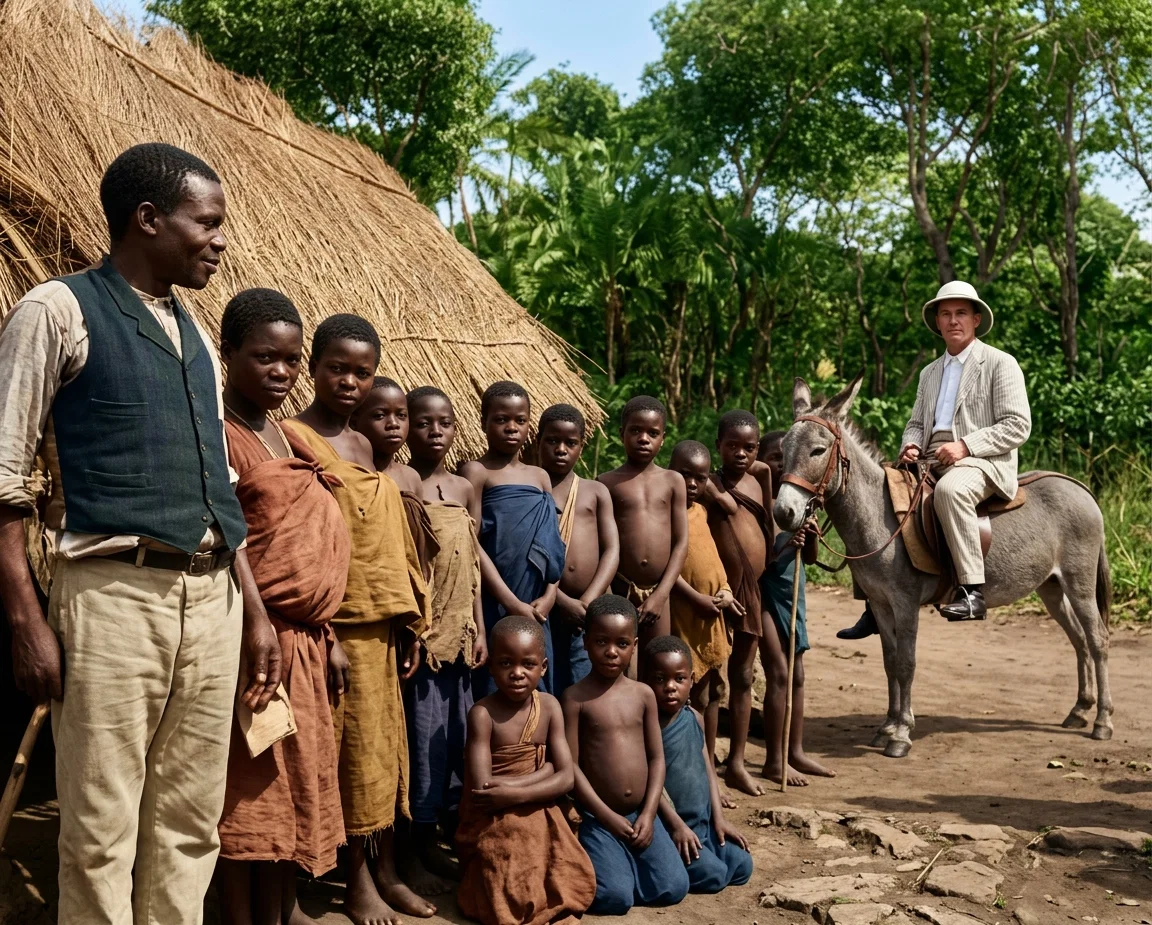
After a long, slow journey of a little more than four weeks from Cape Town, I reached the Malamulo Mission, and was met at the railway station by Elder J. C. Rogers with a machilla team. We made the trip from the railway station to the mission, a little more than twenty miles, in about five hours. When within about four miles of the mission, we were surprised to meet Sisters Rogers and Etta Austen with a number of the boys from the mission, who had come to welcome us.
A NEAR-BY OUT-SCHOOL, WITH TEACHER AT EXTREME LEFT, AND R. C. PORTER ON MRS. J. C. ROGERS’S DONKEY AT RIGHT
It was a very pleasant experience, after being so often delayed on our journey to Blantyre. We were entertained the remainder of the way by the peculiar machilla yell, answered by other machilla teams, which echoed and re-echoed through the neighboring hills, and insured our safety against attack by any of the wild animals that frequent this section of the country.
We were happily surprised, when daylight broke next morning, to find one of the best located mission stations in South Africa. The main station is situated on an elevated plot of ground overlooking the surrounding country. In beautiful panorama the wooded hills and valleys stretch out before the eye for many miles, with Cholo Mountain lying near by toward the west, and Mlanje Mountain standing out boldly in the background, more than thirty miles distant, toward the northeast.
The superintendent's residence stands prominently in the foreground of the station. The front yard is beautifully decorated with a lawn and well-kept walks, lined with beautiful tropical flowers and ornamental trees, shade-trees, and well-laden lemon trees. Near by toward the west is the kitchen, and toward the east is the shop where goods, clothing, and groceries are kept for the trade. Adjoining this is the home for the superintendent of the girls. Standing still back of this are the girls' cottages. Farther north stand the well-built church edifice and the boys' dormitory.
All these buildings, except the girls' cottages, are of brick with thatched roofs. The kitchen, also of brick, has a shingled roof, which was put on as an experiment, but is giving good satisfaction. The advantage of a thatch-roofed building is that it is cooler in the hot weather. A house for married women, and a cheaply constructed schoolhouse westward from the church building, with a temporary carpenter shop and a brick building for the sewing department, completes the present campus.
Shaded avenues lead to the different near-by villages and springhouses. A milk-and-butter house stands east of the campus, and still farther east, across a brook, are the cow-barn and cattle-kraal. The workers are planning to build an additional cow-barn to provide for their increasing dairy herd. They will also build a feed-barn to provide protection for the food which is used at the station. Some of the cheaper buildings will be replaced by brick buildings when it is found necessary to rebuild them. The bricks are made on the ground, and the mission family do all the work. They will make tile roofing for one or both of the barns.
LATEST OUT-SCHOOL ESTABLISHED. TEACHER AT RIGHT
The farm consists of more than two thousand acres of very fertile soil. It is well watered by living streams, which are used for irrigating the gardens during the dry season. As a result, they have fresh garden produce the year round. Strawberries and peaches, as well as oranges, bananas, and other tropical fruits, do well in Nyassaland. The Malamulo Mission workers are planning to have a good supply of home-grown fruits and vegetables to supply the needs of the family and for the school as soon as possible. Already they have an abundance of lemons, bananas, and strawberries. They have other fruits in prospect from their thrifty young orchard.
They have five acres of peanuts, five acres of sweet potatoes, ten acres of beans, ten acres of other vegetables, twenty-five acres of cotton, and fifty acres of corn. The cotton field is all set to rubber trees, which are making a remarkable growth. The rubber industry now gives promise of being very helpful in bringing financial returns. Cotton is also a paying crop for this section. There is no market for corn, and it is profitable to grow only a sufficient amount for their own use. The mission is so far from market, and the shipping and freight rates are so exorbitant, that it is impossible to ship corn from this section.
This is a good stock-raising country, and dairying is very profitable. The mission owns one hundred head of cattle, and sells about five hundred dollars' worth of butter annually. This will become a profitable industry for the support of the mission. The present plan is to increase the dairy, plant larger fields of cotton, and increase the rubber-tree acreage quite materially, as these are all promising industries. Rubber trees begin to yield returns when three years old.
Two hundred students are now in attendance at the main Malamulo school. They are making excellent progress in their studies. They read well, and in mathematics they would keep many in our European and American schools, of the same grades, busy to surpass them in working problems with rapidity and accuracy. When it comes to Bible study, they are in advance of many who have11had better opportunities. The entire school will recite verses committed to memory by the half-hour, and give the references from the Scriptures. I was surprised at the remarkable memory of these darkened heathen. It seems that God gives them special help in committing to memory many portions of Scripture. The entire school is doing a high grade of work. The Bible class gives special instruction to candidates for baptism during a period of two years before baptism, in most instances. This gives them time to become well established in the faith, and those who are vacillating usually drop out before the time for baptism is reached. I had the pleasure of joining Elder Rogers in a baptismal service at the close of the school year, in which twenty-two followed their Lord into the watery grave. This makes one hundred fifteen names now enrolled upon the church record at this mission.
THE NIGHT-SCHOOL AT MALAMULO MISSION
There are nineteen out-schools, with a combined attendance of over five hundred students. It is remarkable to see the amount of work that is being successfully carried forward here in Nyassaland with six white teachers and their thirty native assistant teachers. Brother and Sister Rogers, Sisters Ina and Etta Austen, and Brother and Sister S. M. Konigmacher are the only white laborers connected with the work in this vast field. Were it not that we remember the miracle of the loaves and fishes, we would be inclined to say, “What are these among so many?”
One difficulty here is that there are no wagon roads out from the mission. All produce must be carried out, and all goods carried in, for several miles. The workers are now planning to make wagon roads so that much machilla and goods-carrying expense may be dispensed with. Machilla carrying is very expensive and unsatisfactory.
Nyassaland.
The Work of the Colporteur
The object of the colporteur is always the same—to sell as many Bibles as possible to those who do not possess the book, and to induce the buyers to read it. He sells the Bible, or separate portions of it, because long experience has taught that if it is given away, the recipient does not place the same value upon it, and is not nearly so likely to read it. Human nature is the same in Siam as in Salem, Mass., in the Philippines as in Philadelphia.
The colporteur gets a small commission on his sales, and a small salary: he must live. But the work is so trying, the pay so small, the danger still so great in many places, that only a strong faith in his calling, a devotion to the Christian religion like that of the missionaries themselves, would keep a colporteur at his task. The colporteurs are the nameless and unsung pioneers of Christendom.
Many qualities are required of the colporteur, of course, besides devotion. Perhaps the greatest of these is tact. It is his task to sell a religious book to people generally of alien faith, and often hostile. He must be quick and ready to refute objections, to turn aside hostility, to keep his patience, his temper, his humility, to appeal to the necessary racial motives, to understand the characters of those with whom he is dealing. This explains, of course, why the colporteurs are chiefly natives of the lands where they work.
The colporteur must also know the Bible from cover to cover himself, be able to explain it, to expound it. He must be something of a preacher—an evangelist. When all these things are considered, the number of good colporteurs to be found in Siam, in China, in Korea, and other such lands, is amazing.
—Selected.
The Demand for Bibles in China
CHINA, so long the land of mystery and the closed door, is rapidly becoming one of the largest Bible markets. In the first six months of 1909, three hundred eighty-six thousand volumes of the Scriptures, either whole or in parts, were sold in China. This does not imply a corresponding conversion to Christianity, but is rather a sign of the awakening in the people of a tremendous curiosity to learn the secret of Western power. As the Bible seems to be the great book of the West, they are learning to read it, seeking to discover, through it, the secrets of the Occident.
Prior to the Boxer uprisings, the upper classes in China would have nothing to do with the Bible, “the foreign religion-book.” Three years after the war the change began to be felt. The Rev. Walter Scott Elliott then decided to carry the campaign of Bible distribution back into Paoting-fu, known as “the city of martyrs,” because, in 1900, all the missionaries were slaughtered there, and every foreign book, whether Bible or not, was destroyed. He took with him a band of native colporteurs, and began a house-to-house canvass.
The first day Dr. Elliott took a suit case full of Bible portions, and entered the house of John, the florist. “You have never been to our chapel,” said he, “because you are too much occupied with business. So I have come to bring our Book to you.”
“How much?” said thrifty John.
“We don’t sell books; we give them,” said Dr. Elliott. “But we ask a small sum, to be sure that you value the book. And this sum is used at once to print more books, so that others may get them as cheaply.”
This argument appealed both to the Chinaman’s curiosity and to his interest in helping others. He bought a copy at once.
The same method was repeated over and over. In six days Dr. Elliott and his colporteurs distributed seven thousand copies—one to six out of every seven houses.—Selected.
New Well at Solusi Mission
A new well has been put down at the Solusi Mission. They now have plenty of good water right at their door. This is greatly appreciated, as heretofore it has been necessary to haul it from a distance.
Thirty New Graves
The following incident, related by Rev. F. S. Miller, a missionary in Korea, contains a striking lesson for Christian believers everywhere, but especially in lands of abounding light and privilege:—
“Colporteur Kim was preaching in the market at Chong Ju. A Christian standing on the edge of the crowd heard one of the listeners say to his fellow: ‘I used to know that man. He was a thoroughly bad man. Look at his face now—how changed it is! I wonder what makes him so happy. Let’s listen.’
“But Kim was not so happy-looking as he stood up in the conference during the winter Bible class, and said: ‘I spent July at the class here in Chong Ju. Then I went up to Chung Ju; and as I approached, I saw thirty new graves on the hillside near the city. I stopped and looked at them, and said to myself: “Did I preach to those thirty men and women as I passed this way last time? If I did, all right. If I did not—” I wept as I thought of the possibility.’
“Tears rolled down his cheeks as he recalled the experience.”
Patience, the Soul’s Ballast
“PATIENCE is the ballast of the soul. Without it any passing storm will set the ship tossing and straining. With it, the vessel can keep steady, and go forward, or, at the worst, lie safely in the biggest tempest that can blow over the seas of life.”
Editorial
By W. A. S.
Zinzendorf and the Assassins
COUNT ZINZENDORF, the leader of the Moravians, is said to have been the first white man to set foot in the Wyoming Valley of Pennsylvania. While on a visit to America in 1742, he penetrated this region with his daughter and a few companions, to open mission work among the Shawanese. Conrad Weiser, the colonial Indian interpreter, and, like Count Zinzendorf himself, an observer of the Sabbath, had piloted the party to the Indian village, near the present Plymouth, and then returned, leaving them in the wilds. After a time, the Indians, suspicious and covetous, laid a plan to assassinate the missionary party. Of the manner in which their plan was frustrated, Charles Miner, in his “History of Wyoming” (Wyoming Valley), speaks as follows:—
Zinzendorf was alone in his tent, seated upon a bundle of dry weeds, which composed his bed, and engaged in writing, when the assassins approached to execute their bloody commission. It was night, and the cool air of September had rendered a small fire necessary to his comfort and convenience. A curtain, formed of a blanket, and hung upon pins, was the only guard to the entrance of his tent.
The heat of his fire had aroused a large rattlesnake, which lay in the weeds not far from it, and the reptile, to enjoy it more effectually, crawled slowly into the tent, and passed over one of his legs, undiscovered. Without, all was still and quiet, except the gentle murmur of the river at the rapids about a mile below. At this moment the Indians softly approached the door of his tent, and slightly removing the curtain, contemplated the venerable man, too deeply engaged in the subject of his thoughts to notice either their approach or the snake which lay extended before him.
At a sight like this, even the heart of the savages shrunk from the idea of committing so horrid an act, and quitting the spot, they hastily returned to the town, and informed their companions that the Great Spirit protected the white man; for they had found him with no door but a blanket, and had seen a large rattlesnake crawl over his legs without attempting to injure him. This circumstance, together with the arrival soon afterward of Conrad Weiser, procured the friendship and confidence of the Indians.
Conrad Weiser’s timely arrival was also a direct intervention of Providence, being due to the fact that, although he was far away, attending to other duties, he was seized with the conviction that Zinzendorf was in danger. So impressed was he with the impending calamity for the missionary party, that he hastened back, and arrived just in time to assist the missionary in the crisis.
W. A. S.
The Crisis in Spain
By F. M. W.
SPAIN is now passing through one of the greatest crises in all her national history. Internal strife, involving, as in this case, vital differences of opinion over questions of religion and of church-and-state polity, is more dangerous to a nation's welfare than foreign war. Unfortunately, however, Spain has both foreign and domestic foes, which are plotting together to accomplish her downfall. The struggle is between the progressive elements in the Spanish government on the one hand, with the Vatican of Rome and the clerical party of Spain on the other. Two main questions are involved in the controversy. One is the revision of the concordat, or agreement between the Vatican and the Spanish government, made in 1851; and the other is the promulgation of certain laws which the government claims are entirely separate from the question of revision, but which the Vatican contends are involved in the provisions of the concordat.
An agreement between the government and the Vatican permitted the establishment of two specified religious orders in Spain, and the establishment of another order, which should be named later by the Vatican. It was understood at first that this provided for one additional order for the entire country. The Vatican, however, in later years construed this to mean the establishment of any third order in each diocese. Formerly the Spanish government acquiesced in this interpretation on the part of the Vatican. In consequence, thousands of monks flocked to Spain. According to recent statistics there are now more than three thousand monasteries, and one hundred thousand monks and nuns in that country. Madrid and Barcelona alone have one hundred sixty-nine convents. All this church property has been exempt from taxation. In addition the government paid out last year for the support of church establishments a sum in excess of eight million dollars.
The abuses which have grown out of this liberal interpretation of the terms of the concordat have become a cause of vital concern to the government.
Another leading question involved in the present controversy is that of the freedom of public worship by non-Romanists. The constitution, which was adopted in 1876, provides that “no one shall be hindered by reason of his religious opinions, nor in the exercise of his cult, except with regard to the respect due to Christian morals. Nevertheless, no other manifestations or public ceremonies will be permitted than those of the religion of the state.”
In the past Protestants have been prohibited from erecting churches in the style of church architecture, and from placing public notices of their meetings. Of late there has been a marked disposition to disregard these prohibitions. This, perhaps, is due to the Protestant education of Victoria, the present queen. Although professing Roman Catholicism at the time of her marriage, it is considered that she still has a strong leaning toward her former church connection. In taking up her residence in Spain, she brought with her a number of English relatives and a considerable retinue of English servants. For these a Church of England service is maintained in Madrid. This no doubt accounts in part for the liberal spirit of King Alphonso in the favor which he has shown to Protestant churches in permitting them recently to display on their places of worship the cross and other symbols of worship.
These conditions have prepared the way for the present premier, Canalejas, a Progressive of marked type, aided and sustained by the young king, to propose such measures and issue such decrees as have precipitated the present crisis. The premier proposes to abolish old forms of the judicial oath, in order to meet the objections of the secularists, likewise to secure the secularization of the cemeteries. All non-Catholic religionists are authorized to mark their chapels, synagogues, and places of worship with distinctive emblems.
But the most far-reaching measure which the premier proposes, and one which is incurring for him the most bitter hostility from Rome, is the “restriction of the growth of the numerous associations among the monks and nuns.” This last measure has been quite generally demanded, especially by the tradespeople. Exempt from taxation, the monks have employed their wealth in building up trades and industries which have come into lively competition with the same industries carried on by others, upon whom heavy taxes have been levied.
The government is supported in its position by many loyal Catholics, who consider that the questions involved are not ones which affect the integrity of the Catholic faith, but such as seek only to check the abuses named.
On the other hand, there are several strong elements arrayed against these proposed measures. The center of these, of course, is the Vatican, which commands the support of the bishops and ecclesiastics13throughout Spain. Arrayed likewise on the side of the Vatican are the Carlists, also the Conservatives, who, however, constitute a minority of the parliament.
The Carlists are a political party dating from 1833. At that time the reigning king, Ferdinand VII, set aside the law against female succession, making his daughter his successor. The king's brother, Carlos, claimed the throne. The contention led to civil war, in which Carlos was defeated. His successors, however, have continued to maintain their right to the succession. Don Jamie, the present claimant, who resides in Austria, sees in the present controversy an opportunity to reassert his claims. He and his sympathizers side strongly with the Vatican, hoping for the downfall of the present reigning house and the elevation of the Carlist line.
Thus far in the conflict Canalejas has shown marked ability in uniting many otherwise conflicting elements, and opposing so strong a force against the demands of the Vatican. King Alphonso has unmistakably demonstrated his leaning toward a more liberal policy, and seems disposed to give his minister a free hand in bringing about better conditions. Spain's representative at the Vatican has been ordered home. A spirit of unrest prevails throughout the country, and it is feared that the agitation may lead to serious consequences, if not to civil war.
What the outcome will be, or what new questions may be injected into the controversy, we can not predict. The whole world will watch with interest this struggle in the “most Catholic country” of Europe toward greater light and liberty. Cursed for centuries with ignorance and superstition, bound about by iron creeds and customs, crushed by the grasp of the Papacy, Spain seems awakening from its slumber. This struggle for greater freedom is a cry on the part of some at least for greater soul liberty, for a greater measure of gospel light and truth. Doubtless this struggle may be attended by abuses, by unwise and even unchristian methods, with which we may not sympathize; but let us pray that the result of it all may be to open Spain up to gospel evangelization, and that through the open doors created may go many heralds of the cross to carry the glad tidings of the coming kingdom. The gospel message is due the world. Before the end it will be preached to all nations. It is interesting to watch the course of events in the history of men by which this is being made possible. Barriers are being broken down, and the doors of the nations are being opened, preparatory to the work of the last message.
F. M. W.
Worth Out of Worthlessness
By C. M. S.
In bringing a Redeemer out of Nazareth, God has taught the world a lesson whose value is beyond estimate. Why would it not have been better that Christ should have been reared in one of the great, recognized centers of learning and culture? Many suggestions come to the natural heart that this or that course might have been better than the one which Infinite Wisdom chose; but when the eye-salve of heaven has been applied, the wisdom of God’s way and the foolishness of our own are plainly evident.
God had a design in bringing the world’s Messiah out of the despised Nazareth. He had a design in saving Israel from the Philistines at the hand of a shepherd youth with his sling and pebble; and from the Midianites by Gideon’s three hundred, while the faint-hearted hosts went home to comfort and safety. God sees not as men see, and the reason is because men have allowed themselves to be blinded by the deceptions of one who chooses to have men see truth as falsehood, falsehood as fact, and the unreal as the real. They can lift the eyelid from the eyeball, but they can not, without divine aid, lift the curtain hung by the deceiver over the window of the soul.
Nathaniel asked, “Can there any good thing come out of Nazareth?” And God answered the question. Out of sin-smitten Nazareth came the One who knew no sin,—the One who bore the sins of the world, that the world might again one day be free from the burden of transgression. From that least respected city of the Jews, the byword of the nation, the most hopeless, apparently, in moral influence, came He who held the destiny of the whole race in his hands. Is there no lesson in this? Does it mean nothing that one of the most despised cities of the world cradled the Redeemer of the world?—Surely, there is a lesson and a meaning in it all. God meant to teach men that their hope is not in man, not in the great of earth, not in schools of learning, not in the wisdom of this world, nor in anything that savors of this world; but in him, and in him alone.
The world would look for its Saviour among the great and renowned. Popular religion would look for its Saviour among the highest dignitaries of the church; and the kernel of the whole matter would be trust of men in man. All such trust is vanity, and can not reach beyond the curtain of the tomb. In such trust there can be no salvation; for the one in whom the trust is placed has made no atonement, not even for his own sins. God knew that such trust must lead souls to ruin, and so we have the lesson of Nazareth, teaching men to trust, not in the great of earth, not in environment, not in worldly influence, but in him alone who was made our peace, our sanctification and redemption. Out of the moral darkness of that dark city shone the one clear ray of light that leads to God. On the murky waters of that stagnant pool blossomed the immaculate lily of God’s purposes. It was utterly unlike its environment. With its roots in the soil of this earth, it reaches up and blooms in the atmosphere of heaven—linked to the human, yet breathing out the perfume of divinity.
Again, there is the lesson that God can make out of the most unpromising material the most precious gems for his eternal kingdom. Many go down in suicide every year, because they consider themselves of no worth to the world, and life of no worth to them, not realizing, or at least refusing to believe, that God can, out of their worthlessness, make that which will be of inestimable worth to all eternity. But God has shown that he can bring glory out of that which is despised, worth out of worthlessness, honor out of dishonor, and turn to his praise the wrath of man.
For this reason let the discouraged soul look up. Is your strength gone and your courage weak? Remember this: “He giveth power to the faint; and to them that have no might he increaseth strength. Even the youths shall faint and be weary, and the young men shall utterly fall: but they that wait upon the Lord shall renew their strength; they shall mount up with wings as eagles; they shall run, and not be weary; and they shall walk and not faint.” What a picture of strength, beyond anything possessed in human flesh! It is not for those who consider themselves strong, but for those who know that they have no strength. The condition is that they “wait upon the Lord.” So he brings strength out of weakness, because he is allowed to put his strength where our weakness has been. Paul said, “When I am weak, then am I strong.” In other words, when he realized his own weakness, he went to the Source of all true strength, and obtained strength beyond anything he could hope for in himself.
And just so it is in every other condition of life. The weak points may be made the strong points. In the place of an evil temper we may have kindness; in the place of irritability, patience; in the place of gross indulgence, temperance; in the place of profanity, praise; in the place of avarice, benevolence; in the place of anxiety, peace; in the place of selfishness, service; and in the place of hatred, love. As Christ arose out of Nazareth, so may these desirable qualities arise out of hearts that had fostered their antitheses. Does some habit bind the soul, and cause despair? God has taught you that you may triumph over that, and make that point a strong14bulwark of defense. He can bring out of that unpromising soil a tree that will bear fruit unto life eternal. There is in this fact cause for truest joy and brightest hope, and that is the lesson of Nazareth.
C. M. S.
Our Work for the Cities—No. 3
By A. G. Daniells
FROM a careful study of the problem of giving our message to the cities, it is evident that it means a world-wide evangelistic movement. The cities are in all parts of the world, therefore the endeavor to reach them must be world-wide. Moreover, the endeavor to reach the masses in the cities must be of an evangelical character. It must be made by the proclamation of the truth publicly, and from house to house in various ways. Administrative and institutional work is not the primary work called for in the demand upon us to work the cities.
That a world-wide evangelistic work is required to answer this call in behalf of the cities, is plain from a study of both the call to do the work, and the methods by which it can be done. Here are some of the statements that are made in the call to do this work:—
The spiritual darkness that covers the whole earth to-day is intensified in the crowded centers of population. It is in the cities of the nations that the gospel worker finds the greatest impenitence and the greatest need. In these same wicked cities there are presented to soul-winners some of the greatest opportunities. Mingled with the multitudes who have no thought of God and heaven, are many who long for light and for purity of heart. Even among the careless and indifferent, there are not a few whose attention may be arrested by a revelation of God’s love for the human soul.
The cities everywhere are calling for earnest, whole-hearted labor from the servants of God.
The conditions that face Christian workers in the great cities, constitute a solemn appeal for untiring effort in behalf of the millions living within the shadow of impending doom.
With heart and soul and voice they must respond to the summons of the Master of the vineyard to enter the cities, and work as laborers together with God for the winning of precious souls.
A little has been done in years past, it is true, in a few cities; but in order to meet the mind of the Lord, those in responsibility must plan for the carrying forward of a broad, well-organized work. They must enter into this campaign with a determination to make God their trust, and to labor with unflagging zeal. Thus they will be enabled to do a strong, solid work, and will gain confidence to continue the effort in other places.
These quotations are all taken from a single article written by Sister E. G. White on “Warning the Cities,” and printed in the REVIEW of April 7, 1910. By a careful reading of these statements it will be seen that the place where the work is to be done is “the great cities,” “in the cities of the nations,” “the cities everywhere,” “the world,” the “whole earth.” The work to be done is to reveal “God’s love for the human soul,” to bring multitudes under the “converting influence of Bible truth,” to labor for the winning of souls.
The same outline is given in the following brief statement from Sister White in “An Appeal to Ministers and Church Officers:”—
We have done only a small part of the evangelical work that God desires us to do among our neighbors and friends. In every city of our land there are those who know not the truth. And out in the broad world beyond the seas there are many new fields in which we must plow the ground and sow the seed.
These statements, “the evangelical work,” “in every city of our land,” and the “broad world beyond the seas,” all join together, showing clearly that a great work is intended. And, naturally, God’s people are admonished to take hold of this work with zeal and determination. “With heart, and soul, and voice they must respond to the summons of the Master of the vineyard to enter the cities, and work . . . for the winning of precious souls.” Again: “In order to meet the mind of the Lord, those in responsibility must plan for the carrying forward of a broad, well-organized work. They must enter into this with a determination to make God their trust, and labor with unflagging zeal.”
This counsel must surely appeal to every one who loves this cause, and who has a clear conception of what is to be done in order to finish the work. The very work here outlined is the pressing need of the hour. The everlasting gospel, as revealed in the threefold message of Revelation 14, must be preached in all the world, “to every nation, and kindred, and tongue, and people,” and then the end will come. The hour has come for this to be done. Everything is ready and waiting for it. And now an earnest appeal comes to the church to enter at once upon a great evangelistic campaign that will reach to the uttermost parts of the earth, and continue until the work is finished.
Thus it is plain that the call to work the cities means far more than the working of a few cities in the Eastern part of the United States. It surely means that, and it means that we should enter those cities at once in earnest; but we should understand that the strong, efficient, evangelistic campaign begun there must extend to the perishing masses the world over. And for such a grand, soul-winning movement, we may thank God with full hearts, and give ourselves unreservedly to the work.
In next week’s issue we shall see who are called to this work, and how it is to be carried forward.
A. G. DANIELLS.
What's the Matter?
THIS is a question asked by the Chattanooga Daily Times in view of the disturbed conditions which are affecting the physical world at the present time. It inquires:—
Are the times out of joint? We have of late been witnessing and hearing of conditions and happenings that have no precedent in history, it appears. Certainly, as the Columbus Ledger says, “A strange condition of affairs exists. The surface of the earth has been disturbed since Christmas. Nearly every week there is chronicled the report of an earthquake somewhere. Vesuvius and Etna have both been in eruption. There have been volcanic disturbances in other sections. The oceans, and especially northern waters, have been swept with unusual storms. The weather has been remarkable for its many peculiarities. The South has had more snow than it has had in thirty-four years, and now all storm records are being broken. There must be some cause for all this, and the scientific papers of the world are publishing elaborate articles to account for these remarkable happenings.” The scientists may explain it, in a way, but the perplexing thing with the ordinary reader of these explanations is that they do not agree with one another. Plainly when they attempt to explain the many unusual things that have occurred during the past few months, they must largely rely on guesswork; for it is impossible for them to understand, explain, and account for what has been an abnormal atmospheric condition of late.
Neither science nor philosophy can afford an explanation of many abnormal15conditions existing in the world at the present time. We may learn, however, from the Scriptures of truth that these conditions are signs of the times, precursors of still more startling events which are to take place upon this earth. This world is nearing its dissolution. It is growing old with the weight of sin and years. The end of it all will be the coming of the Lord Jesus and the glorious restitution of all things.