THE day following the baptism of Jesus, John the Baptist stood, with two of his disciples, watching Jesus as he was walking near them. Directing the attention of the two disciples, Andrew and John, to the Saviour as he walked, John said, “Behold the Lamb of God!” This was a short sermon; but it was delivered in the demonstration of the Spirit and with power, and it took hold of the heart. Immediately there sprang up in their hearts a desire to know more of this stranger. These two disciples were familiar with lambs, as they were offered continually in the temple services as types of the coming One. Now that God’s Lamb was before them, they wished an interview with him.
“And they followed Jesus.” They heard John speak, but did not follow him. He did not draw away disciples after himself, but directed all to the Lamb which had come to bear the sins of the world. Desiring a better acquaintance, and being asked by Jesus what they were seeking, they said, “Rabbi, where dwellest thou?” He did not repulse them, but said, “Come and see.” “Come” has been the word of the Redeemer through all the ages, since the fall of man. He has been trying to have us “see” him. “Come unto me, all ye that labor and are heavy laden, and I will give you rest.” “Ho, every one that thirsteth, come ye to the waters, and he that hath no money; come ye, buy and eat; yea, come, buy wine and milk without money and without price.” Isa. 55:1.
The record tells us that they went with Christ, “saw where he dwelt, and abode with him that day.” That this was a memorable interview, and made a lasting impression on the mind of John, is evident from the fact that in recording the event, years after it occurred, though an aged man, it was so indelibly impressed on his mind that he made mention of the very hour when it took place. “For it was about the tenth hour” (John 1:39); that is, four o’clock in the afternoon.
Would that we might seek the Saviour till his presence was as real to us as was the interview referred to in this article! It is his desire to reveal himself to his people, and he will be as real to us now as when on the earth in his flesh. If we follow him, he will encourage us as he did those two disciples, by asking what we are seeking; and when we make known our request to him, we shall hear him saying, “Come.”
THE CHURCH IN POLITICS.
By M. E. K.
THE following very suggestive item appears in a recent paper:—
Count de Mun, who is the leader of the Catholics in the French Chamber of Deputies, takes the seat in the French Academy made vacant by the death of Jules Simon.
The above sounds a little strange to us in America, but we are coming to the same conditions fast enough. At the present time, parties, not churches, are represented in the American Congress. Whatever church work is done in Congress, and there is much of it done, is done under the name of some party, which one church, or several churches, have bought up by the promises of the church vote, or have frightened with threats of withholding it. Not so in France. There the church has long been in the field as a contestant for political preferment. There the church is synonymous with a party—the church party. At one time, and for a long time, too, the church party controlled all things. It could say, as did Louis XIV, “I am the state.” The Revolution broke that power, but the church still cherishes the hope of controlling France again, and this is the secret of the Catholic party.
As before remarked, we have no church party, distinctively so-called, now; but since all the leading churches are in politics, and apparently in to stay, it can be only a question of time when we shall have a Congress on the European plan. There will be the Catholic party, the Methodist party, the Presbyterian party, etc. The sentiment largely prevails that the government exists for the church, and should be run in her interests, and each church in the political arena will want its due share of patronage. Should the Methodists demand too much, the Presbyterians and Catholics will vote them down. This is precisely the way it is in Germany, only there the Catholic, Lutheran, Free Church, Socialist, and Liberal parties are represented. The names here will be different, representing other churches than those in Germany, but the organization will be the same in principle. Our ablest men have warned us against this. The great man whose body has just been laid in its last resting-place in New York City, saw these dangers that threaten our republic, and said, “Keep the church and the state forever separate.” But when the churches rush into politics as the horse rushes to battle, how can it be done?
M. E. K.
PASSING EVENTS AND COMMENTS.
By T.
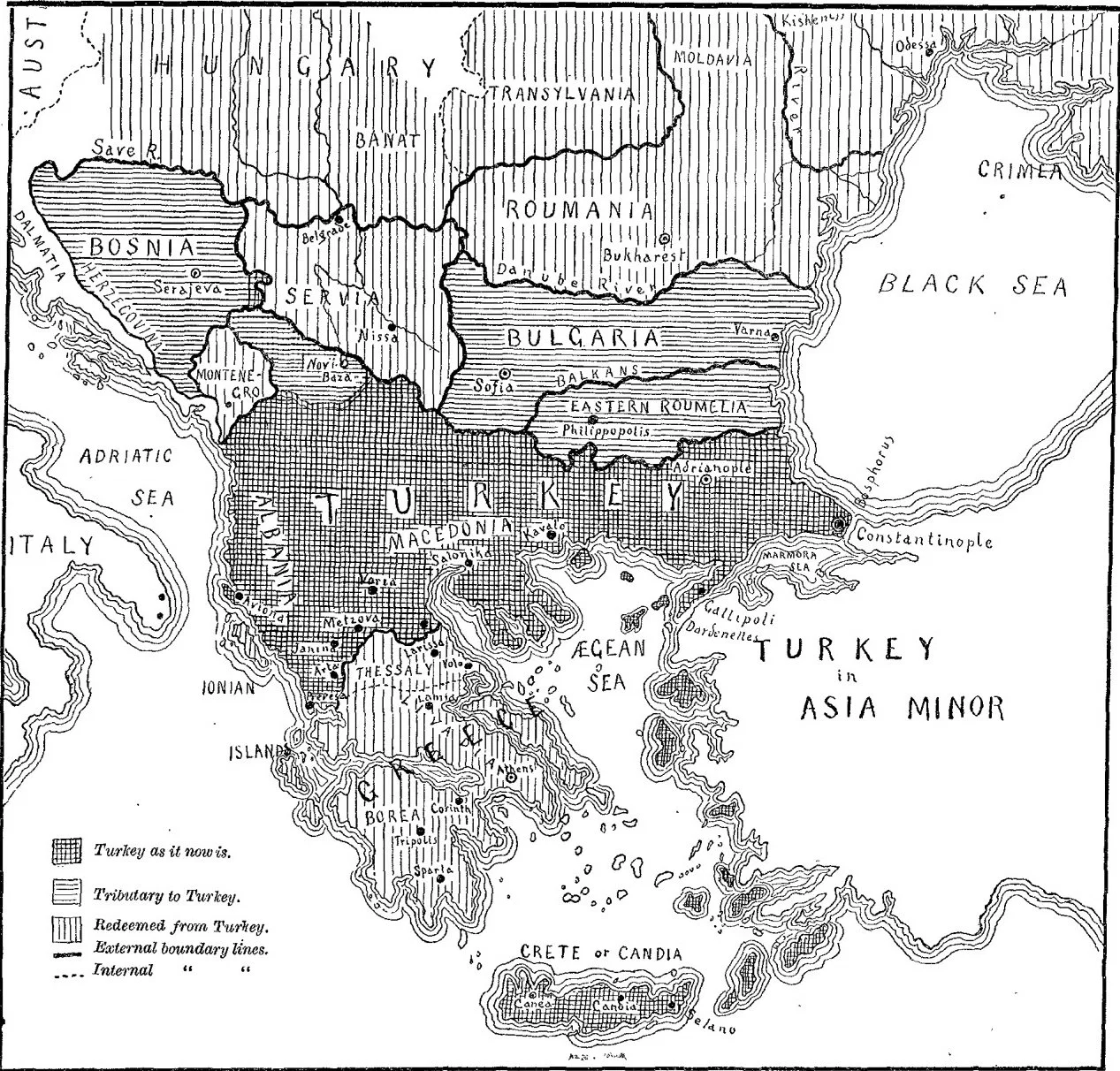
The Eastern Question.—The Turkish Empire has suffered nothing from its three weeks’ war with Greece. On the contrary, it quickly humbled its little antagonist, and even the powers will not fail to be impressed with the vitality displayed by “the sick man.” The Turks have not acted a rapacious part; but if we may believe reports, have restrained pillage, and treated the conquered towns with all the regard that could be demanded. A brief study of the map prepared by Brother A. Swedberg, editor of the Väktare, will repay the reader by giving him an idea of the present and past of Turkey in Europe, and the comparative size of Greece, together with the situation of Crete, the subject of this contention.
At present it seems probable that the war has gone as far as Greece can carry it, and the settlement of terms must be left to the Turk, with the intervention of the powers. It is reported that Turkey is disposed to be quite magnanimous in its demands.
Earthquakes in Divers Places.—Three of the evangelists, giving the Saviour’s discourse on the premonitory signs of his second coming, tell us that there will be “earthquakes in divers places.” These are given as among the signs of the approaching end. Matthew and Mark say that these are “the beginning of sorrows;” and the word means “travail,” “labor.” It shows that the extraordinary distortions of the earth and its surrounding elements are indications of an approaching crisis,—that they are indeed the beginnings of the throes of a worn-out nature that will, in its passing away, give birth to the glorious and immortal world, where destruction and decay will not enter to mar the face of nature. The frequent occurrence of these most unwelcome manifestations of pent-up power is remarkable. Professor Proctor, the celebrated astronomer, said of these: “The planet is slowly losing its vital heat, and these volcanic eruptions and earthquakes are but symptoms of the final destruction,—the first, as it were, a breathing; the last, a paroxysmal condensation of mother earth’s tissues.”
News now comes to us of very severe disturbances in the Leeward Islands, with great destruction of life and property, though at the present writing the news is incomplete. Lima, the capital of Peru, was also shaken about the same time, the shocks continuing for some time. Japan has been especially subject to these manifestations for the past few years, and not a few of the islands of the sea have been engulfed in the fearful convulsions of mother earth.
The Standard Oil Company.—The stock of this giant monopoly has reached an almost unprecedented price, being sold in the market last week at three hundred dollars per share, the shares representing, nominally, one hundred dollars each. This premium is created by the fact that on a capital of $100,000,000, dividends have been paid, in the past fifteen months, to the extent of $40,000,000. In addition to this, the quarterly dividend is due in a few days, when to the regular three per cent., will be added ten per cent. more. The Standard Oil Trust is controlled by five men—John D. Rockefeller, H. H. Rogers, John D. Archbold, Henry M. Flagler, and William Rockefeller. It originated with Pennsylvania and Ohio oilmen, who, by a secret compact, secured a contract from the railways whereby their oil was transported to market at one half the cost that other producers had to pay. When this was discovered, the fight began; investigation by Congress ensued, interstate commerce laws were enacted, and by every means the rising monster was fought; but it continued to thrive until it was able to paralyze the whole business, and to sink every competitor in ruin. Thousands of men have been driven from their legitimate business, and many more thousands of men, women, and children have been driven out of employment, and into desperation and starvation, by the ruthless greed of this soulless corporation. Such is the strength of the Standard Oil Company, that it defies law, and toys with the authorities. Legislatures and Congress are subject to the influence and dictation of the oil-magnates.
It is said that most of these men are known for their liberality toward churches and schools, and in the case of some of them, this is notoriously true. The New York World, in an article on this company, says that “a member of the Pennsylvania Legislature once declared that the Standard Oil directors built two country churches for every independent oil refiner they ruined, and endowed as many colleges as they caused suicides of men whom they had ruined. ‘The Standard Oil Company is explosive at one end and evangelistic at the other,’ said Mr. Henry Demarest Lloyd.”
“Woe unto you, scribes and Pharisees, hypocrites! For ye devour widows’ houses, and for a pretense make long prayers.” T.
A LETTER AND REPLY.
By T.
Dear Review: I have often received help and encouragement through your columns, and next to my Bible, I prize your counsels. How often, when tried, cast down, and almost discouraged, words of cheer and help have come to me through your pages, and how thankful I am for your weekly visits! You give us much that is good regarding our duty as husbands and wives, parents and children, yet there is one thing I would like more light on, and that is the duty of those who have the care of aged and feeble parents. Are the duties all on the side of those who care for them? or do the aged yet have a duty to perform? Must we bear, meekly and patiently, all the many little vexations, and let them go and do their own way, with never a word of remonstrance? How shall we care for them, and be just before God, and faithful, true, and kind to them? I ask these questions not for myself alone, though I do need help; but I know there are many who often feel troubled in regard to this very thing, and would be thankful to have a solution of this difficult question.
Mrs. W. P.
Our correspondent undoubtedly speaks the truth when she says there are many who are interested in the solution of these questions. The trite old saying, “Once a man, and twice a child,” is familiar to all, and very true. But there is a marked difference between young children and old children. The latter carry with them the consciousness of a long experience, which, in their minds at least, entitles them to a good share of consideration. It is very difficult for people to “grow old gracefully;” that is, to relinquish their hold on life and its duties—to acknowledge that age incapacitates them for bearing responsibilities the same as they have done for so many years. But slowly and inevitably, they see life and its accustomed burdens, that have become parts of their lives, slipping out of their grasp. It causes many regrets and many sad hours, such as those who have not reached that time can hardly appreciate. The waning of their physical powers is a fact so patent that they are perhaps willing to admit it; but it takes much longer to convince them that their counsels are not needed. And it is often true that the counsels of the aged are ignored when they would better be heeded.
But the changed conditions, when they are no longer the leaders of their own circles, but are relegated to the rear as out-of-date, inefficient, or actually useless, is a very hard experience for our fathers and mothers; and the continual thought of it irritates some natures into a sensitiveness which we can hardly understand. Of course it may be that with decreasing mental vigor and spiritual power, natural tendencies to peevishness or disagreeableness manifest themselves more prominently. It is usually the other way; for the grace of Christ is sufficient for old age as well as other ages; and there are around us hundreds of old people, beautiful and blessed beyond all earthly endowments with the graces of Christ, which are to them a robe and a diadem.
It is well that we make all allowance for the decrepitude and weakness of age. If we cannot love the aged for what they are, we should think of what they have been. If they are now in our way, think of the burdens they have borne, and be willing that the feebleness of their declining days should rest on us, as that of our growing days rested upon them.
As to the duty we owe to the aged and infirm, it is as sacred as any duty that can ever come to us. We owe to them, not only a subsistence, but love and guardianship, respect and honor. The older and more helpless they become, the more binding this duty becomes.
Now, this is not the question. All this have we kept from our youth up. But how about the other side? Are there no obligations on the old people to be patient and considerate, to appreciate what is being done for them, and not to make themselves any more disagreeable or troublesome than necessary? O, yes; they ought to be good. With their eyes and faith still forward, let the aged wait on God. Life with them is not yet past. It is not yet begun. Probation is well-nigh spent, but the grand and glorious life is yet to come. The Christian never grows old. He that hath the Son of God hath eternal life. The outward man perishes; the inward man is renewed day by day. “The hoary head is a crown of glory, if it be found in the way of righteousness.” As human strength fails, God is ready to put underneath the everlasting arms.
Those who are called upon to bear with the infirmities of age should do so gladly, kindly, graciously. The Lord knows all about it. He will repay kindness and care bestowed upon his gray-haired, feeble children; he will requite any neglect. God pity those hard-hearted, unnatural children who “have no use for the old folks.” They who live in selfish indulgence, while father and mother are left to suffer want, will have a fearful account. This is not said for the benefit of our inquirer, who, we know, does not need it; but there are those who need to pause, in their wicked and thoughtless career, to think of the time when their parents will meet them in the Judgment.
T.
A CHILD TRAGEDY OVERRULED.
By Fannie Bolton
BY FANNIE BOLTON.
(Battle Creek, Mich.)
(Concluded.)
Miss Ashbury went to another field of labor, but from time to time she heard of the Morehouses. Mr. Morehouse left the church, went back to smoking, and began again to take the social cup. He took up his old club habits, and was more reckless than at the beginning. A terrible scandal began to be noised about, and disgrace fell on the household. Carl, who was now a young man, left the country in disgust to make his own fortune. Esther married and moved away, and Frank found a situation in town, and left home. Alma, now a beautiful girl of seventeen, proved to be the only prop of the shattered household. Mrs. Morehouse's health and heart were broken, and the three young children looked to Alma for comfort and support. Mr. Morehouse had not been seen at his home for months, and the report was that the once wealthy barrister was on the road to inevitable ruin.
In this emergency, the discipline (for God turned it to discipline) under which Alma had grown up, that had forced her, in self-defense, to practise self-control and to manifest patience, was shown forth as manifestly overruled for her good. The bitter trials of her childhood had sent her to God for refuge, and through the grace of Christ, had wrought, in her once unbelieving heart, the most tender love and sympathy. The tragedy that seemed inevitable had been overruled for the manifestation of Christ-likeness in this child. Nothing could move her from her loyalty to her father, mother, and the children. Almost without realizing it, her worse than widowed mother, and the more than fatherless little ones, looked to Alma as their only helper.
Alma had inherited her mother's love of beauty, music, and poetry. Though poverty stared them in the face, as the girl began to blossom into womanhood, these instincts, long repressed, burst into undeniable life and expression. Something had to be done for a living, and Alma found a place in a milliner's shop, where her taste and nicety were soon in demand. One of the girls loaned her embroidery patterns, and her patience and quiet perseverance now stood her in good stead. The dainty doilies, neck-scarfs, laces, and handkerchiefs were placed on sale in the shop, and Alma's scanty income began to increase. Little comforts stole into the home. As if God-sent, helper after helper came to her relief. One offered to train her voice in music, and another her fingers, and Alma's latest love for melody rose like a tide. She had acquired a reasonably good education; and now, as Mrs. Morehouse looked to her, and stood in a kind of awe of her, realizing her own dependence, liberty came to the maiden to be her own self, and she was beautiful and winning.
“I have not thought of love,” she said, quietly, when approached on that subject. “I could not and I would not leave mother and the children. My life is all woven up with theirs. I must not think of myself. My father is a drunkard, and worse; but he is my father, and God knows how I love him. Mother and I pray for him every day, and soon we shall move to the city, where I shall take another situation, so that I can do everything possible to save him. Pray that I may be strengthened to be wholly unselfish.”
So Alma moved the shattered household into the city, and began her work.
“We’ll never give up till he is saved, mother,” she said. She found out his haunts, and followed him to them. She won audiences with him on the street corners. She provided him with food and clothing, and after months of prayer, toil, and sorrow, almost despair, she brought him at last to their little home.
Mrs. Morehouse gave a cry of joy and grief as she looked into the pain-lined, shame-reddened face. He did not look much like the proud man she had married, and had promised to love till death should part them.
“Well, I’ve come,” he faltered. “Alma would bring me. Better if I had stayed away, and gone to death and ruin. I was very near to it.”
“Thank God, father,” said Alma, “that we had you first!”
“I don’t know,” continued the man, “what I’m good for. I’m a wreck,” he said, sinking into a chair. “O Sarah! Sarah! I’ve broken your heart! How white your hair has grown!” He lifted his hand with a little pathetic motion of self-deprecation, and then Mrs. Morehouse tottered from her couch, and threw herself into his arms, and they all wept together.
“No, no! it’s not too late, Alfred!” she sobbed; “we’ve been praying night and day for your return.”
“Can you forgive me, Sarah?” he asked.
“All, Alfred; for I love you now with a different kind of love than I ever loved you before. I have learned how Christ loves the fallen; for he has rescued me. Till death do us part now, Alfred—is it not so?”
“Yes, God helping me. I dare not promise anything in my own strength.”
“He will, father,” said Alma in a strong, calm voice. “Listen to his great promises.”295
So Alma took the Bible, and read promise after promise to those who know they have no righteousness of their own. “It was God’s good way, father, to teach you not to depend on yourself, but on him,” she said.
“Yes, and to teach me, too,” said Mrs. Morehouse. “O Alma! I have never confessed to you what I ought to have confessed to you long ago. My darling child, forgive me for being so unkind and hard to you. I was jealous and envious of you, because I could see that God had given you strength and talent that I had not. I felt that you were superior, somehow.”
“There, mother dear, that will do,” said Alma; “I was hateful and hating, and very, very trying. If there is any loveliness in me, it is only Christ. Forgive me, too.”
Mr. Morehouse was like a heart-broken, submissive child, and had nothing now to say of the failings of others. His was no longer the prayer of the Pharisee, who congratulated himself that he was not as other men; rather, it was the heart-cry of the man who would not lift up so much as his eyes to heaven, but smote upon his breast, and said, “God be merciful to me a sinner,” and who rose up justified. Heaven drew near, and robes of righteousness were given to those who were broken and contrite in heart. Just before bedtime, Mr. Morehouse said, “Alma, you have been my only minister for a long time. Hand me the old Church-of-England service book.” Then he turned to the marriage service, and said, “I want you to read this service, and now, Sarah,” addressing his wife, “let us join hands, and renew our vows to each other.” So Alma read the sweet, solemn words, while Mr. and Mrs. Morehouse responded in tearful, trembling voices. The kiss that closed the service meant vastly more than the kiss that had closed their marriage service of years before.
Alma sat up late that night, writing to Miss Ashbury. After detailing her late experiences, she said: “God has brought a chord of harmonious love out of all the discords. The tragedy has been overruled. The great midnight stars are looking love to me from heaven, and my heart rises up in gratitude, as though it had the wings of a dove. O what happy days are before us! Praise God from whom all blessings flow! You taught me, long ago, that to be an agent through which God may retrace the image of Christ in the soul, is the greatest of all work. O pray that I may learn this greatest of arts, so that, when Jesus comes, I shall not go in empty-handed.”
I AM WITH THEE.
By P. R. Havergal
“I AM with thee.” He hath said it
In his truth and tender grace,
Sealed the promise grandly spoken
With how many a mighty token
Of his love and faithfulness.
He is with thee—in thy dwelling,
Shielding thee from fear of ill,
All thy burdens kindly bearing,
For thy dear ones gently caring,
Guarding, keeping, blessing, still.
He is with thee—in thy service;
He is with thee certainly;
Filling with the Spirit’s power,
Giving, in the needing hour,
His own messages by thee.
He is with thee—with thy spirit,
With thy lips, or with thy pen.
In the quiet preparation,
In the heart-bowed congregation—
Nevermore alone again.
— P. R. Havergal.
NATURE SHOULD REVEAL GOD.
By Frederick Griggs
BY PROF. FREDERICK GRIGGS.
(Battle Creek College.)
“The heavens declare the glory of God; and the firmament showeth his handiwork. Day unto day uttereth speech, and night unto night showeth knowledge.” “For the invisible things of him from the creation of the world are clearly seen, being understood by the things that are made, even his eternal power and Godhead; so that they are without excuse.”
God has revealed himself to the natural eye through his created works. Ever since the creation of the world, his power and glory have been visible. God is a God of order and law, and his works all speak of his laws. But for us to have made manifest visibly the laws of God, we must understand the laws of nature. The heavens declare the glory of God far more forcibly to one who understands about the planets and their organization into systems around central suns, than they do to one to whom they present but little more than a gold-bespangled space.
The telescope reveals wonderful beauties of color. Many of the systems have not one central sun, as has ours, but two, having orbits around each other; and while our sun is white, these binary suns are often of different colors, presenting such combinations as green and red, orange and blue, yellow and purple. And then we sometimes see both companions of the same color; and yet again, we find combinations where the contrast, though not so striking as in the pairs first mentioned, is nevertheless exceedingly beautiful, as when we have gold and lilac, or white and blue, or white and green stars; and, lastly, we find among the smaller companions of double stars such hues as gray, fawn, ash-color, puce, mauve, russet, and olive.”
I quote this to show that God has beauties in his works, which are not readily seen. It is probable that most of us cannot have the privilege of seeing this beautiful coloring of the heavens; but the knowledge that such beauties do exist, enables the heavens to declare to us more than ever the glory of God. When, on the other hand, with the microscope we discover the beauty, delicacy, and perfect organization of the tiniest flower or insect, we come to know that God is not confined to a few ways of working, but manifests the wonder and beauty of his power in miniature as well as in magnitude.
The world has been given the telescope and the microscope by God, that man might have a better appreciation of spiritual life as manifested in the natural world. It seems as though every child should possess at least a cheap pocket microscope. It costs no more than a book, and by its aid what wonders he can discover through his own, and not another’s eyes!
Here is where the world has gone astray. Instead of being drawn to God, and recognizing his personality and power in giving life, and sustaining everything that exists, it has almost come to believe that life is inherent in nature itself. The laws of existence are manifested so continually and in such regular order that the power of God in upholding everything “by the word of his power” is lost from view. Whenever God is lost sight of, the tendency is to manifest an undue reverence for created objects. This is what leads to the worship of trees, stones, and the work of men’s hands. This very tendency is seen to-day in schools where the myths which have come down through time from the nature-worshiping ancients, are read and studied by the children. We want the child to love and reverence all the works of our Heavenly Father, and he will do it none the less quickly and sincerely when he believes in God as the One who gives them life rather than that they are not dependent upon this higher power.
God gave the world the Bible because it was needed by man to understand his Creator, and any view of life which may be obtained from nature should be tested by the word, and unless it conforms to inspiration, which is so clear that all may understand, it should not be accepted. Nature study must go hand in hand with Bible study. Thus the laws of true spiritual life will be made clear.
With the increase in scientific knowledge during the past few decades, has come a movement to have the child study things more than books. It has been recognized by many parents and teachers that the child has a natural love for nature, which will give him an interest in its study. Probably all will agree that this, in general, is a wise step in the education of the child. But with this movement has come the danger of having our children taught scientific studies into which the study of God does not enter. Children thus taught soon come to feel little need of God in their lives. This feeling is one of the very things which is causing the world to rely less and less upon the strength of God, and more and more upon so-called natural scientific laws.
David prayed, “Create in me a clean heart, O God; and renew a right [“constant,” margin] spirit within me.” We notice that David depended upon the creative power of God, not only for a change of heart, but to make the clean heart constant. The child needs to be so taught that he may come fully to believe in this power, and to surrender his own life to it. Christian parents should feel the necessity of having schools where all that is studied will direct the mind to God, and tend to strengthen faith in him, and of having their children in these schools. But whether the children can be in such schools or not, and particularly if they cannot, home studies should be continually carried on, conducted in such a way as to lead the children to know the true relation which God sustains to all his works.
SODA, SALERATUS, ETC.
By Mrs. D. A. Fitch
BY MRS. D. A. FITCH.
(Battle Creek College.)
My dear sister, you who are the conservator of the health of your family, do you know you are doing an untold amount of harm in preparing for those under your care, food which contains soda, saleratus, or any other alkali? Experience is not the only teacher we have to show us that these are harmful. Science tells us that by their use the gastric juice is neutralized so that it cannot do the work designed. The Lord in his kindness has spoken against these things, and these same statements apply to the use of baking-powders; for they contain these same alkalis in greater or less degree. On page 537 of Vol. II of “Testimonies to the Church,” we read: “Saleratus in any form should not be introduced into the stomach; for the effect is fearful. It eats the coatings of the stomach, causes inflammation, and frequently poisons the entire system.”
We are asked, “Does not the acid with which the soda is used, neutralize its effect?” When the Lord has said, “Thou shalt not,” I accept his command without question; but in answer to the above, I will quote from “Science in the Kitchen:” “Alkalis, the class of chemicals to which soda and saleratus belong, when pure and strong, are powerful corrosive poisons. The acid used with the alkali to liberate the carbonic-acid gas in the process of bread-making, if rightly proportioned, destroys this poisonous property, and unites with it to form a new compound, which, although not a poison, is yet unwholesome.” Now how many of us know enough of chemistry to enable us properly to make these combinations, even if, by their use, we could prepare wholesome food? Shall we not take what the Lord has said as our rule of action? The truth is, we read the Testimonies much as we do the Bible, many times not discerning what is there. Often we find people who have had access to these precious writings ever since they began to be published, who look with open-eyed astonishment when told that there are such statements concerning these commonly used articles. An experience of several years in cooking for families varying from two persons to more than one hundred, has proved it to be unnecessary to provide any food containing these alkalis in any form.
The question is often raised, “What are ministers and canvassers to do, who must, for so large a portion of the time, depend on ordinary cooking?” It has been the lot of the writer to travel to some extent, and she has found it very convenient to be her own cook. It is not only a privilege of all to acquire this art, but it is also a duty. In “Christian Temperance and Bible Hygiene,” page 58, we read: “I appeal to men and women to whom God has given intelligence: learn how to cook. I make no mistake when I say men; for they, as well as women, need to understand the simple, healthful preparation of food. Their business often takes them where they cannot obtain wholesome food. They may be called to remain days, and even weeks, in families that are entirely ignorant in this respect. Then, if they have the knowledge, they can use it to good purpose.”
THOSE LAST HOURS.
By G. O. T.
WE are doubtless warranted in saying that the chapters which comprise the discourse of our Saviour with his little flock just before his crucifixion, contain words of solemn significance second to none others ever spoken. It was a time when the Master felt the full weight of the mighty work he had undertaken in behalf of a world ruined by sin. He looked with fondness upon the little band of followers who had shared his labors and trials, to whom he had, by labor and association, become fondly attached. He knew, far better than they, their utter weakness and helplessness. Before they could realize it, they must experience it. He saw their hour of temptation and their discomfiture; and how earnestly he labored to prepare them for the struggle, and to teach them their dependence upon him and upon the Holy Spirit!
The conversation opens with the institution of the memorials of his humiliation and suffering. These institutions remain to-day as Jesus established and enjoined them. They have lost none of their vividness or meaning. Those ceremonies and emblems should have for us the same thrilling force they had on that memorable night.
Following these came the crushing announcement that the Master, their leader and protector, was about to leave them; and where he was going they could not go. To counteract the depressing effect which the realization of this fact, now breaking through their minds for the first time, must produce, Jesus sought to fill their minds with gracious promises filled with loving compassion. There are two grand promises: First, he would come again and receive them to himself; second, he would send them as a helper, a comforter, a teacher, a guide, the Holy Spirit. As a mother comforts her children, so we hear our blessed Saviour speaking those words of soothing comfort, “I will not leave you orphans: I will come to you. Yet a little while, and the world seeth me no more; but ye see me: because I live, ye shall live also.” “Peace I leave with you, my peace I give unto you: not as the world giveth, give I unto you. Let not your heart be troubled, neither let it be afraid.”
Then the vine is used to illustrate the true and living Vine, of which he said, “Ye are the branches.” With this lesson came that wondrous assurance of love, “As the Father hath loved me, so have I loved you.” It is well to read, in connection with this, John 17:23: “That the world may know that thou hast sent me, and hast loved them, as thou hast loved me.” O, who can measure the meaning of such words! The Heavenly Father loves his earthly children with the same love that he loved his only begotten Son; and the Son loves us with the very same love! Wonderful truth! Can we receive it? Can we realize that we are united to the Father by the same bond of infinite affection that unites him to the Son; and that Jesus takes all the love the Father bestows on him, and pours it out upon us? He who can receive this truth has nothing more in heaven or earth to ask for. Infinite riches, eternal life, everlasting joy, perfect safety — all things are his forever.
Having promised to return, and having assured his followers of the aid of the Comforter, having told them of the True Vine, and of his wonderful love, he also prepares them for their trials. “In the world ye shall have tribulation.” “If the world hate you, ye know that it hated me before it hated you.” “They shall put you out of the synagogues: yea, the time cometh, that whosoever killeth you will think that he doeth God service.” But mingled with these predictions were blessed promises of grace. He further prepares them for future trials by assuring them that it was better for them that he should go away. It is not expedient to lean upon any arm of flesh, even though it be Jesus of Nazareth. Faith is the life of the Christian, the word is his guide, the Spirit is his companion. Jesus cut short any disposition to murmur at his going away, by saying: “If ye loved me, ye would rejoice because I said, I go unto the Father: for my Father is greater than I.” It would be pure selfishness in them to desire to keep him away from his Father. He showed them that the Holy Spirit would do for his people that which he in person could not do.
At last the clouds broke away. His disciples began to see things as the Master saw them. “Lo, now speakest thou plainly, and speakest no proverb. Now are we sure that thou knowest all things.” To be sure, they were not as well grounded as they thought they were; for they stood only in the strength of their own convictions. No matter how deep our convictions may be, they will not, alone, stand the strain of temptation. They must be reinforced by the Spirit of God.
Then when he could say no more to those children of years, he turned his eyes upward to heaven. Such a prayer mortals never before or since heard. The infinite value of that prayer, by which the association of the trinity — God, Christ, and man — was forever established, can never be understood. The loving solicitude of the Shepherd for the flock he loved, which was soon to be left alone, found expression in words of great tenderness. He prayed that love and unity might prevail; he asked that the disciples might feel underneath them the arms of that infinite love that were upholding himself. Throughout the everlasting celebration of the love of God in the world to come, the prayer of John 17 will furnish a constant theme of delightful study.
Having just passed over these chapters in our Sabbath-school lessons, the object of this article is to refresh the mind on some of the glorious things they contain. The most precious consideration to us is that those words are as much for us as for those who heard them when they were first uttered. They reach all those who believe on Him through their word. To study them as spoken to the disciples of Galilee would not be unprofitable; but to study them as spoken to us, personally, is the real object. They are ours. These promises are ours. That love is ours. The Holy Spirit awaits our reception. The promise, “I will come again, and receive you unto myself,” is very soon to be fulfilled. If we are true to Jesus Christ, the world will hate us, we shall have tribulation; but “these things have I spoken unto you, that in me ye might have peace.” G. O. T.