[The following is the conclusion of a brief presented before the House Committee on the District of Columbia, by W. H. McKee, attorney for the Religious Liberty Association, on the occasion of the hearing on the Breckinridge Sunday bill for the District of Columbia, Jan. 6, 1891. It is just as applicable to the Morse Sunday bill for the District, now before the Commissioners for the District and the House Committee.]
SUNDAY laws, and the whole line of religious legislation which goes in the same category, are alien to the letter of American fundamental law and to the spirit of American institutions. They are a survival of the English Church establishment, and should not have existed after the Declaration of Independence and the adoption of the Constitution any more than the laws governing the control of livings, and the maintenance of the Church of England. They have rightly no more place in our statute book than have laws for the regulation of the royal succession.
But the legal and judicial indolence of bar and bench has permitted this alien brood an entrance into our statute books through precedent and not principle. And the precedent can be relied upon, in every case, to prove its principle wrong.
A clause of Article Fourteen of the amendments to the Constitution says that “no State shall make or enforce any law which shall abridge the privileges or immunities of citizens of the United States;” but, when “legislating for the District of Columbia, Congress is bound by the prohibitions of the Constitution,” and, as otherwise expressed, it is the purpose of this Government to defend the personal rights and privileges of all its citizens, that, as the preamble states, the blessings of liberty may be secured to ourselves and to our posterity. Yet, suppose for a moment that you are able to divest yourselves of the religious heredity acquired since your ancestors first heard Sunday preached, and you proceed upon a civil basis entirely. How far may you, as legislators, proceed in this special legislation without trenching upon individual and absolute rights? To determine that, let us go back again to the source from which legislative authority is derived,—the people.
A citizen holds the right and title to his life in fee-simple. Of what is a man's life composed?—Threescore years and ten, or more, if by reason of strength he may189attain to it. In other words, it is time—that is the stuff of which the web of his life is woven. That time is his, possessed by him in indefeasible right. May he take, civilly, one-seventh of his neighbor's time, ten years of his life? May his neighbor take one-seventh of his life, ten years of his time, and devote it to any purpose whatever? If not, then have they the right to delegate to you the power to take away one-seventh of the life-time of all the people? For, if it be true that they have that right, and may therefore give it to you, then the representative of the Knights of Labor who spoke at the late Sunday Convention at Washington, was on the right track when he said, “We go farther than you, and demand two days in the week, Saturday for play and Sunday for rest;” and it may properly be made a penal offense to labor on Saturday and Sunday; and if for two days then for three, four, five, six, seven; and the State may properly dictate what shall be the works of necessity and mercy permissible for any and all days of the week. Then a man's life-time is not his, but has been absorbed into the being of a vampire of his own creation. If this can be so, what then becomes of the “inalienable rights” of “life, liberty, and the pursuit of happiness,” which the Declaration of Independence asserts?
It is therefore by the inexorable logic of their position that those who are promoting the passage of Sunday laws are compelled to deny the soundness of the foundation principles of our Government, “All men are created equal,” and, “Government derives its just powers from the consent of the governed,” declaring them to be untrue and dangerous doctrines. At a joint convention of the Sabbath Union and National Reform Association, held at Sedalia, Missouri, last summer, Rev. W. D. Gray said, in open convention, “I do not believe that governments derive their just powers from the consent of the governed, and so the object of this movement is an effort to change that feature of our fundamental law.” The assent of the convention to these views was shown by the election of Mr. Gray to the secretaryship of the permanent State organization. Col. Elliott F. Shepard, president of the American Sabbath Union, in a speech made at Chautauqua last summer, said: “Governments do not derive their just powers from the consent of the governed. God is the only lawgiver. His laws are made clear and plain in his Word, so that all nations may know what are the laws which God ordained to be kept.”
These open statements show that the Sabbath Union and National Reform Association are, by the utterances of their representative men, traitors at heart. They unblushingly declare their disrespect for the principles of the Declaration of Independence, as a preliminary to the request to Congress for the passage of laws in violation of the Constitution. They are at enmity with the Declaration and Constitution because they desire to ignore rights which the one specifies and the other secures to the people.
In this nation every individual is subject to the Government, and this Government derives its authority from no foreign power. The just powers of this Government, then, if not from the governed, must be derived directly from God. We can understand how that the people express their highest civil conceptions in voicing human law, and all law is the expression of the perfection of God, what medium shall give voice to it? Upon this point hear Rev. W. F. Crafts, secretary of the Sabbath Union, in the convention lately held in the city of Washington. The following is verbatim:—
MR. HAMLIN. Is it proposed that an end should be put to the running of the street cars on Sunday?
MR. CRAFTS. Well, whatever the law may be, I suppose the consciences of the people, and the officers, will carry out the law; otherwise, I suppose the citizens will form a law and order league, to aid in the enforcement of the law; for, even independent of police, local influence, a law and order league is useful in connection with the officers. As to newspapers and street cars, these would come either under “secular work” or “works of necessity and mercy,” and that is a matter of interpretation by the courts. But the question of horse cars and newspapers will undoubtedly be discussed by the courts, and something will either be put into the law or decided by the courts shortly after the law is passed.
See also “Notes of Hearing,” before the Senate Committee (of the Fiftieth Congress) on Education and Labor, on the joint resolution (S. R. 86) proposing an amendment to the Constitution of the United States, respecting establishments of religion and free public schools, p. 90:—
SENATOR PAYNE. Let me inquire whether Unitarianism is within the principles of the Christian religion? . . . Is not Unitarianism a direct denial of the divinity of Christ and the Christian Church? and is that to be prohibited, or is it to be allowed?
THE CHAIRMAN. The court would have to settle that wherever the question was raised.
There is, then, no controversy but what these questions raised by this line of legislation must come before the courts for adjudication. If this is to be “the American Sabbath,” and these the necessary measures for its “preservation,” who will be the “American god”—Jehovah? the courts? or the theological instructors behind the bench?
This is not a new subject in the committee-rooms of Congress. The Twentieth Congress was largely petitioned for the stoppage of Sunday mails, and it was then said that “these petitions did in fact call upon Congress to settle what was the law of God.” The measure was reported upon adversely, the Senate concurring. See “Register of Debates in Congress,” Vol. 5, p. 43, and “Abridgments of Debates of Congress,” Vol. 10, p. 232. The report of Mr. Johnson, of Kentucky, from the Senate Committee on Post-offices and Post roads, to whom these petitions had been referred, is germane to the present issue. It is submitted that the committee of the District of Columbia would, in this instance, be justified in presenting a similar report on H. R. 3854, on similar ground.
As to the point that the District of Columbia already has Sunday laws in force and enforceable, see “Laws of the District of Columbia, 1868,” p. 137, sections 10 and 11 (re-adopted in 1874). Section 92, p. 9, of the “Revised Statutes of the District of Columbia,” says: “The laws of the State of Maryland, not inconsistent with this title, as the same existed on the twenty-seventh day of February, 1801, except as since modified or repealed, continue in force within the District.” The authority so to legislate is shown in “Laws of Maryland, 1791” (1 Dorsey, p. 269, chapter 45, section 2), in connection with the clause in section 8, Article 1, of the Constitution of the United States, where, in citing the powers of Congress, it says: “To exercise exclusive legislation in all cases whatsoever over such district (not exceeding ten miles square) as may by cession of particular States, and the acceptance of Congress, become the seat of government of the United States,” etc.
The district being thus under the jurisdiction of Congress, and the Maryland law adopted, the “Revised Statutes of the District of Columbia” (section 1049, p. 122) determines what court has jurisdiction of cases coming under this law. It is there found to be the Police Court, and section 1054, same page, provides that “the court may enforce any of its judgments or sentences, by fine or imprisonment, or both.” Therefore, although the penalty affixed to the Maryland law may have become obsolete or difficult of determination, authority is lodged in the court having jurisdiction to affix its penalty by “fine or imprisonment, or both;” and in evidence of the fact that the law survives, although the penalty may become obsolete, see “United States vs. Royall, 3 Cranch, Circuit Court Reports,” pp. 620–625.
If Congress ever had the power to adopt such a law the Maryland Sunday law of 1723 is still in force, and enforceable, in the District of Columbia, and to adopt another would be simply cumulative legislation.
But, on the other hand, if it be true that, when “legislating for the District of Columbia, Congress is bound by the prohibitions of the Constitution,” and Congress never rightfully adopted this law into the statutes of the District, then Congress would be guilty of cumulative unconstitutionality in passing the law contemplated in House Resolution 3854.
Our Present Condition.
By A. J. Harris
THE man who has been blessed with the ordinary gift of discernment may be startled by halting a short time and taking a view of the situation of things around him. And surely there is sufficient cause for wondering when we realize that in this land of boasted wealth and plenty, the home of the honest workingman, such a state of things exists as is represented, as follows, in the Reading (Pa.) Review, of recent date:—
Hard times, hard times, panic, industrial depression, stringency in the money market, mortgage foreclosures, eviction, idleness, bankruptcy, strikes, lockouts, boycotts, riots, want, starvation, crime, anarchy, dynamite bombs, burglary, incendiary, murder, and death from exposure and want of food.
These are words I hear upon the streets, in the mills, stores, private offices, lecture stage, pulpit, press, and in the homes of high and low; from men and women, some with resignation, some with indifference, others with fierce and terrible oaths.
And is it possible that in a land of plenty there is starvation? We know it is. Were there ever more stirring times than at present, especially in times of seeming peace? To this question we can answer, Never!
Honest men are wandering from town to town seeking for something to do; begging for the privilege of earning an honest living. To be sure, there are others who go from place to place who do not care to earn what they get, while the honest are willing to turn their hand to anything to support themselves, and fill the mouths of their hungry wives and children, whom they have left behind. Thousands are in this condition to-day. And this picture is not a dream, but a stern reality.
It is beyond the power of man in a natural condition to solve this problem, to give a reason or an excuse for this great depression. Can we wonder that crime190and bloodshed follow such a state of things? The papers record daily many instances of bad conduct caused by men, and even women, who seem to be mad, and many times the cause of the deed is not made known.
On every hand is desolation. The dark clouds of trouble are rising higher and higher. Armies of unemployed men are gathering in different places demanding relief; starvation seems to be staring them in the face. Life must be sustained, and the question is asked, “What does all this mean?”
We can go to only one source for an answer. It does not take a theological student to see in the Word of God a plain prediction of all these things. Hundreds of years ago, the Creator of the universe looked forward and saw the condition of things as they are at present. For we have the word of God, the one who sees the end from the beginning, that near the end of this world’s history, just such a state of things would exist. He especially combines with these a falling away of the nominal church of Christ, a letting down of the high standard of the true principles of Christianity.
We read in 2 Peter 1:20, 21: “Knowing this first, that no prophecy of the Scripture is of any private interpretation. For the prophecy came not in old time by the will of man: but holy men of God spake as they were moved by the Holy Ghost.”
So Daniel, in his prophecy of the last days, says: “And there shall be a time of trouble, such as never was since there was a nation even to that same time: and at that time thy people shall be delivered, every one that shall be found written in the book.” Dan. 12:1. Therefore Daniel was used by the Spirit of God to communicate the word of God to the world, that men may not be in darkness. Likewise Paul, in 2 Tim. 3:1–5, gives us a description of the condition of the religious world at the time of the end, just before the drama of this world shall close. He says: “This know also in the last days perilous times shall come. For men shall be lovers of their own selves, covetous, traitors, heady, high-minded, lovers of pleasures more than lovers of God, having a form of godliness but denying the power thereof.” And this shows the condition of those who try to follow the church and the world at the same time, hoping to escape the trials and perplexities of the world by a mere profession; but we know that profession without possession is pure folly.
We are now entering upon these perilous times. We see on every hand the selfishness of man, especially of those who have wealth. When we look into the vaults of our land and observe the millions of gold and silver stored there by only a few, and know that these few are grasping for more, and see that men will not invest their means, nor venture out, it only gives us another view of what we find recorded in the gospels. In Luke 21:25–27, Christ is speaking of the sign of the end of the world, and of his second coming; he says: “And there shall be signs in the sun and in the moon, and in the stars; and upon the earth distress of nations, with perplexity; the sea and the waves roaring; men’s hearts failing them for fear and for looking after the things which are coming on the earth: for the powers of heaven shall be shaken, and then shall they see the Son of man coming.” Did we ever see a plainer fulfillment of God’s word, “men’s hearts failing them for fear”? “Uncertainty,” is the cry, “we cannot invest,” etc. And now consider the events that Christ said would follow.
Another significant fact pictured out in the Word of God is recorded in James 5:1–7: “Go to now ye rich men, weep and howl for your miseries that shall come upon you. . . . Your gold and silver is cankered; and the rust of them shall be a witness against you, . . . ye have heaped treasure together for the last days. Behold the hire of the laborers who have reaped down your fields, which is of you kept back by fraud, crieth. . . . Be patient therefore, brethren, unto the coming of the Lord.”
Could words be plainer, could the prophet have pictured a more nearly perfect likeness? The treasures of gold which are heaped together at present, and the millions which are accumulating, will only be a witness against those who are mentioned in this chapter. The nations of the earth are steadily following the lines marked out in the prophetic word, and many millions are ignorant of the fact that they are fulfilling God’s word by their course of action to-day.
But where is refuge for the oppressed? In Christ only there is hope, for the prophet says that “at that time thy people shall be delivered, every one that shall be found written in the book.” “Because thou hast kept the word of my patience, I also will keep thee from the hour of temptation, which shall come upon all the world, to try them that dwell upon the earth.”
To every soul is given the invitation to flee to Christ, and every one who will take the Word of God and study it, and live by it, and accept Christ as his Saviour will be cared for in the time of perplexity, and when all things close, will be found with his name written in the book of life.
A. J. HARRIS.
Battle Creek, Mich.
The Educational Battle.
By Editor
ROME SCORES A POINT.
UNDER this heading the Catholic Times, of May 4, begins an editorial thus:—
Catholics throughout every part of the country will rejoice that their leaders have at last taken a decisive step in the educational struggle. The bishops at their Low Week meeting drew up a series of resolutions on the subject, which have just been published, and under the presidency of the cardinal-archbishop a committee has been appointed to draft a bill which will in due course be presented to Parliament.
The main points in the resolutions above referred to are these: That Catholic parents cannot accept for their children a system of education in which secular instruction is wholly divorced from education in their religion.
That the only system of religious education which Catholic parents can accept for their children is that given under the authority and direction of the Catholic Church.
That to take the management of schools intended for Catholic children out of the hands of Catholics, and to place it in the hands of public ratepayers, is “a violation of parental rights, to be resisted as an unwarrantable attack upon religious liberty.”
“That Catholic public elementary schools, satisfying the demands of the Education Department, have a right to as full a share of public money, whether from the rates or from the taxes, as any other public elementary schools in the country; and that it is unjust to deprive them of it because of the religious instruction required by the parents, which is given to the children attending such schools.”
“That, in the present religious condition of England, the State ought to observe a consistent and strict impartiality in respect to religious education, whether given in voluntary or in board schools; and to distribute for ‘maintenance,’ to all public elementary schools fulfilling the requirements of the Education Department, an equal proportionate share of the public money collected for public elementary education.”
“That compulsory State education is an intolerable tyranny, unless due regard be paid by the State to the education of the children in their own religion.”
“That Catholics, deeply impressed with all that is involved in the issue of popular education, are now compelled to assert their just claim to a full share of the public money raised for the purposes of elementary education.”
This is, in brief, and largely in their own words, the Catholic position. As before stated, the cardinal and his bishops are at work upon a bill to be presented to Parliament at a fit time, which, if passed, will give to the Catholics all that they desire.
The Catholics have chosen their time well. The circular which has been issued, and which has caused so much controversy in the school board, is to the effect that teachers are to give instruction in “the Christian religion.” Now the Catholic Church claims to be Christian, and the majority of Protestants allow the claim. Therefore, by the decision of the majority of the school board, the Catholics are justified in their claim for a proportionate share in the public money.
From the point of view that it is the duty of the State to provide religious instruction for the people, the Catholic claim is unanswerable; for it is very evident to all that the State has no right to insist on giving children religious instruction to which their parents object, and if religious instruction is to be given, it must be given by those who profess the religion to be taught. Consistency and common fairness, therefore, demand that all who believe that public schools ought to teach religion, shall acquiesce in the demand made by the Catholics.
Unfortunately all but a very small and insignificant minority are committed to the idea of State instruction in religion. Those who have protested against the School Board circular have had no case, because they continually asserted their belief that religion should be taught in the public schools. Thus their protest against the proposal to make such instruction definite was deprived of all force.
The dignitaries of the Church of England have just placed another weapon in the hands of the Roman Catholics. Until recently King’s College, London, has been receiving £1,700 a year from the government. This has now been discontinued on the ground that the college is a religious institution. A meeting was recently held under the presidency of the Archbishop of Canterbury, in which it was voted “that the action of the government in laying down rules for the appointment of the Parliamentary grant to university colleges, by which any college founded on191the religious basis of King’s College is excluded, is illiberal and oppressive. Lord Salisbury characterized the action as “spontaneous, gratuitous, and arbitrary persecution.” King’s College is now in exactly the same condition as the Catholic schools; and every statement made concerning it will apply equally to them.
We do not by any means expect that as a general thing either Churchmen or Nonconformists will agree that the Catholics ought to be given a share of the public money, to be used in instructing their children in the Catholic religion. They thought only of themselves when contending for religious instruction to be supported with public money; but now they may see that they were all the time working for the Roman Catholics, who are determined to reap the full benefit. They cannot oppose the Catholic claim without giving up their own claim, and even if they should do that it would not deprive the Catholics of the advantage that they have gained.
Thus Rome steadily moves ahead, assisted by professed Protestants. This is a case that is worth watching. It may be that it will result in bringing many professed Protestants to stand on real Protestant ground, namely, that the State and Christianity have no manner of connection, and that the true Church asks for and accepts no aid from any power except God.—Present Truth, London.
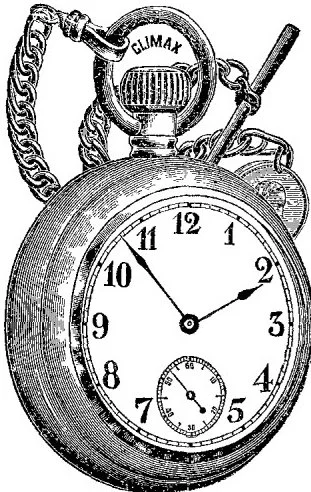
A Low Priced Stem Winder.
THE watch shown in the cut in another column has been selected to illustrate the extremely low cost at which the modern American watch, with all the latest improvements, may be produced. This watch is put on the market by Messrs. R. H. Ingersoll & Brother, of 65 Cortlandt Street, New York, at the extremely low price of $2. It is a stem winder, while the setting arrangement is in the center of the plate.
The regulating device does not differ from that usually employed in high priced watches. The movement itself is a three-quarter plate, quick train, American lever movement. The short wind is one of the valuable features of the watch. The watch is extremely light, weighing only 3½ ounces, will run thirty hours with one winding, and is incased in a gilt or nickel case, plain or chased. A well made chain accompanies each watch. A general idea of the appearance of the watch may be obtained from our engravings, which are three-fourths actual size.
Over 1,400 watches are produced daily at this factory, or between two and three watches a minute, during working hours. It seems very extraordinary that a real watch can be produced, which is capable of regulation, so that it will keep excellent time, for such a small sum of money. The “Climax” watch is guaranteed to run satisfactorily to the purchaser for one year. It is a watch that ought to suit everybody.—Scientific American.
Grant on Free Thought, Speech, and Press
By U. S. Grant
LET us all labor and add all needful guarantees for the more perfect security of free thought, free speech, and free press; pure morals, unfettered religious sentiments, and of equal rights and privileges to all men, irrespective of nationality, color, or religion.—U. S. Grant.
FATHERS OF THE CATHOLIC CHURCH.
By Ellet Joseph Waggoner
BY E. J. WAGGONER.
History repeats itself, because human nature is the same in all ages of the world. Hence, he who would know
HOW TO AVOID ERROR IN THE FUTURE
must know how errors have developed in the past. The “Fathers of the Catholic Church” shows the condition of the heathen world at the time of Christ, briefly states the principles of ancient heathen philosophy, and shows how the adoption of these principles by prominent men in the Church, and the incautious lowering of the standard of pure Christianity, developed the papacy, which was simply a new form of paganism. The chapter on
SUN-WORSHIP AND SUNDAY
is alone worth the price of the book.
Fine English Cloth, Substantially Bound,
CONTAINS ABOUT 400 PAGES,
Will be Sent Post-paid for $1.00
Address this office.
GUARANTEED AMERICAN WATCHES.
STEM WIND, $2.00.
This is a genuine American lever movement watch. Made of the finest material, and guaranteed to give satisfaction. The movement is American Lever; ¾ plate; 18 size; Quick Train; Lantern Pin'on; Regular Stem Wind; Dust Cap over Movement in Nickel Plated Case—fancy or plain. We send each purchaser a substantial Chain and Charm, and our
Written Guarantee for One Year.
We are making one Watch for every minute of the day—hence our low prices for these Timekeepers.
For $2.00 we will send you one by mail postpaid; three for $5.00; six for $9.00; and if you are not satisfied, return to us, and we will refund money.
INSIDE WIND, $1.50 each.
This Watch is our 1894 size, and has many improvements over that offered last year. It is smaller in size, and in every way better than previously offered. This is the cheapest, reliable, AMERICAN Watch on the market—each one tested, timed, and
Guaranteed by us for One Year.
It has Patent American Lever Movement, Lantern Pinion, and Patent Escapement and Regulator, inside wind, for which no key is required; weighs four ounces, and is made in Nickel Plated Case, both plain and fancy, presenting a handsome appearance. With each Watch we give a substantial Chain and Charm. We will send a sample, post-paid, for $1.50; three for $4.00; twelve for $15.00; and if not satisfactory, return to us, and we will send back your money.
Address exactly as follows:—
R. H. INGERSOLL & BRO., R, 44—65 Cortlandt St., New York City.
MAKE BREAD, GEMS AND CAKES—OF—EUREKA HEALTH FLOUR.
By F. W. Bartle
A WHOLE WHEAT FLOUR
Which competent authorities recommend as “THE BEST FLOUR MADE.”
It contains three to four times more of Bone, Brain, Nerve and Muscle building elements than ordinary white flour. Invaluable for dyspeptics, all invalids, and growing children. Everyone likes it. Used by the largest sanitariums.
Special Offer.—Half barrel, $3.25; one barrel, $6.00; freight paid. Usually retailed at $7.00 to $10.00 per barrel. If not perfectly satisfactory return at my expense and get your money. Agents wanted. Wholesale and retail dealers supplied. Circulars and recipes, for stamp.
F. W. BARTLE,Sales Agent, Oxford, N. Y.
STEPS TO CHRIST,
By Mrs. E. G. White.
We take pleasure in announcing an important and exceedingly helpful work, under the title of STEPS TO CHRIST. The rare ability of the author in the presentation of Scripture truth has never been used to better advantage than in this little work. STEPS TO CHRIST is not alone suitable as a guide to the inquirer and young convert, but is rich in thought and suggestion for the most mature Christian. Some idea of its scope and practical character may be gathered from the following table of contents:—
The Sinner’s Need of Christ. Repentance.
Confession. Consecration. Faith and Acceptance.
The Test of Discipleship. Growing up into Christ.
The Work and the Life. Knowledge of God.
The Privilege of Prayer. What to do With Doubt.
Rejoicing in the Lord.
The book is issued in a rich, neat cloth binding, embossed in silver, at 75 cents per copy; in white vellum cloth, silver edges, $1.00. Sent by mail, post-paid, on receipt of price.
Address Pacific Press,
43 Bond Street, New York City,
or Oakland, Cal.
PRISON LIGHT
Edited by one sending the Third Angel's Message to the perishing in prisons all over the land. Agents wanted. 50 per cent. commission. Trial year 20 cents. Terms and sample copy 2 cent stamp. Indorsed by the SENTINEL. PRISON LIGHT, 40 Green Street, Brattleboro, Vt.
This really two dollar paper will be furnished at the following
PRICES OF SUBSCRIPTION:
Single Copy, One Year, Post-paid, — — — — $1.50
Single Copy, Six Months, Post-paid, — — — — .75
In Clubs of Ten or More to One Address, Post-paid, — 1.25
To Foreign Countries in Postal Union, Post-paid, — ($2) 8s.