The American Sentinel, Vol. 10, No. 15.

IN JAIL FOR CONSCIENCE’ SAKE
Earlier text: IN JAIL FOR CONSCIENCE’ SAKE

A LETTER FROM ONE OF THE PRISONERS.

THE following letter written to the Review, and Herald, Battle Creek, Mich., by one of the Dayton prisoners will interest our readers:—
“Dayton, Tenn., Rhea County Jail,
“March 24, 1895.
“Perhaps you would like to hear some of the circumstances in regard to my being indicted for Sunday work. I live four and one-half miles north of Graysville, in what is called the ‘Cove’; it is a little valley between two mountains, three miles from the village.
“On Sept. 9, 1894, Charles Dungan and Mr. Rudd went to meeting about one mile from their home, and during the services they went off across a ridge through the woods, and found me pulling fodder (that is stripping the blades off the standing corn) out of sight of the public road or any public place. They made an agreement that Mr. Rudd would go before the grand jury and prosecute me, and have Mr. Dungan marked as witness, dividing the witness fee. The law does not allow the prosecutor any pay for prosecuting, but the witness is allowed $1 a day. Mr. Dungan received his pay and would not share it with Mr. Rudd. This made Mr. Rudd angry, and he told a brother about it. Since I have been in jail, Mr. Rudd has visited me, and asked if I wanted a bond, and said if I did, he would procure it for me. I explained to him that I was serving out my time and we could not pay our fines, it being contrary to our consciences. He said that my family should not suffer if he could help it, and it made me think of Ps. 76:10 and Rom. 8:28.
“The other case against me was for digging in a well in Graysville, more than forty feet deep. Between me and the most public road was a two-story house, and on the west side a pile of stone nearly as high as a man’s head; on the north side were a barn and a thick patch of corn: the other side was hidden by the house, fence, high weeds, etc.
“The man (Wright Raines) who had me indicted for working at the well neither saw nor heard me at work.
“Our courage in the Lord is good.
“Your brother in Christ,
“WM. S. BURCHARD.”

Natural Rights Versus Human Law on Sabbath Observance

“Do the defendants in keeping the seventh day and working on the first, thereby interfere with any natural right of their neighbors? Or is it an artificial right created by human law?”—Judge Parks.

Autograph Album Page from a Jailed Adventist Father
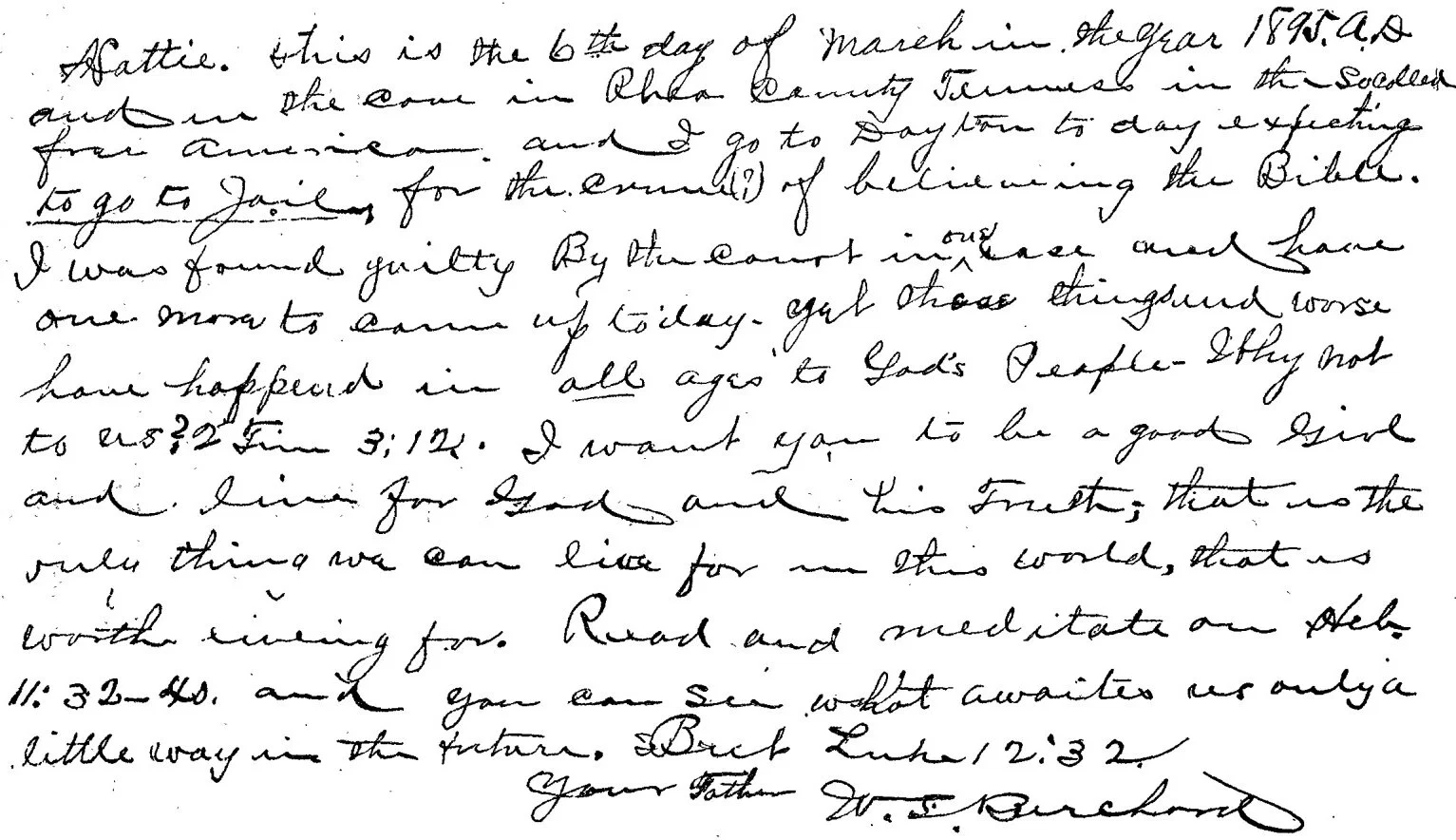
THE above is a photo reproduction of a page from the autograph album of a thirteen-year-old school girl, and was accidentally discovered by a representative of the SENTINEL in the home of a Seventh-day Adventist miner, in the mountains of Rhea County, Tennessee. It was written only for the eye of the child, and with no thought that it would ever be given to the public. The sentiment expressed by this Christian father, who is now in the county jail at Dayton, Tennessee, is eloquent in its simplicity. The first scripture cited reads: “All that will live godly in Christ Jesus shall suffer persecution.” The last text reads: “Fear not, little flock; for it is your Father’s good pleasure to give you the kingdom.”

PRESS COMMENTS.

A few representatives of the religious press, and more of the secular press, have condemned the persecution of seventh day observers. The following brief extracts are examples:—

FROM THE RELIGIOUS PRESS.

The Seventh-day Adventists and Hebrews have the same claim on the protection of our laws in the exercise of their liberty as any other class in the community; and Christians ought to be quite as careful to claim that protection for them as for themselves. Let these abuses be ventilated. The sooner we understand whether this is actually a free country, the better it will be for all concerned.—The Outlook, New York.
In not a few of our States religious liberty is grossly, wickedly, infamously violated through the abuse of what are called the Sunday laws. . . . It is amazing how good people fail to understand what are the principles in this matter. . . . It is this sort of thing that brings reproach upon Christianity.—The Examiner and National Baptist, New York.
Let us be careful how we let in the camel's nose of religious legislation, lest the brute crowd his bulky form in and occupy the whole shop. If the law by which these men were legally imprisoned be a righteous law, then may any State, nation, or country set up a religious creed and enforce it; then France treated properly the Huguenots; Russia, the Jews; and early New England and Virginia, the Baptists and Quakers. Protestant America had better be careful how she lays foundations for other men to build upon. Rome has as good a right to build in her way as we have to build in our way.—Church Bulletin, (Baptist) Chicago.
We wonder that the very stones do not cry out against such travesties of justice, that Christian men do not lift up their voices in protest against this wicked perversion of religion, this insult to the name of Christ. And, in particular, why do not Baptists, whose fathers stood against the world for soul liberty, make themselves heard when these relics of mediæval bigotry and persecuting intolerance are found in our free country? Sunday laws like those in Tennessee and Maryland are a disgrace to a Christian commonwealth in this nineteenth century, and should be repealed at the earliest possible moment.—The Examiner, New York.
We have again and again, during the last few years, had occasion to express our profound indignation at the administration of Tennessee law as applied to some country farmers belonging to the Seventh-day Adventist body, who, after having carefully kept the Sabbath on the seventh day of the week, work in their fields on the first day of the week. This prosecution has been renewed, and three men of families, one fifty-five and another sixty-two years of age, were convicted, and have, during the summer and autumn, been working out their fine, being set to work with criminals at shoveling on the common highway. They refused to pay their fine, declaring that it was unjust, and that they were liable to be arrested again as soon as they were released. We have said before, and we say again that this is bad law, bad morals, and bad religion.—The Independent, New York.

THE SECULAR PRESS.

So long as the labor of Adventists on Sunday does not interfere with the rights of the Mosaic and Puritanic people on the same, the prosecution of them seems neither more nor less than persecution.—Chicago Tribune.
It seems absolutely incredible that in this age of enlightenment, in these free United States, men should suffer and families be plunged into sorrow because they have exercised a right of conscience guaranteed to them by the Constitution of the country.—Chicago Daily Globe.
People are asking if we are returning to the days of Cotton Mather or the Spanish Inquisition, that faithful, law-abiding citizens must be fined or driven from the country when their only offense consists in quietly carrying out the convictions of conscience.—Louisville Courier Journal.
The principle involved is simple and its application plain. The State has nothing to do with religion, except to protect every citizen in his religious liberty. It has no more right to prescribe the religious observance of Sabbaths and holy days, than to order sacraments and to ordain creeds.—New York World.
If in any State the Adventists, the Hebrews, or any other people who believe in observing Saturday instead of Sunday, should happen to predominate, and they undertook to throw Christians into dungeons, and after branding them criminals, should send them to the penitentiary for working on Saturday, indignation would blaze forth throughout Christendom against the great injustice, the wrong against the liberty of the rights of the citizen.—The Arena.
The keeper of Saturday has an undoubted moral right to his convictions. More than this, his legal right to observe Saturday as a holy day and Sunday as a secular day ought not to be called in question in free America, by any civil authority. It would not be in doubt for a moment were it not for the existence of legal anachronisms that should have gone out with the witchcraft laws, or at the latest, with George the third.—Boston Daily Globe.
My whole soul revolts at the barbarism and ferocious savagery which seeks by resurrecting obsolete laws to reenact in a measure the tragedies of the past, and which through legal technicalities ignores the constitutional guarantee of Tennessee. It is a shame, a crying shame, that such insane fanaticism, such anti-Christian intolerance, should flourish at this late day; and doubly shameful is it that our sense of justice and love of liberty are so benumbed by conventional hypocrisy that we do not as a nation rise up against such liberty-destroying inhumanity. To me there is nothing so terrible as the spectacle of just and upright men suffering as criminals.—The Arena.
All these religious laws and prosecutions which have stained the history of the Church in all ages, come not from an earnest, Christian desire to elevate mankind, but from the malicious disposition of the professor of religion to punish the man who dares to question the superior excellence of his professions. The religious Sunday observer of Tennessee could afford to be lenient with the squirrel hunters whose rifles could be heard popping in the timber on all hours of that holy day. He could easily ignore their violations of his Sunday law because the transgressors were low white trash whose influence cut no figure. But when a man making equally high religious professions with himself, whose life was just as pure and exemplary, who derived the authority of his position from the same sacred volume from which he derived his, and could defend his positions with arguments and citations which could not be refuted,—when such a man disputed the sanctity of his Sunday observance, a challenge was thrown out which he could not afford to ignore without serious sacrifice of his professed sanctity.—Sigourney (Iowa) Review.
Indeed, a general lethargy seems to have overtaken our people and this is the most disheartening symptom present in the body politic at the present time. The day seems to have gone by when the cry of the oppressed or the weak arouses the sense of justice in the hearts of our people. Especially is it sad to see the religious press, supposed to represent the spirit of the Reformation (which struggled against such fearful persecution of other days), now so silent when fellow-men are being ground between the millstones for conscience' sake.
I believe that nations commit suicide no less than individuals, and that wrong done by nations will result in evil consequences; and believing this, while loving the great Republic, I cannot remain silent when she is unjust or when she wrongs, in the name of law, upright citizens because they do not believe as the majority believe. No State or nation can afford to allow a law not based on justice to remain upon the statute books. And when our Republic so far forgets the high ideals of justice, liberty, and human rights which made her the flower of the ages, as to permit unjust laws to be passed, or cruel, obsolete statutes to be resuscitated in the interests of any class, any sect, or any religion, she makes law-breaking citizens, and plants in her own breast the seeds of disintegration.—The Arena.

THEY PLEAD THEIR OWN CASES.

At the beginning of the prosecution of Seventh-day Adventists for Sunday labor, prominent attorneys were employed to plead their cases; among them the Hon. Don M. Dickinson, of Detroit, Mich., and thousands of dollars were thus spent with the hope of securing favorable decisions, but to no avail. James T. Ringgold, of the Baltimore bar, one of the ablest lawyers of Maryland, on learning of the injustice being done to seventh-day observers, volunteered his services, and made a noble fight for liberty in his State, but the decisions were against him. One case was carried to the Supreme Court of the United States, but was dropped from the calendar owing to the sudden death of the defendant. Since then, the Supreme Court of the United States has decided that “this is a Christian nation,” citing the Sunday laws of the several States as sustaining proof. Consequently, Seventh-day Adventists entertain no hope of relief from the Federal Court.
The failure of human counsel has led them to rely more implicitly upon divine assistance, and they now appear in their own defense, relying wholly upon the promise of the Lord: “When they bring you unto the synagogues, and unto magistrates, and powers, take ye no thought how or what thing ye shall answer, or what ye shall say: for the Holy Ghost shall teach you in the same hour what ye ought to say.” Luke 12: 11, 12.
The following are brief quotations from the defenses of these people, who, in most cases, are farmers in possession of a limited education:—
I have a few words that I would like to say. This is something new to me. I was born and reared in Queen Anne’s County, and I was never before the court until to-day. I have always endeavored to be a law-abiding citizen. But I am here on a matter between my Lord and myself. I would like to say to the court that I am a Seventh-day Adventist. I study my Bible, and my convictions are that the seventh day is the Sabbath of the Lord my God.
I was raised in the Sunday-school, and I was taught the ten commandments. I was taught that the seventh day is the Sabbath, and then was taught to observe the first day in its stead. In my study of the Bible I cannot find where God, the Lord Jesus, or the apostles, ever changed the Sabbath from the seventh to the first day. I am conscientious in the matter, and choose to stand for God and the right. I leave the case with the court.—Robert R. Whaley, before the Circuit Court of Queen Anne’s County, Md.
I would like to say to the jury, that, as has been stated, I am a Seventh-day Adventist. I observe the seventh day of the week as the Sabbath. I read my Bible, and my convictions on the Bible are that the seventh day of the week is the Sabbath, which comes on Saturday. I observe that day the best I know how. Then I claim the God-given right to six days of labor. I have a wife and four children, and it takes my labor six days to make a living. I go about my work quietly, do not make any unnecessary noise, but do my work as quietly as possible. It has been proved by the testimony of Mr. Fitch and Mr. Cox, who live around me, that they were not disturbed. Here I am before the court to answer for this right that I claim as a Christian. I am a law-abiding citizen, believing that we should obey the laws of the State; but whenever they conflict with my religious convictions and the Bible, I stand and choose to serve the law of my God rather than the laws of the State. I do not desire to cast any reflections upon the State, nor the officers and authorities executing the law. I leave the case with you.—W. S. Lowry, before the Circuit Court of Henry County, Tenn.
I do not deny working on the first day of the week, but I do deny working on the Lord’s day, because the first day of the week is not the Lord’s day. The commandment of God says, “Six days shalt thou labor, . . . but the seventh day is the Sabbath of the Lord,” and we must keep it. If any one can point to a single scripture, showing that Sunday is the Lord’s day and should be kept, I will confess being in error. I have lived in this county all my life excepting eighteen months, and was never before charged with wrong.
There has been offered $2,000 for the production of a scripture which shows that Sunday should be observed, and Cardinal Gibbons has said there was no authority in the Bible for keeping Sunday; and some of you, gentlemen [to the jury], probably know of this. The Lord has said, “We ought to obey God rather than men,” and he also said, “Ye cannot serve two masters.”
I do not work on Sunday to defy the laws, but because I must obey God when his law conflicts with man’s laws.—W. G. Curlett, before the Circuit Court of Queen Anne’s County, Md.
Your honor, the summons which brought me into this court accuses the defendant of keeping open shop on the Lord’s day, to which charge I plead not guilty [drawing a New Testament from his pocket]; and I desire to define the Lord’s day by the declarations of Him who is the Lord of the Lord’s day as they are recorded in the Lord’s book. . . .
I wish to refer you to Mark 2: 27, 28, which reads: “And he said unto them, The Sabbath was made for man, and not man for the Sabbath: therefore the Son of man is Lord also of the Sabbath.” Again, speaking of the Lord Jesus, the declaration is made in the second and third verses of the first chapter of the Gospel by John, that “The same was in the beginning with God. All things were made by him; and without him was not anything made that was made.” The first declaration, your honor, asserts that the Sabbath was made; and the second scripture declares that the Lord Jesus, who was in the beginning with the Father, made all things that were made in the beginning; hence, the Lord made the Sabbath day, and is therefore, rightfully Lord of the Sabbath day or Lord’s day. He it was who labored six days and rested the seventh day; “Wherefore the Lord blessed the Sabbath day, and hallowed it.” Now, having shown that the Son of man is Lord of the Sabbath day, I call your attention to Luke 23: 56, to show which day of the seven is the Sabbath or Lord’s day. The text reads as follows: “And that day was the preparation, and the Sabbath drew on. And the women also, which came with him from Galilee, followed after, and beheld the sepulchre, and how his body was laid. And they returned, and prepared spices and ointments; and rested the Sabbath day according to the commandment. Now (next verse, chap. 24, verse 1) upon the first day of the week, very early in the morning, they came unto the sepulchre, bringing the spices which they had prepared, and certain others with them.” The text first quoted states that the Son of man is Lord of the Sabbath. This text states that “the Sabbath day according to the commandment” is the day which precedes the first day of the week. The Son of man is therefore Lord of the day which precedes the first day of the week, and that day is the Sabbath or seventh day of the week. Therefore the only day which the Son of man declares himself the Lord of, is the seventh day of the week and not the first day, hence the seventh day of the week, or the day preceding the first day of the week, is the Lord’s day. . . .
Your honor, I claim the divine right of dissent, and therefore deny the right of the pope of Rome, the czar of Russia, the president of the United States, or the mayor of the city of Everett, to prescribe for me my religious duty. All I ask, as a free-born American citizen, and as a man, is the free exercise of my civil and religious right to worship God according to the dictates of my own conscience. I deny the right of the magistrate to compel me to observe the first day of the week, and thereby deprive me of one-sixth of my time in which to earn my living.
I have observed the Sabbath since 1878, previous to which time I kept Sunday. I require no civil law to enable me to keep the seventh day, and every one around me exercises his right to keep Sunday and labor on Saturday; and no man disturbs me in keeping Saturday. I disturb no man on Sunday or on any other day, and no man thus accuses me. All I ask is the free exercise of my right to worship Him who said, “The Son of man is Lord also of the Sabbath,” and the right to labor six days, according to the dictates of my own conscience, so long as I do not actually disturb my neighbors.
Your honor, I have not interfered with any natural or constitutional right of my neighbors, and I am not guilty of keeping open shop on the Lord’s day. And I trust you will so decide.—W. T. Gibson, before the First District Court of Eastern Middlesex, Middlesex County, Mass.
Now, gentlemen of the jury, look me in the face, and tell me that I am guilty of any crime! You know, gentlemen, we are not criminals. Are we dangerous men to run at large who need to be restrained and deprived of our liberty? Look me in the eyes and tell me. Is there a single one of you that believes any man’s person or property is endangered by our going at large?—Not one of you. Nor does any other man. No witness has come here and testified to anything of the kind. If our going at large is dangerous to anything, it is to somebody’s religious sentiment, and if that be deemed a sufficient reason for restraining us, then it shows on the face of it that this whole thing is religious persecution.—Eld. W. S. McCutchen, before the Circuit Court of Hall County, Ga.

CONSCIENCE AND THE STATE.

It is clear that government cannot become the judge of men’s consciences; and that the plea of conscientious conviction cannot be accepted as a final and sufficient defense in all cases of violation of law. What rule, then, can be adopted which will preserve the authority of the State and yet not trench upon the rights of conscience?
The question thus raised is well answered by a clause in the constitution of the State of Maryland: “No person ought, by any law, to be molested in his person or estate on account of his religious persuasion or profession, or for his religious practice, unless under color of religion, he shall disturb the good order, peace or safety of the State, . . . or injure others in their natural, civil, or religious rights.” In this the line is drawn just where it should be, namely, at the equal rights of others. Under this provision the courts are not called upon to judge any man’s conscience, but only to judge whether or not his conscience leads him to infringe the equal rights of his fellowmen. That a man’s conscience is just what he says it is, no man has either right or occasion to deny. A man’s statement of his conscience is an end of controversy; but it does not follow that one has a right to do whatever his conscience tells him is right for him to do. There is a difference between conscience and the rights of conscience. No man, however conscientious, has any right to infringe the equal right of another; and at this point civil government has a right to take cognizance, not of any man’s conscience, but of the relation of the act to the rights of others.
The principle briefly stated is this: No man should be either required or forbidden to do any act contrary to conscience, however erroneous that conscience may be, unless the doing or forbearing to do that act trenches on the equal rights of others. This rule would (1) abrogate all civil laws requiring the observance of Sunday or of any other day; and (2) it would leave the courts free, not to judge men’s consciences, but to protect all men against wrong in the name of conscience. But this is only saying in other words that which we have said many times before, namely, that civil governments are instituted not to create or to “grant” rights, but to guarantee the free and untrammeled exercise of equal, natural, God-given, inalienable rights, and that of these the highest and most sacred is perfect freedom in matters of religious belief and practice.

Sunday Legislation and Matters of Conscience

“If the day has been appointed by divine edict, but two or more persons honestly and conscientiously differ as to what day was appointed, can the dispute be settled by legislative enactment? And shall one be given rights which are denied the other? Does might make right, and have the majority the right to dictate in matters purely of conscience?”—Judge Parks.

Secular Power as a Satanic Gift to the Church

“SECULAR power has proved a satanic gift to the Church, and ecclesiastical power has proved an engine of tyranny in the hands of the State.”—Dr. Philip Schaff.

CATHOLICS AND THE BIBLE.

On March 3, Cardinal Gibbons preached a sermon in the cathedral at Baltimore, advising his audience to read the Bible. The Catholic press of the country hastened to publish the sermon, and to remark that it would have the effect, “to convince non-Catholics that they have been misinformed by the Protestant tradition concerning the attitude of the church toward the Word of God.”
No wide awake Protestant will be deceived by the apparent change of attitude toward the Bible. But if there are any of our readers who believe that the Catholic Church is any more friendly to the Bible now than when she burned it, let them read the following from the Cardinal’s official organ, the Catholic Mirror, which appeared in the issue preceding the publication of the sermon (February 23):
‘The Bible is a volume very difficult to be understood by anybody; hardly six lines can be properly comprehended without a commentary.
And now comes the April number of the American Ecclesiastical Review, which is printed under the phrase, Cum Approbatione Superiorum (with approbation of superiors), and says:—
It is the Catholic position that the Bible, although a part, the principal part, of the remote rule of faith, is not the sole and exclusive rule, is not the proximate rule, and is not placed directly by God in the hands of individuals to learn from it by their private reading the truths of the Christian religion.
Protestants, don’t be deceived. It is impossible for the papacy to experience a favorable change of heart and still remain the papacy.

PUBLICATIONS ON THE SABBATH QUESTION.

READ the following and see if there is not some publication among them which you desire to read, or which will benefit some friend:—
The Abiding Sabbath. By A. T. Jones. No. 9 of the Bible Students’ Library. This is a review of two Sabbath “prize essays,” one of $500, and one of $1,000. It contains mighty arguments on the Sabbath question; 174 pages; price, 15 cents.
Is Sunday the Sabbath? No. 24 of the Library. A brief consideration of New Testament texts on the first day of the week; 8 pages; price, 1 cent.
Nature and Obligation of the Sabbath of the Fourth Commandment. By J. H. Waggoner. No. 54 of the Library. Clear and strong in argument; price, 10 cents.
Sunday; Origin of its Observance in the Christian Church. By E. J. Waggoner. No. 80 of the Library. The testimony given with reference to Sunday is wholly Protestant. All Protestants should read it; price, 15 cents.
Who Changed the Sabbath? No. 107 of the Library. What God’s Word predicted; what Christ says; what the papacy says; what Protestants say. A most convincing document; 24 pages; price, 3 cents.
“The Christian Sabbath.” No. 113 of the Library. A reprint of four articles in the Catholic Mirror, the organ of Cardinal Gibbons. What Catholics have to say to Protestants on the subject; 32 pages; price, 4 cents.
Christ and the Sabbath. By Prof. W. W. Prescott. The spiritual nature of the Sabbath, what true Sabbath keeping is, and the relation of Christ to the Sabbath in both creation and redemption. A most important tract. No. 14 of the Religious Liberty Library; 38 pages; price, 5 cents.
The History of the Sabbath. By John N. Andrews. A complete history of the Sabbath and first day of the week in religious life and thought, from the earliest ages to the present time, and especially during the Christian dispensation; 550 large octavo pages; price, cloth, $2.00; library binding, $2.50
Catalogue of publications sent free on application. Address,
PACIFIC PRESS PUB. CO., 43 Bond St., New York.
Or Oakland, Cal.

A Stupendous Wrong.

[Editorial from the Dayton Republican, March 23.]
Do the good citizens of Dayton and Rhea County fully realize the enormous wrong being perpetrated upon the sacred rights of individual citizenship as guaranteed by our blood-bought Constitution, in the imprisonment in the county jail of eight of the Christian citizens of this county, because, forsooth, they have worshiped God according to the dictates of conscience?
Can they quietly and complacently look on while this startling nineteenth century paradox is being enacted?
Will God approve of this oppression of a branch of his devoted followers? and will he not rebuke in the day of judgment the persecution these people are undergoing for opinion’s sake at the hands of others of his professed followers? and will he not further hold to a strict accountability the passive indifference of others of his followers who quietly allow this great wrong to be perpetrated?
Christians all, Presbyterians, Methodists, Catholics, Baptists, Episcopalians and every denomination that worships in the name of the Lord of Hosts, and whose hearts have imbibed the humanity and love illustrated in the life of Christ, put yourselves in these men’s place. They have been taken from their families, deprived of liberty, the stigma of felon placed upon them, their business broken up, and a portion of their property virtually confiscated by the State, and for what? For worshiping the God of their fathers!
Shades of Washington and Jefferson, look down upon us and restore our faith in, and love for, the Declaration of Independence!
Are we insensate blocks of wood, that we shall quietly allow this persecution to proceed? The very walls of the jail cry out in thunderous tones of eloquent indignation against this offense.
Do we need a new Declaration of Independence, in order to quicken our sense of liberty and justice?
In the broad light of the closing nineteenth century, with all the facts of the past ages serving as warnings, are Christians to still suffer a martyrdom for the faith that is in them? Have Luther and Wesley and Whitfield and Rogers lived in vain, that we have not yet learned the lesson that the truth shall make men free?

Persecution of Sabbath Keepers in Tennessee

THE mission of this number of the SENTINEL is to call attention to the injustice perpetrated against a harmless people in Tennessee, and to announce the principles for which they suffer. It is not to create sympathy for them. They do not need it. If their faith is not worth suffering for it is not worth professing. The object is to bring before all the people the vital principles of truth and religious liberty involved in these persecutions, that they may be saved from participating in the cruel work. “Offenses will come, but woe unto him through whom they come.”

Silence Against Persecution Forfeits the Right to Protest

HE who fails to protest against the persecution of his neighbor, thereby virtually forfeits the right to protest when he is himself persecuted.

Religious Persecution and the Law of God

“AMONG all the religious persecutions with which almost every page of modern history is stained, no victim ever suffered but for the violation of what government denominated the law of God.”—From committee report adopted by the United States Senate, Jan. 19, 1829.

Dayton Jail Holds Imprisoned Seventh-day Adventists

OUR first page illustration shows the jail at Dayton, Rhea County, Tenn., in which are confined in this year of our Lord 1895, five Seventh-day Adventists, on the charge of “violating the Sabbath.” Two of the eight imprisoned March 8, have served their sentence and are at liberty.

On the Escalation of Persecution

“It is incumbent on the authors of persecution previously to reflect whether they are determined to support it in the last extreme. They excite the flame which they strive to extinguish; and it soon becomes necessary to chastise the contumacy, as well as the crime, of the offender. The fine, which he is unable or unwilling to discharge, exposes his person to the severity of the law; and his contempt of lighter penalties suggests the use and propriety of capital punishment.”—Gibbon.

Tennessee Sunday Law and Jurors' Conscientious Scruples

The Sunday law of Tennessee is supposed to be for the purpose of protecting the public morals, and yet one of the questions asked several of the jurors in “the Adventist cases,” was, “Have you any conscientious scruples against trying such a case, and, if so, can you lay them aside and decide according to the law and the evidence?” What kind of morality must it be that can be fostered by laws, to administer which courts and jurors must needs lay aside their conscientious convictions? And what guarantee of even common honesty remains when conscience is laid aside, violated, trampled in the dust?

Graysville Academy Closed Amid Sunday Law Prosecutions

The Seventh-day Adventist academy at Graysville, Tenn., still stands a mute witness to the intolerance of certain Sunday-keepers of that State. It will not be opened again during the present school year, and with thirty or more new indictments against the teachers, patrons and students of the institution, it is clear that when it opens it must be with a new corps of instructors, and largely with new students. However it will open with the fall term.

O Freedom!

* * * * *
Thy birthright was not given by human hands: Thou wert twin-born with man. * * * * Tyranny himself, Thy enemy, although of reverend look, Hoary with many years, and far obeyed, Is later born than thou; and as he meets The grave defiance of thine elder eye, The usurper trembles in his fastnesses.
Thou shalt wax stronger with the lapse of years, But he shall fade into a feebler age; Feebler, yet subtler. He shall weave his snares, And spring them on thy careless steps, and clap His withered hands, and from their ambush call His hordes to fall upon thee. He shall send Quaint maskers, wearing fair and gallant forms, To catch thy gaze, and uttering graceful words To charm thy ear; while his sly imps, by stealth, Twine round thee threads of steel, light thread on thread That grow to fetters; or bind down thy arms With chains concealed in chaplets. Oh! not yet Mayst thou unbrace thy corslet, nor lay by Thy sword; nor yet, O Freedom! close thy lids In slumber; for thine enemy never sleeps, And thou must watch and combat till the day Of the new earth and heaven. * * *
—William Cullen Bryant.

Sixteen Graysville Adventists Face Sunday Work Warrants

A letter received after going to press states that the sheriff at the time of writing was serving warrants on sixteen members of the Graysville Seventh-day Adventist church, who are charged with Sunday work. We will give the names next week. The letter also states that the petition for the release of those now imprisoned was rejected by a vote of 13 to 11.

Tennessee Situation Demands Wider Circulation of This Issue

THE gravity of the situation in Tennessee demands that this issue reach a circulation of at least half a million copies. Price, one dollar per hundred; eight dollars per thousand.

Freedom.

Is true freedom but to break Fetters for our own dear sake, And, with leathern hearts forget That we owe mankind a debt? No; true freedom is to share All the chains our brothers wear, And, with heart and hand, to be In earnest to make others free.
They are slaves who fear to speak For the fallen and the weak; They are slaves who will not choose Hatred, scoffing, and abuse, Rather than in silence shrink From the truth they needs must think; They are slaves who dare not be In the right with two or three.
—James Russell Lowell.

Tennessee Bill Would Seize Personal Property for Fines

A BILL was introduced into the Tennessee Legislature on the 2nd inst., the purpose of which is to make all personal property liable for fines and costs, including the State and county tax, in misdemeanor cases. Should this bill become a law it will enable the enemies of the Adventists to absolutely strip them of personal property under the Sunday law of that State.

Christianity's Greater Danger: Corruption by Power

“THE whole history of the Christian religion shows that she is in far greater danger of being corrupted by the alliance of power than of being crushed by its opposition.”—Macaulay.

Academy Closure and Companion Issue Notice

OUR issue of March 21, containing the cut of the closed academy, is a valuable companion number to this issue, and can be had in any quantities at the usual rates.

You have reached the end of this edition.

The American Sentinel · Apr 11, 1895