The Youth’s Instructor, Vol. 35, No. 18.

THE HUMMING-BIRD
Earlier text: MOTIVES

SAGACITY OF DUMB ANIMALS.

That some dumb animals in their maneuvers display a degree of wisdom beyond what one can comprehend, has frequently been portrayed in the INSTRUCTOR; and now, as illustrative of the sagacity of the horse, the following paragraphs, clipped from the S. S. Classmate, seem quite forcible:—
“Even in old age, horses have a very vivid recollection of what they learned in their young days. A good many years ago some laborers were at work on a new turnpike road. One of the surveyors of the road occasionally went on horseback up and down the road to see that the work was properly performed. On those occasions he rode a horse which had for a long time carried a field-officer, and, though aged, still possessed a great deal of spirit. One day, as he was passing near a town of considerable size, which lay on the line of the road, some volunteer soldiers were at drill on the common, and the instant that ‘Solus’ (that was the name of the horse) heard the drum, he leaped the fence and was speedily at the post in front of the volunteers which would have been occupied by the commanding officer of a regiment on parade, or a drill, nor could the rider by any means get him off the ground until the volunteers retired to the town. As long as they kept the field, the horse took the proper place of a commanding officer in all their maneuvers; and he marched at the head of the corps into the town, prancing in military style, as cleverly as his stiffened legs would allow him, to the great amusement of the volunteers and spectators and the not small annoyance of the poor, bewildered surveyor.”
“The Rev. J. G. Wood, the celebrated naturalist, tells a similar story, only in this case the unfortunate driver of the horse was a lady. He says, ‘Some years ago an elderly gentleman died, leaving to his widow all his property, including an old and staid horse which had been driven for many years. It so happened that there was a review in the neighborhood, and the old lady, who was stone-deaf, drove over to see it. During the maneuvers a regiment of cavalry passed her, and as they did so, the trumpeter blew on his instrument some signal which she, from her deafness, did not hear, and if she had heard would not have understood. The horse, however, both heard and understood the trumpet-call. Old as he was, he sprang off at full speed, galloped into the ranks, and put himself in line with perfect accuracy. The signal to charge was then given, and off went the horse with his comrades. The old lady shrieked and dragged at the reins to no purpose. Where the regiment went, the horse went. When it wheeled, he wheeled; and when it charged, he charged, dragging his expostulating mistress after him throughout the whole of the maneuvers. She was, however, a spirited dame, and stuck to the chaise. After the review was over, the officers crowded round the old horse, which evidently had belonged to the cavalry, and offered a very high price for him in order to make a regimental pet of him. The offers, however, were refused, as the lady valued the horse for association’s sake. Neither her husband nor herself had the slightest idea that the horse had belonged to the army.’”

SPONTANEOUS COMBUSTION.

NOWADAYS, when fires occur so frequently, and damage so extensively both life and property, one feels that he cannot be over-cautious in the manner of handling fire. But we may be ever so careful, and the incendiary may let us entirely alone, and yet we are not secure against the attack of this agent; for it is proven beyond question that fires occur where no fire has been applied; and where, apparently, there has been no cause for increase of temperature. There are certain substances which of themselves take fire; or, in other words, upon certain conditions are liable to undergo chemical changes which produce enough heat to set them on fire. This chemical change is called “spontaneous combustion,” and he is wise who tries to understand its operations; for thereby he may, at some time, prevent a loss by fire. The readers of the INSTRUCTOR may acquire some valuable hints from what Treasure-Trove has to say about it in the following paragraphs:—
“It has been discovered that cotton and wool more or less saturated with oil, is liable to take fire. Cotton wet with water also burns. Here are instances: A pile of cotton cloth, left in a heap, and probably more or less saturated with oil, blazed up and fired a building in which there never was a fire or light before. A stone warehouse, filled with cotton and woolen waste in bags, took fire on a summer afternoon, and resulted in the destruction of several buildings. A fire started early one Monday morning in a closet in which the painters had thrown their overalls, these garments being presumably loaded with linseed oil and turpentine. This caused the destruction of a fine block of buildings. In 1861, there was a great fire in Liverpool, caused by the burning of wet cotton. The two English ships, Imogene and Talavera, were burned by the spontaneous combustion of the oakum and tow used in wiping the greasy machinery.”
“Experiments have been made, and it is found that cotton waste, wet in boiled linseed oil, placed where it was warm, took fire in one hour and a quarter. Raw linseed oil on cotton required four or five hours; olive oil, six hours; and castor oil, two days. Lard oil with the cotton produced ignition in four hours; seal oil, in one hour and twenty minutes; and sperm oil mixed with petroleum did not fire in two days. The mineral oils are not liable to aid in spontaneous combustion.”
“There are other causes of spontaneous combustion. Hay and grain, piled into stacks while damp or partially cured, generate heat enough to cause combustion. Some of the supposed incendiary fires, by which barns have been burned, have been traced to this cause. A quantity of oats stored in a barn had been consumed by fire, and the proprietor suspected incendiaries. But several things pointed to the conclusion that it was spontaneous combustion. Some of the sheaves that had been removed the day previous were charred, the center was burnt and blackened, while the outside of the sheaves retained their natural color.”
“A large establishment for the manufacture of machinery was fired from a heap of iron turnings, greasy cotton cleaning waste being intermixed. It is not necessary, however, to have the greasy cotton waste in order to produce fire from a heap of iron turnings, clippings, and filings. The mass of fine iron and its oil are enough to incite heat and combustion. And careful observers can sometimes see, in the dark, shivers of flame over a heap of iron drillings, chips, shavings, and filings, adjacent to machine shops. As far back as 1780, a Russian naval vessel took fire, and caused many superstitious surmises. The fire was traced to a package of matting containing lampblack made from the smoke of fir and hemp oil varnish. An experiment was made, and it was found that a parcel of this mixture of lampblack and oil took fire within seventeen hours. The disastrous conflagration which destroyed in a few minutes the buildings of the great Pittsburg Exposition, with all their contents, was explained by a theory which is, to say the least, very plausible. It seems that Mr. Warner, the aeronaut, spent the day before the fire in re-varnishing the canvas of his balloon with boiled linseed oil. He worked in the boiler room, and after the varnishing was completed, the balloon was rolled up and put by to dry. A more reckless operation it would be difficult to conceive. The only thing that could have made the canvas more certain to take fire would have been to sprinkle it with water before rolling it up, but this is by no means essential. It is very common in cases of spontaneous combustion that some uninstructed person, having been engaged in painting or polishing, undertakes to save the cotton rag he has been using, by washing out the oil or paint, but after one or two trials, finding this a rather difficult operation, abandons the attempt, and rolls up the rag in a knot and throws it into some corner, where the oil and water speedily react upon each other to set the whole in a blaze.”

FAITH

LESSON 5.—THE JUDGE OF ALL THE EARTH WILL DO RIGHT.

1. What did Nebuchadnezzar require of Shadrach, Meshach, and Abednego? Dan. 3:15.
2. What expression in their response implies that they were not certain that God would deliver them from the fiery furnace? Verses 17, 18.
3. What shows that they possessed an uncompromising integrity? Dan. 3:18.
4. How did God show his approval of this confiding trust in him? Verses 24, 25, 27.
5. What important lesson of faith is taught by this narrative?—That God is pleased when we trust him without knowing just how he will work deliverance for us.
6. What message did the prophet Isaiah carry to Hezekiah when he was sick? 2 Kings 20:1.
7. How was the king affected by it? Verses 2, 3.
8. In answer to his prayer, what message did Isaiah return to him? Verses 5, 6.
9. What sign did God give to show that this would be fulfilled? Verses 9-11.
10. Notwithstanding God heard Hezekiah’s prayer, and wrought a miracle as evidence that he should recover, what means did the prophet direct him to use? Verse 7.
11. What was meant by setting his house in order?
12. What serious mistake did Hezekiah make after his recovery? Isa. 39:1, 2.
13. What did the Lord say would happen in consequence of this? Verses 6, 7.
14. What son was born to him during the added fifteen years of his life? 2 Kings 20:21; 21:1.
15. What was the character of Manasseh’s reign? 2 Kings 21:2-9.
16. What terrible judgments came upon Judah in consequence of these, and kindred sins?—The final overthrow of the kingdom, and a seventy years’ captivity of the people. 2 Kings 21:11-16.

SECRETARIES

Do not send to the Tract and Missionary secretary the donations from your school to the South African Mission. These are Sabbath-school donations, and should be sent to your State S. S. Secretary. Do not send any S. S. donations or tithes to the T. and M. Society, but deal directly with your State officers. Several have failed to do this, sending their donations to the Tract Society or to the Review and Herald Office, so that it is impossible, in some Associations to tell how much has been given by the schools to this enterprise. If it is worth while to keep track of what our schools donate, we want the account accurate and complete. This can only be done when all work on the same plan.
W. E. L.

THE LOVING SQUIRREL.

“The Atlanta, (Ga.,) Constitution says, intensity of animal affection has just been pathetically illustrated in this city. Three years ago Mr. Jacob Gardner, of Bull Street, sold a lady a large black squirrel, which had attracted considerable attention, while at the store, on account of its unusual size and the beauty of its coat. The animal became the favorite pet of its purchaser, and was often given the freedom of the house, and other liberties not often enjoyed by its kind when in captivity were extended to it. Occasionally the chatterer left the premises, but never failed to return when night approached. It was the object of almost constant petting and caressing, and nearly always slept snuggled up in the arms of its mistress. A few days ago the owner left the city for a few days, leaving the squirrel at home. The little animal soon missed her and ran from room to room, all over the house and grounds, in search of her, giving unmistakable evidence of grief. All efforts at consolation on the part of others were unavailing, and the squirrel refused either to be comforted or to partake of its usual food, from time to time giving vent to pitiful little cries indicative of grief. After nearly a week had elapsed and it became evident that the little sorrower's death was a matter of only a few days, the owner was notified, and returned home. Her arrival was greeted with evidences of wild joy by the squirrel, which jumped into her arms with all the signs of happiness that its weakened condition would permit. It made every effort to partake of the tempting food placed before it, but was unable to swallow, and on the following day, with its eyes turned almost pitifully into those of its mistress, it gasped out its life while lying in her arms.”—Exchange.

Chinese Scholars.

It has been said that there are more books published in China, and more people able to read them, than in any other country in the world; and yet the Chinese language is such an exceedingly difficult one, that it takes a boy the best part of his school life to learn to read the famous “Sacred Books” which every Chinese scholar is expected to know almost by heart.
Before any man is allowed to take office under the Chinese Government, he is obliged to pass certain examinations in the books which are taught in the schools, and in some other subject. If he does not succeed at one examination, he may try again and again, and it is not an uncommon sight to see quite old men coming up for examination, side by side with boys and young men fresh from College.
When a man has passed the examination, he has a right to wear a particular kind of a button on the top of his cap; and by this button he is known to every one who sees him, as a scholar or learned man.
This is an honor very much coveted in China. They tell of one poor boy who hung his book on the horns of his buffalo, that he might learn while following the plough; and of another, who, too poor to afford himself lights at night, bored a hole in the partition wall, and studied by the help of his neighbor’s light.—Selected.

HINDOO’S MODE OF REAPING.

The Milling World tells its readers how the Hindoo reaps with an iron blade, six inches long, an inch wide, and curved like a sickle, costing him four cents. He squats on his heels, cuts a handful, lays it down, and without rising from his heels, waddles forward and cuts another. In twelve days he cuts an acre, and receives five cents a day, boarding himself. When he wants to thrash his grain he drives a stake in the ground, spreads his grain, around it, ties a rope to his bulls’ horns and then to the stake, and drives them around until the straw is trampled very fine into what they call “bhoosa.” This is fed to the cattle after the wheat is separated. Englishmen have introduced thrashing-machines, but the Hindoos will have none of them. They think their cattle would not eat the straw because it breaks it instead of trampling it flat. They clean their wheat by holding it up in the wind in a scoop made of reeds; or, if the wind is not blowing, two Hindoos make wind by waving a blanket, while a third dribbles the grain from the scoop.—Chicago Times.

The Costly Absurdity of Tobacco Use

TOBACCO is one of the most costly absurdities the world ever saw. In the City of New York alone, ten millions of dollars are burned up every year in cigars!

Curious Leaves.

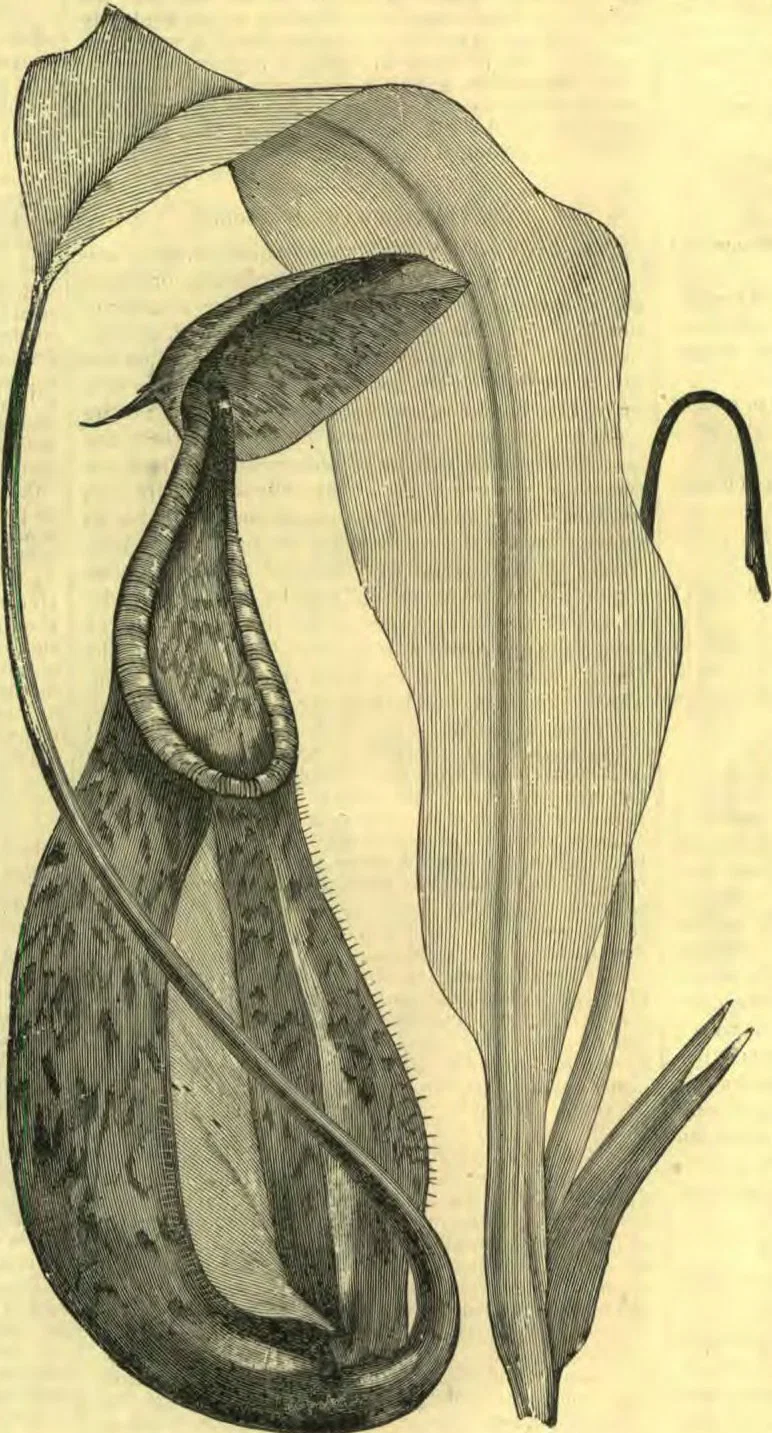
In some warm countries grows a plant with a very curious leaf. There shoots out from the stem a green blade, that looks like hundreds of other leaves; but at the top, the leaf runs out into a little tendril by which the plant clings around other objects to support itself; and from the end of the tendril grows—a little pitcher! And yet the whole is only a leaf.
The pitcher has a little lid that shuts down tight when the leaf is fully grown. If you were to lift up this lid, you would find the pitcher half full of the clearest water. It could not have been caught in a rain shower, because the lid was shut tight. It must have been made by the plant itself, and have oozed through the inside of the pitcher.
Some kind of pitcher plants do not have a lid. But near the top of the pitcher there are a few drops of sweet honey. It is a bait Dame Nature has spread to catch unwary insects. They fly to get the honey, and then fall into the half-filled pitcher, and are drowned. After a time these insects disappear from the inside of the pitcher. Where do they go? The plant must have eaten them up. It seems to need these insects to help make it grow.
In our own northern bogs there is a pitcher plant, called the Side-saddle Flower. It is not quite like the other ones. The whole leaf is a pitcher. It is always nearly full of water and dead insects. But what the plants want of a pitcher full of water it is hard to imagine, for in the bogs there is plenty of water around the roots.
In Ceylon one of the pitchers on these plants hold as much as a tumbler full of water. The monkeys sometimes lift the lids and drink the water. For this reason the plant is called Monkey-cup. W. E. L.

AVA'S JOKE.

I THINK it was the best joke I ever knew of one little girl's playing on another, though it wasn't an April fool. It couldn't be, you know, because it happened some time after the first day of April.
It was when Ava was five years old, and just beginning to go to school—a blue-eyed, sunny-haired little maid, who seemed to find her chief delight in doing pleasant things for people.
One day mamma put an extra nice dinner in the pretty tin luncheon box. There was a slice of frosted cake, and two jelly-tarts, and a piece of lemon pie, and a sandwich with turkey.
Right in front of Ava at school sat little Viny Cates, who never in the world brought anything for her dinner but a biscuit. I suppose she didn't have anything else to bring. That was what Ava thought, too, deep down in her pitying little heart.
Well, this day Ava was swinging her feet while she studied her lesson, and she hit her toes against something that rattled. She looked down, and there was Viny's dinner-pail, that had somehow got pushed back—an old, little, bruised-up pail, with only a biscuit in it, Ava knew.
A bright thought popped into her head that minute. It was so funny she had to put her hand over her mouth to keep from laughing right out loud in school. Viny was saying her lesson; and quick as a flash Ava took off the cover of the pail, and took out the biscuit and put in her own nice luncheon, and put on the cover again.
And at noon, when Viny Cates went to eat her dinner, what do you suppose she said? She said, “Oh, where’d I get ’em? where’d I get ’em?” And she almost cried, but not because she felt bad.
And Ava, full of glee, ran all the way home to get her own dinner, and tell mamma about it.
“She was so s’prised, mamma, and glad!” Ava cried.
And mamma was glad, too—very glad. But somehow she felt her eyes grow moist as she kissed the little glowing face.

Letter Budget.

GEO. T. BROWN sends a letter from Manitoba. He says: “I thought you would like to print a letter from this country. We have been in Manitoba since 1881, and I think ours is the only family in the Province that keeps the Sabbath. We have kept it ever since I can remember, and we have taken the INSTRUCTOR most of the time. I enjoy reading it much. I am thirteen years old. I have two brothers and two sisters, but it is lonely for us without Sabbath-school or meetings. I go to school in the winter, about two miles away; but in the summer I have to herd the cattle. The climate here is very healthful, but it is very cold in winter, and sometimes I come home from school with a frost-bitten nose. We have caught eleven foxes this winter, and a wolf. I also shot a large white owl, which measured four and one half feet from tip to tip of its wings. Last fall the prairie fires did much damage, many people losing their stables and their hay. We have a creek near us, and in the spring when the fish come up, a lot of boys go fishing, and we have a nice time. This is a fine country for raising grain, only once in awhile it is frozen. Our house is made of logs, and is not very large. There are several small lakes and ponds near us, and the ducks are plentiful on them in the fall. We have a boat that my oldest brother made, and we have some nice rides on the water. There are many rabbits here, and in the summer many gophers, which destroy much grain and other crops. I send my love to the editors and readers of the INSTRUCTOR.”
We suspect some of the little boys and girls who will read George’s letter will not be able to tell where he lives; so if you will look on the map directly north of the dividing line between Dakota and Minnesota, you will find Manitoba. It is a Province of Canada, and he lives in Queen Victoria’s dominions. We read your letter with a great deal of interest, George, and we feel anxious to hear sometime that by your faithfulness you have induced some of your neighbors to take hold of the truth with you.
KATIE L. BROWN sent a letter with the above. She says: “As brother George was writing for the Budget I thought I would send a letter too. I cannot write very well, so mamma will write this for me. I am nine years old, but have not been to school very much, as the school is too far from home for me to go except in the nice weather in summer. My ma gave me two hens, all for myself, so I will call them missionary hens, and try to send all I get for them to the cause. I wish we lived where we could meet with Sabbath-keepers. I never went to meeting or Sabbath-school in my life; but I try to learn my Sabbath lesson. I want to be a good girl, so I can be saved with God’s people. I send much love to the INSTRUCTOR family.”
Just think! Katie has never been to meeting or Sabbath-school in her life, and yet she is trying to be faithful. How many of the dear youth appreciate their privileges as they should? One thing, we all have the same kind heavenly Father, and we know he takes pleasure in caring specially for those who are denied church and Sabbath-school privileges. If such seek him with all the heart, he will certainly give them all the grace they need to take them clear through. May the Lord bless these and all the other lonely ones.
ZUELLA F. MORGAN, of Beaver Co., Pa., says: “I am a little girl seven years old, too small to write myself, so my sister writes for me. I have been to Sabbath-school thirteen times. I study in Book No. 1. I am learning the ten commandments, and am trying to be a good girl, so when the Lord comes he will take me. I have three sisters and two brothers.”

Why Jesus Is Called the Unspeakable Gift

A NUMBER of children were asked why Jesus was called an “unspeakable gift.” There was silence for a second or two, when one little girl, with a trembling voice said, “Because he is so precious that no one can tell his preciousness.”

BIRD STORY.

IT'S strange how little boys' mothers Can find it all out as they do, If a fellow does anything naughty, Or says anything that's not true! They'll look at you just a moment Till your heart in your bosom swells, And then they know all about it— For a little bird tells!
Now where the little bird comes from, Or where the little bird goes, If he's covered with beautiful plumage, Or black as the king of the crows, If his voice is as hoarse as a raven Or clear as the ringing of bells, I know not—but this I am sure of— A little bird tells!
The moment you think a thing wicked, The moment you do a thing bad, Are angry or sullen or hateful, Get ugly or stupid or mad, Or tease a dear brother or sister— That instant your sentence he tells, And the whole to mamma in a minute That little bird tells.
You may be in the depths of a closet Where nobody sees but a mouse, You may be all alone in the cellar, You may be on the top of the house, You may be in the dark and the silence, Or out in the woods and the dells— No matter! Wherever it happens The little bird tells!
And the only contrivance to stop him, Is just to be sure what you say— Sure of your facts and your fancies, Sure of your work and your play; Be honest, be brave, and be kindly, Be gentle and loving as well, And then—you can laugh at the stories The little bird tells! —M. E. B., in Wide Awake.

The Power of Kind Words

Kind words cost no more than unkind ones. Kind words produce kind actions, not only on the part of those to whom they are addressed, but on the part of those by whom they are employed.

You have reached the end of this edition.

The Youth’s Instructor · May 4, 1887