Has Always Had His Spiritual Presence with Us—He Will Bodily Return in Clouds of Glory
By Roland E. Loasby
Many people hesitate to study or to inquire on the subject of the coming of Christ, while they do not hesitate, day after day, to repeat the Apostles’ Creed, in which we profess to believe that Jesus shall come to judge the quick and the dead. The duty of searching the Scriptures is incumbent upon all, and this is one of the dearest of our privileges.
Not Left in Doubt
The certainty of Christ’s coming cannot be denied. The Scriptures leave us in no doubt. Angels themselves taught the apostles, in these words: “This same Jesus, which is taken up from you into heaven, shall so come in like manner as ye have seen Him go into heaven.” Acts 1:11. Our Lord Himself has said: “I go to prepare a place for you. . . . I will come again, and receive you unto Myself; that where I am, there ye may be also.” John 14:2, 3.
Not a Mere Spiritual Coming
The second coming of the Son of man is not a spiritual coming. Christ’s second advent does not mean merely dwelling in the hearts of His people.
His coming is future. We all believe that Christ will come, that He is not here now; and yet He says, “Lo, I am with you always.” In other words, the Saviour may be supposed to say, “I am with you spiritually, and will continue with you spiritually; but the Son of man shall come again to gather His children.”
Again, the people of God are represented by Paul as looking for the appearing of their Lord. Yet no one can be a child of God who has not the Spirit of God dwelling in him. “If any man have not the Spirit of Christ, he is none of His.” Rom. 8:9. Thus the Son of man is actually present with us by His Spirit now. Therefore that cannot be the same presence we speak of when we declare that we look for His appearing.
But the Scriptures refer to a presence that shall be hereafter. Hence the conclusion is that a personal presence is to be expected.
Comes as King of Glory
Christ is revealed to us in the character of Prophet, Priest, and King. The two former offices have been literally discharged in the person of the Man Christ Jesus. The third office also will be filled in the person of Jesus of Nazareth, King of kings, and Lord of lords.
The apostles asked their Lord, just as He was on the point of leaving them, when He would restore the kingdom to Israel. Acts 1:6. He replied that it was not for them to know the times and the seasons. After He had spoken, He was taken out of their sight.
We may readily understand the anxiety that must have been felt by the apostles as they saw their beloved Master gradually ascending from their view. Long were they disposed to loiter upon the spot. Steadfastly did they look up into heaven; and then it was that the angels addressed them: “Ye men of Galilee, why stand ye gazing up into heaven?314this same Jesus, which is taken up from you into heaven, shall so come in like manner as ye have seen Him go into heaven.” Verse 11.
Can anything be stronger? Mark what the apostles were doing. They had seen Jesus in the body,—in that body the hands and side of which doubting Thomas had touched; in that body which, after the resurrection, had partaken of food. John 20:27; Luke 24:42. They had seen Jesus in the body ascend from earth to heaven. They watched Him until a cloud received Him out of their sight. Observe, then, that in the verse we have quoted from Acts 1, it is stated that “so,” in “like manner,” Jesus should return. What can that mean, but that He shall return personally, with a body visible and tangible, and in a cloud?
In the Clouds with Power
In Matt. 24:30 we read: “And then shall appear the sign of the Son of man in heaven: and then shall all the tribes of the earth mourn, and they shall see the Son of man coming in the clouds of heaven with power and great glory.” What is the sign of the Son of man but the cloud of glory?
Turning to Matt. 26:64, we find our Lord’s own words. “Jesus saith unto him, Thou hast said: nevertheless I say unto you, Hereafter shall ye see the Son of man sitting on the right hand of power, and coming in the clouds of heaven.” It seems impossible to read such descriptions as these, abounding in details, and then deny that the Lord will come again personally. And all that has been said will apply equally against the theory held by some, that the coming of Christ is at death. No, Christ Himself descends, accompanied by His angels, and visible to all men.
“He shall be great, and shall be called the Son of the Highest: and the Lord God shall give unto Him the throne of His father David: and He shall reign over the house of Jacob forever; and of His kingdom there shall be no end.” “Therefore being a prophet, and knowing that God had sworn with an oath to him, that of the fruit of his loins, according to the flesh, He would raise up Christ to sit on his throne.” Acts 2:30.
How was the word “throne” understood by the Jews? What meaning would it convey to them?—Surely the seat of power and authority; and this must be the meaning in which we are to receive the text.
His Kingdom in This World
It is fully known that Jesus did not, at His first advent, sit on the throne; for He was despised and rejected of men. Though Pilate wrote, “Jesus of Nazareth, King of the Jews,” yet so far was He, who was born a King, from being acknowledged as King, that He had not where to lay His head. There is a wide difference between having the title and having come into possession of the reality.
Again, some may suppose that because our Lord declared His kingdom not of this world, therefore He cannot be King upon earth. Our Lord, however, never declared that His kingdom was not to be in this world, but merely that His kingdom neither took its rise from men, nor depended upon men.
When one reflects that special blessings are promised to those who look for His coming, and that there are special warnings to those who say, “My Lord delayeth His coming,” it is surely subject matter for prayerful reflection.
Are You Ready?
By Janette Bidwell
By JANETTE BIDWELL
O, my heart is daily longing
For the hour that's drawing nigh,
When my Lord shall come to take me
To the fairer world on high.
War and earthquake, plague and famine,
Are but tokens which foretell
That the hour of Christ's returning
Hastes, when we with Him shall dwell.
He is coming, quickly coming,
Christ my Lord, my Saviour—all;
And I long to join heaven's anthem,
Ransomed at His feet to fall.
I have found great joy in walking
With the Master here below;
But the fellowship of heaven,
Full, complete, I long to know.
Are you too, my brother, living
For His coming hour by hour?
Is your hand in His clasped firmly?
Is your life filled with His power?
Sin and sinners will be banished,
Righteousness alone have sway.
O my brother, let me ask you,
Are you ready for that day?
When Jesus Called at Their Home
By Ella Iden
The Blessing and Joy That He Brought—How the Sleeping Dead Will Soon Hear His Voice
The Great Reunion Just Ahead
By Ella Iden
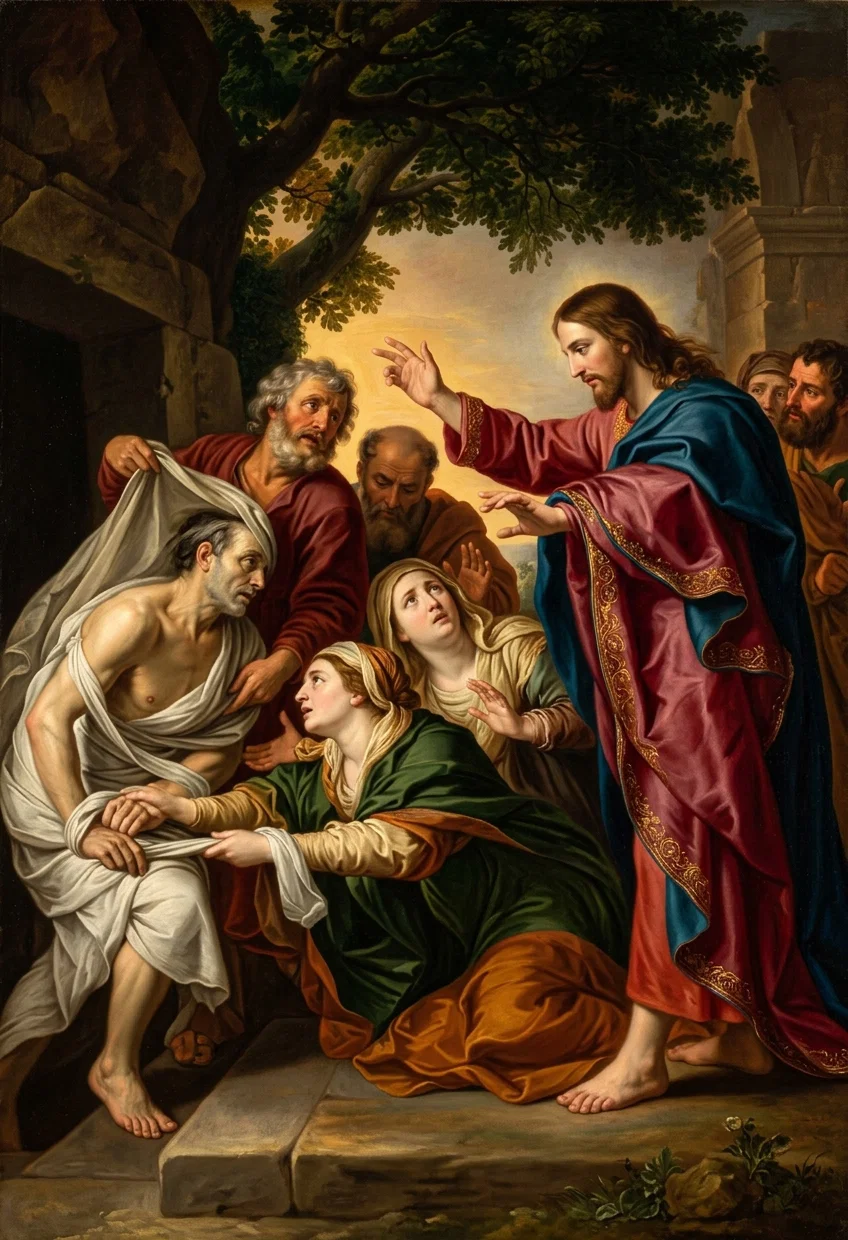
TWILIGHT gathered. The shadows lengthened across the landscape, and wrapped the hills in peace and quiet. Shadows were gathering, too, in the little home at Bethany,—the shadows of sorrow; for Lazarus lay at the point of death. Martha, at the bedside of her brother, watched with intense anxiety as he grew weaker. O, if the Master would only come! Mary was listening intently to catch the sound of a familiar step on the threshold, and from time to time she went to the door to peer into the night. But they waited in vain. The Saviour did not come, and the shadows deepened.
He Seemed Unconcerned
Jesus had received the message telling of the illness of His loved friend, but He had gone about His work apparently unconcerned and unmoved by the sad news. The disciples wondered at His seeming indifference. At length, after some days, the Saviour and His companions journeyed toward the little home in Bethany.
On the way, Jesus said to His disciples, “Our friend Lazarus sleepeth; but I go, that I may awake him out of sleep.” At these gentle words, they realized that their Master had not forgotten His friends in their trouble, and that His heart was full of sympathy and tenderness for them in this hour of need; but the disciples did not understand that Jesus was speaking of the death of Lazarus, until He told them plainly, “Lazarus is dead.”
“The Brother Shall Rise Again”
Lazarus, Come Forth
When the little company reached Bethany, and drew near the home of Mary and Martha, Jesus sent word of His arrival. Martha received the news, and unobserved by the mourners, she slipped quietly out. When she caught sight of the Saviour, her sad face brightened; and hastening toward Him, she saw that He wore the same expression of love and tenderness as in time past. Though Lazarus was dead, she still hoped that the Master might do something to relieve their sorrow. “Lord,” she said, “if Thou hadst been here, my brother had not died.” Looking into her tear-stained face, Jesus answered comfortingly, “Thy brother shall rise again.” She replied, “I know that he shall rise again in the resurrection at the last day.” This was her one hope amid the darkness of her sorrow—the hope of the resurrection morning.
Presently Mary also was informed of her Lord’s desire to see her, and she too left the house to seek Jesus. Thinking that she was going to the grave of Lazarus to weep, the mourners followed her, and soon a large company had gathered at the entrance to the tomb. It was a cave in a huge rock, with a stone at its mouth.
“Lazarus, Come Forth”
Now the time had come for the great Life-giver to manifest His power. He commanded that the stone be rolled away from the grave. Then, standing at the opening, He called clearly, “Lazarus, come forth.” The strength and sweetness of that familiar voice, which had so often brought joy to the peaceful home at Bethany, penetrated to the ears of the sleeper, and awakened him to new life and vigor. The chains of death could no longer hold him, and he came forth well and strong.
Then what a time of thanksgiving and rejoicing! The dead alive again, home ties united, sunshine for shadow, the oil of joy for the spirit of mourning! And all because the Saviour came that day!
Asleep Till the Life-Giver Comes
Christ referred to the death of Lazarus as a sleep; and such is death often called in the Bible. It is a state of unconsciousness, of peace and quiet. Our friends and loved ones who have fallen asleep in Jesus are resting sweetly, wrapped in dreamless slumber while awaiting the voice of the great Life-giver in the resurrection morning. If they had gone before us to their reward in glory, there would be no need of a resurrection, for they would already be enjoying the bliss of heaven.
The resurrection of Lazarus is a pledge of the great awakening that will take place at our Saviour’s coming. On that day, those who sleep in the dust of the earth shall hear His voice, and shall come forth; not with the diseased bodies with which they went down in death, but clothed in light and beauty.
Lazarus, though raised from the dead, was still subject to death; but those whom the Saviour awakes at His appearing, will be freed forever from the power of the grave. He who said, “I am the resurrection, and the life,” has conquered death, and through that victory, has made it possible for His children also to be conquerors and to live eternally.
Since His coming will work such wondrous transformation, and bring such joy, is it strange that His people should long for that time, when they shall see their Lord and Saviour? Can the Christian do aught but rejoice that only a little way in the future is the glad reunion?
“The mossy old graves where the pilgrims sleep
Shall be opened as wide as before,
And the millions that sleep in the mighty deep
Shall live on the earth once more.”
Photo by H. L. Transtrom
Old Milldam near Washington Missionary College
Be Prepared for the Day
By May Wheeler
A Prize Within Our Grasp—Indifference and Delay May Lose It for Us
By May Wheeler
CHRIST has promised, in His word, that He is coming again to take the faithful to a home with Him. Evidences all show that His coming is near, “even at the door.” He has given us signs of the nearness of the event, so that we may make preparation for His coming, and be ready to meet Him.
Some do not heed or notice these signs, and say, “My Lord delayeth His coming.” They put off the needed preparation, thereby running the risk of losing their own souls, and causing loss of salvation to others.
FAILED TO HAVE THE POWDER
The story is told of a keeper of a life-saving station, who one day found that he was out of powder. The next village was two or three miles away, and he concluded that it was “not worth while to go so far expressly for such a trifle.” That night a ship was wrecked in sight of the station. A line might have been shot to the crew, but there was no powder. The keeper was not prepared. He saw the men perishing one by one, and knew that he alone was to blame.
How many are now going along in the same careless way, putting off the needed preparation, although this neglect will result in their eternal loss!
They are living only for this world, not realizing that they must soon stand before the “judgment seat of Christ.” Rom. 14: 10.
How will those feel who have spent all their energies in the laying up of wealth, in the gaining of honor, or in seeking the things of this world, when probation ceases, and they have no longer opportunity to accept of the salvation that had been so freely offered them? Of what value to them then will be their riches and honor?
TREASURE IN THE RIGHT PLACE
Let us remember the injunction of the Saviour. “Lay not up for yourselves treasures upon earth, where moth and rust doth corrupt, and where thieves break through and steal; but lay up for yourselves treasures in heaven, where neither moth nor rust doth corrupt, and where thieves do not break through nor steal.” When we lay up treasure in heaven, then we know it is safe; for no one can take it from us.
LOVERS WILL WATCH
But while some are paying no attention to the tokens of Christ’s soon coming, those who love Him will be watching for Him, and gladly noting the signs of His appearing.
How wonderful it is to think that we may look forward to beholding Christ ourselves, the One who loves us and died for us, coming in the clouds of heaven, to put an end to all sin and suffering!
Christ has told us to “watch and pray.” Watching signifies readiness, and He has told us how to get ready. We read in His word, “And every man that hath this hope in him purifieth himself, even as He is pure.” How much this means!
In view of the beautiful home awaiting us if faithful, is it not well worth while to put forth every effort to perfect that character which Christ may accept, and count worthy to enter the holy city?
We shall have trials to meet and difficulties to overcome while here, but they will appear very small to us when they are all over. Then the wonderful promises which Christ has made to those who overcome will be ours—the promises of being with Him forever, of eternal life, of eternal happiness.
Now is the time for preparation.
Eternal Home of the Saved
By Laura Patterson
Conditions of the Future—Existence in the Kingdom of Peace
By Laura Patterson
ALL about us we see events taking place which to the student of prophecy indicate that the end of earthly governments is at hand, and that erelong Christ will come and set up His everlasting kingdom. Just what this will mean to the Christian is of interest to every follower of Christ.
Jesus said that at His return to this world, He would gather His elect from all parts of the earth, and receive them to Himself, that they might ever be with Him. Some of the questions which naturally come to our minds are: Where will the home with Christ be? What will it be like? What will be the nature of our existence in it?
GO TO HEAVEN IN A BODY
In 1 Thess. 4: 16, 17, we read that as the Lord approaches this earth the second time, the dead in Christ hear His voice, and come forth from their graves, and together with the living righteous, are taken to heaven to be with their Lord. That, however, is not to be their permanent home; for they are to inherit the promise made to Abraham that the whole earth should belong to him and to his seed.
From scenes shown to the revelator, we learn that for one thousand years the saints remain in heaven, and at the end of that time they descend to the earth in the holy city, the New Jerusalem. As fire comes down from God out of heaven and destroys the wicked, this earth is melted and purified. Then the saved will behold the power of God as He makes all things new. The same voice which in the beginning spoke and it was, commanded and it stood fast, will from the ruins of this earth create a new earth, which will have all the beauty and loveliness of the Garden of Eden.
WILL ENJOY THEIR OWN HOUSES
The prophet Isaiah, in describing the new earth, says that the desert shall blossom as the rose, and in the dry places shall be springs of water. There will be no more wide stretches of waste and unproductive land. The whole earth will be fertile, and will yield abundantly of its fruits. Isaiah further says: “They shall build houses, and inhabit them; and they shall plant vineyards, and eat the fruit of them. They shall not build, and another inhabit; they shall not plant, and another eat: for as the days of a tree are the days of My people, and Mine elect shall long enjoy the work of their hands.”
How different is this picture from the conditions of this present life! Here many have built and planted, hoping for joy and happiness as a reward for their labors, only to find that the pleasure which they had expected, was wanting. Or perhaps they have died just as they seemed about to realize their desires, and others have enjoyed the results of their efforts. Not so will it be there; for there we shall find the satisfaction of being able to realize our highest ideals. Then, too, we shall enjoy that perfection of character for which we have striven here; and with sin forever destroyed, we shall delight in the companionship of those who have shared with us this desire for a nobler and purer atmosphere than that of this world.
NONE TO HURT OR DESTROY
The best and noblest of people have desired to see an end of war, with all its terrible results. Still the awful slaughter of human life continues. This desire of Christians for universal peace is to be granted only when the earth is made new; for there “they shall not hurt nor destroy.” Death, the last enemy of man, will have been destroyed; and instead of weeping, the ransomed of the Lord shall be crowned with everlasting joy.
Besides their country home, of which Isaiah wrote, the redeemed will have a home in the New Jerusalem, the capital of the new earth. This city, as it was shown to the apostle John, will surpass in glory and splendor any earthly city. Here will be the throne of God; and from week to week, and from month to month, all the inhabitants of the earth will come to worship before the Lord. The waters of the river of life will flow from the throne, and on either bank will be found the tree of life, which will yield twelve kinds of fruit every year.
Those who eat of this fruit, and drink of the water of life, will never become weary nor old, but will always have the vigor of youth. As the years pass by, and their capacity for enjoyment increases with their knowledge of God and the wonders of redeeming love, their happiness will continue to increase. Every heart and voice will unite in singing, “Blessing, and honor, and glory, and power, be unto Him that sitteth upon the throne, and unto the Lamb forever and ever.”
MOHAMMEDAN TURKS IN CONSTANTINOPLE
All Islam Expects His Coming
By Melvin Munson
The Whole Mohammedan World Looking for Christ’s Return—The Judgment Day in Their Faith
By Melvin Munson
Two hundred thirty million Moslems scattered over the world to-day, are looking for the early return of Jesus, the Messiah. The Koran, the sacred book of Mohammed, in its many references to the life of Jesus, emphasizes the miraculous elements of His birth, ministry, and death; and it reverences the Christ of Nazareth as the Son of God. To the Mohammedan, Jesus of course takes second place to their prophet of Mecca; and although the Christ of the Koran is not the true Christ of the Bible, many Christian truths have embedded themselves in the teachings of Mohammed.
THE JUDGMENT IN THEIR CREED
The doctrine of the last Judgment looms up conspicuously in the creed of Islam, and has a large place in the minds of its followers. Samuel M. Zwemer, who was for sixteen years a missionary in Arabia, tersely states this phase of their belief as follows: “Connected with the day of Judgment are the signs of its approach; namely, the coming of the antichrist, the return of Jesus as a Moslem prince, the rising of the sun in the west, the war of Gog and Magog, and similar events.”
From the above quotation, we recognize truths similar to those taught in the Bible; and as all Adventists anticipate the second coming of Christ as the great event that will bring immortality to all Christ’s true followers, so the Moslem world look forward to the appearance of “Nābi Isa,” the prophet Jesus, as a Moslem prince, as the sign of deliverance to all the faithful of Islam.
NON-CHRISTIANS HOLDING A CHRISTIAN DOCTRINE
Animistic fetish worship; hoary Hinduism, with its gods innumerable; Buddhism, the paling “light of Asia”; and Confucianism, with “the clustered wisdom of the ages,”—these all hold the minds of the Oriental masses; but Mohammedanism stands alone among non-Christian religions of the world in the belief that Jesus will soon return.
But, strange to say, this point of contact between Islam and Christianity makes mission work among the Moslems the more difficult. The gospel of Christ appears no more attractive to the average Mohammedan than does his own faith. There are reasons for this.
Mohammed saw, as many of his followers to-day see, much contradiction in the faith and in the practice of many professed Christians; and this fact, bolstered up by a blind self-righteousness, characteristic of the devout Moslem, depreciates the value of the gospel, and closes many doors to Christian missions.
But on the other hand, the many points of contact between Christianity and Mohammedanism lend emphasis to the gospel; for they pave the way by tearing down the gods of heathenism, and putting in their place the one true God who dwells in heaven.
The doctrine, then, of Christ’s second coming is not the peculiar teaching of a few Christian sects. There are more Moslems to-day who believe in the immediate return of the Messiah than there are Christians who believe in the true premillennial return of Christ. Islam, however, looks with fearful forebodings to the coming Judgment; while the true Christian to-day joyfully waits, “looking for that blessed hope, and the glorious appearing of the great God and our Saviour Jesus Christ.”
Unwritten Music
By Josef W. Hall
Story of a Heroic Struggle
By Josef W. Hall
(With respects to K. M. Adams)
PETER Ivanhoff dragged himself slowly home from the concert hall. True, he had found employment for a few days. While it lasted, he would at least be assured of his tenement and two meals a day. But there was nothing left—not a cent for the wife and boy still in Poland, who were bravely struggling and waiting until he could send for them.
He entered his room, closed the door softly, and went to the corner. On top of the piano, the sole article of furniture in the room worthy the name, stood a framed photograph of his wife and boy. Peter sat down at the piano and gazed at it.
“My dear ones,” he sighed, “when shall I see you again?”
Naturally his fingers went to the keyboard. It responded to their touch, and soon the music was taking him to far-off scenes.
Now it pictured an old garden, and a woman standing with the moonlight playing about her cheeks. Again it was reproducing the voice of a child,—a wonderfully sweet voice, which Ivanhoff had vowed to train into the greatest contralto in the world. It hurt him worse than his fruitless struggle to reunite the family,—worse than his own disappointed ambitions,—to think of the boy’s talent, compelled to go undeveloped.
A sudden knock interrupted the reverie.
“Come,” called the musician, turning to the door.
“What, Peter! Does your new work fag you out like this?” was the hearty greeting of the newcomer. “No, I won’t come in. Wanted to tell you about Maurice. Have you heard about Maurice?”
“The poor Jew next door?”
“Poor no longer. He’s just marketed a composition that will bring him thousands and is already making him famous. Don’t know what it is like—haven’t heard it yet. Got the ‘very devil’ in it, so they say. Well, may your turn come next—or mine, Peter. Good night.”
Peter whirled back in his stool.
“Got the very devil in it!” he repeated. “Yes, that’s the kind they want. There is no more reward for art here than in the old country, and no appreciation at all—no respect for the musician. Only the sensual they love, or the strange—something with the ‘devil in it.’”
Involuntarily his hands began to strike some chords. One after another they came, until Peter was amazed at his power of creation. A strange feeling crept over him. His heart seemed to grow cold and merciless, and a cynical hatred that he could not317resist took possession of his mind. He seized some blank score sheets, and seemingly without effort, wrote page after page of what came to him. When he had finished, he stood awed and terror-stricken at what he had done. Man had never written such music before.
Scene on the Sligo, Near the College
It echoed the licentious, unclean thoughts of a depraved wretch, and the insolence of a demon. All the horrible cruelties of savagery were there; all the sorceries that have ever maddened the reason. The lost hopes, the unreached aims, the fruitless tears, broken hearts, and vain self-reproaches of all the ages of the misery of mankind were represented. Even all the pains of the brute world seemed to be shrieked out in the harmonies. There were the despairing sobs of the lost at the Judgment. Then the music suddenly grew hard and cynical, expressing the hopeless hatred and blasphemous effrontery of a damned soul, cursing its Creator.
“What have I done?” whispered Ivanhoff to himself.
A voice within him spoke so loud that it startled him, and he jumped from his seat, brushing the perspiration from his forehead.
“Made yourself great,” said the voice coldly. “Last night it was Maurice, but Ivanhoff is far the greater. You have destroyed hope, crushed faith, showed that love is a passion, friendship is greed, and God is a revenging tyrant. And you have made yourself the greatest artist that the world has ever known.”
Ivanhoff looked up at the picture. “Our struggle is over,” he muttered. “Now you shall come.” But the well-known faces seemed suddenly to irritate some bestial nature that had seized him. “Ugh! Why, you look hideous. I don’t need you now, anyhow. And the boy—I can’t waste my time and talent now on the training of his voice.”
Then, with a terrific effort, he came to himself. “What were you saying?” he addressed the voice.
“Wealth and honor—and men will have your bust in every—” Suddenly it grew faint and died out.
Ivanhoff, bending low over the charcoal fire, was tearing the score into long, narrow strips. Soon he returned to the piano, dropped his head on the keyboard, and sobbed—as he had once sobbed when, as a child, he had lost the last coin his mother had for bread.
Gradually the ferocious melodies charging through his mind softened. A strain of hope came in, then trust, and voice against voice was added to the chorus, until the triumphal strain of love swelled out in mighty volume. Another voice was added—a woman’s soft voice, sweetened by suffering. And as he listened, he distinguished a rich contralto, untrained and free, pouring out the pure praise of the soul of a child.
The sobs ceased, and Peter looked up long and fondly at the picture.
When Our Brother Comes
By Ida M. Blandford
By Ida M. Blandford
IF we were expecting a very dear friend, who had promised to pay us a visit, what would we be doing?
Suppose it were an older brother whom we have never seen. We have heard of him from others, and have also received letters from him, through which we have learned to love him. We have read his letters over and over again, to learn his likes and dislikes, that we might plan everything about the house in such a way that he will be pleased and feel at home when he comes. Our thoughts are of him continually; for we have learned, from his letters, that he is coming soon, and how anxiously we look forward to that day!
So it is with Jesus. He is more to us than any earthly brother or friend; though many of us do not appreciate this. He has written us a wonderful letter, in which He tells us of His love for us, and also that He is coming back to this earth. We are anxious to see Him, and are busy putting out of our lives those things which we have learned, from His letter, the Bible, will displease Him, or make Him ashamed of us, who have been adopted into His family.
The Pilot’s Smile
“BLESSED is he who, in the midst of earthly stress and storm, can say with assurance, ‘I have seen the face of the Pilot, and He smiled.’”