Your ShelfYour Projects

Review and Herald, Vol. 91, No. 4.

Temperance Annual
Earlier text: Holding Our Ground

Shanghai, China

K. H. WOOD
EARLY in September, Brother F. E. Stafford and the writer began to lay plans for conducting a series of meetings in Shanghai. After some difficulty, we were successful in securing for this purpose a commodious foreign building on one of the main streets of the city.
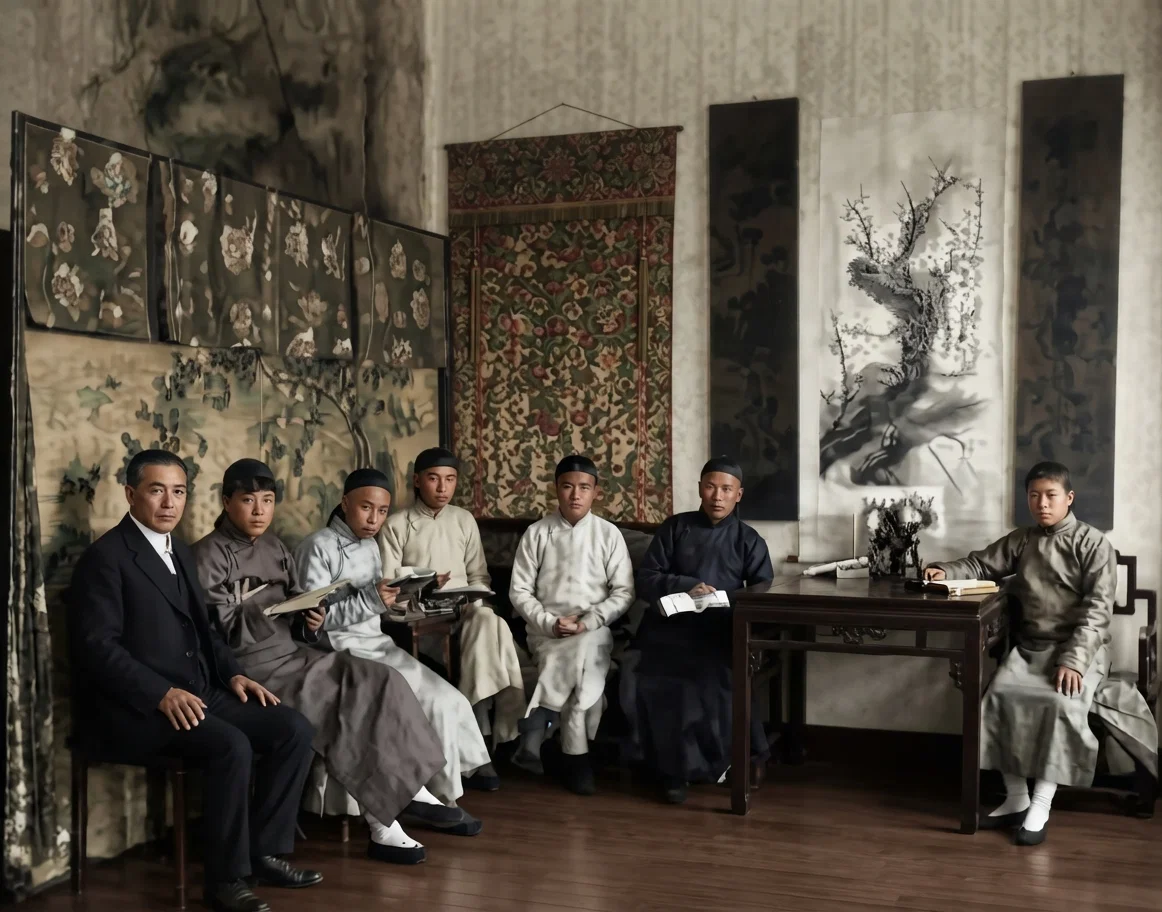
CLASS STUDYING THE MESSAGE IN THE GREAT ROOM IN RENTED CHAPEL, SHANGHAI.
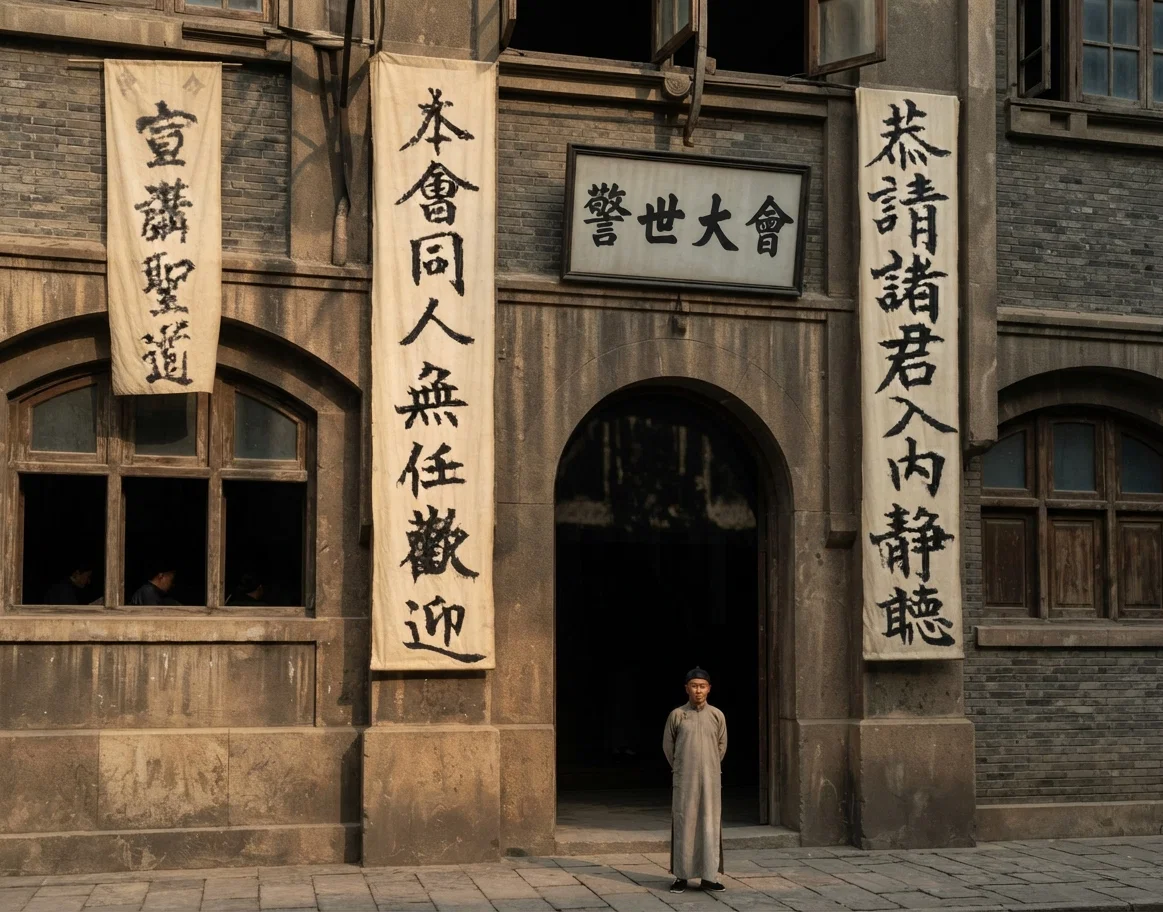
As is the custom in China when opening a business meeting or meetings of any kind, we decorated the outside of the chapel with evergreen and flowers, and the inside with bamboo branches.
Posters and window cards advertising the services were scattered over a large portion of the city. We also hired a man to carry a large flag through the streets announcing the coming meetings.
“The Chapel of the Great Warning” was the name given our hall, and this alone drew many curious hearers, as the events of the recent rebellion in China were still fresh in the minds of the people.
From the first, the meetings have been well attended, and many times standing room has been at a premium after some two hundred persons have been seated.
No doubt our congregation would be quite interesting to our friends in the homeland, as it is composed of nearly all classes of Chinese. On the front seat may be seen two or three little blacksmith boys, with faces as black as the smoke in which they work. Again, a trio of Buddhist priests may take their place among the hearers. They do not seem certain that they are in just the right place at a Christian meeting, but are perhaps interested to hear of a power above men, spirits, or demons. Then, there are a number of coolies, with their long queues, who sit during the entire service with their caps on. However, the majority of those who attend are well-educated business men or of the teacher class, and many show marked interest in the truths presented.
We have adopted the plan of distributing cards among those who seem interested. On these they write their names and addresses, and by this signify their desire to learn more of this great warning message which is going to all the world. This gives an opportunity for us to visit them, and to follow up the interest. Many who made their start in the Christian life by signing these cards have attended the services regularly, and are now coming to the Sabbath meetings.
We have set apart the Friday evening meetings for interested inquirers only, and at every such service there are good testimonies and prayers offered, thanking God that this great truth has been given them.
One evening each week is used for a general prayer and social service, and it is encouraging to hear those who only a short time ago knew nothing of Christ, now praising his name for the great sacrifice he made that they might have eternal life.
There has also been a good attendance at the Sunday afternoon service for English-speaking Chinese. This service is followed by a stereopticon lecture in the evening, on the Signs of the Times, Life of Christ, or some other subject that can be well illustrated. This meeting seems to renew the interest for the following week; and at the present writing, after six weeks' meetings, we have many encouraging omens, some in new Sabbath keepers, and others in those who are intensely interested, but who need more instruction as to just what a Christian's life should be in this world of sin.
CHAPEL IN SHANGHAI WHERE MEETINGS WERE HELD; ALSO GROUP OF WORKERS CONDUCTING THEM
Although there is much for encouragement, there are also many forces working to hinder our efforts. We have encountered much antichristian influence from those who pose as Christian societies and teachers.
A young man brought us a Bible study prepared by one of these societies, and asked for some explanations. We did not wonder that he was somewhat confused, for in this study the name of Christ was included with the names of Buddha, Mohammed, and Confucius as "the four holy men whom God has used to reveal himself to men." In this, one may see the same commingling of paganism and Christianity as that which gave the world the Sunday rest day in the time of Constantine, in lieu of the Sabbath of the Lord.
It is truly a pity that, when there is an opportunity to give the pure gospel to this people, it should not be presented in such a manner as to leave no doubt in their minds as to what is Christianity and what is heathenism.
When we look about us and see the great amount of work to be done, and the few workers to do it, we feel to pray that more of our young men and women may realize their duty toward this benighted race, and help in giving it the gospel before the day of opportunity is past and it will be forever too late.

Remember the Sabbath Day

Commenting upon the use of the word remember in connection with the fourth commandment, Henry T. Scholl, D. D., in the Christian Observer of Dec. 24, 1913, says:—
The use of "remember," in connection with the fourth commandment, "implies that the weekly rest day was not a new institution." It was observed before Sinai was reached. "The Sabbath," says H. Clay Trumbull, "was a recognized institution long before the days of Moses. Traces of its strict observance in the ancestral home of Abraham are disclosed in the Assyrian records unearthed in these later days."

Mexican Federal Army Evacuates Ojinaga

On the night of January 10, the Mexican federal army evacuated Ojinaga, the majority crossing the boundary into Texas, and surrendering to the Americans. Columns of rebel cavalry are scouring the surrounding country, rounding up fleeing federals. Twenty-eight hundred fugitive soldiers and about 1,500 civilian refugees are in custody of the United States Army border patrol. The Japanese have landed an armed guard from their battle cruiser, "Idzuma" for the protection of Japan's legation at Mexico City. The incident is known to be the cause of much anxiety to the State, War, and Navy Departments.

A Moon Festival Celebration

JAMES E. SHULTZ
THE middle of September we experienced our first heathen festival celebration in China. The occasion was the celebration of the festival of the new moon. It is usually a very joyous occasion; especially is this the case in the autumn, as it is also the harvest season of the year. But at this time, just as the celebration began, the moon suffered a total eclipse. It was a very peculiar eclipse as witnessed here, bringing vividly to mind the prophecies of the Word concerning the darkening of the sun and the turning of the moon into blood before that great and memorable day of the Lord.
Immediately the scene of mirth became one of perplexity. Incantations were chanted, gongs clanged, trumpets were blown, and the endless succession of exploding firecrackers made weird the night with one vast bedlam. Tradition teaches that an eclipse is occasioned by the appearance of a mammoth dog which makes its way through the heavens and seizes the moon in an effort to devour it. Should the effort be successful, the world would be without a moon; hence their anxiety to frighten the animal away, which they seek to accomplish by the medley I have described. And this is still believed by a majority of China's millions today, despite the fact that China boasts herself a republic.
As I stood contemplating the scene, I could but reflect upon the need of a people whose heart longings seek expression in such crude ways. I conceived that Sinim was confessing her deplorable lack, and appealing for protection against an evil day that shall try men's souls. Truly this is a needy people, a people ready to perish. Our prayer is that God's blessing may be ours as we endeavor to exalt the Christ before those who are perishing.

In the Theiss-Save Mission

GUY DAIL
THIS evening we successfully closed the second annual session of the Theiss-Save Mission, held here in the fine city of Temesvar, Hungary, November 19-23. At the beginning, difficulty was experienced in securing permission from the city government for the meeting and the accompanying lectures that had been somewhat prematurely announced by the printers' posting up our large handbills too soon. The officials at first refused to accord us the right of assembling (the larger number of the people are Roman Catholic), and we were plainly told that there were already enough "sects" in the town. Our brethren replied, however, that this question had nothing whatever to do with the matter, inasmuch as the Hungarian law allows perfect religious liberty; and by the successful interposition of one of the leading aldermen in our behalf, the necessary permission was granted at the last moment. For this we all thanked God.
The lectures were held in the most beautiful hall of the city. The strangers in attendance represented the higher classes; government officials, military officers, clergymen, one of the city editors, and students being in the audience. The interest awakened will be followed up by a series of lectures.
Most of our one hundred and seventy-six believers in the Theiss-Save field are Servians. Servia itself is a part of the territory in this mission. We were pleased to welcome several members of our Belgrade church, and were sorry that military restrictions prevented the coming of our brethren from the interior of Servia. There were also quite a number of Roumanians, Hungarians, and Germans at the conference. The proceedings of the meeting had to be held in these four languages,—Servian, Roumanian, German, and Hungarian. The message shows its power by the peace and unity it has brought to these believers who belong to such conflicting nationalities.
There has been hard work performed by the one ordained minister, three evangelists, and four Bible workers assisting Supt. R. Schillinger in scattering present truth among the four millions living within the borders of their field. There were six baptized at the meeting, making fifty-one thus received since Jan. 1, 1913.
Sabbath was the great day of the conference. The brethren had already given evidence of their love for the message by raising one thousand and four crowns for missions before voting on the resolution supporting the ten-cent-a-week plan. Brother Boettcher spoke on the cleansing of the leprosy of sin, and the Spirit of God sent conviction to the hearts of believers and friends, and a number renewed their consecration to the Lord, and others gave their hearts to the Master for the first time.
Brethren Huenergardt, Boex, and Braun were on the ground from abroad, to assist Elder Boettcher and the local workers in making the conference a success. The canvassing work especially has made great strides here, and the financial condition of the field has very materially strengthened since last year.
At the meeting one worker received telegraphic word of the death of his wife, who had been ill with consumption for two years, and another worker was handed a dispatch to report for army service. This man had formerly become an American citizen, but because of his love for the message, had renounced his rights as an American, and had again been enrolled among his own native countrymen, supposing that he would be free from the military service; however, immediately on being summoned, he left the conference and reported to his regiment for duty,—a practical illustration of the method we all ought to employ in entering the army of Jehovah, to endure hardness as good soldiers of Jesus Christ, the Captain of our salvation. We expect the coming year to be far better than any the Theiss-Save Mission has had. May God grant it.

Our English School in India

H. R. SALISBURY
I HAVE just returned to Lucknow from a visit to our English school in the Mussoorie hill station. The school has been in operation three years. The first year it had eleven pupils, last year twenty-two, and this year forty-five. The building is far too small, so that the past year we have rented a building near our own school for the boys, and even then I found the girls' building so crowded that Mrs. Bruce, the head mistress, and several girls were obliged to sleep on the porch for want of room. Next year I fear they will be even more crowded, as many applications are coming in. The school is a great blessing to our missionaries, for they are able to keep their children with them in India and give them a Christian education in a most healthful location.
Mussoorie, where our school is located, is one of the largest hill stations in India where Europeans go during the hot months of the year. Here the children spend the entire hot season in school in the mountains away from the great heat of the plains. The school year is from March to November, so the pupils can spend the winter months on the plains, giving them a delightful climate the year round. I never saw a healthier, more contented company of boys and girls.
On each Sabbath they march in a body with their teachers nearly a mile through the town to our chapel, and people are often heard to remark how well those children, who are all vegetarians, look. Because of this, Mrs. Bruce has had requests from parents not of our faith who wish to send pupils, but with two or three exceptions she has had to refuse on account of lack of room.
Besides the regular subjects taught in the school, we have also classes in Urdu (Hindustani), the lingua franca of India.
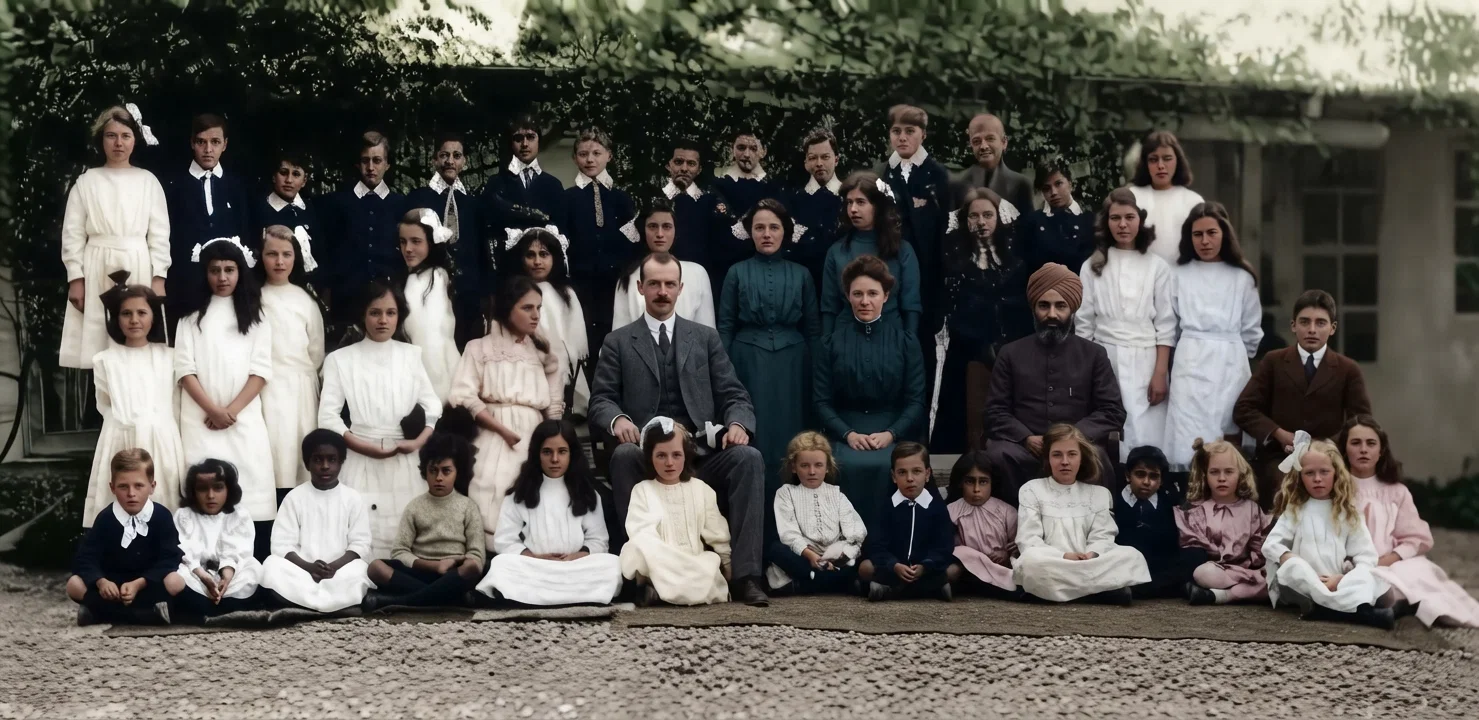
INSTRUCTORS AND PUPILS IN OUR ENGLISH SCHOOL AT MUSSOORIE
The teacher of Urdu (the second from the right in the photograph, seated beside the head mistress) is a Mohammedan, Mohammed Bashier Alla Khan, who has taken so great an interest in our school that he has sent his sons to us, knowing that the principles of Christian education enter into all our class work. Even his wife, who, being a Mohammedan woman, was in purdah (veiled) and not allowed to be seen, showed her friendliness by preparing a dinner of an abundance of most excellent food and sending it to us while I was visiting the school. We watch hopefully these signs of friendship, believing they are the beginnings of God's answer to our prayers that many from Islam may be led to accept the Saviour of mankind.
I am glad we have this school, and glad for the prosperity that has attended its work, for it is not the will of God that while we are striving in this land of great spiritual darkness to bring those to Christ who are afar off, we should neglect those who are within our own gates.

The Espirito Santo General Meeting

F. W. SPIES
According to previous appointment, the general meeting for the state of Espirito Santo, Brazil, was held November 4-9, at Serro Pellado.
Elder Henry Meyer, Brother Jacob Peters and wife, and the writer reached Victoria, the capital of the state, as early as October 22. This gave sufficient time to move Brother Peters's baggage, which had to be done on muleback, to Serro Pellado, where he and Sister Peters went to take charge of the school. Arriving thus early also permitted us to visit the members of the Santa Maria church, as well as the Manteigo company and the believers scattered along the small stream Laranja da Terra.
At the beginning of the general meeting on November 4, a goodly number of brethren had arrived, and the tent, 20 x 45 ft., which the brethren had themselves made and nicely decorated for the occasion, was well filled.
During each day of the meeting a study on some important topic was given in the morning. In the afternoon, papers were read on various topics relating to church, Sabbath school, missionary, and young people's work, and after the reading of the papers the subject was given over to general discussion. In the evening a sermon setting forth some important feature of our truth closed the day's program.
The days of the meeting were certainly days of blessing to the brethren who were assembled at Serro Pellado, and especially was this true of the Sabbath. Many who had grown cold and indifferent consecrated themselves anew to the Master, and also a few who had given up the truth made a new start. Some confessed definite sins, and all seemed to desire to get nearer to the Lord and to be ready for his coming.
After the Sabbath afternoon meeting Elder Meyer buried six persons with their Master in baptism, and these, with six or seven others who were already baptized, brought the membership of the Serro Pellado church up to eighty-four, which makes this church the largest one we have in Brazil at this time.
During our stay, Brother Peters, assisted by Elder Meyer, organized a church school with thirty-four pupils; and a number of the grown young people also planned to take special studies in order better to fit themselves for life's duties. A young people's society was organized. We trust Brother and Sister Peters's coming will be a source of strength to the work in the entire state of Espirito Santo, and especially to the youth.
During the general meeting we learned that a number of brethren had recently come to Espirito Santo from Germany, as immigrants. On my way back to Sao Paulo I passed through the section where they were said to reside. While yet four miles distant from where they lived, I met one of their number, and from him learned that there were nine families in the Guander district. I succeeded in getting all together for a meeting on the evening of November 11, and organized them into a church of twenty-two members. Brother Koppe, who was formerly elder of the Essen (Germany) church, was elected elder. And of the twenty-two members, thirteen had formerly been members of the Essen church. May the Lord bless these brethren as they come to a new country to make it their home.
My visit to Espirito Santo at this time was made after an absence of almost three years, and I was certainly glad to meet once more these dear brethren with whom I had spent many a blessed hour.
At Serro Pellado Elder Meyer and I separated, I returning to Sao Paulo, he, accompanied by Brother C. C. Specht, going on to the Theophilo Ottoni church, where Brother and Sister Specht are expected to do a work similar to what Brother and Sister Peters are doing in Serro Pellado. May the Lord abundantly bless them and make them a blessing is my prayer.
The missionaries who recently arrived in Brazil are of good courage, and are hard at work studying the language. They hope soon to be able to engage in active work. Looking at the prospect before us, we are of good courage, and expect great things for Brazil in the near future.

The Beatitude of the Christian

Most of all, I wish the happiness of a contented spirit, the calm rapture of being able to accept life's crosses without bitterness and its crowns without vanity, greeting each new day with a cheer, believing in the Father's house at the end of the road, and his rewarding smile. This is the beatitude of the Christian.—George Clark Peck.

How to Escape Influenza

A. B. OLSEN, M. D., D. P. H.
THERE are three facts of vital importance with regard to influenza which very few recognize.
The first fact of supreme importance is that influenza is a very serious disorder; and if we take into consideration, as we ought, the disastrous after results that frequently follow, we must look upon influenza as a comparatively fatal disease.
The second vital fact is that influenza is a typical germ disease, and that it is both contagious and infectious, and therefore readily spreads from man to man.
The third and perhaps most important fact of all is that fresh air and the outdoor life are the best preventives and antidotes for influenza.

A Serious Disease

Not until people begin to recognize the serious and even grave character of influenza shall we be able to accomplish much in diminishing its mortality. There is every reason to believe that influenza is quite as "catching" as smallpox or scarlet fever, and infinitely more so than typhoid. Nevertheless, practically no effort is ever made to isolate the patient, as would be done in a smallpox case, and thus protect the family, the relatives, the friends, and the public generally from the contagion.
Influenza is at the present time one of the most prevalent, if not the most prevalent, of winter epidemics, and the toll of deaths which can be traced directly or indirectly to influenza is a very large one, much larger than is ever appreciated by the public. According to Dr. M. K. Robinson, M. O. H., the deaths in Dover, England, from influenza for the first quarter of 1913 amounted to just over eleven per cent of the total mortality, or more than one in ten.

Bacillus of Influenza

Influenza is an acute infection caused by a specific microbe called the bacillus of influenza, which chiefly attacks the respiratory passages, causing the well-known local symptoms of a very hard cold. But there are also numerous constitutional symptoms which are due to the distribution by the blood of the poisons generated by the germs. It is this grave poisoning which accounts for the extreme prostration and the severe aches and pains from which the patient suffers.

Isolation

All persons coming in contact with a patient suffering from influenza are extremely liable to catch the disease; and the spread of influenza through the household, through the school, or through the office or workshop, or in other places where people gather daily, is a common occurrence. The only efficient method of controlling the epidemics of influenza is to isolate the patient from the earliest stage of the attack. Just as soon as the head becomes congested and there is sneezing and a general feeling of languor or malaise, or other symptoms of the disorder develop, the patient should promptly return home, go to his bedroom, get into bed, and remain in the room for a period of ten or twelve days, or until the symptoms of the infection have passed. Such treatment is not only wise for the sake of the family and the community, but equally advantageous to the patient, who has a far better chance for a complete recovery than if he attempts to drag around a day or two and tries to keep at work. Complete rest in a well-ventilated room with an abundance of fresh air, plain feeding, and good nursing, affords the best chance of escaping from the grave disorders which are prone to follow an attack of influenza.

The Treatment

Little more needs to be done for the patient than providing the necessary quiet and rest and nursing. A cleansing enema should be given before the patient is put to bed, and repeated daily as long as is necessary. The bed should be warm, and a hot bottle provided if the feet are cold. Daily tepid or warm baths are soothing, and assist in alleviating pain. Hot fomentations and hot packs bring the greatest relief from the intense aching, and may be given as often as necessary. The patient should also be encouraged to drink water freely. Sponging with tepid water or equal parts of alcohol and water serves to refresh the patient and ameliorate the fever.
The diet should be light, and should consist largely of fruit juices, baked apples, stewed fruits, and also fresh fruit, especially oranges, grapes, and mellow pears and apples. Cereal gruels and other preparations may be taken, as well as stale bread, zwieback, and plain biscuits. Albumen water, Metchnikoff soured milk, and plain eggnogs are nutritious and easily digested.

The Best Antidote

We cannot sufficiently emphasize the importance of providing an abundance of fresh air. Those who would escape influenza must cultivate the fresh-air life, and live in the fresh air constantly whether outdoors or not. This means the freest ventilation possible, and the everopen window. There is little danger of taking influenza when out for a tramp in the country or for a row on the sea or the lake, for in the fresh air the microbes are readily dispersed. Fresh air is also of the greatest importance in the sick room, and whether a fire is required or not, the windows must be kept wide open. This does not mean placing the patient in a draft, or in some other way causing a chill, which might bring on bronchitis, pneumonia, or other mischief.

Hotbeds of Infection

But the foul air of close-ventilated or ill-ventilated rooms should be avoided as you would the plague. All overcrowded living rooms, offices, and workshops are simply hotbeds of infection, not only for influenza, but for the common cold, consumption, and many other contagious diseases. The germ-laden, musty, and dusty atmosphere of the average church, chapel, hall, theater, variety house, and cinematograph show, and similar public places of congregation, is always a serious menace to health, and thousands have caught colds, influenza, bronchitis, pneumonia, consumption, or some other infection from visiting these places. If the public would protest against the foul, vitiated air of so many of these public meeting places by remaining away, the authorities concerned would soon provide the necessary ventilation, and would also take care to see that the hall or church or chapel was thoroughly renovated with fresh air before every gathering.

Bracing Effects of Cold Air

Winter is the bracing season of the year, and the majority of people ought to experience an increase of health and strength in the cold weather. If the proper precautions were taken with regard to equable clothing, protection from the damp and wet, and the provision of an abundance of fresh air, we should find winter the healthiest season of the year, and the cold would become a real tonic which would serve to brace us up and invigorate us for the rest of the year. The cold, fresh air is nature's greatest and best tonic, and those who would increase their vitality and fortify themselves against disease should take deep drafts of the cold fresh air daily, and many times a day.

A Gentleman

A GENTLEMAN is a rarer thing than some of us think. Who of us can point out many such in this circle — men whose aims are generous, whose truth is constant and elevated; who can look the world honestly in the face, with an equal manly sympathy for the great and the small? We all know a hundred whose coats are well made, and a score who have excellent manners; but of gentlemen, how many? — Thackeray.

Revival and Reformation at South Lancaster

THE last meeting of a series which continued for ten days with the church at South Lancaster, was held on Sabbath afternoon, January 3. From the very beginning these meetings were of an entirely unusual character. While there was freedom from excitement and impulsiveness, a deep sense of God's presence and of the demands of the times in which we are living rested upon those present. These were indeed solemn assemblies. Conviction took possession of strong men who had stood unmoved for years. Heartfelt confessions were made, with corresponding reformations in the life.
One backslider who for ten years had refused to bow and offer prayer to God, and who had fully determined to give himself to this world and his business, was reclaimed. He has made wrongs right as far as is in his power, and the Spirit of God has come into his life and home. He and his wife have dedicated themselves and all their possessions to God. It is an inspiration to hear the testimony of this man.
Another brother, who was once a laborer in the cause, but who, through offense and discouragements, had given up all hope of eternal life, refused to attend religious meetings, and said he wanted nothing further to do with Seventh-day Adventists, was sought out and invited to "come and see." He came to the meeting. At the first service he appeared to feel out of place, but at the next one the Spirit of God rested upon him, as with tears and a broken and contrite spirit he made his confession.
It is difficult to explain these meetings; they were so much out of the ordinary. The work done went deep, and was not of a superficial nature. The victories gained carried with them in a peculiar sense the assurance of permanency.
At one of the closing meetings, fully thirty confessed their unfaithfulness in the payment of tithes. When the question was asked in regard to how many were neglecting to live up to the best light they had on the principles of health and felt under conviction because of it, and wished to confess and make reform, scores arose. It was a heart-searching time. Every one went about the work of sweeping the rubbish from the heart in a calm, deliberate, and businesslike manner. Considerable house-to-house labor was done, and prayers were offered for the physically and spiritually afflicted in these homes.
At the young people's consecration meeting on Sabbath afternoon, when the invitation was extended for those who desired the baptism of the Holy Spirit for service to come forward, almost the entire congregation arose to press toward the altar. Possibly not more than a dozen were left on the back seats. It was a most impressive scene. The baptism of the Holy Spirit was earnestly sought by mothers for patient, cheerful service in their homes; by teachers for efficiency in their teaching. A deep conviction was felt that the time had come for a united forward movement in God's work.
This church is returning to her first love. We shall expect to see her first works. The hearts of parents are in a special manner turning toward their unsaved children. This movement resulted from the giving of the message addressed to the Laodicean church: "Thou sayest, I am rich, and increased with goods, and have need of nothing; and knowest not that thou art wretched, and miserable, and poor, and blind, and naked: I counsel thee to buy of me gold tried in the fire, that thou mayest be rich; and white raiment, that thou mayest be clothed, and that the shame of thy nakedness do not appear; and anoint thine eyes with eyesalve, that thou mayest see. As many as I love, I rebuke and chasten: be zealous therefore, and repent. Behold, I stand at the door, and knock: if any man hear my voice, and open the door, I will come in to him, and will sup with him, and he with me. To him that overcometh will I grant to sit with me in my throne, even as I also overcame, and am set down with my Father in his throne. He that hath an ear, let him hear what the Spirit saith unto the churches."
Night after night this message was dwelt upon. At first the people sat quietly, seeming to feel that this message did not apply in any special sense to them. But as new features were brought out, and the standard of true piety as revealed in the life of Christ was dwelt upon, the feeling came: "Woe is me! for I am undone; because I am a man of unclean lips, and I dwell in the midst of a people of unclean lips: for mine eyes have seen the King, the Lord of hosts."
It has been demonstrated that there is vitality in this message. We must have a knowledge of ourselves, a knowledge that will lead to contrition of soul, before we shall feel the need of pardon. We must understand our danger, or we shall not flee to the Refuge. This knowledge must come through the message to the Laodicean church, since no man can of himself understand his errors. "We must behold Christ. It is ignorance of him that makes men so uplifted in their own righteousness. When we contemplate his purity and excellence, we shall see our own weakness and poverty and defects as they are. We shall see ourselves lost and hopeless, clad in garments of self-righteousness, like every other sinner." "At every advance step in Christian experience our repentance will deepen. We shall make the apostle's confession our own: 'I know that in me (that is, in my flesh,) dwelleth no good thing,' and 'God forbid that I should glory, save in the cross of our Lord Jesus Christ, by whom the world is crucified unto me, and I unto the world.'"
We are told that "it was by the confession and forsaking of sin, by earnest prayer and consecration of themselves to God, that the early disciples prepared for the Holy Spirit on the day of Pentecost. The same work, only in greater degree, must be done now. Then the human agent had only to ask for the promised blessing and wait for the Lord to perfect the work concerning him. It is God who began the work, and he will finish his work, making man complete in Jesus Christ. Unless we are daily advancing in the exemplification of the active Christian virtues, we shall not recognize the manifestations of the Holy Spirit in the latter rain. It may be falling on hearts all around us, but we shall not discern or receive it." "If we do not place ourselves in an attitude to receive both the former and the latter rain, we shall lose our souls, and the responsibility will lie at our own door."
Everywhere earnest prayers should ascend to God for the baptism of the Spirit. A new and richer experience awaits the praying ones. R. D. QUINN, D. H. KRESS, K. C. RUSSELL, H. C. HARTWELL.

Self-Discipline and Divine Guidance

ONE has truly said: "In the duty of self-discipline I could never train and temper my own spirit if I had not within me One who is himself the director of my soul. I could never curb my own willfulness, if I had not One who is the governor of my will, who besets me behind and before, and lays his hand upon me, to humble me and to prove me and to make me poor in spirit and pure in heart. The task of self-culture would be hopeless, we should despair of the spiritual fabric unless it had a divine architect, unless we could say concerning the house of character that its builder and maker is God."
Continue reading: The Harvest Ingathering