The Youth’s Instructor, Vol. 27, No. 3.

THE TOUCH OF FAITH

The Youth’s Instructor

Jan 15, 1879

S. D. A. Publishing Association · Battle Creek, Mich. · Jan 15, 1879

THE TOUCH OF FAITH.
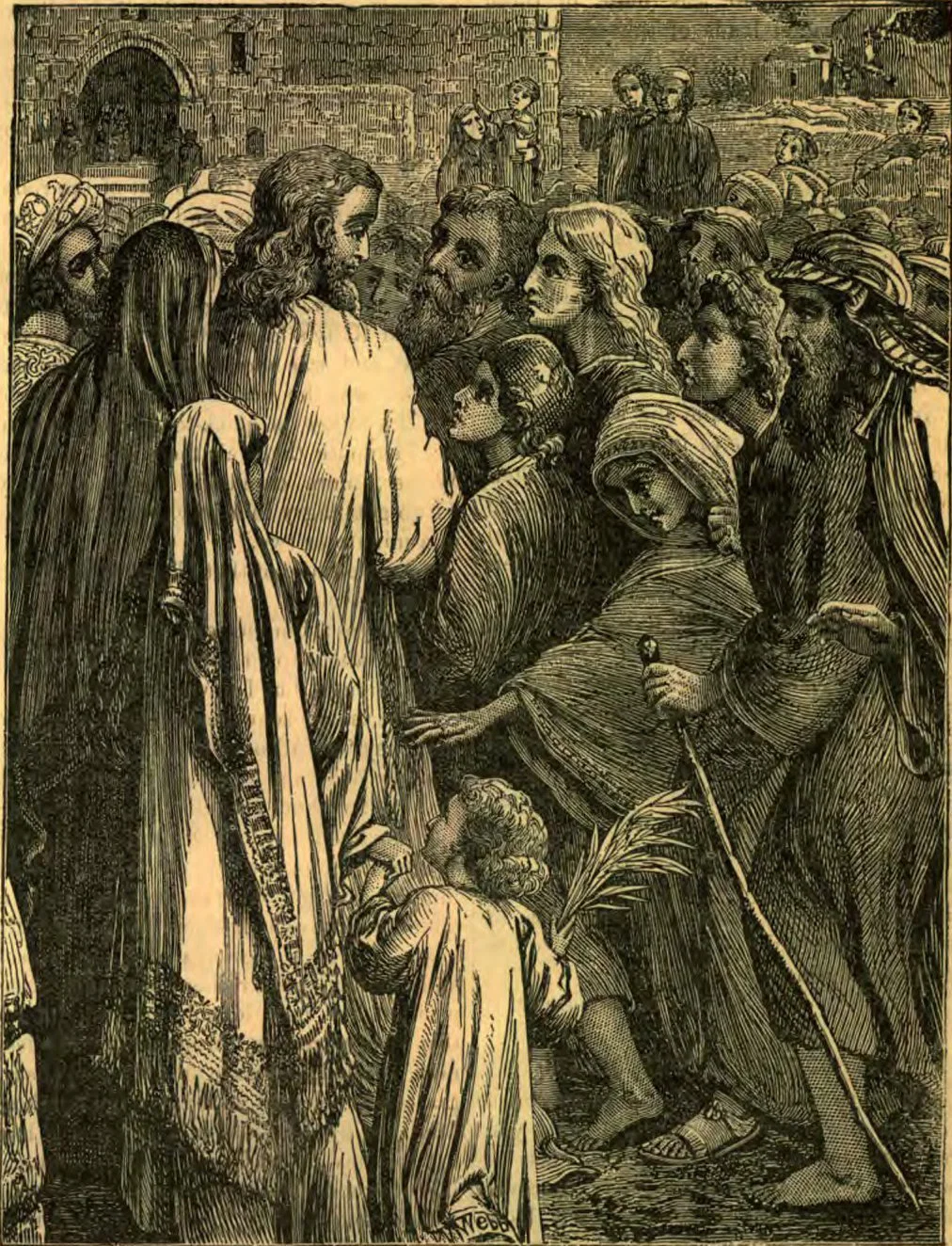
In the throng of people presented in the accompanying picture, there is no difficulty in discovering the prominent form and benevolent face of the Saviour. Multitudes thus pressed about him wherever he went when here upon earth, to listen to his words of wisdom, and to behold, perhaps to share, his acts of blessing.
A poor woman is seen in the picture, stretching forth her hand to touch the Saviour’s garments. She had long been afflicted with a wasting disease. Many physicians had tried to cure her, but had failed. The more they did, the worse she grew. They got her money, and gave her only additional pain and suffering in return. Thus she had spent all her means, and long years of anxiety and sorrow, till hope had given place to despair.
She had heard of Jesus, the great healer. He comes her way. She joins the crowd that press about him. She can do nothing to earn her living or to relieve her affliction, and is daily growing worse. This is her extremity, and now is her opportunity.
But how can she gain his attention in the midst of such a crowd? She said to herself, I will not try to do that; if I can only touch the hem of his garment, I shall be healed. So she pressed through the crowd, and, coming up behind him, as we see her, reached forth her hand and touched him. Instantly, she was healed; but Jesus knew all about it. Turning round, he asked, “Who touched me?” His disciples wondered he should ask that question, when the crowd was jostling and pressing against him on every side. But it was no common touch to which he referred. Many touched him, and received no benefit, because it was not an act of faith; but this woman wanted to be healed, and believed that act would heal her, and touched him in faith; and Jesus knew that touch.
When she saw that she was discovered, she came trembling, and falling down before him told him all. He said to her these kind and cheering words: “Daughter, be of good comfort; thy faith hath made thee whole; go in peace.”
Thus we may come to Jesus with all our wants; and however secretly we may come, he will know it; and whatever may be going on around us, the Lord’s attention is not distracted; but he will notice every act of faith, and help us. Read the story of this woman in Mark 5 : 25-34. U. S.

PRAYING AND LISTENING.

To stretch my hand and touch Him, Though he be far away; To raise my eyes and see him Through darkness as through day; To lift my voice and call him— This is to pray!
To feel a hand extended By One who standeth near; To view the love that shineth In eyes serene and clear; To know that he is calling— This is to hear!

THE BOUNDS OF THE OCEAN.

Comparatively few of the Instructor readers ever saw the ocean, though you have all heard about this great mass of water. What an immense body, to cover three-fourths of the earth’s surface! How terrible it would be if there were no bounds to it!
In the beginning, when the waters were gathered into one great body, the Creator set bounds to the ocean, over which it could not pass. The prophet Jeremiah says, “Fear ye not me? saith the Lord; will ye not tremble at my presence? which have placed the sand for the bound of the sea by a perpetual decree, that it cannot pass it; and though the waves thereof toss themselves, yet can they not prevail; though they roar, yet can they not pass over it.” Chap. 5:22. Similar testimony is found in Job 26:10; 38:8–11; Ps. 104:9.
The truthfulness of this is apparent to every one who has visited the beach. This beach is composed of sand: sometimes in hills, sometimes in gentle undulations; but in any case an effectual barrier to the sea.
As you near the water’s edge, and see the huge waves breaking on the shore, it seems as if nothing could stop them; but God has said, “Hitherto shalt thou come, but no further.”
Thus do all the works of God declare his wisdom and power. E. T. Bedee.

OVER IN A MINUTE.

Kitty had constructed a new swing for her doll’s entertainment; but it proved unsatisfactory, for the wooden lady slipped from her perch and landed with considerable violence upon the table, overturning an inkstand upon a picture which Walter was copying. In an instant Walter sprang to his feet, snatched up the doll, threw it into the fire, and marched out of the room, leaving Kitty in tears and the table in confusion.
In about an hour he returned, gay and sunny as ever, bringing a handsome doll to replace Kitty’s loss. She was easily comforted, and was more sure than ever that Walter was the best brother in the world.
“If a fellow is quick-tempered, why, he is; I suppose that’s all there is of it,” said Walter, more carelessly than penitently. “I do get angry in a jiffy, but it’s all over in a minute or two.”
“Are you sure of that?” asked his grandfather gravely.
“Oh, yes; I’m not one of the sort to go sulking about over anything. I flash up quick enough, but I never bear malice.”
“But the consequences—can you be sure that they ‘are all over in a minute or two?’ I never hear any one speak carelessly of that fault without recalling one scene in my own boyhood. I, too, was quick-tempered, Walter, and, as you say, quick over it—flying into a rage one minute, and ready to laugh at my own tempest of passion the next. I held a high place in my classes, and one day spoke rather boastingly of my position and how long I had kept it; but that very afternoon, through some carelessness, I failed, and gave an answer so absurd that it was received with a burst of laughter. Mortified by my blunder, and vexed at having lost my place, I passed an uncomfortable afternoon; and when school closed, I walked out moodily, inclined to speak to no one, and pretending to be busily whittling.
‘Here comes the infallible! Here’s the fellow that never misses!’ called the teasing voice of a schoolmate; and then he mockingly repeated my absurd answer.
“With all the force of a sudden fury I threw my open knife at him. It just missed his head, and in an instant it was quivering in the tree beside him. The sight of it and of his white, startled face recalled me to my senses, and I sank down upon the ground, covering my face with my hands. The boys gathered about me kindly—even Charlie, the one at whom I had aimed the blow, saying that the fault was more his own than mine. But I knew that only God’s mercy had saved me from seeing my school-mate dead at my feet, and my whole life darkened with the stain of murder.
“For weeks afterward I lived it over in horrible dreams; and to this day, Walter, ungoverned temper can never seem a light thing to me. Anger that is ‘over in a minute,’ may be like a spark of fire on powder, and give you cause for shame and sorrow all your days.”—Sunday School Visitor.

THE RIVER NILE.

The river Nile, known in the Bible as the river Sihor, not only possesses features uncommon to other rivers, but is a subject of prophecy, and is associated with scenes which make it an object of peculiar interest to the Christian. For a distance of 1350 miles it flows without a single tributary stream, which cannot be said of any other river; the banks are much higher than the adjoining plains, while the land along all other rivers rises above their banks.
The Nile supplies the whole land of Egypt with water. Those who live near enough procure it directly from the river. This is the work of the women, who deck themselves in all their ornaments and go to the river in companies, as it is considered improper for a woman to go alone after water. After filling their water-pots, they place them on their heads, and walk away with them most gracefully. After being filtered through porous earthen jars, Nile water is said to be very delicious. Before the railroad was built in those parts, fifty camel loads of this water were daily sent forty miles to the half-way refreshment house between Cairo and Suez; and ship-loads of it are yearly sent to Constantinople for the use of the Sultan and his harem.
As a heavy shower is seldom known in Egypt, except near the sea, the land would soon become a vast desert were it not for the overflowing of the Nile. Should these inundations much diminish, it would cause great famine. Doubtless this was the cause of the seven years’ famine in Joseph’s time.
In the month of June the waters begin to rise, and continue to increase until September, when they gradually fall. In their course they carry with them, and spread out over the whole country, a rich alluvial soil. When they recede, the earth is left so mellow and rich that little remains for the husbandman to do but to sow his seed; for the soil is nearly free from weeds, and many of the crops, as barley and rice, are merely sown on the surface, and then pressed into the earth by means of a log of wood, which is dragged over it.
In the interior are many canals protected by flood-gates. When the river begins to rise, the gates are opened to admit the water, and before the water recedes they are again closed. Thus an abundance of water is secured for irrigation and other purposes during the whole year.
LIZZIE M. GREGORY.

HAVE A CHOICE IN YOUR COMPANIONS.

“Are you sure you saw Harry walking with John Dickson, the boy who stole the money from our till?” asked a master one day of his manager.
“Yes, sir, I am,” was the reply.
“Then be particular to check his accounts, and keep an eye upon him.”
That one of their clerks had been seen walking with a dishonest lad, seemed to them a sufficient reason to set a watch over him, they believing the adage that a man is known by the company he keeps.
Simply walking once with a bad person may not be a sure sign that you are bad too, for it might happen accidentally, or he might be in distress, and you acting the part of the Good Samaritan. Those men were not sure that Harry was a bad fellow, but his being seen with John Dickson gave them cause to fear, and to watch him.
It is a fact that those persons who love purity of character shun evil associates as they would poison. It is also a fact that evil-minded persons do not love the society of the good, unless they are tired of sinning, and decide upon a better life. From these facts the wise and good have said that the best way of knowing a person is to observe who he chooses for his companions.
It is our duty to be kind to the erring, and to try to lead them to the Saviour. This we must do in order to be like Christ. But to choose such for our intimate friends is like taking coals of fire into our bosoms, which, you know, we cannot do without being burned.
Dear reader, do you desire to live above suspicion, to be preserved from the corruption that is in the world and to possess purity of soul, choose the pure-minded for your companions. “Nothing so well tells the changes in a boy’s character” as to know his associates. M. J. C.

BIBLE LESSONS FOR YOUTH.

LESSON XXIX.—THE PLAGUES.

1. How were the children of Israel treated by their taskmasters when they could not perform the labor put upon them? Ex. 5:14.
2. What did this cause the people to do? Verses 15–21.
3. To whom did Moses then take the matter? Verse 22.
4. What did the Lord say to him? Ex. 6:1.
5. What did he say he had remembered? Verse 5.
6. What did he command Moses to say to the children of Israel? Verses 6, 7.
7. What instruction was given Moses in regard to Pharaoh? Verses 10, 11.
8. What miracle did Moses and Aaron perform when they went in before Pharaoh? Ex. 7:10.
9. How was this miracle counterfeited? Verses 11, 12.
10. What effect did these things produce upon Pharaoh? Verses 13, 14.
11. Describe the plague that then followed. Verses 17–21.
12. Did the magicians counterfeit this miracle?
13. How many plagues followed this?
14. In what chapters may a full description of them be found?
15. Tell, in their order, what these plagues were.
16. Describe Pharaoh’s course of conduct during the plagues.
17. What would he do when each plague was removed?
18. What assurances did Pharaoh and his people have that these plagues were direct judgments from God?
19. What did Pharaoh’s magicians and servants say to him? Ex. 8:19; 10:7.

SYNOPSIS.

When more labor was put upon the people than it was possible for them to perform, they were cruelly beaten for not completing it. This made them complain bitterly against Moses and Aaron.
Then Moses took the matter to the Lord, and the Lord said, “Now shalt thou see what I will do to Pharaoh.” He also told Moses that he would remember his covenant which he had made with Abraham, Isaac, and Jacob, and that he would surely bring his people out of their bondage, into the land that he had promised to their fathers.
“And the Lord spake unto Moses, saying, Go in, speak unto Pharaoh, king of Egypt, that he let the children of Israel go out of his land.” Pharaoh refused to comply with this request, and the Lord, by the hand of Moses, turned the water of the land into blood. The water of the great river Nile, which they worshiped as one of their gods, was turned to blood, and stank, and all the fish that were in the river died. The water of the ponds, and the water which they kept in vessels in their houses, was turned to blood.
Then followed a series of nine other plagues. A full description of them is found in Exodus, chapters 7 to 11. The first has been given; the second was the plague of the frogs, the third was the lice, the fourth was the flies, the fifth was the murrain of beasts, the sixth was the boils, the seventh was the hail, the eighth was the locusts, the ninth was the darkness, and the tenth was the slaying of the first-born.
During the infliction of each plague, Pharaoh would seem to relent, begging to have the plague removed, and sometimes promising to let the Israelites go; but as soon as the plague was removed, he would harden his heart, and refuse their request.
Pharaoh and his people had the best of assurance that these plagues were direct judgments from God; for although the magicians imitated some of them by their arts, they were wholly unable to counterfeit others, and plainly told Pharaoh that it was the hand of God, advising him to yield, and save the land from complete destruction. Furthermore, the Israelites were not harmed by the plagues at all.
G. H. BELL.

LESSONS FOR CHILDREN.

LESSON III.—THE CAPTAIN OF THE LORD'S HOST.

BEFORE the priests came up out of the river, Joshua set up twelve great stones in the place where the priests had stood with the ark while the people were passing through. The stones which the twelve men carried up out of the bed of the river were set up at Gilgal. These were to be a sign to keep in memory the great miracle which God had performed. When the children should ask their fathers, in time to come, “What mean ye by these stones?” they were to be told how the Lord parted the waters of the river Jordan, and let all the host of the children of Israel pass through on dry land, just as they had forty years before passed through the Red Sea when they came out of Egypt.
It was the tenth day of the first month when the people passed over Jordan. On the fourteenth day, they kept the passover on the plains of Jericho. For forty years they had lived on manna, which God rained from heaven, but on the next day after this passover they ate parched corn and unleavened cakes made of corn that grew in the land of Canaan. After this the manna fell no more.
“And it came to pass, when Joshua was by Jericho, that he lifted up his eyes and looked, and, behold, there stood a man over against him with his sword drawn in his hand; and Joshua went unto him, and said unto him, Art thou for us, or for our adversaries? And he said, Nay; but as captain of the host of the Lord am I now come. And Joshua fell on his face to the earth, and did worship, and said unto him, What saith my lord unto his servant? And the captain of the Lord’s host said unto Joshua, Loose thy shoe from off thy foot; for the place whereon thou standest is holy. And Joshua did so.”
This captain of the Lord’s host must have been Christ, the commander of the armies of Heaven, or he would not have allowed Joshua to worship him.

QUESTIONS.

1. What did Joshua set up in the midst of the river, in the place where the priests had stood with the ark while the people were passing through? Josh. 4:9.
2. What was done with the twelve stones that the men carried up out of the bed of the river? Verse 20.
3. What purpose were they to serve? Verse 6.
4. When the children should ask their fathers in time to come, “What mean ye by these stones?” what were they to be told? Verses 22, 23.
5. On what day did the Israelites pass over Jordan? Verse 19.
6. What did they do on the fourteenth day? Josh. 5:10.
7. When did the Israelites begin to eat of the corn of the land? Verse 11.
8. How had they been fed for the last forty years?
9. When did the manna cease to fall? Verse 12.
10. What appeared to Joshua as he stood by Jericho? Verse 13.
11. What did he say when Joshua questioned him? Verse 14.
12. What did Joshua then do?
13. What reply did he receive? Verse 15.
14. Who must this captain of the Lord’s host have been?
15. Why?

HINTS ON TEACHING THE LESSON.

(Concluded.)
To vary the exercises, you may ask what each reference proves. Thus, in Lesson Twenty-nine, ask—
1. What do we learn from Ex. 5:14? Ans. That when more labor was put upon the people than they were able to perform, they were beaten for not completing it.
2. What do we learn from verses 15-21? Ans. That this unkind treatment caused the people to complain bitterly against Moses and Aaron.
3. From verse 22, what do we learn? Ans. That Moses took the matter to the Lord.
4. What do we find in Ex. 6:1? Ans. The words which the Lord spoke to Moses. Repeat the passage.
Having proceeded in this way throughout the lesson, give the exercise another turn by asking for the scriptures that prove certain points, requiring the pupil to give the reference, and as much of the text itself as may be necessary to prove the point under consideration. Thus:—
1. Where do we learn how the children of Israel were treated by their taskmasters?
2. Where do we learn what the people did when cruelly treated by their taskmasters?
3. Where is it stated that Moses took the matter to the Lord?
4. Where are the words which the Lord spoke to Moses recorded?
Reviews should be frequent and thorough. In addition to special reviews on certain lessons, there should be general reviews, showing the relation of one subject to another, and bringing out, in their order, the principal subjects in the course of study.
There probably will not be time to go through the lesson in all these different ways each Sabbath, but some of the methods may be used one Sabbath, and others the next, thus preventing any monotony in the exercises.
These methods of conducting the recitations will require an unusual degree of thoroughness in studying the lessons, but the more hard study there is, the greater will be the interest. The lessons will be remembered none too long, even when learned and recited in this way.
Take a position where you can look every member of your class full in the face, and then be sure to have the attention of every one. Be kind, but let it be seen that you expect good recitations and good attention.
There should be no whispering, even about the lesson, and none should be allowed to consult the Lesson Sheet or the Bible.
If you cannot now reach so high a standard as has been held up in this article, lay your plans to reach it as soon as possible. We can often do much more than we think, and many have done what at first they thought impossible.
G. H. BELL.

LETTER BUDGET.

We are glad to meet our little friends in their department again. We love to hear of your home matters, it seems so much like having a visit with you. We love to hear that you are trying to be good, and are helping papa and mamma. I was reading a little girl's letter in a child's paper last evening, in which she said she dreamed of seeing Jesus on her right hand, and he looked so beautiful, as he turned to her and said, “Be good, be good.” She also dreamed that at her left hand she saw Satan, who looked dreadful; and he said to her, “Be bad, be bad.” She thought all the little boys and girls would be good if they could see how beautiful Jesus looked, and hear how kindly he said, “Be good.”
Myrta E. Thayer, Buckland, Mass., sends for the weekly INSTRUCTOR. Her mother writes that she dried thirty pounds of apples to pay for her own paper, and to send one to her cousin. She is nine years old.
CLYDE, OHIO.
DEAR EDITORS: I am a little girl eight years old. I have a sister who takes the INSTRUCTOR, and I have it to read. I attend Sabbath-school every Sabbath. There are five scholars in my class. I am trying to keep all of the commandments of God, and to be a good girl in every way, so that I may at last be saved. I have never written for the INSTRUCTOR before. ETHIE ROWE.
PEORIA, IND.
DEAR EDITORS: I received a copy of your weekly INSTRUCTOR Friday. I subscribed for the monthly in August. I would like to have it changed to the weekly. I love the paper. I have read them over three or four times. We have kept the Sabbath seven years. There are seven Sabbath-keepers here. We have a Sabbath-school every Sabbath. Mamma and papa take the REVIEW.
Yours truly, ELLA GLAZE.
FRUITPORT, MICH.
DEAR EDITOR: I am a little boy twelve years old. I have read two INSTRUCTORS, and would like to have it sent to me. Mamma keeps the Sabbath, and papa talks as if he would before long. I like the paper, and am trying to be a good boy, that I may be saved when Jesus comes.
COVILLE DE JAMES.

THE CHILDREN'S OFFERING.

The wise may bring their learning, The rich may bring their wealth, And some may bring their greatness, And some bring strength and health.
We, too, would bring our treasures To offer to the King; We have no wealth or learning— What shall we children bring?
We'll bring him hearts that love him; We'll bring him thankful praise, And young souls meekly striving To walk in holy ways.
And these shall be the treasures We offer to the King; And these the gifts that even A little child may bring.
We'll bring the little duties We have to do each day; We'll try our best to please him At home, at school, at play.
And better are these treasures To offer to our King Than richest gifts without them; Yet these a child may bring. —Sel.

HARRY'S STRATAGEM.

“O, I can't afford it, Harry,” said John Hale, the rich farmer, when his wide-awake grandson asked him to give to the cause of foreign missions. At this short answer, Harry was grieved and indignant.
“But the poor heathen!” he replied; isn't it too bad that they cannot have churches, and school-houses, and books?”
“What do you know about the heathen?” exclaimed the old man. “Would you wish me to give away my hard earnings? I tell you I cannot afford it.”
But Harry was well posted in missionary intelligence, and, day after day, puzzled his curly head with plans for obtaining money for the noble cause. One day he said:—
“Grandpa, if you do not feel able to give money to the missionary cause, will you give a potato?”
“A potato!” ejaculated Mr. Hale, looking up from his paper.
“Yes, sir; and land enough to plant it in, and what it produces for four years?”
“Oh, yes!” replied the unsuspecting grand-parent, settling his glasses on his calculating nose in a way that showed he was glad to escape on such cheap terms.
Harry planted the potato. The first year it rewarded him by producing thirteen; these, the following season, became a peck; the next, seven bushels and a half; and when the fourth harvest came, lo! the potato had increased to seventy bushels, which were sold and the money put into the Lord's treasury. And the farmer exclaimed:—
“Why, Harry, I did not feel that donation in the least! I've been thinking that if there was a little missionary like you in every house, a large sum would be gathered, and the word of God could be preached ‘unto the uttermost parts of the earth.’”

THE WEEKLY INSTRUCTOR.

This pleasant little sheet lies before me. As I write, I am thinking of the thousands of little hearts which will beat with gratitude, as from week to week they shall read its instructive pages. May its weekly visits prove a present and lasting blessing to all who may read it.
How many children and youth have expressed the wish that they could have the INSTRUCTOR weekly. Well, now you have it. Please notice the beautiful illustration on the first page of No. 1, and read the instructive lesson connected with it. Also, bear in mind as you read it, that our actions form our habits; and our habits form our characters; and our characters shape our destiny.
Remember, dear children, that our habits for good or evil, grow and strengthen as we indulge them, just as the snowball enlarges by being rolled along. Are your principles fixed to do right? Could you say as little Eddie did to the children of Roman Catholic parents, when they threatened to drown him if he would not give up the Sabbath, “You can drown me, but you can’t make me give up the Sabbath”?
Some more than twenty-six years ago I saw the monthly INSTRUCTOR. A goodly number of the young friends who read the first number of this sheet are now in the strength of manhood and womanhood, earnestly engaged in responsible positions in connection with the closing work of mercy; others have fallen asleep; while some who once rejoiced in the prospect of eternal life, we are sorry to say, are without hope and “without God in the world.” A little way from this, when the Life-giver shall come, how will it be with you, dear children?
The Sabbath-school lessons which are to appear in each number of this paper will be of great value if well studied and treasured up in the mind. They are lessons from God’s word. Bro. G. H. Bell, who writes them, has a great interest for the young. He speaks to you in a very familiar style, yet his words are full of instruction. May you all know by experience the truthfulness of the following proverb: “How much better is it to get wisdom than gold! and to get understanding rather to be chosen than silver!” A. S. HUTCHINS.

Weekly and Monthly Instructor Circulation Numbers

This week we send out six thousand and five hundred of the monthly INSTRUCTOR, and two thousand of the weekly.
Continue reading: THE YOUTH'S INSTRUCTOR,