The Youth’s Instructor, Vol. 65, No. 42.

World War News Briefs
Earlier text: Luther at Home

How an Indian “Becomes a White Man”

EARLY this year Franklin K. Lane, Secretary of the Department of the Interior, made a trip to Yankton, S. Dak., for the purpose of “making” one hundred and eighty-six Sioux Indians “white men.” That is what the Indians call it, but our government calls it “conferring full American citizenship upon Indians.”
It is indeed a strange and interesting ceremonial which makes “white men” of “red men,” so far as citizenship goes. Secretary Lane appeared as the official representative of the “Great White Father,” as the President of the United States is always called by the Indians. He gathered the one hundred and eighty-six Sioux Indians about him and solemnly addressed them as follows:
“Your Great White Father has sent me to speak a solemn and serious word to you. He has been told there are some among you who should not longer be controlled by the Bureau of Indian Affairs, but should become free American citizens. It is his decision that this shall be done, and that those so honored by the people of the United States shall have the meaning of this new and great privilege pointed out by symbol and by word, so that no man or woman shall be ignorant of its meaning.”
Each chosen Indian was then called forward by his “white” name, and asked to tell his Indian name. When he did so, he was handed a bow and arrow and directed to shoot the arrow. After that the secretary said to him, calling him by his Indian name: “You have shot your last arrow. That means that you are no longer to live the life of an Indian. You are from this day forward to live the life of the white man. But you may keep that arrow; it will be to you a symbol of your noble race and of the pride you feel that you come from the first of all Americans.”
Then again calling the Indian by his “white” name, Secretary Lane said to him: “Take in your hand this plow,” at the same time standing the Indian in proper position behind a plow that was there for that purpose. As each Indian took the handle of the plow, the secretary said: “This act means that you have chosen to live the life of the white man—and the white man lives by work. From the earth we all must get our living, and the earth will not yield unless man pours upon it the sweat of his brow. Only by work do we gain a right to the land or to the enjoyment of life.”
Following this ceremony, each Indian was presented with a leather purse, a small flag, and a gold-colored badge, the latter about the size of a quarter of a dollar and bearing the inscription: “A Citizen of the United States.” In the center of this badge is the miniature figure of an eagle bearing in his talons a draped American flag. It is quite an artistic piece of designing and finish. After the presentation of these things, Secretary Lane repeated the following to each individual Indian, greeting each, as he did so, by his “white” name:
“This purse will always say to you that the money you gain from your labor must be wisely kept. The wise man saves his money so that when the sun does not smile and the grass does not grow, he will not starve.
“I give into your hands the flag of your country. This is the only flag you have ever had or ever will have. It is the flag of freedom, the flag of freemen, the flag of a hundred million freemen and freewomen, of whom you are now one. That flag has a request to make of you [calling the Indian by his “white” name]: that you take it into your hands and repeat these words: ‘Forasmuch as the President has said that I am worthy to be a citizen of the United States, I now promise this flag that I will give my hands, my head, and my heart to the doing of all that will make me a true American citizen.’
“And now beneath this flag I place upon your breast the emblem of your citizenship. Wear this badge of honor always; and may the eagle that is on it never see you do aught of which the flag will not be proud.”
At this conclusion of the ceremonial, the audience joined in shouting its greetings to each new citizen, hailing him aloud by his “white” name.—Selected.

Lessons from Little Experiences

I was a most beautiful Sabbath afternoon in August, and I was resting under a famous maple tree in the Rome cemetery. All nature seemed filled with the love of God, the birds seemed to be singing his praises, and my heart could not help but respond to the melody. I mused, “Oh, if I could only be a great blessing for God,” when softly and sweetly the summer breezes seemed to waft the reply, “Be faithful in the little things.”
Just then a carriage, containing a man with his wife and little girl, approached the gate. Seeing an opportunity to lend a helping hand, I immediately sprang up and opened the gate for him. He seemed to greatly appreciate the favor, and heartily thanked me. I responded with “You are entirely welcome, sir. Beautiful day, isn’t it?”
Eternity alone will reveal the good that just one little kind act or pleasant word will accomplish. Its influence is far-reaching. I thought, “Now this man was an entire stranger to me, but my dealings with him have been such that I never should be ashamed to meet him again, but rather would enjoy doing so. Could I say that of all my association with different individuals?” This was a great lesson to me. Let us in all our association and dealings with individuals, whether strangers or not, so act that we shall never be ashamed to meet them again. C. H. GERALD.

Gems from the Law Psalm

(Texts for October 21-27)
The following poems are from the United Presbyterian songbook. All are based on the one hundred and nineteenth psalm. A splendid Sabbath afternoon exercise would be to sit down with your Bible and find the verse or verses in the one hundred and nineteenth psalm on which each stanza in these poems is based.

“The Blessed Life

“How blest the perfect in the way who from God’s law do not depart; Who, holding fast the word of truth, seek him with undivided heart.
“Yea, they are kept from paths of sin who walk in God’s appointed way; Thy precepts thou hast given us that we should faithfully obey.
“My wavering heart is now resolved thy holy statutes to fulfil; No more shall I be brought to shame when I regard thy holy will.
“To thee my praise sincere shall rise when I thy righteous judgments learn; Forsake me not, but be my guide, and from thy truth I will not turn.”

“Promised Mercies Desired

“Thy promised mercies send to me, thy great salvation, Lord; So shall I answer those who scoff; my trust is in thy word.
“My hope is in thy judgment, Lord; take not thy truth from me, And in thy law forevermore my daily walk shall be.
“And I will walk at liberty, because thy truth I seek; Thy truth before the kings of earth with boldness I will speak.
“The Lord’s commands which I have loved, shall still new joy impart; With reverence I will hear thy laws, and keep them in my heart.”

“The Scriptures Our Guide

“How I love thy law, O Lord! daily joy its truths afford; In its constant light I go, wise to conquer every foe.
“Thy commandments in my heart truest wisdom can impart; To mine eyes thy precepts show wisdom more than sages know.
“While my heart thy word obeys, I am kept from evil ways; From thy law, with thee to guide, I have never turned aside.
“Sweeter are thy words to me than all other good can be; Safe I walk, thy truth my light, hating falsehood, loving right.”
M. E.

Missionary Volunteer Society Programs for Week Ending October 27

THE programs for this date, with notes, illustrations, and other helpful material, will be found in the Church Officers’ Gazette for October.

The Bible Year

Senior Assignment

October 21. Luke 3 to 5: Preaching of John; the temptation.
October 22. Luke 6 to 8: Sabbath keeping; miracles; parables.
October 23. Luke 9 to 11: The twelve and the seventy sent out.
October 24. Luke 12 to 14: Parables; discourses; miracles.
October 25. Luke 15 to 17: Parables; miracles; the second advent.
October 26. Luke 18 to 20: Instruction; parables; prophecy.
October 27. Luke 21, 22: The widow's mite; the last supper; betrayal.
For notes on this assignment, see Review for October 18.

Junior Assignment

October 21. John 3: Visit of Nicodemus.
October 22. John 4: The woman of Samaria.
October 23. John 5: Impotent man healed.
October 24. John 6: Jesus walks on the sea.
October 25. John 7: Jesus teaches in the temple.
October 26. John 8: Jesus the light of the world.
October 27. John 9: Blind man healed.

The Gospel of John

When I was a little girl, I used to wonder why there were four Gospels. “What is the use,” I would say to myself, “to write the same thing over four times?” I wonder if you girls and boys have ever asked a similar question.
If you have been following the weekly Bible Year assignments, and are now reading John’s Gospel, you have no doubt noticed that each of these four books is quite different from the others. John’s Gospel does not say a word about the birth of Jesus, neither does it speak of his baptism, temptation, transfiguration, or ascension. It does not record any of his parables. Think what we should have missed without the other Gospels. Suppose Dr. Luke had never given us his account of the babyhood and childhood of our Saviour; or Matthew had not left us the wonderful Sermon on the Mount; or we had failed to hear of the two miracles which only Mark records? Truly, God was good to give us all four Gospels. We could not possibly spare any of them.
But while John omits many things in the life of Christ, he mentions much that the others do not. He did not attempt to give the complete story of Jesus, but very likely he wrote the things which impressed him most. He is the only writer who has left us an account of the raising of Lazarus, which you will read in next week’s assignment. This is considered the most marvelous of all the miracles of Jesus.
Did you know that John’s Gospel tells the story of only twenty days out of the thousand and more days of Christ’s ministry? And he devotes seven chapters, or one third of his whole book, to recounting the events of one particular day. Isn’t that surprising! If a complete record of every day of Jesus’ life had been preserved, perhaps, as John says, “even the world itself could not contain the books that should be written.”
Love was John’s favorite word. It appears oftener in his writings than in those of Matthew, Mark, and Luke all put together. Can you quote John 3:16, the most precious verse in all the Bible? At a street meeting one evening an evangelist took this verse as his text; after he had read and explained it, a rough-looking man stepped up to him and said, “I’ve been a bad man, and have committed almost every crime; but I have two little boys, and I love my boys. I wouldn’t give one of them for the best friend I’ve got. When you said that God so loved the world that he gave his Son, that broke my heart.”
Do we, dear boys and girls, appreciate this great gift prompted by the Father’s love for us?
ELLA IDEN.

Prof. W. W. Prescott Departs for the Orient

SEPTEMBER 19 Prof. and Mrs. W. W. Prescott left Takoma Park, Washington, D. C., for a stay of one or two years in the Orient. As field secretary of the General Conference, Professor Prescott visits this field to give counsel and instruction that will aid in placing our evangelistic and educational work on a better basis.

Glorifying God and the Infilling of the Holy Spirit

Is it your purpose to glorify God in all you do? If so, you may expect to have the infilling of the Holy Spirit.

IV — The Sabbath (Concluded)

(October 27)
MEMORY VERSE: “Therefore the Son of man is Lord also of the Sabbath.” Mark 2:28.

Questions

1. Who is our example? 1 Peter 2:21.
2. What example has Jesus left us concerning the Sabbath? Luke 4:16.
3. How are the days of the week designated by an ancient prophet? Eze. 46:1.
4. What day came to an end when the first day of the week dawned? Matt. 28:1.
5. What “was past” before early morning the first day of the week? Mark 16:1, 2.
6. On what day was Jesus crucified and placed in the tomb? Luke 23:52-54.
7. After his burial, what did the women from Galilee prepare? What did they then do? What commandment were they keeping? Verse 56.
8. What did the women do very early on the morning of the first day of the week? Luke 24:1.
9. To whom did Jesus appear on the first day of the week? Verses 13-15, 33-43; John 20:19.
10. What was Paul’s example in reference to the Sabbath? Acts 13:14. Find as many similar statements as you can concerning Paul’s custom.
11. What meeting did Paul once hold on the first day of the week? Acts 20:7.
12. What time of day was it? What did Paul do in the morning? Verses 8-11.
13. Upon what day did the Lord give John visions of his glory? Rev. 1:10.
14. What day is the Lord’s day? Mark 2:28.
15. Whose day is the Sabbath? Isa. 58:13, first part.

Converted in a Shell Hole

An incident recorded in a recent Review, showing that God does marvelously bless those who call upon him, though they have fallen into the depths of sin, gives the experience on the battle field of France of a young man who had been brought up under Sabbath school instruction and the influence of a godly Seventh-day Adventist home, but who had wandered far from the path of righteousness and far from home and friends. He enlisted in the war, and soon after entering the army he volunteered to carry for his commander a message across the open country. In a letter to his friends he describes the thrilling experience he had while on this duty:
“I think God prompted me to say, ‘I’ll take it through.’ I was just a new man then, and the major looked surprised, but a new hope dawned in his eyes. He jerked out his fountain pen, wrote the message, and said, ‘Go to it, man, and if you get through we will all owe our lives to you.’ I crawled out the back of our little shell-hole trench and started; the bullets began to whiz, and I ran faster. Then the artillery on Bapaume Ridge opened up on me with 18 pdr. high explosives and shrapnel. I had always been very self-satisfied and self-confident before that, but I began to realize then how really little and insignificant I was. I went into a big shell hole, and lay down, sobbing because I knew I couldn’t go on and couldn’t go back. Then I began to think, and my lips seemed automatically to frame the words, ‘Our Father who art in heaven,’ and then the Lord’s Prayer followed, and then I turned loose and prayed as I don’t think a man has ever prayed before or since, and when I finished I had promised God to return to his fold once more if he would show me that he really was what I had been taught, by taking me through safely to the deep dugout occupied by battalion headquarters, for I knew no human power could do it. When I left the shell hole, I started to run and dodge the same as before, but something seemed to tell me that there was no use running, that I was safe; and I walked the last five hundred yards just to see, and the men say I came walking in as cool as a cucumber, with an artillery barrage playing around me that would have stopped the best infantry battalion on earth. The colonel congratulated me, and said it was the coolest piece of work that he had ever seen done; but I was so busy being glad that there was a God, a just God, a humane God, and that he knew that even I was on this earth, that I didn’t pay much attention to them. . . .
“When we left the Somme, we went to a quiet part of the line to rest, and my old blue, despondent, murderous devil-may-care-I-don’t, homesick spells started to come on again. I had usually deadened these with all the ‘booze’ I could pour into me, but I had promised I wouldn’t any more, in that shell-hole church of mine, so I couldn’t do it now. A little voice seemed to say, ‘Pray about it, pray about it,’ but I would answer back, ‘I can’t ask God to stop and untangle my personal affairs for me.’ But the little voice said, ‘Try it, and keep it up.’ I did try it once and was satisfied, for I knew then that I should find you some day, but thought it would be after the end of the war, and here it is only a short month or two when papa’s cable came, and I didn’t forget to thank Him either.
“When I first came to the hospital, the pain in my arm was intense. I stood it as long as I could, then I called on Him for help. The doctor operated next day and took out a piece of bone, and I’ve felt practically no pain since. I think He sent me to France in the first place to find him, and has delighted in showering his gifts on his returned son ever since, and I’m so glad.”

The Interpreter’s House

IN Bunyan’s beautiful story, when the Pilgrims were being shown through the Interpreter’s House, they came into a chamber where there was a man “who could look no way but downward,” busily at work raking to himself straws, small sticks, and the dirt of the floor. So intent was he on this task that he gave no heed to the visitors, and was apparently blind to the presence of a Hand that held above his head, and quite within reach, a glittering crown of gold, which he could easily have had for the taking. Like the man with the rake, many of us have been so intent on the accumulation of worldly riches that we have forgotten “the riches that perish not.”
We are living in the Interpreter’s House today, where character, individual and national, is being sifted out. Great fortunes have been heaped together, and these are now to be largely conscripted — taken for fuel to keep up the world conflict. The same sifting process is going on in all the nations, and began in many of them long ago. The hoarded treasures of monarchs, no less than those of the rich civilians, are being used to feed the conflagration.
The only wealth that is imperishable is that of character. Pure, kindly, generous thoughts, good deeds, noble ideals, unselfish sacrifice — these dignify life and bring peace and happiness to the soul. They are the spiritual treasures that are safe and enduring.— Christian Herald.

Hindu Funeral Customs Along the Ganges

IN India, men, women, and children bathe in the sacred Ganges. When death occurs in the family, the corpse is brought to the banks of the river, if possible. A funeral pyre is built and the body placed thereon. Then the relatives march around this three times. Completing the third circuit, a lighted torch is applied to the pyre near the head, and when the body is consumed the ashes are gathered and thrown into the river.

Gold Leaf Buddha Covered in Mandalay

ONE Buddha in Mandalay is covered with more than $8,000 worth of gold leaf. This is part of the worship, and on some parts, like the face, it is two and a half or three inches thick.

Victor Hugo on the Strength of Deeds

“A MAN is no stronger than the weakest point in deeds.—Victor Hugo.”
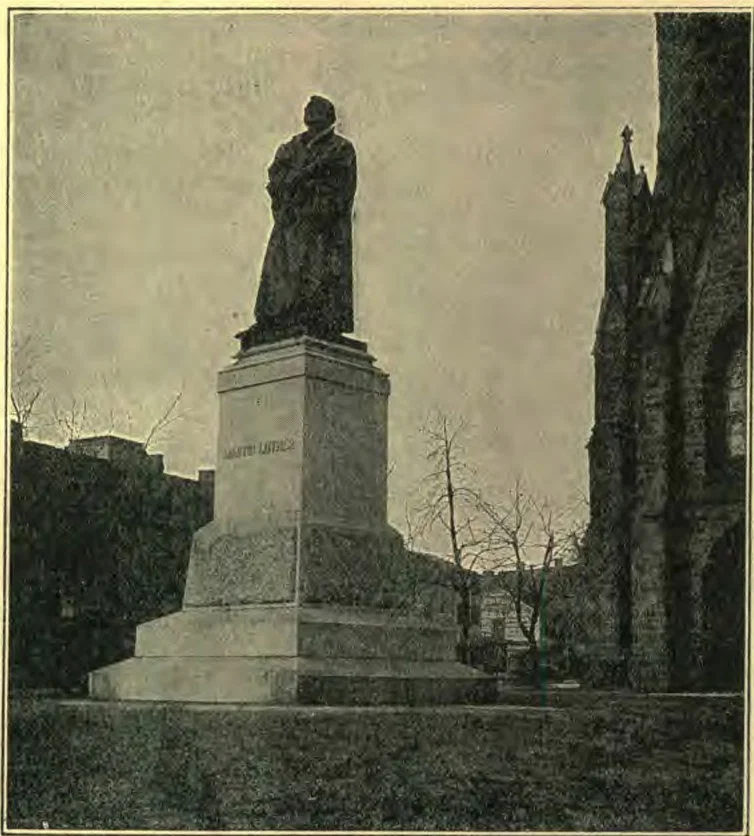
MONUMENT OF MARTIN LUTHER, WASHINGTON, D. C.

You have reached the end of this edition.

The Youth’s Instructor · Oct 16, 1917