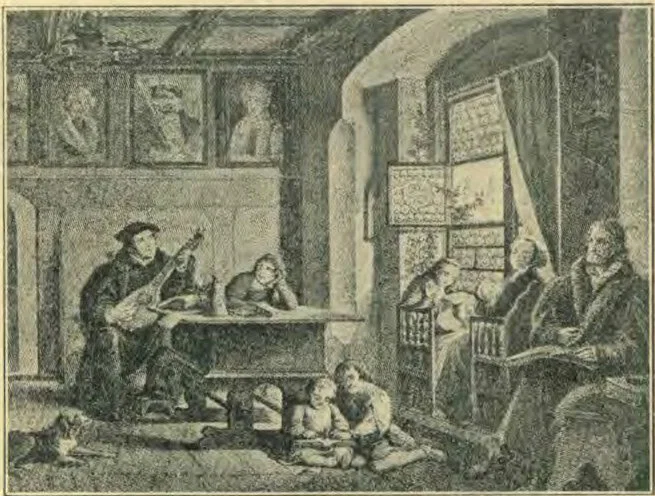
MARTIN LUTHER was never so happy as when associating with children. He was of a kind, genial disposition, an affectionate husband and father. In his home he was a true house-priest, reading and explaining the Scriptures, and singing and praying with the members of his family. “When I rise in the morning,” he says, “I repeat with the children the ten commandments, the creed, and the Lord’s Prayer, and some psalm.”
He was the father of three sons and three daughters, and he brought up no fewer than eleven of his orphaned nephews and nieces. Hans, the oldest son, became an able lawyer and counselor. The second son, Martin, studied theology, but never entered the active ministry, being sickly. He died at the age of thirty-three. The third son, Paul, became a successful physician.
Elizabeth, a beloved daughter, died when eight months old. Informing a friend of her death, the father wrote: “My little daughter Elizabeth is dead. She has left me wonderfully sick at heart and almost womanish. I could never have believed how a father’s heart could soften for his child.” Another daughter, Magdalene, died in the fourteenth year of her age.8She was a child of peculiarly sweet temper, and her father could say of her that she had never provoked him to anger. Her death was a severe blow to Luther. As she lay very ill, he exclaimed, raising his eyes to heaven: “I love her very much, but, dear God, if it be thy will to take her, I submit to thee.” One day when she suffered violent pain, he approached her bed, and taking hold of her small, thin hands, pressed them again and again to his lips, saying, “My dearest child, my own sweet and good Magdalene, would you like to stay here with your father, or would you willingly go to your Father yonder?”
The dying child answered, “Darling father, as God wills.”
Then he said, “Dearest child, the spirit is willing, but the flesh is weak.”
Turning away, and walking to and fro in great agitation, he said, “I love her very much; if my flesh is so strong, what can the spirit do?”
LUTHER AT HOME
She fell asleep in her father’s arms while he was kneeling before her bed weeping and praying. When they had laid her in the coffin he said, “Darling Lena, you will rise again and shine like a star—yea, like the sun. I am joyful in spirit, but oh, how sad in the flesh!”
Luther’s youngest child was a girl named Margaret. She was but eleven years old at her father’s death. In due time she married a rich and noble man by the name of George von Kunheim. She left three children, of whom one, her daughter Margaret, has posterity at the present day.
Although deeply affectionate and tender with his children, Luther could also be quite stern. He demanded and insisted on strict obedience. When his son Hans once had done something wrong, the father refused for three days to see him and grant him forgiveness, declaring that he would rather have a dead son than a disobedient son. And yet this was the same Hans whom he loved so dearly, and to whom, when Hans was four years old, he wrote the charming letter which has been a children’s classic from that day to this.
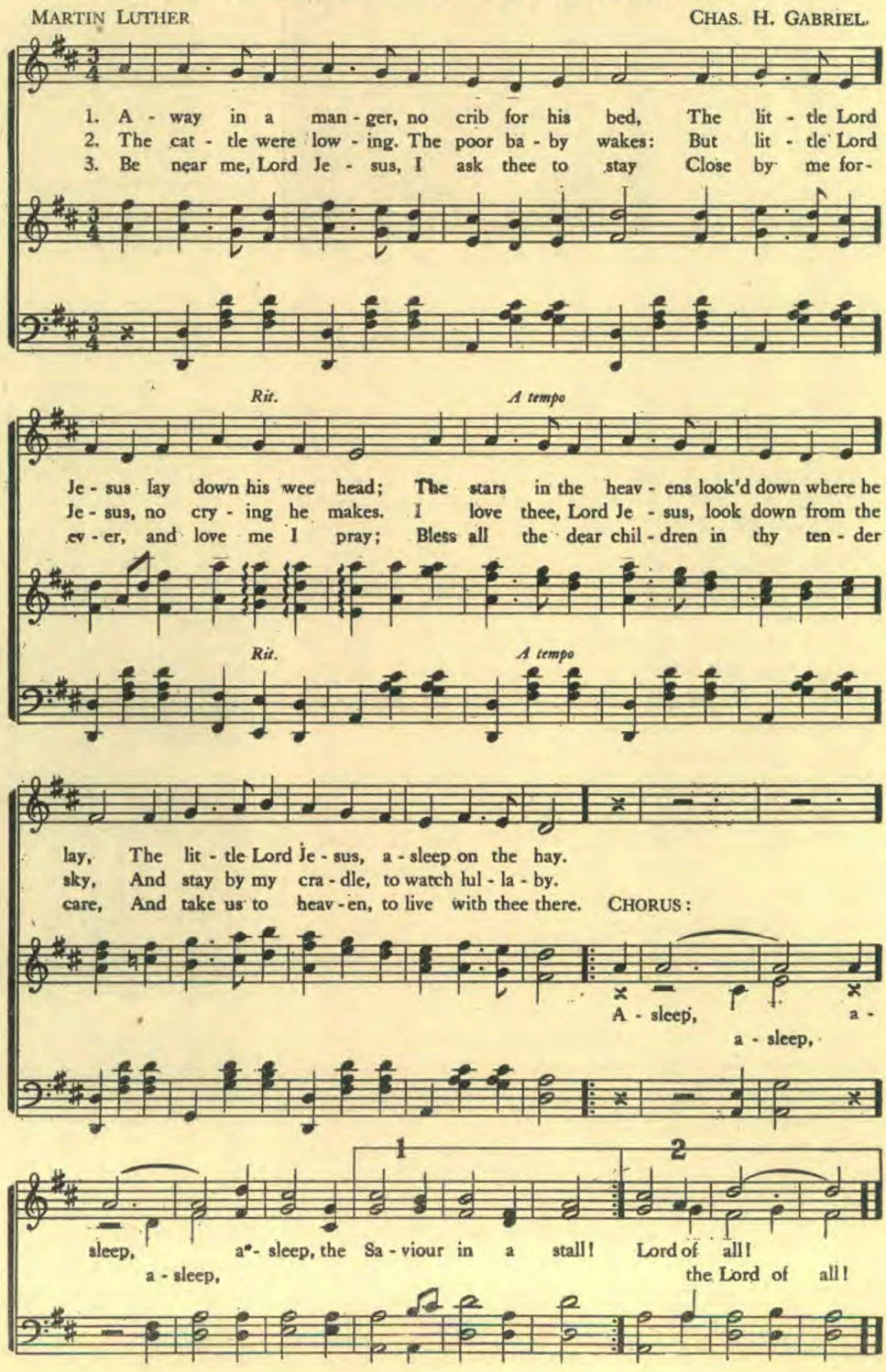
Luther was a lover of music, and enjoyed playing the flute. Many hymns of his composition are in use today, among which might be mentioned “A mighty fortress is our God” (see “Christ in Song,” page 681), which is termed “the battle hymn of the Reformation.” Carlyle says that its notes ring in our ears like bugle blasts from heaven, and the great master Handel confessed that he derived much benefit from a study of its music. “Luther’s Cradle Hymn” is also well known, and many carols by Luther have been sung by old and young through the years. One of these was written in the year 1531 for the same son Hans of whom we read so much. Here are the words, translated into English:
“Good news from heaven the angels bring,
Glad tidings to the earth they sing:
To us this day a Child is given,
To crown us with the joy of heaven.
“This is the Christ, our God and Lord,
Who in all need shall aid afford:
He will himself our Saviour be,
From sin and sorrow set us free.
“To us that blessedness he brings,
From which the Father’s bounty springs:
That in the heavenly realm we may
With him enjoy eternal day.
“Were earth a thousand times as fair,
Beset with gold and jewels rare,
She yet were far too poor to be
A narrow cradle, Lord, for thee.
“Ah, dearest Jesus, holy Child,
Make thee a bed, soft, undefiled,
Within my heart, that it may be
A quiet chamber kept for thee.”
It is related that on Christmas Eve, 1533, when Luther’s wife was very busy preparing for the customary Christmas celebration in their home, little Paul was very restless in his cradle, and the mother asked her husband to rock him for a while. Luther, though engaged in preparing his sermon for the next day, quietly complied with his wife’s wish. While thus sitting at the cradle watching his little son, his heart being filled with thoughts of the Christ-child, Luther indited that most beautiful Christmas hymn which young and old still delight to sing, “From Heaven Above to Earth I Come.”
So great is the love which Christian people feel for Martin Luther and the great good he has done that monuments in various places have been erected to his memory. The cut on the front page shows the monument which stands near the entrance to the Lutheran church in the city of Washington, D. C. While it is well to revere the memory of great and good men in this way, we may also show our love and appreciation by standing true to the principles which they advocate.
Our Luther Monument
Great Luther found the fettered Word,
The lamp of light divine,
Uncased the candle of the Lord,
And trimmed and bade it shine.
As Mary’s fragrant spikenard poured
Is her memorial true,
So the unsealed and preached Word
Is his memorial too.
Where Faith and Love their spires uprear
To greet the rising sun,
There Luther’s monuments appear,
For there his work is done.
Build ye who will the bronze, the stone—
A work which cannot grow;
Perhaps ’twill make his features known
Whose life we strive to know.
But we shall build the mighty work
Which his brave hands begun;
Though grand its vast proportions be,
The work is not yet done.
Let’s build in faith, let’s build in love,
Build first ourselves in one;
O what a monument were reared,
If this grand work were done!
Then with the open Bible haste
To meet its friends or foes;
Beneath your feet the desert wastes
Shall blossom as the rose.
Build schools and churches, conscience, laws,
On every continent;
Thus as ye build great Luther’s cause,
Ye build his monument.
—Adapted from Joel Swartz.
M. V. D.
Before the Great Council
A carriage, in which sat four men, was rapidly approaching the imperial city of Worms. After it rode a number of horsemen, and before it advanced a herald bearing the yellow and black banner of the empire.
“See how the people are pouring from the gate to receive him!” said one of the riders, Dr. Justus Jonas, of Wittenberg, to a companion. “Hark! The watchman on the gate sounds a trumpet, to announce his coming to the whole city. Now all the people are leaving their midday meal, and pouring into the streets to see Dr. Martin Luther.”
“He is coming! he is coming!” rose the cry within the city.
“Come, hasten! let us see the great man,” exclaimed one citizen to another.
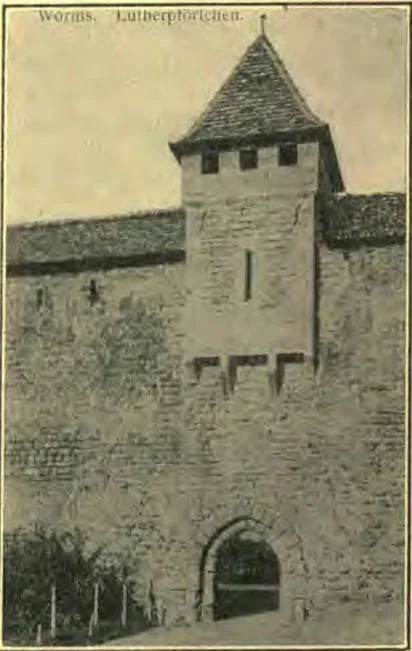
LUTHER'S CELL, WORMS, GERMANY
“This is a great day,” replied his neighbor, as they strained their eyes toward the gate. “The man is coming who has taken up the cause of the people against the evils within the church. No wonder the whole nation has arisen to stand behind him.”
“Not all!” said a surly voice beside them. “Not all, good neighbor! Archbishop Albert is furious with him; Duke George declares that he shall lose his head. It will be well for the noisy heretic if he returns alive from Worms.”
“He has the emperor’s promise of safe-conduct,” said the first.
“So had John Huss at Constance,” returned the other, “yet they burned him alive. This Luther should be careful how he answers the great and mighty council.”
“He comes! he comes!” broke out the shouts again, as the banner of the empire came in sight.
Around the corner came the carriage and halted at the hotel of the Knights of St. John. Out of it stepped a short, dark-haired man in a black gown.
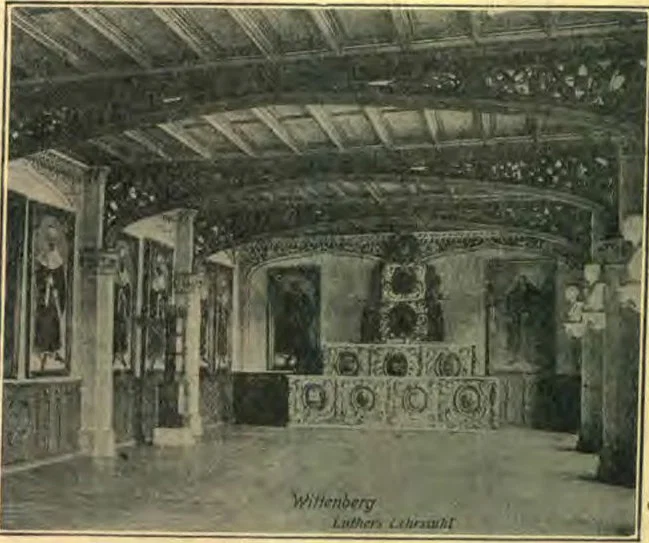
LUTHER'S LECTURE-ROOM IN THE UNIVERSITY OF WITTENBERG, GERMANY
He cast a glance around, with his piercing dark eyes. The throng pressed to touch his garments. Up at the housetops he looked; down the street and up again. Every door, every window, was crowded with gazing faces.
“God be with me!” exclaimed Martin Luther, feeling suddenly that the eyes of all Germany, yes, of all Europe, were upon him. Then, turning quickly, he passed into his hotel.
That evening came Luther’s friend, George Spalatin, secretary to the great Elector Frederick.
“Thank God that you have arrived in safety!” he exclaimed, greeting Luther with warm affection.
“Our journey has been safe and prosperous, dear George,” returned Luther, brightly.
“He speaks very mildly of his triumphal procession,” said Dr. Jonas, laughing. “At every city and hamlet he was met by marching and singing people, cheering him on his way. Everywhere the people begged him not to come to Worms. ‘Your life is not safe, dear Dr. Martin. Do not go on,’ was the cry on every hand. But he answered, ‘Though there were as many devils in Worms as there are tiles on the houseroofs, I would still go on!’”
“Yes,” replied Spalatin. “I myself was afraid, and sent him a message to turn back; but his faith and courage make me ashamed to fear. The elector is here, and will stand by his professor and his university to the utmost of his power.”
“I have a stronger Friend than the great elector, dear George,” put in Martin Luther with a quiet smile.
Next day the summons came for Luther to appear before the diet, or council of the empire, which was being held in the bishop’s palace. The streets were so thronged that the imperial herald was not able to get Luther safely through the crowd; they were obliged to go back into the hotel garden and so make their way to the garden of the palace.
Into the great hall the herald led the solitary, black-robed figure. Within sat waiting for him all the nobles and princes of the empire.
Just as the doors were opened, the gray-bearded old general, George of Frundsberg, stepped to his side and slapped him on the shoulder.
“Little monk, little monk!” he said kindly, “you are about to go into a more terrible battle than I and my knights have ever fought; but if your cause is just, and God is with you, go forward boldly, and have no fear.”
From all around came cries of encouragement. “Play the man!” “Fear not!”
From the crowd outside and the people in the streets, arose shouts that could be heard within the palace: “Luther, our Luther!” “God bless Dr. Martin!”
So Martin Luther went in, with smiling lips, to face the brilliant assembly.
On the throne chair, in his robes of state, sat the young emperor, Charles the Fifth. His long, pale face was calm as marble; but as his eyes fell on the slight figure following the herald, a sneer crossed his cold lips. All about him gathered the princes of his realm—archbishops, cardinals, electors, margraves, dukes, and landgraves; beside these, the ambassadors of all the principal rulers of Europe. Among them all, Luther saw only one face he could count friendly10—the broad, good-natured countenance of the wise Elector Frederick.
Beside the throne stood a table with books upon it. As Luther glanced toward it, he saw the titles of several of his own books.
Then the voice of the chancellor broke the silence. “Martin Luther, His Imperial Majesty has summoned you here, that you may recant and recall the words you have written in these books, published by you and spread abroad.”
“Let the titles of the books be read,” cried a voice. As the names of the books were read, one after another, Luther bowed his head, assenting to each. At the close, he spoke:
“I cannot deny that I have written all the books named; and I have also written some others not mentioned here. As for denying what I said in them, I beg that Your Imperial Majesty will give me time to consider, that I may make my answer without denying my Lord.”
There was a buzz of excited conversation among the councilors. The Italian ambassadors did not wish delay; Martin Luther had spoken in a low voice, and they believed that he was frightened and ready to recant if he were threatened.
At length the chancellor announced that a delay of twenty-four hours should be granted; and the herald led Luther back to his room at the inn.
“Frightened? not at all!” declared Justus Jonas next day to the friends who besieged the hotel all the morning. “You will hear whether he is frightened when he is ready to give his answer.”
“But why did he not answer at once?” asked one impatient nobleman.
“Dear sir,” said Dr. Jonas, “he wanted to consult a Friend.”
“What friend?” exclaimed the noble in surprise. “Surely Dr. Martin needs no one to tell him what to say. Did he consult a lawyer, so that he might be sure of saying nothing his enemies might turn against him?”
“All night,” said Dr. Jonas, in a lower tone, “all night we have heard Dr. Martin’s voice, in his room, talking with his Friend. ‘O thou, my God,’ we heard him say, ‘stand by me against the wisdom of the world. It is thy cause, not mine. I am ready to sacrifice my life, as patiently as a lamb. But the cause is thine; thou must help me to defend it.’”
The nobleman’s voice was husky, as he turned away. “God grant it!” he said.
Once more, late in the afternoon, the herald came to conduct Martin Luther before the diet. The crowd in the streets was greater than ever, as again they made their way through the gardens to the palace.
“How cheerful he looks!” said the watchers in the palace court, as Luther passed into the building.
“Perhaps he has made up his mind to recant,” said one. “He knows he is safe.”
The hall was so crowded that the princes had difficulty in getting to their seats. Again the chancellor called on Martin Luther to recant. His words were bitter and threatening; but they made no change in the serene look on the face of the accused man.
Then Martin Luther began to speak. All hesitation was gone from his manner. His head was raised, and his ringing voice reached every corner of the crowded hall.11
“Most serene lord and emperor,” he began, “most illustrious princes, most clement lords—”
The throng grew still as death to listen. The April twilight was darkening, and torches had been lighted to illuminate the hall. The heat grew intense; yet no one stirred, while Martin Luther spoke on and on.
“Some of my works,” he said, “are on sacred subjects to which no objection can be made by any one. Some are attacks on the many evils in the church; these I cannot retract, without denying Christ. But if any one can show me anything in any of my writings which is false and contrary to the Word of God, I am ready to throw my books into the fire with my own hands.”
“Speak to the point, Luther! Will you, or will you not retract?” cried the chancellor.
Then Luther, his deep eyes glowing like stars, flung back the immortal answer:
“Unless I am convinced by the Holy Scriptures—not by the word of popes and councils, for they may be in error, but by the Word of God himself, by which alone my conscience is bound—I neither can nor will retract anything.”
A tumult of voices arose. The chancellor began to argue, the princes to interrupt. Out of the midst of the din once more arose the voice of Martin Luther, clear and firm as an angel’s trumpet: “Here I stand. I cannot do otherwise. God help me! Amen!”
Then the young emperor arose, dismissing the diet. The assembly poured out of the hall, pushing and thronging so that several of the imperial guards had to be sent to Luther’s side, to lead him safely through the crowd.
As he passed out of the doors, with a guard on either side, the nobles in the court cried out, “He is arrested! they are taking him to prison!”
“They are taking me to my hotel,” called out Luther, and the crowd was pacified.
Across the palace yard and into that of the hotel he was led, to the inn where his waiting friends had spent the anxious hours.
“I am through! I am through!” cried Martin Luther exultingly, with uplifted hands, as they rushed to meet him.
“You have retracted nothing, dear Dr. Martin?” cried his faithful friend, Nicholas Amsdorf.
“Retracted?” exclaimed Luther, with the ring of victory in his voice. “Even though I had a hundred heads, I would have had them all cut off before I would have retracted anything!”—Adapted from “Martin of Mansfeld.”
LUTHER'S CRADLE HYMN
The Finger of God in the Reformation
By Junius P. Remensnyder
THE whole Protestant world is now commemorating the quadricentennial, or four hundredth year, of the Reformation. It will stimulate our faith and piety to recall the proofs in it which point so inevitably to the visible finger of God in this great movement.
The Preparation
Although to a superficial observer Rome seemed more than ever secure in her supremacy, there were certain conditions which were omens of a mighty upheaval. One of these was the great advance in learning and the larger dissemination of knowledge. Falsehood, superstition, and tyranny can never endure the light. The most potent ally of Rome is ignorance. To this day she holds her spell chiefly over the untutored masses. And as education began to disperse the darkness of the mind, men rose up here and there who would no longer bow in blind submission. The renaissance of science, literature, and art; the mystics, as Suso, Eckhardt, and Tauler, who insisted on the right of the individual to seek Christ without ecclesiastical mediation; the great humanists who asserted the freedom of conscience and the natural rights of man; the era of Raphael and Michael Angelo—all these were foretokens that the world could not always be held in bondage to a sacerdotal and irrational system. Above all, the discovery of the art of printing came at the opportune time. It quickened and multiplied a thousand times the agencies opposed to spiritual slavery.
There was then a preparation in the soil of the world, a fitness in the times, a readiness in the opened minds of men, an impulse of freedom springing up in Europe, and especially in Germany, which indicated that the Almighty Ruler was about to inaugurate some revolutionary change, some new epoch, some mighty stride of progress, which would wonderfully advance the welfare and happiness of the race.
The Beginning
We observe further the hand of Providence in the beginning of the Reformation. Notwithstanding the favorable conditions preparing the way for a mighty change, yet never did the church of the Middle Ages seem more firmly entrenched and secure in her power. Her authority was universally recognized as supreme. Kings and states bowed unquestioningly to her voice. The mightiest civil potentates humbly received their crowns from the Holy Father. The Pope, clothed with the investiture of infallibility, was absolute ruler of the bodies and souls of men. As the vicegerent of Christ on earth, his judgment announced the voice of God.
At so apparently unpropitious an hour as this, a humble, unknown monk, meditating in a monastery, concluded that all this august authority was sheltering a false and corrupt system. And one Tetzel, coming to his city, Wittenberg, and setting up a huge red cross, heralded the papal decree for the forgiveness of sins and the delivery of souls in purgatory by the purchase of an indulgence. The money realized by the traffic was to be used for the erection of a magnificent cathedral of St. Peter’s, building at Rome. The motto on the cross read, “The moment the money clinks in the chest, the soul escapes from purgatory.”
This the monk Luther felt to be sacrilege, and indignant at the wrong, and pitying the poor deluded multitudes, he drew up ninety-five theses showing its error from the teaching of Scripture. Then, all alone, on All Saints’ Eve, Oct. 31, 1517, he nailed these theses upon the doors of the cathedral. It was a daring deed indeed, but its author retired, little dreaming of the consequences of his act. The next day the multitudes read them with astonishment. From mouth to mouth they flew. What was in many hearts had suddenly found a voice. Nobles and peasants, scholars and tradesmen, were alike moved by them. And instead of the tumult ceasing, with each day it grew deeper, and spread farther and wider. To every one’s astonishment, “the theses,” says the historian D’Aubigné, “borne as if on angel’s wings, in fourteen days had circulated all over Europe.” The strokes of that hammer nailing up the theses were heard around the world. From this act, therefore, history dates the beginning of the Reformation. And in so vast an outcome issuing from so feeble a cause, who does not see the “Mene, mene” of the handwriting of God, saying to the church of the Middle Ages, drunk with the wine of her fornications, and maddened with her sacrileges and tyrannies over the human mind and conscience, “Thou art fallen, O Babylon! and the hour of thy judgment is come!”
The Means
The divine interposition in the Reformation is shown again in the means. This was the simple Word of God. What was it that Luther in his theses set forth as opposing the errors and corruptions and falsehoods being taught in the name of the Holy Catholic Church?—The authority of the Scriptures, especially the gospel of Jesus Christ, as contained in the New Testament. Armed with naught but this Word of God, Luther bade defiance to all papal decrees and ecclesiastical councils. “What are you,” he said, “but mere fallible, sinning mortals, like myself? Why then shall I submit to you? God’s Word alone is infallible, and to it I make my appeal.” So Luther went to the Bible, and not to the fallible church, for the teaching of the way of life. And when he had there uncovered the closed fountain of truth, he gave to thirsting souls the waters of life. Hence, his very first act, after his notable challenge to Pope and councils on the great stage at Worms, was the translation of the Sacred Scriptures. These he then sought to have circulated everywhere. And he advocated the right of the poorest and humblest to “search the Scriptures” for himself and to find therein “the true light that lighteth every one that cometh into the world.” And always and everywhere, Luther refused to employ any other means. To his mighty friend Frederick the Wise, when he would have taken up arms to resist the oppressive measures of the enemies of the Reformation, he replied: “Sheathe your sword. If this be God’s work, he will take care of it; your armies cannot uphold it.” In the fact, then, that this great movement was born and carried forward by no other means than the study and writing and preaching of the Word of God, we see the divine handwriting, the illustration of that promise that the kingdoms of this world should become the kingdom of the Lord Jesus Christ, “not by might, nor by power, but by my Spirit, saith the Lord of hosts.”
Beneficent Effects
The progress, growth, wondrous results, and beneficent effects of this movement also prove it to have been divinely ordered. Well has it been named the Reformation, for it reconstructed, changed the face12of the world. It was the source of the awakening of the nations. It roused Europe from the paralysis of the Middle, or Dark, Ages. It was the awakening of religion to spirituality, of faith as against mere order, of life as against formality, of worship as against ritual, of the authority of the Scriptures as against the decretals of the church. It was the cradle of liberty of thought. It awoke the slumbering giant of democracy. It founded, through the suggestion of Luther, public libraries and the system of free public schools. It has transformed all classes of society and re-created all states of civilization. Two hundred millions of Christians and the most enlightened and progressive nations of the world—England, Germany, the United States, Switzerland, Holland, Sweden, Denmark, Norway, and Finland—now march under the banner of Protestantism.
The Unique Personality of Luther
James Freeman Clarke writes: “The hour was indeed ripe, but it had been ripe often before and passed; it was only when the hour and the man came together that success was achieved.” “Luther’s words were half-battles,” wrote Richter. He combined qualities seldom united in the same personality. He was a saint and a scholar; a logician and a mystic; a writer and an orator; a poet and a musician; a recluse, and yet gay, bright, and humorous in society. He was by nature timid, saying, “I thought I should die at facing an audience;” and yet, when driven to bay by his foes, before the most splendid gathering of emperor, princes, cardinals, and magnates of earth at Worms, he manifested a courage and thundered forth an eloquence reaching the topmost peak of sublimity.
There, at the peril of his life, he proclaimed the Magna Charta of civil and religious liberty. So we can say in the splendid tribute of Carlyle: “I will call this Luther a true, great man, great in intellect, in courage, affection, and integrity: one of our most lovable and precious men. Great, not as a hewn obelisk, but as an Alpine mountain—so simple, honest, spontaneous, not setting up to be great at all: therefore quite another purpose than being great! Ah, yes, unsubduable granite, piercing far and wide into the heavens: yet in the clefts of it fountains, green, beautiful valleys with flowers! A right spiritual hero and prophet; once more a true son of nature and fact, for whom these centuries, and many that are to come yet, will be thankful to heaven!” Had Calvin or Erasmus or Knox, great as they were, been at the head, the Reformation would doubtless have been a failure; but this myriad-minded Luther, he was the chosen hero, the man with the requisite gifts of leadership, which alone could conduct it to success. . . .
May God give Christians of our time the faith, zeal, courage, and sacrifice of these great leaders of the sixteenth century, that we may preserve and transmit unimpaired their precious heritage to future ages.—Junius P. Remensnyder, in the Christian Herald.
A Peep into Brazil
By Louise V. Wurts
(Concluded)*
Perhaps it will do no harm for the young people in the homeland to know something of the trials the missionaries have, and how they stick to their post in the face of all difficulties. Our faithful colporteurs meet many trying experiences and have to endure many hardships. This they do without murmur or complaint, but we who see and hear of their work day by day, know that only the sustaining power of God can make them equal to the emergencies which arise. The native is used to the climate, and the life of deprivation, but when it comes to our American boys going out into the interior of Brazil, carrying on their backs all the books they hope to sell (they cannot take orders and deliver as they do in the States), trudging up steep and high mountains under the broiling tropical sun, sleeping in the woods or out in the open, then the idea of service takes on a new aspect, and the colporteur learns from experience, as did Paul, what it means to be as nothing that souls may be won to Christ.
After two years of such labor, one of our workers at the present time is not able to carry a grip for a block, because of the injury to his spine which he received by carrying heavy loads of books long distances. He needs medical attention which cannot be procured in this country. He is a power in the hands of the Lord here, and the work cannot spare him. We ask the prayers of God’s children in his behalf.
Sometimes the colporteur finds himself in the open country at nightfall, and seeing a friendly light in the distance, hastens on in the hope of obtaining food and a night’s lodging. He has learned by many bitter experiences, however, not to set his hopes too high, for all of these ranches are guarded by large, fierce dogs which, if they happen to be tied during the daytime, are always loose at night. Some of our workers have had really marvelous escapes from death by these ferocious beasts.
One day, after it had been raining for a number of hours and the ground was well soaked, one of our colporteurs came to an open gate. Instead of clapping his hands, as is the custom before entering, he walked inside a few steps and then clapped his hands. In an instant there was an enormous hound at his throat. The force of the encounter threw the man on his back in the mud. Fortunately the mistress of the house came quickly and called the dog. The woman could not understand how it was that the man was not killed. At another time a dog rushed at him, and he turned to flee, but the dog caught him, and the animal’s teeth went into the flesh. But there was no injury to either body or clothing,—a fact for which the brother himself cannot account.
Even when the dogs are conquered, and the hospitality of the rancher is secured, the sleeping accommodations often consist of a wooden bench, with a worn-out blanket in which to wrap one’s tired body. This would not be so bad, were it not for the fleas and unmentionable vermin which interfere with sleep. Added to this, the wayfarer often has the company of goats, and chickens, or the ranchman’s donkey to share his room; and should he by chance drop to sleep, he may be suddenly awakened by a somewhat strenuous caress on the cheek by the donkey’s rough tongue, or by the lusty crowing of the roosters.
One of the greatest difficulties is to secure desirable food. Everything is cooked with pork meat or fat. Sometimes our workers live on oranges for a week at a time. Just now a brother has returned from a trip during which he had to subsist on stiff cornmeal mush and burnt corn coffee for several days.
The experience of Brother G. A. Storch is related in his own words:
“One day at noon I arrived at the house of a farmer, with my heavy case of books on my back. The head of the house, who saw me through the window as I approached, was sitting in one of the rooms, engaged in conversation with some other persons. I was invited to enter, and some minutes later the man came13to where I was, and after greeting me, glanced about, saying, ‘Why did you not bring your companion in?’ I told him that I had no companion, but, without paying attention to what I said, he sent his son to bring in the other man. His son assured his father that I had come alone, but the man was so positive that he went himself to see. After crossing the courtyard and finding no one, he returned very much surprised. I then commenced to show him ‘Vida de Jesus’ (‘Christ Our Saviour’), but he interrupted me by saying, ‘Don’t you see how my hair stands on end?’ and making various other remarks of his astonishment, and finished by declaring to the entire family that he knew I was a man of God, explaining that he had plainly seen another person walking by my side, even describing the clothing of the person. He asked me finally, ‘Who could that person be?’ I then directed his attention to Ps. 34:7: ‘The angel of the Lord encampeth round about them that fear him, and delivereth them.’ I sold in that house four dollars’ worth of books. The news of this occurrence quickly spread through the whole neighborhood, thereby considerably facilitating my sales.”
This same student canvasser later writes from another place: “I have had the privilege of being the pioneer canvasser here. I am grateful to the Lord for the tribulations I have suffered here, seeing that through them patience is gained. During the month of January I sold in this city $150 worth of books. There is a strong Catholic element here, and after being threatened with imprisonment, I decided to leave the city and work in the country. In one of the outlying towns I met a group of Methodists, and had an opportunity to study the Bible with them on the Sabbath question. Before leaving them, they promised me they would keep the Sabbath. There are in all five families. I pray God that they may be faithful. If God permits, I will return to the city and continue my work. I hope the priests will then leave me alone. My trust is in God.” LOUISE V. WURTS.