Few things are sadder than the gradual dissolution of a family circle. When, moreover, it once begins, it goes forward with a rapidity that is almost startling. The eldest son, it may be, dissatisfied with his narrow surroundings, takes his journey into some far country to seek a better fortune; or the eldest daughter, obeying the deepest instincts of a woman’s nature, listens to the voice of a stranger, and forsakes with a light and hopeful heart the roof that sheltered her girlhood, to become the mistress of a new home. Then the younger children follow in quick succession. Some of them, most likely, are wrapped in white robes, and borne forth amid blinding tears to their last resting place. Sooner or later, and in one way or another, they are all gone. The long table in the dining hall is shortened, the chairs are taken out of the family room because there is no one to occupy them, and the old folks are left to each other as absolutely as they were in those far-distant days when under bright skies and with buoyant spirits they began life together. Well indeed is it for them if the young love that once animated their hearts has deepened and ripened into that rational affection which is the most sacred bond of union between two human beings.
We have known aged couples whom not even the experiences of fifty years had disenchanted of the glowing ideals that floated before their vision when they first set their feet in the long road which begins at the marriage altar and ends in an open grave. Would that there were more such! At the risk of being sneered at by that large class of people to whom a bushel of corn or an ounce of silver is worth more than a ton of sentiment, we wish to protest against the criminal carelessness and indifference that allows all the glory to fade out of the wedded life, and suffers it to become a dull, monotonous, and commonplace thing. It is a matter of vast importance that husbands and wives, instead of losing their tender interest in each other, should cultivate this holy feeling with constant assiduity; for the time is coming when it may be the only human resource upon which they can draw for comfort.
It is a pathetic picture, this of the old man and his old wife trying still to keep a cheerful spirit in the empty house that once rang with the laughter of happy children. But it is not without features that relieve it of its sadness. No true home was ever created in vain. In the order of God’s providence it serves a useful purpose, though it may afterward perish from the earth, and even the memory of it utterly decay. One of the most inestimable blessings that a boy or girl can carry with him into the busy world is the recollection of the dear, familiar hearthstone, on which perhaps no fire now glows, and around which no cheerful faces gather. This recollection is strength against temptation, courage in the teeth of hard conflict, fortitude under the pressure of grievous disappointment, and illuminating hope when sun, moon, and stars are obscured by cloud and tempest. Whatever is of high spiritual quality in the family life abides, and passes on as a quickening force into the thought and aspiration of later generations. The purity, the love, the gentleness, the self-denial, that find in that divine sphere the fittest theater for their display and exercise, do not evaporate into empty air, but become incorporate in the character of the children, and are transmitted in increasing volume to bless the souls of men and women still unborn.
— Christian Advocate.
Only To-day
By Henry Burton
ONLY to-day is mine,
And that I owe to Thee;
Help me to make it thine,
As pure as it may be;
Let it see something done,
Let it see something won,
Then at the setting sun
I’ll give it back to thee.
What if I cannot tell
The cares the day may bring?
I know that I shall dwell
Beneath thy sheltering wing;
And there the load is light,
And there the dark is bright,
And weakness turns to might,
And so I trust and sing.
What shall I ask to-day?
Naught but thine own sweet will;
The windings of the way
Lead to thy holy hill;
And whether here or there,
Why should I fear or care?
Thy heavens are everywhere,
And they are o’er me still.
Give me thyself to-day,
I dare not walk alone;
Speak to me by the way,
And “all things” are my own;
The treasures of thy grace,
The secret hiding-place,
The vision of thy face,
The shadow of thy throne!
— Henry Burton, in Christian Advocate.
Neighborly Kindness
By Mrs. M. J. Bremner
MRS. M. J. BREMNER
“If I can get the time” is an expression frequently heard. Many of us are too busy to be friendly or hospitable, too busy to visit the sick or to sympathize with the unfortunate. In the hurry and rush of living, we are losing many of the finer traits that should find expression among us as a people. If we each felt a friendly interest in our fellow men, the world would not be starving for kindness, as it is to-day. A little more consideration and practical effort to lighten a weary one’s load might be the surest way to prosperity. It would cut off many needless wants, and would lead us to give less attention to self. The pity of it is we are kept so busy catering to ourselves that we have no time to look after the comfort and convenience of our neighbor.
We should be on the alert for kind, helpful acts. This love for all men and women, this kindness, this self-sacrificing devotion emanating from a kind, compassionate heart, wins the world. It was the good, motherly heart of Queen Victoria that made her the world’s peerless queen. It was the love for men and women, and a desire to lift them above destructive indulgences, that made Lucy Hayes the most conspicuous and best-beloved of all the ladies who have resided at the White House.
Our Corner of the Field
By Mrs. B. J. Cady
MRS. B. J. CADY
OUR field of labor is called the Society Islands, which are found in the Pacific Ocean, about eighteen degrees south of the equator. But we do not regard our field to be this group alone, for there are several other groups lying near by which are almost as closely related to this through commerce and the intercourse of the people as its own islands are related to one another. The adjacent groups are the Marquesas, Tuamotu, Gambier, and Austral, which, like the Society Islands, are French possessions.
There are also several lone islands belonging to France, and some to Great Britain, among which is the famous Pitcairn Island. At present, our corps of laborers is operating in the Society Islands, with the exception of Brother Jones, who has gone to Pitcairn and the Gambier Islands. Sister Jones will follow him soon.
The most important island is Tahiti, the largest of the Society Group. It is also the headquarters of the French government for this part of the world. It has a population of about twelve thousand, consisting principally of native Polynesians and half-castes, French, English, Americans, and Germans. There are also a large number of Chinese here.
This group is divided into the Windward and Leeward Isles. The Windward are composed of Tahiti, Moorea, Tetiaroa, Meatia, and Maiao; and the Leeward are Raiatea, Huahine, Borabora, Tahaa, and Maupiti, all lying within a radius of two hundred and fifty miles. Each division also has other small islands of minor importance.
The only town of any size is Papeete, Tahiti, which has about five thousand inhabitants, and is the principal seaport among these islands. Only small villages or settlements are found upon other parts of Tahiti and in the surrounding islands. Most of the foreign population of the group is located in Papeete, and strangers arriving here are often surprised to find so much civilization in such an out-of-the-way place. Viewed from the harbor, the city presents a very pretty appearance, with its abundance of ever-green foliage, and smooth, well-kept roads. Though the buildings are not fine, and many of them are old and rickety, they are so hidden by the shrubbery that their condition is not usually noticeable. In this tropical clime, where the earth is clothed in beauty, and the bright sunlight brings out the beautiful colors of earth, sea, and sky, and makes them appear at their best, though the scenery may not be considered grand, it is certainly beautiful.
A SCENE IN TUAMOTU
The Society and most of the surrounding islands are high and mountainous, and the mountains are covered with verdure even to the very summit. The most important of the tropical fruits and vegetables may be found here, though we have not as great a variety as have the larger tropical countries. The islands are usually blessed with an abundance of rain, and vegetation grows rapidly and luxuriantly.
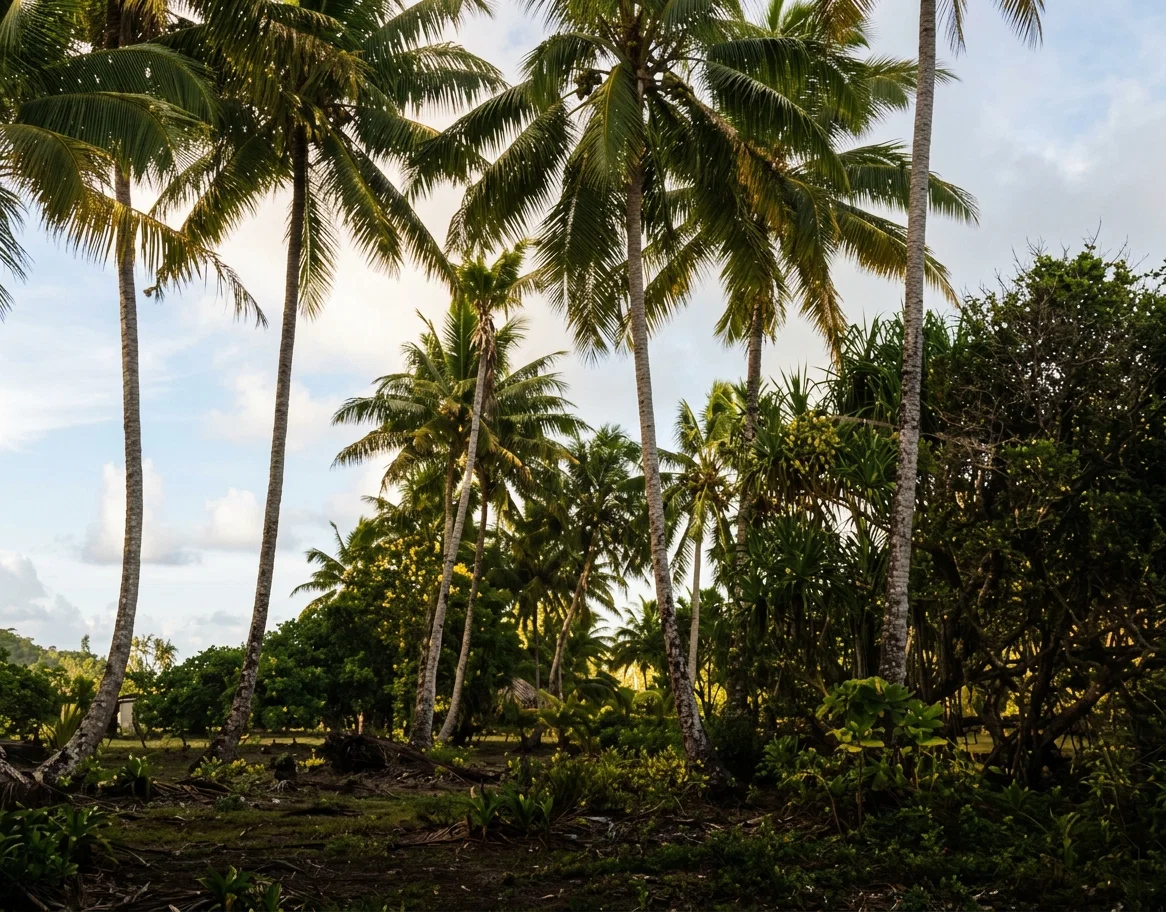
But many of the Tuamotu Isles are simply of coral formation, and are so low, and possess so little soil, that but few fruits and vegetables can be raised there. The cocoanut, however, will grow wherever it can find a footing in the sand, and it flourishes upon every island, and is very useful to the people. The Tuamotu natives subsist chiefly upon fish and cocoanuts, using the fish either raw or cooked, except as they are able to buy bread and preserved meats from the store.
The people of the last-mentioned group are nearly all either Roman Catholics or Mormons; both the Salt Lake City and the Reorganized Church of Mormons being represented among them. The Gambier Islanders generally adhere to the Catholic faith, and have not had much labor from other denominations. The natives of the Society and Austral Islands regard themselves as Protestants, and usually make a high profession of Christianity, though possessing but little of the power of godliness. The Marquesas natives still cling to heathenism, with the exception of a very few.
For the past four years, we have had a small steamer, which made monthly trips between Tahiti and the Leeward Society Islands, and also between Tahiti and the Marquesas and some of the Tuamotus, completing these two trips in four weeks. Quite recently, it has begun another trip, taking in the Austral Islands and Mangareva, the principal islands of the Gambiers. It now takes about forty days for it to get around. This affords a good way for our laborers to go back and forth among the islands, and to reach those where the truth has not yet been presented. It also takes us within three hundred miles of Pitcairn Island. A cutter of fifteen tons has recently been procured for the Pitcairn people, which will run between Pitcairn and Mangareva, and occasionally make a trip to Tahiti. We hope this little boat may be run in such a way that it may be a blessing and an honor to the Master's cause. It sailed from Tahiti June 1, bound for Pitcairn Island, with Brother Jones as captain. He does not expect to remain with the boat permanently, but will teach navigation to some of the Pitcairn people, so that they can look after it themselves.
A Trip Through Asia Minor
By J. H. Krum
J. H. KRUM
On Dec. 1, 1901, I left Asia Minor. My first visit was to the province of Cilicia. This is the province through which Paul and Silas traveled, confirming the churches. Paul was born in Tarsus, now a city of twelve thousand inhabitants — a mixed population of Turks, Greeks, and Armenians. We have about fifteen church members scattered throughout this province, besides probably ten others who keep the Sabbath.
My labors were chiefly confined to Adana, a city of about fifty thousand inhabitants, near Tarsus, where we have fifteen members — Greeks and Armenians. The company in this city has been frequently persecuted. Last summer seven brethren were arrested and imprisoned for holding meetings on the14Sabbath. Since then they have been compelled, by the existing circumstances, to hold their meetings in different places, sometimes along the river, where they could praise the Lord with perfect freedom. A few had promised the government officials that they would not attend the meetings; but when they heard that I had come, they could not keep their promise any longer, but attended the meetings again.
Our Bible workers and Brother Baharian have frequently had great opposition here. Some have been arrested and imprisoned. The American Protestants — not the Turks — are usually the accusers. Some time ago they passed a resolution not to bury any Sabbath keeper in their cemeteries. Since I left them, two of our brethren died there. One, an Armenian, was buried in the Armenian cemetery; the other, a Greek and former Protestant, was only accepted after long entreaty by his family, who are yet members of the Protestant Church. We were told, however, that he is the last one who will be accepted.
The members had not been visited by any of our laborers for three years, and yet they seemed contented. After five weeks of joyful labor, I had the pleasure of baptizing four souls in the historic Sarus River. I am glad to state that the young Greek sister, who interpreted my lessons from the English into the Turkish, was among this number.
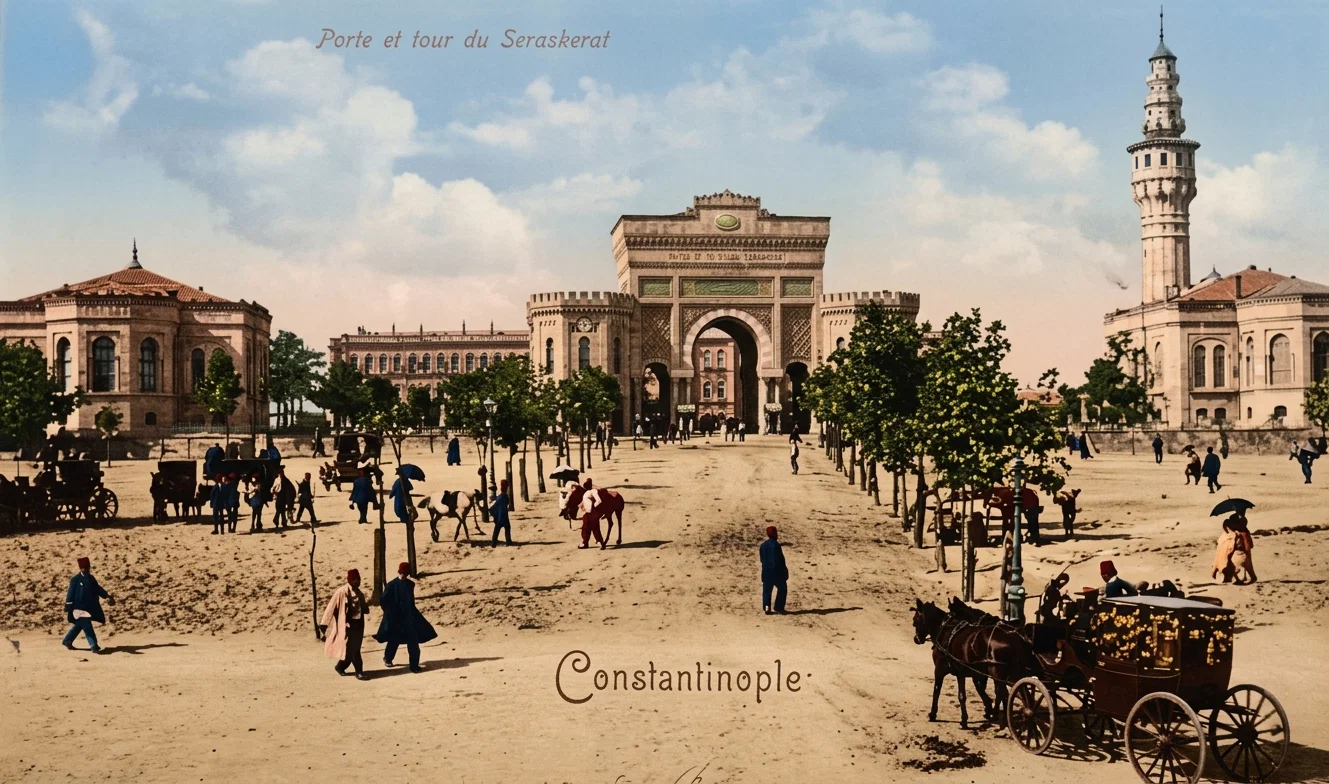
Constantinople
Jan. 31, 1902, I arrived in Constantinople, where I met Brother Baharian for the first time. Owing to the fact that the officials three years ago forbade him to leave the city, and his repeated efforts to do so have met with refusal, it was decided that I should visit our churches in the provinces of Brusa and Bithynia. On the seventh of February, Sister Azniv Inedjian, our medical missionary of Constantinople, accompanied me to Broussa, the first capital of the Osmanlis, as my interpreter. This city is famous for its natural hot baths, and for its large silk industry. There also the beautiful Turkish towels are made. Our church elder and his family, besides other members of our church there, are engaged in weaving different fabrics. We found the believers and many interested friends ready to receive the Word.
After remaining one week, we were permitted to baptize a Greek sister away up in the mountains, where a large spring sends forth its living waters. We also accepted an Armenian sister by vote. From twenty to thirty attended our meetings here.
February 14 we drove in nine hours to an Armenian village called Sellous. At this place the interest was good, as many as one hundred persons attending the meetings, although we have only nine members there. The Spirit of God was at work, and we were encouraged. At this place enemies accused us before the government officials. But before the officers arrived from the neighboring seat of government, we had left for Chenkeler, where one brother resides. On the third day after our departure they also arrived in Chenkeler, and required us to appear before the kaimakam. I politely requested the officer to send his sabdiye down to the kaimakam to request him to allow us to proceed on our journey, as our papers were all right. But after about four hours he returned, accompanied by three officers of higher rank, with the news that we must come down. We arrived there on horseback, after two and one-half hours, and had an interview with the kaimakam, who charged us with preaching a forbidden religion. Of course my Biblical argument availed nothing, as he said that he must obey his instructions. We were politely allowed to live in the hotel until instructions should be received from his superiors. However, there were soldiers watching in the hotel corridor night and day, and when any of us wished to go out, a soldier was sent with us.
On the evening of the second day a telegraph message came, instructing the kaimakam to let us proceed, but accompanied by a soldier, to the next government town, called Yalova. When we arrived there, we tried to proceed to Shagshag, where we have nineteen members. But the officials refused, even after we had appealed to them five times. The next day, being Sabbath, about seven members came down to the hotel where we were stopping, and we improved the time by holding meetings there several days.
On March 4 we took a steamer for Ismed (Nicomedia), the capital of Bithynia, situated near the head of the Gulf of Ismed. The city was the residence of Diocletian. Here he began his persecutions of the Christians; here he afterward abdicated. Constantine frequently visited the city, and it was in his villa in the suburbs that he died. We have four members in this city. When we landed here, our Bibles were taken by the customhouse officials, and not returned until the next day. We held three meetings here with an attendance of thirty-five.
The next day we went across the gulf to the village of Bardizag, where we have a company of intelligent Armenian believers. We remained here ten days, and had a good outside interest. The meetings were attended by from forty to sixty persons.
On the sixteenth of March we left for Ovajik. Owing to a severe snowstorm, the road was dangerous. This part of the country has few driving roads, in fact, much of our journey from village to village was on horseback. At many places wild mountain streams must be crossed with the greatest of precaution. In this village we had the best interest, as many as one hundred and twenty-five people attending our studies. Here the children especially took an active interest, which caused us to rejoice greatly. Some years ago, when the church was organized, Brother Baharian was in danger of his life from the hands of a mob; but from all appearances there are many under conviction now, and we confidently expect a rich harvest of souls there soon.
We left March 24 for the thriving city of Ada Bazar, where we had a company of four. After a week's labor, we baptized four sisters who had been keeping the Sabbath several years. From thence we went to Sari-Dogan, a Greek village, where we have about ten members. We remained about one week, and just before leaving baptized a Greek sister who had also waited a long time to take this step.
We now started on our return trip to Constantinople, stopping over in Yalova, expecting the officials would allow us to go up to Shagshag. But this time they again refused to give us permission. After holding a meeting in the hotel with some sisters who had come, we took the steamer for Constantinople, arriving there April 10. I remained there six days, then started for my home in Jerusalem, and after a delay of five days' quarantine in Beyrout, arrived there, comparatively well, on April 28, after an absence of five months.
From present appearances, Asia Minor is a fruitful field. The Greeks and Armenians there are more religious than their national representatives in Palestine. They are altogether more pliable than the Syrians and Arabs. Apparently persecution has had the effect of keeping them close to the Fountain of all strength. The American Protestants have raised up many churches, and instituted good schools among them.15
Since the Armenian massacres the government has become more vigilant. People wishing to travel from place to place must have a special permit (visa), costing about fifteen cents, and this cannot always be had without the usual back-sheesh. On approaching the ticket office in the railway stations, one's papers are examined before the ticket can be purchased. Likewise, before entering a ship, proper papers must be presented, and all effects are carefully scrutinized.
All books and papers mentioning Turkey are taken, and sometimes confiscated. We cannot print anything until the manuscript has passed through the censor's hands, and been favorably commented upon. On the trains an officer will go through from one end to the other, asking the destination of each passenger, also his name and the name of his father. Our people can easily see how this affects our work, when they take into consideration that our religion has been forbidden in all the country. All passports designate the religion of the bearer.
I have found many promising young people throughout the field. My suggestion would be that we hold an institute for two months in Bithynia, and another for two months in Cilicia, the coming winter; but before this can be done, proper help must be supplied. Medical missionaries could travel about with more freedom than can our ministers. Therefore, canvassers for our medical and religious literature who have a knowledge of both the Bible and the medical missionary work should be trained for this field, before this open door shall be closed to us.
Health School and Canvassing in Allahabad, India
By Anna Knight
India
SIMLA.—During March and April Sister Donna Humphrey and I spent six weeks in Allahabad, one of the large stations in the northwest provinces of India, canvassing for “Ladies’ Guide,” and visiting the people. After we had finished our canvassing, we held a school of health. A sister who had been a patient at the sanitarium, having accepted the truth while there, invited us to make our home with her. She gave us a room, bath room, and two cots. We had our own furnishings, so we got on nicely, boarding ourselves.
We met a number of nice people, and found many who seem hungry for this truth which the Lord has so graciously intrusted to us as a people.
The first room we looked at when we were in search of a place to hold our school of health was just what we wanted. When we asked the man his terms, he said, “Well, I’ll tell you, but don’t be shocked—thank you.” We felt confident that it was the Lord’s doings. The man also said that he would seat the room, and put up punkahs so as to enable us to keep cool; for it was very hot.
Sixteen ladies attended our studies, and every one seemed intensely interested in the different subjects presented, all expressing themselves as being sorry to have the school close. We had the secretary of the Y. W. C. A. with us in the classes three days, also a number of active Christian workers from different parts of the station, all of whom thoroughly appreciated the studies. Four took patterns of our health garments, and went to work with enthusiasm, remodeling their clothes.
During the school a wealthy woman invited us to her home to give her some help in hygienic dressmaking, sending a carriage and two servants to convey us to her residence, and when our visit was over, sending us home in the same way. We felt that the Lord had most wonderfully blessed our effort, and had done even more for us than we could ask or think.
We sold quite a quantity of the health foods, and left a number of warm friends behind, and obtained a list of twenty-eight names to whom the “Ladies’ Guide” will be sent as soon as the books arrive at the office.
God has been good to us in all our work, and we do praise him. We are sure that it pays to trust the Lord for everything, and go forward each day in whatever path he leads.
After finishing our work at Allahabad, we were invited by the mission to leave the heat of the plains and visit the “queen city” of the little hill stations, Simla. So in a few hours we were off on a two days’ journey to this station. It hardly seems possible that one can be carried from the scorching heat of the plains to the chilliness of the hills so soon.
This is our first visit to a hill station, and to us it is most beautiful, and a great treat; but fruits and vegetables are scarce, so it is hard for us to get along. But as soon as we find rooms where we can board ourselves, we hope to do better. We have been here only two days, and are rooming and boarding with the Y. W. C. A. They received us kindly, and seem glad to have us. The Lord supplies all our needs in every place, and we only wish that all our dear friends and fellow workers were having the same experience. But I am sure that every one is having just what the Lord desires; for he has given to every man his work, and with the work he also gives the preparation and experience needed.
The work is onward in India, and we are full of good cheer. We find friends everywhere, and the Lord is with us always. ANNA KNIGHT.
General Notes
BROTHER ENRIQUE BALADA, our Spanish minister in Chile, went into Callao, Peru, and began to present the truth five months ago. At the last report a few had accepted the truth, among whom is a man who has been a missionary for twenty-two years. He has taken hold earnestly, and is assisting Brother Balada.
Fiji Connected to the World by Cable
FIJI is now connected with the outside world by a cable. This took place on the ninth of April, when the large cable steamer “Anglia” brought one end of the cable from Norfolk Island. From that island there are two branches — one to New Zealand, and the other to Australia. It is to be finished to Vancouver this year. This is a great thing for Fiji.
Progress of the Message in Basutoland
BROTHER J. M. FREEMAN writes from Basutoland of the progress of the message in that field. The use of intoxicating liquors and snuff prevails, and this stands in the way of many who are interested. Some, however, are seeking the Lord earnestly for strength to overcome these habits. A poor woman who was interested in the truth spoke in one of their social meetings, and praised the Lord for enabling her to do without snuff for six days. Remember Brother Freeman and his work in this needy field.
British Guiana
By D. C. Babcock
GEORGETOWN.— Our meetings continue in the hall we rented for the general meeting, and we have sufficient subscribed to the meeting expenses from the fifteenth of the present month for three or six months. The Lord is adding victory to victory.
I have just had a call from several Indians from the Mazaruni River. They came down to escort the governor of the colony on a trip to the northwest Essequibo district. One of them had called on me before, but the others were strangers. Thus I am forming acquaintances that will be a great help when I go there to labor.
I went to Laguan last week, and spent four days there. Two decided to obey the Lord. One was baptized and joined the church.
D. C. BABCOCK.
Progress of the Work in Iquique, Chile
By A. R. Ogden
Chile
IQUIQUE.—My courage is good in the Lord, and his blessing is attending the work in this part of the vineyard. Some are accepting the faith, and we believe that our brethren are being strengthened in the message. Since moving to Iquique, where we have the largest church on the west coast, I have been giving a course of study to the church on the rise and progress of the work. The work with our paper is moving forward with marked success. We are now (beginning with the July number) printing five thousand copies of the Señales each month. More than enough money is coming in to pay for this edition. A. R. OGDEN.
J. A. LELAND
By J. A. Leland
Mexico
GUADALAJARA.—Last Sabbath we had quarterly meeting. During the past eight months the church here has paid almost four hundred dollars tithes and offerings, bought three dozen chairs for the meeting room, also an organ. There have been about sixteen accessions to the company. We are of good courage in the work. We see tokens of God's care for us every day. Quite a number are interested through the mission work.
J. A. LELAND
M. W. LEWIS
By M. W. Lewis
Michigan
MENOMINEE.—Since my last report I visited the church at Stephenson to attend their quarterly meeting. We were favored with the presence of Elder H. R. Johnson, who gave us some valuable help in our services. We had a good meeting, and to the Lord be all the praise. He certainly revived us again, and we hope to gain greater victories over self, and a deeper experience in the Master’s service. On account of smallpox the quarterly meeting at Wilson was postponed until August 9 and 10.
After the meeting at Stephenson, I was invited to hold a short series of meetings in a country schoolhouse east of Talbot. We had a good meeting. The Lord blessed the effort. One family became deeply interested. Lard, pork, and tobacco were discarded, and a warfare was begun against the habit of using opiates.
Eight have signed the covenant to keep all the commandments of God and the faith of Jesus. One of these is an intelligent young woman, who is planning to go to one of our schools to educate herself for the missionary work. Her aunt, who lives here, is telling her friends of this glorious truth. Her husband has not accepted the Sabbath yet, but is deeply interested. He has taken twelve copies of “Christ’s Object Lessons,” sending them where he thinks they will be appreciated. He has two large stores and many employees. He says that the way does not look clear yet for him to close these stores and turn off his employees on the Sabbath. We are looking to Him who is able to make the way clear. Some of the employees are interested, too. And his decision in favor of the truth would encourage them. May the Lord give the victory.
The sale of “Christ’s Object Lessons” in this locality has fallen upon just a few of us, others not being situated so they could help. Elder Johnson came here for a few weeks at just the right time to assist us in this work. He thinks it harder to sell books here than in other places. But we are thankful that we have nearly enough orders to finish our quota according to the arrangement. But there is another quota that will not be finished until Jesus says that it is enough. The book is making a good impression on the minds of all those who read it; and I am persuaded that it will prepare the way for some of our other publications. Please remember the work and the workers here, at the throne of grace.
M. W. LEWIS
Preparation for the Michigan Camp Meeting
By S. P. S. Edwards
As I read the announcement of our annual camp meeting and the words of caution offered by Brother Gowell in regard to our preparation for that event, there floated before my mind visions of wailing infants, of distressed and woebegone children, and of agonizing and careworn parents, that have been so indelibly fixed upon my mind by the experiences of past years, not only at our own meetings, but also in other States; and this wailing and distress was not the result of the convicting power of the Spirit, leading old and young to a deep experience in the putting away of sin, but rather the cry because of, or an appeal for relief from, physical suffering, which had come as the direct result of neglect on the part of the individuals themselves or those responsible for them.
It is true that all this suffering may not have come as the result of willful violation, ignorance in many cases being at the root of the trouble; but since “the health is as sacred as the character,” is it not time for all to become intelligent in these matters? Indeed, “ignorance in these things is sin.”
How many parents who have been praying for weeks for the conversion of their children at the camp meeting, will spend several days before starting to the meeting, in cooking up a good supply of cookies and cakes and pies, upon which to feed and stimulate their passions, and will allow them to eat between meals of candy, peanuts, fruit, etc., thus doing everything in their power to prevent the working of the Spirit of God upon their hearts?
How much better it would be for the parent to prepare a good supply of plain food, as good bread and zwieback, rolls or sticks, plain crackers, good fruit without much sugar, and a good supply of nuts, as walnuts, hickory nuts, and butternuts, and thus impress upon the children the fact that they are going, not to a picnic to give free rein to appetite, but to meet with God, to a holy place where the body must be pure, the mind clear, and where nothing that can grieve away the Lord’s Spirit can be permitted.
Let the days before the camp meeting be a time of preparation not merely for the bodily needs, but let the necessary preparations for the physical well-being be the means of impressing the true object of the meeting upon the young hearts as well as upon our own.
How many mothers will spend many weary days, and perhaps nights, preparing new dresses and hats for their daughters, which may not be really needed, but which will be nice to “dress up” in? and who will be to blame if, when they get to camp meeting, these daughters prefer to “dress up” in these things and roam around the camp or elsewhere, instead of attending the meetings where they will learn of the garments which Christ is preparing for them, and of which they stand so much in need?
Having spoken thus generally, may I not offer a few suggestions on several specific points as to our preparations for camp meeting?
Clothing
Above all things do not bring dresses with very long skirts. While trains or anything approaching them are objectionable17at all times, they are abominable at camp meeting. On the other hand, let every sister have at least one short walking or bicycle skirt. This skirt should come just to or a very little below the shoe tops, and may be worn mornings and evenings when the ground is damp, or on rainy days.
Bring different weights of underclothes, so they can be changed to suit the weather. Especially should this be done for the children. Make special provision for keeping their bowels warm, as many bowel troubles come from neglect of this matter. It should not be necessary to emphasize the necessity of keeping the feet dry.
Bring plenty of wraps, as they are needed mornings and evenings; also bring your rain coats or mackintoshes. Bring your most comfortable walking shoes, so you can take a good walk each day.
Foods
Do not bring a store of cookies and cakes and pies and rich preserves and jellies. These things are injurious at any time, and especially so when our digestive systems are deranged by change of surroundings and water, and lack of exercise.
Bring plenty of good bread and zwieback. The latter can be prepared nice and crisp by making the bread of dough as soft as can be kneaded, and cutting it into thick slices and baking in a slow oven while it is fresh. Graham rolls are much liked by nearly every one, and they can take the place of the sweet cakes. They may be made by taking a cup of very cold milk, and, after salting a little, stirring in slowly three cups of graham flour, beating in as much air as possible, and when as stiff as can be stirred, kneading into rolls three fourths of an inch in diameter, and cutting into four-inch lengths. Place in a shallow pan, and bake in a quick oven.
A good supply of canned fruit without too much sugar will, with a variety of nuts, furnish the necessary elements of nutrition without taxing the digestive organs excessively. These may be supplemented by such health foods as may be purchased at the camp, and by fresh, ripe fruit, and a few vegetables if they are especially desired. Remember that the digestive organs will not be able to handle as much food as normally, and so we should eat less heartily than at other times. It should not be necessary to caution against such things as cheese, pickles, bologna, and similar abominations, but past experience has proved that a word on this subject would not come amiss.
Every one should come prepared to boil his drinking water. This cannot be emphasized too strongly.
In General
Every family should bring a syringe and a hot-water bag, also material suitable for giving fomentations. For the latter purpose pieces of old mixed cotton and wool blanket, a yard square, answer the purpose very nicely.
If you have canned blackberries or blackberry juice, bring it, as it will prove very useful in bowel troubles.
Bring a bottle of ammonia, as it will be useful in treating ivy poison also mosquito bites. Oil of pennyroyal will be found useful in keeping the mosquitoes away if it is rubbed on the face and hands.
Begin at once to emphasize the evil of eating between meals.
Let every parent who contemplates bringing a baby under one year of age to the camp meeting, stop and consider carefully if it is not her duty to stay at home this year with the little one, and not expose it to the dangers of camping out. If it is clear to you that you should attend the meeting, then ask the Lord to give you special wisdom in caring for the little one so that it will not have to suffer because you thus expose it.
The conference officers will, as far as possible, take every precaution to have the camp in a perfect condition hygienically, and will not permit temptations to be placed in the way of the young people publicly. Shall we not as an entire conference work together to make the camp meeting a model one? Let every church elder see that his flock is fully instructed in this matter, if necessary devoting a special service to the subject, and let our yearly gathering be such that when the Lord walks through the camp, he will not be grieved by finding the abominable thing in our midst, but will find clean grounds, clean tents, clean bodies, and clear minds to hear him speak, and ready hearts to respond to his call.