The unhealthfulness of the food products put on the market by the Chicago meat-packers depends not alone upon the diseased conditions of the animals received at their establishments. The testimony that has been set forth on this subject, bad as it is, does not tell all the tale of the dangers which threaten the consumer of such products. There remains to be considered the condition of the persons who handle and prepare the meat and other products for the market, and this is by no means an unimportant part of the subject. Even though the meat itself be in a healthy state when it comes into the hands of the packing-house employee, it by no means follows that it will be fit for food when it leaves the hands of employees who are themselves diseased. And here the fact confronts us that the unsanitary conditions in the packing establishments and in Packingtown where the employees live, invite disease, and that the latter are, to an unusual degree, victims of tuberculosis.
The following quotations on this subject are taken from an article in The World's Work by Dr. Caroline Hedger, a physician who visits and practises among Packingtown's inhabitants.
“No one yet knows how many cases of tuberculosis there are among the workers in the yards, for until now, no system of reporting cases of the plague has been used in Chicago. In 1902 the deaths in the twenty-ninth ward, which embraces this district, were twenty-eight per ten thousand, which is fifty-five per cent more than the average number per ten thousand for the whole city in the same year. One physician who has worked here for years, says Packingtown has more tuberculosis than any other city in the country. . . . As I write, I take from my desk the last thirty-three sheets giving the history of cases in my office on which I have been working, and I find that eleven of the cases are of tuberculosis. Conversation with the workers makes me believe that tuberculosis is an ever-present menace, and that it is feared by them.”
Of general conditions in Packingtown, Dr. Hedger says:—
“The houses in Packingtown are small and mean, the land is low, and often wet, four families on the average live in each house; there are four adults on the average to each bedroom, with some children thrown in for good measure. . . . The houses are so close together that in summer, with doors and windows open, and with a swarming population in each house, rest becomes a terrific problem. Flies buzz in the houses, fleas hop in the dirty yards, babies cry fretfully in the heat, dogs whine and bark, and the tenement is transformed into a sleep-destroying monster.
“The workers shut out of their houses much of the air that might save their lives, partly through ignorance, partly, in cold weather, to save fuel bills. Many of the people are compelled to keep boarders to help with the rent or the payments on the house, and this adds to the fearful overcrowding and discomfort.”
“Every possible opportunity is given for the men of Packingtown to drink. Outside the stock-yards, on Ashland Avenue, are forty-five saloons in two blocks. . . . A drinker of alcohol stands the chance of infection by tuberculosis, as compared to a teetotaler, of three to one.
“In any infectious disease, such as tuberculosis, the resistance of the individual means much. Disease germs are less apt to attack a body the tissues of which are well nourished, healthy, and rested, than a body in a low condition of vitality. Thus the matter of food and drink becomes vital. So does ventilation. . . .
“Then there is Bubbly Branch on the west edge of the district. It is a stagnant branch of the Chicago River. The filth from the stock-yard's sewer pours into it. It is really a large open sewer itself. In summer, if you are detained on the bridge that spans it, your clothing will smell for hours. The scum of filth gets brown and dusty looking in hot weather. It will bear up cats and chickens. [And even this unspeakable filth, we are told, is utilized as a food product by the packers.]”
“The ‘dump,’ another menace to the workers’ health, is a great excavation made by a brick yard. Into this hole is dumped the city garbage from the residence wards. . . . One woman who has tuberculosis has a wall of garbage nearly four feet high marking off her tiny front yard. . . .”
“Given now a worker ill-nourished from improper food, poisoned by bad air in his house and in his neighborhood, and tempted to drink more alcohol than he ought, he is an almost ideal soil for tuberculosis. You have but to supply the germ. . . . In the stock-yards, too, they work under very good conditions for supplying tuberculosis germs. Sunlight kills the germs of tuberculosis. A vast number of the packing-house workers work by electric light. If a tubercular person chose to expectorate in those totally dark rooms, where scores of girls work, those germs could live almost indefinitely unless removed.” [And in these dark rooms, full of tubercular germs, the meat is handled, dragged about on the floor, and expectorated on by infected employees.]
“The air in some of the departments, especially in the canning department, is bad—sometimes so steamy that it is impossible to see through it, and this provides moisture to keep tuberculosis germs alive. . . . In the soap-mixing department of one firm which I visited, the dust was choking. . . . In the painting rooms, where girls paint the cans, the smell of turpentine is very strong. . . . This department is popularly credited with more tuberculosis than any other department where women work. One woman, in the last stages of consumption, was found sewing bags at home. These were for a special kind of export sausage. . . . In two weeks she was dead. . . .”
“It is revolting to think of the chances for infection of food in a situation like this.”
That disease and death must naturally follow the eating of such food is self-evident. Dr. H. L. E. Johnson, of Washington, trustee of the American Medical Association, declares that to sell such food is “worse than to fire a Gatling gun up the street. With the gun some people would escape, while with bad meat all are affected more or less.” Dr. Johnson is quoted by the Washington Post as saying:—
“The terrible dangers of preserved meats to the health of the system can not be exaggerated, neither can the despicable schemes resorted to by the packers in foisting off upon an unsuspecting public diseased meat, fish, and chickens.
“Puffed cans filled with meat which has fermented, are perforated, and filled with a solution of formalin, when the hole is soldered up, and they are put upon the market as food to be eaten by people.”
It is not generally known, but according12to Dr. Johnson it is a fact, that fish and oysters are sometimes kept in storage for years before being sold for food. “Right in this city,” he states, “a porter delivering oysters told me that the oysters had been in storage three years in this city, and that when they dried out a pint or two of preservaline was put into the kegs in which they were kept. The effect of such food on the human system,” this authority adds, “is such as to produce either acute indigestion or a catarrhal condition of the intestines, which goes on to a point where the appendix becomes affected. Various grades of appendicitis then result, such as catarrhal or recurrent, or a violent inflammation which results in perforation of the intestines and peritonitis, from which the patient dies.”
We have given only a small part of the testimony which might be produced regarding the obnoxious character of meat foods. The imagination of the reader can supply what we have omitted without danger of exaggerating the truth. The whole meat-packing business well illustrates the Scripture declaration, “The love of money is the root of all evil.” For money, men are willing to perpetrate any kind of outrage on their fellow men, and the health or even the lives of others does not weigh with these men against their financial profits.
The attitude of the heads of the meat trust at this time is interesting and instructive. In the face of the exposure that has been made of their nefarious methods of gain, these men, instead of being abashed or showing any disposition to regard the well-being of the people, boldly put forth every effort to prevent any effective action by Congress in the direction of providing a remedy. The air is filled with their vociferations about the damage that will be done to their business, or to the pocketbooks of some class or other, if Congress proceeds to provide an adequate system of inspection. That it is of any importance whatever to protect the public is apparently beyond their conception. And from the latest reports there are indications that their opposition tactics in Congress will prove successful, and that nothing effective will be done by that body to remedy the existing situation. In any case, there will be a constant tendency toward a return to former conditions.
It ought to be clear to all that the only safe course for the individual is to let meat and meat products severely alone, and compose his diet of other and better foods. The only effective remedy and adequate safeguard for an individual, will be that which he himself provides in the decision to turn wholly away from these nauseous products of the packing-house, and this, with the evidence of their character before him, ought not to be a difficult step. Certainly any one who, in the face of the exposure that has come in the meat-packing business, will continue to make use of such “foods,” will evince a reckless disregard of sanitary decency, and will have only himself to blame for the results that must follow.
The Iberian Peninsula
By C. E. Rentfro
C. E. RENTFRO
MANY are the experiences and varied the history on this large peninsula in southwestern Europe. While at the present time it has two kingdoms, once there were twenty-three different tribes. The history of these dates back beyond 200 B. C. Some of the general names are Celts, Iberians, Galicians, Lusitanians, Cuneenses, and Carthaginians. Rome waged two wars to subjugate what was then called Spain; the first from 197 to 178 B. C., and the second from 153 to 133 B. C. Many leaders arose to free Spain from the Roman yoke, but this was not accomplished until the invasions of the barbarians from the north. The Romans left many traces of their power. One main benefit was the unification of their languages.
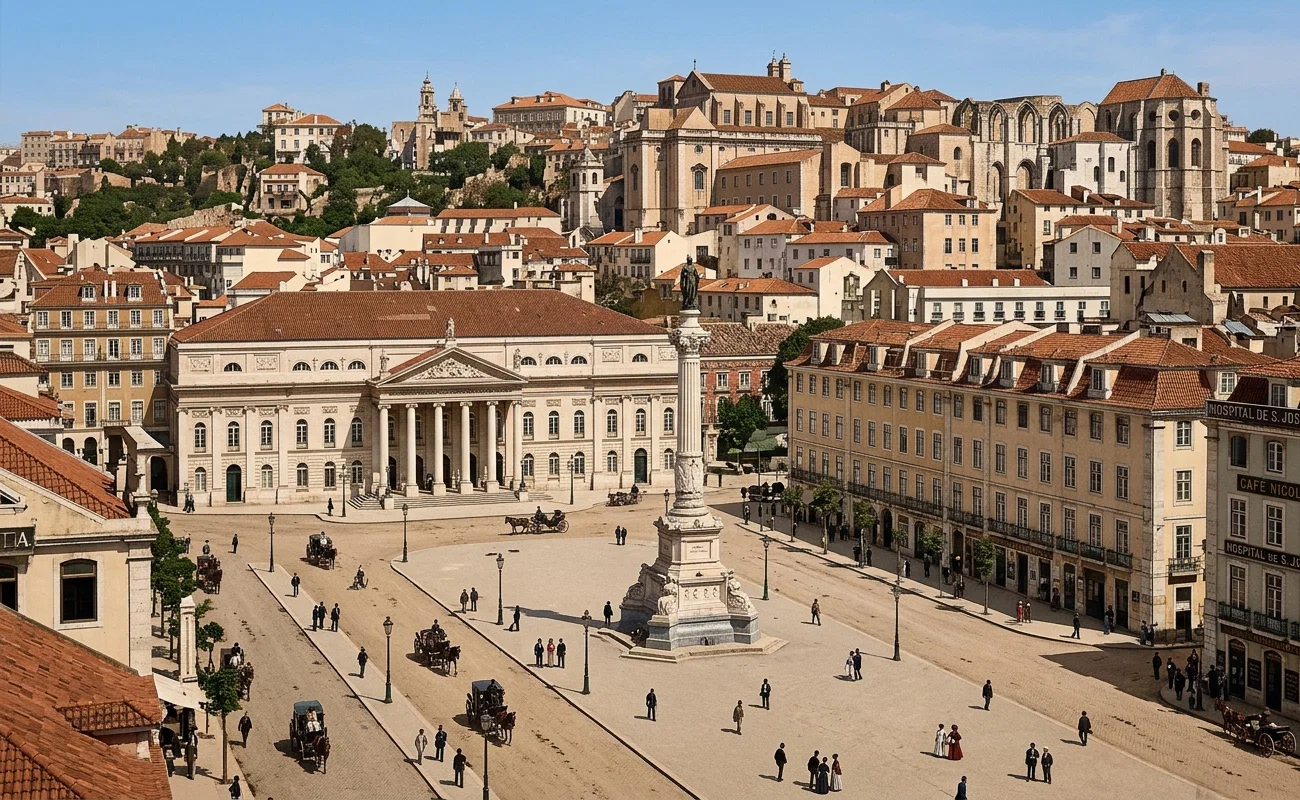
A VIEW IN LISBON. THE THEATER WITH SIX PILLARS WAS THE OLD INQUISITION BUILDING
The sovereignty of Rome was broken by the invasions of the Alani and Suevi during the fifth century. These were followed by the Visigoths, who ruled until the eighth century, and were in turn conquered by the Mussulmans. The Goths left traces of their rule in the architecture of noted buildings, and in the language, especially in northern Spain. The Saracen, or Mohammedan, invasion, brought the Moors into the peninsula, and wars raged between them and the so-called Christians until they were driven out in the twelfth century. Many Moorish mosques dot the country reminding the people of the presence of days gone by. These also remind the Bible student of the prophecy in Revelation 9, about the Mohammedan religion, in its inroads over the domains of the papacy.
In the eighth century a descendant of the Gothic kings accepted the command of a body of warriors, and taking refuge in northern Spain formed an independent state called the kingdom of Oviedo, between the mountains and bay of Biscay. As they grew stronger by fighting the Moors, the capital was changed to Leon, farther inland. Beside the kingdom of Leon, three others were constituted,—Castella, Navarra, and Aragon.
A descendant of the Duke of Burgundy, on entering the kingdom of Leon, was given a portion of land with a title, Count Henry of Portugal. This land lies between two rivers in north Portugal to-day, but a son of the count by conquest enlarged his dominions south to Lisbon and along the Tagus. We may picture the geography of the times. Leon lay east and north of Portugal, One Castella farther east to about half the frontier between Spain and France, and Aragon in the center and northeast. The Moors occupied the country from Lisbon to Valencia on the Mediterranean and all the southern portion of the peninsula.
In 1139, D. Alfonso Henriques was acclaimed king of Portugal, and the kingdom was recognized by the pope in 1144. In 1230 the kingdoms of Leon and Castella were united by inheritance of Ferdinand III, king of Castella. In 1479 Aragon and Castella were united by the marriage of D. Ferdinand II to D. Isabel of Castella. Little by little the Portuguese drove the Moors away from their territory, and the Spanish as well. This was completely accomplished in 1610. In all these years many were the wars between the neighbors on the peninsula. The Portuguese were helped by the English in wars against Spain and France, but now peace reigns between the two. We note that the Inquisition raged in13the two countries at about the same time, although first in Spain as a machine of the state as well as of the church. The expulsion of the Jesuits by the Marquez de Pombal broke the power of the Inquisition in Portugal, and it shortly ceased.
One thing we see now is the cordial relations between the two peninsular powers. The postal system provides for the same rates between the two as exist in each country. A letter sent to Gibraltar, English territory, is five cents, but to any part of Spain or her possessions it costs two and one-half cents. The rate on printed matter is very low. As the two languages are so similar, a paper could be published in the two, thus building up a unity in the two fields. Another thing may be done as the necessities demand, and that is there could be opened a union school for training workers in the two fields so close together.
We have noticed reports of workers in lands of Bible fame, yet perhaps few know that Spain and Portugal represent a place where Paul the apostle desired to go. In Romans 15 he twice mentions his desire to go to Spain on his return from Jerusalem by way of Rome. Now if Paul realized the importance of going there, surely it is more important now, especially when is due the last warning message to the world.
About three years ago the Brethren Bond started work in the ancient kingdom of Aragon, in and near Barcelona, and they report between fifteen and twenty Sabbath-keepers. With this start, the land of the Visigoths, of the Moors, of the kingdoms of Castella, Leon, and Aragon, will not long hence hear the sound of the loud cry of the third angel's message. The work in the land of the Suevi, the Moors, and the kingdom of Portugal, is still in the “rooting” stage. We who are here are sowing seed. May God bring the fruit, and bless the work in the Iberian Peninsula.
Missions in German East Africa
By Ludwig Richard Conradi
L. R. CONRADI
By looking at a modern map of Africa, one sees that British East Africa, with Uganda, right under the equator, and adjoining the Sudan on the north, forms the northern boundary of German East Africa—a colony extending from about one degree south to nearly twelve degrees south of the equator, and including in its territory the northern part of Lake Nyassa. Thus British and German East Africa are the connecting links between the Egyptian Mission (which includes the Sudan) and the territory of the South African Union.
German East Africa has an East Indian Ocean coast line of about 620 miles; the British island of Zanzibar lies right before it; and its area is about one-half more than the whole German empire in Europe, although its population is not quite seven millions, mostly Bantu negroes. The well-watered and alluvial seaboard is inhabited by the Swahili, who dwell in a malarious climate, and are surrounded by a luxuriant vegetation. The language of this people is enriched by an intermixture of the Arabic, and is the general medium of intercourse among the interior tribes, so that, as far as the area over which it is spoken is concerned, it is one of the twelve most important world-languages, and it possesses, besides the Bible, a number of religious works, and a general literature.
On going inland, after one leaves the coast, he gradually ascends, crosses a great plain, and a high plateau, until he comes to the Nyanza, Tanganyika, and Kiwu Lakes, forming the western border of the colony, while to the north is the great Victoria Nyanza, the northern half of which belongs to British East Africa.
Besides ours, there are the following societies working here: The Berlin, the Leipsic, the Moravian, and the Church Mission societies, the Universities Mission, and the Roman Catholics (who are very strong along Tanganyika and Victoria Nyanza Lakes).
The capital of the country is Dar-es-Salam (the city of peace), a most beautiful place, with a population of about twenty-five thousand. It has a lovely port. A railway is now being rapidly pushed inland from this town, with the expectation that before long it will extend to the lakes, a distance of about nine hundred miles. While I was in the capital, I had the privilege of calling on the governor, Graf von Goetzen, and his wife, a Washington lady. They received me very kindly, and were much interested in listening to the principles of our truth for two or three hours.
MISSIONARIES' DWELLING AND KITCHEN AT KIHUIRO
(Friedenthal is at the base of the mountain in the distance)
The port which concerns our work most, is the northern port, Tanga. It has about six thousand inhabitants. It is nicely situated. The government has erected fine post-office and hospital buildings in this city. From here the first railroad was built, and now it extends about eighty miles inland. When I was there the road had been constructed only along the southern base of the Usambara Mountains, which attain an elevation of about seven thousand feet. In this region the Germans have a number of nice plantations, and in this neighborhood there are some fine mission stations belonging both to the German and also to the English societies. While I was still in Africa, the railway was extended some thirty miles farther inland, on the western side of the mountains, with the expectation that it might some day be extended either to Nyanza, or to Kilima-Njaro. Thus while our mission is now about 110 miles from the coast, we can make eighty miles of the way by rail, and in one night more, push through to our nearest station, at Kihuiro.
We are located in the Pare Mountain district. The Pare Mountains are about one hundred miles long, extending from the south to the north, and ten to fifteen miles broad. This short range is divided into the South, the Central, and the North Pare region; the last really forms the base of Mt. Kilima-Njaro, the highest mountain in all Africa, reaching an altitude of nearly twenty thousand feet.
Our first missionaries, Brethren Ehlers and Enns (the latter being a nurse), left Europe in the autumn of 1903; and by the kind assistance of the German governor, who gave them letters of recommendation and introduction to the German Commissioner at Tanga, in charge of that district, they were able to secure a location in the South Pare Mountains at an elevation of about four thousand feet. The Bantu tribes throughout this country are not very populous, and they are more or less mixed. As the roving Massai often raided them, these mountainous tribes were somewhat shy, and our missionaries found them only in scattered huts in the valleys between the hills. Up to an elevation of about three thousand feet, the mountainsides were rather unfruitful; yet after reaching that altitude, one finds here and there well-watered and productive valleys.
It was in one of these valleys that our first missionaries decided to locate, and on Nov. 25, 1903, they telegraphed us: "Pare Mountains," meaning that they had decided to start a station there. They leased about sixty acres of land from the government. We first paid the natives about fifty dollars for their rights, and now we pay a nominal rent of about seventy cents per annum for the entire tract of land, our contract being something like the homestead laws of the States. At once we had to take possession of the land, and began to improve it, until half of the land is in good shape. Then we may ask the government to sell us the tract for about fifteen dollars.
The brethren immediately pitched their tents, and began to clear off the land. At first they had trouble to secure provisions from the natives, some of whom had never before seen a white man. But as Brother Enns went among them, doing medical missionary work,14they soon became more friendly, until they finally even brought their provisions to the station. Later on, after our missionaries had sufficiently mastered the native language to enable them to be understood, from one to three hundred natives would attend the Sabbath services.
In the spring of 1904, the writer started for German East Africa, accompanied by two brethren, and two sisters, missionaries. One of these, Brother Wunderlich, was a builder and general mechanic, who assisted in the erection of the buildings, which we planned for while there. They now have at the first station, Friedenstal, a schoolhouse on the top of the hill; a little lower down, is a place for the black boys; then comes the dwelling for the missionaries; and finally the stables for the cattle and donkeys are lowest down the hillside. We have constructed a good road from this station down to Kihuiro, a distance of about ten miles; our land has been placed under much better cultivation.
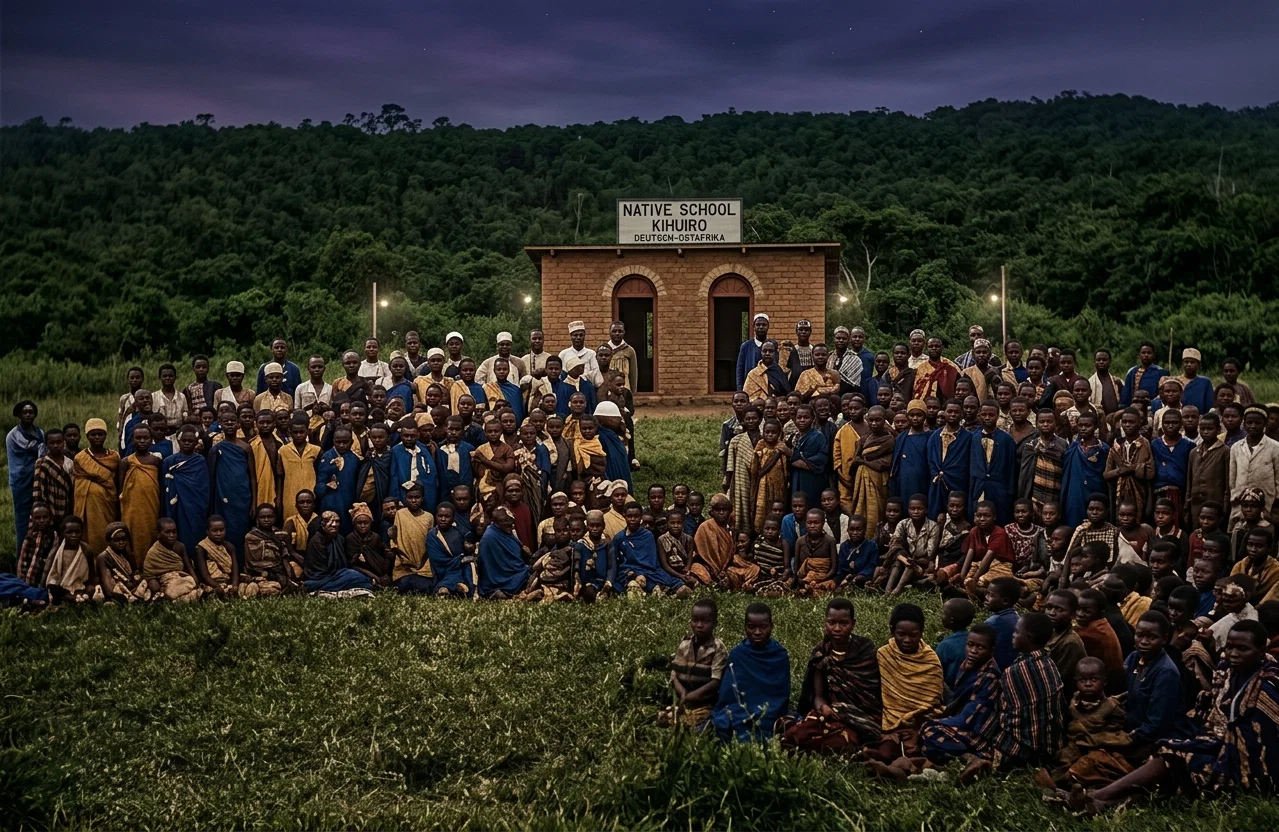
NATIVE SCHOOL AT KIHUIRO
While in Africa, we looked over the whole region surrounding our station. When we first entered the Pare district, there was no other station within fifty miles of ours; but a few months later the Leipsic Mission, which had occupied the North Pare Mountains, wrote our missionaries, asking them to leave that territory. We had previously been very careful to assure ourselves that we were settled in virgin missionary soil. But in view of this protest we went, although it was during the rainy season, to visit the Leipsic station, which was rather hard for us to find, as our boys did not know the exact location—they had been informed only of the general direction in which it lay from us. We had no regular road to guide us. We found that the Leipsic missionaries had rather primitive dwellings. These friends received us very kindly, and we agreed on a boundary-line. Since then, I have visited their missionary director in Leipsic, and had a very pleasant chat with him.
Before leaving, we went up an elevation of eight thousand feet, whence we could see one hundred miles southward into the German colony, and as many miles to the northward, into British East Africa. We were prospecting as to favorable openings for future stations. As the people in the mountains are scattered over a wide area of country, I urged upon the brethren the necessity of opening a station at Kihuiro, a village containing about two thousand people, and located on the caravan road. This place is situated on the river, and is about fourteen hundred feet above the sea. The brethren at first thought that such a location would be very unhealthful, but as thriving missions have been established by other denominations even farther down toward the lowlands, they finally decided to open a second station at that place. From the accompanying pictures, you will see that we have erected a nice schoolhouse in the village itself. We have one hundred and fifty students here now. The dwelling-house is about a mile farther up the valley, away from the village and out of reach of the mosquitoes. To open this station, we sent three missionaries—Brother and Sister Ohme, nurses, and Brother Kotz, who has a good classical education. Both brethren spent over half a year in the Oriental Seminary in Berlin, studying the Swahili, under a good teacher. The Lutheran professor spoke very highly of Brother Kotz’s linguistic abilities, and promised to help him later on, if he should desire to bring out a grammar or dictionary in the native African language, seeing that it would be published free of cost to Brother Kotz. These three workers left for Africa the middle of May, 1905.
We have now arranged for Brother and Sister Langholf to have charge of the upper station, at Friedenstal, where they will look after the cultivation of the land, and see to instructing twelve or more boarding pupils we have, with the forty-five day scholars. Below, at Kihuiro, we have about the same number of boarding pupils, and about one hundred and sixty day scholars. At the time of the dedication in Kihuiro, about six hundred natives were present. In both stations, the Sabbath services were well attended.
But we have now begun the opening of a third station—on the other side of the mountains, where there are about seven thousand people. Brother Enns is to conduct the work there, until some one else can be supplied to take his place.
The natives worship snakes, hyenas, etc., secretly; it took us some time to find this out. Some of the chiefs are more or less influenced by Mohammedanism, and they have ten to thirty wives.
While thus far we have had no direct conversions, the following translation of a letter written by one of our pupils will be of interest:—
“Kisuaheli: Mimi mwanafunzi Senamwaye bin Semboja nataka nifuate maneno ya Muungu nikuwe Mkristo na mwanafunzi wa Yezu.”
When translated, this letter reads: “I, pupil Senamwaye, son of Semboja, will now follow the words of God, becoming a Christian and disciple of Christ.” This youth is only fourteen years of age. We are glad for this omen of a better day, when our faithful missionaries there will see fruits of their labors.
When we first began to think of opening this German East African Mission, we expected to have to call on our American brethren to help us with about five thousand dollars, as at that time the German Union was not entirely self-supporting. But as the Mission Board was cramped for means, we decided to take hold of the matter over here; and God has so wonderfully blessed us that up to the end of 1905 we had been able to expend about eleven thousand dollars for the transportation, wages, and outfits of missionaries, and for the buildings we had erected. Not only have we been to such expenses, but we have today a nice capital to go toward starting further stations. We feel very grateful for the help various friends have rendered us from the States; they may be assured that the money they have kindly sent us has been put to a good use.
Brother and Sister Ehlers have had to return to Germany on account of failing health. There is no hope of his being able to return. Brother Wunderlich, our faithful builder, after superintending the erection of the mission buildings, succumbed to a fatal sickness. He returned to Friedensau, where he had left his family, and was permitted to be with them only about two weeks, before death took him from us. He had returned with no intention of remaining in Germany, but had thought to go back to Africa with his family. This seemed to be his chief concern, even during his illness, as his whole soul had been stirred by the needs of the African peoples. While he now sleeps in Jesus, a valiant soldier of the cross, yet his modest tombstone in the Friedensau graveyard will only serve as an incentive to our students, urging them to devote their lives to the noble work of the self-denying missionary.
Nebraska
By L. Johnson
DENMARK AND DANNEBROG.— May 22 was a good day for our new church at Denmark. The writer baptized nine persons. The church has now twenty-six members.
May 27 I baptized two dear souls at Dannebrog. A number from the town were present and witnessed this rite in the scriptural manner for the first time. The Lord is good to his people.
L. JOHNSON.
Porto Rico
By B. E. Connerly
WE are glad to report the opening of the third meeting place in Porto Rico. Our work has moved slowly, but the message is going. In Guanijibo there is a good interest, some we shall baptize. We need a man to take charge of the work at this place.
In Arecibo the work is encouraging, and, thank the Lord, the Board have promised to send us a man and his wife to take charge of the work there. We have one sister who speaks English there who will be a great help to them until they get hold of the language. Next month we hope to go to enlarge their meeting-house, and make seats of which they are sadly in need. Recently, an intelligent, influential man and his family have accepted the truth there. These we hope will also be a help to the work. When we were there in March he was married in Brother Moulton’s home. (It often happens in Porto Rico that when people get converted they get married even after they have raised a family.) They will be baptized next month.
Our new place in Mayaguez is a comfort to us. It has a seating capacity for one hundred and twenty-five people. We have a good interest there, the house being full from the first. Last year it was exceedingly hard to hold the interest in our church and Sabbath-school because we had no place to worship; the people went to the other denominations who had chapels. This place came to us in answer to our earnest prayers for it, and we feel sure that as the Lord has given it to us he will bless it. We look for the return of some who had become cold and indifferent. We are praying more earnestly than before that the Lord will send workers into this part of his vineyard. B. E. CONNERLY.
British Guiana
By D. E. Wellman
WE were never more busy than we have been since about the first of February, when the conference committee separated. Up to the middle of March I spent my time in Trinidad. Since then I have been in this colony, with the exception of the time I spent in the office of the Watchman and in repairing the church in Port of Spain.
In Georgetown our labors for a higher spiritual life in the church have met with signal success, and nearly all have come to see eye to eye. Eleven were baptized, and we had a most excellent quarterly meeting, which was one of the best, and the largest in its history.
At New Amsterdam our labors were fruitful. Four were baptized. The members were brought into closer union, and plans were laid for earnest labor for their fellow townsmen. An elder and a deacon were ordained, and other matters were set in order. Brother J. J. Smith, of St. Thomas, has charge of this section of British Guiana, having recently moved to this field at the request of the conference committee. We hope his labors will be marked with success. He has been well received.
From this place we expected to go up Canje Creek, which is really a large river, to visit a thriving little company of our people. But having received word that important business matters would require many of them to be away from home, we had to turn back to Georgetown. Two of the brethren from this company were with us at New Amsterdam, and from the instruction given, gathered much to take home with them. They live seventy miles back in the interior, and their only highway is the river above mentioned. The entire distance has to be made in a small row-boat. They, however, take advantage of the tides, which naturally assists in making the journey. The whole country is nearly a dead level; consequently, the tides affect the river far into the interior, something like a hundred miles. This church has its own building, and conducts a thriving Sabbath-school, day-school, and young people's society, and is showing a true spirit of progress in the message.
Although there has been much in this colony to hold back the message, and to bring discouragement, we are fully persuaded that better days are before us.