At the University of California, Prof. M. E. Jaffa has carried on, in co-operation with the United States Department of Agriculture, a number of investigations which have to do with the food value of fruits and nuts, the special object of this and the earlier work which it continues being to study the value of such foods when they constitute an integral part of the diet.
Nine dietary studies and thirty-one digestion experiments were made, part of them with persons who had lived for a number of years on a strictly fruit and nut diet, and others with university students who had been accustomed to the ordinary fare. In the majority of the dietary studies, and all but one of the digestion experiments, fruits and nuts constituted all or almost all of the diet. Thus, in one series of tests the daily ration consisted of apples and bananas, alone or in combination, eaten with walnuts, almonds, Brazil nuts, or pecans. In other experiments different combinations of grapes, pears, figs, walnuts, and other fruits and nuts were eaten with small quantities of milk, cereal breakfast foods, etc., the latter articles being taken simply to give a relish to the experimental dietary combinations, some of which were rather unusual.
In connection with this work, the nutritive value of individual fruits and nuts was studied, and many data were collected and summarized regarding the composition and energy value of these materials, an interesting feature of the work being a comparison, on a pecuniary basis, of these and some common foods as sources of protein and energy. In general, it may be said that the chief nutrients in fruit consist of sugars and other carbohydrates and in nuts of protein and fat. In other words, while both fruits and nuts furnish the body with energy, nuts furnish some building material (protein) as well. Some idea of the range may be gained from the fact that at ordinary retail prices in the United States, ten cents expended for fresh grapes will supply the body with about 830 calories of energy, and in the case of dried apples or apricots will supply about 1,200 calories, as compared with 6,600 calories from ten cents' worth of wheat flour. In the case of almonds, this sum will supply .08 pound protein and about 1,100 calories of energy, and in the case of peanuts .28 pound protein and about 2,800 calories, while expended for cheese it would provide .17 pound protein and about 1,300 calories, and for flour .46 pound protein as well as the large amount of energy noted above.
Although some of the dietaries showed that it is quite possible to obtain the needed protein and energy from a fruitarian diet, the majority of those studied fell below the tentative dietary standards. It is hardly just to ascribe this entirely to the form of diet, as the same people might have consumed no larger quantities of nutrients on an ordinary mixed diet. The nutritive value of the fruitarian diet is, perhaps, most clearly shown in the case of one of these subjects, a university student, who, though entirely unaccustomed to such fare, gradually changed from an ordinary mixed diet to one of fruits and nuts, without apparent loss of strength or health. He was then able for the eight days of the experiment to carry on his usual college duties, and for a part of the time also performed heavy physical work on an exclusive fruitarian diet, without material loss of weight.
The daily cost of the fruitarian diet per capita varied from eighteen to forty-six cents, values which compare favorably with those of an ordinary mixed diet.
Although it is undoubtedly advisable to wait until more data have been gathered before making definite statements regarding the digestibility of different fruits and nuts, enough work has been done to show that they are quite thoroughly digested, and have a much higher nutritive value than is popularly attributed to them. In view of this, it is certainly an error to consider nuts merely as an accessory to an already heavy meal, and to regard fruit merely as something of value for its pleasant flavor or for its hygienic or medicinal virtues.
As shown by their composition and digestibility, both fruit and nuts can be favorably compared with other and more common foods. As sources of carbohydrates, fruits at ordinary prices are not expensive; and as sources of protein and fat, nuts at usual prices are reasonable foods.
In the investigations at the University of California, the question of the wholesomeness of a long-continued diet of fruit and nuts is not taken up. The agreement of one food or another with any person is frequently more or less a matter of personal idiosyncrasy, but it seems fair to say that those with whom nuts and fruits agree can, if they desire, readily secure a considerable part of their nutritive material from such sources.— Scientific American.
Why Snow Falls in Flakes
Why does snow fall in flakes? This question which puzzles so many people unfamiliar with the process of crystallization, is answered in the American Press in this way: “Snow falls to the earth in flakes because it is water solidified in starlike crystals, each snowflake being usually made up of several crystals, which are excessively light on account of the large quantity of air among the frozen particles. The snow crystals arise from the slow passage of the water vapor of clouds, when the temperature falls below freezing-point, into the solid condition, the fairy-like transformation taking place by the tiny independent particles of water grouping themselves with the utmost mathematical regularity around different centers. Each crystal of snow, as of anything else, is, therefore, a more or less perfect geometrical solid. The most complete snow crystals are formed in a clear atmosphere, where there is nothing to retard the gradual process of crystallization or molecule construction. Rain, on the other hand being a liquid, falls in drops.”
Give Freely and Cheerfully
Give! as the morning that flows out of heaven;
Give! as the waves when their channel is riven;
Give! as the free air and sunshine are given—
Lavishly, thoughtfully, cheerfully give.
Not the waste drops of thy cup overflowing;
Not the faint sparks of thy hearth ever glowing;
Not a pale bud from thy full roses blowing—
But give as He gives thee, who gave thee to live.
— Selected.
The American Bible Society Colporteur
By Henry Otis Dwight
We all know something of the ceaseless work of the colporteurs of the American Bible Society. But we have to be reminded every now and then of the thoroughly missionary quality of this branch of the Bible enterprise all over the world.
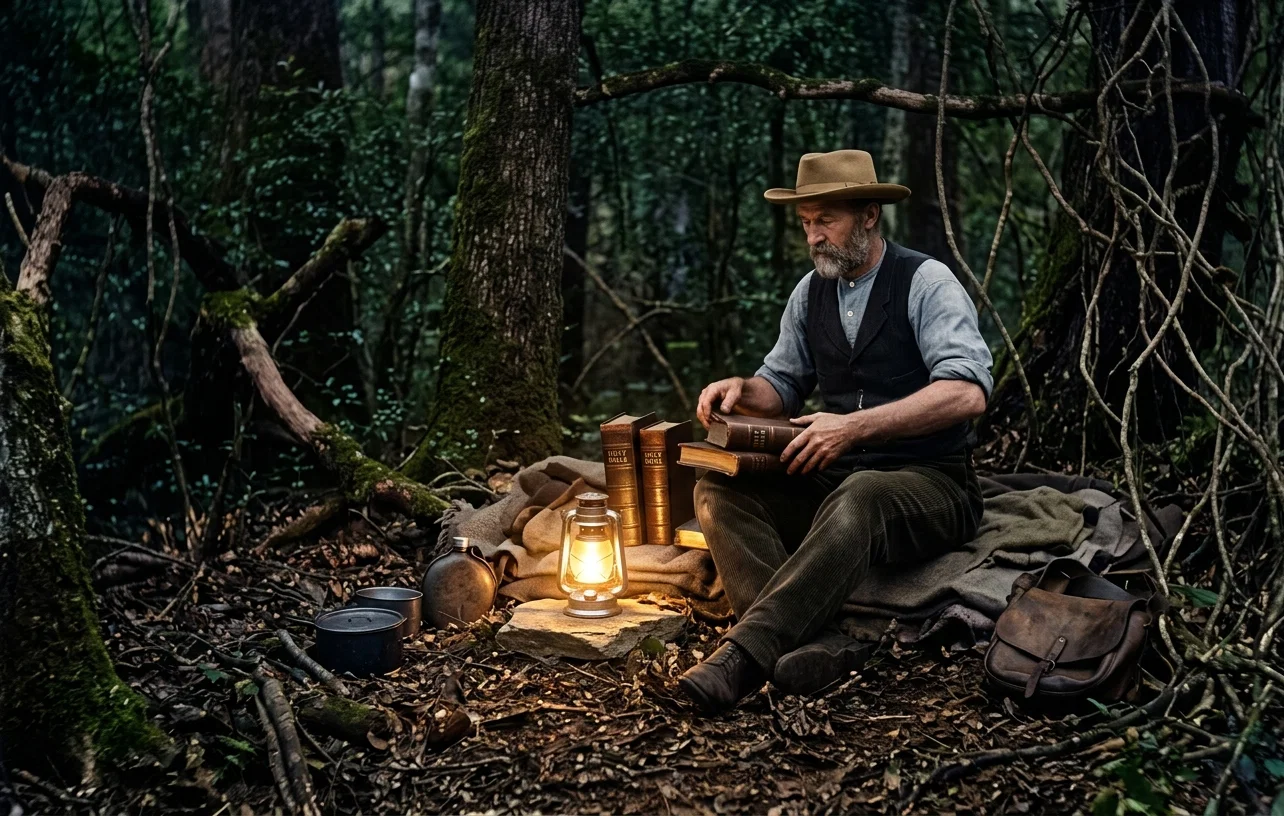
COLPORTEUR'S BIVOUAC
The nature of the work of selling Bibles to those who do not care for them calls out the highest types of devotion and self-sacrifice; the out-of-the-way places where colporteurs find their duty make them like skirmishers in advance of an army, pioneers who discover fields for missionaries to occupy; and their evangelistic visits constantly set in motion forces whose action does not cease when the man of the Book has gone away.
In a small town of Bolivia one of these agents of the American Bible Society is going along the main street. Some well-dressed gentlemen near by are looking at him curiously. Leaning against the wall to sun himself is a ragged, dirty, half-naked Quechua Indian. He, too, sees the man with the Bibles, and rushes toward him with extended arms. He is going to welcome him with an embrace, for it is a joy to see him. The Bible agent hesitates; all these well-dressed people are looking on. Shall he let this Indian kiss him in that public place? Why not hold him off, and make him moderate his wild affection? But no, this poor fellow's heart has been touched. Perhaps in due time his soul may be won for Jesus Christ. So the Bible agent endures, at great cost to his feelings, and solely for the sake of his Master, the embrace of the unkempt savage and the unconcealed mirth of the gentlemen of the town. It is one of the acts of knightly heroism of which many different kinds are demanded of the colporteurs.
In a little town in Mexico a blind woman is a colporteur. She is also an illustration of devoted energy. She takes a few books in a covered basket, and is led through the streets by her little son, a bright-eyed lad of five or six years. Every day she comes home tired, but happy because she has sold some Bibles or Testaments. The whole number she had sold was one thousand seven hundred at last accounts. She expresses in one sentence the reason why colporteurs of the Bible Society are willing to endure long tramps, storms, burning heat, cold scorn, and violent attacks, in their quest after people who need the Book, and need to be taught and comforted by it. She says, “It is such a joy to be used by the Lord in his work.”
The colporteurs are pioneers because the place where the Bible is most needed is the place where the Bible has not yet gone. The little book is the entering wedge that will open a way for light. The man of the Book must overcome obstacles and find a place for it. They are pioneers of our own home missions, as well as in the fields of the various foreign missionary societies. In one of our Southern towns a colporteur reports: “I can step from porch to porch and go through the block of twenty-five or thirty houses, and I find but two or three Bibles in the block.” He has to argue over almost every Bible that he sells, to convince his customer of the need of the Bible as a guide. It is a rather shocking picture of conditions in this Christian land. Yet we can see that in such a place the man is doing his characteristic work—pioneering for the missionary societies.
The beginning of missionary work in Acayucan, Mexico, was made by a colporteur of the American Bible Society. When the priest heard that the Bible had been brought to town, he preached three days against the heretic and his books, threatening his flock with the major excommunication if they bought. It was only human nature for his hearers to go straight to the colporteur, that they might see the evil of his books for themselves. He was daring; their need of the book weighed more than the danger of the priest's wrath. So it came about that the four evenings he was there, the colporteur had a Bible meeting every evening. These were the first Protestant meetings ever held in Acayucan.
Naturally the missionary societies are planning to begin work in the canal zone of Panama. But the pioneers are already there. The Bible Society requires no large outfit for these advance guards.
As has been well said, the colporteurs go out, like David, with the simplest weapons,—the smooth pebbles from the brook,—and when the missionaries reach Panama, if God will, they shall find that the Bible is already being read and pondered by some, and thus somewhat preparing their way.
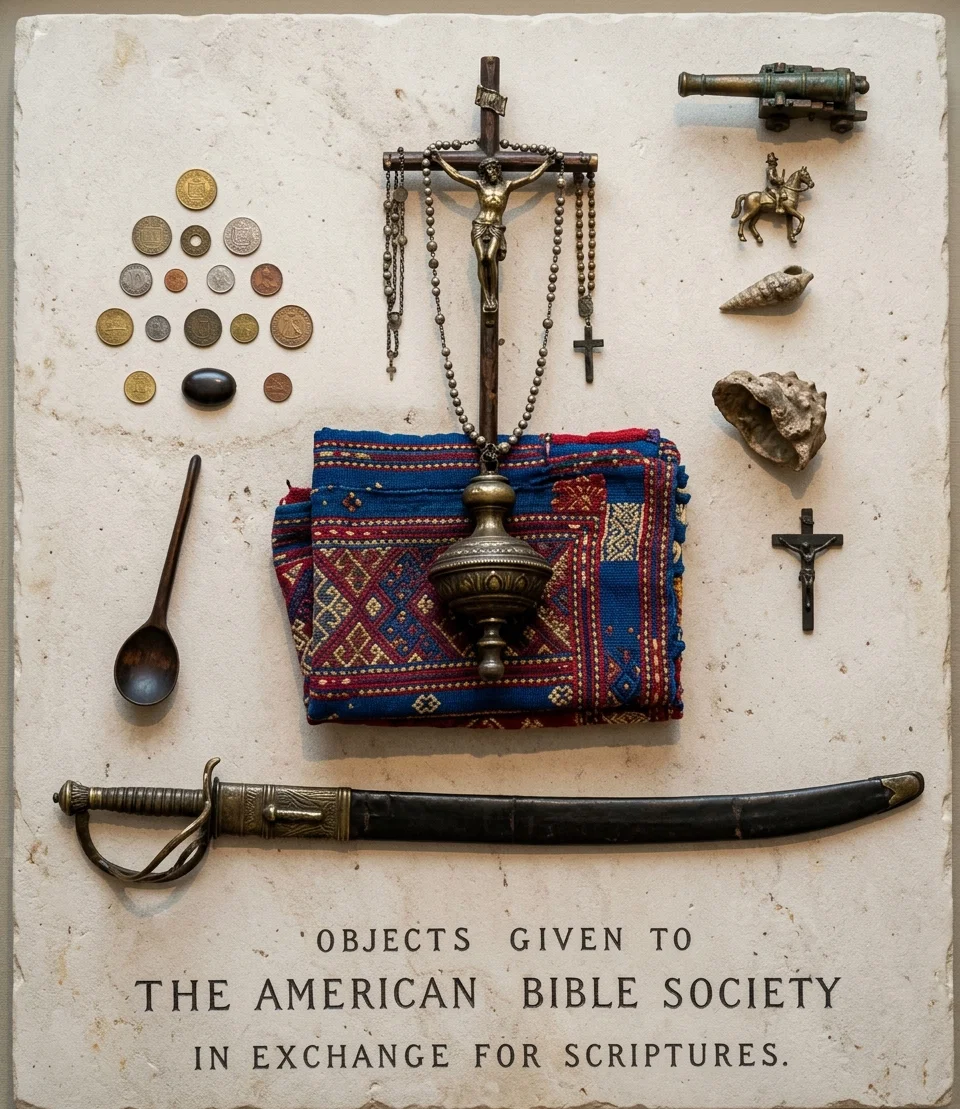
Strange experiences the colporteurs have where the Bible begins to be bought freely. The people have no money, and they pay in eggs and fowls; barter rosaries, crucifixes, idols, weapons, for the book. When things reach that stage, the colporteurs have their reward in knowing that seed sown by their instrumentality is taking root. In the Philippine Islands a colporteur at Malabon had an earnest talk, some three years ago, with a Signor Blas, whom he found in a position like that of a pool-room proprietor in New York, for the man made his living out of cockpits used for gambling. The colporteur had that one talk with Signor Blas, and the same night he died of cholera. But his work remained. The keeper of the gambling-house was converted, gave up his business, and is now a most powerful evangelist who has won many to Christ.
This feature of the unceasing labor of the men who wander abroad to scatter the Scriptures—the permanence of results—is worth enlarging upon, for we do not yet realize how far the influence of a Bible can reach when sent forth with prayer.
OBJECTS GIVEN TO THE AMERICAN BIBLE SOCIETY BY EX-CHANCELLOR
About the year 1859 some one's gift of money to the American Bible Society (whose gift it was God certainly knows) paid for printing the book of Genesis in Chinese. Then some other person, chivalrously anxious to help, comfort, and save the distressed (who it was God knows), carried some copies of the Chinese Genesis to Japan, and gave them away. As is the usage of those who do such work, he let them go in that newly opened land like arrows shot at a venture. A boy named Neesima read the first words of the book: “In the beginning God created the heavens and the earth.” He grasped the meaning of that sublimely simple verse, and, being14taught by the Holy Spirit, he instantly knew that God is.
THE AFFECTIONATE INDIAN
We all know the result through the story of the life of Joseph H. Neesima, who went to America because the book had come to Japan through Americans, and returned to Japan moved by the Christian and chivalrous wish to free his own people from bondage to sterile beliefs, to help them to rise from ignorance and become men. We know the wonderful fruitfulness of his self-sacrificing life. Though dead, his deeds still wield influence, arouse aspirations, impel other Japanese to do as he did. The point to be noted here is that Neesima's life thus became worth telling in print, and has been well told.
Meantime, struggles, and wars, and upheavals wrought among the Chinese a strong willingness to learn things from Japan. This momentous change of mind toward Japan in the last ten years can not have been accidental, unplanned by Him without whom not a sparrow falls to the ground. Because of this new tendency among the Chinese to learn from Japan, some one (who it was we may be sure that God knows) paid for printing the life of Joseph Neesima in Chinese. This unknown one played the part of a relay magnet in a telegraph office. By his act the book sent out from the Bible Society so long ago, which made Neesima's life possible, extended the field of its work to China after more than forty years.
As promptly as if published for that very purpose, the life of the great Japanese Christian stirred to its depths the soul of a Chinese Christian in Amoy. The beauty and nobility of that life filled the man with regret that he was too old to prepare to use opportunities he now saw for the first time for benefiting his own nation. But the good Chinaman resolved that his son Eng-ki should have a chance to wield influence for Christ in China as Neesima did in Japan.
Now we have word that young Eng-ki of Amoy became a Christian in the school of the London Society's Mission, studied well, took the regular government examination, and that in July he came out first among the whole crowd of aspirants in the great province of Fukien. He is now in the Imperial University of Peking, preparing for the government service. The fact of a Christian's taking the first place in the great examination has become noised abroad, and men are looking into this thing, hoping to learn what led young Eng-ki to this brilliant success.
It is clear that results are yet to spring from the act of sending out the Scripture which began Neesima's life. More fruit is yet to ripen in China from the seed sown by the hand which took the book to Japan. But already we can see, by tracing this little history of a long-forgotten gift to the American Bible Society, that the work of men of prayer in the circulation of God's Word bears with it a possibility of extension such as no other enterprise can offer. For the word of truth once lodged in good soil in the heart of man must go on working—can not stop working—in wider and wider spheres of influence, even to the very end of the world. These modern Knights of the Round Table are laborers together with God.—Henry Otis Dwight.
The Work at Battle Creek
By Board of Elders
THE cause of truth is onward at this place, and there are many encouraging conditions. During the year 1904 there were two hundred and forty-two new members added to the church, and one hundred and seventy-two members dismissed , leaving seventy as the net gain in membership for that time. There has been quite an exodus of our people from Battle Creek, some to Washington, some to Nashville, some to College View, some to Mountain View, and to a number of other localities. The removal of burden-bearers has resulted in calling others of our members to take up their work, who, before that, were more or less inactive.
There are still others who are planning to remove to localities where they will have wider opportunities and more urgent demands for missionary effort than exist here. The desire seems to be quite general on the part of our members to go wherever the Lord wants them, and to do what they can for the advancement of the cause of present truth.
Some of the more important financial items in the work of the church for the past year are as follows: Amount of tithe paid, $15,385.20; receipts of the tract and missionary society, $1,719.23; church expense, $1,358.04; relief fund, $225.40; church-school teachers' fund, $1,711; Sabbath-school contributions, $1,185; Young People's Society contributions, $560; contributions to various other denominational interests (including only a portion of the contributions to the Washington fund), $3,000, thus making a grand total of revenues from this church of more than $25,000 for that year. There have been many personal contributions to the Washington fund, also to some other funds, which can not be definitely tabulated, and hence are omitted from the foregoing compilation.
In the autumn of 1903 the church decided to procure a site and erect a school building suitable for the accommodation13of the resident children of our people. That was accomplished, and our church-school moved into the new building in April, 1904. The amount contributed for the site, the building, and its equipment up to the present time, aggregates $5,800.
The record thus far for the year 1905, as to membership and finances, compares favorably with last year.
The degree of harmony and union that prevails among the believers here is very encouraging, and in all departments of the work there is a determination to keep step with the advancing message. We are carefully studying the world-wide demands of the gospel of the kingdom.
Commendable activity is manifest in the work of the Young People's Society, the district missionary and prayer-meetings, and in house-to-house missionary effort. To a marked degree there has been of late a drawing together of the church and sanitarium interests and work; and more general and hearty co-operation now exists in this respect than for a number of years—perhaps than ever before. The nurses and helpers of the sanitarium and the students of the medical college are decidedly active in missionary work, which is only a logical outgrowth of the general policy and conviction that prevail in those two institutions. In no other year of the history of the sanitarium have there been so many opportunities in connection with that institution to place the truth before those not of our faith as during 1904, and in no year have those opportunities been more diligently improved, nor with better results.
The Industrial Academy—that being the name of our church-school—has enrolled a total of two hundred and ten pupils for the current school year. The teaching force consists of the principal (Prof. B. E. Nicola) and five regular teachers, besides some cadet help. The work done in this institution is thoroughly in harmony with the principles of Christian education, and most excellent results are manifest.
The general services at the Tabernacle are well attended. Those who have the preaching services in charge are making a special study of the needs of the congregation and community with a view of having such discourses as will best meet existing conditions.
The Battle Creek church is full of courage in the good work, and has nothing but words of good cheer, encouragement, and hearty accord for the progress of the third angel's message.
BOARD OF ELDERS.
Canvassing in Ontario
By H. D. Carr
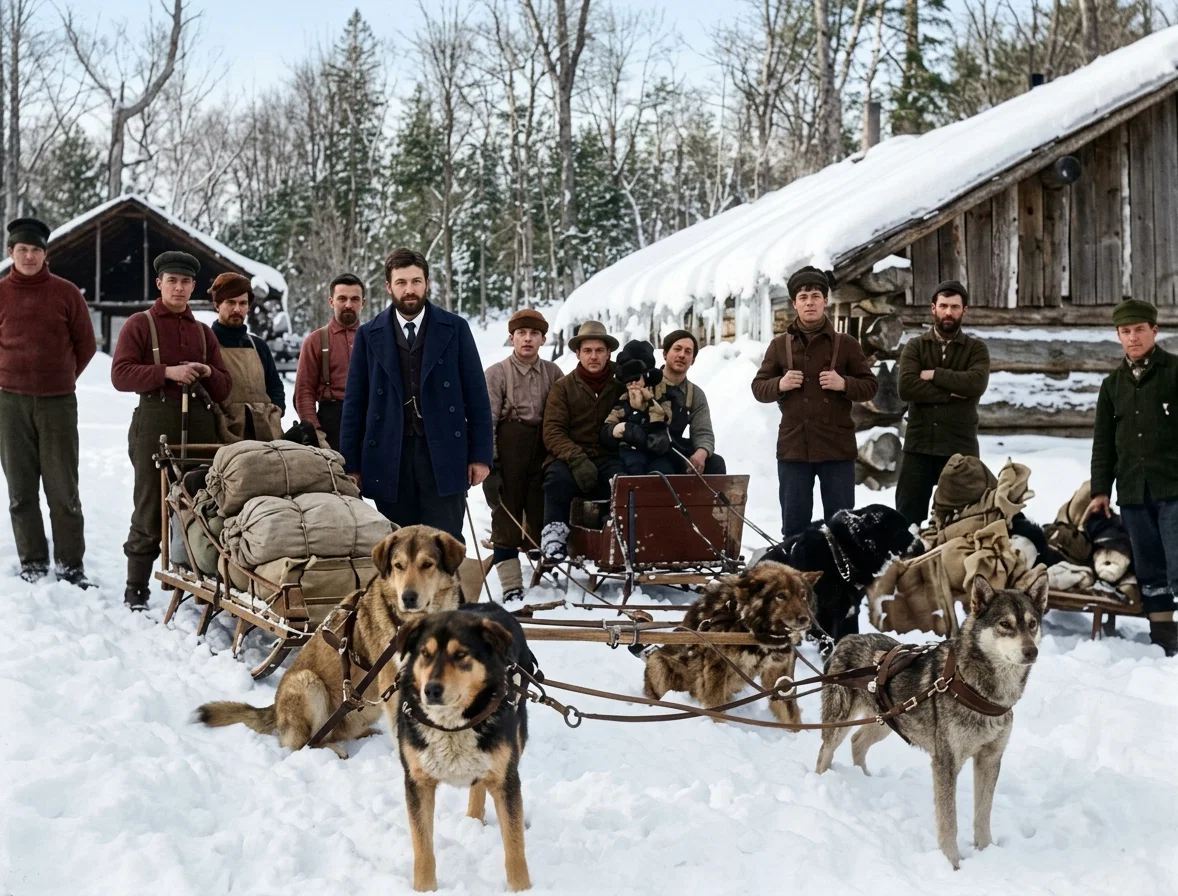
I LEFT my home at Gore Bay, Ontario, Dec. 26, 1904, with a team of three dogs, and a load of two hundred pounds on my sleigh. I drove forty miles to Little Current, where I delivered some books, and then continued my journey to Blind River.
It is not possible for a horse to travel where I went with my dog team, but there are people in these lonely places who must have this last warning message. My journey occupied two and one-half days, and I scattered the printed page by the way.
THE CANVASSER AND HIS DOG TEAM
I then visited the lumber camps, and sold twenty-one dollars’ worth of books, and took fifteen dollars’ worth of orders. I held two meetings, and met some honest souls who were hungering for the truth.
I then went to Cockburn Island, where I sold twenty-five dollars’ worth of books, and took sixty dollars’ worth of orders, in less than two weeks. I then returned to Blind River, and visited the camps again, taking a good supply of books. This time I sold books to the amount of seventy-five dollars. On this trip the picture was taken which accompanies this article. I made three trips to the camps, and sold one hundred and fifty dollars’ worth of books in less than one month, nearly all of which were our larger books.
I tell you, brethren, if you who are sickly and dying spiritually will tarry in the upper room until you are endued with power from on high, and then buckle on the armor, our publishers will have to run a night force to print books fast enough to supply our canvassers this coming summer.
Canvassers should not be afraid of telling the people of Jesus, and of his coming again for those who are watching for him; for this message will melt the hardest heart. I tell the people that I know by experience that the books will do them good.
How is it with you, my brethren and sisters? Are you standing in your lot that God has appointed for you? I am sure there are many who are quenching the Spirit, and saying, I will go after a while. Delays are dangerous. To-day is the time. Go forth now.
I must go back to Cockburn Island and deliver my books, and there are two other islands I am anxious to visit before the ice breaks up. H. D. CARR.
Buluwayo Mission, South Africa
By M. C. Sturdevant
Report for the Three Months Ending
Sept. 30, 1904
M. C. STURDEVANT
OUR church-membership is now fifty-eight. We thought best to drop from our number twelve who have gone back to the ways of their people. With but one exception, these were of the first of those baptized at the mission before we could understand their language sufficiently to teach them as we desired. The other members, though young in years, seem true and in earnest. Sabbath, September 24, we celebrated the ordinances. A good spirit pervaded, and I am sure all enjoyed the blessing of God.
We are still holding our Sabbath afternoon kraal meetings. Eleven or twelve kraals are visited every Sabbath, and every second Sabbath some of our teachers go out to the places where they hold their school, and preach to the people. In this way, from one hundred and seventy-five to three hundred hear the word who otherwise would not. At our Sabbath morning service at the mission, and also at the Sabbath-school, our school building is full. Some in the kraals are manifesting an interest in the Word. We still believe that some will turn to the Lord.
Our Sabbath-school opens at 10 A. M. Our building is too small to accommodate all our classes, so nearly one half must go out and sit on the ground. Yet the interest seems good. We have been studying the Psalms. At the beginning of the quarter we asked how many wished to leave the study of the Psalms and study the life of Christ in the New Testament. Very few hands were raised. They said they had learned so many precious things in the Psalms that they wanted to continue their study. Nevertheless, we took up the life of Christ again. The membership is 78; average attendance, 61; classes, 12; visitors, many. Mrs. Sturdevant has the oversight of the school, with native officers and teachers.
The Friday evening prayer-meeting is an encouraging occasion. Here the children tell of their battles and victories. Truly, they are growing in Christ. This gives us courage.
School Work
Our enrolment has been ninety, a good attendance for this people. The teaching of English has created a new interest in school work. Our studies are as follows: Zulu, primer and Bible, arithmetic, and simple English reading. Our first session begins at eight o’clock, and lasts till a quarter past ten.
At eleven o’clock Mrs. Hyatt and native teachers are in charge. From eleven till two o’clock we have the second session. This is attended by our more advanced students and those in training for teaching. Mrs. Hyatt teaches English, reading from “Christ Our Saviour” and “Steps to Christ,” also arithmetic and writing. I have two classes in Zulu, and one in English. The New Testament class is drilled in English words. Special study is given to the books of Daniel and Revelation. Never did I teach the message when it shone more clear to me; nor have I ever taught a people more fully ready to receive it. This class is very interesting.
Two hours every night is spent in the study of the next day’s lessons. Mrs. Sturdevant and A. H. White are in charge.
Industrial Work
Outside of the school work, all the boys and girls have their hour of labor in the home and on the farm. The girls, under Mrs. Sturdevant, care for the home, cook the food, etc. I have charge of the store, with native boys to help, and of the stock and farm. Last month Brother A. H. White joined us. He works with the boys about the farm, looks after repairs, helps in the night-school, and wherever needed.
This is our winter season, and little farm work can be done, except repairing fences. So our time has been spent in making brick. We have made about eighty thousand, hoping to put up a new church building and enlarge our mission home next dry season.
Finances
The Lord is still blessing us financially, so that all our wants have been supplied. However, we have not had the income our mission has before enjoyed. We are told that Rhodesia never knew before such a time for lack of money—and I believe it. This, of course, affects us. The store has brought in no more grain than we have needed in the home this season; we sold the mealies (corn) raised on the farm, expecting to take in an abundance through the store. And very little cash has been realized from the sale of goods. We were able to sell sixty bags of peanuts, unshelled, for ten shillings a bag. With the sale of fowls taken in trade, some sweet potatoes, and four oxen, we have been able to hold our own and meet our obligations. The home fowls have brought in quite a little, but we have had no butter for market the past three months. The stock has not done well. The grass this season has contained but little nourishment, and water has been very scarce. Rivers were never known to be so dry before. Some of the goats and sheep died. One third of our kids have also died. They are dying by the hundreds around us; and while we have lost some, we have been greatly blessed above our fellows. We praise God for his care.
Health
To the praise of our Heavenly Father, I can say that the health of our missionaries has been very good, with little fever or colds this season. At one time sixteen of our number had mumps, and stopped a few days from work; but it was not serious. Outside of this, we have had no sickness. We are truly thankful to God. All the workers are of the best courage, and thankful for a part in the closing work.
Pentecost and World Missions
“THE Holy Spirit always refuses to let Christians enjoy their privileges alone. Wherever Pentecost dawns—in the individual, in the family, in the church—there missions burst forth like a spring.”
TWENTY people die every minute in India. As the second-hand moves around, every third second some one dies who never learned to love our Lord. Every year more than eight millions die not knowing that “God so loved the world, that he gave his only begotten Son, that whosoever believeth in him should not perish, but have everlasting life.”
THE All Nations Missionary Union, of London, has discovered a new form of evangelistic work for Japan. It collects Christmas cards from its friends in England, sends them to Japan, has a Japanese text or hymn inserted, and then distributes the pretty cards to the wounded soldiers. It has just sent out two enormous packing-cases full of Christmas cards for this service.
An Echo From the India Conference
By H. H. Voraw
(Continued)
On the morning following the one upon which Brother Barlow gave the account of the work among the Santals, Brother H. B. Meyers occupied the time in relating the leadings of God in connection with the opening of the work in Burma. Brother Meyers is really the pioneer of our work in the Burmese field. Even before he entered the ministry, he canvassed all the cities of Burma, and the Straits Settlements. (Do not be misled by this statement, and conclude that this is a small field; for Brother Meyers was assisted by his eldest son, and they canvassed only the Europeans and the English-speaking natives, who comprise a small portion of the entire population.) During this canvassing tour, Brother Meyers was much impressed with the character of the people, and as soon as he began preaching, he went to Rangoon to work.
Immediately upon arriving, he found a young native woman who, by reading the Bible, had become convinced of the Sabbath truth, and was observing the “Sabbath according to the commandment.” She had known nothing of any people who kept the seventh day, and had taken her stand, influenced only by the Spirit of God. When, however, she learned of our work, she greatly rejoiced, and has worked most diligently in behalf of the truth. After Brother Meyers began work, this lady’s brother, Mong Mong, became convinced, and obeyed, although it caused him to lose his position in the government offices, where he was earning about eighty dollars a month. For two years he has been most faithful, and has labored unceasingly for his people. In all this time he has received no remuneration whatever, but at this conference meeting it has been decided to give him wages. I think he has proved himself worthy.
His brother, a public-school inspector and highly educated man, is in the valley of decision, and he said recently that he could not stand much longer the pricking of conscience in regard to his Sabbath desecration. Altogether, there are about twenty Sabbath-keepers in Rangoon, besides some isolated ones in different places.
Brother Mong Mong gave an interesting account of a conversation which he had with three ministers belonging to the American Baptist Mission. They attacked him upon the Sabbath question, and one said, “Don’t you know, Mong Mong, that in ancient Egypt Monday was reckoned as the first day of the week?”
Mong Mong said to each one of them personally, “Do you think that Monday is the first day of the week?” Each man replied in the affirmative. Then he said, “Did Christ rise on Monday?” They were so beaten they would not reply.
Then one of them began to quote from Canright’s “Adventism Renounced.” Mong Mong stopped him, and asked, “When you go into the pulpit to preach, do you use Canright’s book or the Bible?” The man replied, “The Bible.” “Then,” said Brother Mong Mong, “take Canright away, and stick to God’s Word, and don’t quote Canright for proof.”
Last Sabbath we held the ordinances here, and after the feet-washing Brother Mong Mong said, “When my people see such humility, they will all be Christians.” This shows how impressive this service is to those who have not seen it before. I thank the Lord for giving us such services.
During the conference it has been decided that we shall go to Burma. Remember us in your prayers, thinking while you pray that I shall be the only ordained minister of our faith in the Burmese field, among a population of nine million.