Your ShelfYour Projects

Review and Herald, Vol. 82, No. 22.

General Conference of Seventh-Day Adventists
Earlier text: The Work in Washington

Biennial Report of the East Caribbean Conference

The East Caribbean Conference was organized in February, 1903. Its territory comprises the string of islands that fringe the eastern part of the Caribbean Sea, and a portion of the mainland of South America.
Beginning with the Danish and British Virgin Islands on the north, and extending to and including the Guianas of South America, with Venezuela as a mission field, it covers a territory over one thousand miles in length, including more than a score of islands, and embraces over eight hundred thousand square miles of the South American continent. If the island of St. Thomas were placed in northern Michigan, the southern part of the Guianas would reach as far south as Florida. But this comparison will scarcely help those in the States, who have good communications, to grasp the difficulties encountered by our few workers. The East Caribbean Conference is composed of many islands, separated by hundreds of miles of sea, with poor communication, and subject to frequent quarantines. These conditions are a great hindrance to the speedy proclamation of the message.
We have in our conference one of the most thickly populated spots on the face of the earth, not excluding China or Belgium, Barbados having an average of over eleven hundred people to the square mile. Our field is also cosmopolitan. British Guiana and many of the islands belong to England, and the English language is principally spoken. Several of the larger islands and French Guiana belong to France. French is the prevailing language in those islands. Other islands and Dutch Guiana belong to the Dutch government, and the Dutch language prevails. St. Thomas, St. Croix, and St. Johns belong to Denmark. Venezuela is Spanish. In British Guiana and Trinidad there are about two hundred and fifty thousand East Indians, brought from India to work on the sugar estates. Many of these are educated in English, and are well to do. We look with anxiety upon the problems we have to face as our force of workers is being diminished, owing to the lack of funds.
At the time of our organization, our three mission fields—the Lesser Antilles, Trinidad, and British Guiana—were merged into the East Caribbean Conference, with a membership of about six hundred. At the present time our membership is 907, 142 having been added in 1903, and 165 in 1904.
The finances of our young conference are far below what we wish we might report, yet they have shown a steady increase, for which we are very thankful. The money given for the support of the cause was as follows: tithes for 1903, $1,975.19; for 1904, $2,292.47; total, $4,267.66. Annual offerings for 1903, $117.13; for 1904, $237.54; total, $354.67. Weekly offerings for 1903, $99.95; 1904, $56.04; total, $155.99. Sabbath-school donations for 1903, $178.23, of which $92.82 was given to missions; and for 1904 they were $306.91, $163.59 being sent to missions. Total Sabbath-school collection, $485.14; to missions, $256.41. Miscellaneous donations for 1903, $89.93; for 1904, $193.35; total, $238.28. Raised for Watchman press, $407.63. Grand total, $5,954.37. Per member, $6.56, besides the amount raised for several church buildings.
When the low wages, the small amount of money in circulation, and the general poverty prevailing in the West Indies, are taken into consideration, it will be seen that there is evidence of faithfulness on the part of many in these matters. If you could go into the provision shops patronized by the laboring classes, you would see them purchasing for their dinners half a cent's worth each of rice, corn-meal, salt fish, butter, etc. It is no uncommon thing to have tithes and offerings paid in a cent at a time.

Our Work

At the present time we have twenty-nine workers; seven ordained ministers, six licensed ministers, ten missionary licentiates and Bible workers, and six canvassers. Eighteen laborers are on the pay-roll—eight Americans and ten natives. The work is now well established in eight islands and British Guiana. There are also believers in seven other islands and Dutch Guiana. We have twenty-one church buildings—nine in British Guiana, seven in Trinidad, and one each in Barbados, Antigua, St. Vincent, Tortola, St. Kitts, and one on the island of St. Thomas is now in process of erection, and the foundations for others are being laid in Dominica and Tobago.
Since the organization, fourteen tent and hall campaigns have been actively prosecuted in new fields. Of these, five were in British Guiana, three in Antigua, one each in Trinidad, Tobago, Grenada, Barbados, Tortola, and Dominica. In addition to this, the workers connected with the Caribbean Watchman and office have carried on faithful work in connection with their other duties.

The Caribbean Watchman

Perhaps one of the most interesting and encouraging features connected with our work is that of scattering the Caribbean Watchman. For several reasons, it was difficult for us to rally our people to do periodical work necessary to warn the people, so long as we were wholly dependent upon our American, or even the English, periodicals. At the time of our organization, it was decided to begin the publication of a missionary paper, to be known as the Caribbean Watchman. This seemed a great undertaking. No funds were available for investment in publishing work, yet the brethren were unanimous in the opinion that the matter could not be further delayed. No expensive printing plant was purchased, but our plans were laid before printers in Trinidad, and tenders submitted by them, some of which we considered very reasonable. We launched out by faith, purchased the stock, and began with an edition of three thousand. We have had many bright experiences in this work. The circulation rose quickly to seven thousand copies of each issue, which has been kept up. We have strong hopes that we shall soon have our forces so well organized that we may materially increase our circulation. The circulation has gone far beyond our borders, having a stable list in Jamaica, Central America, Colon, and Bermuda.

Canvassing Work

On account of the financial condition, and a lack of reliable agents, our book work has dropped considerably. But we are laying plans to revive it; the total amount of book sales was $5,457.29.

Sabbath-Schools

The Sabbath-school work is a great factor for good in our field, the Sabbath-school being our only training-school. We are trying to make this work a means by which our people may not only become familiar with present truth, but be fitted to do the work required of them by the Lord. We have a total of thirty-six schools, with a membership of nine hundred and twenty-one.

Our Needs

With such a field before us, and so small a band of workers, it is surely evident that our needs are manifold. But as we look over the great harvest-field, and see more destitute fields, we only desire to mention a few of our greatest needs.
We should have at least three faithful Bible workers. The three largest cities of our conference—Bridgetown, Barbados; Port of Spain, Trinidad; and Georgetown, Demerara—are promising and fruitful fields. There is a demand in each city for a company of Bible workers, but we only ask for one in each city, and we trust that this urgent need may be provided for at an early date, as doors stand open before us among all classes. We know of no more fruitful field in the world, if the right kind of labor is put forth. Are there not three of our more favored conferences that would like to send and support a faithful Bible worker in these three cities?
In the three cities mentioned above there is a great need in the medical line. Treatment rooms should be established, in harmony with British laws. If properly conducted, these would give to the third angel's message the right arm so much needed.
Barbados is the great health resort for this part of the West Indies. Hundreds of people come from unhealthful places each year to recuperate. A small sanitarium started here would doubtless succeed from the beginning. The medical workers would have the hearty co-operation of our conference laborers. There is also a demand for a good agent to sell our health literature.

Finances

We are exceedingly sorry that our conference is such a helpless child, drawing so heavily upon the Mission Board for aid. It is the financial condition, and not a lack of interest among our people, that makes this a necessity. Besides our laborers' wages and expenses, we have two special needs that are confronting us at the present time,—the building of churches and the Watchman press. It is difficult for those who labor in a field where it is easy to obtain halls and schoolhouses suitable for meeting places, to realize the need of church buildings in pioneer fields, where it is almost impossible to get proper meeting places for a reasonable figure. The ministers in the West Indies have a great hold over the people, and use the non-permanent argument continually. To add to this argument, a multitude of so-called “Holiness” missionaries from the Eastern States, have flooded the West Indies, leaving nearly as soon as they have succeeded in getting people to leave their churches. These conditions give color to the ministers' arguments, and cause people to be suspicious. A church building gives permanence and stability to the work.
We do not mean by this that we erect churches before we get a constituency, but that it is not beneficial to our work for a company of Sabbath-keepers, from twenty to one hundred, to struggle on year after year with no suitable place for public worship.
The building of houses of worship from now on will not occasion much expense, as we have churches already in Bridgetown, Barbados; Port of Spain, Trinidad; and Georgetown, British Guiana, the three largest cities in our conference. But as our people are for the most part very poor, it is impossible for them to raise the money necessary to erect the buildings needed. So far the burden has fallen mostly upon our American workers in the field. But just now they are well drained, and there is a special need for help from more prosperous lands, to assist in this matter in Dominica, Tobago, and Speightstown, Barbados.
By the second year our Watchman work had so grown, and its influence was so far-reaching, that other denominations began to print papers to supply their members with reading-matter, so that they would not read our paper. These circumstances made it necessary for us to make improvements, both in appearance and in the matter put into our paper. In council it was decided to purchase an outfit of type and borders, so that we might get the Watchman out more as we desired to see it. Accordingly, the necessary things were purchased, costing $354.35, and the last December number was set up at our own office, though the press work was still done outside. This has enabled us to make some needed improvements, and the Watchman still leads all periodicals in the West Indies.
We had to borrow money to secure this outfit, but we have raised in the West Indies $407.63, and in the United States $63.25, leaving $383.47 still due. This amount should be raised at once. We trust there are those who would like to help clear this off.
While there are many obstacles to be met, the prospects for gathering in a harvest of precious souls never looked more encouraging. The laborers are of good courage, and feel like pressing the battle forward until the work is closed up, and the rewards are given to the faithful.
A. J. HAYSMER, President.
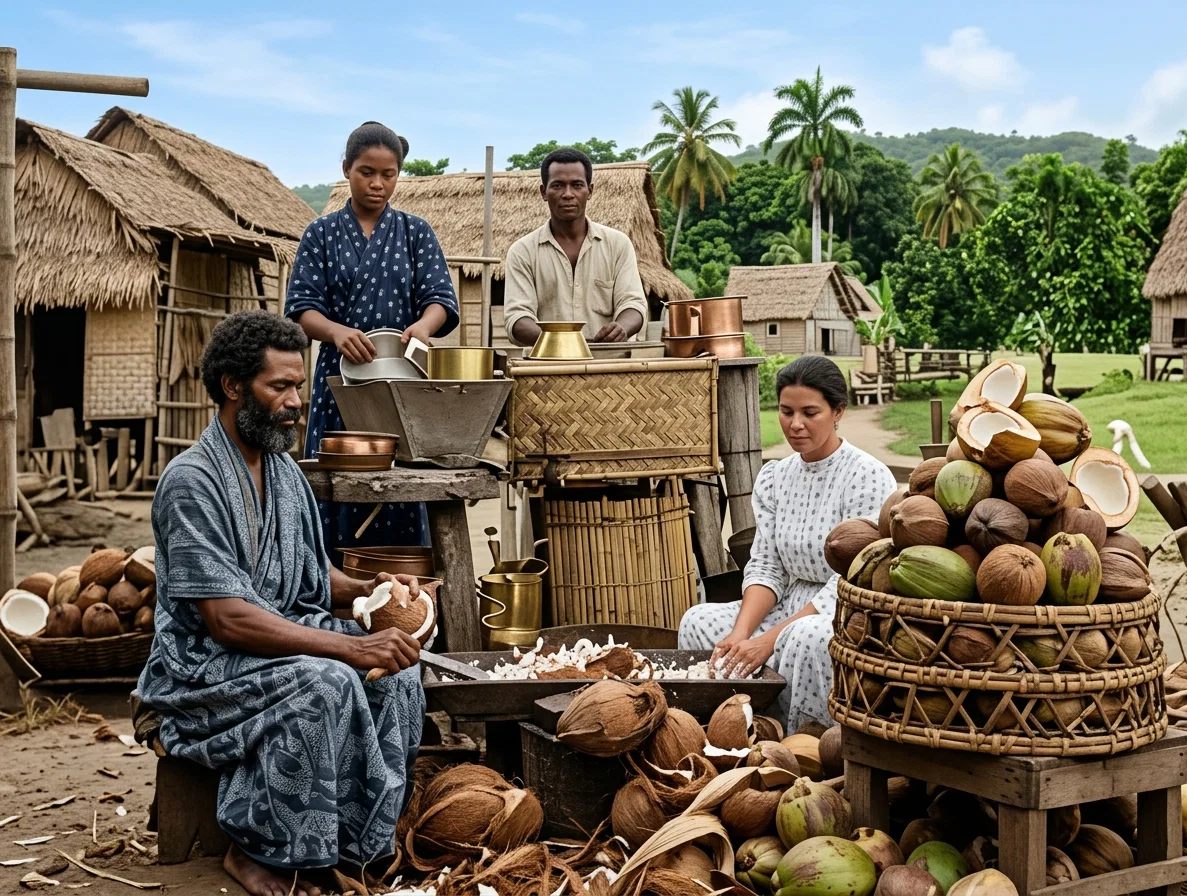
MAKING COCOANUT OIL
MAKING COCOANUT OIL
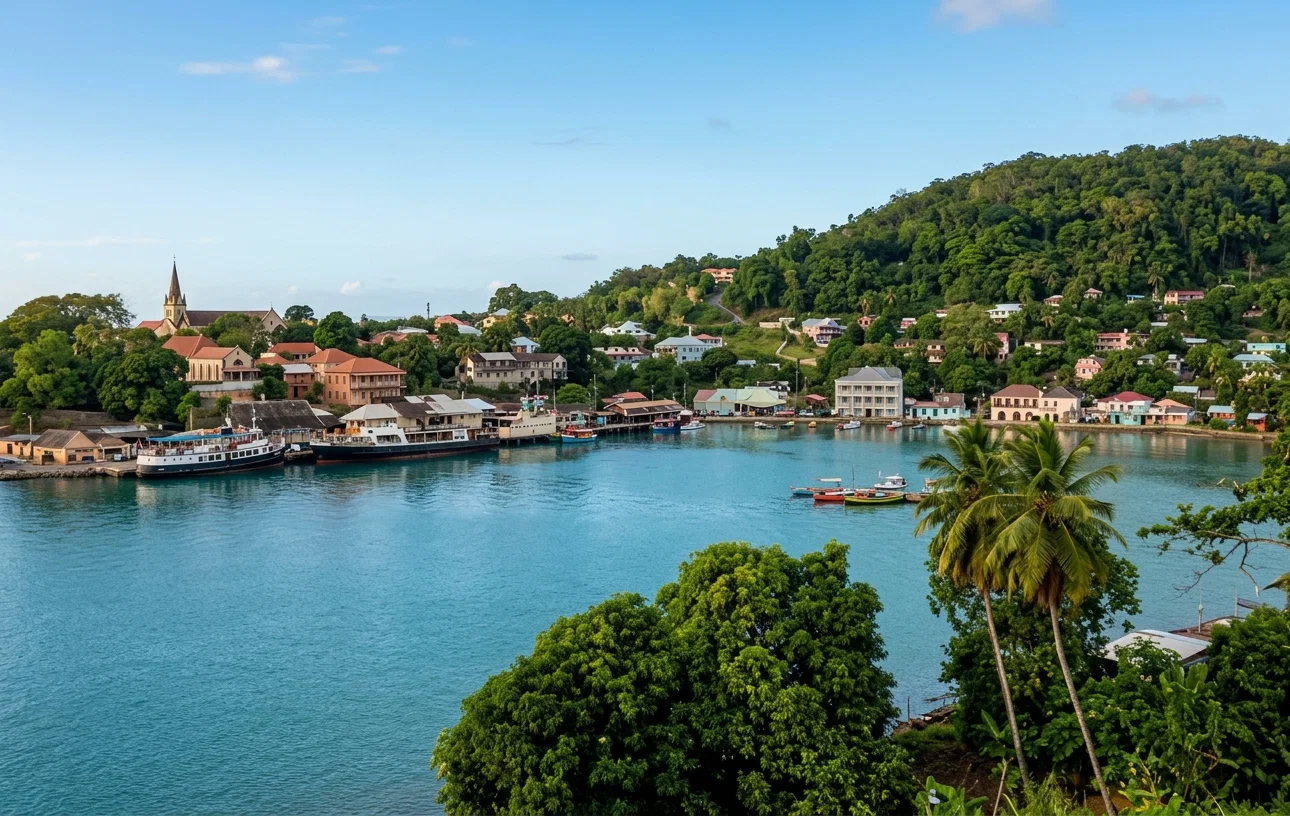
HARBOR, PORT OF SPAIN, TRINIDAD
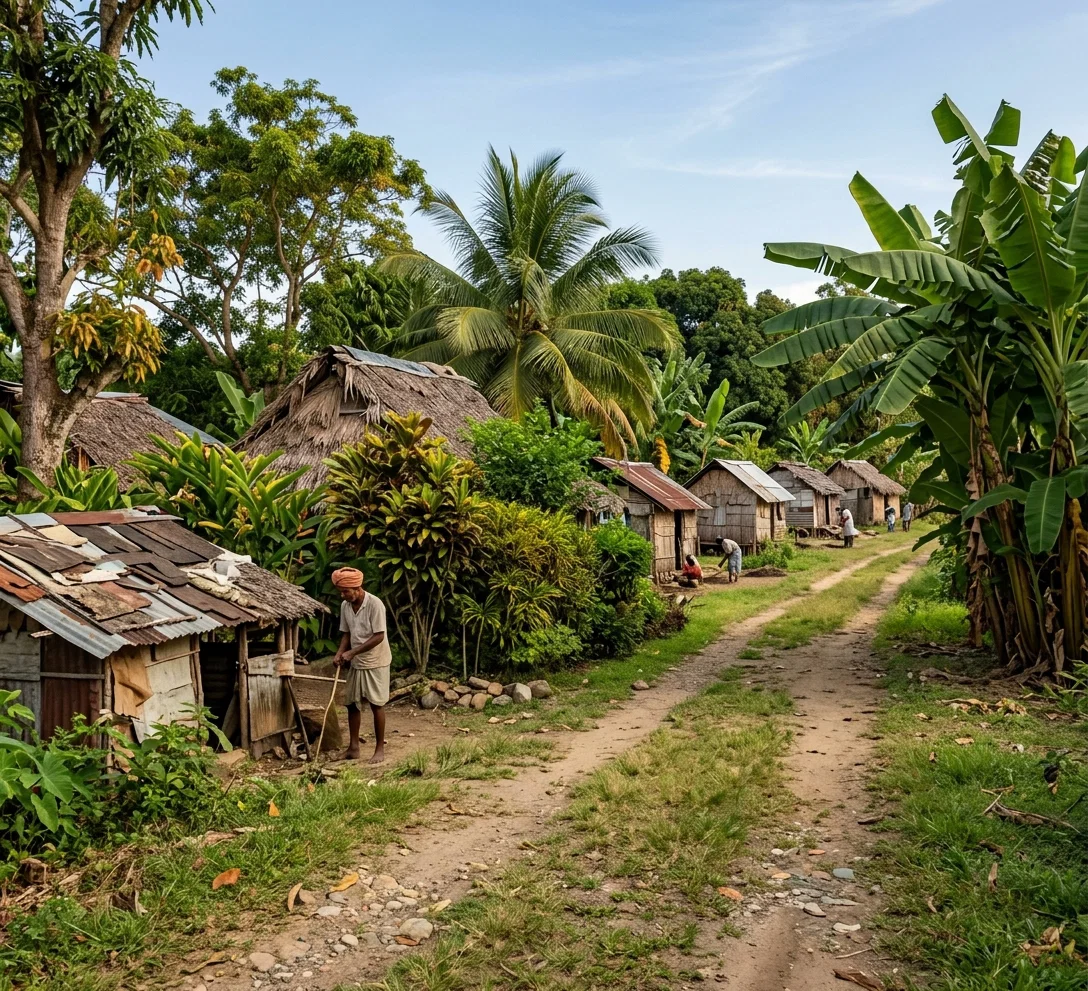
LOW CASTE COOLIE HUTS, TRINIDAD

Biennial Report of the Jamaica Conference

In submitting the report of the work in this field for the past two years, it is with thankfulness to God for his mercy and blessings upon the efforts that have been made, and with sorrow of heart that we have not accomplished much more than we have done, and have not entered many of the opening providences of God.
There are evidences of progress in the work in different respects, as the report will show in the raising up of new companies of believers, and the building of church-houses.

The Field

Our island is small, but a little world in itself. Its extreme length is one hundred and forty-four miles, and average width about thirty miles. The original name of Jamaica was Xaymaca, a word supposed to imply an overflowing of rivers, and truly its little rivers—which are many—are often overflowing from the rains which fall nearly every day of the year.

Laborers

There were three ordained ministers and four licensed ministers in 1903, and five in 1904 (the licensed ministers are all natives, and since the beginning of the present year one of these has been ordained to the ministry), also thirteen canvassers in 1903, and eighteen in 1904.
Tithes for 1903, $1,462.76, and for 1904, $1,427.03. Offerings for 1903, $842.53, and for 1904, $553.88. This decrease was in consequence of the destructive storm in the latter part of 1903, and the general depression that followed.

Progress of the Work

BUILDING A CHURCH
BUILDING A CHURCH
There are twenty organized churches with a membership of 784, and twenty-nine companies with a baptized membership of 310. These, with sixteen isolated and 257 unbaptized Sabbath-keepers, make a total of 1,367. There are twenty-two church buildings dedicated. Five have been built during the past two years. Eight are now in process of building.
From our American brethren we received $453.95 for our church-building fund. This enabled us to rebuild all the church-houses that were blown down by the hurricane, the Port Antonio house being the largest.

Sabbath-Schools

They are the life of each church and company. The donations for the year 1903, were $420.24, and for 1904, $228.24.

Church-Schools

A number were started during the two years, but the extreme hard times were such that the teachers could not be paid, and nearly all were discontinued, and the children went back to the government schools. A number have been started again, since the beginning of the present year.

Canvassing Work

During the past year our canvassers have sold $2,549.16 worth of books, this being an increase of $38.46 over the sales of 1903. The island has been literally sown with our books. The good seed is springing up everywhere, and the living preacher is being called upon for more light.

General Meetings

We have had no camp-meeting, but our conference meetings have been well attended by our people; and being held in Kingston, they have been the means of bringing the message to the notice of the general public.

The Watchman

During the two years 34,800 copies of the Watchman and English Good Health, and 400 copies of the Life and Health, have been sold. Our papers generally are received very cordially, and are eagerly read by the people.

Needs of the Field

Our need is money. With this could be provided an industrial central school, of which our young people stand in great need; and with this, we could establish a small sanitarium or treatment rooms for the suffering public, and by this means reach a class of people with the message that we could not otherwise reach.
J. B. BECKNER, President.

Twenty-Third Meeting

THE twenty-third meeting was called at 9:30 A. M., May 25, A. G. Daniells in the chair.
Prayer by Elder A. G. Haughey.
It was announced that the day was to be devoted to the educational work, and those taking part in the program were invited to the platform.
A call was made for the report of the committee on plans in regard to educational work, which was presented by L. A. Hoopes, and on motion considered item by item, as follows:—

On Educational Work

30. Recognizing the kind and favoring hand of God in our educational work, we hereby express our deep gratitude for his mercy and help, and further express our determination to work unitedly for more efficient co-operation and unification in this work for the future.
31. Resolved, That the Department of Education of the General Conference consist of twenty-five members representing all portions of the world, to be appointed by the General Conference Committee, and that five members, of whom the chairman or secretary shall be one, shall constitute a quorum.
32. We advise those in charge of our schools of all grades to seek for a higher standard of education in the Word of God, the sciences, and literary attainments, so as to prepare workers of sufficient education and culture to meet all classes of society.
33. Resolved, That we adopt sixteen grades as the standard of our educational system, with general divisions as follows:—
(a) Primary schools, grades one to seven.
(b) Intermediate schools, grades eight to ten.
(c) Colleges, grades eleven to sixteen.
In reply to questions,— B. G. Wilkinson explained that it was not intended to make any rigid limitation as to grades. If in the primary school special local conditions demand a higher grade, it should be left optional. It is the “general” plan that is recommended.
34. Resolved, That our training-schools be advised to so plan their work that the State examining boards, such as the Regents of New York, can give credit for any work done in these schools.
Whereas, In some of our schools there has been observed a lack of discipline, tending to militate against the ideals of our work, and to counteract much of the good which the schools are designed to do; therefore,—
35. Resolved, That the attention of the managers and teachers of our schools be hereby called to these important matters, and that they be urged to maintain a high standard of discipline and a pure moral atmosphere in all our schools, and that a special effort be made by the teachers to do heart-to-heart personal work for their students.
Whereas, The strength and efficiency of any department of the Lord’s work depends upon unity of spirit and harmony of action on the part of the workers; and,—
Whereas, The nature and character of our educational work in a special sense requires well-laid plans and the most hearty co-operation in the carrying out of these plans; therefore,—
36. Resolved, That we urge our educators to put forth earnest and well-directed efforts to unify the educational work,—
(a) By completing a simple and effective plan of organization in the General, union, and State conferences, the organization of each being a part of a harmonious system of education which will develop Christian character, and prepare our children and youth for the various lines of denominational work.
(b) By formulating courses of study for our primary, intermediate, and training schools, which shall be uniform in the subjects taught, and in harmony with the character and scope of work to be done by these three classes of schools.
(c) By the Educational Department, in counsel with the General Conference Committee, appointing a representative Text-book Committee, whose work shall be to examine manuscripts, text, supplemental, and reference books, and recommend those that are suitable for use in our various schools.
(d) By uniform adoption and use of the books and helps prepared by our people which have been approved by the Text-book Committee, and also, as far as practicable, the uniform adoption of books secured from other sources.
(e) By preparing a school manual which shall be used as a guide in our schools, and which shall contain,—
(1) A brief but comprehensive statement of the principles underlying the work of Christian education.
(2) The plan of organization.
(3) The courses of study.
(4) The lists of text, supplemental, and library books to be used, with the price of each, and where they may be secured.
(5) Suggestions as to the best methods to be employed in teaching the various subjects in the courses.
In reply to inquiry on section “d,”—
M. E. Cady explained the difficulty and confusion brought into our school work by lack of uniformity in courses of study and in books used. Lack of uniformity has led to changes in books, as one teacher succeeded another in a school, and parents are troubled over having to buy books different from those used the year before. A general agreement among educators will remedy this. And in bringing out text-books, it is essential that a book to be published shall be generally used, else the expense of bringing it out can not be met.
Inasmuch as there is a great responsibility not generally understood resting upon the members of our churches in the education and training of our youth,—
37. Resolved, That a vigorous educational campaign be carried on by the General, union, and State conferences,—
(a) By the publication and circulation of literature on primary-school work.
(b) By holding educational conventions, and by such other means as may seem advisable.
Whereas, There are great numbers of our young people who ought to be obtaining the benefits of a Christian education who are not in our schools,—
38. Resolved, That the teachers in our training-schools, as well as all our workers, take a more active interest in getting our young people into our schools; that a systematic correspondence be carried on by these schools throughout the year, and that as far as possible, the teachers labor in the field during vacation.
E. E. Miles emphasized the need of work in the churches, from family to family, looking out young people who ought to be in school.
Whereas, It appears that one cause of weakness in our schools, particularly those of the primary and intermediate grades, is due to the lack of sufficient supervision; therefore,—
39. We recommend, That each conference provide for the schools within its territory to be closely supervised by a competent superintendent or visiting board, who shall visit these schools as the needs require.
Whereas, The conducting of our primary schools is an action requiring careful planning and good counsel; therefore,—
40. We recommend, That no schools should be established or discontinued without advice or counsel from the conference officials.
M. E. Cady urged that conference officers take a real burden to give encouragement and counsel in this very important matter. While there have been discouragements by starting schools more rapidly than we were prepared to operate them in a satisfactory way, it is so important a matter that the officers of a conference ought to be alert and watchful to promote school work in every way possible.
41. We recommend, That intermediate schools should not be established without the co-operation and counsel of the union conference.
Whereas, In almost every church where schools are located our teachers are called upon to aid in church work which requires experienced workers; therefore,—
42. We recommend, That the corps of teachers in our primary and intermediate schools be strengthened,—
(a) By encouraging more mature persons to engage in the work; and,—
(b) By each conference committee encouraging many of our young men who are preparing for the ministry to spend a part of their time teaching primary and intermediate schools.
Whereas, There is a dearth of thoroughly qualified teachers in our schools of all grades; therefore,—
43. We recommend, That our training-schools make provision for a more thorough training of our prospective teachers, and that a thorough knowledge of the common branches of study and of the Bible and Testimonies should be obtained by these teachers, together with the best methods of conducting and teaching our schools.
44. We recommend, That the union conference educational secretary, together with the State superintendents, shall constitute an examining board to provide questions and conduct examinations for the promotion of students and the granting of certificates to teachers.
45. We recommend, That, as far as advisable, conferences provide employment for teachers when not engaged in school work, placing them at work selling publications, giving Bible readings, assisting in tent-meetings, etc.
46. In order to guard against the improper use of the word “professor,” we express it to be the understanding of the Department of Education that this title should be limited in its use to those who are or who have been engaged in advanced lines of education.
47. Resolved, That a uniform system of examinations in each union conference be provided to be given to our teachers, and that regular courses of reading and study be required, and that certificates or credentials be given all such teachers as are considered properly qualified.
48. We recommend, That the conference authorities who are charged with the duty of licensing teachers for our denominational schools give due recognition to the work of schools accredited by the Educational Department of the General Conference by exempting graduates from the normal departments of such schools from literary examinations for two years after graduation, and longer if they deem best.
49. Recommended, That the Department of Education, in conjunction with the General Conference Committee, be authorized to call conventions at such times and places as they think the needs require, and, that a general convention be held next year.
Action was taken on the entire report, which was unanimously adopted.
Adjourned.
A. G. DANIELLS, Chairman,
W. A. SPICER, Secretary.

A Visit to the President

Deputation From the Conference at the White House

MONDAY, May 22, at noon, a deputation of about forty delegates from the General Conference called on President Roosevelt at the White House, and presented to him an address, extending to him the greetings of our people, and setting forth our views respecting civil government.
On our part the call was official, the General Conference at its eleventh meeting having authorized the deputation to wait upon the President for the purpose stated. See last week's REVIEW, page 20.
The address was beautifully engrossed on parchment paper, eleven by sixteen inches in size. A reduced copy of the address appears on the first page of this number of the REVIEW. The names of the forty members composing the deputation were also all neatly written upon another sheet of the same kind of paper. These sheets were placed on a sheet of heavy grayish-blue paper, and all tastily tied together with red, white, and blue silk ribbon. The document was then rolled up, and tied with the same kinds of ribbon.
Elder A. G. Daniells, president of the General Conference, headed the deputation, and presented the address to the President.
After reading the document over carefully, the President received the deputation very cordially, expressing his appreciation of the call, and of the courteous language in which the address was couched. He then shook hands with each one, and the deputation passed out. The meeting took place in the cabinet office.
The names of those constituting the delegation will be found on page 7 in the conference proceedings.
One object in making this call on the President, besides wishing him well, was that we might place ourselves on record before the nation and the whole world, as believers in civil government and in its divine origin and institution. Our enemies have charged us, and doubtless will charge us again, with not believing in civil government. This official pronouncement of our views on this subject from the General Conference to the President of the United States, will forever be a denial to this false charge. For this and other reasons many of our people will doubtless desire to preserve a copy of this important and historical document, and it would be well if they would do so.
The address also shows that we are Protestants, and that we therefore believe in the American idea of civil government; in other words, in religious liberty and in the total separation of church and state.
Reports of the visit appeared in the Washington daily papers, the Evening Star, and Washington Times of May 22, and the Washington Post of May 23.
Let all our people remember what took place in Washington, May 22, 1905. When charged with being anarchists, and enemies of law and order, and opposed to civil government, this event will be a convenient and ready refutation to the false accusation. Although adjourned for a considerable portion of the day, the conference, we feel, did important business, and made good progress on this day.
W. A. COLCORD.
Continue reading: Twenty-Fourth Meeting