The first sentence of Rev. 20: 5, "The rest of the dead lived not again until the thousand years were finished," is by some said to be spurious, not being found in the earliest MSS., or before the fourth century. What ground is there for this? T.
We reply in brief: (1) The earliest New Testament manuscripts are as follows: The Codex Sinaiticus, now in St. Petersburg. It contains the whole of the New Testament. It was discovered by Tischendorf in the monastery of St. Catherine, on Mount Sinai in 1859. It was written in all probability in the Fourth Century, not later than the Fifth. It once contained the whole Bible.
2. The Codex Alexandrinus, now in the British Museum, written in the Fifth Century. It contains the whole Bible.
3. The Codex Vaticanus, now in the Vatican, known also as Vatican MS. No. 1209. It was probably written in the latter part of the Fourth Century or in the Fifth. It contains the whole Bible, with exceptions of parts of the New Testament, among which is the Apocalypse.
4. The Codex Ephraemi Rescriptus. This is what is called a "palimpsest," the original writing of which has been erased in order to use the parchment for another. In this MS. part of a Greek Bible was used on which to write some of the works of Ephraim, a Syrian "father." So have the "fathers" in other instances obliterated the Word. But by chemical reagents the old writing has been partially restored. It was written in the Fifth Century, and contains about two-thirds of the New Testament.
5. Then we have the Peshitto Syriac version, but the Oxford Bible Helps assure us that "there are no [Syriac] copies extant which were written so early as the oldest of the Greek MSS."
Now of the above, Rev. 20: 5 is found in the first, we believe, and in the second, and fourth. The third does not contain the Revelation at all. The Syriac omits the passage, and so does Vatican MS. No. 1160, of the Eleventh Century. Thus the three oldest Greek copies which contain the Revelation at all have the text. The Emphatic Diaglott, based on Griesbach's text, has the following foot-note on the first part of Rev. 20: 5: "These words were probably omitted by oversight in Vatican MS. [No. 1160] as they are found in A. B. C., tho not in the Syriac." By "A" is meant Codex Alexandrinus; by "B," Codex Vaticanus, No. 2066, of the Seventh or Eighth Century; by "C" Codex Ephraemi Rescriptus. Finally, the best Greek Text, that of Wescott & Hort, contains the passage, and neither have the Revised Versions nor any of the critics, so far as we know, even questioned it. The revisors adopted for their revision the text "for which the evidence is decidedly preponderating," and when that differed from the Greek text "from which the Authorized Version was made, the alteration be expressed in the margin." (See Preface to Revised N. T., Division II, ¶4.) But there is not even an indication of doubt over Rev. 20: 5. The clause in question is considered spurious only by those who have a doctrine to prove which the text condemns.
1553.—Was Moses Translated to Heaven?
C. B. G.
He was, after his resurrection. That he was raised from the dead is evident from two facts: (1) When Michael the Archangel, or Christ, contended with the devil over the body of Moses, it must have been for his resurrection. We know who must have been the conquerer. Jude 9. (2) Moses appeared with Elijah on the Mount of Transfiguration representing those who will be raised from the dead when Christ comes. Luke 9: 30, 31.
1554.—"Say Ye Not, A Confederacy."
Please tell me where in the Bible it says, "Say ye not, A confederacy." Does it not mean we shall not join unions for help, but rather trust God.
The twelfth verse of the eighth chapter of Isaiah is the clause. Why not get a good cheap concordance? The passage means that we should look to no earthly society or organization of men whatsoever for support or help in the fearful crisis of the last day. The cry of the world is, Save yourself by confederation. The children of God will make Him their refuge.
IN THE WHITENING HARVEST.
"THERE is much that may be done
While the glittering life-sands run;
If ye be but earnest-minded,
If ye go not weakly blinded
By gay fashion's heartless folly,
Or a selfish melancholy,
By a momentary pleasure,
Or a love of ease and leisure;
Lured not by flitting beauty
From the narrow path of duty;
Much there is that may be done
By an earnest-minded one."
LETTUCE PREVENTS SMALLPOX.
By Medical Talk
So far as it is possible for a human being to be protected from catching smallpox, lettuce is a protection.
No need for vaccination whatever. Any person who eats a small quantity of lettuce twice a day, morning and evening, is as well protected against smallpox as it is possible for any one to be.
To be sure, one ought to be clean, ought to live in ventilated rooms, and avoid dirt of all sorts. Also avoid contact with people who have smallpox. Foolish exposure to the contagion of smallpox is not to be thought of. But there is no need for vaccination.
Lettuce is one of the oldest vegetable remedies known to the medical profession. Long before it was used as food it was used as medicine. Many times it has been claimed that it has magical or miraculous powers to prevent contagious disease. We believe this is carrying matters altogether too far. But lettuce does furnish to the system exactly what is needed to protect it against the poison of smallpox.
—Medical Talk.
Dandruff
Men once a week, women once in two weeks, should wash the head with a copious lather of warm water and Glenn's Sulphur Soap. It will remove and keep out dandruff.
Glenn's Sulphur Soap is a specific for scalp and skin diseases. Be sure and get
Glenn's
Sulphur Soap
25c. a cake at all drug stores or mailed for 30c. by The Charles N. Crittenton Co., 115 Fulton St., New York.
WILLING TO SPEND AND BE SPENT.
By Ellen G. White
BY MRS. E. G. WHITE.
EVERY true, self-sacrificing worker for God is willing to spend and be spent for the sake of others. Christ says, "He that loveth his life shall lose it; and he that hateth his life in this world shall keep it unto life eternal." By earnest, thoughtful efforts to help where help is needed, the true Christian shows his love for God and for his fellow-beings. He may lose his life in service. But when Christ gathers His jewels to Himself, he will find it again.
Do not, for the sake of appearance, spend time and money on self. Those who do this are obliged to leave undone many things that would have comforted others, sending a warm glow to their weary spirits. We all need to learn to improve more faithfully the opportunities that so often come to us to bring light and hope into the lives of others. How can we improve these opportunities if our thoughts are centered upon self? He who is self-centered loses countless opportunities for doing that which would have brought blessing to himself and those around him. It is the duty of the servant of Christ, under every circumstance, to ask, What can I do to help others? Having done his best, he is to leave the consequences with God.
The Lord has provided for every one pleasure that may be enjoyed by rich and poor alike,—the pleasure found in cultivating pureness of thought and unselfishness of action, the pleasure that comes from speaking sympathizing words and doing kindly deeds. From those who perform such service the light of Christ shines forth to brighten lives darkened by many shadows.
The perils of the last days are upon us. Those who live to please and gratify self are dishonoring the Lord. He can not work with them; for they would misrepresent Him before those who are ignorant of the truth. Be very careful not to hinder, by an unwise expenditure of means, the work that the Lord would have done in proclaiming the warning message to a world lying in wickedness. Study economy, cutting down your personal expenses to the lowest possible figure. On every hand the necessities of the cause of God are calling for help. God may see that you are fostering pride. He may see that it is necessary to remove from you blessings which, instead of improving, you have used for the gratification of selfish pride. The truth that we hear will save us only as we gladly accept it, showing in our lives the result of its working, growing in grace and in a knowledge of God.
Help in Every Time of Need.
Those who are laboring in places where the work has not long been started will often find themselves in great need of better facilities. Their work will seem to be hindered for lack of these facilities; but let them not worry. Let them take the whole matter to the Lord in prayer. When trying to build up the work in new territory, we have often gone to the limit of our resources. At times it has seemed as if we could advance no farther. But we kept our petitions ascending to the heavenly courts, all the time denying self; and God heard and answered our prayers, sending us means for the advancement of the work.
Lay every care at the feet of the Redeemer. "Ask, and it shall be given unto you." Work, and pray, and believe with the whole heart. Do not wait till the money is in your hands before doing anything. God has declared that the standard of truth is to be planted in many places. Learn to believe, as you pray to God for help. Practise self-denial; for Christ's whole life on this earth was one of self-denial. He came to show us what we must be and do in order to gain eternal life.
Do your best, and then wait, patiently, hopefully, rejoicingly, because the promises of God can not fail. Failure comes because many who could put their means into circulation for the advancement of God's work are lacking in faith. The longer they withhold their means, the less faith they will have. They are barrier builders, who fearfully retard the work of God.
My dear fellow-workers, be true, hopeful, courageous. Let every blow be struck in faith. As you do your best, the Lord will reward your faithfulness. From the life-giving Fountain draw physical, mental, and spiritual energy. Manliness, womanliness,—sanctified, purified, refined, ennobled,—we have the promise of receiving. We need that faith which will enable us to endure the seeing of Him who is invisible. As you fix your eyes upon Him, you will be filled with a deep love for the souls for whom He died, and you will receive strength for renewed effort.
Christ is our only hope. Come to God in the name of Him who gave His life for the life of the world. Rely upon the efficacy of His sacrifice. Show that His love, His joy, is in your soul, and that because of this, your joy is full. In God is our strength. Pray much. Prayer is the life of the soul. The prayer of faith is the weapon by which we may successfully resist every assault of the enemy.
A MODERN MIRACLE.
AFRICANER, the convert to Christianity with whom Robert Moffat had so much to do, was a veritable demon of cruelty, but he became such a disciple of Christ that Moffat was able to say of him, concerning the whole time of his association with him after his conversion, that he did not remember once having occasion to be grieved with him, or to complain of any part of his conduct. Africaner's testimony on his death-bed was: "I feel that I love God, and that He has done much for me, of which I am totally unworthy. My former life is stained with blood, but the blood of Jesus Christ cleanseth from all sin."
BUENOS AIRES.
By Sadie R. Town
HERE we will leave you to wander at will through Argentina's capital city. Another world seems to have dawned upon us. The straight, well-paved streets, the network of trams, cabs, carts, automobiles, private carriages, and pedestrians, seem to indicate that the world moves, even in South America. Here the principal lines of railway terminate, the suburban trains run swiftly in and out, and the freights and steamboats bring in the agricultural and stock-raising products which represent the chief industries of the country.
Ex-United States minister Barrett, in a recent speech in New York, calls this the New York of South America, and compares it to a youth whose robustness and rapid growth attract the admiration of all who behold him. Aside from some of the western towns in the United States, the increase in population has been exceptionally rapid, having risen from 177,000 to 900,000 in the last twenty-four years.
The other towns of the republic are so nearly represented by this one, that when you have seen one, you may be said to have seen all.
The houses can not be distinguished one from another, but present one solid front to the pavement like those of English and Scotch towns. But through the street doors potted plants, palms, and ferns are nearly always visible, indicating a yard or garden inside. This yard is paved with tiles, would be called a court in the east, but is here designated patio. There are often two or three patios, one back of the other, and the rooms are in a row, running back from the front, and usually derive all their light and air from tall doors, composed mostly of glass, which open into the patios. A great deal of time is spent in the patio, taking maté, chatting with friends, etc. In the afternoon, however, the women who are at leisure make themselves presentable with careful hair-dressing and plenty of powder, and lean from the windows to see and be seen. The only windows in the house, of course, open onto the sidewalk.
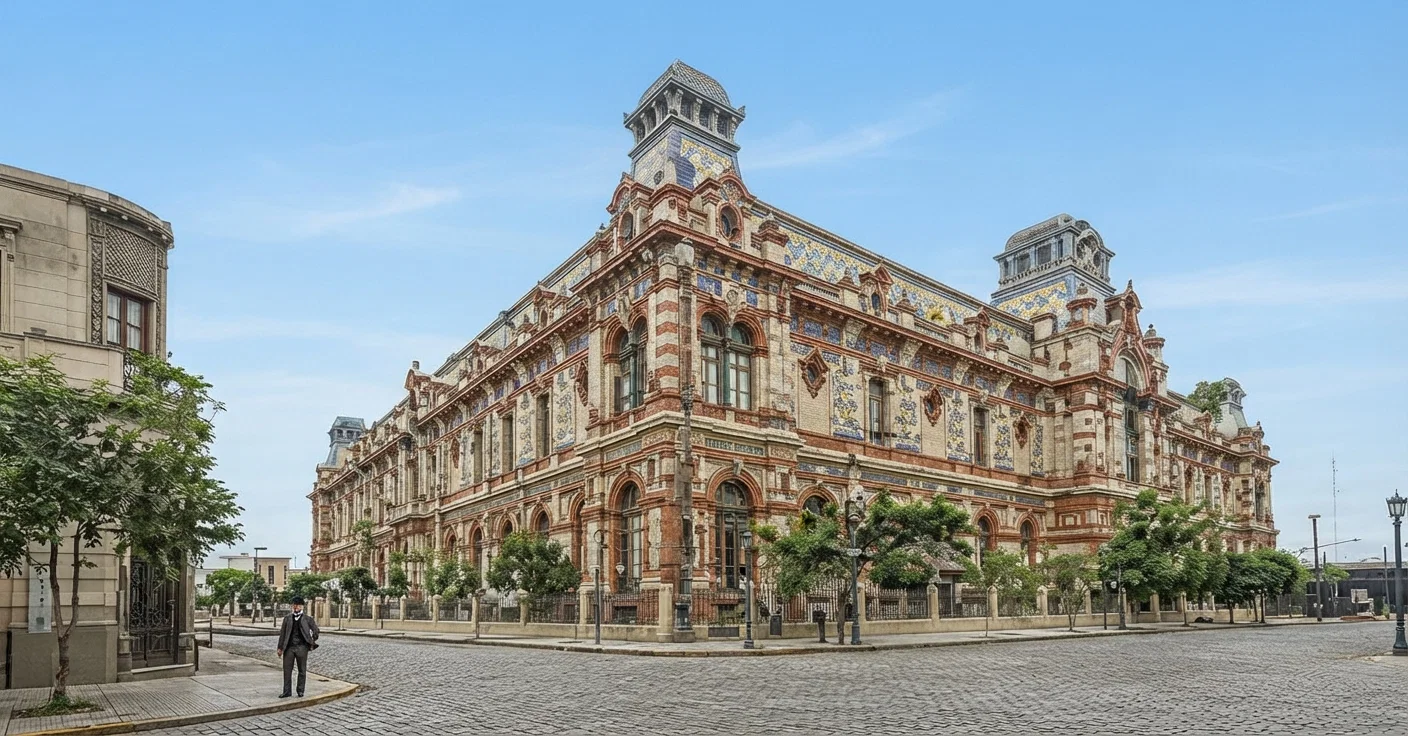
Water Deposit, Buenos Aires, Argentina.
The shops are quite imposing, some of them running through from square to square with their enormous show-windows decorated very attractively, and offering for sale anything and everything in their line which money can buy, altho it must be confessed that considerable money is required to buy these.
There are thirty-four markets located in different parts of the city, from which the food supplies come. During the year 1903, 2,748,922 unfortunate animals were slain and consumed by these carnivorous people. The fruit markets are beautiful, and have nearly all the varieties of fruits and vegetables found at home, in their seasons, which are, of course, the reverse of the seasons in the northern half of the world. The Central market is said to have the13largest wool dock in the world, and an idea of the business carried on there may be gotten by the figures which show it to have received 200,000,000 kilos of different products, mostly wool and cereals, during the month of April. Here everything is measured by the metric system, and described in the Spanish language.
The earlier efforts of foreigners in learning Spanish are often very amusing to their friends who have but recently been over the road themselves; but the polite gravity of the natives under such provocation, and their tactful way of setting one right without ostensibly correcting him, inspire wonder and admiration. It is to be hoped that intercourse with such a large per cent. of foreigners as immigration continually lands on these shores, renders them less sensitive than what they would otherwise be, to the mutilation which their beautiful language suffers at our hands from day to day.
But to one thing they never do seem able to accustom themselves, and that is foreign peculiarities in dress. A woman wearing a sailor hat or a rain cloak seldom fails to elicit comments on the part of the passer-by, and the children quite likely greet her with a chorus of “man’s hat,” or “thatch roof.” Here only the most faultlessly attired wear hats at all, so that a peculiar or shabby head-dress attracts immediate attention.
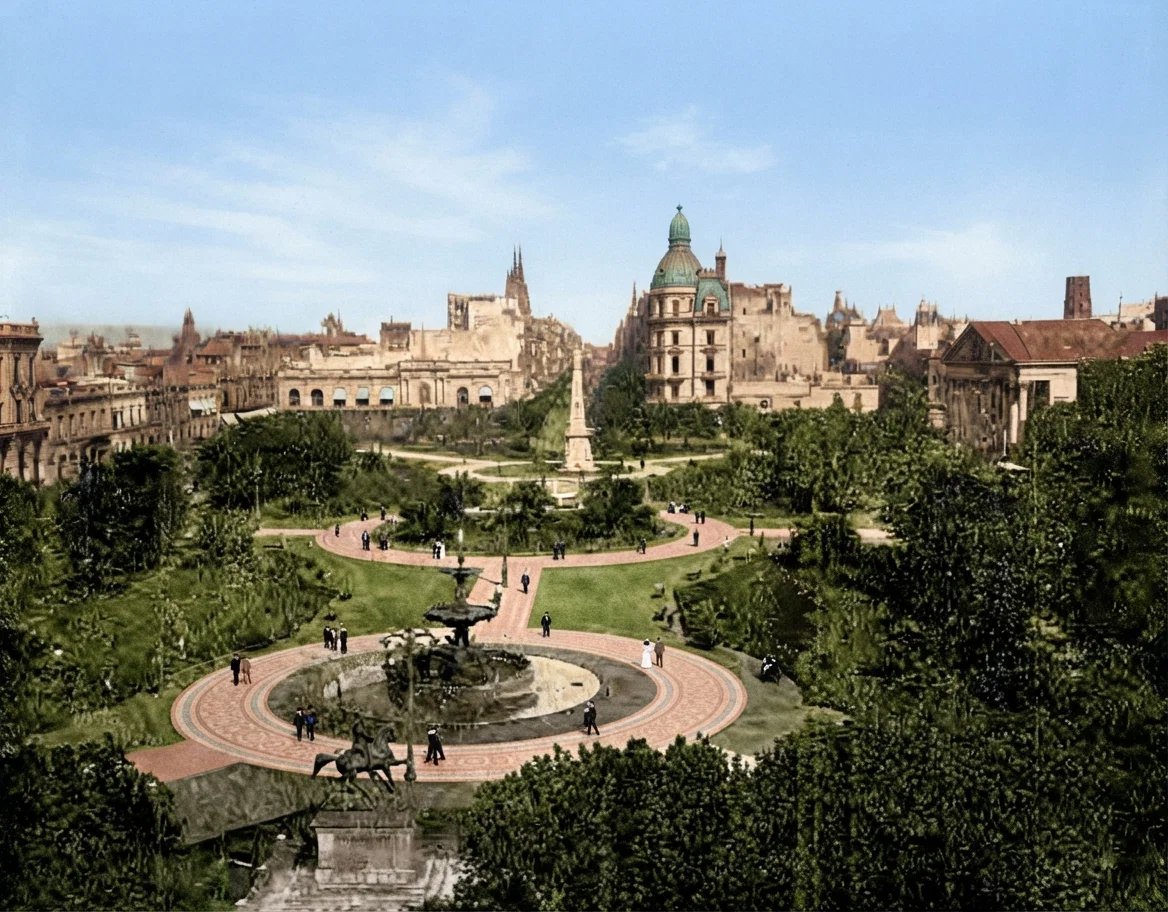
A Plaza in the City of Buenos Aires, Argentina.
Buenos Aires boasts of having one of the best systems of water supply in the world. The water is pumped from the River Plata a little above the city, and conveyed to huge tanks in the northwestern part of the town, where it is thoroughly filtered before being given to the public.
The buildings are all low, usually one story, and tram lines cross the city in every direction. Some commodious automobiles are also being brought into use as public conveyances. Every few squares they bring the passenger to one square devoted to horticulture, which breaks the monotony in a very pleasant way. These diminutive parks are termed plazas. There are also several large, well-kept parks, and a zoological garden.
There are six free municipal hospitals in the city, in all of which advice is given gratis. The British, French, German, Spanish, and Italian communities each have their respective hospitals in addition to the above. There are also several establishments where baths of all kinds can be had, and electricity, Röntgen rays, and massage applied.
Education is free, and supposed to be compulsory, but option is granted between educating the children at home or in a private or public school. How strictly the school law is enforced may be judged from the fact that more than one-half of the inhabitants can neither read nor write. The law permits of religious instruction either before or after regular school hours, and the Catholic priests improve their opportunities in this respect, only those children whose parents request it, being dismissed before the religious instruction is given.
The city university has departments in law, medicine, the sciences, etc.
In the colonial days (1613), when three lawyers arrived at the port of Buenos Aires, the population was so stirred that the town council issued the following decree:—
Considering that their coming is useless and can only cause disturbance by reason of the difficulties which they will create among the citizens, we declare and order that these three personages be strictly prohibited from remaining in this town, except by special order from his Majesty, the king of Spain.
But times have changed since then. Out of a total of 2,500 students in the universities of Buenos Aires and Cordoba in 1897, 1,172 were studying law. Two of the most prominent signs that one sees, passing through the city, are “abogado,” lawyer, and “medico,” physician. But those who have occasion to deal with them, assure us that the old town council sized them up about right.
The Argentines monopolize the professions to the exclusion of the trades. The Prenza, one of the leading dailies here, erected a new building a few years ago, and advertized for master workmen in the different branches, giving the preference to Argentines. But they were not to be found, and the building (the end of which may be seen at the right of the street leading out of the plaza) was erected by foreigners. The Statue of Liberty upon the top of the building is one hundred and eighty-one feet above the street, with a powerful electric reflector whose rays are visible at a great distance. This paper offers many advantages to its patrons in the way of museum, library, post-office, and medical and judicial departments. A writer in the English Review of Reviews estimates it to have the best equipped office of publication of any newspaper in the world.
There are forty churches and twenty chapels in the city, the most of which are Roman Catholic. In each of the Catholic churches mass is celebrated every day, beginning very early in the morning. On Sundays mass is repeated every hour of the day. The Methodists have two churches and several other places of worship in the city. The Presbyterians, Anglicans, and Lutheran Germans also have each a church.
The religion of the country is the Roman Catholic, which is supported by the government, and is one of the necessary qualifications for occupying the highest office of state, the presidential chair. Altogether there are about 27,000 Protestants and 6,000 Jews in the country, the remainder being Roman Catholics. But, unlike the North American Catholics, their religion here sets as lightly upon them as it is possible for it to do; and the saddest part of it is that among those who have come here from more enlightened homes in Europe and North America, there is a strong tendency to conform to the senseless customs and practises prevalent here, instead of holding up and cherishing the greater light for which they are responsible.
Buenos Aires, Argentina.
UNCONSCIOUS INFLUENCE.
By Frances E. Bolton
BY FRANCES E. BOLTON.
THORSWALDEN wrought with his chisel and stone,
A sculptor whose treasures were marvelous art,
Conscious with joy that he worked not alone,
His hand was God-guided, inspired was his heart.
His statues he bore to his own Danish land,
In sea-weed he gathered from Italy's strand.
The wondering people paused long on their way,
Enrapt with the beauty the artist had wrought;
And the sea-weed was trodden deep into the clay,
As useless, unmeaning, nor calling for thought;
Yet seeds men were sowing, unconsciously trod,
Which stored as in caskets the glory of God.
Men wondered and worshiped, and bowed on the land,
Not now for the beauty the artist had wrought,
But for glory so lavishly strewn on the sand,
Beyond man's conception and higher than thought;
For the flowers of Italy, fair to behold,
Had blossomed in splendor no sculptor could mould.
Then, humbled in spirit, in reverence there
The sculptor looked forth with amazement untold,
To see that he'd sowed without knowledge or care,
In what he thought rubbish, such beauty of mould,
And prayed, " Be it thus, Lord, in all days of mine,
From my unconscious sowing bring glory divine."
O heart, throbbing so to thy hurrying hand,
And strained with a work that is consciously wrought,
God grant thee His seed for the unfurrowed land,
That is sown without knowledge and grown without thought.
May thine unconscious influence scatter abroad
The seeds of a harvest to glorify God.
The work of thy hand to men's eyes may be fine,
The work of thy heart must be God-wrought with love,
Or thine unconscious influence will lack the divine,
Nor stand in the judgment of heaven above.
The unconscious influence of life has the weight
Of the soul that thou art, and is pregnant with fate.
OUR WORK AND WORKERS.
By Editor
AT the recent quarterly-meeting of the church in Oklahoma City, O. T., five members were added to the church, four by baptism.
MEETINGS held at Chandler, O. T., by Brother A. E. Field, have resulted in six new Sabbath-keepers and an organized Sabbath-school.
THE church at Etna, Wash., which was organized last March with eight members, now has twenty-eight, who expect soon to erect a church-school building. The labors of Brother A. J. Stover have been mainly instrumental in this work.
BROTHER T. H. DAVIS, of Esmeralda, Cal., has returned to South America. He spent several years canvassing in Chile, where he was quite successful, but was obliged to return to California for a time on account of his health. He goes now to Quito, Equador.
THREE members were united by baptism to the church at East Liverpool, Ohio, at the last quarterly-meeting. These are fruit of meetings being held there by Brethren C. C. Webster and F. M. Fairchild. Others have commenced the observance of the Sabbath “according to the commandment.”
BROTHER A. G. MILLER, who has for five years been a faithful and trusted servant in the office of the Pacific Press Publishing Company, acting as secretary of the corporation and in various other positions, sailed for his native home in Australia, July 28. He expected to connect with the Bible Echo Publishing Company, in Melbourne.
IN the Pacific Union Recorder we find the following report by Brother O. Soule, of Roseburg, Ore.:
“Six adults and four children have taken their stand for God’s commandments at South Deer Creek. A Sabbath-school has been organized, and regular Sabbath services are held, as a result of a series of meetings I have just completed there.”
THE August number of Save the Boys is an unusually valuable issue, and deserves a wide circulation. It contains twelve pages of varied matter, devoted to the purpose which the title indicates. Price of single copy, five cents. Per year, monthly, thirty cents. Address, H. F. Phelps, 118 W. Minnehaha Boulevard, Minneapolis, Minn.
FROM San Pasqual, Cal., Brother F. I. Richardson writes, under date of August 4:
“A four weeks’ meeting at this place, closing July 26, resulted in the acceptance of the truth by twenty-six persons. Nineteen were baptized, and the church seemed to be much benefited. Seldom have I seen greater evidence of the deep movings of the Spirit of God; not in excitement, but, as described by the Psalmist: ‘The Lord is nigh unto them that are of a broken heart; and saveth such as be of a contrite spirit.’”
OF the work in Mississippi, Brother H. G. Thurston writes as follows to the Pacific Union Recorder:
“The Lord is still at work in Mississippi. July 2, five were baptized in Laurel, where we held our last series of meetings, and last Sabbath five were baptized at Ellisville, where we held our first series of meetings last fall. On the 10th inst. a church of seventeen members was organized at Ellisville. This makes the fifth church organized in this conference since last November. The others were brought out largely as a result of our mission school work.”
IN connection with the meetings held at Modesto, Cal., by Brother C. M. Gardiner, a Sabbath-school was organized July 23, with twenty-four members. At one of the meetings a gentleman arose and gave the following testimony:
“I must speak of the light that has flooded my soul the past two weeks at these meetings. I have been a member of the Baptist Church for many years, and at different times have asked my pastor why we worshiped on the first day of the week, and he would explain and smooth it over, not quite satisfactorily to my conscience. But now it is clear to me that the seventh day is the Sabbath, and I can not resist the Spirit. This is the first Sabbath I have ever kept in my life. I thank God for the light, and mean to walk in it. Pray for me.”
THE SABBATH SCHOOL INTERNATIONAL SERIES
LESSON X.—THE RETURN OF THE KING.
(Study for Sabbath, September 3.)
QUESTIONS.
1. What longing desire is in the heart of the Saviour? John 17:24.
2. Before He left the earth, what promise did He make concerning His return? Why did He go away? When will He come back? For what special purpose? John 14:1-3.