THE Young People's Society of Erie, which was organized a year ago, has been doing a good work. There are twenty members, all under nineteen years of age.
We are working with tracts which come in sets—three or four in a set. These are done up nicely in numbered envelopes. We take number one to the first house in a square, and leave it there for a week. At the end of the week we call for it, and leave number two. We then take number one to the next house, and continue thus until we have five sets in the hands of readers. Then they are gathered, and another square is worked with them.
We have a reading-rack in the union station. Two of the girls keep this filled with Signs of the Times. These are read by travelers, and thus good seed is sown. We also visit the sick, and the soldiers' home, and hope we may be instrumental in bringing some souls to Christ.
CARRIE LELAND.
Pittsburg, Pennsylvania
By W. C. Fleisher
OUR Young People's Society consists of twenty-nine members, and was organized about a year ago. There are some among this little company who are Bible missionary workers, and some who sell periodicals with success. We have been paying dues in our Society, and have a nice little sum collected, but have not decided to what branch of the work it should be given; one plan, however, is to get tract racks for the depots and other public places. This city presents a large field for work, and much can be done to herald the glad tidings of a soon-coming Saviour, and to arouse the people to prepare to meet the blessed event. Some literature has been distributed, and some sold, but as yet small results have been seen. We have our meetings every Sabbath afternoon, and in our study enjoy much of the Spirit of God. We follow the YOUTH'S INSTRUCTOR lessons, and find them a great help. Pray for us as a band of young workers, that we may do the work that God has assigned us, leaving no talent unimproved. W. C. FLEISHER, President.
Neglect
I. Do not neglect to save your soul, unless you are willing to lose it.
2. Do not neglect to study your Bible if you want to find out how much God loves you.
3. Do not neglect to do good every chance you get if you want to please your Heavenly Father.
4. Do not neglect to walk in the light that God gives you, and you will never be overtaken by darkness.
5. Do not neglect to follow the counsel that mother gave you.
6. Do not neglect to keep the promises you made the loved ones who have passed away.—Selected.
Table Manners
IN silence I must take my seat,
And give God thanks before I eat;
Must for my food in patience wait,
Till I am asked to hand my plate.
I must not scold, nor whine, nor pout,
Nor move my chair or plate about.
With knife or fork or napkin ring
I must not play, nor must I sing;
I must not speak a useless word,
For children must be seen, not heard.
I must not talk about my food,
Nor fret if I don’t think it good.
My mouth with food I must not crowd,
Nor while I’m eating speak aloud.
Must turn my head to cough or sneeze,
And when I ask, say, “If you please.”
The table-cloth I must not spoil,
Nor with my food my fingers soil;
Must keep my seat when I have done,
Nor round the table sport or run.
When told to rise, then I must put
My chair away with quiet foot,
And lift my heart to God above
In praise for all his wondrous love.
— Selected.
A True Story of a Young Indian Boy
By A Friend
On an Indian reservation in Ontario is the home of the Indian boy of whom I shall tell you. At the time of the incident related, he was about eighteen or twenty years of age. His father died when he was a small boy, and his mother married again. His stepfather, being a drinking man, at times was very unkind to the boy’s mother and sister, and especially to the boy himself.
Although it is against the law of the province to sell an intoxicating drink to an Indian, there are those who will do so, when the Indian wants it, if it can be done secretly. The Indians themselves will not tell who sold it to them, for this would make it all the harder for them to obtain it, and they all seem very fond of it.
Here, the white people, or many of them at least, take advantage, if possible, of the Indians in all business dealings. This causes the Indians to distrust the white people, even those who are trying to help them. They seem naturally inclined to idle away their time, yet generally work well when employed by white men.
While quite young, this boy, whose name was Bazil, left his home, and went to work for some of the white people living near the reservation. All his small earnings he took home to his mother to help clothe her and his sister. After once leaving home, he could not go back because his stepfather would not allow him to. Bazil soon learned the way of the white men, and wherever he went to work, he was well liked, because he was kind, quiet, and polite.
About one year ago he came to work for one of my uncles who lives near the reservation. After Bazil had been there for some time, my uncle went on a visit to some friends in Michigan, and left him to look after the farm. Uncle knew him to be trustworthy. Bazil seemed to appreciate the responsibility resting on him, and he worked very hard to do everything the best he could.
On this reservation there is a school, and a white lady or gentleman teaches there. There is also a church, with an Indian pastor. Bazil would often go to church, and was very fond of music. As all the Indians seemed to be good singers, I wondered whether Bazil could sing, so asked my aunt about it. She said he was very often heard singing hymns while at work, but could not be persuaded to sing in the home.
One evening my aunt and I went to see an old lady who was ill. There was nothing we could do for her, so we came home much earlier than our Indian friend expected. As we came up on the porch, we heard him softly singing:—
“Have I long in sin been sleeping?
Long been slighting, grieving Thee?
Has the world my soul been keeping?
O forgive and rescue me!
Even me, even me,” etc.
After a few moments he began another hymn:—
“Pass me not, O gentle Saviour,
Hear my humble cry.
While on others thou art calling,
Do not pass me by.”
So he sang on all through the hymn, and then, feeling that he was alone with God, with no human ear to hear, he began to pray. Although he spoke English quite well, we could hear only a few words of the prayer. After the prayer we went in. Bazil sat by the table in the dining-room reading his Bible; his hymn-book lay on the table, but when we entered the room, he put away his books at once in a satchel, and went to his room for the night, with a smile on his face which showed he was happy.
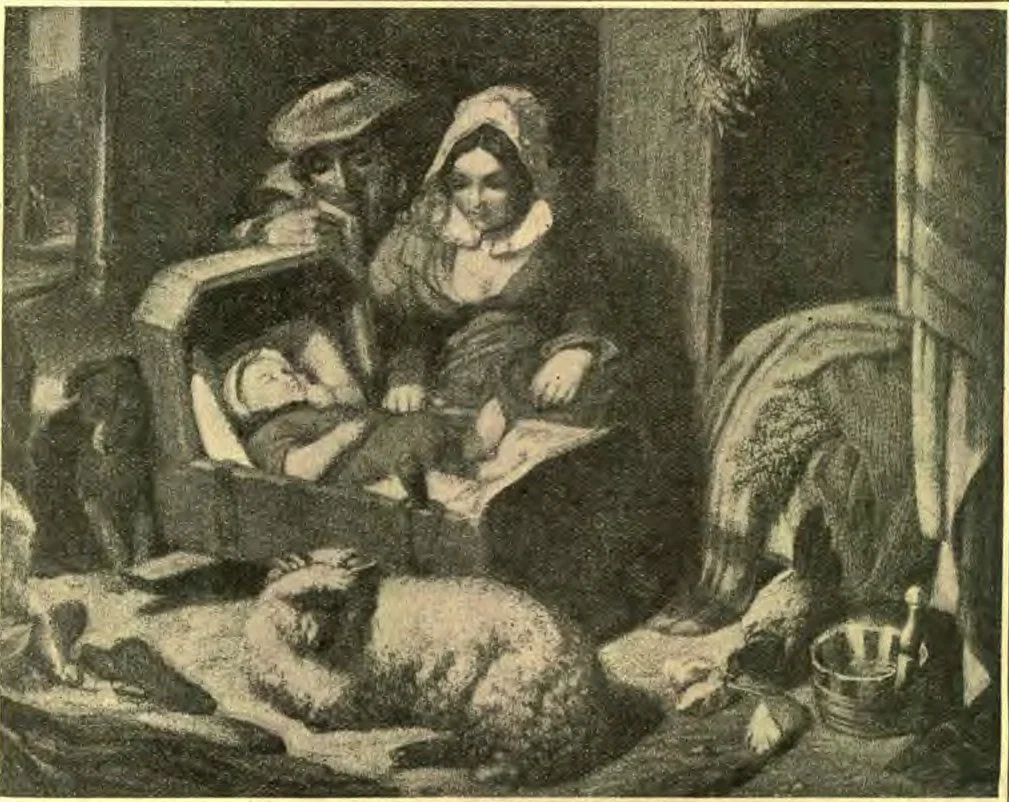
A SCOTTISH SHEPHERD'S HOME
I felt sad to think that in a home where each was a professed Christian, this boy never heard the name of God mentioned, unless on Sundays after church, and that he was not free to read his Bible and sing Christian hymns, but must go away alone to enjoy such privileges.
My aunt said she often wondered why it was she heard him up in his room hours after he left the rest, but now she knew. He had no doubt been reading his Bible, learning of God. What an example this young Indian man is for many of the youth of to-day who have had far greater advantages. God is no respecter of persons; he loves the contrite heart, whatever be the blood or nationality. A FRIEND.
Klingats Who Give Rather than Receive
FAR to the north and west of the United States, where Mount St. Elias raises its snow-capped head to the clouds, there is a tribe of Alaskan Indians whose boys and girls are taught from babyhood up that “it is more blessed to give than to receive.” These children belong to the Eskimo tribe known as Klingats, and this tribe has in its language no such phrase as “Thank you.”
This is not because the tribe is rude or sullen. On the contrary, it is one of the most gentle northern tribes men know. The Klingat boy or girl says that he need not say “Thank you” for any gift or favor, because the honor of doing the good act is upon the giver, and not the receiver. It is the donor who profits by the gift, the recipient being under no obligation. It is the latter who confers the favor, by accepting the present or service. The “potlach” is an outcome of this teaching; a giving by wholesale, an auction where there is neither bidding nor buying, where the rich become poor and the poor rich. Here is displayed devotion to a simple idea to an extent seldom found elsewhere. The Klingat man of wealth has no desire to die rich; and, as the easiest means of preventing this, for which so many strive, he gives away his accumulations. A great feast is prepared to tickle the palates of relatives and friends, who are bidden from far and near. Day and night the eating and drinking continue, until even the ever-hungry dogs are gorged to repletion.
Then the host rises and delivers a speech, in which he recites the glory and valor of his ancestors, compliments, in the order of their rank, each guest present, and refers to their deeds of honor, not forgetting the least or most humble. When the speech and those made in reply are at an end, the giver of the “potlach” turns to the place where are piled the money, furs, blankets, weapons, ornaments, and other property representing his worldly possessions. In one case, a few years ago, these represented a value, approximately, of ten thousand dollars.
The fastenings of the nearest bale or package are cut, and, first to one guest and then to another, and so on down the line, the man hands the contents. When one pile is gone, another is broached, and the giving continued until each one has had his share, and the host, but a short time before the richest, is the poorest man present, possessed only of the clothes he stands in, and possibly a gun or fishing outfit with which to keep himself and family alive. Having made this gift of his wealth, the Klingat man, his wife and children, do not start out to accumulate6another fortune. From the time of the gift-distribution on, they devote themselves only to securing their daily supply of food and to keeping a comfortable shelter over their heads. When the boys come into young manhood, then they may strive for a fortune, but only with the same object in view that, when they have secured it, it must be given away. In this giving they believe they ensure for themselves greater happiness here and peace in heaven.—Boy’s World.
How to Make a Simple Weaving Machine
By Edison Driver
It is not at all a difficult matter for an ingenious boy to construct a real loom for his little sister, with which she will be able to weave both plain and variegated fabrics. A nicely made machine, together with a few balls of colored druggist’s twine, make a very acceptable present for any little lady.
The Things Needed
These will cost nothing, because you can find them around home. A few pieces of wood, such as may be had from an old box, a broomstick, some nails, and a piece of very hard, tough cardboard, form all the needed materials.
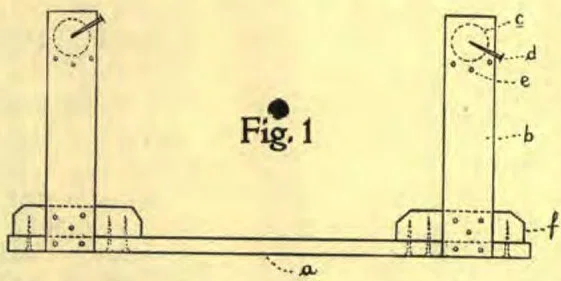
Fig. 1
As for tools, a knife and a hammer are necessary; a plane, saw, and brace with bit are useful.
Putting Together
Fig. 1 shows the construction, and pieces of wood necessary; a is the baseboard; and in the model from which this description is taken, it is about 26 inches long by 10 inches wide. It can be made longer and wider if the materials are at hand. If you have a plane, be sure to dress the edges down nice and square, and make the surface smooth. Then go over it with a piece of sandpaper, giving it a good finish. There are four upright pieces, quite thick (from one-half to an inch in thickness), 2 or 3 inches wide and 10 or 12 high. These are nailed or screwed securely in place, and braced by some other pieces of the same wood, as shown at f. This makes a strong, light frame.
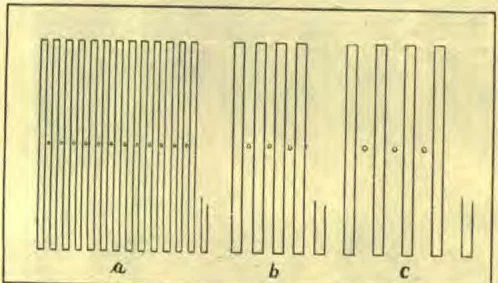
Fig. 2
Now the two rollers, which should be as long as the baseboard is wide, are either pieces of a curtain pole, broom handle, or a rounded stick, 2 x 2; they are better if they are quite large, though this is not at all necessary. Two of the axle pieces for the rollers are nails driven into them. The other two, as shown at d, may also be very long nails bent to form a kind of crank. If the nails of sufficient length are not to be had, some steel wire driven in straight will do. The holes marked e in the diagram are placed there to hold a nail which keeps the cranks from turning backward while the weaving is progressing.
The comb is made of cardboard, which should be thick and hard (a piece of stiff binder’s board will do), cut with slits and holes as shown in Fig. 2. These slits should be 5 to 7 inches long, and wide enough to give the string or thread an easy movement lengthwise in them. The holes should also be slightly larger than the diameter of the string. The distance between these slits and holes will depend on the nature of the cardboard you are working with. If that is soft and brittle, the openings will of necessity be farther apart than with tough, hard board. The distance will also depend on the closeness of weave the machine is to make. Two or more “combs” or different styles will enable the weaver to do more than one class of work.
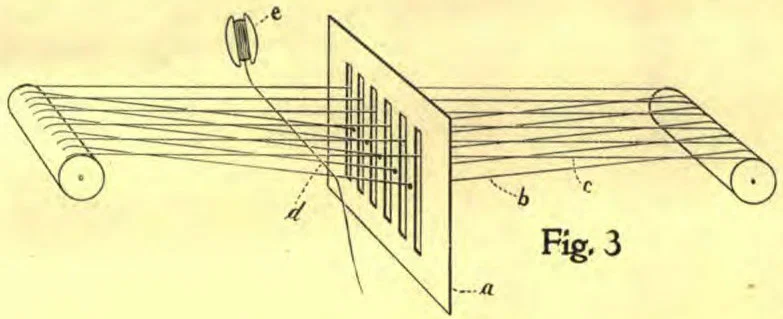
Fig. 3
Fig. 4
Cardboard Shuttle
Fig. 4 shows the cardboard shuttle, which is to carry the “woof” between the strands of “warp.” Make several of these, so that the little girl who uses the machine will not be obliged to so often rewind the shuttles. They should be of the same tough, heavy card as the comb.
Operating the Loom
To one of the rollers make fast the end of a string for every hole and slit in the comb. Pass these “warp” strings through the comb, and now wind a long length of each string up on the roller to which you have fastened its end. Cut the strings off, and tack or tie them to the other roll. Fig. 3 shows the relation of part to part thus far.
In the same figure you will see that by pushing the comb downward one set of strings is separated from the other, forming a V-shaped opening between two flats of “warp.” Through this V a shuttle of twine is passed, and the comb drawn against it to force it tight up to the roller. Returned to its position, the comb is next raised instead of lowered, and the shuttle passed back through the V. The comb presses this tight up to the former woof thread, and the operation is repeated till sufficient cloth is woven, or the little weaver is tired. Of course, from time to time it will be necessary to wind up the fabric that has been made, and bring new warp into position. The cranks and nails will serve the good purpose of stretching the strings.
Colored Cloth
So far there has been woven a plain material, all of one color. Now if we had put five warp threads pink, five white, and five blue, entirely across the roller, and from different shuttles passed five white, pink, and blue threads alternately through the V’s, we should have a checkered cloth. In this way we can make any possible design in checks or stripes. Some of the color weaving done by mere children has a very rich and pleasing effect.
A Word More About the String
String is cheap—don’t pay too much for it. If you can get only white, you can dye it any color you like in the package dyes sold at the drug store. Of course, white and colored threads may be used to make a finer cloth, but the weaving of it is very slow and wearisome. Cloth of thin texture and any color, torn into long strips or sewed together, may be used on the shuttles to make very pretty little rag carpets and rugs for the children.
EDISON DRIVER.
A Thought Hoed out of the Garden
By Frank A. Page
THE garden had been divided among the members of the household, each one having the responsibility of keeping the rows allotted to him free from weeds. The mother was hoeing in a distant part of the garden, but on a row running by the side of the place where her little boy was triumphing over grass and pigweed. Looking over the row, Carroll called out, “You have a good many weeds up here, mother.” Quickly, and perhaps a little harshly, the answer came, “Well, don’t tell me about them, I have enough here.”
Then I thought of a parallel. How often as we hoe along our row of character, we are irritated when some one suggests that there are a few weeds among our good-habit plants! (There are many reasons why others can see the weeds easier than we can.) It is human nature to resent these suggestions; yet he who is determined to have the “image of God” restored in his soul will welcome them; for the knowledge of any sin gives us the opportunity to at once confess and forsake it, accepting Christ’s righteousness for the present and his strength for the future. Our character row may be cleansed immediately.
In the work in the garden, the weeds spoken of could not well be hoed out till that point in the row was reached, though they were seen long before. Knowledge of work that we ought to do and have not done, makes life’s work drag. But we need not struggle along under a burden of work to be done on our character row; for the Master Gardener, under whose direction we are working, will not point out (though he use a human pointer) a bad-habit weed or a sinful thistle until we are provided with the tools and power from on high to remove it from the garden of the heart.
FRANK A. PAGE.
An Early Umbrella
A CURIOUS relic of the century before last is still to be seen in Sheffield. This is nothing less than the first umbrella that ever created a sensation in the streets of the city of cutlers. It belonged originally to John Greaves, of Fargate, who faced the ridicule of the townsmen under its shelter. A marvel of ingenuity is this old Sheffield umbrella. Nothing could be less like its slim and genteel modern representative. Instead of being folded in present-day fashion, the handle unscrewed, and the ribs were hinged in the middle, so that the cover could be doubled back. The whole rolled up like a constable’s cape, and, packed in a cover, it was little over a foot long. It could probably go easily into the capacious pockets of 1770. An old-time master cutler, William Trickett, soon followed the example of Greaves, but the first time he appeared in the streets with his umbrella, he was mobbed by the crowd. His own brother led the mob, shouting, ‘Hey laads, ahr Bill’s getten’ a waukin’ stick wi’ petticuts on.”—London Tatler.
MEMORY VERSE: “And in the days of these kings shall the God of heaven set up a kingdom, which shall never be destroyed.” Verse 44.
When Daniel was taken before the king, Nebuchadnezzar asked: “Art thou able to make known unto me the dream which I have seen, and the interpretation thereof?” But though the dream had been revealed to Daniel, he did not want the king to think it was because of any wisdom that he possessed. “There is a God in heaven,” he said, “that revealeth secrets, and maketh known to the king Nebuchadnezzar what shall be in the latter days.” Then Daniel told the king his dream:—
“Thou, O king, sawest, and behold a great image. This great image, whose brightness was excellent, stood before thee; and the form thereof was terrible. This image’s head was of fine gold, his breast and his arms of silver, his belly and his thighs of brass, his legs of iron, his feet part of iron and part of clay.”
“Then sawest till that a stone was cut out without hands, which smote the image upon his feet that were of iron and clay, and brake them to pieces. Then was the iron, the clay, the brass, the silver, and the gold, broken to pieces together, and became like the chaff of the summer thrashing-floors; and the wind carried them away, that no place was found for them: and the stone that smote the image became a great mountain, and filled the whole earth.”
Then Daniel told the king what this strange dream meant. “Thou, O king,” he said, “art a king of kings: for the God of heaven hath given thee a kingdom, power, and strength, and glory. . . . Thou art this head of gold. And after thee shall arise another kingdom inferior to thee, and another third kingdom of brass, which shall bear rule over all the earth. And the fourth kingdom shall be strong as iron: forasmuch as iron breaketh in pieces and subdueth all things; and as iron that breaketh all these, shall it break in pieces and bruise.”
“And whereas thou sawest the feet and toes, part of potters’ clay, and part of iron, the kingdom shall be divided; but there shall be in it of the strength of the iron, forasmuch as thou sawest the iron mixed with miry clay. And as the toes of the feet were part of iron, and part of clay, so the kingdom shall be partly strong, and partly broken. And whereas thou sawest iron mixed with miry clay, they shall mingle themselves with the seed of men: but they shall not cleave one to another, even as iron is not mixed with clay.”
“And in the days of these kings shall the God of heaven set up a kingdom, which shall never be destroyed: and the kingdom shall not be left to other people, but it shall break in pieces and consume all these kingdoms, and it shall stand forever. . . . And the dream is certain, and the interpretation thereof sure.”
When King Nebuchadnezzar heard these words, he fell upon his face, and said: “Of a truth it is, that your God is a God of gods, and a Lord of kings, and a revealer of secrets, seeing thou couldest reveal this secret.”
Then the king gave Daniel many gifts, and made him ruler of the province of Babylon. He also gave positions of honor to Shadrach, Meshach, and Abednego.
Questions
1. What question did King Nebuchadnezzar ask Daniel as soon as he was brought before him? To whom did Daniel give honor as the one who has power to reveal secret things? What did he say the God of heaven would make known to Nebuchadnezzar?
2. What did he say the king saw in his dream? Describe its appearance. Of what was the head of this image made? Describe the rest of its body.
3. What else did the king see? What did this stone do? Tell what finally became of the image. What did the stone become?
4. What did Daniel say that Nebuchadnezzar himself was? Who had given him his kingdom and power? What kind of kingdom would arise after Babylon? Over what would the third kingdom rule?
5. How strong would the fourth kingdom be? What would it do? Of what were the feet and toes of the image made? What kind of kingdom did they represent?
6. In the days of these kings, who will set up a kingdom? How long will this kingdom stand?
7. What did Daniel add when he had given the dream and its meaning? What did Nebuchadnezzar do and say when he had heard these words?
8. What did the king do for Daniel? What did he give to his three friends?
Be Kind, Boys
HORACE MANN gave a bit of advice to boys: “You are made to be kind, boys. If there is a boy in school who has a clubfoot, don’t let him know you ever saw it; if there is a lame boy, assign him to some part in the game that does not require running; if there is a hungry boy, give him a part of your lunch; if there is a dull one, help him with his lessons; if a larger or stronger boy has injured you, and is sorry for it, forgive him. All the school will show by their countenances how much better it is than to have a great fuss; and remember who said, ‘Love your enemies,’ and ‘Bless them that curse you.’”—Children’s Friend.
Bible Gates
By Mrs. Elizabeth Rosser
A Guess Poem
Two strangers at this city's gate
In haste appeared; the hour was late.
There sat a patriarch, aged and gray,
Who took them home till break of day.
Then o'er the hills they bade him fly,
And 'scape the dire destruction nigh.
And e'er the evening fell again,
A smoking ruin lay the plain.
Among his foes the giant lay;
They waited till the break of day,
Intending then to capture him.
But he arose at midnight dim,
And on his shoulders took the gate,
The post, and bar, a mighty weight,
And to the top of Hebron's hill
He bore them, while his foes slept still.
At morn beside the gateway stood
The king, a man of wars and blood;
As forth he sent his captains three,
“Deal gently with my son,” said he.
At even, when the host returned,
With grief they heard him as he mourned.
“O Absalom, my son,” cried he,
“Would God that I had died for thee!”
There is a gate with portal broad;
Beyond it lies a flowery road;
But though its pleasures thousands tell,
Its steps lead down to death and hell.
There is a gate,—a narrow gate,—
If thou pass through that portal strait,
A rugged road before thee lies,
That ends at last in paradise.
Mrs. Elizabeth Rosser.
I Will Pay My Vows Unto the Lord
“I WILL pay my vows unto the Lord.”
V—Signs on the Earth
(October 29)
MEMORY VERSE: “And when these things begin to come to pass, then look up, and lift up your heads; for your redemption draweth nigh.” Luke 21:28.
Questions
1. Where, besides in the heavens, will there be signs? Acts 2:19; note .
12. When we see these things begin to come to pass, what may we know? Luke 21:28.
13. When all the signs are fulfilled, of what may we be assured? Verse 31.
14. How sure is this promise? Verses 32, 33.
15. What warning did the Saviour give in this connection? Verse 34.
Notes
Free Libraries Spreading Across the Southern States
A MOVEMENT has been inaugurated to establish libraries in the smaller towns of the Southern States. It is said that there are 577 libraries in Massachusetts, while in all the South there are but 517. The latter average about one thousand volumes, and the libraries of Massachusetts have nearly twice as many books. Of the thirty States which provide money for libraries, only three are Southern States. There promises now, however, to be a general awakening of the Southern people to this work.
In the Government Building at the World's Fair, there is displayed a large map of the United States, on which have been pasted small, colored circles to indicate all libraries containing a given number of volumes. The concentration of bright spots in the eastern part of the Bay State, which boasts an annual circulation of three volumes to every inhabitant, is very conspicuous. Equally so was the absence of the bits of color throughout the great West and South; not that there is a complete dearth in all these States, but where libraries do exist, they are newer, and do not contain the large number of volumes found in the older libraries of the East.
The great, generous conception of providing free literature to those who can not procure it for themselves is wisely magnanimous; yet the library is not altogether a beneficent provision. The abundance of fiction found in nearly all of them detracts in great measure from their usefulness. Could all the youthful readers be wisely advised and directed in their choice of books, the library would stand for one of the chief public benefactions.
A Helpful Experiment
PLEASE tell me what chemicals to use for the illustration oftentimes given to children, using a bottle of water, and staining it to represent sin, and then putting something in to make it clear again.
Use a pint bottle of distilled water. The bottle should be of clear glass, and not quite full. Get an ounce of tincture of iodine, and two ounces of saturated solution of hyposulphite of soda. The effect of this illustration is enhanced by using a few drops of the tincture of iodine at a time, indicating how sin gets hold of a person. When the contents of the bottle is black and ugly, a good point can be made by asking the children if the contents of the bottle can be made clean again by washing the outside of the bottle with water. The point taught is that morality does not save. Pour in nearly all of the two ounces of the bleach, and the contents of the bottle will immediately assume the appearance of clear water. Another good point in the illustration can be made here by putting in some more of the tincture of iodine, which now will not stain the water in the bottle, because of the counteracting influence which is there. The point illustrated is that the Christian can resist temptation in the power of Jesus Christ. All such object-lessons should be used with great care, so that the permanent thought left in the minds of those who witness it will be directed to the truth, and not to the objects.—Sunday School Times.
Former Speaker Henderson Retires From Public Life
Ex-Speaker Henderson, of the House of Representatives, has retired from public life, ill health compelling complete retirement. Failing memory has made him unable to recognize his old friends and to recall events of public life long familiar.
Centennial of the Constitution's Last Amendment
THE editor of the Washington Post suggests that the twenty-fifth day of September of the present year should have been celebrated by the American people, as it marked the centennial of the last normally adopted amendment of the Constitution of the United States. So strong is the editor’s belief in the wisdom and foresight of the framers of the Constitution, and so great is his confidence in the combined good sense of their descendants, that he regards the “immortal document” as incapable of change. He makes the observation that those who contemplate securing changes should have learned the futility of their efforts by the failures of men of the past century. The Constitution has proved itself an able friend and protector to the American people under such varying conditions of life that it would seem the most confident would hesitate to suggest an improvement.