THERE could hardly be a greater mistake than that of supposing that a Christian gains influence over those who are not Christians, by laxity rather than by strictness, in any matter of questionable or debatable propriety. The world's standard for Christians is higher than Christians' standard for Christians. A Christian is not so likely as a man of the world to judge a Christian severely because of his indulgence in theater-going, or card-playing, or dancing, or wine-drinking, or tobacco-using. Apart from the question whether these things are in themselves right or wrong, it is a fact that men of the world who practice them have a higher respect for a Christian who abjures them, than for a Christian who indulges in them.
Two Christian gentlemen were sitting with a gentleman who was not a professed Christian. The latter and one of the former were smoking, and when a cigar was proffered to and was declined by the third, the Christian smoker expressed regret that his companion did not smoke. "And I honor him the more for that," was the instant response of the man of the world. "His standard is clearly higher than ours."
An army chaplain thought to bring himself on better terms with his fellow-officers by sharing a simple game of whist with them. That course so lost him the respect of officers and men who were not Christians, that his usefulness as a chaplain was at an end.
On an ocean steamer, a clergyman and his young companion were the only total-abstainers at their cabin table. They were repeatedly urged to drink for their own good, and they were spoken of as unwisely strict in their abstinence. But the very men who thus criticised them spoke with a contemptuous sneer of the course, in this line, of another clergyman at an adjoining table, who was supposed to take a glass of wine socially—although he really did not do so.
A young girl who had been brought up to dance and to go to the theater, and whose father seemed to have little interest in religious matters, connected herself with the church. Wishing not to seem a gloomy Christian, she continued in her old habits of social life. Yet her father told a clergyman friend that he should have a higher regard for his daughter's religion, if it kept her from dancing and theater-going.
And these incidents are but illustrative of the great sweep of popular feeling concerning personal habits of self-denial and constraint as a fruit of the Christian life. Whatever may be said in favor of these laxer social customs, it will have to be admitted that men of the world have a lower estimate of the Christian standard which tolerates them.—S. S. Times.
THE MILK OF THE WORD.
By Tyron Edwards
It seems to be a common impression that the "strong meat" of the gospel refers to its great evangelical doctrines, and that the "milk of the word" has reference to its duties. And this appears to be the idea, not only of ordinary readers of the New Testament, but of not a few intelligent and thoughtful divines and scholars. Quite recently the writer has seen articles from two prominent ministers, one of whom says, that as a safeguard against heresy, "our congregations need to be fed with the strong meat of the word—to be more thoroughly taught its great doctrines," while the other speaks of the preaching of doctrine as "giving strong meat to the people," both thus implying that "the milk of the word" has reference to the duties enjoined in the gospel. But is not the very reverse of this the fact? Does not the milk of the word refer to the great doctrines that lie at the very foundation of its duties, and without which duty cannot be known, and the strong meat to the duties which are so hard to be performed, even when they are fully known and understood? Let us look a moment and see.
The word "milk," referring to the teachings of the gospel, is found in the New Testament in only three instances. One is in 1 Peter 2:2, where it is not used in contrast to "strong meat," as it is in the epistles to the Corinthians and the Hebrews, but simply in reference to the nourishing quality of all the divine teachings as laying the foundation for Christian growth. In the other two cases (1 Cor. 3:2, and Heb. 5:12, 13), the "milk" is spoken of as in contrast to the "strong meat." In the former case the apostle presses on the Corinthians the duties of the Christian life, on the ground that he had previously taught them the great doctrines of Christ, feeding them with the latter as with the milk of the word. In the latter he makes plain that by the milk he meant the great doctrines of the gospel, for he expressly mentions, as the very foundation of the Christian life, the doctrines of repentance and faith, and the washings of baptism and regeneration, and the laying on of hands as conferring the gifts of the Holy Spirit, and the resurrection of the dead, and the final Judgment. And this order of thought is just what we might naturally expect, for the very foundation of Christian character is truth or doctrine, taught and believed, before it can have reared on it the superstructure of duty; and we cannot know what is duty till we first know the truth that lies at its foundation and indicates it to us. Duty not resting on doc-
trine is but mere worldly morality, and doctrine not issuing in duty is but a lifeless orthodoxy—a faith without works, being dead, like that of devils, who believe while they tremble.—Tyron Edwards, D. D., in New York Observer.
"MY RELIGIOUS EXPERIENCE."
It is not true that the gospel offers to any man immunity from the consequences of past transgression on condition of repentance and faith. Such a promise would be a very dangerous one, and the granted boon one of more than doubtful value. Indeed, it would be difficult to conceive of anything more disastrous to the moral well-being of the race, than a provision by which a man might violate the moral laws of life and avoid the penalty of the violated laws by regret however sincere, or a new moral purpose however earnest. What the gospel promises is the help of God to any soul which finds itself enmeshed in evil habits, whether of outward conduct or of inward thought, which are the consequences of transgression, and who desires deliverance and an emancipated life. It is the revelation of a law of life setting free from the law of sin and death. No man can neglect the education of his intellectual powers in his youth, and acquire the fruits of culture in his manhood by experiencing knowledge. Neither can a man neglect the education of his morals and spiritual powers and acquire the fruits of moral and spiritual culture by experiencing religion. He may be born again, but if he is late born he must bear in the immaturity of his manhood experiences the consequences of his early fault.
—Christian Union.
PREPARATION FOR THE PRAYER-MEETING.
THE nature of the prayer-meeting, as a gathering of God's children around "the throne of grace," with its purpose—that they "may obtain mercy, and find grace to help in time of need"—is understood; the necessity of preparation is admitted.
What is this preparation to be?
1. That of a course of life in harmony with God's requirements. "Wherewith shall I come before the Lord, and bow myself before the high God? . . . What doth the Lord require of thee, but to do justly, and to love mercy, and to walk humbly with thy God?" To do each of these three things. Do not think you can walk humbly with God, yet not do justly and love mercy. God will have no such company. You cannot come from acts of injustice or from coldness of feeling toward your fellow-men during the day, and get a blessing in the prayer-meeting in the evening. You must be just in all things. You must "love mercy" out of the prayer-meeting to "obtain mercy" in it. You must also live in the spirit of loving intercourse with God. So that the preparation begins far back of the meeting. It is not subject to a summary call of will fifteen minutes before the appointed hour.
2. During the day make the meeting your aim. Think of yourself as on a journey, and of the meeting as your destination. In the early morning read the Scripture, and note the subject for the meeting. Let the subject be recalled through the day; your thought glancing toward and resting upon it, as your work may permit. Send up silent prayers for an evening blessing. In this wise bring yourself into the tone and spirit of the meeting, so that when it comes it shall be but as the climax to the whole day's tendency.
3. Go to the meeting in faith, fully expecting that the object of the meeting will be fulfilled to you. "Let us therefore come boldly unto the throne of grace," in reverent, humble confidence, assured that our coming shall be no doubtful experiment, but rich and satisfying in its results of good to our souls. "Good prayers never come weeping home;" says an old English divine: "I am sure I shall receive either what I ask, or what I should ask." One element of a good prayer is hopefulness of answer.
4. Go with the purpose fully formed not simply "to be ministered unto but to minister," in the meeting. Go with your mind made up to take some part, so to give while you seek to "obtain." It is to the open soul, prompt and cheerful to contribute in such ways as may be possible to the spiritual good of others, that spiritual good is given.—Golden Rule.
Preachers and Public Affairs
By Editor
GREAT harm comes to the church and public morality when preachers and other teachers hide themselves away from sight, become, in other words, recluses. But harm almost as great arises from their too prominent identification with affairs that do not properly belong to them. The latter difficulty is, perhaps, the present one, the many reforms and goodish movements of the period tempting them to help in their advancement. The middle ground is the right one, with a heavy leaning to the side of the gospel as a gospel of salvation.
"THEY OVERPASS THE DEEDS OF THE WICKED."
By Editor
THESE words were used by the inspired prophet (Jer. 5:28) concerning the professed people of the Lord in ancient Jerusalem. The careful reader of the context, however, will readily see that their sole application is not to the ancient Jews, but that Jeremiah, while looking at the Jews, saw in prophetic vision far beyond them, and beheld another people in the last days walking in the same path. That the prophecy concerning Jerusalem has equal reference to the church in the last days, may be seen by reading from the beginning of the fourth chapter, and especially verses 19-31 of that chapter.
If anything more were needed to prove that the iniquity which brought destruction upon ancient Jerusalem will be duplicated in the last days, we have only to quote the plain language of the apostle Paul, in 2 Tim. 3:1-5:—
"This know also, that in the last days perilous times shall come. For men shall be lovers of their own selves, covetous, boasters, proud, blasphemers, disobedient to parents, unthankful, unholy, without natural affection, trucebreakers, false accusers, incontinent, fierce, despisers of those that are good, traitors, heady, high-minded, lovers of pleasures more than lovers of God; having a form of godliness, but denying the power thereof."
The last sentence shows that these things will be seen among those who profess to be followers of God. Within the past three weeks, three different things have come under our notice, which vividly illustrate some of the things mentioned by the apostle as characteristic of the last days. First of all, as illustrating the phrase, "lovers of pleasures more than lovers of God," we quote the following which appeared in the column of church news in the Oakland Tribune of September 3:—
"A CHURCH ENTERTAINMENT.
"Yesterday afternoon was devoted by the ladies of the Church of the Advent, East Oakland, to the selling of fancy work, toys, candy, and other useful or ornamental articles at a bazar open in Washington Hall. In the evening a short literary programme was given, after which dancing was indulged in until 11 o'clock. Refreshments were served during the afternoon and evening. About 11 o'clock the company was called together to attend an auction of cakes. W. S. Goodfellow acted as auctioneer, and succeeded in getting a goodly sum of money into the church treasury by the sale of the delectable merchandise."
Lest some should by any possibility get a wrong impression, we will explain that the "Church of the Advent" is the name of an Episcopal house of worship, and has no reference whatever to Adventists. In regard to the above notice, some may say, "It shows, to be sure, that they are lovers of pleasures, but how does it show that they are 'lovers of pleasures more than lovers of God'?" Just this way: Although professedly for the cause of Christ, the pleasures indulged in were such as are utterly incompatible with love to God. It was pleasure which is only of the world. Now John says: "If any man love the world, the love of the Father is not in him." 1 John 2:15. Therefore the indulgence in such amusements at all, at any time or for any purpose, is evidence of absence of love to God. But such things are common nowadays, and we pass to another phase.567In the New York Observer of September 1, we find the following item:—
"Strange things are done in the name of charity. The 'champion' prize-fighter of America, whom Boston delights to honor, recently gave an exhibition of his skill in the fistic art for the benefit of a Roman Catholic benevolent society in Rhode Island. Some charitably disposed persons in Paris, France, have improved upon the Sullivan scheme by instituting 'a grand cock-fight for the benefit of the poor.'"
Certainly nothing more than this is needed to prove the correctness of the appellation, "fierce," to those who in the last days are content with only a form of godliness. To be sure the prize-fight in Rhode Island was under the auspices of the Catholics, but they are now, by the most of the so-called Protestants, recognized as a "branch of the Christian Church."
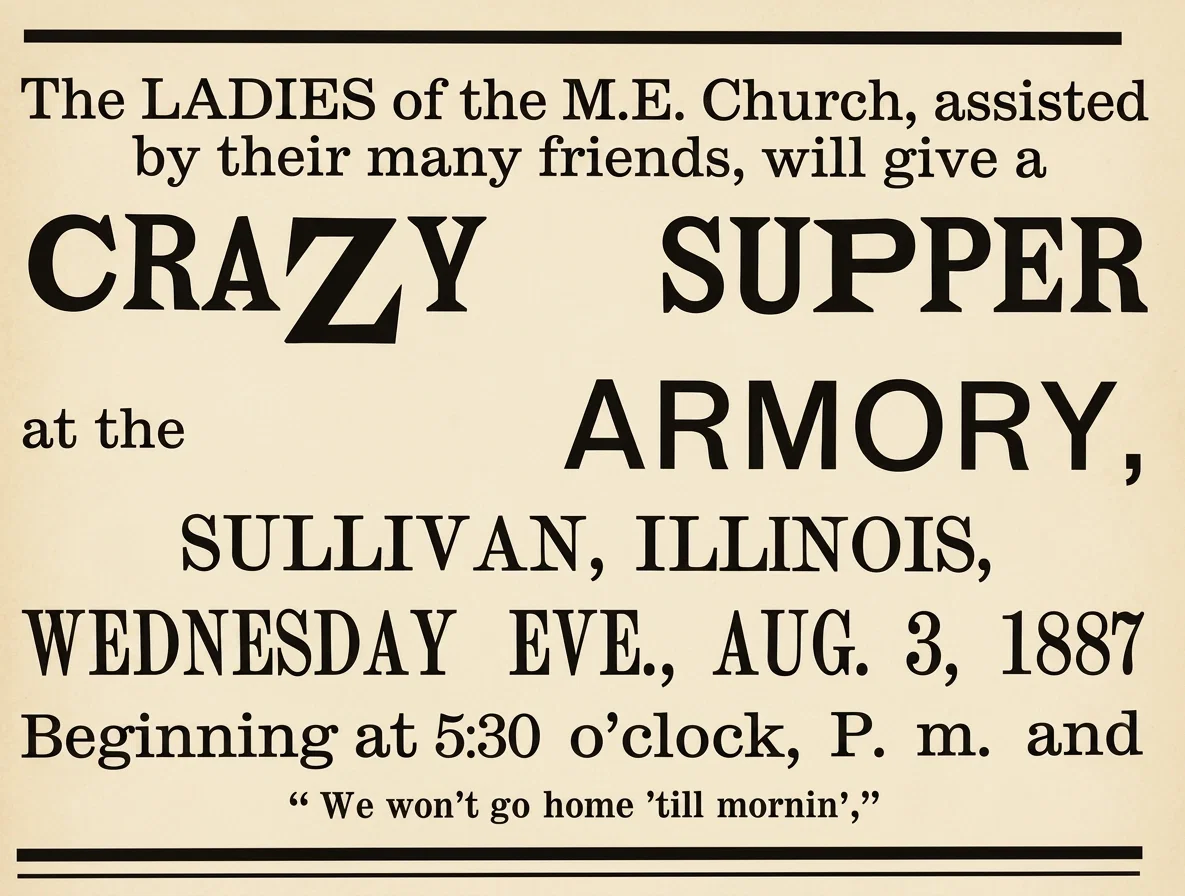
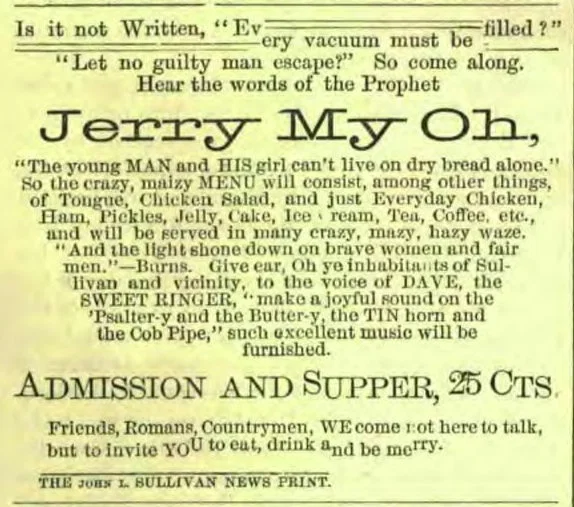
But all these acts of wickedness and worldly pleasures are overpassed by a thing which was done in Illinois about a month ago. It was a "crazy supper" given by the ladies of the Methodist Church. No description could do justice to it, and so we give below as nearly as possible a fac-simile, reduced in size of course, of the hand-bill which announced it:—
The Magic MOON is BREAKING, Like a conqueror from THE east, THE waiting world awakening, To A golden, fairy feast—shakeSPEARE.
One of the original bills, of which the above is an exact copy, is in our possession, having been sent us by our friend Elder A. O. Tait, who was holding meetings in the town of Sullivan when the crazy revel took place. The shape of the hand-bill we cannot reproduce, but it is sufficient to say that it is fantastic, and fully in keeping with the matter which it contains, giving evidence that those who got it up were eminently qualified to conduct a "crazy" supper.
But while the bill shows the church people who got it up to be "lovers of their own selves," and "lovers of pleasures more than lovers of God," it proves to a demonstration that the epithet "blasphemers" is fully merited by these last-day professors. Passing by the extracts from the drunkard's song, "We won't go home 'till morning," which shows that their revel, beginning at 5:30 P. M., was to last all night, we call attention to the abominable caricature of the language of sacred Scriptures. Isaiah's prophecy of the forerunner of the Messiah, in which are found the words, "Every valley shall be exalted," (Isa. 40:3, 4), is distorted into "Every vacuum shall be filled," and made to apply to the filling of the stomachs of unholy gormandizers. The name of that holy man who before his birth was designated as a prophet of God, is caricatured as "Jerry My Oh," and then to him are attributed the words, "The young man and his girl can't live on dry bread alone." And then, worst of all, if we can mark degrees in such blasphemy, is the parody on the name of the psalmist, and of the language of the Psalms, in the sentence: "Give ear, Oh ye inhabitants of Sullivan and vicinity, to the voice of Dave the Sweet Ringer, 'make a joyful sound on the Psalter-y and the Butter-y, the tin horn and the Cob Pipe.'"
We venture the assertion that there is not an infidel club in the United States that would dare put forth such a blasphemous caricature of sacred things. Truly the words of the prophet whom they have ridiculed apply to them: "For among my people are found wicked men; they lay wait, as he that setteth snares; they set a trap, they catch men. As a cage is full of birds, so are their houses full of deceit; therefore they are become great, and waxen rich. They are waxen fat, they shine; yea, they overpass the deeds of the wicked." Jer. 5:26-28.
It is not because we take pleasure in exposing the evil deeds of others, that we give such prominence to these matters, but that we may fulfill the injunction of Isa. 58:1, and if possible to arouse those who are not wholly given over to such abominations, to the fact that the end cannot be far off. There is another point also, that we would make. When we say that the passage of a Sunday law would result in the persecution of those who conscientiously observe the seventh day, we are told that that cannot be, because Christians will not persecute, and worldlings will have no interest in the matter. Leaving "worldlings" aside, what clemency, we ask, can humble commandment-keepers expect from "Christians," who have no sense of the sacredness of the Bible? What better are such professors than "worldlings"? And when the matter comes to the test, no more zealous advocates for a rigid Sunday law can be found than these same ones who walk in "lusts, . . . revelings, banquetings, and abominable idolatries." Having no real godliness in themselves, they will think to make up for it by excessive zeal for a form thereof.
Further, Solomon says, "They that forsake the law praise the wicked" (Prov. 28:4); and they who praise the wicked must, as a necessary consequence, despise the good; therefore it is as clear as the noon-day sun that professors who are guilty of such blasphemies as these which we have noticed, or who suffer them without stern rebuke, will, when the power is placed in their hands, be foremost in persecuting those whose godly lives and teaching condemn their course.
When the Saviour was on earth he drove from the temple those who made it a place of merchandise. Soon he is coming again, and terrible will be the fate of those who do abominable deeds under the garb of religion. The prevalence of these things of which we have spoken should serve simply to cause the servants of God to humble themselves, to seek righteousness, and meekness, that they might be hid in the day of the Lord's anger. "Hear the word of the Lord, ye that tremble at his word: Your brethren that hated you, that cast you out for my name's sake, said, Let the Lord be glorified; but he shall appear to your joy, and they shall be ashamed." Isa. 66:5.
Therefore, "Take heed to yourselves, lest at any time your hearts be overcharged with surfeiting, and drunkenness, and cares of this life, and so that day come upon you unawares." Luke 21:34. W.
"THAT THEY MAY ALL BE ONE."
By W.
THERE is no one thing to which Christians are exhorted more strenuously than they are to unity. Indeed it is the one thing essential. Without unity they have no means of proving to the world the truth of the religion which they profess. Christians are those who are united to Christ, and if they are united to Christ,—members of one body,—they must necessarily be united to one another. Therefore union is the great test of Christianity.
But when we say this, we do not mean that all who profess Christianity must necessarily be united. We can conceive of union that would be far worse than dissension. We refer to a union upon something contrary to the commandments of God and the faith of Jesus. Such a union would be no evidence of Christianity, as anybody can see. It must be, therefore, that when our Saviour prayed that all his professed disciples might be one, he designed that their union should be a union upon the truth of God as revealed in his word. And this is still more evident from our Saviour's words in another part of that same prayer, where he said: "Sanctify them through thy truth; thy word is truth."
These thoughts were suggested by reading a letter which we recently received, in which the writer deplored the fact that some are keeping the seventh day of the week,—the Sabbath of the Lord,—while the majority of Christians observe the first day of the week. He wished that there might be unity in this respect, and hoped that the time would soon come when Christians should unite in bringing about the fulfillment of our Lord's prayer, "that they all may be one." Inasmuch as he pleaded quite strongly for Sunday observance, we conclude that he wants those who keep the seventh day to unite with the majority, and thus fulfill our Saviour's desire.
It is not an unfrequent thing for people to accuse seventh-day keepers of bringing in dissension, and of being the cause of there being a division among professed Christians. Now to us the case looks very much as follows: A teacher sends her score of pupils out to play, with instructions for them to keep within a certain inclosure, and an express injunction for them to keep together and be united in their play. Very soon they propose a game which if carried out would make it necessary for them to go outside the inclosure. They all start over the fence, except two who refuse to disobey their teacher. The others beg them to come along, stating that the teacher will not care, because so many of them have already gone outside, and then they remind the two of the teacher's injunction that they should keep together. But still the two refuse to go outside, and so the play is hindered, and the good feeling with which they all started out is marred. The teacher, hearing the dispute, goes out to see what is the matter, and is told by the majority that all the trouble is caused by those two obstinate ones, who refuse to act in harmony with them. Now we think that almost anyone will say that the two are all right, and that the trouble is all caused by the majority who refuse to obey the simple command of the teacher. The teacher also would say that when she enjoined them to keep together, she meant that they should keep together in the place marked out for them. No one would say that the eighteen ought to be praised for being united in an act of disobedience.
Well, God has enjoined upon all who profess to be learners from him, that they should be one; but when he tells them that, he expects that they will be one in obeying his law.
It would be too much to suppose that he would reward them for being united, if they were united in disobedience. Indeed, he has said that union in disobedience is displeasing to him, for we read: "Though hand join in hand, the wicked shall not be unpunished; but the seed of the righteous shall be delivered." Prov. 11:21. Numbers do not make a sin respectable in the eyes of God. He had more pleasure in Noah than in all the antediluvian world besides. In fact, Noah was the only one with whom he was pleased, and the reason is given thus: "For thee have I seen righteous before me in this generation." Doubtless Noah was accused of being a disturber of the people; but it was better to be a disturber on the side of right than to be joined to the multitude in error.
In later times, when the Jewish nation had nearly all gone into idolatry, there was one faithful man, who refused to join their iniquitous union. The Israelites were a very united people at that time, and did not want to have any disturbing element among them. And so when Elijah came to warn them again, Ahab said to him, "Art thou he that troubleth Israel?" Elijah did not accept the accusation, but stated the matter in its true light, saying, "I have not troubled Israel; but thou, and thy father's house [have troubled Israel], in that ye have forsaken the commandments of the Lord, and thou hast followed Baalim." 1 Kings 18:17, 18.
We love union, but we hope that we may never accept of any union that will involve a violation of the plain precept of God. Rather would we stand in the law of the Lord, calling the multitude to return and walk in the old paths. W.
ONCE A SIN ALWAYS A SIN.
By Editor
A FRIEND asks us concerning the curse in Deut. 27:23, against a man marrying his mother-in-law, wishing to know if that prohibition is still in force, or if it is part of the law that was nailed to the cross of Christ. He says, "Does all from the 14th verse to the end of the chapter stand good, except the 23d verse? If so, why?"
We say most emphatically, None of it has passed away. The words at the close of the chapter: "Cursed be he that confirmeth not all the words of this law to do them," apply to all the precepts therein recorded, without exception. There is no more reason for saying that verse 23 does not apply now, than there is for saying that the 15th verse is out of date. To say that these verses are part of that which Christ took out of the way, nailing them to his cross, is equivalent to saying that Christ is the minister of sin. For even heathen nations recognize the fact that to set light by one's father or his mother (see verse 16) is a sin. If this law is done away, then it would follow that it is all right for one to smite his neighbor, provided he does it in such a way as not to be found out. See verse 24. No; these curses are in full force to-day, and it is as surely a sin for one to marry his mother-in-law, as it is to make a graven image to worship, to smite a man secretly, or to take a reward to slay an innocent person.
The curses recorded in Deut. 27:15-26, are all for violation of some one or other of the ten commandments. This can be seen by an examination of the passage itself and also by comparing verses 11-14 with Deut. 11:26-28. The latter passage reads thus: "Behold, I set before you this day a blessing and a curse; a blessing, if ye obey the commandments of the Lord your God, which I command you this day; and a curse, if ye will not obey the commandments of the Lord your God, but turn aside out of the way which I command you this day, to go after other gods, which ye have not known. And it shall come to pass, when the Lord thy God hath brought thee in unto the land whither thou goest to possess it, that thou shalt put the blessing upon Mount Gerizim, and the curse upon Mount Ebal." Now by reading Deut. 27:11-14, we find that the curses which follow were to be pronounced in harmony with the above injunction, and with the statement that God set a curse before those who should transgress his commandments.
The simple fact is, and it should be remembered by all, that no man can be blessed now for doing what would once have brought him under the curse of God. God's will is ever the same. He never pronounced a curse upon anything except sin, and no one was ever cursed except for sin. And since God cannot change, the standard of right and wrong must ever be the same. Whatever would bring a man under the curse of God four thousand years ago, will bring one under that same curse to-day. Wherever in the Bible you find a curse attached to the performance of a certain thing, be assured that thing is to be always and forever avoided by the children of men.
"WHITHER I GO YE CANNOT COME."
In the Bible School at Northfield, last month, Mr. Moody preached one Sunday on the second coming of Christ, arguing that Christ will come to earth in bodily form as he left it, and that it is a duty of the Christian to watch for his coming and to expect to meet him when he comes. But to Mr. Moody's argument some of the attendants at the school made answer:—
"We expect to meet Christ in death and be with him. What difference can it make in our Christian life and work whether we are always on the tiptoe of expectation to meet him thus, or go to him. In other words, what difference does it make whether we go to a friend or he comes to us, provided we are with our friend?"
With such an expectation for the premise, then that argument is sound, and as Mr. Moody accepts the premise he could not avoid the conclusion, and therefore in defense of his sermon he could only reply to this that, "we should get great encouragement in our evangelical work by the thought that at any moment Christ may come to help us in that work." Thus by admitting one error as a premise, Mr. Moody became involved in a dilemma where he had to commit another error to get out.
Did Mr. Moody teach those young men whom he was there training for evangelical work, that they were to go forward and engage in that work without the help of Christ, and to be constantly on the watch and waiting for Christ, and that their encouragement should be the thought that at any moment he may come and help them in their work? Not at all. Mr. Moody knows the "Great Commission," and he knows that when Christ gave that Commission, he said to every soul who should ever engage in evangelistic work, "Lo, I am with you always, even to the end of the world." And that is the only way in which Christ has ever promised to be with anybody to help them in their evangelistic work. When he comes to earth in bodily form, that is, when he comes in his second advent, he does not come to help anybody in "evangelical work," but to take his people unto himself. When he comes, all evangelical work is done, and he comes to reward the workers and to take vengeance on them that know not God and obey not the gospel of our Lord Jesus Christ. Rev. 22:12; 2 Thess. 1:7. He comes then, not as a priest making reconciliation for the people, but as King of kings and Lord of lords. He comes not then as a Saviour of sinners, but as the Judge of all men, and the Saviour of saints. Therefore, Mr. Moody in answering his young men as he did only set them on further in their erroneous course. Because the very idea of their answer to his statement in the first place is erroneous, that the Lord will come to earth in bodily form.
They argued, We expect to go to him at death. Then what difference does it make whether we are always watching for and expecting him to come to us or whether we go to him? In other words, what is the difference whether Jesus comes again or not? We say again that that is a valid argument, provided the expectation is correct. But the expectation is a deception. It is directly contrary to the plainly expressed word of Christ. In that last night, just after the Last Supper, Jesus said to his disciples, "Whither I go, ye cannot come." John 13:33. And that there might be no mistake about it, he said, "As I said unto the Jews, Whither I go, ye cannot come." And what he said to the Jews on this subject was this, Ye "shall die in your sins: whither I go ye cannot come." John 8:21. We suppose it would be considered by Mr. Moody and these same young men at Northfield, a most presumptuous thing for a man who was about to die in his sins to say, "I expect to meet Christ in death and be with him. I expect to go to him." And yet it would be no more presumptuous so far as the fact is concerned, than it was or is for these young students at Northfield to say it. For to the men who die in their sins, Jesus says, "Whither I go ye cannot come" and to his disciples Jesus says the same thing, "Whither I go ye cannot come." "As I said unto" them, "so now I say to you."568Now why didn't Mr. Moody answer these young men in the words of Christ, "Whither I go ye cannot come?" Then they could have seen the necessity of the Saviour's coming again, and the beauty of the doctrine. For when his disciples were troubled at this saying, Jesus said "Let not your heart be troubled: ye believe in God, believe also in me. . . . I go to prepare a place for you. And if I go and prepare a place for you, I will come again, and receive you unto myself; that where I am, there ye may be also." This is Christ's own word and doctrine on that subject. And the only way in which his children can ever be with him, is by his coming to receive them unto himself. And in that coming "The Lord himself shall descend from Heaven with a shout, with the voice of the archangel, and with the trump of God; and the dead in Christ shall rise first; then we which are alive and remain shall be caught up together with them in the clouds, to meet the Lord in the air; and so [in this way, by this means] shall we ever be with the Lord." 1 Thess. 4:16, 17.
But instead of believing the plain word of Christ, these young men have their minds full of the doctrine of the immortality of the soul, and so according to Satan's promise at the beginning they expect to be gods as soon as they die, and expect to go to Jesus when they die, although he has told them as plainly as he could possibly do so, that they can do no such thing. And Mr. Moody is wrapped up in the same delusion, and so when his own sermon is disputed from the standpoint of this erroneous expectation, all he can do is to confirm the young men in their delusion, and to add to it another error, by teaching them to expect the coming of Jesus in bodily form only to help them in their evangelical work. If there is any doctrine that was ever taught in this world, that is more thoroughly subversive of the word of God than is the doctrine of the immortality of the soul, we have never heard of it, and we do not think we ever shall hear of one such. And that is the kind of training that young men get nowadays in theological training-schools. Even in Mr. Moody's which is undoubtedly the best in the nation.
The Use and Answer of Prayer
By Editor
SOMEONE writes: "What is the use of prayer? I get no answers, and it is just the same whether I pray or not." Possibly an answer may be found in the article on the second page of this issue. It may be, too, that the questioner is unacquainted with the language of Heaven, and does not understand the answer when it is received. It is a great mercy to most people that all their prayers are not answered.