The Youth’s Instructor, Vol. 67, No. 9.

Which Is More Daring?
Earlier text: A. E. V

Cecil Brown Made Dumb

CECIL BROWN, with his lithe body, bright eyes, and pleasant smile, was a popular lad, forward in his studies, and quick and alert at play. His Sabbath school and day school teachers relied upon him for help in public entertainments, for Cecil could execute his part well.
But as he grew older his closest friends observed that he lacked a fine sense of true manliness, that he was rude and irreverent at times, exhibiting unmistakable signs of being a “spoiled lad,” a pathological condition not only difficult to cure but highly disagreeable to those with a truer view of life.
“What, that hen!” was Cecil’s exclamation when told in Sabbath school who was to be his instructor.
Nothing more need be said to show that Cecil at his early age was very thoughtless, or else was well started on the wrong path; for it is only the coarse, uneducated, or the drinking man that will apply such a term to a woman.
A test of true manhood is reverence for pure womanhood. If a man speaks in such an uncomplimentary way of a woman, it is at once conceded that he is not possessed of the first principles of a worthy character.
Cecil was exhibiting the influence of unworthy associates. His parents had felt that an insidious change was taking place in their boy; so on hearing of his discourteous remark they were not altogether surprised, but were none the less grieved and humiliated. They counseled together as to the course to pursue to correct the irreverent and discourteous spirit he had manifested. Finally they decided that a boy who could not speak respectfully of a woman should not be allowed to speak to one at all, or of one, until some evidence of a change of heart was revealed.
They had Cecil write a letter of apology to the lady to whom he referred in his uncouth remark, and also to those who heard him make it, and then forbade his speaking to any girl or woman for a fortnight, and also asked him to keep much to himself, for one who would be rude to women was hardly a suitable companion for any one. Cecil was devoted to his queenly mother, so this sentence was a deprivation indeed.
His parents explained the matter to his teachers, and gave them extra remuneration for assigning him written work. His mother served him graciously in the home, but suffered him not to speak to her during the punitive period.
Cecil’s father sought to impress upon him that Tennyson spoke truly when he said:
“For he that wrongs his friend Wrongs himself more, and ever bears about A silent court of justice in his heart, Himself the judge and jury, and himself The prisoner at the bar, ever condemned.”
In talking with Cecil, Mr. Brown told him the story of the Indian sage, Ammi, who took a seed one day and cut it in two. Then showing it to his son, he asked, “What do you see, my child?” “A seed, father,” was the reply. “And what do you see in the seed?” “A small speck,” was the answer. “And what do you see in the speck?” “Nothing,” said the boy. “Ah, where you see nothing, I see a great tree,” replied the sage.
So Mr. Brown explained that where Cecil saw only a joke, a chance to make his companions laugh, he and his mother saw a very serious breach of good form; they saw the beginning of a trait of character which if not overcome at once would mean to him a reckless, despoiled youth and manhood.
We shall not attempt to detail the embarrassing and inconvenient experiences that came to Cecil during the days of his isolation. He was glad to read the biographies of great women and other books his father provided for him during the extra hours that naturally came to him.
Eight long wearisome days had passed, when two of Cecil’s cousins came to visit the family. They were his favorite cousins and were about his own age. They were beautiful girls in character and features, and came to spend the week-end at the home of their best-loved uncle and aunt. Great was their disappointment to learn that Cecil could not speak to them; but even greater was Cecil’s chagrin and disappointment. While he recognized his punishment to be just, under the circumstances it grew to be almost unbearable; so one day in his desperation he sent his father the following note:
“DEAR FATHER:
“I never before knew what a hard time Zacharias had when he couldn’t speak for so long. I have tried to imagine just how he felt when the Lord loosed his tongue, but I wish I could find out for sure before long, especially now that Leel and Neel are here. You see, I am afraid they won’t have proper respect for manhood, boyhood I mean, unless my tongue is loosed before they go.
“Your loving son, “CECIL.”
Mr. Brown smiled as he read Cecil’s appeal, and determined to cut short the period of punishment, especially since the girls must leave the next day. He therefore wrote Cecil as follows:
“MY DEAR SON:
“For your cousins’ sake as well as your own, present restrictions will be removed at the rising of the morrow’s sun. But my dear boy, I hope after this experience there will be in your heart such a wholesome respect for true womanhood that never again can you by word or deed show disrespect, much less real insult, to any woman.
“It is only the cheap, ill-bred boy or man who slurs or insults women. The world’s really great men have always honored womanhood. It has been said by some writers that a man’s real worth can be judged by his respect for woman.
“Therefore, Cecil, as long as life lasts, soil not your lips by any words that will dishonor your own mother or sister; for remember, you dishonor them in dishonoring other women.
“Your mother and I shall be happy to greet you as of old at the morning meal.
“Your devoted father, “THEODORE BROWN.”
As the lad came to the table the next morning he gave his mother a real bear hug, and left in her hand a crumpled note, over which she smiled as she later read:
“There’s not a place in earth or heaven, There’s not a task to mankind given, There’s not a blessing or a woe, There’s not a whisper yes, or no, There’s not a life or birth, That has a feather’s weight of worth, Without a woman in it.”
The girls and Cecil made strenuous effort to redeem all lost time; and while Mr. and Mrs. Brown were satisfied that the enforced silence had resulted acceptably, they frequently endeavored to water the good seed they felt had taken root in the heart of their son.
F. D. C.

The Golden Keys

“A BUNCH of golden keys is mine To make each day with gladness shine.
‘Good morning,’ that’s the golden key That unlocks every day for me.
When evening comes, ‘Good night’ I say, And close the door of each glad day.
When at the table, ‘If you please’ I take from off my bunch of keys.
When friends give anything to me, I use the little ‘Thank you’ key.
‘Excuse me,’ ‘Beg your pardon,’ too, When by mistake some harm I do.
Or if unkindly harm I’ve given, With ‘Forgive me’ I’ll be forgiven.
On a golden ring these keys I’ll bind; This is the motto: ‘Be ye kind.’
I’ll often use each golden key, And then a child polite I’ll be.”
— Selected.

“Too Late”

I HAVE noticed how strangely on some days one idea clings to me, and how all I see and hear seems to prevent my forgetting it. Thus it was the other day when I happened to be at a large railway station in the country. The train was expected, and great was the bustle and excitement among the passengers on the crowded platform. Suddenly the bell rang, and the long train drew slowly in. I always find special pleasure in studying the countenances of travelers, even in the bustle of these railroad days. I wonder where they have come from and where they are bound for, why one looks so sad, and why another is so joyous. What a busy, strange world this is!—and so I was going off into a waking dream, when a guard’s loud voice and shrill whistle roused me. There are my friends waving their hands,—“Good-by, good-by,”—and I am slowly walking away. In a moment I am almost carried off my legs by a man rushing in at the door, breathless and excited. “Just too late, sir,” says the porter. An angry, impatient expression burst from the man’s lips, and then he hurriedly asked, “When’s the next train?” “In an hour’s time, sir,” quickly replied the porter, as he walked off to his business. I watched the gentleman. He walked up and down, drew his hand over his brow as if to rub off some unpleasant weight, looked at his watch, muttered to himself, took a letter from his pocket, read it, stopped, walked on again, and then I heard him say, “Perhaps I may do it yet.”
And so I left the station, pondering these words, “Too late.” My walk took me past the post office, where many people were thronging, for in three minutes the box would be closed. I stood quietly by to make my observations. Poor and rich, masters and servants, hurried to post their letters. But the time is up; the door closed; and now stare me in the face two words, speaking hopelessly to all comers—“Too late!”
Again I walked on, thinking of all that those two words meant. What a far better and happier world this would be, what trouble would be spared, how much be gotten through, if none were ever “too late!”
But this “one idea” was to be impressed still more deeply upon me. The same afternoon I went into a cottage near my home to visit a child, who I had heard was dangerously ill. I found the family in deep distress, for the little one, they told me, was suddenly worse, and dying. I went upstairs, stood by the bed, and saw that even then the hand of death was upon her. In a few minutes the doctor, having been sent for, came hastily into the house. I heard the mother say, as he came softly up the stairs, “I am afraid it is too late, sir.” He came into the room, touched the child’s wrist, shook his head, and said in a whisper, “I can do nothing; it is too late.” He was right, for in a short time the little one passed away.
Can you wonder that during that day and for many a day after, those words, “too late,” seemed to be ever ringing in my ears; and that solemn thought filled my mind? Reader, how is it with your soul? It is bad to be “too late” in earthly matters; many a man has thus been ruined as far as worldly things go. It is possible to be “too late” in reference to your soul. What then? Why, there is no hope left. “Another train in an hour’s time.” “The post will go out again.” Yes, that was true. But go to that bed where I stood; try and bring that child back; bring the most skilful physician—all “too late.”
Turn to the twenty-fifth chapter of Matthew and read this: “Afterward came also the other virgins, saying, Lord, Lord, open to us.” But they had delayed until it was too late.
For you, dear friend, it is not yet too late. Still the voice of mercy sounds in your ear; still Christ, as the Saviour of lost sinners, is preached to you; still the calls to repent and believe the gospel are addressed to you, still the precious promises of God’s Word are before you; still God waits to be gracious; still the “Spirit and the bride say, Come.” But what if present opportunities should be suddenly cut short? What if you should be surprised by death? Remember, “there is no work, nor device, nor knowledge, nor wisdom, in the grave, whither thou goest.”
“Today if ye will hear his voice, harden not your hearts.”—Selected.

Counsel Corner: Letters from Young People

[It has been thought best to publish in the Counsel Corner from time to time extracts from letters received from your people by our Missionary Volunteer workers. Young people's problems are much the same everywhere, and the introduction of such letters, together with the answers, may be helpful to others. Obviously the names cannot be published, nor any information that would identify the writers. We hope that our young people will be free to write of their personal problems. We have but a short time in which to develop Christian character for eternity. Let us not rest satisfied until we know the way of the victorious, soul-winning life.—M. E. K.]

How to Begin Missionary Volunteer Work

Of late I have felt much concerned about the young people here, but there seems absolutely nothing that I can do. There are several Senior young people who are church members, and many Juniors who are not. We have no society or young people's meetings whatever. Efforts have been made several times, but have proved unsuccessful for lack of leaders. The church is somewhat scattered, and we do not even have prayer meetings. You will think it is strange, but there really is no interest or effort made for missionary work at all. Surely, we could do much if we would awaken and see the opportunities and the danger of sleeping at our post. I am ashamed to say it, but I have never led one soul to Christ, the Saviour who has done so much for me. Nine years since I enlisted for him, and nothing accomplished! I know that of late a fatal indifference has been creeping over me, and oh, how I want to do something! But, honestly, I don't know how to begin. Of course, I have prayed much about it. ANXIOUS.
This letter gives evidence of the work of the Holy Spirit. It is the Spirit that makes you dissatisfied with the lack of fruit in your life, and helps you to see your own and others' needs. God is calling you into closer fellowship with him, even the fellowship of soul-winning service. It is too bad that there is no prayer meeting. It is unfortunate that these young people and the Junior boys and girls have not been organized for service. Perhaps the elder of the church does not sense the importance of these things; or perhaps, like you, he hardly knows how to begin.
But you have already begun, and begun right—by praying. “Prayer changes things.” Remember that. God is looking down into every needy church for young people who pray—for he can use those who pray. Keep close to God. Yield yourself as an instrument of righteousness, and he will use you.
After you have earnestly sought the Lord for strength and wisdom to interest others, invite the young person whom you think would most likely be interested, to join you in prayer. Study and pray together. Study the promises of God for the victorious life. As his blessing fills your hearts, you will want others to share it. Invite another. And let the prayer band thus formed reach out for all the young people of the church. Let each member be a personal worker. Make the New Year's Resolve in the Morning Watch Calendar your own, especially the last part. Soon you will have a Missionary Volunteer Society, and it will be clear to you all who should be leader. A society born in prayer will not go down so easily.
Perhaps before this the spirit of service will have taken hold of the Juniors. You probably have no church school, else you would have a Junior society. But you can have a society anyway. Pray about this. Invite some mature person, who you think has ability to lead Juniors, to join some of you in prayer for the boys and girls. If this individual manifests a genuine interest, suggest this work to him or her. Begin to work for the children in a personal way. Doubtless the church officers will gladly co-operate in the organization of the Missionary Volunteer work when they see the earnestness manifested, and learn that there are those who are able and willing to lead.
The church prayer meeting? Well, probably before this it is being held; for a little leaven of spirituality will leaven the whole lump. And the missionary spirit and the prayer-meeting spirit go together.
There is no better way to revive the spiritual life of a church than by prayer and personal work. Try it. M. E. K.

XI — The Child Samuel

(March 15)
LESSON SCRIPTURE: 1 Sam. 1; 2: 1-19, 26.
MEMORY VERSE: “Even a child is known by his doings, whether his work be pure, and whether it be right.” Prov. 20: 11.
STUDY HELPS: “Patriarchs and Prophets,” pp. 569-575; “Bible Lessons,” McKibbin, Book Two, pp. 39-44.
“Master, hast thou work for me? I would gladly toil for thee; I have neither strength nor skill, Yet some place I long to fill; Though my hands are small and weak, Yet some little task I seek.”

Questions

1. Where was the ark of God at the time of the events of this lesson? Joshua 18: 1. Note .
2. Where did Eli, the priest and judge, live? 1 Sam. 1: 9. Note .
3. What other priests lived at Shiloh? Verse 3, last part.
4. Among the worshipers who thronged the temple courts, what particular family is mentioned? Verses 1-3. Note .
5. What was the great grief of Hannah, wife of Elkanah? Verses 4-8.
6. On the occasion of one of the visits to Shiloh, to whom did Hannah take her grief? What shows that she was very much in earnest in her prayer? What vow did she make? Verses 9-11.
7. Of what did Eli take note as he sat by one of the temple pillars? What caused him to have a wrong idea concerning Hannah? How did he rebuke her? Verses 12-14.
8. What patient answer did Hannah make? Verses 15, 16.
9. What encouraging words did Eli then speak to her? What shows that she believed God would answer her prayer? Verses 17, 18.
10. To what place did Hannah and her husband then return? What name did Hannah give her son? Of what was his name a constant reminder? Verses 19, 20.
11. When it was again time to go to Shiloh, what did Hannah say? Verses 21-23.
12. When Samuel was old enough to leave his mother, where did she take him? What did she say to Eli? For how long did she give him to God? Verses 24-28.
13. Mention four things that Hannah said of the Lord in her prayer of thanksgiving. 1 Sam. 2: 1-10.
14. To what place did Elkanah and Hannah return? What did Samuel remain in Shiloh to do? Verse 11. Note .
15. How was Samuel dressed as he ministered before the Lord? How often did Samuel see his mother? What token of love did she bring him? Verses 18, 19. Note .
16. With whom did Samuel grow in favor? Verse 26.

An Important Thing to Think About

What children can do to make their home the best a home can be.

Notes

The Tu-ren of China

Dr. Joseph Beech, a Methodist missionary in China, having just returned to this country to participate in the Methodist centenary, tells of 4,000,000 people in the wilds of Western China, 95 per cent of whom have never heard of the great World War. They are the tu-ren, said to be the strangest people of the Orient.
The tu-ren include almost every type of mankind, “Negroes, American Indians, East Indians, Gurkhas, South Sea Islanders, European, and other races apparently from all four quarters of the globe.
“They live in a region about the size of New York State, bounded on the north by the province of Kansu, the south by Burma, Yunan, and Kuichau, the east by Szechuan, and the west by Tibet.
“Huge smokestacks in their communities gave them the appearance of thriving industrial cities. When we arrived, we found they were employed solely for the purpose of drying and curing vegetables, meat, and fish, which were suspended, tier upon tier, the entire height of the chimney.
“The architecture of the country is distinctively foreign to China, resembling in many respects the feudal castles of Normandy. In other respects it is not unlike the structures of Babylonia and Palestine. Grain, for instance, after being harvested, is threshed upon the roofs of the houses, just as in the Holy Land. The houses themselves are nothing more than boxes, with perhaps one window from which the odors and smoke of cooking escape.
“All the natives are farmers or herdsmen. The latter raise huge numbers of goats, hundreds of thousands of which can be seen on the mountain sides. Recently, or since the Chinese have equipped their army with modern rifles, the Chinese have opened up trading with the tu-ren, and now vast quantities of raw wool and hides are being exchanged. The Chinese, too, are utilizing some of the valleys to raise opium, but this is done without the approval of the Peking government.”

A Little Prayer

WHERE'ER thou be, On land or sea, Or in the air, This little prayer I pray for thee: God keep thee ever, Day and night — Face to the light — Thine armor bright — Thy ’scutcheon white — That no despite — Thine honor smite. With infinite, Sweet oversight, God keep thee ever, Heart’s delight! And guard thee whole, Sweet body, soul, And spirit high; That, live or die, Thou glorify His Majesty; And ever be, Within his sight, His true and upright, Sweet and stainless, Pure and sinless, Perfect knight! —John Oxenham.

Good News from Rangoon

THE appeal that the INSTRUCTOR made for the starving Armenians has touched responsive hearts in far-off Burma. The Rangoon Sabbath school has ordered that the General Conference pay fifty dollars a month throughout the year 1919 to the American Relief Committee for the care of Armenian and Syrian children, and charge the amount to its account. This one school by this generous offering supports ten children for one year.
The General Conference has received more than $25,000 from our home churches for Armenian and Syrian relief. Has your school or your society done its share in this praiseworthy work? Why not tell us what you have done for the hungry children of Bible lands?

Paying What One Owes

ONE of our well-known magazines tells of a business man who says that he has loaned women about $15,000 in amounts ranging from $300 to $1,200, and that not one of them has ever paid the amount borrowed. He cited also an instance of a debt of $1,745 that a friend on leaving for a foreign shore contracted of him. The man left a sealed note, directed to his wife, to be opened only in case of his death. In this note he told her of owing this friend $1,745, expecting of course that she would meet the debt out of his life insurance, as the borrowed money enabled him to get the insurance policy. He died, but the wife announced that she could not be held legally for the amount, so refused to pay it, though she received the $10,000 insurance money.
The business man who has had this unfavorable experience courteously speaks of these women as “good Christian women,” but says they are dishonest.
He is mistaken. They may be society church members; but they cannot be good Christians. If they were, they would meet their financial obligations. The respectable woman must meet her debts if she would have the respect of others. The Christian woman will pay her debts if it is a possibility.
Christianity does not permit a man or woman, boy or girl, to be dishonest. If a Christian owes but a nickel, it will be paid. If he owes much more, he will pay it, or die in the attempt. The Christian’s motto is, “Owe no man anything,” and the real Christian, man or woman, boy or girl, lives up to this motto.
F. D. C.

What Came from One Egg

A PEDDLER threw a dead turkey over a fence. A boy found it, dissected it, and secured from it an egg. From the egg he raised a turkey gobbler, which he sold for five dollars.
With this money he bought a pig. With the $50 received from the pig and her offspring, he bought two heifers. These finally brought him $200, which he invested in two one-year-old colts.
When the lad was twenty years old, he was the proud possessor of two good mares, and $1,000 in gold which he had realized from the sale of their colts. This $1,000 may come in handy in helping to meet his expenses at the State university where he is studying agriculture and animal husbandry.
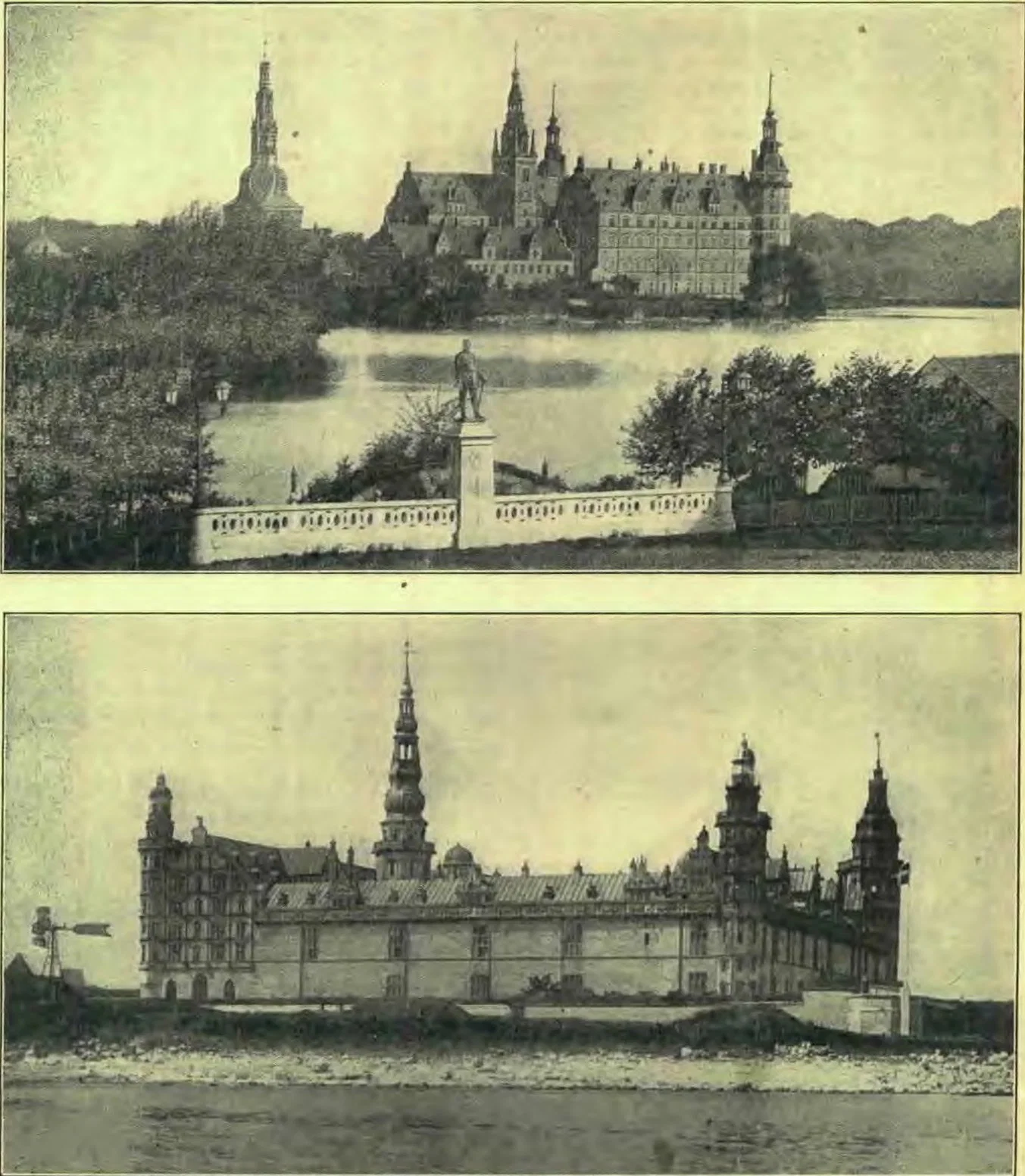
The upper building is the castle of Frederiksberg on the island of Zealand, twenty miles north of Copenhagen. The castle is now a national museum, and the former royal garden a public park. Frederiksberg was built before the pilgrims landed in this country. The lower building is the castle of Kronborg, for many years one of the strongest fortifications in Europe. It is nearly three hundred fifty years old.

You have reached the end of this edition.

The Youth’s Instructor · Mar 4, 1919