When sin entered the world the sentence of death was pronounced upon all mankind. Rom. 5:12; Gen. 2:17. Immediately the plan of salvation was put in operation. John 3:16; Gen. 3:15. “And I will put enmity between thee and the woman, and between thy seed and her seed; it shall bruise thy head, and thou shalt bruise his heel.” These words were spoken to Satan. This may properly be said to be the first gospel sermon ever preached in the world. It is comprehensive. Analyzed it is as follows: “The woman” represents humanity. “Her seed” represents one of the human family. The singular pronoun “it” shows the seed to be one person. The pronoun “his” indicates the gender and shows the seed to be a man. Both pronouns refer to Christ. “Thou shalt bruise his heel” represents that Satan will temporarily take the life of Christ. The heel is not a vital part of the body. “It shall bruise thy head” represents that finally through the death on the cross, as a penalty for sin, Christ shall destroy Satan entirely and forever. Heb. 2:14; Eze. 28:18.
The Stronger Overcomes the Weaker
It is not possible for a weak man to overcome a strong man. Contrarily, the stronger naturally always overcomes the weaker. Luke 11:21, 22. Man was created a little lower than the angels (Heb. 2:6, 7), and is therefore of a weaker order of beings than that from which Satan came. It follows then that no mortal man, simply as man, could overcome Satan and destroy him. Based on this principle it would require a being of a higher order than Satan to overcome him. This is manifestly true. But who is greater than Satan? Satan as Lucifer was the covering cherub on God’s throne. Eze. 28:14. Only two stood above him in power, God the Father and God the Son. But the promise in Gen. 3:15 provided that the seed of the woman, a human being, should overthrow Satan. Plainly then there is indicated a union of God with man in order to effect Satan’s destruction. This is precisely the plan.
Union of Divinity With Humanity
God the Son took our nature (Heb. 2:16) and was born of human flesh and blood (John 1:14; Gal. 4:4). In prophecy he was called “Immanuel.” Isa. 7:14. Among other titles given him are, “The mighty God, The everlasting Father.” Isa. 9:6. Immanuel means “God with us” (Matt. 1:23), a union of divinity and humanity.
The Relationship of Christ to Man
Christ was the Son of God. John 1:29, 34. He was God. He was also man. 1 Tim. 2:5. The manner by which he became God-Man is an unfathomable mystery. 1 Tim. 3:16. On the part of humanity a new birth is necessary. “Ye must be born again” (John 3:7), not born of earthly parents, but heavenly. “That which is born of the Spirit is spirit.” John 3:6. Man must be born of the Holy Ghost into divinity, even as Christ was born of the woman into humanity. Again we are introduced to a great mystery. Col. 1:27.
The Mystery of Redemption Through Christ
This great mystery cannot be explained so as to be fully understood, but it can be experienced. John 3:8, 11. Through being born of woman Christ partook of humanity’s flesh and blood. Heb. 2:14. Through being born of the Holy Ghost man, in like manner, may partake of divinity. 2 Peter 1:3, 4. Once again, through this divine plan human beings may, as in the beginning, be the children of God, the “sons of God.” Luke 3:38; 1 John 3:1, 2; Mark 3:35; 2 Cor. 6:18; Heb. 2:11. Christ is called “the first-born among many brethren.” Rom. 8:29. He is therefore the elder brother of all Christians in the family of God. Jer. 31:1.
Fruits of the Spirit
By G. B. THOMPSON
The Holy Spirit—No. 19
Fruits of the Spirit
G. B. THOMPSON
FRUIT-BEARING is an important factor in the Christian life. “Trees of the fruit Lord” bear fruit unless they are dead. A living tree cannot keep from bearing fruit, a dead tree cannot bear fruit. Jesus says, “I am the true vine, and my Father is the husbandman. Every branch in me that beareth not fruit he taketh away: and every branch that beareth fruit, he purgeth it, that it may bring forth more fruit.” John 15:1, 2. While the husbandman may dig about us for a time if we do not bear fruit, yet if no fruit appears, there is but one thing that remains to be done; that is to cut us off as dead branches, and cast us finally into the fire. Cumberers of the ground will do well to reflect soberly on these solemn words.
But the Master does not leave us here in uncertainty. He tells us how we may bear fruit: “I am the vine, ye are the branches: he that abideth in me, and I in him, the same bringeth forth much fruit: for without me ye can do nothing.” The secret of fruit-bearing is in union with Christ. In the lives of those who so “abide,” there is seen, not a little but “much fruit.” The life is in the tree, and if there is a proper union between the vine and the branch, the sap of life will flow into the utmost twig. Apart from the Vine, we but wither and die.
The result of having a professed connection with the Vine and yet bearing no fruit, is illustrated in the barren fig-tree that Jesus cursed. The fig-tree had leaves, and thus had a pretentious appearance of fruit-bearing. It said to the hungry passer-by, “There is fruit here.” But when the Saviour looked for fruit, “he found nothing but leaves.” What a striking example of a vain, fruitless life! “And Jesus answered and said unto it, No man eat fruit of thee hereafter forever.” “And in the morning, as they passed by, they saw the fig-tree dried up from the roots.” Mark 11:13, 14, 20.
“It was, indeed, the very type of a fair profession without performance, of the hypocrisy which has only leaves, and no fruit. Such a realized parable could not be passed in silence by One who drew a moral from every incident of life and nature. ‘Picture of boastful insincerity,’ said he, loud enough for the disciples to hear,—‘type of Israel and its leaders; pretentious, but bearing no fruit to God,—let no fruit grow on thee henceforward forever,’ and passed on. They were to learn that profession without performance found no favor with their Master.”—“Life and Words of Christ,” page 378.
We should not forget that it is the Holy Spirit who diffuses the life of Christ among the members of his body. The “love of God is shed abroad in our hearts by the Holy Ghost.” It is the Spirit that “giveth life.” 2 Cor. 3:6. “It is the Spirit that quickeneth.” John 6:63. The fruit, therefore, which is produced in the life is “the fruit of the Spirit.”
The apostle Paul, writing to the church at Galatia, mentions some of the fruit of the Spirit which will be seen in the life of the believer. “But the fruit of the Spirit is love, joy, peace, long-suffering, gentleness, goodness, faith, meekness, temperance: against such there is no law.” Gal. 5:22, 23. This fruit cannot be produced in the life by merely making good resolutions nor by studying the rules of ethical culture, any more than sweet water can flow out of a bitter fountain or figs grow on a bramble-bush. There must be a new life, a new birth: “Except a man be born from above, he cannot see the kingdom of God.” John 3:3, margin.
The apostle Peter gives us a list of Christian virtues: “And beside this, giving all diligence, add to your faith virtue; and to virtue knowledge; and to knowledge temperance; and to temperance patience; and to patience godliness; and to godliness brotherly kindness; and to brotherly kindness charity.” 2 Peter 1:5-7. Then he adds that if these things be in us, we shall be neither “barren nor unfruitful.”
The graces here referred to are the fruit or outgrowth of the Spirit in the life. The apostle Paul begins with love;16Peter ends with this. The apostle Peter seems to dwell more on the process of growth, by which the fruit of the Spirit is brought to perfection in the life. The Christian life is a growth. “But grow in grace, and in the knowledge of our Lord and Saviour Jesus Christ.” As another has said, “Such is the process through which the Spirit brings us: blossom, berry, fruit, ripeness, vintage,—‘complete in Christ.’”
Again the apostle says, “For the kingdom of God is not meat and drink; but righteousness, and peace, and joy in the Holy Ghost.” Rom. 14:17. Here the spiritual kingdom of God is defined. The principles of this kingdom are implanted and perfected in our lives, through the power of the Spirit of God. Here is found what the soul in its struggles with the forces of evil longs for,—righteousness, peace, and joy. How the heart of the Christian longs after purity, peace, and happiness. In every life there are starless nights; there are times when we are tossed on the billows of Adria, when neither sun, moon, nor stars in many days appear; when friends seem few and cold, and hope appears to mock us. There are landscapes with somber hues; there are times of bereavement and affliction, when we sit in the region and shadow of death and anxiously long for the breaking of the morning and the lifting of the clouds. But the Spirit of God brings peace and joy to the heart. It brings a peace whose tendrils twine around the everlasting Rock. “Peace is love reposing. It is love in the green pastures; it is love beside the still waters. It is that great calm which comes over the conscience when it sees the atonement sufficient and the Saviour willing.” It keeps the soul serene in the midst of poverty and distress.
The Spirit brings love into the heart. Love is a wonderful power. It brought the Saviour from heaven to die for an ungodly race. It has strengthened the martyrs to face the rack, the fagot, and the wild beasts in the arena. Weak and timid women have faced the Numidian lions in the Colosseum for the love of the Master. It strengthens the feeble mother to watch uncomplainingly through the long vigils of the night by the bedside of the sick child. At a great coal-mine disaster, where a number of miners were entombed, an aged and feeble man was seen approaching with a shovel. He began to dig at the mouth of the mine. When remonstrated with, he said, “Let me alone, I have two boys down in this mine.” Love in the heart of this aged father strengthened him to make a superhuman effort.
The peace which the Spirit brings into the heart is not a stagnant peace, where the malaria of doubt and discontent find a breeding-place. It is of a different kind. “O that thou hadst harkened unto my commandments! then had thy peace been as a river, and thy righteousness as the waves of the sea.” Isa. 48:18. It is the peace of motion. It flows on and on, like an Amazon, with its banks green, and bearing on its bosom the burdens and sorrows of humanity.
An arctic explorer is said to have been moved to tears by finding a solitary violet blooming beneath an iceberg. So with those in whom the Spirit abides. Even in the most unlikely places, amid poverty and sickness, in the slums of the great cities, amid papal corruption and apostasy, among the very icebergs of sin, through the power of an indwelling Spirit, there may bloom forth in us the beauty and perfume of a Christian life. It is our continual privilege to walk “in the fear of the Lord, and in the comfort of the Holy Ghost.” Acts 9:31.
1. An ancient book was a scroll; part was rolled and sealed, then another part was rolled and sealed. The number seven denoted a complete thing.
2. The “seven seals” deal with prophecy, even as do the “seven churches.”
3. The first three seals covered the same time as the first three churches.
Color of the horses.
1. White signifies purity and truth. Going “forth . . . to conquer” indicates an answer to Christ’s command to preach the gospel to all the world.
2. Deepening color, from white to red, and then to black, denoted an increase of error and corruption, and consequent persecution. The professed church early began to adopt wrong doctrine, superstitions and heathen practises, and worldliness.
3. The oil and the wine represent the graces of the Spirit.
The third seal, from Constantine to 538 A. D.
1. During this time pernicious errors were fostered in the church, symbolized by a sword, a balance, and measures of grain.
2. Constantine united the church and the civil power. The bishop of Rome now first spoke with authority. The first Sunday law was passed by Constantine in 321 A. D.
3. Under this seal the “mystery of iniquity,” which began its work in Paul’s day, grew from babyhood into the full stature of “that man of sin,” and, like a living statue, was ready to be “revealed” to the world. This took place in 538, when the fourth seal opened.
The fourth seal, the supremacy of the Papacy.
1. The Papacy is a close and not a clumsy counterfeit of the true. It has beautiful churches, adorned with exquisite sculpture and paintings by such artists as Michelangelo and Raphael, while its music is entrancing. The ceremonial is imposing, the vestures of those officiating are of purple and scarlet and gold. Everything is calculated to captivate the senses, to awe the credulous and bind them in despotism of body and soul.
2. The spirit of the papal system is self-righteousness and intolerance. True religion is meekness; faith in God, and love.
3. In the Catholic religion manhood is degraded by human confessionals and penances, and life is full of unscriptural fears. In the religion of Christ there is a happy sense of sins forgiven, comfort, and peace.
The fifth seal.
1. A change came. Millions had gone down, and were still going to a death attended with deadly hate, shame, and disgrace. The great Reformation of the sixteenth century dawned, and righteousness by faith began to clear away the heavy mists of error and superstition. As the characters of the martyrs were seen in clearer light, “white robes were given unto every one of them.” Rev. 6:11.
2. Their blood cried from under the altar on which they had suffered, as Abel’s cried from the ground.
3. The “little season.” Many still suffered from Roman cruelty. Doubtless others in the future will feel the hate of the beast and his image.
The sixth seal.
The language of the sixth seal is literal, while that of the preceding seals is symbolic. The reason is that prophecy could not be understood till the sixth seal was opened, and current history verifies prophecy.
Three wonderful signs of Christ’s coming under the sixth seal:—
1. The Lisbon earthquake. Lisbon had one hundred fifty thousand inhabitants; ninety thousand perished in this earthquake of Nov. 1, 1755, crying “Misericordia! the world’s at an end!” Mountains were shaken as if from their foundations.
2. The darkening of the sun and moon. Christ told his disciples that this would take place in the days of papal persecution, after the persecution had ended. Mark 13:24. The days extended to 1798, but their tribulation ended in 1773, with the suppression of the Jesuits in papal countries. This fixes the dates under the sixth seal with mathematical precision.
3. The falling of the stars. A stupendous shower of stars (meteors) fell Nov. 13, 1833. Mark 13:25. All these signs were believed at the time they were witnessed to be precursors of the judgment-day. But their real bearing on the second advent was not perfectly understood until they had all been seen. Christ said, “When ye shall see all these things, know that it is near, even at the doors.” Matt. 24:33, “This generation shall not pass, till all these things be fulfilled.”
Duty and Freedom
By George Macdonald
A MAN must do his duty, if he would be a free man, whether he likes it or not, and whether it is appreciated or not. But if he can regard it as the will of God, the work not fallen upon him by chance, but given him to do, understanding that everything well done belongs to his kingdom, and everything ill done to the kingdom of darkness, surely even the irksomeness of his work will be no longer insuperable.—George Macdonald.
A Glimpse Into the Village of Shahhad
By M. D. Wood
M. D. WOOD
WHEN we first came to Kalyan, India, to live, we wondered where we could get good fresh milk for our use. A neighbor said an old woman from a near-by village brought most excellent milk right to her door every day, and she thought this woman would also supply us. I thanked her, and said I should be on the lookout for her.
In a day or two, a quiet-looking, timid old heathen woman presented herself at my front door. I wish I had her picture to show you. She had on a jacket with short waist and sleeves. Her dress was of dark green, and was tied up about her hips. She had on her wrists a few glass and brass bangles, and an old chain and other native ornaments about her neck. On her head she had a large brass milk-pot, or dota; and in her hand she carried her small brass cup with which she measured the milk. I asked her how she sold it, and she said, “Two annas, or four cents, a seer.” I then asked her if she watered the milk, and she said “No.” (By the way, this is not cow’s milk, but pure buffalo’s milk.) So I agreed to take three seers a day. We boil the milk as soon as it comes, to kill any germs that may be in it; for buffaloes and other cattle often drink muddy water, and it would not be wise to use unboiled milk. In the morning we skim off the rich cream, and always have enough to supply our table with fresh butter.
This same milkwoman sometimes brings us eggs also. One day I gave her a few bananas to eat, and that greatly pleased her. At another time I gave her a large English tomato. Soon she began to bring us eggplants and other green vegetables, and so a friendly feeling has grown up between the old milkwoman and us. She is a poor heathen, but she has a sympathetic heart, and can feel that we are interested in her and her people. One day she brought her old mother to see us, and wanted us to examine her eyes. We did so, and told her that as she was so very old her eyesight could not be restored by the hand of man or drugs. One by one, this milkwoman has brought her son and daughter and other members of the family. She likes to get inside the front door and sit down in the corner and watch us at breakfast or while we have family devotions. She is always quiet and respectful. She thinks Mrs. Kelsey’s little white baby Cathlene is very beautiful, and Cathlene is not afraid of her. A few days ago the woman sat down in the corner and heaved a sigh. We asked her what was the matter. “Oh, my!” she said, “just look at my ankles.” They were badly swollen and were tied up with old rags. I examined them and found they were filled with Guinea-worms. I saw a portion of one hanging out of the flesh. These worms get into the flesh from the drinking of bad water. This is a very common trouble among many classes of people at Kalyan, and we have many such cases at the dispensary.
For several days our milkwoman has not brought the milk, but has sent her daughter instead. So this evening Mrs. Wood, Mrs. Kelsey, and I went to the small village of Shahhad to see our old friend and neighbor. The village road was too rough for our horse and carriage, so we left them and walked across the fields. We saw two small Hindu boys driving home their leisure-loving buffaloes. They directed us to the village. It was just at dusk. We inquired the name of the old woman who brought the milk to our house, and they said she lived on the other side of the village. So on we went, passing by the temple in the center of the village, around which was gathered a group of men and boys. The temple lamps were burning and smoking and gave a dismal appearance and horrid odors. Dumb idols are found in each village, with their devotees sitting about. The people know no better.
At length we came to the home of our friend and patient. We asked if we might enter, and receiving the reply, “Hoy” (meaning yes), we went in. It was merely a barn with a whole row of bullocks, cows, and buffaloes, all tied to a long pole. Just in front of them, stretched out on a cot, lay our milkwoman. A small, smoking lamp without a chimney was brought in. The poor suffering creature turned over in bed, and in a low moan said, “Salaam. I am sick.” Then she asked how the baby was. We looked at her poor ankles, swollen and with worms protruding. She had a slight fever, and was too weak to sit up. We asked her if she would come to our dispensary for a few days, but she said she could not walk and they had no cart. Well, we soon told the neighbors who had carts that they must bring her, and they agreed. As we left, they presented us with two eggs, as a thank-offering. So to-morrow we expect to make a place for her at our dispensary. There we shall treat her and, with God’s blessing, cure her.
On our way out we stopped at the home of Mr. Nargogee, from whom we recently purchased land for our mission. His home was filled with people and cattle. Several women were grinding grain, and they said they were preparing for a great wedding. There they live right in with the goats, sheep, buffaloes, and cows. They can neither read nor write.
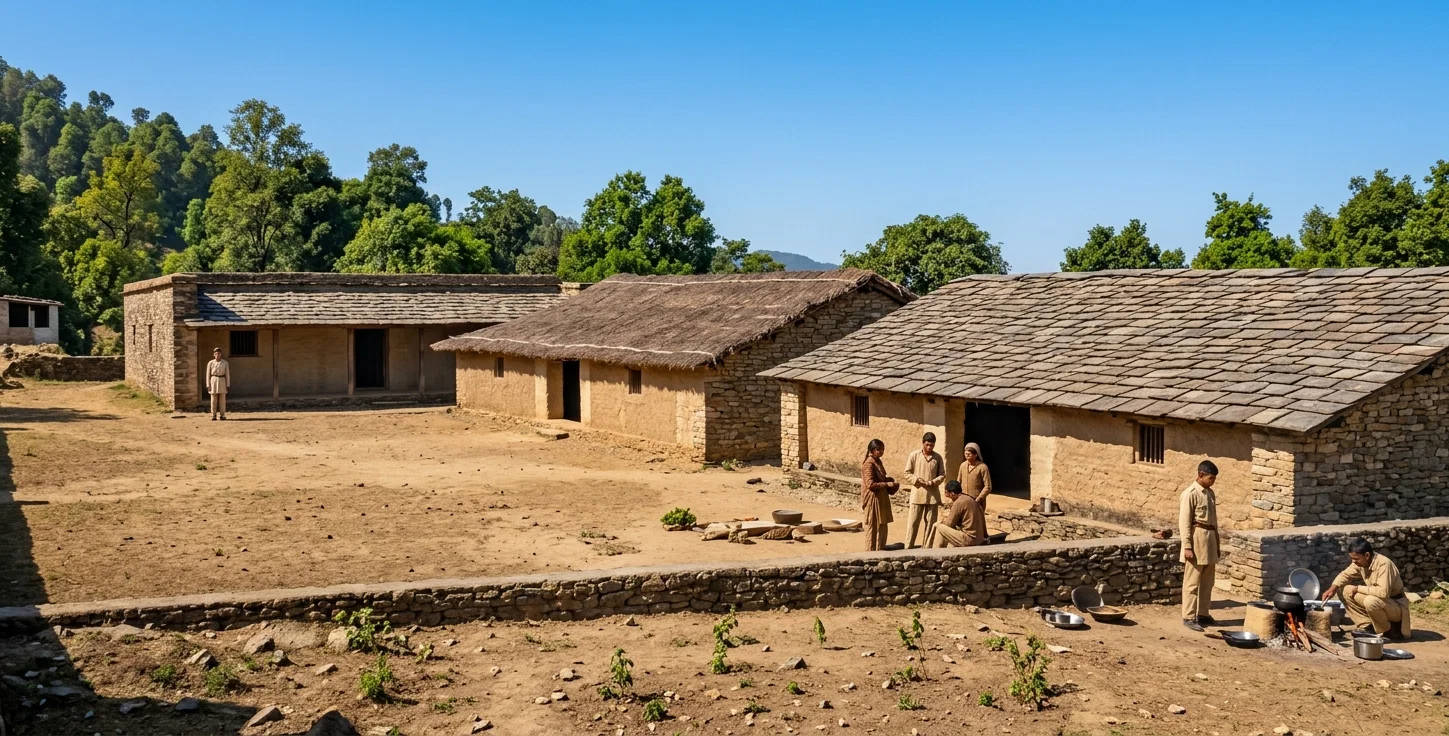
DORMITORIES AND COOK-HOUSE OF THE GARHWAL SCHOOL IN THE HIMALAYAS
They have homes and enough to eat and wear. They fall at the feet of huge stones, believing them to be gods. This is heathen Hinduism, and after hundreds of years no advancement, no improvement, has been made. We cannot read to such a people; they would not come to listen, and are not used to book language. We can not preach sermons to them; they would not like that. But we can minister to their sick and show them the love of Christ. We hope to instruct their children and reach a few of them. It will take a long time to bring them to a state of what we call civilization. Yet Christ died for them, and they need him.
Please pray for the villagers of Shahhad, and also pray for your representatives who try to teach these people of Christ their Saviour.
Nothing Is Drudgery
“NOTHING is drudgery to the one who submits to the will of God. ‘Doing it as unto the Lord’ is a thought that throws a charm over whatever work God gives him to do.”
The Zapotecan Indians of Southern Mexico
By G. W. CAVINESS.
It is well known that when Mexico was discovered there were a number of different tribes of Indians, and although most of them have amalgamated more or less with the Spaniards, yet some of the tribes retain much of their tribal characteristics.
In the state of Oaxaca, especially in the southern part, there still exists a remnant of the Zapotecan tribe, said to number about one hundred thousand. They are civilized, but retain the use of their primitive language in the family, though in business and in the schools the Spanish is used.
They live in villages, and the land round about the village is held in common. Each family chooses a location in the village and builds a house, which is very primitive indeed. Poles are set in the ground at the corners and at convenient distances apart along the sides, and on these are placed beams which support the thatched roof made of palm-leaves. The walls, formed of small poles and twigs interwoven, are plastered with mud and then whitewashed. Usually there is no floor but the earth. Here they live; but each one goes outside the village and chooses a small patch of ground which he clears up and cultivates. This is his as long as he uses it, but he has no permanent title.
As a rule, the people are rather tall, strong, and well-built. Since their country is in the hot lands, their clothing is rather scanty and simple. The men wear cotton trousers and shirt, go barefoot, or perhaps wear sandals. The women also dress simply, though in the city of Tehuantepec they have a special costume consisting of a blouse, very high-colored, which leaves the arms entirely bare; the upper part of the skirt is usually of dark colors, but from the knee down it is pure white. The head-dress reminds one of a peacock’s tail, except that it also is pure white. It is spread out over the head, standing out in all directions about a foot, in a semi-circle. It is a sort of bonnet with a stiff ruffle. The whole dress gives the wearer a striking appearance. This is said to be the dress of the belles of the place, so of course is not worn by all.
The people, as a rule, are honest and serious, and religiously inclined. I have never seen people who would sit and listen to the preaching of the gospel with greater interest and attention. They seem to drink in every word, and at the close of the sermon nearly every one, whether a church-member or not, will give assent with a hearty “Amen.”
This people generally lead the simple life, and while they can not be called progressive, yet they do take considerable interest in education, some of them being quite well informed. In their own language they have scarcely any books, and the prediction is made that the language will die out in the near future. They are not much given to amusements. The principal entertainment, which doubtless they received from the Spaniards, is cock-fighting.
Their furniture is very rude and simple. The beds are pieces of tent cloth, each stretched between two poles, on crossed legs like a sawhorse; this, with pillow and sheet, is all one needs. The rest of the furniture consists usually of a few chairs, a table, and a few boxes set up on benches, in which they keep their clothes. While these articles of furniture are simple-looking objects, yet when one attempts to lift them, he finds they are very heavy. On asking what they are made of, he is told Caoba (mahogany). At times pieces of wood used as fuel for cooking will be found to be of this material. Think of using mahogany for cooking beans and tortillas!
From September to March the weather is pleasant, but the rest of the year it is warm. In some places, they tell me, it is even necessary to wrap the body in a wet sheet in order to be able to sleep.
Although these people appear so sober and even stoical, yet they are tender-hearted and affectionate. When one comes into close relationship with them, they are found capable of warm affection. Nowhere in the republic is the fraternal embrace given with a more hearty good will. Our work has made a good beginning in this tribe. We have four companies and about fifty or sixty believers, about forty of whom are baptized. There does not seem a more promising field in all the republic than this tribe presents. May the Lord raise up men and means that soon all the honest-hearted among them may hear the message God is sending the world in these last days.
G. W. CAVINESS.
A Word of Appreciation
By Esther M. Boardman
THE dear REVIEW AND HERALD has been a constant visitor in my home for twenty-five years. During this time the paper has been worth more to me than I can tell. Often I have thought of writing to tell you how much I appreciate the timely instruction and words of admonition and encouragement that are given from week to week. Frequently, as I open the paper, my eyes rest upon words which fill a longing in my heart and seem to have been penned purposely for me. Surely all our people should take this excellent church paper. I do not see how they can keep in touch with the rapid progress of the message without it. We are truly living in the closing hours of earth’s history, and Jesus is coming very soon.
ESTHER M. BOARDMAN.
Fish River, Rhodesia, South Africa
By Janet H. Ryan
It was just one year ago yesterday that I wrote my first report on our arrival at this mission two days previous. I have been thinking of the year just past, and all that it has meant to us, and I should rather be at Maranatha or with the wagon in Kafirland than in any other place on earth, were I in health. I never was in a place where I felt the need of consecrated physical and spiritual strength more than here. And as we watch the lives of these people at this out-station, and see the improvement since eleven months ago, our hearts yearn for the other kraals which surround us and are yet in darkness.
One old man of whom I wrote once before, arose in the last meeting before we left, saying, “I’m only a poor Red Kafir, an old man, but I want to know God.” Well, thanks to the Holy Spirit, this poor Red Kafir became acquainted with God, and was one of the fifteen who were baptized at the mission a few weeks ago. Now his face shines with the light of God. One other man who could scarcely leave his old black pipe sufficiently long to come to one of our meetings, was also among the fifteen; and yesterday as I went into the hut where others were lying and sitting all about him with their pipes and he sat with none, I thought, “O, the wonder of God’s power!” All about us we see the results of Brother Faba’s faithful service here, and at almost every meeting some refer to his work as the cause of their being present.
Mr. Ryan is now sitting outside talking to a company of men who have just come; among them the sobanda, who says he wishes baptism. On Sunday Mr. Ryan went six or eight miles from here to hold meetings. About twenty-five blanket natives were present, besides the converts. The following day a letter came from the sobanda there, asking Mr. Ryan to come again next Sunday for meeting and to talk about opening a school for his people. So we see how God is working; and seeing this, we say to ourselves so many times, We must work now with energy.
JANET H. RYAN.
Work Along Fish River
By R. G. RYAN
We had a rather strenuous time at Fish River. The heat was intense. The river is dried up, except for pools here and there. There is no water at the out-school except what is carried from these pools in the place where the river should be. Fortunately, we took a supply of water from the mission, but on the trips to the outlying kraals there was nothing to do but drink this stagnant water. We stayed at the river two weeks, and during this time we held just thirty-three meetings. We should have held more, but the weather was very trying. As it was, Mrs. Ryan and I came within a hair’s breadth of having sunstroke. We got as far as the river when we were both taken violently ill. The following morning the oxen came from the mission and brought us home.
Our rain has come at last, for which we are truly grateful. If it had delayed much longer, our crops would have perished.
There is a good interest along Fish River, which, with earnest labor, must yield fruit. I had a letter from the head man of the location farther on. He is desirous of having a school, but we have no one to send. R. G. RYAN.
West Africa
By J. E. HARTLEY
FREETOWN.—The week of prayer has been to the little flock over here in Freetown, West Africa, a source of encouragement, a fountain sweet and refreshing to satisfy the panting, thirsty heart’s desires. From the very day of its announcement, hearts began to prepare for the week of prayer. The meetings were attended with increasing zeal each evening. The attendance was steady and some visitors met with us. Following the plan and instructions given, the readings were conducted by brethren and sisters who were informed and had ample time to study the readings before presenting them. Even the children were brought in touch and communion with the Saviour.
Sister Myers had charge of the children’s lessons. Greater showers fell on us at each meeting, until the last day when each heart was really touched to confess the goodness of the Lord and to renew the vows of consecration. This meeting was conducted by Elder D. C. Babcock, who had just returned from a missionary tour through the protectorate. He brought us words of encouragement, telling how the message was making its way in the hinterland. The experience of this day will never be forgotten. When he put the question, Who among the congregation is willing to follow the principles and teachings of the third angel’s message? in response all, both young and old, arose. Tears were shed and the Lord blessed us. All felt the need of praying, and many had the chance to do so.
Throughout the week the prayers were fervent and earnest, and we realize that they have accomplished much for us. They have lightened and eased our burdens; they have filled our hearts with joy and comfort; they have awakened us on our watch, and have brought the second appearing of the precious Saviour near to us. We felt like repeating the experience recorded in 2 Chron. 20:23, where it says, “And the whole assembly took counsel to keep other seven days: and they kept other seven days with gladness.” The readings afforded us great help. The harvest is white in West Africa, and we beseech our good brethren in America to pray for us.
J. E. HARTLEY.
First-Fruits in West India
By GEO. F. ENOCH
MARCH 29 and 30 were red-letter days for the work in west India. After about five years of labor in virgin territory it was our privilege to see the first steps taken toward organizing a church in this part of the vineyard.
Elder and Mrs. J. L. Shaw stopped on their way to the General Conference. After a sermon Sabbath morning on church organization, seventeen Europeans and Eurasians signed the church covenant as the first step toward the organization of a Seventh-day Adventist church in Lonavla. After this service thirty believers gathered round the table of the Lord in the communion service, and he graced our assembly with the sense of his presence that brought joy to our hearts. One of these new members has been trained as a canvasser, and has had very good success in the city of Bombay with “Heralds of the Morning.”
The next day the same scene was repeated at our mission station at Kalyan. Fourteen native brethren and sisters signed the covenant, and we had our first communion service with the Marathi people. The ordinance of humility was quite new to them, but the Lord drew very near and all our hearts were melted in tender love one for another.
We feel now that we have crossed our Rubicon in west India, and look forward into the future with hope. We shall proceed with the instruction necessary and organize these two churches, one for the English people at Lonavla and the other for the Marathi people at Kalyan, before the next quarterly meeting.
One of the sisters baptized is an Indian lady who has done service for ten years in the court of one of the ruling princes of India. She now goes to be the companion to the wife of the heir apparent of the throne of Kashmir. She expects to take up the circulation of our good books and other literature among the ruling princes of India, a work for which she is eminently fitted, and for the prosecution of which she will have the most unique opportunities.
Both our school work and our medical work in the two mission stations are progressing favorably. We have about one hundred fifty children in the schools, and Mrs. Wood had nearly nine hundred patients at her dispensary last month, which was only the third month of its operation. She took in about twenty-five dollars in fees. We are looking for definite fruit from our effort this year.
One very encouraging feature of our work is that it is the higher castes that are putting their children in our mission schools and inquiring into Christianity. Many of the missions operating in the Marathi country have been unfortunate in filling up with the low-caste people to such an extent that the mold that has been put on their work has made it hard for them to do adequate work for the high-caste people. We by no means pass by the low caste, but the Lord is opening the hearts of the higher castes, and if he will give us our first converts from them it will put a stamp on the work that will be for its future good. A young Brahman is now studying with me here in Lonavla, and there are several bright young Brahmans who we hope will soon take their stand with us.
The workers in west India are all of good courage, and are unitedly pressing the battle to the gates. We ask an interest in your prayers.
GEO. F. ENOCH.
A Journey to Tashkent
By G. PERK.
AFTER visiting some of our people in the government of Simbirsk and holding meetings in Samara, I started on my journey to Tashkent on October 20. It was a very comfortable journey. The cars were quite clean, and I had to change only once, so I used the third-class compartment. After a few days’ journey we were in the midst of the wilderness. The land looks just like the waves of the sea for hundreds of miles, nearly as far as Tashkent itself. I arrived there October 24, and was met by Brethren Ebel and Kurbatow. It seemed quite strange to me; for here the people were working in their gardens, and the weather was comfortably warm, whereas at Saratof the thermometer registered several degrees below zero. We have only a few members in the town, besides the families of our workers, but there are several who are interested in the message.
On Sabbath we visited a German village, about twenty-nine verst away [eighteen miles], named Konstantinovka, where we have a little church. We held a meeting in the morning, and celebrated the Lord’s Supper in the afternoon; we also held a public service in the evening, which was attended by several strangers.
Sunday morning we started on our way to Orlof, where we visited our people. It took a whole week to reach them, our only means of conveyance being a team. We were glad that it had just rained (this was the first rain since May), so that the dust was not bad. Sometimes one cannot see even the horses’ heads from the wagon. At night we generally stayed with a Kirghiz or Sarten family, although we preferred to sleep in our own wagon, as we felt safer there.
Thursday, October 31, we arrived in Orlof. Brethren Otto and Trippel were kind enough to come about forty-five miles with their spring wagon to meet us. We were able to hold well-attended meetings every evening for a week in a school building. We baptized two sisters in the pretty river there. After we had celebrated the ordinances of the Lord’s Supper, we returned to Tashkent.