Your ShelfYour Projects

Signs of the Times, Vol. 36, No. 29.

Comfort Ye My People

Signs of the Times

Jul 28, 1909

Pacific Press Publishing Association · Mountain View, California · Jul 28, 1909

“Comfort Ye My People”

(SPURRELL)
Wherefore then sayest thou, O Jacob, And wherefore speakest thou, O Israel, My goings forth are hidden from Jehovah, And my cause is unregarded by my God? Hast thou not understood, hast thou not comprehended, That Jehovah, the everlasting God, The Creator unto the extremities of the earth, Fainteth not, neither is wearied, That His understanding is unsearchable? He giveth sinew unto the weak, And unto the powerless He multiplieth strength. Even the young men shall faint and be weary, And the applauded youths stumbling shall fall; But they who trust in Jehovah shall renew their strength; They shall arise on the wing like unto the eagle; They shall run swiftly and not be wearied; They shall proceed onward and shall not faint.

OUR BIBLE BAND

Question Corner

[To Our Inquirers.—(1) The name and address of all who ask questions must accompany questions, not necessarily for publication, in token of good faith, and that we may reply by letter if thought best. All communications will be considered confidential if so desired, and no name will be published unless requested. But we have no time to give to anonymous or unsigned epistles or articles. (2) Let the questions be to the point. Do not say, “Explain Josh. 7:1-8,” but state the thing upon which help is desired. (3) Questions can not be answered immediately in this department. Sometimes it will mean a month or more of waiting. We can not reply to the same question frequently. Read answers to other questions; you may find reply to yours. (4) Members of the Bible Band will kindly enclose stamp if answer is desired by letter. Others will please enclose ten cents. This does not begin to meet expenses oftentimes. (5) “Foolish . . . questions avoid.”]

2898.—The Apostles and the End of the World.

Why did Paul and the other apostles in their day say that the end of the world was at hand, and that they were living in the last days? How long has it been since the end of the world has been said to be imminent? B. B. No. 1600.
Answering the second question first; it may be said that the “last days” included the entire Christian dispensation from the apostles’ days until the Lord shall come the second time. This, of course, in a broad sense. They must however include the very last day, for we could not speak of last days unless the last day was included.
Secondly, the apostle Paul and others wrote not only for their own day, but for all time. Their writings were to be for the whole Christian dispensation until our Lord should come the second time. They therefore gave meat which would be food in season at every stage of the earthly career of the church. It was for the church itself, living in the light, to understand when these truths were applicable by the prophetic word, by the revelation of God, and by the conditions and environments of the church. This would be clearly seen by the spiritual minded, and preached by the servant of God who would bring forth from the treasure-house of the word, things new and old.
So God spoke by His ancient prophets as tho the events predicted were to occur in their own day. Take the prophecies of Daniel, for instance, which the prophet himself desired to understand (See chapter 12), but which the Lord tells him will not be understood until the time of the end. Read also 1 Peter 1:10, 11. That the apostles did not believe that Jesus was coming in their day is evident from the apostle Paul’s epistle to the Thessalonians. In the first epistle every chapter speaks of the second coming of Christ. The brethren at Thessalonica seemed to obtain the idea that Christ was coming in their day. This the apostle corrects in his second epistle, saying that they should not be moved or alarmed at any word that he should write or epistle that he should send that the coming of Christ was at hand. For that day would not come until the falling away came and the apostasy itself was revealed. See 2 Thess. 2:1-3.
The end of the world may be said to have been imminent from 1830 and onward. There have been times when mistaken people have believed that the coming of the Lord was at hand in past centuries, but the prophecies have been focused upon this last generation, and the doctrine based upon the prophecies of the word of God began to be preached in all the world—1830 and onward. Now we may know that He is near, even at the doors.

2899.—The Worm That Dieth Not.

Will you give me some light on the worm that does not die, as mentioned in Isa. 66:24; Mark 9:48. T. S. S.
The term “hell” in Mark 9:43-48 comes from the Greek word Gehenna, and that from the Hebrew Valley of Hinnom, south of Jerusalem, called also Tophet or Topheth. See Jer. 19:2, 6, 11, 12. This valley, says Bagster’s Greek Lexicon, was “once celebrated for the horrid worship of Moloch, and afterwards polluted with every species of filth, as well as the carcasses of animals, and dead bodies of malefactors, to consume which, in order to avert the pestilence which such a mass of corruption would occasion, constant fires were kept burning.” Isa. 66:24, it will be noticed, speaks not of live men upon which worms feed, but the carcasses, or dead bodies of men. See Isa. 37:36, where the Hebrew word is rendered “corpses,” and Jer. 31:40; Amos 8:3, and other places where it is translated “dead bodies,” which is what the word everywhere means. The terms “undying” and “neither . . . be quenched” simply indicate that these agents of destruction will not cease until they do their appointed work; for the worm shall eat them up (Isa. 50:9; 51:8), and the fire shall burn up the chaff (Matt. 3:12; Mal. 4:1; Rev. 18:8). For an instance of this use of unquenchable fire see Jer. 17:24-27 and 2 Chron. 36:19, 21. The former text declares that if the Jews would not observe the Sabbath, the Lord would kindle a fire in her gates which should not be quenched. In the latter it states that this fire “burnt the house of God,” and “burnt all the palaces thereof with fire,” “to fulfil the word of the Lord by the mouth of Jeremiah.” The “undying worm” and the “unquenchable fire” are symbols of utter and complete destruction. These arguments will likewise apply to Mark 9:43-48. Gehenna, as Wilson remarks, “symbolizes death and utter destruction, but in no place signifies a place of eternal torment.”

2900.—Oleomargarine.

Will you kindly tell me if oleomargarine is a pure food, good for hygienic people to use? Is there lard in it? H. H.
Oleomargarine is made up from oleo, a product of beef fat and lard. So far as we know all oleomargarine is a combination of beef fat and lard. Different manufacturers have their own formula, but these elements enter into it in the different combinations of them all. Doubtless there has been a great deal of lard eaten for butter. Now that the pure-food laws are in force, those who eat in restaurants or hotels may be able to know better whether they are eating dairy butter or oleomargarine. We would say that after the mixture is completed it is generally put through a process in connection with milk, buttermilk, or some milk product, to give it more of the taste and appearance of butter.

No. 2901.—“Became as a Jew.”—K.

You have evidently misunderstood the expression of Paul, “To the Jews I became as a Jew.” He did not mean by that that he compromised truth in any way, but made himself as one of them, in sympathy with them. Just as missionaries in going into a new country ought not to hold themselves off as one of another and superior nation, but become one with the people. This does not imply yielding to unholy customs or practices in any way. He should make them feel however that he was there to help them and was one with them. Not so with Peter when he was blamed by Paul. He really was compromising the truth by hiding the Gospel and separating himself from the Gentiles.
How do you get around the fact that it seems improbable that Dan. 9:24-27 is an explanation of the vision of Daniel the 8th, when the 8th chapter vision was given fifteen years before the 9th chapter vision, when there is no hint in Daniel’s prayer (9:1-22) or Gabriel’s expounding the vision, of such a thing? How do you account for these two things? What year was the third year of the reign of Belshazzar? Was it B.C. 553? Are there tablets to prove that Usher is wrong here? J. G.
We answer both together. There is no fifteen years between the two chapters. Usher is wrong. He supposed that Nabonadius, the last king of Babylon, mentioned in the records of history that came down to him, was identical with the Belshazzar of the Bible. If that were the case the third year of Nabonadius was in 553 B.C. This did not satisfy all Bible students. It was suggested by one devoted man that there must have been a second ruler in Babylon, intimated in Belshazzar’s promise to Daniel. Belshazzar promises Daniel, if he will read the writing, that he would be the third ruler in the kingdom. This implies a second ruler. Belshazzar was the second. There must have been a first. This was revealed in the tablets. One of the tablets records a prayer written by Nabonadius for Belshazzar his son whom he had associated with himself in his kingdom. Belshazzar reigned but three years and in the third year of his reign he was slain and Babylon was captured. There is also a tablet recording the capture of Babylon and the death of Belshazzar or the son of the king Nabonadius. Therefore the time between the vision of chapter 8 and chapter 9 is but a matter of a few months instead of fifteen years. You will note in the 8th chapter that the vision was explained to Daniel with one exception, and that was the time. Gabriel who was commissioned to make Daniel understand the dream did so as far as Daniel was able to bear it; and the angel explained all but the matter of the time when Daniel fainted. Daniel was still anxious to know the rest of the vision, and therefore his prayer. He seemed to have connected the seventy years of captivity with the vision to some extent and so he prayed for understanding. The angel who had been commissioned to make Daniel understand came again. That he had reference to the vision of the 8th chapter is clearly evident from the very first words to Daniel: “Therefore at the beginning of thy supplications the commandment went forth, and I am come to tell thee, for thou art greatly beloved; therefore, consider the matter and understand the vision.” Then, seventy weeks are cut off upon thy people, that is seventy weeks of the 2,300 days. This seems to us very clear indeed. If there is no connection between the chapters, then Gabriel left the vision of Daniel 8 unexplained and there is no pertinency to the words of Gabriel as he meets Daniel the second time.

Schedule for Week Ending Aug. 7, 1909.

Morning Evening
Su. Aug. 1 Ps. 57, 58, 59 Rom. 4
Mo. " 2 " 60, 61, 62 " 5
Tu. " 3 " 63, 64, 65 " 6
We. " 4 " 66, 67 " 7
Th. " 5 " 68, 69 " 8: 1-21
Fr. " 6 " 70, 71 " 8: 22-39
Sa. " 7 " 72, 73 " 9: 1-15

Suggestive Notes.

Our morning readings for the week consist of Psalms 57 to 73 inclusive. It is impossible to even attempt an analysis of these songs of Israel. Some of them ought to be memorized that they might constantly abide with the Christian pilgrims of earth, that they may be sung along the way. Among these are the sixty-second, the sixty-fifth, and the sixty-seventh. Many of the psalms are expressive of David’s thankfulness in deliverance from trials, and are also typical of the greater David, whose Spirit inspired the psalmist. What a paean of victory is Psalm 68, prophetic of Christ in His triumph! Psalm 72 is entitled “the Psalm for, or of, Solomon,” but it also is prophetic through Solomon, of Christ. It will be noted that the seventy-third Psalm is a “Psalm of Asaph,” one of the great singers of Israel, mentioned again and again in Ezra; while the seventy-second Psalm closes what is called the second book of the psalms.
The evening readings are from Romans; beginning with Romans 4 and closing with the 15th verse of Romans 9—the wonderful and inspired argument for justification and life through our Lord Jesus Christ. From the third chapter the apostle has proved that all are under sin, irrespective of nationality, and he proceeds to show that Abraham received justification before he was circumcised, showing that ritualism, or mere human organization, had naught to do with his salvation. From that the apostle’s argument gathers force with every chapter until we come to the climax of his argument in the eighth chapter. “There is therefore now no condemnation to them which are in Christ Jesus.” The outworking of this life is shown in the trust that is taught in the closing verses of chapter 8. Then the apostle proceeds to present the true condition of Israel.

The Temple Cleansed

By Mrs. E. G. White
THE CLEANSING OF THE TEMPLE

Going Up to Jerusalem

“And the Jews’ Passover was at hand, and Jesus went up to Jerusalem.”
In this journey, Jesus joined one of the large companies that were making their way to the capital. He had not yet publicly announced His mission, and He mingled unnoticed with the throng. Upon these occasions, the coming of the Messiah, to which such prominence had been given by the ministry of John, was often the theme of conversation. The hope of national greatness was dwelt upon with kindling enthusiasm. Jesus knew that this hope was to be disappointed, for it was founded on a misinterpretation of the Scriptures. With deep earnestness He explained the prophecies, and tried to arouse the people to a closer study of God’s word.

Buying—Selling

The Jewish leaders had instructed the people that at Jerusalem they were to be taught to worship God. Here during the Passover week large numbers assembled, coming from all parts of Palestine, and even from distant lands. The temple courts were filled with a promiscuous throng. Many were unable to bring with them the sacrifices that were to be offered up as typifying the one great Sacrifice. For the convenience of these, animals were bought and sold in the outer court of the temple. Here all classes of people assembled to purchase their offerings. Here all foreign money was exchanged for the coin of the sanctuary.
The leaders demanded exorbitant prices for the animals sold, and they shared their profits with the priests and rulers, who thus enriched themselves at the expense of the people. The worshipers had been taught to believe that if they did not offer sacrifice, the blessing of God would not rest on their children or their lands. Thus a high price for the animals could be secured; for after coming so far, the people would not return to their homes without performing the act of devotion for which they had come.

Confusion Amidst Worship

A great number of sacrifices were offered at the time of the Passover, and the sales at the temple were very large. The consequent confusion indicated a noisy cattle market, rather than the sacred temple of God. There could be heard sharp bargaining, the lowing of cattle, the bleating of sheep, the cooing of doves, mingled with the chinking of coin and angry disputation. So great was the confusion that the worshipers were disturbed, and the words addressed to the Most High were drowned in the uproar that invaded the temple. The Jews were exceedingly proud of their piety. They rejoiced over their temple, and regarded a word spoken in its disfavor as blasphemy; they were very rigorous in the performance of ceremonies connected with it; but the love of money had overruled their scruples. They were scarcely aware how far they had wandered from the original purpose of the service instituted by God Himself.
The priests and rulers were called to be the representatives of God to the nation; they should have corrected the abuses of the temple court. They should have given to the people an example of integrity and compassion. Instead of studying their own profit, they should have considered the situation and needs of the worshipers, and should have been ready to assist those who were not able to buy the required sacrifices. But this they did not do. Avarice had hardened their hearts.

Pity and Mercy Lacking

There came to this feast those who were suffering, those who were in want and distress. The blind, the lame, the deaf, were there. Some were brought on beds. Many came who were too poor to purchase the humblest offering for the Lord, too poor even to buy food with which to satisfy their own hunger. These were greatly distressed by the statements of the priests. The priests boasted of their piety; they claimed to be the guardians of the people; but they were without sympathy or compassion. The poor, the sick, the dying, made their vain plea for favor. Their suffering awakened no pity in the hearts of the priests.
Christ saw that something must be done. Numerous ceremonies were enjoined upon the people without the proper instruction as to their import. The worshipers offered their sacrifices without understanding that they were typical of the only perfect Sacrifice. And among them, unrecognized and unhonored, stood the One symbolized by all their service. He had given directions in regard to the offerings. He understood their symbolic value, and He saw that they were now perverted and misunderstood. Spiritual worship was fast disappearing. No link bound the priests and rulers to their God. Christ’s work was to establish an altogether different worship.

Christ as Judge

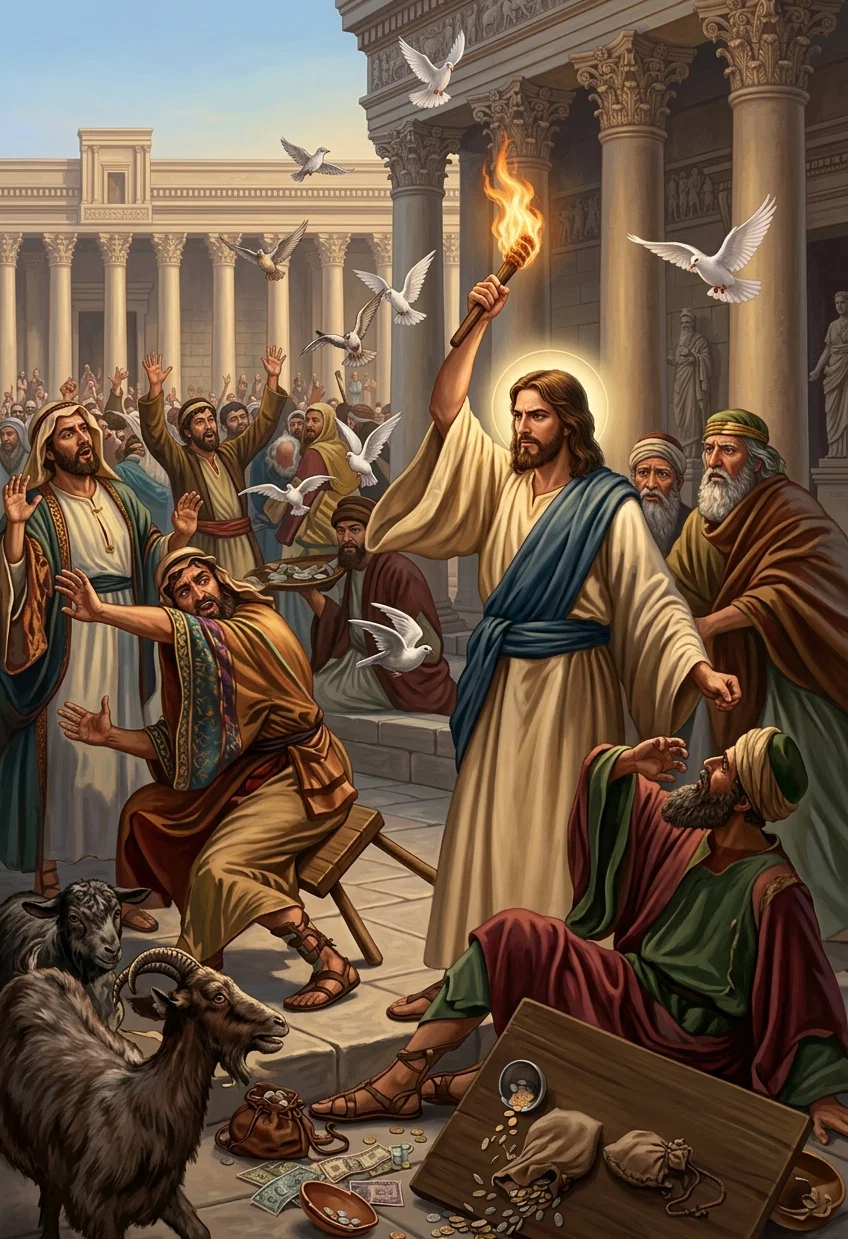
With searching glance Christ takes in the scene before Him, as He stands upon the steps of the temple court. With prophetic eye He looks into futurity, and sees not only years, but centuries and ages. He sees how priests and rulers will turn the needy from their right, and forbid that the Gospel shall be preached to the poor. He sees how the love of God will be concealed from sinners, and men will make merchandise of His grace. As He beholds the scene, indignation, authority, and power are expressed in His countenance. The attention of the people is attracted to Him. The eyes of those engaged in their unholy traffic are riveted upon His face. They can not withdraw their gaze. They feel that this Man reads their inmost thoughts and discovers their hidden motives. Some attempt to conceal their faces, as if their evil deeds were written upon their countenances, to be scanned by those searching eyes.
The confusion is hushed. The sound of traffic and bargaining has ceased. The silence becomes painful. A sense of awe overpowers the assembly. It is as if they were arraigned before the tribunal of God to answer for their deeds. Looking upon Christ, they behold Divinity flash through the garb of humanity. The Majesty of heaven stands as the Judge will stand at the last day,—not now encircled with the glory that will then attend Him, but with the same power to read the soul. His eye sweeps over the multitude, taking in every individual. His form seems to rise above them in commanding dignity, and a divine light illuminates His countenance. He speaks, and His clear, ringing voice—the same that upon Mount Sinai proclaimed the law that priests and rulers are transgressing—is heard echoing through the arches of the temple: “Take these things hence! make not My Father’s house an house of merchandise.”

Driving Out the Offenders

Slowly descending the steps, and raising the scourge of cords gathered up on entering the enclosure, He bids the bargaining company depart from the precincts of the temple. With a zeal and severity He has never before manifested, He overthrows the tables of the money-changers. The coin falls, ringing sharply upon the marble pavement. None presume to question His authority. None dare stop to gather up their ill-gotten gain. Jesus does not smite them with the whip of cords, but in His hand that simple scourge seems terrible as a flaming sword. Officers of the temple, speculating priests, brokers, and cattle-traders with their sheep and oxen, rush from the place, with the one thought of escaping from the condemnation of His presence.
A panic sweeps over the multitude, who feel the overshadowing of His divinity. Cries of terror escape from hundreds of blanched lips. Even the disciples tremble. They are awestruck by the words and manner of Jesus, so unlike His usual demeanor. They remember that it is written of Him, “The zeal of Thine house hath eaten Me up.” Soon the tumultuous throng with their merchandise are far removed from the temple of the Lord. The courts are free from unholy traffic, and a deep silence and solemnity settle upon the scene of confusion. The presence of the Lord, that of old sanctified the mount, has now made sacred the temple reared in His honor.

Meaning of the Temple Cleansing

In the cleansing of the temple Jesus was announcing His mission as the Messiah, and entering upon His work. That temple erected for the abode of the divine Presence was designed to be an object lesson for Israel and for the world. From eternal ages it was God’s purpose that every created being, from the bright and holy seraph to man, should be a temple for the indwelling of the Creator. Because of sin, humanity ceased to be a temple for God. Darkened and defiled by evil, the heart of man no longer revealed the glory of the divine One. But by the incarnation of the Son of God, the purpose of heaven is fulfilled. God dwells in humanity, and through saving grace the heart of man becomes again His temple.

Soul Cleansing

“Know ye not that ye are the temple of God, and that the Spirit of God dwelleth in you? If any man defile the temple of God, him shall God destroy; for the temple of God is holy, which temple ye are.” No man can of himself cast out the evil throng that has taken possession of the heart. Only Christ can cleanse the soul temple. But He will not force an entrance. He comes not into the heart as to the temple of old; but He says, “Behold, I stand at the door, and knock: if any man hear My voice, and open the door, I will come in to him.” He will come not for one day merely; for He says, “I will dwell in them, and walk in them; . . . and they shall be My people.” “He will subdue our iniquities; and Thou wilt cast all their sins into the depths of the sea.” His presence will cleanse and sanctify the soul, so that it may be a holy temple unto the Lord, and “an habitation of God through the Spirit.”

The God of Answered Prayer

Stars that blaze across the sky, To the Christian’s sight; So the answered prayers stream by, Flooding him with light.
How they gleam, and glow, and shine— Wondrous answers all; Every one a special sign For a special call!
Looking back o’er life’s long way, Christians show their power! Answered prayers for every day And for every hour.
— Anon.

God Goes With Us

WHEN God says, “Come,” He goes out to meet us; when He says “Go,” He goes with us.—A. E. Lawrence.

The Home-Coming

There are few joys greater than that of the forgiveness that comes after “owning up.” And there is no torture worse than that which comes from a conscious sin, committed in rebellion against God’s laws and God’s love, which is held on to and unconfessed. We may live in either of these conditions, as we will,—heaven or hell; and every one lives in one or the other state, tho he may not yet realize it. The more that one has experienced of the joy of living in conscious fellowship with God, the keener is the agony of conscious and self-willed separation from God. A man who, as the rule of his life, was so true to God that his heart was said to be perfect, or complete, before God, because of this very record and privilege felt the tortures of deliberate and unconfessed sin so keenly that he cried out,
“When I kept silence, my bones wasted away Through my groaning all the day long. For day and night Thy hand was heavy upon me: My moisture was changed as with the drought of summer.”
And when he had confessed his sin and had been restored to his place before God, he poured forth, in that same thirty-second psalm, a song of joy and thanksgiving that has never stopped sounding through the ages, and that never will stop while sinners leave their sin to return to an all-forgiving Father. Therefore “for this let every one that is godly pray unto Thee in a time when Thou mayest be found.”—S. S. Times.

The Lord’s Day

JOHN was “in the Spirit on the Lord’s day.” Rev. 1:10. There are many who believe the Lord’s day to be the first day of the week. But where did we ever learn that the Lord’s day was the first day of the week, commonly called Sunday? But the Bible says, “The seventh day is the Sabbath of the Lord thy God.” Ex. 20:10. Whose day is it?—The Lord’s day. “Thou camest down also upon Mount Sinai, and spakest with them from heaven, and gavest them right judgments and true laws, good statutes and commandments: and madest known unto them Thy holy Sabbath.” Neh. 9:13, 14. Whose day was the holy Sabbath?—The Lord’s day. “If thou turn away thy foot from the Sabbath, from doing thy pleasure on My holy day; and call the Sabbath a delight, the holy of the Lord.” Isa. 58:13. Whose holy day?—The Lord’s day.
“For the Son of Man is Lord even of the Sabbath day.” Matt. 12:8. To whom does the Sabbath day belong?—To the Lord. Now find where He ever called the first day His day. Surely not in the Bible.
These texts prove that there is a seventh day, that it is the Sabbath, the holy Sabbath, the Lord’s day.
God or man, whose word shall stand? “There are many devices in a man’s heart; nevertheless the counsel of the Lord, that shall stand.” Prov. 19:21. “Every plant, which My heavenly Father planted not, shall be rooted up.” Matt. 15:13.
LUELLA L. HARMON.

Only in Believing

“Not the labors of my hands, Can fulfil Thy law’s demands! Could my zeal no respite know, Could my tears forever flow; All for sin could not atone, Thou must save and Thou alone.”
BELIEVE. Let yourself go. Do not quench the smoking flax or break the bruised reed. Do not stifle the cry for pity. Do not let the paralyzing doubts creep upon thee. Do not even try to repress thy trembling hopes and prayers. Let thyself go. Believe. Venture upon the pardon and power of the Lord Jesus Christ. Put Him to the test. Try what He can do. Make the venture of faith.
Humanly speaking there is nothing else to do. You can not forgive yourself: then try His offer of pardon. You can not wash out the stains of sin from your own heart, then offer yourself for His cleansing. You can not face your own accusing conscience, then present yourself to Him for His gift of peace. Become, saith God, a living soul. Love, think, aspire, believe, adore.
But, say you, you can not live like that unto God with a pure heart. You do not love with all the soul and mind and strength. You do not love your neighbor as yourself. Then, saith Christ, I am come that you may have life, and that you may have it more abundantly. Try Him. Put Him to the test. Believe, believe.
But He may fail me. That is not what they say who have made the great venture. But see. Was it not John Inglesant who said?—“If all the promises failed me at the last, and immortality faded like a dream, I would still choose here to live and die with Christ. A day with Him is better than immortality without Him. He does redeem, He does transfigure, He does enrich, He does enrapture and beautify the life.” Therefore, believe, and thou shalt receive. Thy soul shall spring to fulness of stature, and by His divine grace, and not by labor of thy hands, thou shalt fulfil the demands of thy God upon the soul.—Rev. Sylvester Home, M.A.

The Sabbath Through the Ages

I. The Sabbath at Creation

By Charles L. Taylor

The Memorial

TIME had begun. The first six days of earth’s career had sent up for entrance in the heavenly books their wonderful record of Jehovah’s mighty miracles. For God had just completed the great masterpiece of all His handiwork — man; and, now, surveying all that divine power had wrought, He pronounced it “very good.”
However, all was not yet complete. The divine plan, laid in the counsels of infinity and from the days of eternity, called for one further miraculous effort on the part of Omnipotence. In honor of the King-Creator and to seal to Him the love and loyalty of those for whom the earth had been so gloriously adorned, there was still to be established a memorial. A monument of righteousness must be erected, one that would forever exalt the majesty and creative power of Him from whose word worlds had sprung forth and at whose bidding darkness had fled, giving place to light and life and symmetry and unsurpassed beauty, — a monument proportionate to the greatness of the work accomplished and that would indeed cause “His wonderful works to be remembered.” Ps. 111:4. That monument was the Sabbath.
The value of the Sabbath to the human race can be understood only in the light of the truth that at the very foundation of all things, before sin entered and while all was perfect and upright, it was given by the Creator — the Lord Jesus Christ — as an infallible and continuous reminder of His power to create and uphold. But the Sabbath was more than a reminder; it was, as we shall see, the very essence of creative power itself.

For Man

The record of our Lord’s gift of the Sabbath to man is set forth in Gen. 2:1-3: “Thus the heavens and the earth were finished, and all the host of them. And on the seventh day God ended His work which He had made; and He rested on the seventh day from all His work which He had made. And God blessed the seventh day, and sanctified it; because that in it He had rested from all His work which God created and made.”
To this same time and event Jesus undoubtedly referred when, seeking to show to His people that the Sabbath was designed as a blessing, He said, “The Sabbath was made for man, and not man for the Sabbath: therefore the Son of Man is Lord also of the Sabbath.” Mark 2:27, 28.
Before turning again to the word in Genesis, let us note, dear reader, these words of Jesus Christ. According to His own statement, He Himself was Lord of the Sabbath and for no other reason than that it had been made by Him. It was made for man; therefore I am its Lord. Why use the word “therefore”—for this reason? Simply this: Jesus was the Author of the Sabbath. It was He who created the earth, who made man and placed him in the garden, who rested on the seventh day and gave it as a Sabbath to man. Having made the Sabbath He is “therefore” its Lord. See John 1:1-3; Col. 1:16, 17.
How very beautiful and how intensely interesting is the simple story of Gen. 2:1-3 when we consider that we are reading of the Lord Jesus and of His relations with our first parents! That it was our “chiefest among ten thousand” and the One “altogether lovely” who, with Adam and Eve, kept that first Sabbath in Eden, who, with them, rejoiced in His finished work, and who “rested, and was refreshed.” Ex. 31:17.

Three Steps

“The Sabbath was made for man.” Yes, made. Definite, specific steps were taken by Divinity to bring the Sabbath into being and to place it in man’s realm of experience. What were those steps?
Referring once more to the Author’s own account we find, first, that He rested; second, that He blessed; and, third, that He sanctified.

He Rested in It

The readers of the SIGNS are probably well acquainted with the fact that our English word Sabbath was brought bodily from the Hebrew and signifies “rest.” Sabbath day is but rest day. The great Creator rested on the seventh day, and in so doing made of it a rest day or Sabbath day. Paradoxical as it may seem, His resting was the first step in the work of Sabbath-making. He rested for man’s sake, having in view a divine end,—His own glory in man’s exaltation. And when He rested, then that day became His rest day and He, truly, was its Lord. Throughout the Scriptures, therefore, God calls His rest days “My Sabbaths.” See Eze. 20:20, and many other texts.

He Blessed It

“And God blessed the seventh day.” As the first step was the resting, so the second was the blessing. Already it was His rest day, and now it became a blessed rest day. The blessing of Jehovah, placed upon and in the day, was nothing less than His own divine presence. God’s blessing can never be separated from Himself. His blessing to mankind, that blessing which “maketh rich,” is only His own glorious fulness which, brought into the life, changes man’s character and transforms him into the divine image. As the apostle stated, it is “Christ in you, the hope of glory.” Col. 1:27. The blessed rest day was to be to man the day of Jehovah’s presence, the day of divine visitation, the day of creative energy, the day of heavenly illumination and holiness.

He Sanctified It

And God “sanctified it.” Not only did He make it holy by placing within it His sacred presence; He also set it apart to a holy purpose. The word “sanctified” signifies to set apart, to announce or proclaim, to appoint. As one of our great scholars has said: “It is by this term [‘and sanctified it’] that positive appointment of the Sabbath as a day of rest to man is expressed.” To state the truth in the words of another great writer: “We should do no violence to the text if we should read it, ‘And God blessed the seventh day, and commanded Adam to sacredly observe it.’”

He Made It for You

“The Sabbath was made for man,” that is, for mankind. Not for one age, but for all ages. “Whatsoever God doeth, it shall be forever.” Eccl. 3:14. Made as it was at the very first, before sin had place on earth, it was designed to be an everlasting token between God and His children. Ex. 31:16, 17. Truly, it was “to be devoted to God as holy time, by all of that race for whom the earth and its nature were specially prepared.”
It should never be forgotten that the advent of sin can not in the least set aside that great creation idea. Than the plan instituted in Eden — the plan by which men may live and walk with God — none other can be found. The Christ of creation is our Christ, His power our power, His work our work, His Sabbath our Sabbath, His life our life.
O, dear reader, pass not by these thoughts carelessly. Are we hoping to share the glory of Eden restored? Then well may we turn to the Eden lost, embrace what was there given, enjoy it as we may throughout this life, and when all is perfect again, enjoy the same throughout eternity.
Continue reading: The Church