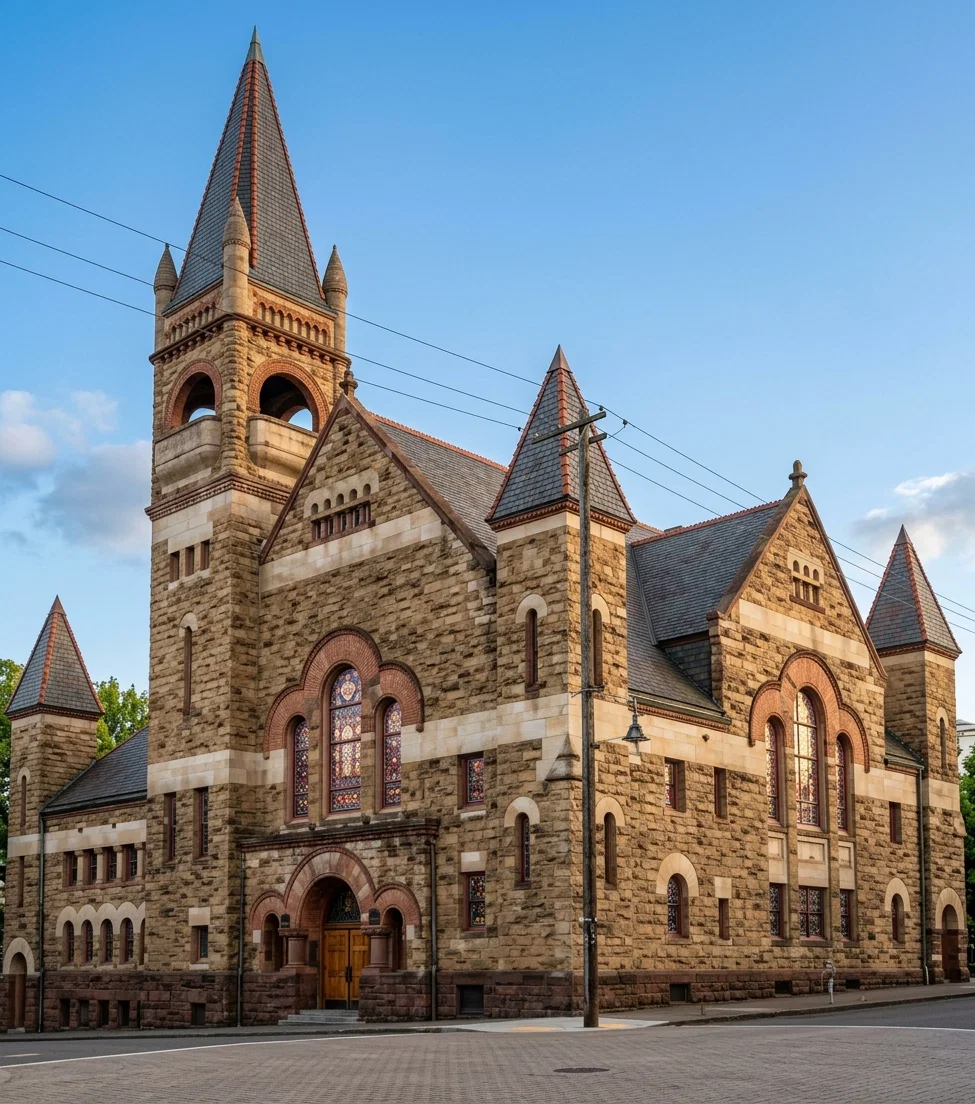
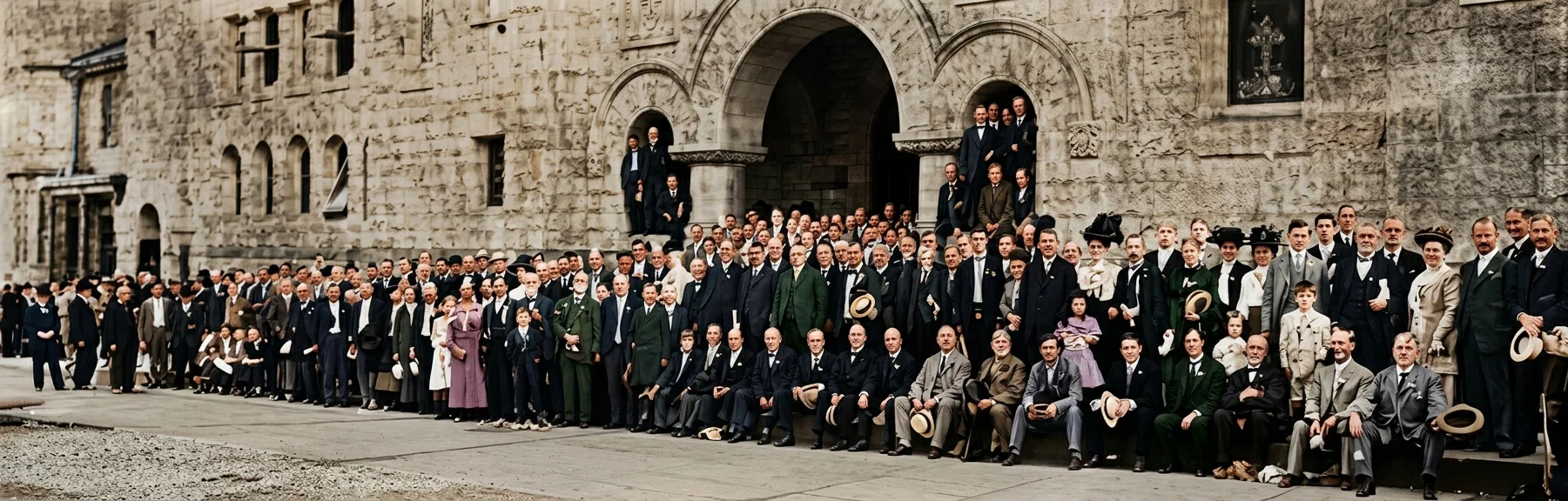
The National Convention of Northern Baptists convened in Portland, Ore., June 24, with thirty-six states represented. There were about thirteen hundred delegates in attendance; the largest number coming from any one state being from Washington, that state having sent a grand total of 208. Oregon with 192, and California with 162, were respectively second and third in the number of delegates represented. The meetings were held in the White Temple at the corner of Twelfth and Taylor Streets.
Missionary Endeavor
Thursday afternoon the Woman’s American Baptist Home Mission Society held its meeting, which was really a preliminary to the regular meetings of the Convention. More than 5,000 roses were used by the decoration committee in adorning the church. In this first meeting the statement was made that in parts of Oregon persons grew to manhood before hearing a Gospel sermon; that one third of the Baptists of Oregon were members of the Portland churches, and that only five per cent of the population of the state were foreigners. It was decided to ask the Home Mission Society to become a cooperating organization with the Northern Baptist Convention, and that $200,000 be asked for this year for the work of the organization. At a later date in the Convention this society was made an integral part of the central organization.
Organization
At the opening meeting of the Convention, President Judson, who, by the way, is also president of Chicago University, stated that the Convention was only formally inaugurated last year at Oklahoma, and that it was the first time in the history of the church as an organization that any scheme of cooperation has existed for the carrying out of the working plans of the three Baptist societies. As a result of this cooperating movement the past year there was, among other things, $200,000 more in contributions than in any previous year, and all three societies, the Publication Society, the Home Mission Society, and the Missionary Union, started the fiscal year free from debt.
R. E. Chambers in his address, Saturday, said that ten years ago the China Baptist Publication Society began its work. It was undertaken by a small handful of earnest men, and to-day had a plant worth $65,000. Many nights last year the four presses ran from twilight to dawn, as well as in the daytime and ten million pages of literature for circulation among Chinese were turned out. By the recent receipt of $1,500 the Society had just begun the publication of a Bible in which baptism is referred to as immersion.
Chapel-Car Work
Tired of a sometimes vain effort to make people go to church, Baptists decided several years ago to make the church go to the people. Now they have six churches on wheels, that are fitted up with organ, hymn-books, pews, and include even a parsonage for the pastor and his wife. They go from one side of the continent to the other, settling down in sage-brush towns, or communities where churches have grown feeble, doing a pioneer or reconstructive work, and this comprises the chapel-car system of the American Baptist Publication Society.
Rev. Mr. Neil, the secretary of this work, said:
“Our chapel-car work is the most spectacular feature of our denomination. We commenced the work seventeen years ago, intending by means of the cars to reach the people in new towns, along the railroads, in mining-camps, and in the shops. We now have six cars in the field. We call them Evangel, Emmanuel, Glad Tidings, Good Will, Herald of Hope, and Messenger of Peace.
“All have justified their names. They have been the means of carrying the Gospel message to thousands of discouraged lives, who otherwise might have died in ignorance of their greater hope. We have stopped the car at the side of a tract where a town was just beginning to build. Our singing service and the sermon attracted the people. We stayed long enough to get them in the church-going habit and left them organizing a new church.
“We have been treated in a wonderful way by the railroad companies, too. During the seventeen years, transportation has never cost us one penny. Our cars have been cared for and kept clean, supplied with fuel and ice-water. Every courtesy possible has been shown us by the railroad magnates. It has given us great encouragement.
“At the present time we are the only Protestant denomination that has attempted chapel-car work. The Catholics are operating one car down in the mountains of Kentucky.”
The Publication Society also operates what are known as Gospel wagons, that travel into the hills and along lonely roads where the whistle of a locomotive is never heard.
Tithing System Considered
One subject of live discussion was the tithing system. But fear of ecclesiasticism (or was it something else?) held the Convention from accepting God’s plan, and the following resolution was adopted:
“That the churches be requested to lead the largest possible number of their members to form the habit of laying aside a definite proportion of their income for distinctively Christian work, and that ways and means be provided by the committee for carrying out this recommendation.”
One of the most important features of the Convention was the adoption of the provision for government proposed by Judge Clinch, a decidedly new departure in Baptist procedure. It takes away from the three great Baptist missionary organizations—the American Baptist Publication Society, the American Baptist Missionary Union, and the American Baptist Home Mission Society—the right to nominate their own boards of managers, as has heretofore been done, but does give each organization mentioned the right to select its own officers from the names nominated by the Convention.
The report makes it possible to incorporate the Northern Baptist Convention under the laws of some states yet to be specified. The names of the missionary organizations are changed to read “society” in each instance, making it more apparent that they are auxiliary members of the central body.
A significant expression relating to these organizations and the perpetuation reads:
“The existence of the American Baptist Home Mission Society, of the American Baptist Missionary Union, and of the American Baptist Publication Society must be preserved. The trusts committed to these societies may be imperiled if the societies themselves are not perpetuated. Nothing must be done to imperil these trusts or that in any aspect may be considered a disregard of the sacred obligations assumed by, as trustees, the funds constituting the trusts.”
Central Body Established
This action makes the Northern Baptist Convention the great central body of the whole denomination as it is represented in thirty-six states, including the District of Columbia.
The Convention hereafter will have supervisory and regulating power over what now becomes Sub-organizations. It will have charge of expenditures, becoming the receptacle for all contributions and apportioning sums for the support of various departments of the work.
Recognition for Women
It gives women prominent place in the work11. An executive board to control the acts of the Convention will consist of seventy-five members, not more than three fifths of whom may be ministers, not less than one fifth women, the president, secretary, two vice-presidents, the presidents ex officio of the Woman’s Baptist Foreign Missionary Society and the Woman’s Baptist Foreign Missionary Society of the West.
Officers Elected
The Convention placed Harry Pratt Judson, president of the University of Chicago, at its head for the ensuing year. Corvin S. Shank, of Seattle; George Edwin Horr, D.D., of Newtown Center, Mass.; and Frank Harvey Field, New York, were elected vice-presidents; George W. Coleman, Boston, Mass.; Rev. W. C. Bitting, D.D., St. Louis, and William E. Lincoln, Pittsburg, were elected respectively recording secretary, corresponding secretary, and treasurer.
The Convention decided to raise one million dollars for the coming year for all departments. The meeting-place decided upon for next year was the city of Chicago, some time in the month of May.
R.
Rev. A. C. Petty, of California, brought the warning before the Convention. With tears coursing down his cheeks he related the indifference with which all evangelizing efforts have been met. “Something must be done and done now,” he asserted. Both speakers were of the opinion that the situation more than warrants a campaign made by united Protestants to save wicked San Francisco.
The Rich and the Poor
The conditions of the poor and the inhuman grasping of the rich were commented upon by Rev. J. H. Franklin, of Colorado, who styled Patten, wheat king and stock operator, a parasite:
“Mothers are groaning under burdens they can not bear,” he said, “and orphans and widows are starving at empty cupboards, while granaries burst because a master of finance—so-called—a parasite in truth—has cornered the wheat market.
“A Christian nation is building dreadnoughts in mortal terror of another Christian nation. Christ said, ‘Put up the sword.’ We are not without danger yet of Christians seeing the spilling of human blood in such fashion as this old world has never known. Has God’s will been done?”
Baptists on Present-Day Conditions
HERBERT S. JOHNSON, of Boston, in his address had the following testimony to bear with reference to conditions in the East. He asks:
Conditions Bespeak Ruin
“What shall we expect in a country where one per cent of the people own ninety-nine per cent of its wealth? Such a condition uncorrected, such a tendency unrestrained, will bring us to the ash-dump of the world, where now rest Greece and Rome and Spain. Such centralization of wealth robs the churches, deprives them of influence, and bespeaks their fall. In my own city of Boston there are four or five great churches of national fame going to the wall because of the lack of money. Ten or twelve years more and the end will be at hand; Boston will be a private cemetery for Baptist churches, and the epitaph will be: ‘Died of Independence—Died of Individualism.’ Organization is the only corrective, the only hope, and must be accomplished by the Baptists.”
And we know that conditions in the West are no better.
San Francisco Facing Ruin
Said Dr. George Burlingame, of that city:
“The Orient and Occident will fight their last battle in San Francisco; yet it is largely a pagan city. It is a state, a national, a world-wide matter.
“Half of the population of 500,000 are pagan. It is a city tending toward destruction. In all the city there are but 16,000 Protestants. There are but 1,000 Baptists and many of them Finns, Russians, negroes, and Chinese. Emmanuel, our largest church, is in a moribund condition; buildings of the other four Baptist churches are in bad condition. Ours is a unique condition.”
Compulsory Restoration
ONE of the most dishonest combinations which the trust age has developed is the American Sugar Refining Company. There are charged against it dishonesty, trickery, fraud, bribery, and so on ad libitum. Not long ago it submitted to a heavy fine rather than stand trial for exacting rebates contrary to interstate commerce law. Later it has been forced to confess that for thirteen years it had been swindling the government, says The Philadelphia North American, by false weights and tricks with the scales. The North American remarks that an attempt was made to shift the whole blame upon a few scapegoat employees, but the logical conclusion is that the whole thing proves the highly respectable millionaire directors and managers of the giant monopoly to be nothing more nor less than wholesale sneak-thieves.
Several years ago the Pennsylvania Sugar Refining Company started. Mr. Geo. Segal, the gentleman who established it, found himself short of money. The American Sugar Refining Company came to his relief, but in a way that Mr. Segal did not suspect that those who were aiding him belonged to the rival firm. The money was loaned Mr. Segal on the conditions that the one who loaned it should name the directors of the sugar refining company, the majority of the stock of which he held as collateral. This enabled the sugar trust which Mr. Segal thought to rival to choose the directors of his company. Of course, it ruined Segal; for the directors voted not to open the refinery. Suit was brought to recover damages. The company went into the hands of a receiver, Mr. George H. Earle. He presented the matter before the previous national administration under the Sherman Antitrust Law and was told that he had not sufficient evidence. Mr. Earle began suit himself, but rather than face a jury the trust submitted to a fine of $2,000,000. Now people are waiting to see whether the government will prosecute the great criminal trust for its illegal operations in various directions. Whatever the government does, the moral turpitude is seen.
Delegates to the Baptist Convention
Fourth of July Harvest of Casualties.—
In many cities of the country there was a decided effort to celebrate the nation’s birthday in a “safe and sane” manner. The result was discouraging, the number of deaths being more than last year. The number injured was also larger, and the fire loss was greater. Cleveland and Washington apparently have the best records, as in neither city was there a serious accident. New York had four deaths, with 332 injured; Chicago had only one or two deaths, with less than fifty injured; Milwaukee suffered only slightly. As usual, fireworks head the list in the causes of accidents and fires. The total number of deaths was 114; the number injured, 2,423; the fire loss $724,775. Spokane, Wash., being the heaviest loser by fire, $350,000. The New York World designates the day as “The Fourth We Desecrate,” and calls it our national “Carnival of Lockjaw.” During the last seven years the deaths from our national day number 1,430 and the reported accidents 30,441. These were accidents requiring medical treatment. Surely we Americans pay too high a price for our celebration; we are still far from a “safe and sane” method.
Cheaper Burials
A Chicago Congregational minister makes appeal for cheaper burials. He remarks that it costs a little sum to be born, but a far greater sum to die and be buried properly. He instances the cost of $500 for a burial in the family of a workman who received only $1.50 per day. Advantage is taken of the sorrow of bereaved ones at such a time and much unnecessary expense is incurred. This minister advises the formation of organizations within churches, which can make preparation for those who may be bereaved and secure much cheaper service in every respect. His suggestion is certainly reasonable. If each church would purchase its own plot of ground, the burial of the dead could be made much less expensive.
The Philippine Islands
By J. E. Fulton
[Part of a report from Pastor J. E. Fulton, of the Australian Union Conference, at the recent world's conference at Washington, D. C.]
These islands are a very old settlement, being discovered only twenty-nine years after Columbus discovered America, by the great navigator Magellan, who landed on the island of Cebu in 1521. Of the inhabitants, some are pagans, some are Mohammedans, and the greater number are professed Christians. Since America has taken over these islands, Protestant missions are operated by different denominations. There seems to be quite a movement on the part of the natives to read the Bible, which has been withheld from them so long. The population of these islands is stated to be about 8,000,000. What a field for missionary effort! It would seem that now is our time to work there. Brother and Sister Finster and Brother and Sister Caldwell are our only missionaries in that group, but what are they among so many?
In the Philippines one finds himself in a country of strange contrasts. He sees the old forts and city walls, and ancient cathedrals, some of which were built not long after the time of Martin Luther. Alongside these he now sees modern buildings of every kind; and emerging from, or entering through, the gray and moss-covered walls, in old Manila, the electric cars are seen raging along in American style.
Native Laundry
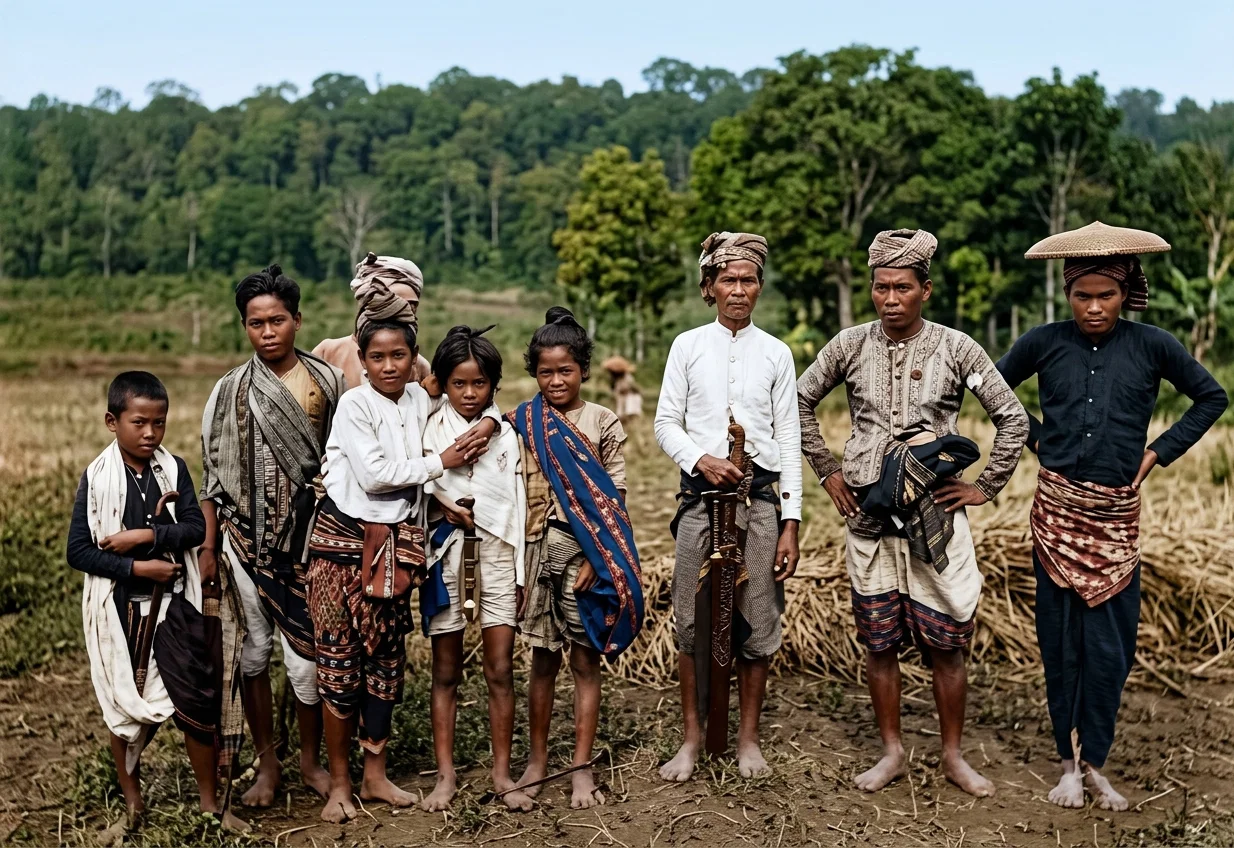
Filipino Moros
We have done something here in circulating literature. The Lord has opened the way to secure a good translator, to put some of our literature into the Tagalog language, one of the most important dialects in the group. At our late council meeting in Manila we decided to get a few leaflets translated and printed in this dialect. Three hours after a meeting where we decided on two small tracts to be translated, we were in the house of the translator, a man who has been employed by the American Bible Society. He immediately took the work, and in three days had completed the task, and the manuscript was placed in the hands of the printer, copies of the tracts soon to be in the hands of the people, and, we trust, the truths taught soon to be in their hearts. In a recent letter from Brother Finster, we are told that the translator has been working on a Sabbath tract, and that he became so much exercised over the question himself that he has decided to obey.
Many of you have been interested in hearing about the great split in the Catholic Church in the Philippines. You have been interested because you have heard that the new movement, called the Independent Catholic Church of the Philippines, has been circulating God's written word. While in Manila I called upon Archbishop Aglipay, who claims to stand at the head of at least 3,000,000 people. He received me cordially, and asked me many questions about our faith. He expressed himself as happy to learn of a people who really have the interest of the native people at heart, which he thought was an unusual thing. When he heard of our General Conference, and knew that I was a delegate, he asked me to bear a request for him to this Conference. “Tell your delegates assembled at General Conference,” he said, “to pray for my people.” Let us pray.
Philippine Needs
The needs are great. We ought immediately to have two more ministerial workers, one in the north and one in the south, and two canvassers for the same districts. Many more laborers could be used; but considering the general needs of God's cause in many lands we make only this moderate request.
A mission station, where a school can be carried on, will soon be needed. This will need to be carefully selected, and should, we think, be located where the workers could have the most favorable surroundings for health, which must be carefully guarded in this climate.
Sumatra
There are about 3,000,000 people in this great island. Padang is the chief city, and the place where our mission is located, under Brother Wantzlick. There are about 30,000 people there, 18,000 being Malays, 10,000 Chinese, and the remainder Europeans. Mohammedanism has a strong hold upon the Malays. Padang is a good center for our Malay work, and we have unrestricted privileges to work for any class. The Battaks live in the interior, about seven days' travel from Padang. We have a few there who are keeping the Sabbath. There is an interest among the Battaks, but on account of the promise of the government to the German mission occupying this territory, no other people are allowed to enter here. Still no one man, or company of men, can set bounds which will not be broken over by the message. Four of these Battaks have attended our school at Singapore. Two of them have since returned, and one of them is teaching the truth to his people, and writes of an interest on the part of many, and also of opposition on the part of the German missionaries. But, being a native son, he is left to carry on the work. Brother G. F. Jones, of the Singapore Mission and school, writes that there are a number of these Battaks who wish to attend school. It seems that a school should be started at some point in Sumatra, near enough to receive these eager people. Where are the workers for this great island with its millions? There are precious souls there ready to receive the light. Who will go?
Two Ways—Which?
One evening in a parlor, at a summer watering-place, the young people were dancing. One young lady was not taking any part in the exercise. “Does not your daughter dance?” asked another lady of this lady’s mother. “No,” was the reply. “Why, how will she get on in the world?” “I am not bringing her up for the world,” was the quiet answer. That young lady is now a woman, and the influence of her consecrated life is felt in many of the Christian interests of a great city.
But for what are you bringing up your daughters, dear mothers of other girls? What aim have you for them? Are you bringing them up for the Lord or for the world? What do you want to see them become? What are your dreams and ambitions for them? Do you want them to shine in society, to “marry well,” to live in wealth? Is that the vision that fills your soul when you think of them? Look on a little farther. Life is short. Suppose your dream is fulfilled — is it anything more than a dream? What lies beyond? The curtain is drawn, and there is the hushed chamber of death. What do you want for your child then? The curtain is drawn again, and13eternity opens. What would your fond affections choose for her then? It is better to think matters of this kind through to the end.—Selected.
Not Mine the Praise
By D. R. Buckner
IF I can reach a heart, swing back the door,
And let a ray of light shine from above;
If I can drop but one sweet word of love,
Where hate abode and tyrannized before;
If I can ease a heartache or a pain,
Prevent, or wipe away, a falling tear,
The world is better for my being here;
My life has not been wholly lived in vain;
But tho I help some plodding pilgrim on;
Altho I cheer my neighbor with a smile,
I ask that thanks may not be given me,
But to that One who aids at dusk and dawn,
Who, brother-like, stands by in every trial,
Who well can aid, for He was tried as we.
D. R. BUCKNER.
Ambato, Ecuador.
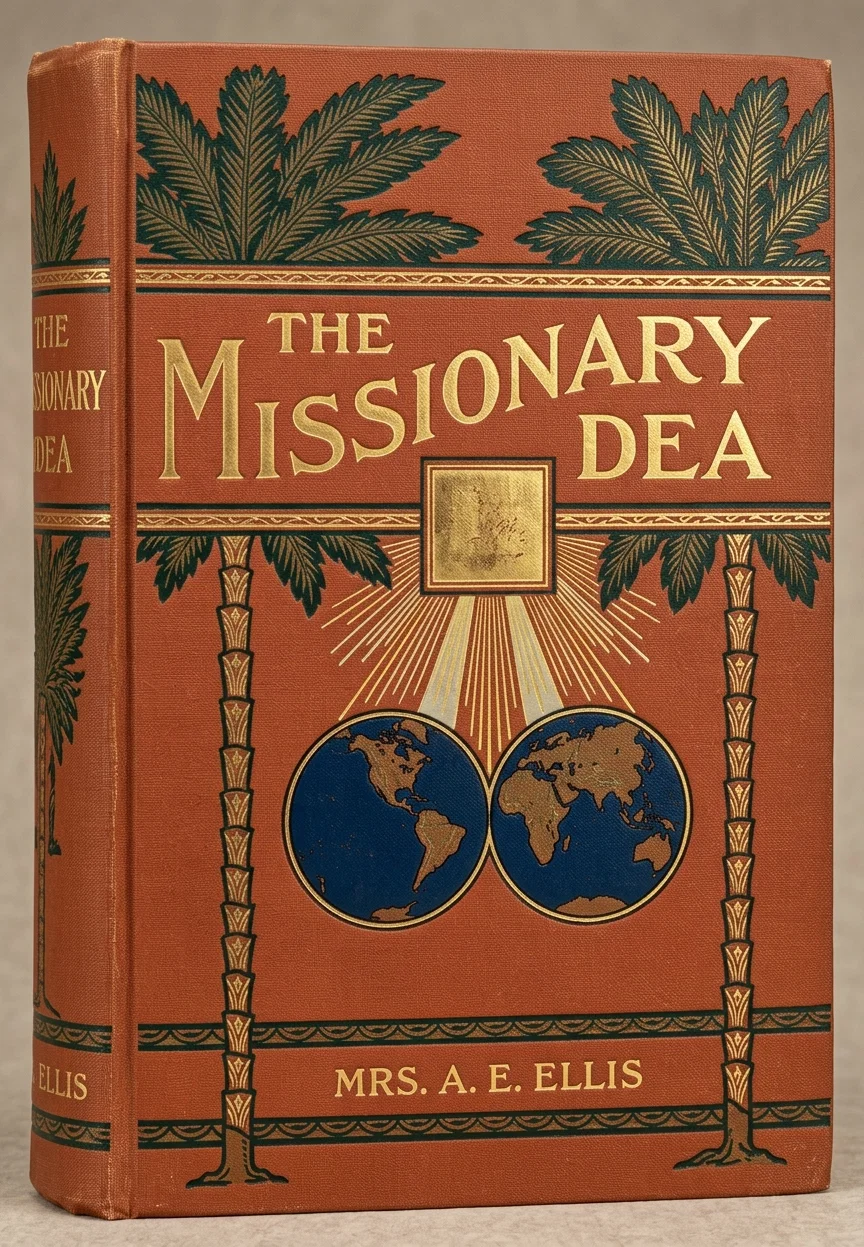
The Missionary Idea
By Mrs. A. E. Ellis
BY MRS. A. E. ELLIS
THIS little volume aims to be a suggestive help to every missionary worker whose heart has been touched with a sense of the world's need.
Part One is designed to stimulate a healthy interest in missionary work, both “Home” and “Foreign.” Each of the 16 subjects is arranged in the form of a “Lesson” with carefully prepared questions.
Part Two consists of contributed, selected, and arranged matter which, besides its inspiring character, will suggest to the thoughtful reader ways in which missionary information may constantly be gathered and missionary sentiment encouraged.
Part Three gives an outline of the work done in mission fields since 1874, with a brief history of each mission and outline map of the more important.
317 pages in two handsome bindings. Paper covers 50c. Cloth bound $1.00, post-paid
Pacific Press Publishing Association
Mountain View, Cal.
Portland, Ore. Regina, Sask., Can. Kansas City, Mo.
Life and Health
A PRACTICAL health journal, published with a view of meeting hygienic needs in every home; teaching how to care for the health and how to preserve life; prescribing simple home treatments to assist nature in throwing off diseases rather than adding more poison by using drugs or unnatural stimulants as remedies: teaching how to avoid disease as far as possible, how to manage in the home when sickness does come, and how to combat the disease by simple remedies which nature provides.
Send for sample copy and special rates to agents. Price 10 cents per copy or $1.00 per year.
Address, LIFE & HEALTH, Takoma Park, D. C.
Thoughts from the Mount of Blessing
Thoughts from the Mount of Blessing.— An exposition of Christ’s Sermon on the Mount. It has 218 pages and six chapters: On the Mountain-side, The Beatitudes, The Spirituality of the Law, The True Motive in Service, The Lord’s Prayer, Not Judging but Doing. A new edition just printed on fine enameled paper, new type, and reillustrated with 27 beautiful half-tone engravings specially prepared for the book by eminent New York artists. It will be found full of comfort and blessing by all fortunate enough to obtain and read it. A beautiful gift book. In paper covers, 35 cents. Address this office.
Testimonies for the Church.
By Mrs. E. G. White. Bound in eight volumes, of from 300 to 770 pages each, each volume containing a complete index of subjects. Volume 1 contains a brief sketch of the early life and Christian experience of the writer of the Testimonies, together with Testimonies Nos. 1 to 14. Volume 2 contains Testimonies Nos. 15 to 20. Volume 3 contains Testimonies Nos. 21 to 25. Volume 4 contains Testimonies Nos. 26 to 30. Volume 5 contains Testimonies Nos. 31 to 33. Volume 6 contains Testimony No. 34. Volume 7 contains Testimony No. 35, price, 75 cents. Volume 8 contains Testimony No. 36, price, 75 cents. Bound in cloth, per volume, $1.00; Full set, eight volumes, cloth, $7.50. Volumes 1 to 6 are obtainable in limp leather, with round corners, per volume, $1.50. Volumes 7 and 8 are also bound in limp leather, price each, $1.25.
Address this office.
Home and Health.
Prepared and edited by a competent committee of home-makers and physicians.
“Home and Health” is a household manual containing two thousand recipes and helpful suggestions on the building and care of the home in harmony with sanitary laws, the preservation of health by clean, consistent living, and the home treatment of simpler ailments and diseases by use of natural, rational remedies instead of drugs.
It contains six sections as follows:
The Home: Its Location, Suggestions on Building, Sewerage, Healthful Surroundings, Water Supply, etc.
General Housekeeping, including all the general features of the housekeeper’s work, such as care of the rooms, Laundering, House Cleaning, Fruit Canning, Pests, etc.
Diet.
Care of the Body.
Care and Training of Children.
The Home Treatment of Disease.
The object of this work is twofold:
(1) The prevention of disease by teaching the principles of life and health.
(2) The classification in convenient form for reference of such recipes and items of information as are most needed in the home.
The book contains nearly six hundred pages, is fully illustrated, and bound as follows:
Cloth, marbled edges, $3.00; library style, $4.00; full leather, $5.00. Address this office.