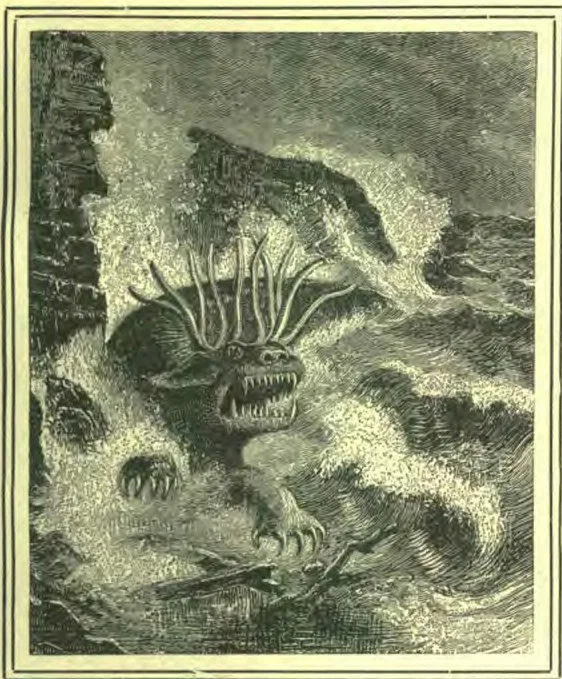
READ again the chapter under consideration. The four beasts are symbols of Babylon, Medo-Persia, Grecia, and Rome. Upon this there is general agreement. Even the notes in the Douay Bible, or common Catholic standard translation, say on verse 3: “Four great beasts; namely, the Chaldean, Persian, Grecian, and Roman empires.”
Each succeeding kingdom of the four possessed territory peculiarly its own. Before Medo-Persia conquered Babylon, these nations had existed in territory peculiarly their own, to the north and east of Babylonia; and Babylonia, as a part of the Medo-Persian empire, continued to exist after her subjection by Medo-Persia. Grecia arose out of territory peculiarly her own to the west of Medo-Persia. When Grecia conquered Persia, that nation continued to occupy territory, then subject to Greece. Rome, the fourth kingdom, arose out of territory peculiarly her own, west of that of Greece; and while all the territory of these preceding empires was subject to her sway, yet as nations and peoples they still continued to exist. So the prophecy declares: “And as for the rest of the beasts, their dominion was taken away; yet a prolonging in life was given them.” Verse 12, R.V., margin.
Of the fourth beast, “dreadful and terrible,” we read that “it had ten horns.” These horns, we are told in verse 24, “are ten kings [or kingdoms] that shall arise” “out of this kingdom” represented by the beast. In other words, they represent divisions of the Roman empire, the part distinctively Roman, the western part. This division is represented in Daniel 2, not by any parts of the image, but by the intermingling of clay with iron. “Whereas thou sawest the feet and toes, part of potters’ clay, and part of iron, the kingdom shall be divided,” and “they shall not cleave one to another, even as iron is not mixed with clay.” Dan. 2:41, 43. We do not wait for the division till we come to the toes; it begins in the feet, and continues till the end. It is not that the toes will not cleave together, but that the divisions of imperialism and democracy will not cleave one to another, even as iron does not mix with clay. In chapter 2, it is declared that the kingdom will be divided, but we are not told the number of parts. In chapter 7, we are distinctly told that the parts finally become9just ten. These ten divisions, if symbolized by the toes, naturally ten, would exist as ten to the very end; but, according to chapter 7, where the horns are specifically said to represent kingdoms, three of these kingdoms are plucked up at least a millennium and a half before the end. And this also clearly shows that the division of the fourth kingdom, as indicated in chapter 2, is symbolized by the intermingling of the iron and the clay, and not by the parts of the image.
The Ten Kingdoms.
These ten divisions we gave last week. We give them again from the “Great Empires of Prophecy,” the author of which admirably summarizes Gibbon’s irrefutable testimony as follows:
“Alemanni, about A.D. 300, in Agri Decumates, from the River Main to Basel, and the Lake of Constance; A.D. 351, take Alsace Lorraine in addition; A.D. 455, extend to the Seine.
“Franks, A.D. 351, northeast Gaul; early in the fifth century spread to the Somme; middle of the fifth century, A.D. 455, to the Seine, and gradually progress till in the sixth century they take all Gaul, north and west of the Moselle and the mountains of the Vosges and the Cevennes.
“Burgundians, Dec. 31, A.D. 406; in Burgundy, A.D. 420; spread over West Switzerland and the whole valley of the Rhone, A.D. 443 to 476.
“Suevi, October 13, A.D. 409 in Spain; A.D. 428 in Galicia in Spain; A.D. 466, held the kingdom of Galicia, and shortly afterward spread to what is now Portugal.
“Vandals, Dec. 31, A.D. 406; in Spain, A.D. 409; in Africa, May, A.D. 429.
“Visigoths, A.D., 408, Italy; in southwest Gaul (Aquitaine), A.D. 419; spread into Spain, A.D., 466.
“Saxons, A.D. 449, Britain.
“Ostrogoths, A.D. 451, under Attila; A.D. 453, in Pannonia; A.D. 489, in Italy.
“Lombards, A.D. 451, under Attila; A.D. 453, in Noricum.
“Heruli, A.D. 451, under Attila; A.D. 475, in Italy.”
The ten divisions of Rome were complete in A.D. 476. They remained ten till A.D. 493. At this very time the prophet, in considering the ten horns, sees coming up “among them another horn, a little one, before which three of the first horns were plucked up by the roots.” Verse 8.
Thirteen Particular Specifications.
What does this little horn symbolize? Read again from chapter 7 the following verses concerning this little horn: Verses 8, 11, 19, 20, 21, 22, 24, 25, 26. Note these particular specifications:
It arose among the ten horns, v. 8.
It was a LITTLE horn at first, v. 8.
In order that it might be established, three of the first horns are plucked up before it, v. 8.
It had eyes like the eyes of a man, v. 8.
It had a mouth which uttered not the meaningless noise of a beast, but great boastings, such as could be uttered only by a being above a beast, vs. 8, 11, 25.
It was a different horn in character from those around it, v. 24.
It became strong, so that its look was more stout than its fellows, v. 20.
It made war upon the saints, or people of God, v. 21.
It was to prevail against them till the Lord should come and take judgment to Himself, vs. 21, 22.
It should presume, or think, to change “the times and the law” of God, v. 25, R.V.
It should continue for “a time and times and half a time,” or three and one-half years, v. 25, R.V.
It would lose its temporal dominion as a horn, v. 26.
Its greatest words come in the very closing part of its career.
Here are thirteen definite, specific characteristics given of the power symbolized by this little horn. In the very nature of the case it would be a certain impossibility to find even two powers to which these specifications apply. But the prophecy tells us that this little-horn kingdom is diverse from those among which it arose. These specifications reveal wherein it is diverse. Two or three might apply to several powers of earth; but it is an utter impossibility to find more than one to which they all apply. Thus specific is God in His “sure word of prophecy.”
Let us ask the reader in this study to divest himself of all prejudice and receive just what the word says. In its application to us, the only application which can be made, it does not deal with persons, but with systems. It is the evil system and its consequences against which God warns us. It is submission to an evil system based on evil principles which makes the most conscientious man do evil. It is to warn all, within the system and without, that God gives us this Gospel of Daniel 7. Let us examine the specifications, or earmarks, of this power.
"A fourth beast, dreadful and terrible. . . . and it had ten horns. . . . And the ten horns . . . are ten kings that shall arise."
1. The little horn arose among ten horns. What power differing in character from the civil divisions of Rome rose to a position of prominence in Western Rome in the fourth century? There was but one—the Papacy, centering in the bishop’s See at Rome. Primarily there was no preeminence of one bishop over another in the early church. “One is your Master, even Christ, and all ye are brethren,” were the words of our Lord. But at an early date the bishops of Rome began to put forth great claims for the See at Rome. Rome being the political capital of the empire, and the church becoming more or less political, it was demanded that the bishops of Rome should have the preeminence. This was the horn that the prophet saw coming up among the ten. No one will dispute the fact.
2. It was a little power at first, in the eyes of man. It did not look as if it would amount to any great thing. Other bishops were as great and learned. Its claim to authority was not thought to be serious. Other bishops considered their own sees as important and as influential as Rome. In its organized form the Papacy was at first a little power.
3. Three horns were plucked up before this little horn. In the midst of the great controversy between Arianism and Trinitarianism the Papacy arose. In brief, the bishop of Rome stood on the Trinitarian side of the controversy, waging relentless war against Arius and his followers. In the finality of the conflict, three of the ten kingdoms—the Heruli, the Vandals, the Ostrogoths—opposed the rising power of the Papacy and its coalition with the state. The last of the ten kingdoms was established in A.D. 476; the first of the three, the Vandals, was “plucked up” in March, A.D. 493; the last of them, the Ostrogoths, was overthrown in March, A.D. 538. In 533, by acknowledgment and decree of Justinian, the bishop of Rome became “head over all the holy churches,” and “true and only corrector of heretics.” This decree reached its culmination when the last opposing power in Rome was overthrown.
4. The little horn of the beast had “eyes like the eyes of a man.” It would be a strange thing to see a horn with eyes at all. But if eyes were given it, they would naturally10be the eyes of the beast whose horn it was. But this horn of a beast had eyes, not of a beast, seeing only what is near, but the eyes of a man,—far-sighted eyes, that see the future—indicative of the mind behind that thinks, and plans, and schemes.
How true is this of the Papacy as compared with the kingdoms of earth! Like blind beasts, they have seen only what is present and near. They have planned for the present. They have lived for the present. Present power, present glory, present prestige, have been the rule, and the future is often sacrificed for the present. Not so the Papacy. She has planned for generations ahead. Pain, toil, sacrifice, have been taught her children that she might enlarge, expand, and be established. Thus has her diplomacy been more than a match for all Europe.
[The rest of these specifications will be considered next week. Study these and them. They are important.]
The Forum of Trains.
A Mistaken Idea.
It Is No Wonder That He Failed.
NOT long ago a clergyman of a "respectable parish," not being in full harmony with his wife, seduced a young girl, ran away with her to the Pacific Coast, and is now working at a trade for the support of the poor girl and the illegitimate child. They have been in dire need for some time, and kind neighbors have pitied them for the poor, deceived girl's sake. He has recently been giving the story of his life to the world thru the daily press. He half excuses the desertion of his wife and talks as tho he did an honorable sort of thing in staying by the girl, when he might have hidden his betrayal of her young confidence, and gone on heaping up honors and success. But he "sacrificed" these for the girl's sake—after he had ruined her; and he thinks he did what the world would not do, "but I [he] differed from the world." But there are many in the world who would have done better—they would not have betrayed the girl. He has nothing of which to boast, nothing to defend.
When in his ministry, he tells us he studied human life in every phase, even in the "tenderloin" district. It does not seem to have helped his morals; but he thus defends himself:
"The physician is allowed to study all the horrors of disease; the lawyer must understand the baseness of the human mind; the man of business must be acquainted with the trickery of a dishonest rival; but the minister must be ignorant of sinners and their ways. He must lead his flock from the snares of sin, and yet know less about sin than do those in his spiritual care. Should he dare to investigate, should he examine mankind for himself, he is damned on the spot. Lies and rumors assail him at every turn, and the net result is that while some ministers of the Gospel know nothing of sin, others know far too much."
The above clearly shows that this man—and he represents others not a few—knows nothing about Christianity. Even in purely worldly conceptions of common employment in life he is wrong. The first business of the physician is to study and know the normal functions of mankind. He can better understand disease, that which is not in harmony with the normal. It is the duty of the man of business to be exactly honest, and do all things honestly. With dishonesty he should have naught to do. The lawyer should understand the law, its right construction, meaning, and its proper enforcement, for the good of the commonwealth. If the positive side were studied more, we would have less disease, less complicated laws, more honorable business. "Evil companionships corrupt good morals."
But if there is the shadow of an excuse in his argument for the physician, the lawyer, the merchant, there is absolutely none for the minister of Jesus Christ. If he believes God's word, he knows that the heart of the human is "deceitful above all things, and desperately wicked." Jer. 17:9. He knows from the word of God that "all have sinned, and come short of the glory of God." Both Jew and Gentile stand equally condemned before God. And if this minister-that-was, and others like him, would but let the word of God shine down into his own heart, he would have seen the depths of depravity which would have sufficiently horrified him. That word also declares that there is but one remedy, even Jesus Christ—an all-sufficient Remedy and Healer for all mankind.
The mighty Paul did not need to visit the "tenderloins" of Athens or Corinth or Ephesus or Rome to learn that the hearts of mankind are sinful and vile. Neither did John nor James. It is not man's knowledge which reveals the sinner to himself; it is the mighty word of God which illumines his soul and pierces his heart. It is a denial of God's plan of salvation to say that God's minister must dabble in sin or go down among the flesh-pots and muck heaps to behold its viciousness and nastiness and breathe its atmosphere.
Jesus Christ is our Example. The word of God is the revealer of God's will. "Preach the word." The Holy Spirit will convict of sin.
Restoring the Coin Superscription.
THE House of Representatives by a vote of 255 to 5 passed a bill requiring that the expression "In God We Trust" be restored to the coins. President Roosevelt is a religious man, and when he caused the expression to be stricken from the coins it could not be charged that it was done by an irreligious hand. It was done out of reverence and respect to God. But there came a strong clamor to have the superscription restored, and Congress has almost unanimously acceded to it.
If an apostrophe were addressed to the American dollar saying, "In thee we trust," it would much more truly represent the actual facts in the nation at large. This is a money-mad age. Everything is made to bow before the god of money-getting. And to require the inscription "In God We Trust" to be placed on the coin is requiring the money to11say the exact opposite of the real condition of the people. President Roosevelt is most assuredly right in his contention that placing this superscription on the coin tends to produce irreverence for the great Creator and divine Father.
But certain religious people have had the conviction that it was the sign of great irreverence and a very wrong thing to have this phrase removed from the coin. Articles have been written about it, and many resolutions by religious bodies have been passed condemning it. The vote of the House upon the measure shows how unanimous the members are in thinking that they would go against this sentiment to their peril should they fail to demand that the superscription be replaced on the coin of the Republic.
This is a matter of but little consequence in itself alone. But the religious people who are in favor of coercing Congress into passing certain religious measures will be very quick to see that if they can influence the vote on a thing of this kind, they can also get other measures passed that will be still more to their liking. There has been a strong and growing sentiment in favor of various kinds of religious legislation, and things of this kind will help the work of that character along. The fact that the present House of Representatives has passed such a measure will be made a part of the accumulating basis for further demands. With this seemingly innocent legislation as a precedent, the laws that may be enacted in a very few years from now may not be so innocent, even in appearance. All past history should teach us that any kind of religious legislation is dangerous.
There are many devoted people in all the churches in the United States who truly trust in God. But to try to put such words of trust into the mouths of the majority of the dwellers in this land is nothing short of hypocrisy. T.
The Danger of the Boycott.
There can be no question about the right of an individual to refrain from buying from another individual if he so chooses. If one individual does not want to employ another, or otherwise refrains from doing business with him, it is his unquestionable right. But when a person starts an active propaganda against another in order to keep everybody else from doing business with him or employing him he has entered upon dangerous ground. Such a course of boycott can only result in ultimate ruin in the country where it becomes general.
The press despatches state that an effort is being made to have Congress enact certain laws that will legalize the boycott. President Roosevelt is being urged to recommend this legislation in a message to the national Legislature, but he is refusing to set his approval to any such measures.
Any one who will take the pains to examine closely into the trend of this time will have no difficulty in seeing that the boycott sentiment is gaining ground rapidly. Capital has set the example by combining to crowd out competition, and now the labor-unions are following on to combine and use the boycott to enforce their terms of demand.
The whole situation shows a condition of internal faction and hostility in the country that can not fail to end in revolutions and riots. If men were seeking to help each other there would be hope in the outcome. But instead of seeking to help each other they are striving to beat the other man in every way they can. This condition of things can not go on for very long without resulting in ruin.
The prophecies indicate that this generation is to see a great international boycott declared. It should be very apparent to any one that the people are being trained for it thru the boycott sentiment that is being generated in the society of to-day.
T.
Reverence
By Ruskin
REVERENCE is the chief joy and power of life—reverence for what is pure and bright in your youth, for what is true and tried in the age of others, for all that is gracious among the living, great among the dead, and marvelous in the power that can not die.
—Ruskin.
These Two Commandments.
“Teacher, which is the great commandment in the law?” the lawyer asked of the Saviour. The answer was, “Thou shalt love the Lord thy God with all thy heart, and with all thy soul, and with all thy mind. This is the great and first commandment.” Matt. 22 : 36-38. Man’s first allegiance is to his God; no other gods must claim his worship, not even an image to Him, or to any other god; His name must be held in reverence; and His Sabbath must be kept inviolate.
“And a second like unto it is this, Thou shalt love thy neighbor as thyself.” Honor to parents, regard for life, purity, honesty, truthfulness, benevolence, and justice; such is the law framed by Divinity for His creatures, a law insuring the highest good and the greatest happiness to the obedient. Summed up, it is supreme love to God, unselfish love to man; and “On these two commandments the whole law hangeth, and the prophets.”
“And the prophets.” The prophets look to the future, to the time when the original perfection of creation’s morning shall be restored. Then the same law of love will prevail, love to God and love to man; no other gods will claim homage there; no false worship will exist; the name of God will never be blasphemed, for all will be loyal; the Sabbath of Jehovah shall be unprofaned; man shall dwell with man in harmony; “they shall not hurt nor destroy in all My holy mountain,” saith Jehovah. Every precept shall be obeyed, for only so could the restoration be complete. Love shall be the standard then as now, and the truest love is manifest in the most implicit obedience. The Saviour Himself has said, “If ye love Me, ye will keep My commandments.” H.
Putting Down Graft.
IT has been only a few months since the "graft prosecution" in San Francisco seemed to be accomplishing the feat of successfully placing a lot of high-handed law-breakers behind the prison-bars. The whole country was looking on with interest—indeed the whole civilized world seemed to be giving heed to the work that was being done.
Many of the newspapers had exultant editorials in regard to "the awakening of the public conscience" to drive the evil from the land. It was stated over and over again that when the people once become aroused, they will make short work of exterminating the grafter and the briber. The mighty bulwark of the "public conscience" was extolled, and the people were told in strong, clear language that they could rest secure and happy in the "wave of reform" that was sweeping over the country.
Not only were the "graft prosecutions" in San Francisco heralded as an evidence of the awakening of the "public conscience," but the efforts of the President in prosecuting the big corporations were spoken of much more loudly and proclaimed much more widely as the sure sign that the public had become aroused and that wrong-doers were being irresistibly and impartially dragged before the bar of justice. "The majesty of the law" was asserting itself and would show no respect of persons.
All this sounded good and it could be wished by every law-abiding and right-minded person that these ideals really represented the facts. But what has been the outcome?—The President is being fought by men who are losing no opportunity to attempt to show that all that he has been doing is politics, and that in working politics he is ruining the business of the country. You will hear many men of influence in business circles declare that they think the President is working a great and irreparable injury by the course that he is pursuing in unrelentlessly fighting the trusts. A great financial panic was precipitated right in the midst of the most unprecedented prosperity; and while the country has recovered somewhat from the money stringency, yet, as you mingle among business men, you will hear it everywhere that they wish Roosevelt had let things alone.
There seems to be a regular campaign going on to discredit the work of bringing the corporation magnates to justice. Let the question be raised at this juncture, Does this signify that the "public conscience" is so strong after all when the great dollar is in danger? A "public conscience" that is worthy of the name is willing to subordinate mere money-making in order to put down robbery, oppression, and every other form of evil work.
The "graft prosecutions" in San Francisco have taken a turn that is decidedly ludicrous. The men who were apparently looking into the yawning doors of the penitentiary a few months ago are now the prosecutors, and are hauling before the courts both the lawyers that prosecuted them and the judges that tried their cases. The prosecuting attorneys that were so confidently looked upon as the saviors of San Francisco are now suffering the humiliation of having the arch grafter of the Pacific Slope subject them to the most scrutinizing inquiries in court. At the present writing it would almost appear that instead of the grafting, boodling, bribing gang being sent to prison they would succeed in having their prosecutors fined if not imprisoned.
So it would seem that this great awakening of the public conscience, that has been so loudly proclaimed as the saving grace of the republic, is fading into a vapid farce right before our eyes.
And now comes another chapter in the history. Nine policemen have just been suspended from the San Francisco police force for grafting. This is not for grafting that they did a year or so ago, but for crimes of this character that they have been committing up to the present. Evidently these men have felt that it was so hard to convict a grafter that they would be safe in going right on in the evil work. In other words, the much-talked-of graft prosecutions in San Francisco have not been enough of a terror to evil-doers to prevent a whole platoon of policemen from going on with their work in the very time when the country was led to expect such great things in the way of righteousness.
We may seek to evade the fact, but it is nevertheless true that moral integrity is lacking in this generation. There is a vast army of men who have become dependent for their daily support on blackmail, grafting, boodling, and bribe-taking. So deeply is this evil entrenched in society that nothing short of the power and the glory of the second coming of Christ will ever put an end to it. If we study the Bible, we will see that the prophecies all show that the last generation of men has been reached. And we will further see that the same Bible teaches also that this last generation that is to live on the earth is to rival the generations of Noah and Lot in their debaucheries, wickedness, and crimes.
It is often the case that people will resent the facts, and especially so if those facts are unpleasant. But it is nevertheless best to look the facts squarely in the face and reckon with them. For in the end it is the one who is in harmony with the facts that will prevail.
T.
Liquor-Sale Restrictions in England.
The new British licensing bill abolishes 30,000 bars, provides for the annual renewal of licenses and the police inspection of all places where liquor is sold, Pall Mall clubs included, and it reduces to three hours the time during which public houses may remain open on Sunday. It invests the licensing authority in justices of the peace, who are empowered to exclude children from barrooms, and who may decide whether women shall be employed as bartenders. It allows compensation for liquorsellers put out of business, who are to be reimbursed for fourteen years by the assessment of the surviving license-holders. After that period the granting of new licenses is made dependent on local option, and the theory of property in liquor licenses will cease. In this country no such theory has been generally admitted.
The bill is decried as socialistic and an attack on vested interests. A financial panic is predicted as a result of its reversal of an established British industry. But if, as critics of the bill say, it will not diminish drinking, what have the great brewers to fear who are fighting it?
To American liquor interests, accustomed to frequent regulation, the measure will seem less drastic. It would prove acceptable as the alternative of absolute prohibition contained in recent southern and western state and county legislation. The British plan of saloon control restricts the sale of liquor to conditions of least harm and offensiveness. Laws on similar lines would be a logical outcome of the far-reaching temperance agitation in this country.—New York World.
Blue Laws for Boys.
An exchange vouches for the existence of the following laws to regulate in old colonial times; it is worth while to note them again:
"If a boy shall whistle or sing on the Lord's day, it is a fine of ten cents.
"If a boy shall go to sleep in church, it is a fine of three cents, and the warden may cane him.
"If a boy shall throw a stone at a neighbor's dog, it is a fine of five cents, and his father shall whip him.
"If a boy laughs in public school, his teacher may take off his coat and administer thirteen hard blows."
And it is just to such extremes as the above that a commonwealth is led when it tries to regulate moral conduct. Such statutes are logical results of Sunday legislation.
The National Board of Rifle Practise
ago, have these iet a right much have event was right- never this have black- So moth- second
The National Board of Rifle Practise, the Springfield Republican tells us, `is meeting with considerable success thruout the country, altho the work will not be fairly inaugurated until provision is made for its support thru the War Department at Washington. General Robert Shaw Oliver, assistant secretary of war and president of the national board for promotion of rifle practise, has recommended that a provision for $100,000 be embodied in the army appropriation bill for the promotion of rifle practise in public schools, colleges, universities, and civilian clubs, including the cost of arms, ammunition, prizes, and other incidentals.'' This, we suppose, is to help on the work of The Hague Conference. Train these young men to shoot at dead targets, and military ambition will never be set at rest till they can shoot at live ones. Truly it is the fulfilment of the cry of the prophet, `Prepare war.'' Joel 3: 9-13.
Ic
Smoking Banned on Streetcars
By Editor
A Good Ordinance.—San Francisco's city fathers are considering a proposed ordinance to prohibit smoking on street-cars, making no provision for a smokers' department. Good, we hope it will pass. In some hours of the day the cars are enormously crowded, and it is impossible to get on and off without inhaling tobacco smoke or running into an end of a cigar or a burning pipe. If men persist in poisoning themselves, why should they be permitted to poison others on public thorofares? The slaves to the weed will not suffer greatly to abstain during the few minutes' ride.
Conventions
Conventions.—The Republican National Convention meets in Chicago, June 16. It will have 980 delegates, taking 491 to nominate. At present there are six or seven prominent men named as candidates: Messrs. Taft, Cannon, Hughes, La Follette, Fairbanks, and Knox. The Democratic National Convention meets in Denver, July 7. But two men are thus far prominently named as candidates, Messrs. W. J. Bryan and J. Johnson.
The Czarina Against Tobacco
It is good to know there is one woman of authority who is outspoken against tobacco, and that is the czarina of Russia. She has forbidden the ladies of her court to smoke; an unprecedented order in Russia, where society women have smoked for a century. She considers the practise of smoking a barbarism, and declares that a cigaret in the mouth of a woman is as ugly as an oath in that of a man.
A Gentleman in California
A gentleman in California recently sold his orange grove, consisting of 165 acres, for $200,000.
Book Reviews.
"The Ancestry of Our English Bible." By Ira Maurice Price, Ph.D. Second edition. Price $1.50. Sunday School Times Company, Philadelphia.
This volume is an account of the various manuscripts, texts, and versions of the Bible, from the oldest Hebrew text to the latest-found Greek. Its author is professor of Semitic languages and literatures in the University of Chicago. The design is a popular treatise as to where our Bible came from. There is one chapter on "The English Bible of To-day," with its various versions, variant readings in the margins, and another chapter on the "Bases of Our Present Versions." The rest of the work is divided into three parts: The Old Testament, ten chapters; the New Testament, six chapters; and the "English Versions of the Bible," seven chapters. In these twenty-five chapters is packed a vast amount of information on the old versions and manuscripts, the changes in methods of writing and preserving; the Apocrypha, and why rejected, the great Greek manuscripts, the uncial and discursive writing of Greek and of the men who labored so diligently and keenly to dig out, restore, and translate these ancient writings. The last part, the "English Versions," is of great interest, and makes one appreciate more fully the last, the American Standard Revision. There are added to the book a Bibliographical list, a chronological table, with a topical and a Scripture index. It is a valuable little work. There are upwards of fifty cuts and diagrams.
"Religious Liberty in South America." By John Lee, M.A., D.D. $1.25 net. Eaton and Mains, New York.
This truly illuminating little work is written "with especial reference to recent legislation in Peru, Ecuador, and Bolivia." This movement for religious liberty in these republics began by an address by Dr. John F. Thomson before the Methodist ministers' meeting of Chicago, Ill., April 2, 1894. At the close of the address, a committee of three was appointed to lay the matter before the Roman Catholic authorities, and for six years agitation was maintained and crowned with a large degree of success. Mr. Lee tells the story of the struggle. It clearly shows by official documents that the Roman Catholic love of religious liberty depends on the country. The points at issue in these countries were liberty of worship and legalized marriage, both of which had been proscribed in the republics named. It is a serious question whether Bishop Vincent has not in the second paragraph of his introduction done as much harm as good in his talk over "Church-State," a thing which would develop into as much evil as the State-Church. There is an ample index to the book. Every professional man in the United States ought to read it.
"History of Medievæval and Modern Civilization to the End of the Seventh Century." By Charles Seignobos, of the University of Paris; translation edited by James Alton James, Ph.D., professor of history in Northwestern University. $1.25 net. Charles Scribner's Sons, New York.
This little volume is the second in a series of three, the first of which is "History of Ancient Civilization," and the last, now in press, "History of Contemporary Civilization." The main facts of history are set down seemingly without passion or partiality. Those who wish to study history exhaustively will desire some of the standard larger works, but those desiring a limited work on the History of Civilization, will find in this a concise, general view, written clearly, and letting facts moralize for themselves.
"The Bible as It Is." By Rev. Alexander Patterson. Price 75 cents. The Winona Publishing Company, Chicago.
This is designed to be "a simple method of mastering and understanding the Bible, illustrated by diagrams and charts. This volume extends from Genesis to Judges. There are many excellent hints and suggestions in the little book, and it is a pity it is marred by a few errors which are vital to the understanding of the word. The writer speaks of the week of Genesis 1 as six creation days and creation week, which he holds to be six long periods of time; but the Bible never so designates that week. "In six days the Lord made heaven and earth," distinct from its creation in verse 1. In looking upon that week as a long period of evolutionary change, we lose the assurance of God's power to change, transform, remake, the soul. He places the fourth commandment on the second table as a commandment pertaining to man, because Jesus says "the Sabbath was made for man," forgetting that it is to be kept "holy unto the Lord." And then, when the Bible declares the Sabbath to be the seventh day, and he finds no command authorizing a change, he tries to uphold it by inferences, utterly unwarranted. Apart from these blunders largely, the little work has excellent hints and helpful suggestions.