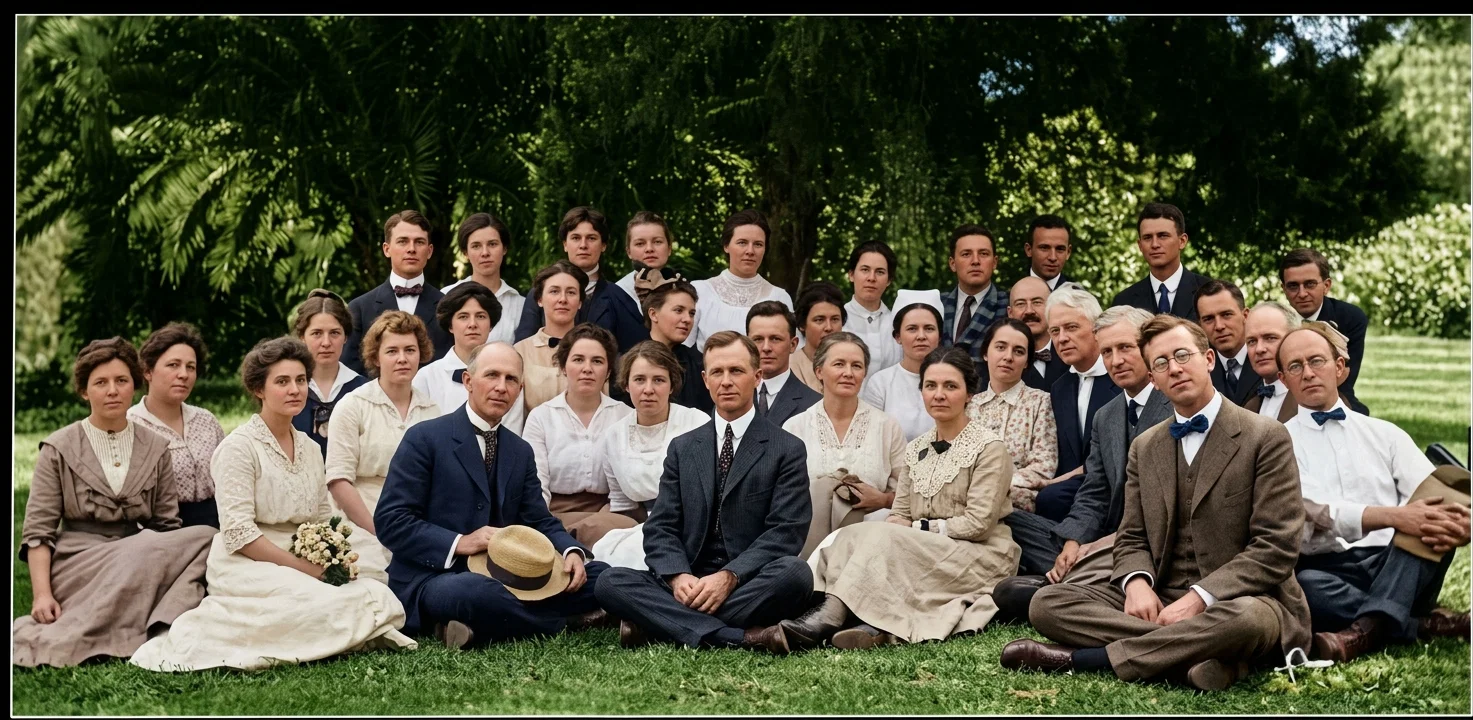
The camp meeting for the Southern Idaho Conference was held at Boise, May 18 to 28. The State Fair Association kindly permitted us the use of the fair grounds, which proved to be a most ideal place. Many more of our people were in attendance at this meeting than at any previous camp meeting held in this State. A deep spiritual interest prevailed, and the testimony of all was that it was the best camp meeting they had ever attended.
The first few days of the meeting the weather was unfavorable, but not a word of complaint was heard. Most of the delegates and others remained till the very last meeting. On the last day fifty-four persons were baptized.
The conference sessions were conducted in a way that made all realize that this is the work of God. Elder T. G. Bunch, of the Southern Oregon Conference, was elected president for two years, and Brother H. A. Green, of Western Washington, was chosen conference secretary and treasurer, Elder J. J. Nethery, former president, having been elected to the presidency of the Upper Columbia Conference, and Brother T. L. Copeland, former secretary and treasurer, taking Brother Green's place in Western Washington.
About $3,600 was raised at the meeting, $800 of which was for home work, and the rest for missions. Four new churches were admitted to the conference.
The workers from outside the conference were as follows: Elders C. W. Flaiz, E. W. Farnsworth, G. F. Watson.17S. A. Nagel, and J. H. Riffle (our German minister); Profs. F. Griggs and E. C. Kellogg; Dr. J. Reith; and Brethren S. N. Rittenhouse, W. R. Beatty, and H. J. Hoskin.
Many visitors came from the city; and as the interest continued to grow, it was deemed best to follow the meeting with a tent effort in the city. The writer was asked to remain and assist the president of the conference, Elder T. G. Bunch, in holding this effort. A beautiful place was secured in the heart of the city, and this effort began June 4. Pray that God will greatly bless to the saving of many souls.
S. A. NAGEL.
Nebraska
By Geo. J. Seltzer
FAIRBURY.— In May, 1915, I was rejoiced to see a neat little church building completed in Nebraska City, and dedicated to the service of God. A year later, May, 1916, I thank God for another new church building, in Fairbury. The Lord has surely blessed my ministry, and I am glad to have helped these new believers in providing themselves with suitable church homes.
In June I began a series of tent meetings in Hastings. The company already organized here has a good church, so I shall not need to help them in this matter. Pray for our success in the winning of souls for the kingdom.
GEO. J. SELTZER.
Finding Jewels in Africa
By Mrs. Ida Bowen
MRS. IDA BOWEN, whose husband, Lynn Bowen, fell asleep at the Tsungwesi Mission, Rhodesia, South Africa, June 2, 1913, writes from that mission, under date of Feb. 22, 1916, as follows:—
“We enjoy having a home by ourselves again. At first I thought it would seem lonely, but our house is anything but a lonely place. At eight o’clock we begin school for Ethel, Eugene, Guendelin, and Tennyson (a native). They have school until ten o’clock; then I go down and teach during one period in the mission school. Brother Tarr’s children are often here, and sometimes little Everett Jewell comes in.
“I have charge of the sewing. I have a girl to help me, and am planning to teach others to sew. A young woman just came who is going to ‘sign on’ [that is, contract to remain at the mission a certain time]. She came in with my sewing girl yesterday. She can already use a thimble, and sews very neatly by hand. She has lived near the Old Umtali Mission for three years. Her husband is coming later. She had on a white dress with black stripes in it, and trimmed with red. She looks very neat. Today she wore a white dress to meeting.
“We have a native here named Jonah, who came from that mission. He was here when we first came. He is one of our native teachers now. He is also a pupil still. He said he had been asked to return to the Old Umtali Mission, as that mission wishes to put him out to teach. He has no idea of going back. He is doing third-standard [grade] work now. He has no time for his reading lesson in school, so comes to my house to read and spell after dinner.
“His little three-year-old boy was dangerously ill a short time ago. Some of us stayed with the child day and night for a time. One day while I was there, Jonah was telling about two men who have come from Old Umtali Mission. The head teacher at that mission knows the native language well. He translated the hymns in the hymn book we use. They have a printing press there. Jonah says that that mission has asked these two men to return. We always wish we could do more than we are doing, and when Jonah told me this, I thought perhaps the men had a mind to go back. But Jonah’s face beamed with a smile as he said, ‘They say, “I want Tsungwesi Mission.”’
“Elijah, one of our native teachers, preached today. He spoke on the subject of faith, referring to Hebrews 11. He told the people that it meant much to be prepared to enter heaven. Of all that vast throng that left Egypt only two entered the Promised Land. Even Moses did not enter; he only saw it from the mountain top. Elijah told the people that they must not think, because they put on clothes and come to the mission, that that will save them. Many people who listened to the warnings of Noah were lost. It is not enough to listen. We must believe and act. We must have faith. We must believe the Word of God without any visible evidence of its fulfilment, as Noah did when he entered the ark at the command of God seven days before the rain began. When the people saw the storm coming, of course they believed Noah, and begged to enter the ark, but then it was too late. So it will be now. Then he referred to Hebrews 4, laying special emphasis on the fact that ‘the word preached did not profit them, not being mixed with faith in them that heard it.’
“I wish you could see Elijah. He told Lynn that he was at Solusi Mission six years. He said he plowed, but was not asked to teach, as others were, who had been there the same length of time he had. Some told him they did not see why he stayed, when all they asked him to do was to plow. But he said he stayed and plowed and plowed. At last he came here with Elder Sturdevant and was asked to teach. Now we think we could not get along without him. His ability and influence now simply show what a diligent study of the Word of God will do for any one.”
Editor's Testimonial Concerning the Book, “Bible Readings for the Home Circle”
By Walter L. Burgan
ONE of the most striking illustrations of the power of the newspapers in molding opinion favorable to our cause, was recently given in the city of Roanoke, Va., where one of our colporteurs was selling, “Bible Readings for the Home Circle.” This brother visited the editor of a daily newspaper there, and left with him a copy of the book, that he might examine it, and if favorably impressed, write something about it in the paper.
Our brother then visited the mayor of the city, who said that the giving of his order depended upon the way the editor felt toward the book. The editor wrote a most interesting editorial on the merits of the book, whereupon the mayor gave his order, and this opened the way for a number of other orders to be taken.
The editorial appeared in the World-News of April 6, and reads as follows:—
“For the Home Circle”
“Reading or studying the Bible may be a dull experience, or it may be delightful and interesting. It all depends on how the study or reading is undertaken. If we follow the Bible purely as a routine duty, it will not have for us the attraction and instruction that it ought to have and can have. If we take hold of it in earnest, get into the very depths of its wonderful mysteries, its uplifting lessons and history, we find it a fascinating companion, always new and fruitful, and containing information and suggestions that in the beginning seemed impossible. To obtain the best results from the pages of this marvelous book, the student must have many aids, and the chief of these is of course the writings of devoted Christian workers. These writings extend over thousands of years, those on the Old Testament penetrating into the remote past, and those on the New Testament to the birth of Jesus Christ.
“One of the most interesting and valuable of works on the Bible that we have had the good fortune to come into the possession of recently is, ‘Bible Readings for the Home Circle,’ a topical work arranged for home and private study, and printed by the Review and Herald Publishing Association, of Washington, D. C. More than a million and a quarter copies of this book have been sold. The copy of it which the World-News has obtained is a revised and enlarged edition, containing two hundred readings, in which are answered nearly four thousand questions on important religious subjects. These are contributed by Bible students, and present an array of knowledge on Biblical points that must prove extremely valuable. The publishers are represented in this community by Mr. S. N. Wilmer.
“With an index carefully and accurately arranged, the reader can find his way through the pages of this volume with ease, learning first the origin of the Bible, its history, and its place in the world, and then passing into almost a thousand pages of questions and answers that cover a vast ground and seem to embrace every possible point of Bible truth and discussion. Through lessons thus to be obtained, the student may learn the Bible view of life in its every phase. He may be armed with truth in all its strength, and for every problem that human existence presents, for every sorrow, and for every triumph; he may find the right answer. Seemingly each human need is weighed and each religious longing fulfilled. And in the end, in the simple but beautiful admonition of Proverbs, ‘Keep thy heart with all diligence; for out of it are the issues of life,’ there is the solution of every mystery and the pointing out of the way to victory.”—The World-News, Roanoke, Va., April 6, 1916; J. M. Miles, editor.
Our colporteurs over all the field would do well to clip this article from the REVIEW AND HERALD, and use it in visiting editors in their respective localities. No doubt many editors would be of the same opinion as the editor in Virginia, and by publishing something concerning “Bible Readings” they might open the way for our agents to place copies of this book in the home of people where they might not otherwise meet with success. Let us praise the Lord for the many opportunities that are continually coming to us to reach people with the light of gospel truth.
WALTER L. BURGAN.
Field Notes
NINE new members were recently received into the Central Church, at Seattle, Wash.
At St. Louis, in the East Michigan Conference, nine persons have begun the observance of the Sabbath.
THE new Seventh-day Adventist church in Huntsville, Ala., was dedicated to the service of God a few weeks ago.
What the Missionary Society Is
By Edith M. Graham
There seems to be in the minds of some a confusion in regard to who compose the church missionary society. Not infrequently we hear some one say, “The church took that action, not the little missionary society;” or, “The missionary society is responsible for that, it has nothing to do with the church.” Evidently, in the minds of these speakers, there is a belief that the missionary society is an organization separate from the church, made up of such members as choose to join it.
“The church of Christ has been organized on earth for missionary purposes.”—“An Appeal to Our Churches,” p. 28.
A body that has been organized for missionary purposes must be a missionary society. It cannot be an association from which a missionary society may be selected, while the association disclaims missionary responsibilities. Therefore every Seventh-day Adventist church as a whole is the missionary society, and every member is a member of the missionary society.
When Christ left this world, he placed his church in charge of the apostles as leaders and overseers, and gave it the following commission: “Ye shall receive power, after that the Holy Ghost is come upon you: and ye shall be witnesses unto me both in Jerusalem, and in all Judea, and in Samaria, and unto the uttermost part of the earth.” Acts 1:8.
That this great commission was not given alone to the apostles is evident. “The words, ‘Go ye into all the world, and preach the gospel to every creature’ (Mark 16:15), are spoken to each one of Christ’s followers. All who are ordained unto the life of Christ are ordained to work for the salvation of their fellow men. The same longing of soul that he felt for the saving of the lost is to be manifest in them.”—“Testimonies for the Church,” Vol. VIII, p. 16.
The church took up its appointed work, and every member evidently recognized his responsibility for making the truth known to others. “At that time there was a great persecution against the church which was at Jerusalem; and they were all scattered abroad throughout the regions of Judea and Samaria, except the apostles.” “Therefore they that were scattered abroad went everywhere preaching the word.” Acts 8:1, 4.
A careful study of the work of the apostle Paul shows that he must have trained his converts to make the gospel known. His conversion took place in A. D. 35. In A. D. 45, according to Bible chronology, he began his extensive work among the Gentiles. He visited countries, selected centers in which to start the work, labored there for a longer or shorter time, and then passed on. There is no record that he ever labored a second time in any place, though he visited the churches he had raised up. He left the churches to continue the work he had started, and to branch out into the districts around them.
It is supposed that the epistle to the Colossians was written in A. D. 64. In it Paul says, “If ye continue in the faith grounded and settled, and be not moved away from the hope of the gospel, which ye have heard, and which was preached to every creature which is under heaven.” Col. 1:23. “For the hope which is laid up for you in heaven, whereof ye heard before in the word of the truth of the gospel; which is come unto you, as it is in all the world.” Col. 1:5, 6. In thirty-three years from the death of Christ, a knowledge of the gospel had been given to the then-known world. This shows what can be done when every believer is a worker.
When the apostasy arose in the church and the mystery of iniquity was established, it was Satan’s studied plan to cover up or pervert all the principles on which Christ’s church was organized. Among these was the individual responsibility for making the gospel of salvation known to others. Instead of this, the ideal held up was retirement for prayer and meditation, with entire separation from human interests. Those who so lived were considered the most saintly. The propagation of religion was left to the ordained ministers and others set apart for that work.
Throughout the centuries of the Dark Ages, though largely covered up, the principle of individual service was never entirely abandoned. There were always individuals who had a burden to help other souls and to lead them to Christ. The Waldenses trained their youth to give to others a knowledge of the Scriptures. As the sacredness of the Sabbath was never entirely lost sight of, so the responsibility of believers for making the gospel known to others remained a living principle in many loyal hearts.
The third angel’s message is to prepare a people to meet the Lord when he comes in glory. They are being gathered out by a call to return to all the principles on which Christ’s church was organized, among them that of individual responsibility for laboring for other souls.
“God calls upon every church member to enter his service. Truth that is not lived, that is not imparted to others, loses its life-giving power, its healing virtue. Every one must learn to work, and to stand in his place as a burden bearer.”—Id., p. 47.
“To his servants Christ commits ‘his goods,’—something to be put to use for him. He gives ‘to every man his work.’ Each has his place in the eternal plan of heaven. Each is to work in cooperation with Christ for the salvation of souls. Not more surely is the place prepared for us in the heavenly mansions than is the special place designated on earth where we are to work for God.”—“Christ’s Object Lessons,” pp. 326, 327.
The final reward is for the workers, for those in whom Christ lived, and through19whom he carried on his work of saving sinners. “Glorious will be the reward bestowed when the faithful workers gather about the throne of God and of the Lamb. . . . They will stand before the throne, accepted in the Beloved. All their sins have been blotted out, all their transgressions borne away. Now they can look upon the undimmed glory of the throne of God. They have been partakers with Christ in his sufferings, they have been workers together with him in the plan of redemption, and they are partakers with him in the joy of seeing souls saved in the kingdom of God, there to praise God through all eternity.”—“Testimonies for the Church,” Vol. IX, p. 285.
“Then shall the King say unto them on his right hand, Come, ye blessed of my Father, inherit the kingdom prepared for you from the foundation of the world.” Matt. 25: 34.
Amos, a herdsman and fruit gardener of Tekoa, a small Judean town about twelve miles south of Jerusalem, was called to prophesy to the northern kingdom. In answer to the call he went to Bethel, where the heathen sanctuary was, and to Samaria, and fearlessly lifted up his voice against the idolatry and depravity of the chosen people as well as of the surrounding nations. On the complaint of Amaziah, the priest, Amos was expelled from the kingdom, and it is supposed that he returned to his home village and there wrote out his prophecy.
The book of Amos stands third in the list of the minor prophets, but in point of time it precedes that of Hosea. The prophecy was “delivered during the reign of Jeroboam II and just after his great successes. Prosperity brought grave evils in its train. The rich lived in great luxury; their houses were built of hewn stone and paneled with ivory, ‘where they drank and feasted to excess amid delicate perfumes and soft strains of varied music.’ But all this was obtained through violence and robbery. The poor and needy were sold as slaves, and false weights and measures used. The judges were notoriously corrupt. To be upright was to be hated and unpopular. Such in brief was the state of society in Israel when Amos went on his mission. He taught the truths that justice between man and man is one of the divine foundations of society; that privilege implies responsibility, and that failure to recognize responsibility will surely bring punishment; that nations, and by analogy, individuals, are bound to live up to the measure of light and knowledge which has been granted them; that the most elaborate worship is but an insult to God when offered by those who have no mind to conform in will and conduct to his requirements.”
Hosea
The prophetic career of Hosea, the first of the minor prophets, began about 784 B. C., and covered a period of about sixty years, the reigns of the last six of the kings of Israel. Hosea was a prophet of the northern kingdom. He was a contemporary of Isaiah, Joel, and Amos, and, like the latter prophet, was sent to the Israelites. It was a time of great spiritual darkness. Vice and iniquity flourished; the kings were dissolute and profligate; and the priests, lost to all sense of the sacredness of their office, introduced shameful heathen rites into God’s worship.
In the vivid pages of Hosea’s prophecy we are given some glimpses of the conditions prevailing at that day, against which his voice was uplifted in fearless and faithful warning. Of the style of the book, Eichhorn says, “His discourse is like a garland, woven of a multiplicity of flowers; images are woven upon images, metaphors strung upon metaphors.” Jesus, Matthew, Peter, and Paul quoted from this book.
Missionary Volunteer Department
M. E. KERN Secretary
MATILDA ERICKSON Assistant Secretary
MRS. I. H. EVANS Office Secretary
MRS. DE MACGUIRE Field Secretaries
C. L. BENSON
J. F. SIMON
Home Missionary Department
E. M. GRAHAM . . . General Secretary
F. W. PAAP . . . N. Am. Div. Secretary
The New Training School in Brazil
A LETTER just received from Elder F. W. Spies speaks very encouragingly of the opening of the new training school for Brazil, which took place on the fifteenth of April. He says:—
‘On the fifteenth instant we opened up our new training school. We had counted on twelve to fifteen students to begin with. There were thirty-two, and four others, perhaps more, are probably on the way. This will oblige us to use every available place as a dormitory tory. We are now occupying the laundry-rooms, the bakery, and, in fact, every place where people can sleep, as, aside from the students, we have to entertain the men who work on the buildings; but we are glad to see that the Brazilian youth are getting an education for the work.”
The Loma Linda Medical Evangelists’ Class
By George B. Starr
MORE interesting and more attractive than California’s sunshine, its mingled oranges and orange blossoms, and its profusion of roses, or its acres of poppies, geraniums, and other flowers, is the student body of one hundred and fifty earnest youth at Loma Linda, preparing for the work of God.
To observers here who are interested in the progress of the work of God, and who are praying the Lord of the harvest to send forth laborers into his vineyard, the passing of these students over the green lawns to and from the assembly hall, the laboratory, the hospital, and the sanitarium, seems a daily promise of speedily answered prayers.
Into this earnest body of teachers, medical students, and nurses was introduced last fall a new class of matured persons,—graduate nurses, canvassers, church elders, and Bible workers,—to take the special training called for by the Spirit of prophecy to prepare for medical evangelistic work.
Hundreds, said the servant of the Lord, should be rapidly trained to be able intelligently to treat the sick poor, to diagnose their troubles, and minister to them both physically and spiritually.
This class opened Sept. 26, 1915, with a membership of thirteen. It rapidly grew to more than forty, and reached at its highest point a registration of fifty-one. The faculty are now hoping to open the next fall term with a medical evangelistic class numbering one hundred.
The daily school work of this class embraces: Study of diseases; anatomy and physiology; theoretical and practical hydrotherapy, including experience in the bathrooms; dietetics, both theoretical and practical experience in cooking and assisting in schools of health; infant feeding; obstetrics; and Bible doctrines in the form of Bible readings and class study in the Spirit of prophecy. The afternoons are occupied largely in field work, consisting of visiting and conducting meetings in the near-by cities and villages.
It is planned that the second year of this two-year course shall be spent in Los Angeles in advanced class work, clinical experience, public health work, and Bible work.
It is the design to adapt this medical evangelist course to especially meet the requirements of graduate nurses who desire postgraduate work to fit them for medical evangelism and soul-winning work.
We hope our people will pray especially for this medical evangelistic class and for those who ought to join it. There are hundreds of graduate nurses who ought to prepare to answer the call of the hour for workers in the ripened harvest of our own cities and in the regions beyond.
MEDICAL EVANGELISTIC CLASS, LOMA LINDA
Such persons ought to be sought out by friends and acquaintances, by church and conference officers, and encouraged by counsel, and by financial help when necessary, and urged, for the salvation of their own souls as well as those for whom they might minister, to give themselves at once to the work of the Lord. A large number of “eleventh-hour” workers are needed just now to help finish the work, to hasten the coming of the Lord, and to bring to an end earth’s sufferings, and the sufferings of our sympathizing Lord, who shares the sorrows of every suffering soul.
A very precious spirit has attended this class all through this year.
G. B. STARR.
A Rural School
By Ettie V. Brown
WE send a few words of encouragement from our little rural school here in the mountains near Rome, Ga. We started a free school for white children in one room of our small cabin. The school grew beyond our expectations, and when it closed, at the end of eight months, we had twenty-two children, whose ages varied from six to fifteen years, all crowded into the small room.
Many others wish to come as soon as the cotton is “chopped,” so it has become necessary to plan for a place to hold the school. Friends in San Fernando, Cal., sent us a few dollars to start our fund. We laid the matter before the people of our neighborhood, and they were ready to help what they could. The editors of the Tribune-Herald of Rome took an interest in our work, and offered encouragement through the channel of their paper. When we approached the merchants, lawyers, and other business men of the city, we felt that angels had gone before us, and with scarcely an exception every man was ready to help with a donation and words of commendation and good wishes.
Just one year ago we made the start to raise the money, and now our schoolhouse stands under the beautiful oak trees. It is all inclosed, oil finished inside, and has one coat of paint on the outside. Two days’ more work and it will be finished. It will seat fifty pupils, is neat and sanitary, and rightly represents the work we are trying to do. Patrons and friends here have made pledges to cover the amount due on the house, and we shall do all we can to have every cent paid in a few weeks. The people certainly appreciate what is being done for their children.
We were urged to start a Sunday school, but had no place to hold it. Now that the weather is warm, we have organized a Sunday school a half mile from our home, where we have the use of a large pavilion and plenty of benches. We expect to have between seventy-five and one hundred in attendance, and hope to make it a source of light to these people.
We pray for God to bless our crops,20so that we may have the necessities of life and be able to push forward in work for the Master. The burdens fall heavily on our little family of four, but we are not discouraged. Pray for the work in this neglected field.
ETTIE V. BROWN AND FAMILY.
Medical Missionary Department
W. A. RUBLE, M. D. - - General Secretary
L. A. HANSEN - - Assistant Secretary
H. W. MILLER, M. D. - N. Am. Div. Secretary
Educational Department
FREDERICK GRIGGS - - General Secretary
W. E. HOWELL - - Assistant Secretary
Items of General Interest
— James J. Hill died at his home in St. Paul, Minn., May 29. His age was seventy-eight years. Mr. Hill was acknowledged as the foremost railroad builder and business man in the Northwest, but his unparalleled ability appeared in many other fields of endeavor. His wealth is estimated at $3,000,000.
— David S. Jordan, chancellor of Stanford University, has been relieved of active duties as head of the institution and retired with the title of chancellor emeritus. Dr. Jordan was president of the university from 1891 to 1913, after which he became chancellor. He is considered as one of the first authorities on that branch of science which treats of fishes.
— M. Venizelos has been reelected as a member of the Chamber of Deputies of Greece. It will be remembered that he resigned under pressure several months ago.
— The American people, long known as the world's coffee drinkers, actually consume forty per cent of the amount sold in the international markets, according to figures announced recently by the Bureau of Foreign and Domestic Commerce. More than 1,000,000,000 pounds of coffee came to this country last year.
— Philadelphia lays claim to the honor of being the greatest Sunday school city in the world. Three hundred thousand people, or one fifth of the city's population, are enrolled in Sunday school. It has seven hundred Sunday schools, and 50,000 men are enrolled in men's classes, and 15,000 women in the women's classes.
— New interest is being displayed among the mining camps of Colorado, owing to the rise in the price of silver. With the prices around 50 cents an ounce, as they have been for a number of years, operators have been unable to work their mines to an advantage. Now the price of silver has jumped to more than 73 cents, and many owners are preparing to begin operations anew.
— At the request of a number of the students, a course in military training under the direction of the United States War Department has been added to the regular curriculum of the University of Pennsylvania. The course will be made up of lectures and camp and field work, and will require about three hours of training each week. A large part of the student body has already enrolled.
— Secretary of the Interior Lane officiated at ceremonies held recently in Yankton, S. Dak., in which 186 Sioux Indians publicly renounced the faith of their ancestors and took the oath of allegiance to the United States. Each Indian was given an arrow, which he shot into the air, signifying that he would never want it again. Then each grasped the handle of a plow, thus showing his willingness to accede to modern civilization.
— The Elephant Butte dam in New Mexico on the Rio Grande River, which has just been completed, forms the greatest storage reservoir in the world. The reservoir will supply water for the irrigation of 185,000 acres in New Mexico, Texas, and Mexico. It will hold 115,000,000,000 cubic feet of water. The height of the dam is 318 feet and the length 1,674 feet. At its base it is 235 feet thick. It provides a roadway across the cañon sixteen feet wide.
— It is officially stated that New York has become the greatest commercial port in the world. A computation made by the Bureau of Foreign and Domestic Commerce in the Department of Labor at Washington, D. C., of the commercial standing of all the leading trade centers of the world, shows that New York had in 1915 a total of foreign trade amounting to $2,125,000,000. This is $200,000,000 more than London can claim. The exports from New York in 1915 totaled $1,194,000,000, as compared with $969,000,000 credited to London.
— While a battery of field artillery fired the Presidential salute of twenty-one guns, the first statue of George Washington to be erected on the reservation of the United States Military Academy was unveiled at West Point on the afternoon of May 19. A large assemblage, which included the entire corps of cadets and army officers stationed at West Point and more than 100 specially invited civilians, witnessed the ceremonies. The statue, representing Washington as a general on horseback, was given to the academy anonymously, the donor simply styling himself, "A patriotic citizen, a veteran of the Civil War."
— Without a single stop and without a mishap Victor Carlstrom, in his big 190-horsepower Curtiss aeroplane, the J. N. 8, carrying Alan R. Hawley, president of the Aero Club of America, as a passenger, flew from New York to Washington on May 24, in 187 minutes. The line of flight is estimated as 237 miles long, so that the average speed was almost one and one-fourth miles a minute throughout, or about seventy-eight miles an hour. They brought with them a heavy load of newspapers, as the flight was intended to show the availability of the airship as a mail-carrier, as well as to give an object lesson of the feasibility of forming a force of 2,000 trained aeronauts in connection with the National Guard.
— New York is the largest Jewish city in the world. It is the largest Irish city, there being 674,000 of Irish blood there. There are 723,000 Germans, 306,000 Austrians, and 735,000 Russians. New York spent last year $424,662,000, which was $4,000 more than its income. Its debt is $1,361,483,800, greater by more than $250,000,000 than the debt of the United States, and six times the combined debts of Boston, Philadelphia, and Chicago. There are more than 3,000 miles of water pipes under the city; the capacity of the reservoirs is 170,000,000,000 gallons, and the conclusion of the Schoharie project will add 80,000,000,000 to this. The police department costs $16,241,000. There are 10,674 policemen. The fire department costs $9,719,000. Every day 290,000 persons arrive or depart from the city through the railroad stations. The railroad systems terminating in New York have a mileage of 45,300, or eighteen per cent of the total mileage of the country. Every thirty minutes a new business corporation is formed in New York, and every forty-five minutes one is dissolved. New York has 38,000 factories. They employ capital amounting to $1,800,000,000 and turn out $2,900,000,000 worth of goods a year. More than twenty-one per cent of the nation's banking resources are here. The banks have a capital of $216,157,000 and deposits of $5,377,461,000. The city has 198 parks, with an acreage of 8,600. It has 1,500 hotels. More than 500 conventions are held here a year. There are 250 theaters and 600 smaller places of amusement. New York has 1,525 churches, with 1,709,241 communicants. The schools have 802,573 pupils and 20,063 teachers. There are 102 hospitals, with 21,850 beds. There are 31 post offices. The Manhattan post office received last year $30,127,000 and spent $10,915,000. It handled 109,480 tons of second-class mail.21
— The National Education Association will meet in New York the week beginning July 3. An attendance of 50,000 is expected. With them will meet also the American School Peace League, the School Garden Association of America, the National Congress of Mothers and Parent-Teacher Association, National Federation of State Teachers' Association, National Vocational Guidance Association, League of Teachers' Associations, National Conference of Workers in Extension Education, United States Department of Agriculture, American Home Economics Association, American Posture League, the National Council of Teachers of English, and the Conference of Deans of Women. Every facility for sight-seeing and observation in New York has been arranged for their advantage. The main session will be addressed by men and women of national reputation, at the head of whom stands President Wilson. Plans for seventeen department or sub-meetings have been prepared.
Broadview Swedish Seminary
By H. O. OLSON
THE Broadview Swedish Seminary has just closed one of its most successful school years. The closing exercises were very impressive and inspiring, and a fitting culmination of the many spiritual feasts enjoyed during the year.
Of the seventy students enrolled, all except three remained until the close of school. The enrolment was about fifty per cent above that of the previous year. Half our number enter the canvassing work during vacation. Several go out as tent masters and Bible workers. The seminary graduated a class of eight,—two from the seminary course, which includes fourteen grades of work; and six from the academic. These two were the first to be graduated from the seminary course. They will probably remain permanently in the work.
Plans have been laid to increase the enrolment for next year, and consequently dormitory room is being provided for about fifteen additional students. A number of improvements were voted by the board of trustees at its last meeting. These will be made as soon as sufficient money is secured. We have every reason to believe that by the opening of the next school year the entire debt of the institution will be liquidated, and a surplus raised to make possible all improvements voted. When this has been accomplished, we plan to dedicate the seminary and celebrate our jubilee of freedom from debt.
We extend a cordial invitation to all Swedish young people within our ranks who have not finished their education to attend the seminary next year. The fall semester opens September 20. Any one desiring information concerning the courses offered by the school should write for a catalogue at once. Address the Broadview Swedish Seminary, R. F. D. 1, Box 20. Lagrange, Ill.
H. O. OLSON.
News and Miscellany
Notes and clippings from the daily and weekly press