Donald Sees Some Bible Pictures and Hears Them Explained
CARLYLE B. HAYNES
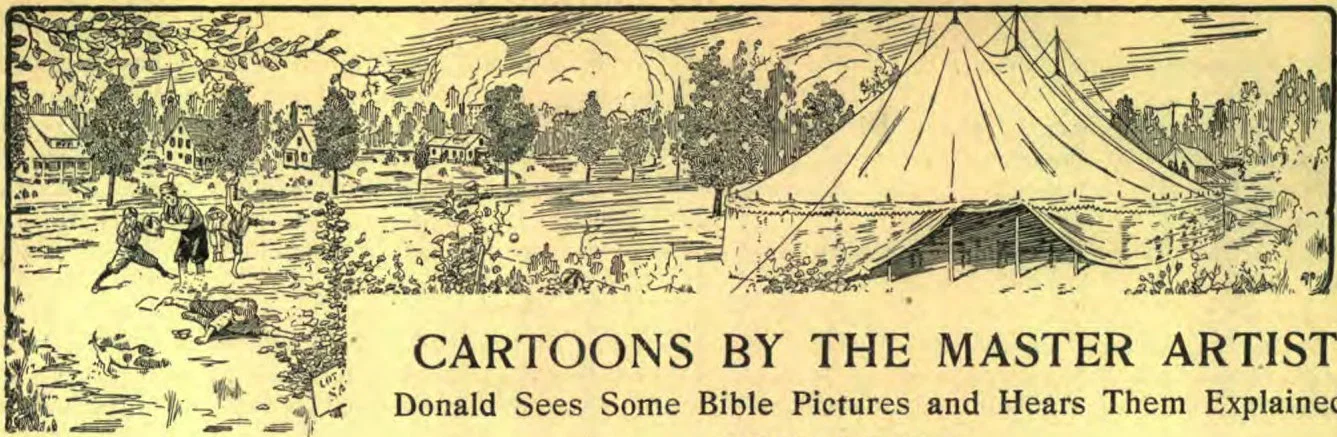
THERE was a light rain falling when Donald Hunter and his folks reached the tent on Friday night of the second week of the tent meetings, but notwithstanding the unpleasantness of the weather, the tent was comfortably filled by the time Elder Harris began his sermon. And it was not long until every person present was intently listening to every word of the wonderful things he was saying.
“During recent years,” the preacher began, “the educational world has discovered that one of the best methods of imparting information and giving instruction is that of teaching by object lessons, and this method has now been widely adopted in the public school system of the United States and other countries. Thousands of years ago God knew the value and benefits of the object lesson, and used it largely in the writing of the Bible, especially the prophetic parts of the Bible.
“In the prophecy of the seventh chapter of Daniel, which we are to study tonight, the Lord used this method.” Here the minister read the first four verses of Daniel 7. [Let the boys and girls who are reading these stories turn to this passage and read these verses and others mentioned later in this article.] Then Brother Harris said:
“It is just such parts of the Scripture as this that bring discouragement to many a Bible student’s heart. As he reads, he says to himself, ‘What a strange dream; what can it possibly mean?’ And he decides that the Bible is one of the most peculiar and most difficult books in the world. Many, reading such a prophecy for the first time, and not finding an explanation at once, give up trying to understand its meaning. Many conclude it has no meaning, and was never intended to be understood; and when they again read the Bible they avoid these prophecies which are so rich in instruction and wisdom for the people of God today. Undoubtedly the two most neglected books in the Bible are those of Daniel and the Revelation, the books which are filled with prophetic symbols of beasts, horns, wings, many-headed monsters and their strange doings.
“But when the same persons pick up the daily paper and see similar things portrayed there in the form of cartoons, they have no difficulty in understanding them. We are accustomed to just such representations in our papers as we find in the prophetic parts of the Bible, so accustomed to them indeed that we grasp their meaning at a glance, and they never give the trouble that the cartoons of the Bible do. For these symbols of prophecy are cartoons,—cartoons by the Master Artist. If all who study the Bible could get that thought clearly in their minds, it would make plain many things in these prophecies which they have considered hard to understand, and they would find in the prophetic parts of the Scripture a rich and fruitful field of study in which they would take the keenest delight.
“If tomorrow morning you should see a cartoon in the paper in which there were a lion and a bear, what would you understand by them?” Brother Harris asked the audience.
“England and Russia,” called out Donald, almost before he thought.
“Even the young folks understand this method of instruction as used today,” said Elder Harris. “And if you should see a great yellow dragon and an eagle in a cartoon, what would they mean?”
“China and the United States,” came back the reply from the audience.
“Yes,” said the preacher. “And now consider the value of this system. Very often by a mere glance at a front-page cartoon in the paper one can get a better idea of the conditions which prevail on the earth than by reading many columns of printed matter. This method conveys to the mind quickly what other methods take much longer to convey.
“This is the reason why God uses this method in this chapter of Daniel. By it he imparts to men a great amount of truth in a very small compass. In this chapter God has told the whole history of the world, from Daniel’s time to the end, in eight verses. In these verses he has covered the history of the four great empires of the world, history which human writers have taken whole libraries to tell; and God has told it so well in these pictures that no important thing has been left out.
“And, it must be remembered, this is history in advance. Here is outlined the origin, the work, and the fall of the world’s great empires before these empires existed. Surely, if this is done accurately, all must confess that only the One who knows the end from the beginning could have caused these prophecies to be written. Jehovah, the God of heaven, to whose glance all the future is as open as all the past, caused these things to pass before the mind of Daniel in holy vision, and they were written for our comfort and our learning who, in this age of the world, are to see their complete fulfilment.
“In the verses I have read there are five symbols: the winds, the sea, the beasts, the lion, and the wings. Let us notice what these symbols represent.
“The winds represent wars, strife, commotion, and bloodshed. This will be seen by reading Jer. 25: 32, 33.
“The sea, or water, represents the nations and multitudes of the earth. This you will learn from Rev. 17: 15.
“The four great beasts of this chapter represent four great kingdoms which were to exist in the world. This is evident from Dan. 7: 17.”8
“This prophecy might be stated in literal language as follows:
“I saw in my vision by night, and, behold, as a result of great wars among the people and nations of the earth, four great kingdoms arose, different one from the other.”
“The first beast represented the first universal empire, the kingdom of Babylon. Read Jer. 4:7; 48:40; 49:22, 28.
“The eagle’s wings on the lion represent the rapidity with which Babylon conquered its enemies. It spread its wings over them all until all kingdoms were brought into subjection to it. Then the wings were plucked. This means it no longer flew forth to conquest, but became timid and fearful, and thus lost its dominion.”
After reading verse 5 of Daniel 7, the speaker said: “This bear represents Medo-Persia, the kingdom which overthrew and conquered Babylon.”
He then read verse 6, and explained: “The leopard represents Greece; the wings on its back represent the unparalleled rapidity with which Greece, under Alexander, made its conquests. The four heads represent the divisions of this empire after Alexander died. There were just four of these divisions, and they were ruled over by his four leading generals, Cassander, Lysimachus, Seleucus, and Ptolemy.”
After reading the seventh verse, Brother Harris said: “This terrible ten-horned beast represents Rome, and fitly represents it, for Rome was dreadful, terrible, and exceedingly strong.
“The ten horns of this beast represent the ten kingdoms into which Rome was divided between the years 351 and 476 A. D. See verse 24. These were the kingdoms of the Alemanni, the Franks, the Suevi, the Burgundians, the Vandals, the Anglo-Saxons, the Visigoths, the Ostrogoths, the Heruli, and the Lombards.”
Then verses 8, 24-26, were read, and the speaker continued: “This little horn which came up after the ten horns represents the Papacy, or the Roman Catholic Church. The Papacy did subdue three of the first powers. Its ambitious designs brought about the destruction of the Heruli in 493 A. D. and of the Vandals in 534, and it gave the deathblow to the independence of the Ostrogoths in 538; therefore this last date becomes the starting point for that long period of time mentioned in verse 25 during which the Roman Catholic Church was to have power over the people and laws of God.”
After the reading of verse 25, the following remarks were made: “The Catholic Church has spoken ‘great words against the Most High.’ Throughout all its long history, under the pretense of standing for God, it has been against him, against his people, his truth, and his church.
“The Catholic Church has worn out ‘the saints of the Most High.’ Between 50,000,000 and 100,000,000 of the people of God suffered for their faith during the supremacy of this terrible power. They were put to death in every way known to the ingenuity of men and devils. They were thrown into caldrons of burning oil; torn with hot pincers; splinters of pine wood were driven under their finger-nails and toenails, and then set on fire to burn into their flesh; they were pulled to pieces by the rack, and burned at the stake.
“The Catholic Church has attempted ‘to change times and laws.’ The only time referred to in the law of God is in the fourth commandment, the Sabbath commandment. The Catholic Church has attempted to change the Sabbath, and has succeeded in changing its observance from the seventh to the first day of the week. It has substituted the first day for the seventh, and today the larger part of the Christian world is observing Sunday. But the only authority for the observance of that day is the authority of the Catholic Church.”
“The time during which the Catholic Church would have power to work its will with the saints, the times, and the laws of God is next pointed out. ‘They shall be given into his hand until a time and times and the dividing of time.’ In Rev. 12:14 this same period is mentioned as ‘a time, and times, and half a time.’ In Rev. 12:6 it is spoken of as ‘a thousand two hundred and threescore days.’”
“As each one of the 1260 days of this period represents a year, according to Eze. 4:6, it is plain that this period would mark the limit of the time of the supremacy of the Catholic Church over the saints, the times, and the laws of God. The time of that supremacy would be just 1260 years.”
“This long period of time began in 538, the date we have already mentioned, at which time the Ostrogoths in Italy were subdued. Adding 1260 years to this date, 538, we are brought to 1798, the terminal point of Catholic supremacy, and the end of the 1260 years.” This was illustrated on a large blackboard.
“In 1798, the end of the time of papal supremacy, a French army under General Berthier entered the city of Rome, proclaimed a Roman republic, took the Pope prisoner and exiled him to France, where he died the following year. A new pope was elected in 1800. From 1798 to the present time the Papacy has not possessed the power that it had before that date. Thus this prophecy has been exactly fulfilled.
“Before long the dominion of the Catholic Church will be completely taken away from it, as you will see in verse 26, and then the dominion of the earth will be given to the people of God, and the everlasting kingdom of Christ will be set up, according to verse 27.”
“Thus the prophecy ends with the assurance that Christ’s kingdom is near at hand. It points forward to that time when God’s people, so long without a kingdom of their own, will at last enter into the kingdom prepared for them and be free from all oppressive powers, holding it in everlasting possession. I trust all here tonight will turn their eyes in the same direction, and through the grace of Christ, by obedience, bring their lives into harmony with the law of God, that they ‘may have right to the tree of life, and may enter in through the gates into the city.’” Rev. 22:14.
As Donald was going home he heard many comments on the sermon. All were agreed that it was wonderful, but they talked mostly about that part of it in which the declaration had been made that the Catholic Church had changed the Sabbath. This troubled Donald, too. He had never thought of that before, and he made up his mind to ask Brother Harris about it.
Thoughts and Words Carry Far
“Your thoughts and words seem little things:
Do not forget that they have wings,
With wondrous power to travel far
Around the earth or toward a star.”
God's Work in Forming Christian Gentlemen
“God has not yet finished his work with the Christian who is not a perfect gentleman.”
Worth-While Exercises
TEACHERS often give the command to their pupils, “Good position.” By this they really mean for the pupil to stand erect, with every organ in its proper position; or, in other words, to take the position of a soldier at attention. This position is thus described:
“Heels on the same line, and as near each other, as the conformation of the man permits.
“Feet turned out equally, and forming an angle of about forty-five degrees.
“Knees straight without stiffness.
“Hips level and drawn back slightly; body erect and resting equally on hips; chest lifted and arched; shoulders square and falling equally.
“Arms and hands hanging naturally, thumb along the seams of the trousers.
“Head erect and squarely to the front; chin drawn in so that the axis of the head and neck is vertical; eyes straight to the front.
“Weight of the body resting equally upon the heels and balls of the feet.”
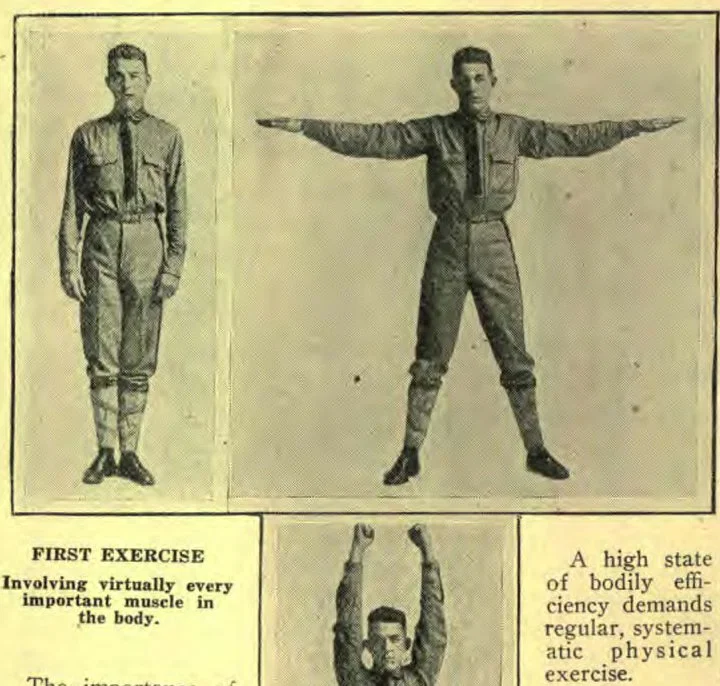
FIRST EXERCISE
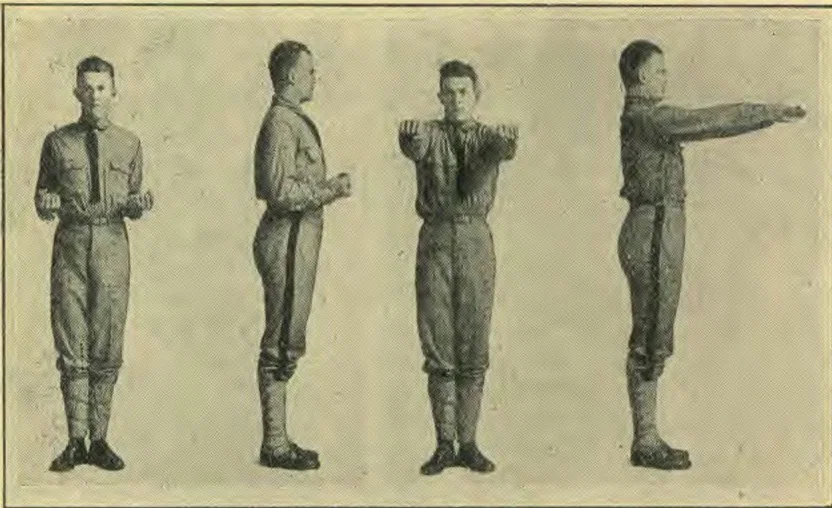
Involving virtually every important muscle in the body.
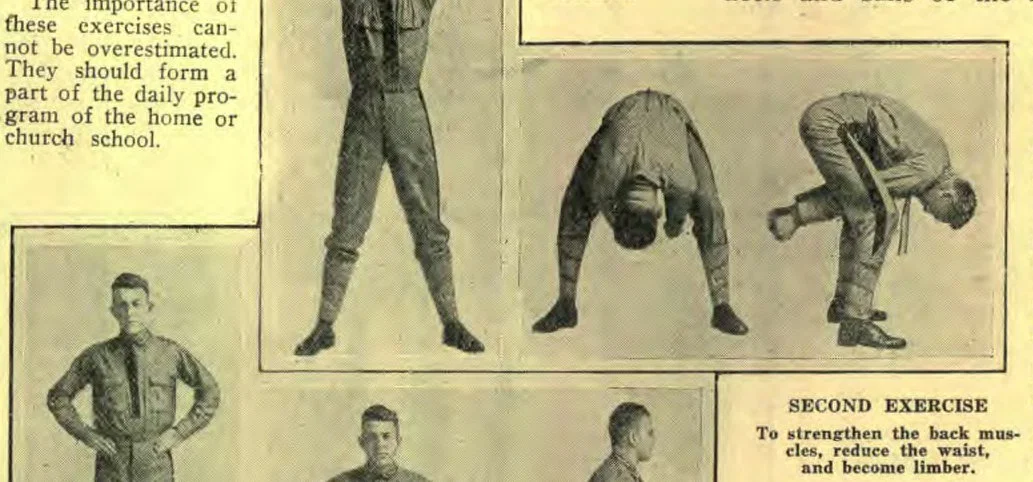
SECOND EXERCISE
To strengthen the back muscles, reduce the waist, and become limber.
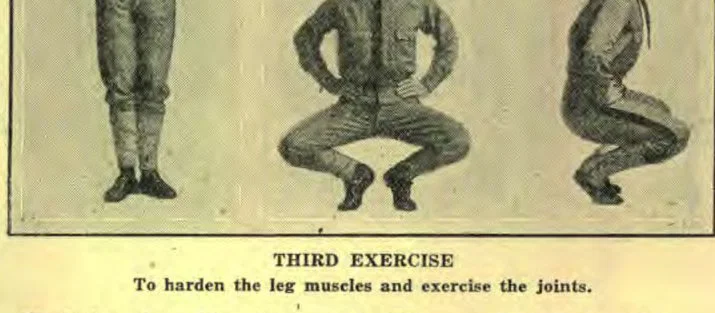
THIRD EXERCISE
To harden the leg muscles and exercise the joints.
There are five exercises which are given to recruits that are the results of years of study, and comparison and expert advice. These are as good for citizens as for soldiers; and as helpful in times of peace as in war. These exercises should be taken before an open window, and with the body in position. If these five exercises are taken two or three minutes once or twice a day, they will correct all defects in carriage of the body, besides keeping one in good physical condition.
The exercises to be most effective should be taken slowly and vigorously.
“The first exercise involves virtually every important muscle in the body — a general limbering-up. Stand at attention. Now spring to a position with the arms fully extended at the side and with the feet in a 45-degree position, about fifteen inches apart. From this instantly return to the first position, back to second, and so on.
“Be light on your feet. Alight on your toes. Begin with a limited number of times. Day by day increase it a little until you reach a fair number. Be moderate at first. Never allow yourself in any exercise to become greatly fatigued.
“The second exercise is to strengthen the back muscles. With feet apart (about fifteen inches), extend the arms above the head, the hands closed. Then swing the body down as far as possible, letting the arms pass between the legs. Then return to the original position.
“The next exercise is to harden the muscles of the legs and make the joints supple. Stand with heels10touching, hands flat on hips, the fingers forward and close together. Then, with toes turned out, drop to a sitting position, at the same time rising on the toes. Return at once to the original position. Turn out the toes well. Hold body and head erect and come up with a slight spring. After a little practice you will have no difficulty in balancing yourself.
FOURTH EXERCISE
To exercise the arm and shoulder muscles and the organs of the chest.
“Now let’s get at the arm, chest, and shoulder muscles. Stand with the elbows close to the sides, the hands lightly closed, and raised, palms up, to the level of the waist. Now thrust the arms straight forward from the shoulder, at the same time turning the hands so that the backs are up. Return to the original position. Vary this by thrusting the arms downward, sidewise, and upward, moderately at first, but growing more vigorous with practice.
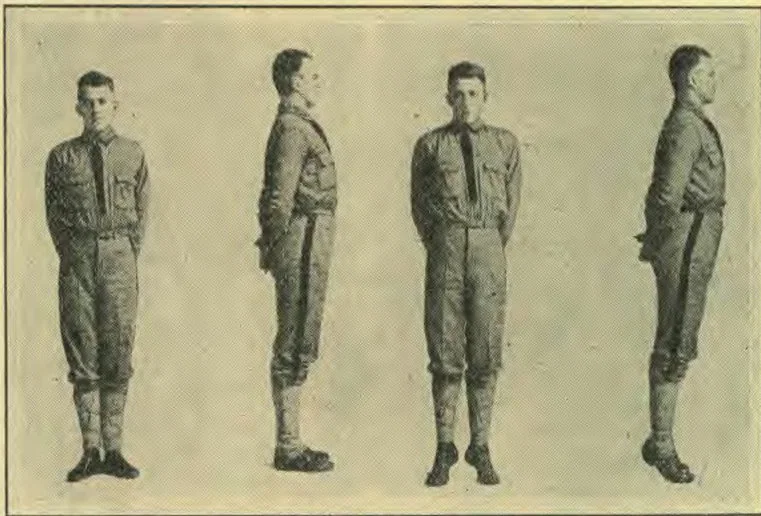
“The fifth and last exercise is one to strengthen the ankle and instep. You would be surprised to know how many men fail to pass the military examination because these muscles have not been properly developed. Standing erect, with hanging hands clasped lightly behind the back, rise on the tips of the toes, as high as you can, and drop back again.”
FIFTH EXERCISE
To strengthen the ankles and insteps.
Prayer Answered
By D. E. Belleau
ONE bright autumn evening George Bell could be seen walking quickly to the boys' dormitory. He was a student in Rosedale Academy, and had traveled nearly nine hundred miles because he thought this was the best school he could attend. He had heard many testify to God's answering the prayer of faith. His heart was deeply stirred. He really longed to be a Christian, but, like the apostle Thomas, had little faith. The question kept ringing in his ears, Will God answer my prayer? He was not a Christian, and wanted personal proof of God's power before accepting Christianity. Humbly he earnestly besought the Lord to heal his sick mother, promising that if his prayer was answered, he would become a Christian.
Three days later he received a letter from home. To his joy he read of his mother's restored health, and of her healing about the time he had prayed so earnestly for her recovery. Surely God had revealed himself to George. True to his word he then accepted Christ as his personal Saviour, and now he is abiding in God's love.
As surely as God answered this prayer, he will answer yours if asked in faith and if it is expedient, because he has said: “Ask, and ye shall receive.” However, sin must first be banished from the heart. Let us therefore determine that with God's help we will put away all sin. Then God's richest blessings may be ours.
D. E. BELLEAU.
Facts About Bible Weights and Measures
By William Woolgar
IF you had been reared in Palestine at the time of Christ, you would not have learned that sixteen ounces make one pound, that one hundred pounds make one hundredweight, or that twenty hundredweights make one ton. Instead, you would have learned that ten gerahs equal one bekah, two bekahs equal one shekel, sixty shekels equal one maneh, and fifty manehs equal one talent.
Not only were the Jewish weights and measures arranged in an unsystematic way, but the standards were often variable, so that all measures were more or less inaccurate. Thus we find that a cubit, which was the distance from the elbow to the tip of the middle finger, varied as different arms varied. However, it is generally accepted that a cubit was approximately a foot and a half.
There are three reasons for the inaccuracies found in different standards. The first cause is the general inexactness to which the Oriental mind was accustomed. Another reason is that the original models of measures, etc., were lost hundreds of years before. The third reason for variation is because the Hebrews would adopt a measure of other peoples and call it by the name of their own measure which approximated it in size.
A barleycorn was the smallest measure of length, and it equaled the average length of a grain of barley.
Thus all measures, to a great degree, were reckoned by comparison with commonplace objects. The Hebrew “small mile” was one fourth the distance of our mile, and the “long mile” was one half of our mile. A day’s journey was about twenty miles, and a Sabbath day’s journey was two thousand cubits, a half mile or more.
An omer, the measure that the children of Israel gathered manna in, was two and one-half times as large as our quart. The seah was equal to a peck and a half, and the ephah was about three fourths of a bushel.
We find that the Hebrews had very minute measures of weight, because in the early days money was reckoned by weight. Coins came into use later.
There are two systems of money recognized in the Bible, the Jewish and the Roman. The Jewish system consisted of gerahs; bekahs, shekels, etc. A gerah, the smallest amount of money, was equal to a little more than two and one-half cents, while the kikkar of gold, the largest amount that was used as a measure, was over twenty-six thousand dollars. The Roman coins mentioned in the Bible are the two different farthings, one equal to one fourth of a cent and the other equal to one cent; and the Roman penny, which was equivalent to seventeen cents. Comparing sums of money spoken of in the Bible to modern units, we get a more vivid idea of the lesson set forth. Naaman’s offering to Elisha was more than $48,000. This sum, and others to be mentioned, had then ten times the value or buying power they would have today, a fair day’s wage in early times being a Roman penny, or seventeen cents. In the parable of the two debtors, the one who had been forgiven 10,000 talents, or $14,400,000, refused to forgive 100 pence, or $17. Christ was sold for $16.96, the price of a slave, and Joseph for $11.28.
These few illustrations show how much more interesting our Bible is when we look up little details about the passages we read.
WILLIAM WOOLGAR.
EASY LESSONS IN LETTERING
By Harry H. Hamilton
By Harry H. Hamilton
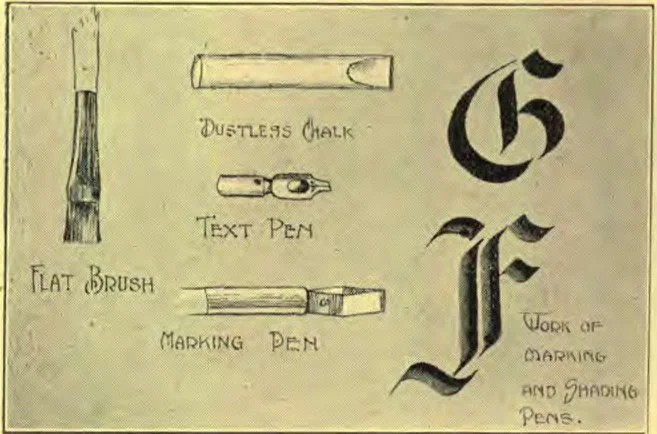
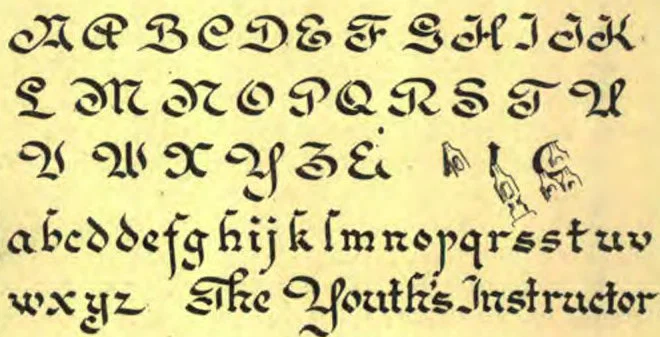
Shading pens are used in exactly the same manner as the lettering pens. Shading pens are toothed for a short space on one side to produce a heavy line opposite the tooth, and a shadow for the remainder of the width. Marking pens are toothed all the way across, to produce a solid color. I have drawn in one of the plates a marking pen, and also a specimen of the work done by both. The most satisfactory results are obtained by the use of Nos. 3 and 4.
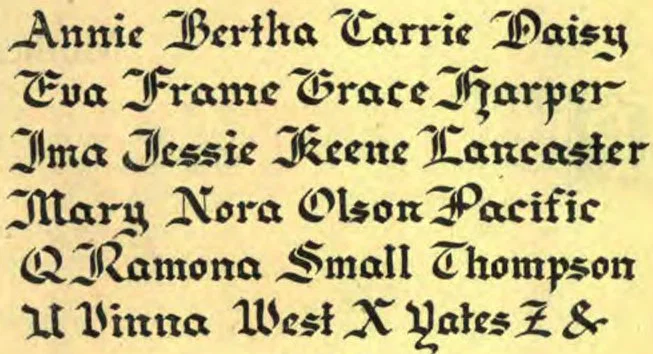
Plates II and III were made with a No. 4 Esterbrook's Text Writer Pen. Guide lines should be made one-half inch apart for capitals and five sixteenths for small letters.
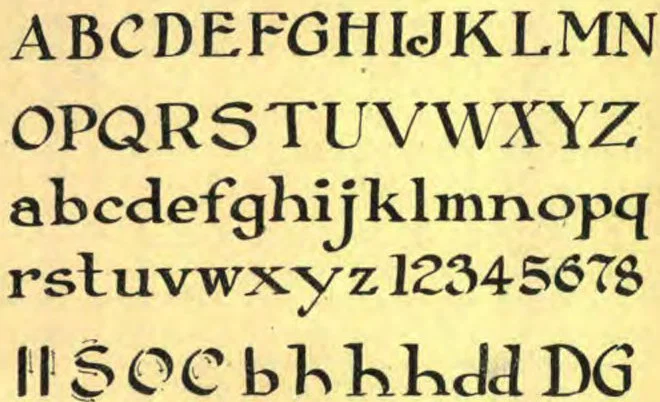
Plate IV was made with the same pen that was used in Plates II and III, but held so that the point was parallel with the line of writing, this position being maintained in making every part of the letter. The little ticks at top and bottom of stems are made by moving the pen in a direction parallel to the line of writing, and filling in as shown in the letters of the last line.
The lines are nine sixteenths of an inch apart in this alphabet for the capitals and five sixteenths for the small letters. Similar letters may be made with a pencil pointed like a chisel. Persistent practice in this line of work will bring the reward.
Lettering with Brush
In lettering with the brush, the same motion may be used as with the text and lettering pens, however a different ink should be used. The best ink for this same purpose is Carter's “Velvet” Show Card Ink. This ink dries with no luster, and the colors are true.
All the styles of letters given in this series of articles may be written with chalk crayons sharpened flat and held at an angle of forty-five degrees to the line of writing for text and Old English letters. The pencil motto accompanying this article was made with a soft lead pencil sharpened flat and held as you have been instructed elsewhere for pen work.
PLATE II
If those practicing these letters desire to take up fully the study of the use of the brush, they are referred to the revised edition of “Modern Show Card Lettering of Designs,” by the Thompson School of Lettering, Pontiac, Michigan. The best book on the subject of lettering and writing is “Palmer's Penmanship Budget,” published by the A. N. Palmer Co., New York, Chicago, Boston, Cedar Rapids. The latter book is not filled with obsolete and out-of-date plates, but it contains no instruction in brush lettering.
PLATE III
[NOTE.—The pencil motto referred to by Mr. Hamilton is shown on page six. Another copy of the motto in which more capitals are used is found on page thirteen. The first article of this valuable series appeared in last week's INSTRUCTOR, bearing date of July 17.—EDITOR.]
PLATE IV
On the Chains of Habit
THE chains of habit are generally too small to be felt till they are too strong to be broken.—Samuel Johnson.
A Russian Proverb on Dependence on God
WITH God go over the sea; without him go not over the threshold.—A Russian Proverb.