TED BOWEN was visiting his grandparents on the old farm. One morning after the fall harvesting was nearly done, he came into the house, exclaiming, “O grandpa! that red squirrel is at the corn-house again! I was out that way just now, and he was perched on the roof, his bushy tail curled over his back. As soon as he saw me, he began chattering, and didn’t seem one bit afraid. I kept going closer and closer, but there he sat; finally I said, ‘You little scamp, what business have you here, getting my grandpa’s corn?’ But he only blinked his eyes so saucy-like, and turned himself, as much as to say, ‘I own this corn-house, young man.’”
“Well, well, Ted!” said Grandfather Sanderson, looking over his glasses, “the young fellow is getting rather important. What would you advise doing?”
“I don’t know, grandpa. Couldn’t we set a trap, and catch him?”
“I am afraid we’d miss the little chap, if we should catch him. I am almost sure that he and his mate are the squirrels we have so often watched at their play in the orchard; for I have many times seen him coming from that direction. He will run down the fence as far as the snow-apple tree at the corner, and jump from its branches to the roof of the corn-house. The two seem so happy while chasing each other up and down, and from tree to tree, that I hardly feel like disturbing their frolic.”
“This reminds me,” and grandpa laid aside his newspaper and adjusted his spectacles,
“of a clever squirrel I met one fall several years ago.
“Near the east end of the field where I had corn this year, stood a large hickory tree. I had cut hay there in the summer; and after the fall rains, the clover came on wonderfully. It was so nice that I decided to turn the cows in for a time, and how they did enjoy themselves, eating that tender grass! One evening when I went to drive them up to the shed, I passed under this hickory tree. As I came near, I heard something dropping, dropping, and saw that nuts were falling. I wondered at this; for we had had no frosts to speak of. Looking up, I soon discovered the cause,—a squirrel was biting them off. And he was a diligent worker; as soon as one fell, he began on another.”
“I stood watching him for some time. He didn’t appear to notice me, until, thinking I would carry a few to the house, I began to fill my hat with the nuts. Then he immediately stopped working, and sat high on a limb, scolding me as hard as ever he could. His tone sounded very different from the pleasant chatter a squirrel usually makes. I felt something like a thief; anyway, I emptied my hat, and went on after the cows. But not another nut did he drop while I was within hearing distance of his tree. Perhaps he was afraid I would come back again.”
“What did he do with all those nuts?” asked Ted.
“Oh, he carried them to some safe hiding-place, and stored them up for winter. You have noticed squirrels running along the fence with nuts in their mouths, haven’t you?”
“Yes; but I supposed they had been scared, and were making for some place where they dared stop to eat. Do squirrels really store up food for winter, grandpa?”
“Yes, Ted; at least some of them do. One time I came across a hollow log in which was nearly half a bushel of beechnuts, all nicely shucked. Grandma once found quite a few walnuts hidden under one corner of the barn.”
“How handy that was for you, grandpa! you had a nice lot of nuts without going to the trouble of gathering them.”
“No, Ted; I left them there, every one. Do you think I could enjoy stolen food? While eating them, I should have wondered what the poor squirrel-family were having for supper.”
“Why, grandpa! how queer you are! No one else would ever think of such things. But this squirrel doesn’t seem to believe in doing as he would be done by; for he comes and steals your corn after it is all husked, and housed, too.”
“I know, Ted; but I don’t call it stealing. I have plenty left.”
“I think,” said Ted, emphatically, “that he is a lazy thief. He ought to have saved up something for winter himself, and not live on your corn all the time. I wouldn’t have it.”
“He does eat some corn,” grandpa replied; “but when I think that any day some thoughtless man or boy may come along with a gun, and shoot the poor little fellow, I say to myself, ‘I’ll let him be happy as long as I can.’ He seems to think he has found a treasure-house, and he has. I do hope, however,” added grandpa, “that he will keep his secret, and not bring all his relatives with him; and I’m not going to worry for fear he will.” FERN HAYSMER.
Verses on Infants and Tender Childhood
*“Such soft, warm bodies to cuddle,
Such queer little hearts to beat;
Such swift round tongues to kiss with,
Such sprawling, cushiony feet.”*
THE PLANET MERCURY
By O. C. Godmark
II
In our last study we learned some things about the home of the planet Mercury,—that he wings his rapid flight so near our sun that it is with difficulty that we get more than a dim glimpse of him; we also learned where and when to look for his next appearance to us. As we wish all to become familiar with these worlds, we will spend another hour trying to fix in mind more clearly just where this planet may at all times be thought of.
When we remember that Mercury never gets more than twenty-nine degrees away from the sun, we realize that wherever the sun is, this planet is not far away. Could the light of the sun be shut off from our earth at any time during the day, we should see Mercury shining out not far from the sun. You can readily see that the only exceptions to this would be that when Mercury lay to the east of the sun, the planet would still be below the horizon, should we shut off the sun’s rays just as it was rising in the early morning; also, should the sun’s rays be shut off just at sunset at such a time as Mercury happened to be to the west of the sun, he would then have set before the sun, and so be out of the range of our vision. Let all fix in mind the fact that Mercury is always to be found in that part of the heavens where the sun is.
In these science studies with the INSTRUCTOR family, we propose to leave out such terms as will not be familiar to many of our circle, and to speak of the many wonders of nature, in language so simple, and make the subjects so plain, that every one may, by a little thought, become intelligent upon them, and be able to point out and describe to others the many interesting phenomena that are continually taking place in the heavens.
In our last study we told you that we should soon see Mercury twinkling in the gray light of the western sunset; and true to his promise, he was there. Last evening, also the evening before, we could not but admire his efforts to send his struggling rays through the still, bright light of early sunset, to say “good night” to us before he disappeared. Last night a heavy storm settled over our Wisconsin horizon, and hid him from view; and to-night I fear we shall also be denied the pleasure of seeing his face. By the time this article reaches you, Mercury will have swung in between us and the sun; and we shall not see him again until in April, when he will have reached a point so far to the west of the sun that he will rise earlier than the sun, and will therefore appear as a morning star.
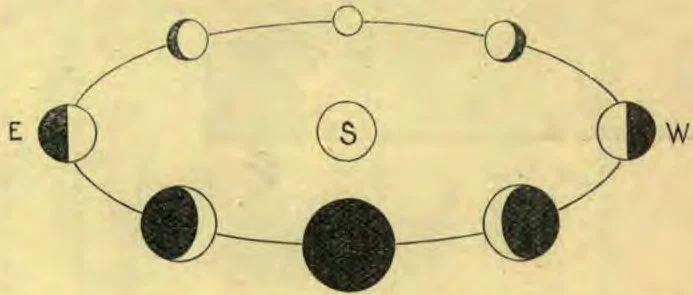
If the reader will hold the accompanying diagram squarely before him, facing the sun, at noon, he will get a good idea of the different relative positions of Mercury and the sun. The circle in the center of the diagram, marked “S” represents the position of the sun, while the different disks represent the positions and phases of Mercury in his journey about the sun, as they would appear to us through a telescope if we could see this planet at all times. Beginning with the large black disk, which, in the diagram, illustrates the dark side of Mercury,—the side that must be turned toward us, as he passes between our earth and the sun,—let us follow the planet westward, or to our right, for a period of eleven days; and we shall then find him as represented by the crescent old moon in the first figure to our right; going on for another period of eleven days, we find him to the extreme west of his circuit, and presenting to us his half-moon shape, as represented in the disk marked “W” in the diagram. It will be readily seen that when in this part of his circuit, he must, as he, in connection with the sun, apparently sinks in the west, pass below the horizon before the sun; and being ahead of the sun in their apparent journey, he must rise in our eastern sky before the sun reaches that horizon; thus the planet is then a morning star.
By noticing the diagram it will be seen that when Mercury reaches the point exactly opposite the sun from us, he shows us his full face, although his size at this time has apparently greatly diminished, owing to the fact that he is now nearly seventy-two millions of miles farther away from us than when we saw only his dark side, as shown by the large disk in the diagram.
In twenty-two days from the time when we see his full face, as just described, he will have passed to the most eastern portion of his circuit, and will appear as represented by the half-moon disk in the diagram, marked “E.” It was at about that point that I caught him last evening and the evening before. Twenty-two days later he will have returned to his starting-point, between us and the sun, having passed through all the phases illustrated above, enjoying the different seasons of spring, summer, autumn, and winter, and accomplishing the whole journey of some one hundred and seven million, eight hundred and seventy-five thousand miles in exactly eighty-seven days, twenty-three hours, and twenty-five minutes. Thus you see that he has traveled at the rate of about one hundred and nine thousand miles each hour.
In some future study we will learn more of the wonders of this world, whose home seems to be in the very chariot of the sun itself.
Dr. O. C. GODSMARK.
Natural Bridge Near Camp Verde, Arizona
THE Well-Spring is authority for the statement that down on Pine Creek, near Camp Verde, Arizona, is a natural bridge that is probably greater than any other in the world. It is nearly five times the size of the Natural Bridge of Virginia, and has a span of more than five hundred feet across Pine Creek, which is dry three hundred days in the year. The height of the bridge is about six hundred feet.
CLEANLINESS II
By Mrs. M. D. McKee
The chief uses of the skin are as follows (1) protection; (2) sensation—to pain, touch, or temperature; (3) excretion; (4) absorption; (5) respiration; and (6) regulation of temperature.
No one should sleep in the clothing worn during the day. The best way is to sleep in a single garment; but if one is ill and weak, an undervest for night use may be added. The clothes worn during the day should be thoroughly aired at night.
We have learned that the perspiration pours out on the surface of the skin a stream of waste matter, the watery portion of which evaporates, leaving the organic matter to be either removed or reabsorbed into the body! Then, too, deposits from oil glands and dust accumulate on the skin. All this matter should be removed. A warm bath, not exceeding two or three minutes in duration, should be taken twice a week, and a cold hand-bath should be taken daily. Hot baths should be followed by cool sprays, to reduce the temperature of the body to normal. Cool bathing, with friction, brings the blood to the surface, and relieves internal congestion. Never bathe near mealtime. Dry the skin thoroughly, and follow the towel-rub with hand friction. Exercise after a cold bath; rest after a warm bath. Pure soap and soft water are the best and safest cosmetics.
An analysis of the old saying, “Beauty is only skin deep,” compels us to resent it as unreliable. The diet has much to do with a clear skin. Tea and coffee, condiments, meats, and other indigestible foods, will not produce a good complexion. Our food is turned into blood. If impure, it carries its impurities to every part of the body, distributing its poisons, and the result is a muddy, yellow skin, or blotches, boils, and pimples.
With intelligent bathing, proper clothing, plenty of exercise in the open air, correct dietary, and the windows lowered in the sleeping-room at night (the room having been well aired during the day), few need lack the comfort of a healthy body, clean skin, bright eyes, and a cheerful disposition. With all this will come a growing appreciation of the wonders of the “human form divine,” and the God who has so marvelously fashioned us.
Time: A. D. 31. Place: Road to Emmaus, Jerusalem. Persons: Jesus, women of Galilee, disciples, Cleopas and another disciple.
QUESTIONS
1. After making himself known to Mary Magdalene, to whom did Jesus next manifest himself? Matt. 28:9; compare v. 5. How did he address them? What did he allow them to do? Id.; note 1. What comforting words did he then speak? What message did he send to the brethren? V. 10.
2. When the women were gone, to whom did Jesus go? Mark 16:12. Where were the two disciples going? Luke 24:13. As they walked along, what was the subject of conversation? V. 14; note 2.
3. In what natural way did Jesus reveal himself? V. 15; note 3. Why did they not recognize him? V. 16. What did he ask? V. 17.
4. In surprise what did one of the disciples ask? V. 18. By what query did Jesus draw out the thoughts of their minds? How did they respond? Vs. 19, 20. Of what false hope did they mournfully speak? V. 21.
5. What facts concerning the resurrection were then mentioned? Vs. 22-24. Pained over their ignorance and unbelief, what words of reproof did Jesus utter? V. 25. What pointed question was also asked them? V. 26. How fully did Jesus then make known the truth? V. 27; note 4.
6. As they drew near to Emmaus, what attitude did Jesus assume? V. 28. What led him to accept their hospitality? V. 29; note 5. As they sat down to the evening meal, what familiar practice did Jesus follow? V. 30. What was the result of his doing so? V. 31.
7. What did they say to each other when Jesus disappeared? V. 32. Where and to whom did they immediately go? V. 33. With what report did the disciples greet them? V. 34. On hearing this, what testimony did the two give? V. 35.
NOTES
1. It is evident that this meeting took place after Jesus had returned from heaven, whence he had gone to receive the Father’s approval of his work on earth. We may know this from the fact that previously to his ascending to his Father, he would not suffer Mary to touch him, while now he permitted it.
2. The burden of the disciples’ talk was of “all these things which had happened.” Their minds were concentrated upon the events that concerned their most vital interests. Their faith was imperfect, their understanding faulty, their discernment poor; but notwithstanding, they talked of Jesus, and of the misfortunes (for so they appeared to them) that had befallen his cause and followers. Their conversation revealed their real position; namely, that they loved God, and desired to know the truth. This fact was in itself an invitation to Christ to come to their aid. How true it is that one’s words reveal his true standing! Cheap or foolish talking and sinful jesting proclaim loudly that Christ is not in the soul temple; but thoughts of God, however imperfectly expressed, show that the life is above. “By thy words thou shalt be justified, and by thy words thou shalt be condemned.”
3. It is a grand, practical truth that Jesus to-day walks and talks with his people, through his word, just as truly as he did when upon earth. By his good Spirit he follows every child of God; and whenever his word is studied in faith, he draws near to shed the light of truth on needy hearts. Oh, that all would believe this, and walk ever as with him! To-day Jesus is not only with his people, but in them. John 14:17.
4. Jesus used “all the Scriptures.” Those who claim that the Old Testament is not for Christians find no example for such practice in the life of Jesus. In all the Old Testament Scriptures (for the New Testament was not yet written), Jesus found testimony concerning himself. The New Testament is but a fulfillment of the Old. And so it is true that—
“In the Old Testament the New is concealed; In the New Testament the Old is revealed.”
5. Every incident in the life of Jesus Christ has deep meaning for us, and should therefore be most carefully studied. It is not a happen-so that the record speaks of Jesus’ making “as though he would have gone further.” God designs to teach us that if we would have his presence with us, we must extend an invitation as urgent as was that of the two disciples. They constrained Jesus to enter their home and share its blessings; we must do the same. “The kingdom of heaven suffereth violence, and the violent take it by force.” Only the heart that refuses to take No for an answer will ever know the fullness of God. “Strive to enter in.”
Live for Your Countrymen
WHAT can a man do more than die for his countrymen?—Live for them! It is a longer work, and therefore more difficult and nobler.— Charles Kingsley.
Life and Work of DWIGHT L. MOODY
Official and only authentic edition. Written by his son, WM. R. MOODY, and IRA D. SANKEY, his lifelong associate and friend.
100,000 AGENTS WANTED AT ONCE. Liberal terms. Freight paid. Credit given. A golden opportunity for you. Outfit free. Write to-day.
P. W. ZIEGLER & CO., 324 Dearborn St., Chicago.
Good Until April 15.
By Joseph Lambert
$11 for $7.
We will ship to any address for $7, cash, “Guide for Nut Cookery,” Perfect Ball-bearing Nut Butter Mill, Family Blanching Mill, and 50 lbs. extra No. 1 shelled Spanish peanuts. Without the Blanching Mill, 75 cents less.
The mill has been on the market for four years, and has been greatly improved. Nearly 3,000 in use. A child can operate it. It makes fine sterilized nut butter. “Guide for Nut Cookery” tells how. It is a complete recipe book, showing the most healthful ways to prepare nuts, grains, legumes, and all varieties of foods.
Write for descriptive circular, and prices on nuts and health foods.
JOSEPH LAMBERT,
Battle Creek, Mich.
To Reach BATTLE CREEK
FROM
CHICAGO, BUFFALO, DETROIT, OR TOLEDO,
Purchase Tickets Reading over the MICHIGAN CENTRAL
“The Niagara Falls Route.”
A First-class Line for First-class Travel between Chicago and New York and Boston. Elegantly equipped through trains pass Battle Creek in each direction daily.
R. N. R. WHEELER, Ticket Agent, Battle Creek.
G. W. RUGGLES, Gen'l P. and T. Agt., Chicago, Ill.
TAKE THE Canadian Pacific Railway
for . . . CHATHAM, OTTAWA, MONTREAL, LONDON, GALT, QUEBEC, WOODSTOCK, TORONTO, BOSTON, PORTLAND, and
All points in New England, the Maritime Provinces, Great Britain, and the Continent.
Illustrated literature, time-tables, and full particulars, upon application to—
J. FRANCIS LEE, GEN. AGENT,
Passenger Dep't. 228 SOUTH CLARK ST., CHICAGO
Branch Offices: 76 Ottawa St., Grand Rapids, Mich.; Room D, Chamber of Commerce, Cincinnati, Ohio; 315 Chestnut St., St. Louis, Mo.
Cincinnati Northern Railroad Co.
TIME TABLE NO. 3.
IN EFFECT SEPT. 24, 1899.
Trains Pass Battle Creek, as follows:
WEST-BOUND.
No. 21, Mail and Express ............................ 6.58 P. M.
No. 23, Accommodation ............................... 2.07 P. M.
No. 27, Local Freight ............................... 8.25 A. M.
EAST-BOUND.
No. 22, Mail and Express ............................ 8.25 A. M.
No. 24, Accommodation ............................... 1.45 P. M.
No. 28, Local Freight ............................... 5.30 A. M.
Direct connections are made at Toledo with all roads diverging. Close connections for Detroit and Cincinnati.
J. L. READE, Ticket Agt., Battle Creek.
E. R. SMITH, City Pass. Agt., 6 West Main St.
CHICAGO & GRAND TRUNK R’Y
E. W. Meddaugh and Henry B. Joy, Receivers,
CHICAGO & GRAND TRUNK R’Y.
Trains arrive and leave Battle Creek.
WEST-BOUND FROM BATTLE CREEK.
No. 9, Mail and Express, to Chicago — 12.15 P. M.
No. 1, Chicago Express, to Chicago — 9.00 A. M.
No. 3, Lehigh Valley Express, to Chicago — 3.40 P. M.
No. 5, Pacific Express, to Chicago, with sleeper — 1.10 A. M.
No. 75, Mixed, to South Bend — 8.20 A. M.
Nos. 9 and 75, daily, except Sunday.
Nos. 1, 3, and 5, daily.
EAST-BOUND FROM BATTLE CREEK.
No. 8, Mail and Express, to Pt. Huron, East, and Detroit — 3.45 P. M.
No. 4, Lehigh Express, to Port Huron, and East — 8.27 P. M.
No. 6, Atlantic Express, to Port Huron, East, and Detroit — 2.25 A. M.
No. 2, Leh. Exp., to Saginaw, Bay City, Pt. Huron, and East — 6.50 A. M.
No. 74, Mixed, to Durand (starts at Nichols) — 7.15 A. M.
Nos. 8 and 74, daily, except Sunday.
Nos. 4, 6, and 2, daily.
A. S. PARKER, Ticket Agent,
Battle Creek.
AN OPPORTUNITY FOR TEN YOUNG MEN
Ten young men could easily be admitted into the Chicago Medical Missionary Training Course, which begins its next session May 15, 1900. Several of these could be taken in at once, and be getting a good experience in the various lines before the opening of the next course. The work in Chicago now reaches all classes of society, and those who enter this work fully consecrated to God will surely be guided and directed by his Providence to work for whichever class of humanity they are best prepared to labor.
Several hours each day are devoted to class work, and the remaining time is largely spent in actual work, thus combining theoretical instruction with practical work,—a system that constitutes the highest ideal of educational effort.
There is an equally good opportunity for twenty young women. More detailed information with reference to courses of study, expenses, etc., will be furnished upon application. Address all correspondence to Chicago Medical Missionary Training School, 1926 Wabash Ave., Chicago, Ill.
The Finest Set of Chimes
At the Pan American Exposition in Buffalo in 1901 will be seen and heard the largest and finest set of church bells in this country; in fact, they are little, if any, inferior in size or musical quality to the most famous European chimes of Copenhagen, Westminster, Ghent, or Amsterdam. These carillons, as they are termed by their French originators, which will delight the visitors to the all-American Exposition next year, have a peculiar history. Although they have been in this country more than thirty years, and their fine qualities are well known, their superb tones have never been advantageously heard. For over a quarter of a century they have hung with dumb tongues in the silence and gloom of the tall tower of Buffalo’s great Cathedral of St. Joseph.
They were produced by the noted French bell-makers, “Bolle et Fils,” having been contracted for by Bishop Timon in 1865, at a cost of about twenty-five thousand dollars. They were cast in 1866, and exhibited at the Paris Exposition in 1867, being there awarded a gold medal. They reached Buffalo in 1868, and were then hung in St. Joseph’s tower, which, however, proved a very unsuitable receptacle, being damp and of very limited area. Attempts were made to sound the chimes, but the result was ineffectual; and since 1875 the bells have been mute.
There are forty-three bells in this splendid carillon, ranging in weight from the small tenor of twenty-five pounds to a ponderous and sonorous monster weighing five thousand and sixty-eight pounds. Each bell is artistically ornamented, and each bears an inscription in Latin, with some religious phrase in the same tongue. The metal of the bells is a composite of seven hundred and seventy-five parts copper and two hundred and twenty-five parts tin.
It was originally intended that these chimes should be rung by clockwork, but the more modern methods of keyboard manipulation and electrical power will be used.
At the Pan American Exposition the bells will be hung in a graceful campanile especially constructed for the purpose, erected on elevated ground in a location that will permit their melodious voices being heard with due effect whenever they are sounded. The importance of this group of bells, and the volume of harmonious sound they will produce, may be in a measure realized when it is remembered that the fine chimes of St. Patrick’s Cathedral, so much admired in New York, consist of only twenty-four bells,—a little more than half the number comprised in the carillon of St. Joseph.
RACING CAMELS
The ordinary camel, which will never hurry under any circumstances, has been transformed in southern Algeria into an animal so different in size, temper, and appearance that it may almost be looked upon as of a different race. This animal, the racing camel, is prized for its speed. It is the result of many generations of careful breeding, which has been encouraged by valuable prizes, and it can be depended upon for nine or ten miles an hour, which rate of speed it can keep up for sixteen or seventeen hours, almost without a stop. Its value is five or ten times that of the beast of burden. Camel races are popular sport, and are made exciting by the evident interest of the creatures themselves.
ACADEMIES
By W. S. Chapman
ONE of the suburbs of the city of Athens was called Academy, and it is said to have been the property of the hero Academus. Hipparchus built a wall around it, and Cimon, the son of Miltiades, beautified it with walks, groves, fountains, etc., and gave it to the citizens as a public park. Plato, who owned a small estate near by, used this park as his school, and taught there for nearly fifty years, or until his death, in 348 B. C. As distinguishing his school from others, the park was known as “The Academics.” This school founded by Plato continued till the time of Cicero.
In its modern use the word “academy” signifies a body of learned men, “united for the advancement of science, literature, or the arts.” Ptolemy Soter organized at Alexandria the first institution of the kind, and it was the beginning of the great Alexandrian library, the most famous library of ancient times.
A century later Alfred the Great opened an academy at Oxford, England, but it was more of a grammar school than a society of learned men. From it developed the university of Oxford.
In 1325 Clemens Isaurus founded, at Toulouse, an academy of Floral Games, the object being the distribution of prizes to troubadours—an amaranth of gold for the best ode, a silver violet for the best poem, a silver eglantine for the best prose composition, etc. This institution may be rightly regarded as the true foundation of modern academies. W. S. CHAPMAN.
IMPROVING THE ENTRANCE TO THE WELLAND
As soon as spring fairly opens, work will begin on the contemplated improvements in the harbor at Port Colborne, Ontario, the Lake Erie entrance to the Welland canal and the great St. Lawrence canal system.
The improvements will include new docks and eventually a new breakwater. The work was necessitated by the completion of the uniform fourteen-feet depth in the St. Lawrence system.
The present side slopes and walls of the Port Colborne basin are to be removed in part, and the basin and entrance to the canal, for its entire width and length from the locks to the south end of the west pier, will be deepened to fifteen and sixteen feet. The distance is about four thousand four hundred feet.
At the end of the pier two docks, each six hundred feet long and two hundred feet wide, with four sides available for the accommodation of vessels, will be constructed on cribs carrying concrete superstructures. Within the limits of deepening, there will be a full depth of twenty-two feet of water when there is fourteen feet of water upon the south-miter-sill of the new lock.
West of this section of the deeper harbor, it is proposed to construct a breakwater seven thousand five hundred feet long, which will give a wide area of safe shelter for waiting or storm-bound vessels. The specifications call for the completion of the work by June 30, 1902.
These improvements are preliminary to the erection of elevators at Port Colborne sufficient in number and capacity to provide against any threatened congestion, and to furnish employment for a large number of the smaller lake boats whose draft is suitable to the navigation of the St. Lawrence canal system.—Selected.
FOR EVERY DAY OF THE WEEK
Sunday:
“There is no witness so immediately effective with a discouraged and discontented world as Christian cheerfulness.”
Monday:
“There is a little sentence
Worth its weight in gold,
Easy to remember,
Easy to be told;
Changing into blessing
Every curse we meet,
Making earth like heaven:
This is all—Keep sweet.”
Tuesday:
God’s power will keep God’s promise. It is not your weakness that can defeat God’s promise, nor your strength that can fulfill the promise.—Spurgeon.
Wednesday:
“Contentment is happiness. A quiet mind makes one richer than a crown.”
Thursday:
“The sorrow that nobody mentions,
The sorrow no one may share,
Is the sorrow the dear Lord giveth
His sweetest, tenderest care.
He knows where the hurt is deepest,
The tears of night and of day,
And whispering softly, ‘I love you,’
Brushes the teardrops away.”
Friday:
Do not pray for easy lives. Pray to be stronger men! Do not pray for tasks equal to your powers. Pray for powers equal to your tasks! Then the doing of your work shall be no miracle. But you shall be a miracle. Every day you shall wonder at yourself, at the richness of life which has come in you by the grace of God.—Phillips Brooks.
Sabbath:
“I therefore, the prisoner of the Lord, beseech you that ye walk worthy of the vocation wherewith ye are called, with all lowliness and meekness, with long-suffering, forbearing one another in love.” Eph. 4:1, 2.