The Youth’s Instructor, Vol. LI, No. 40

An October Day in Muskoka

The Youth’s Instructor

October 6, 1903

Review and Herald Publishing Assn. · Washington, D. C. · October 6, 1903

An October Day in Muskoka
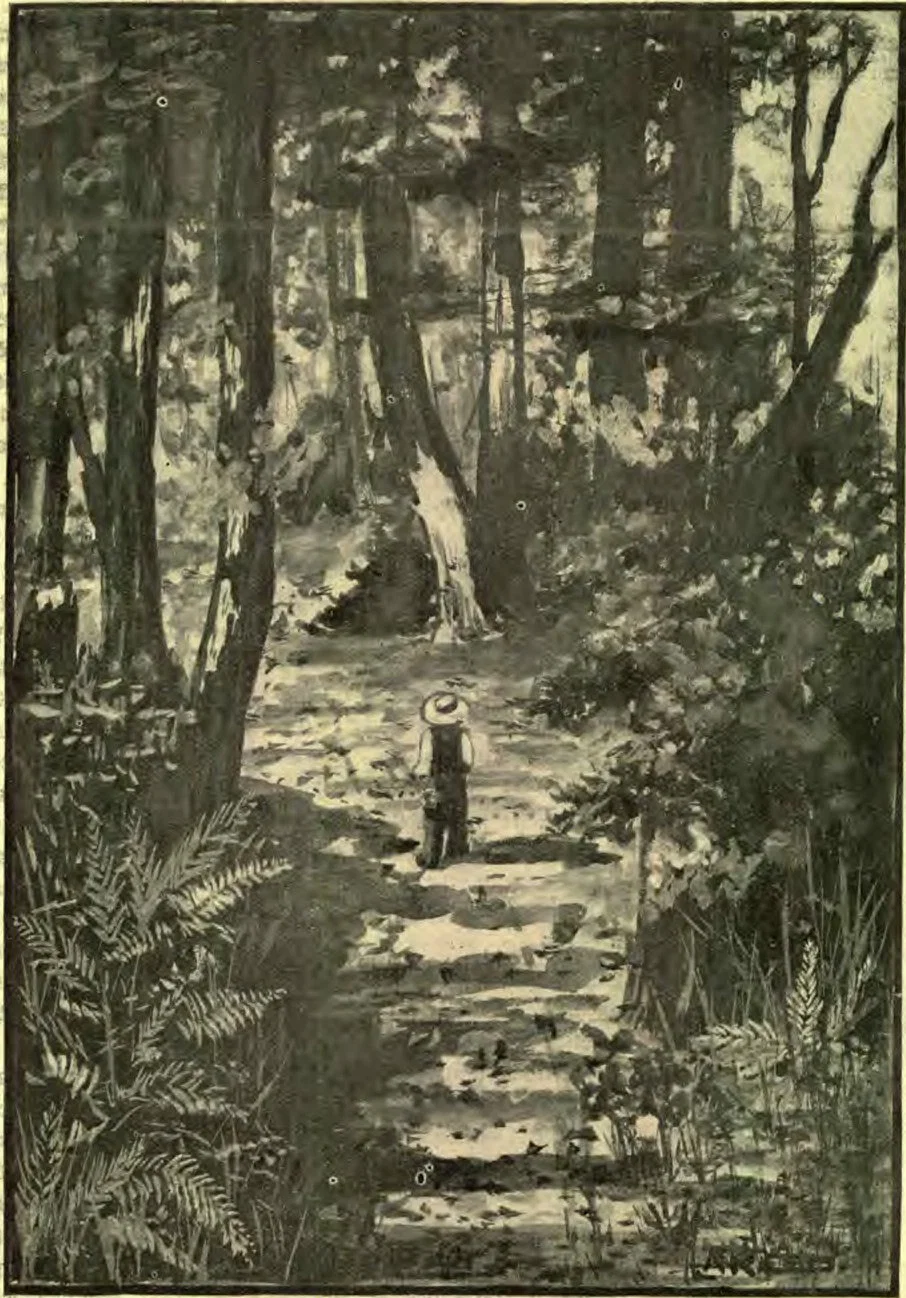
Not a cloud dims the azure of the sky. The thermometer registers nearly seventy in the shade at noon. We have heard of only two frosts in this vicinity, only one of which touched our garden, and that with such dainty fingers that few things bear the imprint.
I sit in “Queenie’s chair,” a natural seat in a large rock to which the little wharf is fastened, in the lake by our cottage. I look up and down the bay,—to the island across it, and to the mainland above the island, and to the smaller islands below. A light haze envelopes the land in the dim distance. The day is still; not a sound falls from the ripples on the shore. Anon there are tokens of life around me. A squirrel leaps among the low-growing trees near by, and, chattering his pleasure or displeasure, disappears. The sharp, incisive note of a woodpecker reaches me from the woods near by. The fine, liquid note of a belated goldfinch, just as sweet as those heard in my childhood, passes by me, and a robin gives his one-note call from a tree only a short distance away. There are no corn fields near; hence the crow does not linger, but flying aloft and away, keeps a sharp lookout for a “corner” on corn.
More rain fell this summer than for many a season, and the trees retained their fresh appearance later than usual. Now they are slowly turning color. A soft maple in its “cloth-of-gold” near where I am sitting reminds me of the two long lines of the same kind of trees that so often feasted my eye for the beautiful as I looked from the academy grounds up the street of my native town. To be truthful, I must say this is not so beautiful as those were. The autumnal coloring does not yet compare in brilliancy of display with that seen in dear old New England in my girlhood days. Our Father would ever have us see beauties and blessings as well as beauties in the present. If we are truly true to the yesterdays of our life, we shall not be pessimistic in the todays. Let us learn to pick out the grain of beauty and pleasure from the sands of life lying each day beneath our feet. Not only should we heed the voice telling us, “Do ye next thing” in duty’s line, but we should educate ourselves—if necessary, discipline ourselves—to see the beauty in the blessing that is near, instead of bemoaning the loss of “a day that is dead,” or vainly longing for one that may never come.
ONE DAY AS AUTUMN'S FIRST BRIGHT LEAVES WERE FALLING
This morning there was a stiff breeze for a little time, and the resultant flecks of foam are now floating on the water around me. At the right on the shore stands a black alder bush with green foliage, and full of scarlet berries suggestive of Christmas-tide. Not far away is a maple with its beautifully shaded crimson leaves. All along the shore, green, garnet, and gold commingle, the stately pine and the smaller evergreen supplying the darker shades. Whirr goes a partridge, and now another. Their mottled plumage is so in keeping with the color in fallen leaf and brush and tree that often we do not see them until they fly. I heard the loons scream, and heard them at their bathing frolic, only a few days ago. Not even a sea-gull enlivens the scene to-day with the flash of his white wings. Peace and quiet settle down with the brooding haze that has crept over the land, the water and the sky. Up jumps a fish to catch an insect, and down he goes with a splash. The largest fish are those that were never caught; next in size are those that, having been caught, slipped off the hook without assistance.
All along the shore of the island across the bay the trees in their foliage of shaded yellow melting into shades of blending brown, stand about half the height of the trees beyond, reminding one of the serried ranks of an army on a hillside.
Two rowboats pass,—one up the lake, the other down; at least half a mile distant, we hear the rowers’ voices, and the splash of oars. Happy children are calling beyond the point, wakening the echoes on the opposite island. Now the trees along the shoreline with their intermingling colors are mirrored in the listless lake. O, the glory of it all as I sit here vainly wishing for the artist’s pencil, or for the era of color photography to reach its zenith!
Earth is not heaven, but sometimes the Father vouchsafes us glimpses of heaven, while still our weary feet press the pathways of earth. If our ears are not attuned to hear, and our eyes to see, the beauty of the passing days as they come and go, what assurance have we that the Giver of it all will welcome us through the pearly portals that open on the never-fading glories of the eternal world? MARY MARTIN MORSE.

The Song of the Forest

I HAD but just taken one look that was serious At some of the difficult problems of life, Just tried them enough to find out how they weary us, And longed for a respite from unequal strife; When one day as autumn’s first bright leaves were falling And filling the hollows with rivers of gold, It seemed that I heard the great solitude calling; So, led by the impulse, I thoughtfully strolled To where the great forest rose round and above me, Encircling the valleys and shading the hills. The heart of the wood, like a heart that could love me, Was throbbing in chord with murmur of rills. A sky full of sunshine, a pure streamlet straying Through patches of asters,—all spoke peace and rest; And like a tired infant, grown weary of playing, Who falls fast asleep on a fond mother’s breast, I threw myself down on the grass in a clearing, And heard the wind rustling the leaves dreamily, Till, softer than music, too soft for the hearing, I dreamed the great forest was singing to me.

Song: Child Born to Sorrow and Pleasure

Song

Child born to sorrow and pleasure, Child born to gladness and grief, List while I pour out in measure Thoughts for thy sick soul's relief.
Child that I love, I have known thee When, thy boy's heart full of glee, Life only sunshine had shown thee; Then, child, thou camest to me,—
Came for a handful of berries, Picked a bright wild flower or two, Hunted in vain for the fairies, Bathed thy bare feet in the dew.
Youth came with vague visions varied: Snatches of poesy's lore, Whispered to me in the moonlight Life's secrets over and o'er.
Now when youth's impulsive madness Cools to young manhood's warm glow, Thou again comest in sadness,— Sad, for the world is thy foe,
Thou hadst thought Heaven had called thee To deeds of greatness alone; Dreamed, and saw fetters that galled thee Fall when thy genius was shown,
And, walking, found thy great powers Common as sunshine and rain. Men slight the greatest thought towers, Seeking but temporal gain.
What in thy dream thou hadst taken For truth the world had not known, Proved to be, when thou didst waken, Truth it had trampled upon.
One look at earth's desolation,— One look at manhood self-wrecked,— Hath this, child, altered thy station? Hath this thy high purpose checked?
Now dost thou come to me grieving; Seeking a balm for thy grief? If in my song there's relieving, Gladly I'll give thee relief.
I am the product of ages, Planted by almighty hands; Teacher of poets and sages, Witness of truth in all lands.
Decades fall around me unheeded, Centuries mark my slow growth. When into gloom hath receded All else, I still voice God's oath.
Each spring new leaves robe my bowers, Breathing in sunshine and heat; Autumn winds sweep them in showers, Withered and dead, at my feet.
Greatness grows e'en as the forest; Thou, my child, art but a leaf. Few are the sunbeams thou storest,— Few, for thy life is but brief.
E'en as the red leaves fall dying, Wither, and fade, and decay, And the roots under them lying Silently steal them away,
So when thy mission is ended, After life's summer is past, Thy life and work shall be blended Into all greatness at last.
Grieve not because the world barters Beauty and wisdom for gain; Nor, doubting, deem that the martyr's Poured out their hearts' blood in vain.
Oft have I sheltered earth's heroes; Safely they lodged 'neath my shade When, like a tempest-swept sea, rose Perils that make men afraid.
These sleep. Still souls, heaven-favored, God calls to witness for him. Others before thee have labored; Thou art but entering in,
Fear not: the path shines before thee; Walk where thy Leader has trod. Faint not; though trials sweep o'er thee, Truth belongs ever to God.
Cheerfully take all he gives thee. If, Ruth-like, gleaning thy sheaf, Fame's portal, opening, receives thee, Boast not; thou art but a leaf.
---
I awoke from my dream. The wild wind was still sighing, The trees were still raining down purple and gold; And only the burden upon my heart lying, Mysteriously, silently, from it had rolled.
And now when I feel that the world is all gloomy, And sicken at sight of the hatred and strife, That dream of the forest comes soothingly to me, And sweetens the bitterest thoughts of my life.
ARCHER WRIGHT.

Rambles in Bermuda—IV

Castle Island and Its Neighbors

WHILE there are many places of historic interest in Bermuda, Castle Island is one which above all others carries the thoughts of the visitor back to the days of its early settlement. Very likely this is because its ruins have been repaired or replaced by more modern structures; so that there is nothing to divert the mind of the observer from the real antiquity of the place. Suppose we spend a short time exploring this and the adjacent islands.
On account of the tides, the afternoon is usually the best time to effect a landing on the really inhospitable shores of Castle Island; so we visit first its quiet and peaceful neighbor, St. David's. A small steamer plies at regular intervals between St. George's and St. David's; but when we leave this steamer, we seem to have entered another world. We notice first that the majority of inhabitants are barefooted, a matter, however, that does not in the least affect the social standing in Bermuda, inasmuch as few natives of St. David's are known outside their own little island. They are essentially patriotic and conservative; and the average St. Davian is quite a traveler if he leaves his island once a year for a visit to Hamilton, the metropolis. The little steamer is mostly patronized by visitors, and a few of the inhabitants who sell their produce in St. George's. There are, of course, a few families to which this does not apply; but the ordinary native prefers and enjoys the quiet, tranquil life, and almost Arcadian simplicity of his forefathers.
It is also noticeable that there is but one road, which, following the shore, makes the circuit of the island without once diverging into the interior. Even this road is an innovation; for up to a very recent date, horses were entirely unknown in the island. There is a story current among Bermudians of the astonishment and fear manifested by a St. Davian on his first visit to Hamilton, at sight of one of these familiar beasts of burden. Never having seen anything larger than an occasional donkey, and the goats which supply him with milk and flesh, the horse must have appeared a strange, new species.
The especial object of interest in the island, aside from its inhabitants and the beautiful bays and beaches, is the St. David's lighthouse, the second largest in the islands, which commands a magnificent view. The Gibb's-Hill lighthouse, at the other extremity of Bermuda, is much higher, and commands a much wider expanse of ocean, but by reason of its height the view of the islands is not so satisfactory. From St. David's, however, the colors stand out in marked prominence; and in early summer, when the oleander hedges are in full bloom, the blues of the ocean and the greens of the landscape, illuminated here and there with dashes of red and purple, pink and white, form a color study that could scarcely be rivaled in any other clime.
The chief occupations of the islanders are agriculture and fishing, and by these pursuits their simple wants are easily supplied.
But time passes rapidly in an island so quiet; and we must take the little steamer back to St. George's at once if we wish to take advantage of the tide to visit the ruins on Castle Island. After no little haggling over prices, a negro boatman consents to take us to the island for a few shillings. Now the trip must be made entirely by water, but in early days Castle Island was a rocky peninsula connected with the mainland by a natural bridge of rocks. The sea has worn these nearly all away and the few that remain serve only to lash the waves into greater fury as they beat about the barren and unsheltered rock, where was once the seat of government of the Bermudas. There are several rough stairways hewn in the side of the rock, leading down to the old-time landings. Most of these are dangerous, and some impassable, on ordinary days. In fact, there are many days when the hardiest boatman does not attempt to land. The point most accessible is on the southern side near an old stone gate that marks the entrance to what was once Government House.
The immense thickness of the walls—such that no bullets of that time could penetrate them—shows that even in the midst of the sea the early colonists did not consider themselves secure from invasion. They were continually on the outlook for Spanish warships, though, if I remember rightly, history does not record a serious encounter. Perhaps this imaginary enemy only lent a sense of security to the festivities with which these same walls were wont to resound. The “dungeons” in the midst of the ruins are especially interesting because one does not really know what purpose they served, and can imagine all sorts of gruesome things. It is probable, however, that they were designed as a refuge in case of an attack. They consist of a series of small rooms entirely underground, with entrance even now half concealed, and furnished with air through breathing-holes pierced from above.
There are some old stone ovens still intact, and a few rooms, roofless, and with ruined stone stairways leading nowhere. Enough of the walls are standing to give some idea of the shape and size of the place.
Standing on the spot where, three centuries ago, the flower of Bermuda gathered to spend the hours in festal mirth or watch fearfully for the dreaded Spaniard, one is forcibly reminded of the words: “As for man, his days are as grass: as a flower of the field, so he flourisheth. For the wind passeth over it, and it is gone; and the place thereof shall know it no more.” WINIFRED M. PEEBLES.

Unexpected Light

“Another six days’ work is done, Another Sabbath is begun; Return, my soul, enjoy the rest, Improve the day that God has blessed.”
The singer, though light-hearted and happy, was a very conscientious girl. Her father and mother had started on the early train for the seashore, to be gone a month, for the benefit of her mother’s health.
Aunt Myra, her father’s youngest sister, had arrived only the evening before, to stay with her and with her little brother and sister.
It was Saturday morning, and she was very busy doing up the work and preparing for Sunday. Aunt Myra remained in her room all morning. Alice wondered at this, and thought, “If that is the way she spends her time, she will not be much help or company to me.” But that song brought Aunt Myra from her room to the kitchen. Taking a chair by the table where Alice was making a cake, she said: “Alice, do you realize the truth of that song you sang a few moments ago?”
“Why, I think I do, auntie,” she replied, with a look of surprise.
“Do you know,” said Aunt Myra, “that this is the day the song is speaking of?”
“This! Why, this is Saturday, Aunt Myra; what do you mean?”
“This is the Sabbath of the Lord,” said Aunt Myra, smiling,—“the seventh day of the week,—the one the Lord has blessed and sanctified, set apart and made holy, and given to us for a day of rest.”
“Why does everybody keep Sunday, then?” asked Alice. “I never heard any one say a word against it before.”
“Everybody does not keep Sunday,—I, for one, your grandmother for another, and many others keep the seventh-day Sabbath.”
“You and grandma?” said Alice, in surprise. “Why, papa and mama do not know of it.”
“No, dear,” replied Aunt Myra. “We had not written because we hoped to visit you long before this; but mother’s health has been so poor we could not come. When your father wrote me, it seemed impossible for me to leave her, but a friend kindly offered to stay with mother and care for her as we thought it best for me to come. Mother said, ‘Myra, the Lord is opening the way for the third angel’s message to be carried to my son and his family.’”
“Third angel’s message! What is that?” asked Alice.
“Would you really like to know?” asked Aunt Myra.
“Why, yes,” answered Alice; “I like to learn anything that is good.”
“Well,” said Aunt Myra, “after dinner we will have a long study. I want you to learn the answer to your question from the word of God.”
While getting dinner, Alice’s mind was filled with perplexing thoughts. Aunt Myra was in her room, earnestly praying that this girl might receive the true light of his word.
Dinner being over, they went out on the lawn, where, as Aunt Myra said, “We can breathe God’s pure air as we read his precious word.”
“Aunt Myra,” Alice said, earnestly, “if you have any scripture to prove that Saturday is the Sabbath, I want to see it. I have been a Bible student since I was quite a little girl, and have seen nothing to that effect; and father and mother are constant readers of the Bible, and they have never mentioned such a thing.”
“You know,” said Aunt Myra, “that Saturday is the seventh day?”
“Yes.”
“Then let us turn to the twentieth chapter of Exodus, and read the ten commandments.”
When they had read the fourth, they turned to the thirty-first chapter of Exodus, and began at the twelfth verse, reading the rest of the chapter. There they found that the seventh-day Sabbath is a sign, a perpetual sign, with the children of Israel forever.
“Now we will turn to the fourth chapter of Hebrews. Here we find that if Jesus had meant for us to keep another day, he would have said so. We will also turn to Luke 16:17,” said Aunt Myra.
Alice read: “‘And it is easier for heaven and earth to pass, than one tittle of the law to fail.’”
“I see, I see,” she cried; “the changing from the seventh to the first is one tittle, and it is impossible for it to fail. Oh, how I wish father and mother were here, so I could show them!” And she reached over and kissed away the tears that fell on Aunt Myra’s cheek,—tears of gratitude that God had given this girl the light that she so desired her to receive.
The remainder of the day was spent in looking up other texts on the same subject, until Alice was astonished that there was so much on the subject, and that she had never seen all this before.
“I know, Aunt Myra,” she said, “that some good angel sent you here to reveal this message to me, and I can never keep Sunday again; but what will father and mother say?”
“We will pray constantly, Alice, that upon their return they may see the truth as you have seen it.”
As the Sabbath day closed, they knelt together, aunt and niece, the first time in their lives, and Alice thanked God that his true Sabbath had been revealed to her, and promised that she would keep the day the remainder of her life.
In one month her father and mother returned.
After the usual greetings, Alice said, “Mother, you and father look as if you had found both health and happiness while you were gone.”
“We have,” said the father, while the mother stood smiling. “We have found more than that; we have found God’s true Sabbath.”
Oh, what a rejoicing when all was told! There had been a man teaching at the seashore, and Mr. and Mrs. Norton had listened until they had become interested, and had searched out the truth for themselves.
Mrs. M. E. UNDERWOOD.

We Should Be Friends

We should be friends; so let not foolish pride Come in between our pathways to divide. Life’s short at best, and long as we shall live, Each needs the aid the other well may give; We should be friends.
We should be friends. What if an idle word An angry feeling in the heart hath stirred? On one small word lay not too great a stress, But noble be, and this one fact confess— We should be friends.
We should be friends. Then let us now renew That friendship that of old was warm and true. Though others change, let us in this agree, If long or short our day of life may be, We should be friends.
Let us be friends. The anguish we have known Will for our error graciously atone; Give me your hand, and on this sacred night, Let us renew our pledge with keen delight— We will be friends.

Perseverance: The Price of Success

Perseverance—I

It has been truly said that there is no royal road to success. The greatness which we covet and admire in men is the result of indefatigable push and energy.
Success grows out of struggles to overcome difficulties. If there were no obstacles to surmount, there could be no success in the truest sense of the word. “Heaven helps those who help themselves,” is a maxim we do well to remember. In order to succeed we must persevere through trials and obstacles, and many times practise the most rigid self-denial. A harvest can be gathered only where seed has been sown. Strenuous individual application is the price we must pay for true distinction; excellence has been forever placed beyond the reach of indolence. Greatness can not be transmitted to another. It is related of an old bishop, who possessed great power in his day, that he was once asked by his stupid and idle brother that he make a great man of him. “Brother,” replied the bishop, “if your plow is broken, I'll pay for the mending; or if your ox die, I will purchase you another; but I can not make a great man of you; a plowman I found you, and a plowman I must leave you.” One person, writing of himself, repudiated the idea of being “a genius,” but attributed his success to industry. “My mind is like a beehive,” he said; “but full as it is of buzz and apparent confusion, it is yet full of order and regularity, and food collected with incessant industry from the choicest stores of nature.”
Disraeli, a Jew, was hissed when he first appeared in Parliament, and every sentence was laughed at. But he did not become discouraged, and mope and whine in solitude. He persevered. Writhing under his humiliation and defeat, he said, “I have begun several times many things, and have succeeded in them at last. I shall sit down now, but the time will come when you will hear me.” And it did come. By persevering effort he forced his way to the front, and arose to be one of the leading men of England till at last he occupied a place where men laughed with him instead of at him. His success was the result of dauntless energy and unfailing perseverance.
Never, since the advent of sin, was competition in every branch of industry so fierce as now. Tireless energy is in demand. On every hand we can see wrecks; on some hidden shoal or unknown rock they have stranded. But we must not falter because of these. God will honor the right, and triumphantly vindicate those who adhere to righteous principles. In this time especially we are exhorted to be diligent. “Seest thou a man diligent in his business? he shall stand before kings; he shall not stand before mean men.”
G. B. Thompson,

WEEKLY STUDY

Historical and Biographical Exercise

Wycliffe, Huss, and Jerome

FIRST EXPERIENCE—TEN MINUTES

Select three persons to prepare, either in writing or for a concise statement, a brief biographical sketch of the three Reformers,—Wycliffe, Huss, and Jerome. The facts for these sketches may be gathered from the notes on this lesson, chapters five and six in “Great Controversy,” and from a biographical dictionary or other reference-books that may be accessible. Each person should occupy only about three minutes.

SECOND EXERCISE—TEN MINUTES

Select some one to occupy five minutes in simply mentioning characteristics in the lives of these three Reformers, which are worthy of imitation. Let another be appointed to call attention to manifest providences of God in the lives of these Reformers.

THIRD EXERCISE—TEN MINUTES

A lively catechetical exercise may be made interesting and profitable. It should be conducted by the leader or some person qualified to question the young people vigorously on the points passed over.
The following questions and suggestions may be helpful to the one selected to conduct the exercise:—
Time covered by the work of Wycliffe.
What queen was converted under Wycliffe’s teaching? Result to the cause of God.
By what name is Wycliffe often called?
What was the great and most prominent work of his life?
How did he die?
What violence was done to his bones long after his death?
What people carried the work of the Reformation to Bohemia?
Locate Bohemia.
Who were the great champions of the work in Bohemia?
How did their life work end?
At what place?
Where is Constance?
Who said, “Most joyfully will I wear this crown of shame for thy sake, O Lord Jesus, who for me didst wear a crown of thorns”?
Who said, “Prove to me from the Holy Writings that I am in error, and I will abjure it”?
What is the meaning of “abjure”?
Mention practical lessons that we may learn from the spirit of these men, and the movement which they started? (Let many answers be given.)

John Wycliffe

John Wycliffe, “the Morning Star of the Reformation,” was born at Spresswell, in the North Riding of Yorkshire, England, about the year 1312, and died at Lutterworth, December 31, 1384. He was educated at Oxford, and early in life occupied many honorable positions in the schools and in the Church of England, and took the degree of Doctor of Divinity in 1365. Strange as it may appear, his work as a great Reformer began in politics, when, as a member of the British Parliament, he maintained the political independence of the crown and the country from the pope by defending before the University of Oxford the action of King Edward Third and the entire Parliament, in refusing to pay the papal claim of right to collect tribute from the people of Great Britain. Wycliffe’s defense was so emphatic and so successful that the claim was never again made by the pope, and Wycliffe won a high place in the esteem of the British people and their king. This was the opening of a life-long struggle against the encroachment of the papal power; and repeatedly he was summoned before councils to answer for his writings and preachings; but he was so firmly entrenched in the confidence of the people, and in the hearts of many noble and powerful men, that he was always in some way rescued from violence, which often seemed inevitable.
Although a scholar and teacher of the highest rank, an astute and powerful statesman, and a powerful preacher of the word, Wycliffe’s crowning work, for which the English world is most indebted to him, was the translation of the Bible into the English language. First he translated the New Testament; and while he was at work, a certain man named Nicholas, of Hereford, England, began the translation of the Old Testament; but a sentence of excommunication was soon passed upon him, and he was unable to proceed with his work. Wycliffe took up the task of Nicholas where he had left it, and in 1382 completed the translation of the Bible, and thus gave to the English people the first copy of the Sacred Book in their own language. This translation marks an epoch in the development of the English language.

John Huss

John Huss, the Bohemian reformer and martyr, was born in 1369 at Sunhussnetz, Bohemia, and died at the stake in Constance, Germany, July 6, 1415. He received his education at Prague, where he took the degree of Bachelor of Theology and Master of Arts. In 1403 he was appointed Rector of the University of Prague. He was a diligent student of Wycliffe’s writings, and waved aloft the torch which had fallen from Wycliffe’s hands, in the hope that he might effect a religious reformation in Bohemia.
From the beginning of his advocacy of the doctrines set forth by Wycliffe, he met with strong opposition from the leaders of the Catholic Church; but the students of the University, and the common people, who assembled in vast numbers at the Bethlehem church, of which he was the pastor, received his teachings with rejoicing. In 1414 the religious agitation of Bohemia assumed such dimensions that King Sigismund of Hungary decided that the case ought to be brought before the General Council about to be assembled at Constance. Huss cheerfully agreed to appear. Soon after his arrival the cardinals trumped up a charge against him, and placed him in confinement in a Dominican convent. In the investigation which followed, Huss was denied a hearing. Later, in June, 1415, he was given a second hearing before the king; but his attempt to vindicate himself was interrupted by tumultuous cries.
The condemnation of Huss to the stake was a foregone conclusion. He himself knew it. His letters bear the stamp of approaching death. On Saturday July 6, 1415, the sentence of the Council was pronounced in the Cathedral condemning him as a heretic, and condemning his books to be burned. Huss fell on his knees, and lifting up his hands, appealed to heaven, and prayed for his enemies. Thereupon followed his degradation from the priestly office, and all cried out together, “Thy soul we deliver up to the devil.” Huss answered, “I commend it to the holy Lord Jesus.” Then a paper cap a yard high was placed on his head, and he was led forth to the judgment square, and burned as a heretic. As the flames rose around him he refused again to recant, and died singing: “Christ, thou Son of the living God, have mercy upon me.” His ashes were thrown into the Rhine.

Jerome of Prague

Jerome, also of Prague, Bohemia, was a fellow laborer in the Reformation with Huss, and shared with his noble leader a martyr’s death.
He was born in 1365, and was burned at the stake in Constance, May 30, 1416. He studied at Oxford, and returned to Prague with Wycliffe’s theological writings. Later on, he studied in Paris, where he took the degree of Master of Arts. He returned again to Prague in 1407, and entered into hearty sympathy with the plans of Huss. In 1410 he was suspected of heretical doctrines, and fled to Vienna; but was there arrested and imprisoned. When Huss was summoned before the General Council at Constance, Jerome encouraged him to fortitude, and promised to go to his assistance if necessary. On April 4, 1415, he fulfilled his promise; but on the advice of the Bohemian nobles he fled from Constance the day after his arrival, but was almost immediately arrested, and taken in chains to Constance, where on May 30, 1416, he was condemned by the Council as a heretic. As the flames crept about him, he sang the hymn, “Hail, Festal Day!” His ashes were also scattered upon the Rhine.

The Master's Word

“HEAVEN and earth shall pass away; but my words shall not pass away.” Luke 21:33.
They have not passed away. The ages lie In myriad heaps of ashes, cold and gray, Upon the moorlands, stretching far away Into the past, where, gaunt against the sky, A cross once stood and raised its arm on high. Gone is the cross, and likewise gone are they Who saw the Master lifted up that day To perish that the world might never die, But have eternal life. Caiaphas lies To sleep his last, and Herod's bones are dust; Judea's memory is a thing of rust, Which time shall sweep away. The arching skies Themselves shall pass; the earth itself decay; But Christ's sweet words shall never pass away. — Selected.

Rising Again: Courage to Press Onward

ONE who falls may get up again and press onward if he has a brave heart.

Despise Not the Little Ones

THERE is a very pretty story told of the late Earl of Shaftesbury, who one day when out walking in one of the busiest streets of London with a friend, was accosted by two little street arabs. They had been standing on the edge of the pavement, gazing, half bewildered, at the great sea of traffic rolling ever on and on.
As the earl approached them, maybe they saw by the kindly light in his eyes that their request would not be denied them; for fearlessly one little lad held out his dirty hand, saying, “Mister, will ye help us across to the other side, for we are afraid, and want some one to lead us.”
The earl readily consented, and taking one little grimy hand of each child, led them until they safely landed on the other side. When he returned, his friend questioned him, in a half-contemptuous manner: “What ever made you do that, to take their dirty hands into your own? I should have been afraid to touch them.”
His lordship smiled, replying: “One day when my work here is ended, and I get over yonder, I want to meet those lads, but no longer poor and dirty; and to hear my Master’s welcome, ‘Inasmuch as ye have done it unto one of the least of these, ye have done it unto me.’”—Selected.
Continue reading: The Marshal of the City of Refuge