I'm glad vacation's over,
And I am back in school.
We spent the long, hot summer
In the mountains, keeping cool.
Of bears, and wolves, and panthers
We never saw a sign;
Nor any creature bigger than—
What's six times nine?
My Papa, and my Mama,
And I, and little Claire
Camped out, there on the mountain,
And breathed the pure, fresh air.
And every bush had berries,
Bright blooms decked every vine;
And every day for dinner—
What's six times nine?
The stream was full of minnows;
And pretty speckled trout,
Below the bank o'erhanging,
Went flashing in and out.
And one day, in the branches
Of a tall and noble pine,
I thought I saw a little—
What's six times nine?
ELIZABETH ROSSER.
The Armor of Righteousness
By Edith E. Adams
This is what the apostle Paul calls the armor that the Captain of our salvation provides for each one of the soldiers in his army. It is not our own righteousness, or right-doing, that is a protection to us; “for all our righteousnesses are as filthy rags.” But Jesus clothes his warriors with the robe of his own perfect, spotless character, and in this they are more than a match for all the hosts of Satan.
If some of the world’s great warriors, such as Alexander or Napoleon, could have put their own spirit and hope and fearlessness into each one of the soldiers in their army, what a strong, what an invincible host they would have had! This is what the Captain of the Lord’s host does for us,—he puts his own armor upon us, so that nothing can harm us; and he puts his Spirit within us, to make us fearless and strong.
When our Captain puts his own armor of righteousness upon us, he says, “I give unto you power . . . over all the power of the enemy.” Then if we believe his word, we shall be “strong in the Lord, and in the power of his might.”
In the sixth chapter of Ephesians we are told about the different parts of this wonderful armor. There is—
The Helmet
of salvation, to cover the head. David knew something about this; for he had proved it, and found that it fitted and protected him a great deal better than the armor of King Saul.
It was this that made him so fearless when he fought the great giant, Goliath, and other of the enemies of the Lord.
We are told of Jesus himself that he puts “an helmet of salvation upon his head” when he goes forth finally to destroy all the hosts of evil. So you see that the armor he gives us is just the same as his own.
The Breastplate
of righteousness covers the heart; and so we are to let our Captain’s righteousness guard our hearts from all evil. He says to us, through his word, “Who is he that will harm you, if ye be followers of that which is good?” And of those who trust in the Lord, the psalmist says: “His truth [which is his righteousness] shall be thy shield and buckler. Thou shalt not be afraid of the terror by night; nor for the arrow that flieth by day; nor for the pestilence that walketh in darkness; nor for the destruction that wasteth at noonday.” These are some of the devil’s weapons of destruction, but the strong breastplate of righteousness can protect us from them every one.
“WHAT'S SIX TIMES NINE?”
The Girdle
You all know what a girdle is for. It is to bind the garment, and keep it from flowing loosely everywhere. So all our thoughts are to be kept within the girdle of truth, and not allowed to run loose, upon that which is not true, nor upon our own or any one else’s imaginations. Whatever is true, and pure, and lovely, we are to think about. Then the mind will be kept pure, and become strong and ready for service whenever the Captain calls.
The Shoes
The shoes that Christ’s soldiers wear, like all the rest of their armor, have wonderful power in them. Would you not like to have a pair of shoes that would keep you from ever getting weary? that would put such strength into your feet that you would never grow tired? This is what these shoes do for those who wear them. Our feet are to be “shod with the preparation of the gospel of peace.” The gospel of peace is “the power of God unto salvation,” and so our feet are to be shod with the power of God, that we may be strong to carry the glad tidings of the gospel to others. Of those to whom this work is given the prophet says: “They shall run, and not be weary; and they shall walk, and not faint.”
Solomon knew something about these shoes. In his Song of Songs he says to the church of Christ, which is his army, “How beautiful are thy feet with shoes!”
“Beautiful feet are those that go
On kindly ministries to and
fro.
No,
Down lowliest ways, if God
wills it so.”
The Sword
Notice that the sword is not ours, but “the sword of the Spirit.” And the first place where the Spirit will use it will be in our own hearts. He will have to cut away from us everything that is evil; for this would make us weak and useless in his army. His sharp sword, the word of God, will pierce even to our most secret thoughts, and take away all that is not good.
This is the only sword that the followers of Jesus are to have anything to do with. Of every other sword Jesus says: “Put up thy sword again into its place: for all they that take the sword shall perish with the sword.”
The Shield
To protect our whole bodies from the fiery darts “of the old serpent,” we are to take “the shield of faith,”—faith in Jesus and in the free gift of his righteousness to us. Even this is not something that we are to provide for ourselves, but it is the gift of Jesus. It is “the faith of Jesus,”—that faith which endured every kind of conflict with Satan, and won the victory every time,—that is given us for our shield. “For this is the victory that overcometh the world, even our faith.” EDITH E. ADAMS.
THREE GATES OF GOLD
If you are tempted to reveal
A tale some one to you has told
About another, make it pass,
Before you speak, three Gates of Gold.
These narrow gates — first, “Is it true?”
Then “Is it needful?” in your mind.
Give honest answer; and the next
Is last and narrowest, “Is it kind?”
And if to reach your lips at last
It passes through these gateways three,
Then you may tell the tale, nor fear
What the result of speech may be.
— Selected.
SEPTEMBER STUDY OF THE FIELD
PART IV: BERMUDA: THE FIRST GERMAN CAMP-MEETING: FROM THE LAND OF TURKEY
(September 16-22)
1. Our School in Bermuda.—For several years Brother and Sister M. R. Enoch have been in Hamilton, Bermuda. For some time Mrs. Enoch taught school, using a room in her home for this purpose. When the number of students increased, Brother Enoch assisted in the schoolroom whenever he could spare time from his other duties. About two years ago these laborers found that they could not give the necessary amount of attention to teaching, aside from their other work, and asked the Foreign Mission Board to send some one to take entire charge of the school. In answer to this request Miss Winifred Peebles sailed from the States to this field in the fall of 1898. Now that after two years she has found it necessary to return home, it is expected that her place will be filled by another. In the Bible studies the children have been instructed in many of our peculiar points of faith, and in her letters Sister Peebles tells of many interesting conversations with the little ones, and of their interest in these studies. The white people of Bermuda will not associate with the blacks. There are several classes among the whites, and the same is true of the blacks, and one class will not mingle with another. Owing to this class distinction, it has been found necessary to exercise the greatest care in taking children into the school; for no influence could be obtained if the prejudices of the people were violated. But these prejudices will vanish when Christ enters the heart.
2. The Friedensau Farm.—Last fall a farm was purchased at Friedensau, Germany. When it was known that a school would be opened on the farm, fifty pupils from Germany, Russia, Hungary, Holland, and Switzerland made application to attend; but the buildings were not ready, and there was room for but twenty-five. Buildings for a health-food factory, a sanitarium, a tent factory, and a school have been erected. The laborers in this field hope that at this place may be developed workers who will go as missionaries to Germany and Holland.
3. Early Life of William Goodell.—William Goodell was born in Templeton, Mass., in 1792. His parents were exemplary Christians. In letters to his sons Mr. Goodell spoke of his father and mother in high terms, paying tribute to their Christian character. At his mother's death none of her eight children professed religion, though they did afterward, three out of four sons preaching the gospel. During the last illness of his mother, her appetite was generally poor, but one morning she fancied she could eat a trout. Her son knew that these fish were usually found only in clear, running water. It was in early spring, the meadows were flooded, and the water was sluggish. But at her entreaty he went on horseback. He could not get anywhere near the main stream, so threw his hook into the nearest waters. A trout larger than it was common to take there, even in the best season of the year, seized it. The fish was carried home and cooked. Mr. Goodell says: “I doubt not she prayed then, as I feel assured that she had often prayed before, that I might one day become a ‘fisher of men.’” When twenty-eight, he decided to devote himself to God’s service in a foreign field. We quote a few lines from a letter written to a friend about this time: “I would never go among the Turks, were they not embraced in those blessed promises that relate to the universal extension of the gospel. I should not dare take one step forward, had not the Saviour said, ‘Lo, I am with you alway, even unto the end of the world.’”
4. His Labors in Turkey.—In 1822 Mr. and Mrs. Goodell sailed for Malta. They labored there for one year, when they went to Beirut. For a time the work at the latter place went on without restraint from the civil or religious authorities; but finally persecution came, and a plot was laid to drive out the missionaries. In this state of affairs the attention of the people was called to the Greeks, who engaged the Turks in battle, and everything else was forgotten. When quiet was restored, the work was resumed, though not without threatenings, it being made an offense worthy of severe punishment for a person to render any service whatever to the missionaries. During the last two years of their stay in Beirut, Mr. Goodell seldom went to sleep without first thinking over ways of escape if they should suddenly be surprised by the enemy; and he seldom went out without looking for rocks and bushes and caves and pits, which might furnish hiding-places for the persecuted in a time of danger. For several months before leaving the place, they had everything packed, so that they might depart at the shortest notice, and their money so separated and disposed of that if hurried off to prison, they would not be penniless. It was with reluctance that they left Beirut when political disturbances rendered such a course necessary. The gospel had been proclaimed there, and converts were preaching faithfully; schools had been established; tracts had been distributed. Malta was the next stopping-place, but the missionaries hoped to be able soon to return to the city that they had just left.
Soon afterward, having received instructions from the American Board to open a mission in Constantinople, Mr. Goodell went to that place. When planning how best to begin labors there, a fire swept away nearly everything he possessed; but friends came to the rescue, and he was enabled to replace some things. Other laborers joined him. As in Beirut, things went smoothly for a time, but afterward persecution came. Many converts to the Christian religion were punished by imprisonment, exile, or death. The hand of persecution was again arrested by war. When Mr. Goodell and his family went to Constantinople, they were the only Americans there. This faithful worker spent thirty-four years in active service in the capital, forty-three years altogether in the Turkish Empire. One of his principal works was the translation of the Scriptures into Armeno-Turkish,—a task that occupied twenty years. At the age of seventy-three Mr. Goodell returned to the United States. He died at the age of seventy-five.
CHRIST THE SON OF MAN
By Charles A. Oliver
CHRIST was a man, not a phantom, nor a thin veil of flesh used to conceal the divine being, but a real man like other men, and yet unlike others, because he was the ideal man.
He called himself “man.” He said to his enemies, “Ye seek to kill me, a man that hath told you the truth.” He frequently called himself “the Son of man.” After his resurrection he said to his disciples, “Behold my hands and my feet, that it is I myself: handle me, and see; for a spirit hath not flesh and bones, as ye see me have.”
His followers asserted that he was truly a man. John said, “The Word was made flesh, and dwelt among us.” Both Matthew and Luke trace his human descent through David. Paul called him, “the man Christ Jesus,” “God manifest in the flesh.”
Then when we read the Gospels, we find them to be the record of a human life. In these accounts we see that:—
1. Jesus had the appearance of man. Pictures with a halo about the head misrepresent our Lord; no supernatural light shone from his person. The transfiguration occurred but once. He looked like other men. There was nothing uncommon in his dress or bearing. The only glory one could see was the outshining of a wondrously beautiful soul. “Is not this the carpenter?” asked some. “Is not this Joseph’s son?” asked others. They all saw that he was a man. The woman of Samaria knew that he was a Jew; Mary Magdalene took him for a gardener: no one ever doubted that he was a real man.
2. He passed through the experiences common to mankind. He lay a helpless baby in Mary’s arms, his body was subject to the laws of growth, he increased in stature, his mind developed, he gained wisdom, he was subject to the limitations of human nature, he was weary at Jacob’s well, he was hungry in the wilderness, he thirsted on the cross, he wept, he prayed, he was tempted, he suffered, he died. These were human experiences; we recognize the marks. He was our brother, flesh and blood like ourselves.
3. He was both human and divine. His person was divine, his nature both human and divine. This union was mysterious yet harmonious. We see something like it in our own persons. I say of one that he has head, hands, and feet; and it will be seen that I refer to his physical being. I say, He thinks, feels, loves, and plans; and I have in mind his spiritual being. In either case I mean the same person. When he assumed human form, Christ continued to be the same divine person he had been from287eternity; his God-nature was not changed. The human nature, however, was greatly exalted by its union with the divine. It was like ours, only purer, stronger, and grander. He was not at one time God, and at some other time man; but from the moment of his incarnation he was both God and man.
The value of this truth is very great. By becoming man, Christ invested manhood with a new dignity; how grand it is to be a man, since he was a man! By becoming man he entered into the experience of human joys and sorrows, that he might forever be our sympathizing Friend. By becoming man he was able to meet all the requirements of the divine law, in the place of sinning man.—Charles A. Oliver, in Well-Spring.
LOVE'S RETURN
By Mrs. D. H. R. Goodale
THE life that on His hand depends
With joy its little treasure spends;
It loves, and love's return is given;
Seeking, it leads the way to heaven;
By loss it gains a strange increase,
And wins, through struggle, deepest peace.
—Mrs. D. H. R. Goodale.
TAKE HOLD AND HELP
Are you waiting idly by,
While a brother's fainting nigh
For the help your hand can give?
Oh, be useful while you live,
And take hold and help!
Many hearts are filled with care,
Bowed 'neath burdens hard to bear.
Lift with those who lift alone,
Lifting theirs, you lift your own!
Oh, take hold and help!
Hundreds need you, need you now;
Do not say you know not how
The aching heart with joy to fill.
You can learn how if you will!
Now take hold and help!
In reviewing these two chapters, read them over carefully several times each day during the week. As you read, try to recall all the lessons that have been drawn from each verse. The review should help you to gain a more connected view of the whole subject, just as you might take a long walk through the fields and woods, and then, having climbed a high hill, could look over, or review, all the places you had visited.
Of the questions that follow, those on the first chapter are quite general, and will suggest many more. Review Lesson V on this chapter if possible. Also review the notes and suggestions on as many lessons as you can. This review lesson will be an easy and profitable lesson if you have learned well all the lessons week by week. Otherwise you will find it long and hard.
The second chapter is naturally divided into two parts. In verses 1-10 Paul gives an account of the council at Jerusalem, mentioned also in Acts 15. The Lord directed him to go, and to present there the gospel as it had been shown to him. He opposed the false brethren who taught that the Gentiles must be circumcised and keep the law. Then he sets forth the results of the council. Titus, a Greek, who was with Paul, was not compelled to be circumcised. Peter, James, and John, the apostles who were then at Jerusalem, gave to Paul and Barnabas the right hand of fellowship, thus approving of the work done among the Gentiles.
In the remainder of the chapter, from verse 11, Paul refers to his experience with Peter at Antioch, and then sets forth the doctrine of justification by faith instead of by works. Peter had at first eaten with the Gentile brethren at Antioch, contrary to Jewish custom; but when some of the brethren from Jerusalem came to Antioch, he changed his course. Paul reproved Peter publicly for this, and showed that he was going contrary to the gospel. Jews as well as Gentiles are sinners, and must seek righteousness by faith instead of by the law. But in thus justifying sinners, Christ is not the minister of sin. The believer becomes dead to the law, that he may live a new life of righteousness unto God. But to seek to be justified by works would frustrate, or hinder, the grace of God, and make the death of Christ in vain.
QUESTIONS
1. To whom does Paul address this epistle? What blessings come from God the Father? What has Christ the Son done for men?
2. What had the Galatian brethren done that caused Paul to write to them? Who had been troubling them? How many gospels are there? How should any pretended gospel be received?
3. From whom had Paul received the gospel? Who had made him an apostle?
4. What does Paul say of his life before he became a Christian? How does he refer to his conversion?
5. When did he first visit Jerusalem after his conversion? What does he say of his experience there? Why does he give these experiences?
6. When did Paul again visit Jerusalem? What was the occasion of this visit? What was Paul’s attitude toward the false teachers?
7. After hearing Paul present the gospel, what did the apostles at Jerusalem do? What did they request Paul to do in his work?
8. Where did Paul and Peter meet again? What course did Peter take? What did Paul do?
9. What question did Paul ask Peter? How are both Jews and Gentiles justified, or made righteous? How shall no flesh be justified?
10. Of what is Christ not the minister? If the believer in Christ falls into sin, whose fault is it?
11. What death does the believer die? Does he remain dead? What life does he then live? How may we frustrate, or defeat, all this wonderful working of God’s grace?
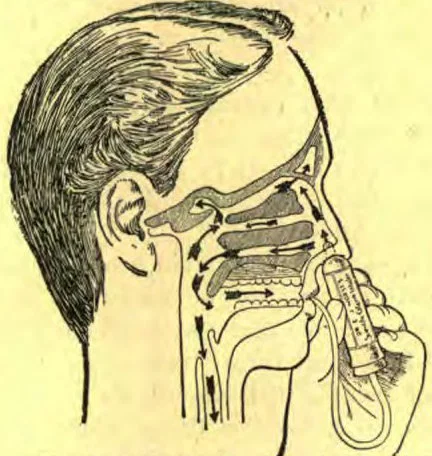
Destroy the Germs; Cure the Disease!
By E. J. Worst
The above illustration
The above illustration shows how the E. J. Worst Scientific Catarrh Inhaler sends the medicated air into every air passage of the head. Nothing but air can penetrate these fine air cells and reach the homes of the living germs that cause disease.
No snuff, powders, douche or spray can possibly reach them. Don't be deceived—make no mistake—apply common sense, and you will find that
E. J. Worst’s Catarrh Inhaler
is the only instrument that will give you quick return for a small outlay, and perfect satisfaction as a Cure for Catarrh, Colds, Pains and Roaring in the Head, Bronchitis, Sore Throat, Headache, Partial Deafness, and all Diseases of the Air Passages.
SPECIAL OFFER.
For a short time I will mail to any reader, naming this paper, one of my new Scientific Catarrh Inhalers, with medicine for one year on three days’ trial, free. If it gives satisfaction, send me $1.00; if not, return it after three days’ trial. Could any proposition be fairer?
E. J. WORST, Main Street, ASHLAND, O.
Not Sold by Druggists. AGENTS WANTED.
Self-Pronouncing S. S. Teachers' Reference Bible.
By Editor
CONTAINS the celebrated Teachers' Helps, comprising nearly 400 pages. Also a complete series of fifteen new maps.
Description. — Imperial Seal Binding, Tuck Edges, known as “Divinity Circuit,” Rounded Corners, Full Red under Gilt Edges.
We offer this Bible, post-paid, for only SIX NEW YEARLY SUBSCRIPTIONS at 75 cents; or TWELVE NEW SIX MONTHS' SUBSCRIPTIONS at 40 cents.
We will also send it, post-paid, with the INSTRUCTOR one year for $2.25. For 20 cents extra we will stamp your name in gold upon the cover.
To Reach BATTLE CREEK
FROM
CHICAGO, BUFFALO, DETROIT, OR TOLEDO,
Purchase Tickets Reading over the MICHIGAN CENTRAL “The Niagara Falls Route.”
A First-class Line for First-class Travel between Chicago and New York and Boston. Elegantly equipped through trains pass Battle Creek in each direction daily.
R. N. B. WHEELER, Ticket Agent, Battle Creek.
O. W. RUGGLES, Gen’l P. and T. Agt., Chicago, Ill.
TAKE THE Canadian Pacific Railway
For . . . CHATHAM, OTTAWA, MONTREAL, LONDON, GALT, QUEBEC, WOODSTOCK, TORONTO, BOSTON, PORTLAND, and
All points in New England, the Maritime Provinces, Great Britain, and the Continent.
Illustrated literature, time-tables, and full particulars, upon application to—
J. FRANCIS LEE, GEN. AGENT,
Passenger Dept. 228 SOUTH CLARK ST., CHICAGO
Branch Offices: 76 Ottawa St., Grand Rapids, Mich.; Room D, Chamber of Commerce, Cincinnati, Ohio; 315 Chestnut St., St. Louis, Mo.
The Prayer of Enlistment
By W. W. Fenn
To ACCEPT the will of God is not to surrender, but to order a charge. To say, “Thy will be done,” is not to sink back discouraged and resigned before misfortune or sin, but to consecrate ourselves unreservedly to warfare against it, and at last to complete victory over it. It is not the prayer of resignation, but the prayer of enlistment.—W. W. Fenn.
CHICAGO & GRAND TRUNK R'Y
E. W. Meddaugh and Henry B. Joy, Receivers.
CHICAGO & GRAND TRUNK R'Y.
Trains arrive and leave Battle Creek.
WEST-BOUND FROM BATTLE CREEK.
No. 9, Mail and Express, to Chicago.......................... 12.15 P. M.
No. 1, Chicago Express, to Chicago............................. 9.00 A. M.
No. 3, Lehigh Valley Express, to Chicago....................... 3.40 P. M.
No. 5, Pacific Express, to Chicago, with sleeper............... 1.10 A. M.
No. 75, Mixed, to South Bend................................... 8.20 A. M.
Nos. 9 and 75, daily, except Sunday.
Nos. 1, 3, and 5, daily.
EAST-BOUND FROM BATTLE CREEK.
No. 8, Mail and Express, to Pt. Huron, East, and Detroit..... 3.45 P. M.
No. 4, Lehigh Express, to Port Huron, and East................ 8.27 P. M.
No. 6, Atlantic Express, to Port Huron, East, and Detroit..... 2.25 A. M.
No. 2, Leh. Exp., to Saginaw, Bay City, Pt. Huron, and East... 6.50 A. M.
No. 74, Mixed, to Durand (starts at Nichols)................... 7.15 A. M.
Nos. 8 and 74, daily, except Sunday.
Nos. 4, 6, and 2, daily.
A. S. PARKER, Ticket Agent, Battle Creek.
Cincinnati Northern Railroad Co.
TIME TABLE NO. 3.
IN EFFECT SEPT. 24, 1899.
Trains Pass Battle Creek, as follows:
WEST-BOUND.
No. 21, Mail and Express — 6.58 P. M.
No. 23, Accommodation — 2.07 P. M.
No. 27, Local Freight — 8.25 A. M.
EAST-BOUND.
No. 22, Mail and Express — 8.25 A. M.
No. 24, Accommodation — 1.45 P. M.
No. 28, Local Freight — 5.30 P. M.
Direct connections are made at Toledo with all roads diverging. Close connections for Detroit and Cincinnati.
J. L. READE, Ticket Agt., Battle Creek.
E. R. SMITH, City Pass. Agt., 6 West Main St.
OUR PRIVILEGE
Is not the cause of much of the loneliness, the crying out against being misunderstood, the unsatisfied longing of the heart, to be found in the fact that we so persistently turn away from our privilege of communion and acquaintance with our best Friend? Of course he is our Friend always: no amount of coldness and indifference and slighting of his love, can make him other than our most constant and loving and loyal Friend: but whether or not we shall be his friends, and enjoy all that such a relationship will bring, rests entirely with us.
We love to think about our friends—does the thought of him and his constant, upholding care come like a benediction into our busiest hours? or are we so taken up with our work, our study, our pleasure, that we give no thought to the One who stands waiting, waiting, for us to turn to him—to acquaint ourselves with him, that we may be at peace?
It is a pleasure to do things for those we love, to make sacrifices, if we may but serve them: we can never do all we would; the little we can do only makes us long to do more. But do we love, really love, to do things for this Friend—our truest and best? If we do, we shall slight no opportunity, no matter how small or apparently unimportant, to express our love. “The test of service,” some one says, “is to be always doing things for God, and not to mind because they are such little things.” That is one of the tests of our friendship for him, too,—to be always doing things for him,—little things, for him,—and rejoicing in the privilege.
And when we are separated from our friends, with what longing do we wait for a message from them: how eagerly we read their written words! how carefully we treasure their expressions of regard, their assurances of love and faithfulness! but—alas that it should ever be true!—do not days often pass without more than a hasty glance at the word sent to us by our most faithful Friend? and sometimes, perhaps, is even that grudging concession to an uneasy conscience omitted?
We enjoy the society of our friends: it is a pleasure to be with them, to listen to their words of experience, cheer, encouragement, and comfort, and to tell them of our hopes and plans, sure of their interest in whatever concerns our welfare. Does it sometimes happen that we allow our human friendships, perhaps unconsciously, almost to usurp the place that no such friendship, no matter how dear and sweet and precious, should have,—the place that belongs to that Friend one of whose very names is Counselor, and who longs to be our counselor in all the affairs of our life?
What we need, what multitudes need, is not less of human love and friendship, but to remember to give these their proper place—not the first place—in our hearts. We need to remember Him who gave himself for us, and to whom we of right belong; we need to study his word, dwell upon his promises, and meditate on his goodness and love; we need to talk to him often—not merely to fly to him for help when we are in trouble, or to pray from a sense of duty, but to go to him as naturally with whatever touches our lives as a child confides in its mother.
When we do these things,—give to our best Friend the place that belongs to him, so that in all our thoughts he is first,—there will be in our hearts a fountain of happiness that will be unaffected by any outside influence. The worst terrors of loneliness are impossible to the one who has come really to know him. Shall we not love this Friend more, trust him more, and accept the rest and peace he longs to give us?
Singing Away the Cares of the Week
“I LIKE to sing at the beginning of the Sabbath,” said a man not long ago; “it drives out the cares of the week, and brings in the Sabbath peace.” And as song after song rose on the air, and at last the familiar strains of the Sabbath hymn, “Safely through another week,”—the spirit of peace and of Sabbath reflection did come into the hearts of the little company gathered by that quiet lakeside for worship.
Singing will not only drive out the demons of care and perplexity at the end of the week; but a song on the lips and in the heart will carry one safely and easily over many a hard place, triumphantly and happily through many a dark hour. It will bring in the spirit of hope, courage, forgiveness, and love, and prepare its possessor to be one of the glad company who shall at last “come to Zion with songs and everlasting joy upon their heads.”
IS THIS YOUR EXPERIENCE?
HAVE you ever, under the influence of God's Spirit at some camp-meeting, or during a revival effort, yielded your heart to him, and started out in his service, confident in his strength and sure of the victory? and then have you perhaps gone home, and taken up your every-day work, and one day awakened to the fact that you had in some way lost out of your heart a part or all of the blessing you enjoyed? In short, have you had the experience that Dr. Paulson describes in the article entitled, “Are You a Chronic Backslider?” on page 284 of this paper? If you have, and if you wish to learn how to gain something better, read this article, and those that will follow it, thoughtfully, and with a prayer that you may live up to the light they contain. These articles are the result of years of experience and observation among young people, and their author is only anxious that they shall reach and help those they are intended to benefit.
OUR INSTRUCTOR MISSION FUND
By Editor
A SISTER who, as she says, though “no longer young, still reads and enjoys the INSTRUCTOR, and sends copies to young people in whom she is interested,” sends the first contribution to our new INSTRUCTOR Mission Fund. This is the harvest season—do not forget our opportunity in India and other fields. An earnest young teacher in one of our Eastern schools is planning to interest her pupils in this matter: will not other teachers in both church- and Sabbath-schools do the same?
Mary C. Harlock . . . $1 00
Do You Want Relief
From that ever-troublesome catarrh? If so, send us one dollar, and we will mail you, on _ten days' trial_, subject to return of money if unsatisfactory,—
THE MAGIC POCKET VAPORIZER,
As it Appears when in use in Treating Catarrh of
An instrument so simple in construction that the germ-destroying oils may be applied to the affected parts while you go about your everyday labors.
The many unsolicited testimonials which we have received from our gratified patrons from Maine to California, are a sufficient guarantee of its effectiveness.
Our booklet, “Hygiene and Cure of Nasal Catarrh,” free on application.