The Youth's Instructor, Vol. LIII, No. 22

The Saviour's Love

The Youth's Instructor

May 30, 1905

Review and Herald Publishing Assn. · Washington, D. C. · May 30, 1905

The Saviour's Love

“I HAVE loved thee with an everlasting love: therefore with loving-kindness have I drawn thee.” Jer. 31: 3. Our hearts thrill within us as we read those beautiful words written in our Holy Guide-book, because one so infinitely above us should condescend to look upon us, frail creatures of dust. And yet everything in creation is willing to come under the controlling influence of our Heavenly Father, but man, the crowning work of creation, made in the image and likeness of God. Wonderful opportunities Adam had as he walked and talked face to face with God and his Elder Brother.
God intended to reveal to man many things that are now mysteries. Man's thinking would have been in harmony with God's. But since sin came, it is different. For has not God said, “My thoughts are not your thoughts, neither are your ways my ways.” But the repentant sinner, though steeped in sin to a crimson dye, may come to the throne of grace, and find acceptance in the name of Jesus, who has said, “I will never leave thee, nor forsake thee.” And yet we wonder at the children of Israel's murmuring by the way, when they had the visible presence of the Everlasting Arm in the pillar of cloud by day and the pillar of fire by night. How great have been our opportunities for spiritual development as we have had all the experiences of former ages to take for our example. “All these things . . . are written for our admonition, upon whom the ends of the world are come.”
And we on the very borders of the eternal world, the heavenly Canaan, when trials and temptations come, forget to feed upon the heavenly manna, though it is within our reach in abundant measure; but, like Israel of old, we turn to the flesh-pots of Egypt, forgetting that “to be carnally minded is death; but to be spiritually minded is life and peace.” If we would only realize that the Lord is sufficient for us in all our sorrows, and learn to know his voice as the sheep know the shepherd's, how much more peaceful and blessed would be our lives! A sweet radiance would shine out to others as we come in contact with our fellow men. “My peace I give unto you: not as the world giveth, give I unto you.” We would have more of that perfect love that Christ had for us, and a great deal more of the true missionary spirit.
Surely the Lord is long-suffering toward us, and he remembers we are but dust. He says that he has not chosen us because we were more in number, but because we were the fewest of all people, and again, “O Israel, fear not: for I have redeemed thee, I have called thee by thy name; thou art mine.”
And at times when we feel that everything is lost, when perplexities deepen on every hand, and Satan seems to be conquering, and we about to give up to despair, how often the blessed assurance comes to us, “I have loved thee with an everlasting love: therefore with loving-kindness have I drawn thee.”
If we but take the first steps toward God, he sees us afar off and advances to meet us, and in his joy that we have come, forgets all our shortcomings, and exclaims, as did the father of the prodigal, “This my son . . . was lost, and is found.”
“O that men would praise the Lord for his goodness, and for his wonderful works to the children of men.” Does it not seem selfish on our part that when God has given us life, health, and happiness, we refuse to come to him, and are slow to tell others of his wonderful love toward us while we were aliens and strangers from the commonwealth of Israel?
MARTHA GYLES.

“A Mighty Fortress Is Our God”

MARTIN LUTHER was born in Eisleben, Germany, in 1483, a poor miner’s son. His heart was full of music when he was a boy, and he used to sing from door to door. After he became a man, and had led in the great revolt from the superstitions, sins, and injustices of the Roman Catholic Church, he did two things that, more than all others, established Protestantism firmly,—he translated the Bible into the language of the common people, and he wrote hymns also in their every-day language, to be sung to attractive, familiar tunes. The first printed hymn-book was published at Wittenberg in 1524;—eight hymns with tunes, and four of them by Luther. Since that beginning it is said that Germans have written more than one hundred thousand hymns, and the greatest of all is this hymn of Luther’s. Luther wrote some thirty-six hymns in all, but this is his noblest. Some say that the strong tune to which the hymn is always sung was composed by Luther, but he probably merely adapted a tune already in existence.
The hymn was written about 1528, and though many attempts have been made to associate it with various stirring events in the life of the great Reformer, it is not known what occasion prompted it. He based it on the forty-sixth psalm, but it does not follow the course of the psalm; it merely catches up and carries on the psalm’s leading thought.
Whatever its origin, it had an immediate influence in Germany, and became for the Reformation what the great French hymn, La Marseillaise, became to France. It is now the national hymn of the fatherland.
Dr. Benson says: “It was sung at Augsburg during the Diet and in all the churches of Saxony, often against the protest of the priest. It was sung in the streets; and, so heard, comforted the hearts of Melanchthon, Jonas, and Cruciger, as they entered Weimar, when banished from Wittenberg in 1547.
“It was sung by poor Protestant emigrants on their way into exile, and by martyrs at their death. It is woven into the web of history of Reformation times, and it became the true national hymn of Protestant Germany.
“Gustavus Adolphus ordered it sung by his army before the battle of Leipzig, in 1631, and on the field of that battle it was repeated, more than two centuries afterward, by the throng assembled at the jubilee of the Gustavus Adolphus Association. Again it was the battle hymn of his army at Lutzen, in 1632, in which the king was slain, but his army won the victory.
“It has had a part in countless celebrations commemorating the men and events of the Reformation; and its first line is engraved on the base of Luther’s monument at Wittenberg.”
Luther comforted his own heart with the hymn, and when his great cause seemed almost lost, he would turn to his friend Melanchthon and say, “Come, Philip, let us sing the forty-sixth psalm.”
There is a story of the use of it by the German troops lodged in a church after the battle of Sedan. They were too excited to sleep. At last some one began to play Luther’s hymn upon the organ. The soldiers united in a splendid outburst of song, after which they fell into peaceful slumber.
The hymn has been translated into English more than eighty times, but only twice with such success that the result has won popular favor.
Our favorite American version is that by Rev. Frederic Henry Hedge, a great German scholar, himself a poet of no mean ability, whose translation appeared in 1852. Longfellow has a version in his “Golden Legend,” and one of Whittier’s war poems is in Luther’s meter, and has the same name. Here is Dr. Hedge’s translation of this great soul-stirring hymn:—
“A mighty fortress is our God, A bulwark never failing; Our helper he amid the flood Of mortal ills prevailing: For still our ancient foe Doth seek to work us woe; His craft and power are great, And, armed with cruel hate, On earth is not his equal.
“Did we in our own strength confide, Our striving would be losing; Were not the right man on our side, The man of God’s own choosing: Dost ask who that may be?— Christ Jesus, it is he; Lord Sabaoth his name, From age to age the same, And he must win the battle.
“And though this world, with devils filled, Should threaten to undo us, We will not fear, for God hath willed His truth to triumph through us: The prince of darkness grim,— We tremble not for him; His rage we can endure, For lo! his doom is sure, One little word shall fell him.
“That word above all earthly powers, No thanks to them, abideth; The Spirit and the gifts are ours Through him who with us sideth: Let goods and kindred go, This mortal life also; The body they may kill: God’s truth abideth still, His kingdom is forever.”
— Amos R. Wells, in Junior Christian Endeavor World.

Psalm Ninety-one

In the secret of the Highest I'm abiding, In the shadow of Almighty I am hiding, In my Refuge and my Fortress I am resting, In deliverance from the fowler I am trusting.
With the feathers of his pinions shall he cover All his children, as a hen her brood doth hover, And the terror of the night shall not alarm me, And the arrow of the day shall never harm me.
Though a thousand at my side shall oft be smitten, And ten thousand at my right hand, as is written; I shall see it, but it never shall come nigh me, For a shield and for a buckler shall his truth be.
From all evil and from plagues shall I be shielded With his sword, which for me is ever wielded, And my refuge in the time of desolation Is the stronghold of my Father's habitation.
In the hands of holy angels I am holden, Lest my feet by jagged rocks be bruised and swollen. I can tread upon the adder or the lion Or her whelps, or even trample on the dragon.
Just because His love hath won my heart's endeavor, He hath promised to be with me to deliver Me from trouble and oppression, And to satisfy my soul with his salvation.
J. M. C. JOHNSON.

A Story of a Song

Of all the stories concerning the dear, familiar hymns, I think none has moved me more than one old one told me of that grand old hymn, “Coronation.”
“It was years ago,” said my friend, “and I had gone back to the old homestead to spend Thanksgiving as usual. There was a houseful of us—uncles, aunts, and cousins—and, of course, we young folks were anxious for a frolic.
“It had been unusually cold, the river was frozen over, and looked perfectly safe, as well as beautifully clear and smooth.
“‘I’ll tell you,’ said my cousin Richard, the afternoon before Thanksgiving, ‘why can not we young folks skate across the river, have supper at the hotel, and come home by moonlight? Grandma and Aunt Martha will be glad to have us out of the way so they can finish their preparations for to-morrow, and we will have a jolly good time.’
“So about four o’clock we started. Some of our number could not skate, so we who were skaters got sleds and drew the rest.
“We reached our destination all right, and, with ravenous appetites, had a fine time over our supper, laughing and talking until it was time to start for home.
“It happened on our return journey that Richard, who was the best skater in the party, and I were side by side in front; behind us was a row of skaters hand in hand, every other one having a sled in tow.
“We had not gone very far before, to my unspeakable horror, I was sure that the ice was bending in front of us. I looked again, straining my eyes and trying to think that I was mistaken, but, even in the uproar about me, it seemed to me that I could hear it crack.
“I looked at Richard. I could not have spoken to save my life; my tongue seemed to cleave to the roof of my mouth, and I felt the perspiration coming out on my forehead in great drops.
“I thought of everything in those few terrible seconds. Like a flash it went through my mind that we might possibly get through in safety if we could only keep in motion as we were; but, if the rest suspected our danger and there was a panic, those on the sleds, at least, would probably be drowned.
“Richard read my thoughts, and, though his face was drawn and white with horror, his voice was perfectly clear and natural.
“‘Let’s have a good sing!’ he called out, without turning; ‘it will help us to keep step.’
“Then he struck up instantly into ‘Coronation.’”
“For a minute the party were taken by surprise, but before we had gotten through the first verse, every one in the crowd was singing.
“We flew over the ice, though it seemed to me the others must hear, as I did, that awful crack, crack of the ice. Thank God we were past the middle of the river, where the ice was thinnest! Would the verses hold out until we reached the bank? Did Richard know them all? He had a magnificent voice, but I had never heard him sing before, nor have I since, as he did that night.
“‘Let every kindred, every tribe,’—
“Yes, we should be out of danger before the verse was finished, I was sure.
“‘To him all majesty ascribe, And crown him Lord of all.’
“The last words rolled out triumphantly as we reached the bank.
“After we had reached home, and were all gathered round the open fire, we told our story. The faces of the merry company grew suddenly very grave; no one could speak for a minute or two, but we drew closer together, and then my grandfather poured out his heart in thanksgiving to God.”— Kate S. Gates.

Tens of Thousands Perishing

HON. GEO. W. STUBBS, the judge of a juvenile court, in Indianapolis, says that the cigarette is mainly responsible for the trouble in the cases of more than six hundred boys who have been brought into his court, many of whom were charged with some grievous, debasing, criminal action. In strong terms he condemns the use of the cigarette.
E. E. York, superintendent of the Indiana Boys’ School at Plainfield, says that out of six hundred boys admitted to that institution during the last three years, sixty per cent were known to have been cigarette fiends, while less positive evidence at hand shows that ninety per cent formed the habit that sapped their virtue and strength at an early age. Nervous, listless, no energy nor ambition, emaciated, blear-eyed, and agonizing deaths is the record he gives.
And now, dear reader, who can tell but that some of these boys would have been saved from this soul- and body-destroying habit if we, as a people, had only put forth the effort that we could and should have made years ago? We have only to multiply this one juvenile court, and this one boys’ school by the thousands of cities, to see what an army of boys are fast placing themselves where they can no more discern sacred things than could the two sons of Aaron.
The hour is late, the time of work is nearly past, and yet we may save some. The situation demands haste. Shall we arise to the demands of the hour? Why should not our Sabbath-schools everywhere arise as one man to the rescue, and throw out the life-line? By your co-operation, that journal Save the Boys, set as a safeguard against rum and tobacco, may have a larger circulation, for which its readers are calling. Some of our Sabbath-schools are using clubs of them, and report a blessing in the work. Why should not all do something? Why not order now? Price, only 30 cents a year. In clubs of five or more to one address, 25 cents each. Address Save the Boys, 118 W. Minnehaha Boul., Minneapolis, Minn.

“The Little Cares”

THE little cares that fretted me, I lost them yesterday Among the fields, above the sea, Among the winds at play, Among the lowing of the herds, The rustling of the trees, Among the singing of the birds, The humming of the bees.
The foolish fears of what might happen, I cast them all away Among the clover-scented grass, Among the new-mown hay, Among the husking of the corn Where drowsy poppies nod, Where ill thoughts die and good are born— Out in the fields with God.
— Elizabeth Barrett Browning.

“He Sealeth Up the Hand of Every Man”

A YOUNG man upon being asked to give his opinion concerning a fellow student’s stability and consecration, would not permit an evil insinuation to escape his lips, and answered simply, “Time will tell.”
Sometimes the temptation comes for us to perform “Time’s” duty. We forget that our lips have been set apart for a holy use, that God has put a new song in our mouth, even praises. The enemy deceives us to defraud the one for whom the Spirit is working.
“Lord, who shall abide in thy tabernacle? who shall dwell in thy holy hill? . . . He that backbiteth not with his tongue, nor doeth evil to his neighbor, nor receiveth a reproach against his neighbor.”
The time is now far spent. We are doing a great work, and dare not “come down” to worry over the supposed misdeeds of others. The disciples were so busy proclaiming the risen Saviour that they had no time to censure Thomas. They let the Lord convince their brother while they prayed and praised. The Lord wants strong symmetrical, consecrated characters upon which to lay the burdens of so great a cause. If we have failed to meet his requirements, and have dwarfed our souls by watching with critical eye a struggling fellow Christian, the Lord has had to pass us by, and choose the worthier one to bear responsibilities.
When tempted to tear down the structure a brother Christian is laboring to build, “refrain . . . if it be of God, ye can not overthrow it; lest haply ye be found even to fight against God.”
“Except the Lord build the house, they labor in vain that build it: except the Lord keep the city, the watchman waketh but in vain.”
Satan is the destroyer. Let him find some one else to carry on his work. We can not safely unite in it. It is ours to rear beautiful structures which God can “keep.”
MRS. J. C. BROWER.

God’s Ways

HEAR what God says: “One of you shall chase a thousand, and two put ten thousand to flight.” That is God’s arithmetic. Twice one thousand is two thousand in our mathematics, but in God’s arithmetic twice one thousand is ten thousand. God is sublimely indifferent to numbers. It is not quantity, but quality for which God cares; he would rather have one consecrated man or woman than a thousand who are half-hearted in his service; and so he keeps sifting down, and down, and down, just as he did Gideon’s great multitude, till he gets the choice “three hundred” with whom he can do mighty works. Will you be one of the “three hundred?”—Arthur T. Pierson.

Look for the Light the Shadow Proves

“Look for the light the shadow proves.”

Ignorance Is the Mother of All Evils

“IGNORANCE is the mother of all evils.”

Why Weeds Are Weeds

LUTHER BURBANK, famed in horticultural pursuits and a grafter of the fashions of grafting that brings forth good, and even better, fruits and flowers and vegetables, thus tells why weeds are weeds:—
“Weeds are weeds because they are jostled, crowded, cropped, trampled on, scorched by fierce heat, starved, or, perhaps, are suffering with cold, wet feet, tormented by insect pests, or a lack of nourishing food or sunshine. There is not a weed alive which will not, sooner or later, respond liberally to good cultivation and persistent selection.”
Luther Burbank speaks as one having authority, and is possessed of knowledge that makes his authority well-nigh binding. It is easy to recall the one-time weeds that have, by study and cultivation, come to be the producers of flowers, and it is not much more than a generation when even the succulent and the delicious tomato was regarded as nothing but the product of a weed to be avoided, as it is to-day in many parts of Germany. The earth annually offers treasures of the field hidden in ugly weeds, and only needing the “good cultivation and persistent selection” recommended by Mr. Burbank to make of them useful servants to man, instead of noxious plants to be avoided.
The suggestion of Mr. Burbank might be applied to other things than weeds of the forest or of the field. There are weeds growing in the streets and in the slums and in the tenements of every city in the United States, noxious and growing to be dangerous to organized society, but which, with good cultivation and persistent selection, would come to a growth beneficial to themselves and to society. And the good cultivation and persistent selection that would bring forth good fruits from the weeds of the streets and alleys are equally applicable to the weeds gathered into penal institutions.—San Jose Herald.

How Corks Are Made

CORK, as most persons know, is the outer bark of an evergreen oak-tree which grows in Spain, Portugal, Algeria, Morocco, and to some extent in Italy. Its peculiar properties, especially its lightness and its compressibility, make it valuable for scores of purposes, but its original use, in the manufacture of corks, or stoppers for bottles, still consumes the greater part of all that is brought to market.
The cork oak varies in diameter from six inches to three feet. By a generous provision of nature, the tree may be periodically stripped of its outer bark without losing its life.
Twenty years is the usual age at which the first cutting is made. After that the cork may be harvested about every ten years. The first cut, which is called virgin bark, is of little value, as it is coarse in texture and deeply seamed. The tree may be expected to live and yield cork until it is one hundred fifty years old.
In Spain and some other European countries corks are still made by hand, each one being pared from a square block by a common knife.
In this country, where are made the finest corks in the world, the work is done by machinery, all of which is of American invention and manufacture. Every boy who has ever whittled a cork for a fishing “bob” or a pop-gun pellet knows how difficult the material is to cut smoothly. To do it well his knife must be as sharp as a razor, and must be used with a drawing motion, not a mere pressure; and if the cork be wet, so much the better. The same difficulties confront the manufacturer by machinery, and are met in the same way.
The bark, after having been wet, and then allowed to remain for a time in damp cellars to soften, goes first to the stripping-machines, which reduce it to slabs of a size proportionate to the corks to be made. These machines are merely small iron tables, through which appear very thin steel disks, like circular saws, except that they have no teeth. They are really keen-edged steel knives, as thin as paper, and running at a high rate of speed, but so smoothly that they seem to the spectator to be standing still.
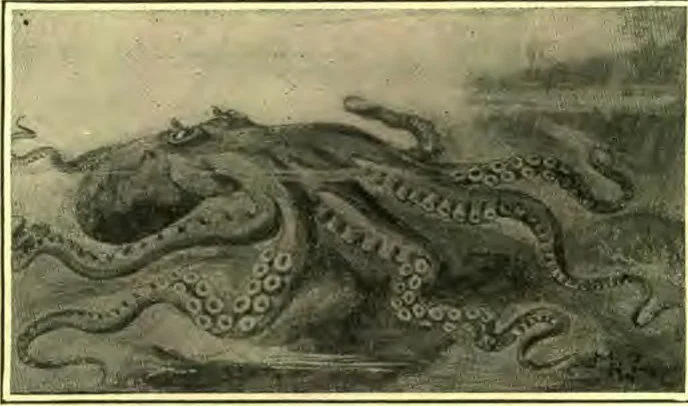
THE OCTOPUS, OR DEVILFISH
The little slabs or strips of cork go next to the “blockers.” The cutters here are cylindrical steel punches, or tubes, with razor edges. They are arranged in rows or “gangs,” and instead of being simply pressed through the cork, are also revolving at high speed, and so cut their way through. Having perforated the slab, the cutters back away automatically, while plungers like pistons working in the cylinders come forward and punch out the cores, which, for some purposes, are already finished corks.
They are, of course, perfectly cylindrical, that is, without taper, and in that form they are preferred by bottlers of effervescent liquids because their shape enables them the better to resist the pressure of the restrained gases.
But for the use of druggists, who are the great users of corks and need the very finest, a tapering stopper is preferred, and this necessitates another operation. The tapering-machines are run mostly by young women. Each machine consists of a little lathe which centers the cylindrical cork automatically, and then brings it into contact with the edge of the cutting-knife, which, like the cutter of the slicing-machine, is a very thin steel disk. As the cork touches this knife, a thin shaving rises and curls away, light as a puff of smoke.
One who knows nothing of the machinery could see no reason for it, but during the second that the cork has been in contact with the apparently motionless disk some dozen yards of flying, razor-edged steel have been at work, and the cork is now a perfect truncated cone, with a fine, satin-like surface and an even and regular taper. By hand, a very rapid and skilful cutter can turn out twelve or fourteen gross in a day. With these machines one girl will produce four hundred twenty gross.
There are few businesses in which the quantity of waste material is so large as in the manufacture of corks. In the best-managed factories it ranges from sixty to seventy per cent; but American ingenuity and industrial development have succeeded in transforming it into a source of profit. By grinding the waste to various degrees of fineness and pressing it, with glue or shellac, into various shapes, it is made useful for the inner soles of shoes, for bath-room mats, for insulation in refrigerating plants, and the deadening of sound in apartment-houses, the making of bicycle handles and the grips of tennis rackets, fly-rods and golf clubs; and there are dozens of other uses for the waste which are quite as interesting.
A few years ago one manufacturer of corks was paying a teamster a dollar a load to cart away his waste and dump it on a refuse heap. To-day he receives sixty dollars a ton for the very cheapest quality of this waste.—Edward Williston Frentz, in Youth’s Companion.

A Fun-Loving Moth

IT has undoubtedly occurred many times to many people, says a writer in an exchange, that insects have a sense of humor. But never in serious literature on subjects of natural history have I seen any reference to evidence that insects possess, even in the slightest degree, this very human attribute. Ernest Thompson-Seton and others attribute to higher orders of animals almost every human faculty; but insects have been signalized in history for their perseverance, industry, and thrift alone, and have for ages most properly been held up as models to those humans who happen to lack in energy, application, and providence.
My observation enables me to say positively that insects have a distinct and well-developed sense of humor—an appreciation of play which is the foundation of all fun.
I own a very handsomely marked young coach dog that, like all youthful canines, takes an active interest in everything animate in the world of nature that is presented to his notice. One summer afternoon the dog became interested in a little yellow moth that flew under his nose as he lay at my feet on the piazza at my country home, and a chase across the lawn ensued, the moth keeping just out of reach of the dog, and leading it around and around the yard. Finally the dog tired and lay down on the grass, still watching the moth, which settled down on a clover stem a few feet away, lazily waving its wings in a manner to hold the dog's attention. When the dog had rested, he again chased the moth until he grew tired, and again lay down to rest, when the moth, as before, wafted down, and again waited for him to recoup his energies. Desiring to possess the bright little yellow “bird,” the dog, having learned that speed did not avail, then crept up carefully on the moth where it was resting, and just as he was ready to pounce upon it, the moth fluttered up from under the dog's nose, and led him away for another chase. When the dog finally gave up in disgust, that tantalizing little breath of yellow floated up under the dog's very nose, and challenged him again to the inevitable romp.
Off and on all that long summer afternoon these tactics were repeated, and I could not help concluding that the moth was deliberately making sport of that dog, and that in the oft-repeated tactics for attracting the dog was evidence that it was enjoying hugely the bright-spotted beast's ineffectual efforts at its capture, and the frequent evidence of anger and disgust at the failure.—Selected.

Steamship Stopped by an Octopus

THE Pacific Mail Steamship Company's large vessel, the “Peru,” that has just arrived at San Francisco from a Central American port, had a most remarkable experience. While steaming along one day off the Mexican coast, the captain of the “Peru,” who was on the bridge, noticed that for some time the vessel was not making her usual speed. He sent word down to the chief engineer inquiring the cause of the slowing down. To the captain's surprise, the engineer affirmed that the engines were running at the customary speed. The captain and engineer began immediately to investigate the cause. Finally the mystery was solved on looking down over the steamer's bow. Stretched across the prow was discovered a monster octopus, or devilfish. It was of immense size, weighing not less than four tons, some of the giant tentacles, or arms, being fully twenty feet long. This octopus was one of the largest ever seen anywhere. So huge was the hideous creature that it made the sharp prow of the “Peru” like a blunt scow, and greatly retarded the steamer's speed. How to get rid of the monster was a question. The steamer was stopped and repeatedly backed hard and fast, but that signally failed to dislodge the devilfish. Finally a brave seaman was cautiously let down by a rope over the bow. The octopus is a very dangerous creature; and if a person is caught by one of its long, slimy arms, escape from a fearful death is almost impossible. The sailor was armed with a powerful steel hook to which was fastened a rope. With great caution the sharp hook was fastened into the central part of the octopus, and the rope wrapped around the vessel's capstan. When the windlass began tightening the rope, the huge creature loosened its fearful grip on the vessel, and finally dropped off into the sea. It made frantic struggles with its many long, snake-like tentacles, and the sailor had a very narrow escape from being caught in their folds. So strong was the strain that the powerful steel hook was straightened out before the monster was dislodged.
The “Peru” was detained some time by the octopus, and the thrilling incident caused intense excitement among the many passengers. This is the first instance on record, so far known, where a large steamer was stopped by a devilfish.—J. Mayne Baltimore, in Children's Visitor.

THE WEEKLY STUDY

Paul Before the Sanhedrin
OPENING EXERCISES.
SCRIPTURE FOR STUDY: Acts 22:30; 23:1-11.
TEXTS FOR PERSONAL STUDY: Luke 21:12-18; Rev. 2:10.
REFERENCE STUDY: “Sketches from the Life of Paul,” pages 221-225.
TOPICS FOR STUDY:—
Sanhedrin summoned.
Speaks to his inquisitors.
Smitten.
The chief inquisitor reproved.
Raises a dissension in the council.
Belief of Sadducees and Pharisees defined.
Great clamor.
Escorted by soldiers to the castle.
The Lord stood by him.

Notes

Sanhedrin, a Jewish council and tribunal, especially the supreme council of the Jewish nation, in existence from an uncertain time after the exile until A. D. 425, originating in the municipal council of Jerusalem, which gradually increased its functions. This supreme council, called also Great Sanhedrin, was composed of seventy-one priests, scribes, and elders of the people, and under the Romans was presided over by the high priest. It had not the power of inflicting death. The lesser sanhedrins, or provincial courts, were each composed of twenty-three members appointed by the Great Sanhedrin.” — Standard Dictionary.
This council before which Paul is now arraigned is the same that he was once a member of, and before which Stephen stood. He no doubt recognized among the inquisitors, some whom he knew in the school of Gamaliel, and some were his associates in the persecutions of his earlier belief. The mind of the great apostle was doubtless subject to strange emotions as he stood a prisoner before this august tribunal. “Thou whited wall.” The Saviour compared the hypocrites to “whited sepulchers.” Matt. 23: 27. “Lightfoot goes so far here, as to say that the words themselves mean that Annas had the semblance of the high priest’s office without the reality.” — Conybeare and Howson.
“God shall smite thee.” These words of Paul to the high priest were not spoken in anger, but were prophetic. The high priest was murdered by assassins in the Jewish war.
“The apostle’s bearing was calm and firm. The peace of Christ, ruling in his heart, was expressed upon his countenance.”
“Paul was convinced that he could not hope for a fair trial and just decision at this tribunal. And his natural penetration and shrewdness enabled him to take advantage of the circumstances. The Sanhedrin council was made up of Pharisees and Sadducees, who had long been at variance upon the doctrine of the resurrection. Knowing this, the apostle cried out in clear, decided tones, ‘Brethren, I am a Pharisee, the son of a Pharisee: of the hope and resurrection of the dead I am called in question.’ These words, appealing to the sympathies of those who agreed with him in regard to the resurrection, brought a change in the council. . . . The Pharisees flattered themselves that they had found in Paul a champion against their powerful rivals; and their hatred against the Sadducees was even greater than their hatred against Christ and his apostles. With great vehemence they now began to vindicate Paul, using nearly the same language that Gamaliel had used many years before: ‘We find no evil in this man; but if a spirit or an angel hath spoken to him, let us not fight against God.’ The sentence was hardly completed before the judgment hall became a scene of the wildest confusion. The Sadducees were eagerly trying to get possession of the apostle, that they might put him to death, and the Pharisees were as eagerly trying to protect him.”
“And now he was in prison, and his enemies, in their desperate malice, would resort to any means to put him to death. Could it be that his work for the churches was closed, and that ravening wolves were to enter in, not sparing the flock? The cause of Christ was near his heart. . . . In distress and discouragement he wept and prayed. The Lord was not unmindful of his servant. . . . And now the Lord stood by him and said, ‘Be of good cheer, Paul; for as thou hast testified of me in Jerusalem, so must thou bear witness also at Rome.’”
G. B. T.

Dogs That Wear Shoes

THE dogs that wear shoes are the Eskimo dogs. They do so only occasionally, and then not on account of the cold, for these shaggy animals are comfortable and frisky when a man would freeze to death. The New England Farmer gives some interesting items about them:—
“The dog does all the work of dragging and carrying which in the country falls to the horses, and in trotting over the rough ice of the mountain passes his feet soon become bruised and sore. Then his driver makes him soft little moccasins of buckskin or reindeer skin, and ties them on with stout thongs of leather. In this way he will travel easily until his feet are thoroughly healed. Then he bites and tears his shoes with his sharp wolf-like teeth, and eats them up.
“Wonderful animals are these dogs of Alaska! Although they are only little fellows,—not more than half the size of a big Newfoundland,—they are worth from $75 to $200 each,—more than an ordinary horse will sell for in this country. They will draw two hundred pounds each on a sled, and they are usually driven in teams of six. They need no lines to guide them; for they readily obey the sound of their master's voice, turning or stopping at a word.
“But the Eskimo dogs have their faults. Like many boys, they are overfond of having good things to eat. Consequently they have to be watched closely, or they will attack and devour stores left in their way, especially bacon, which must be hung out of their reach. At night, when the camp is pitched, the moment a blanket is thrown upon the ground, they will run into it and curl up, and neither cuffs nor kicks suffice to budge them. They lie as near the men who own them as possible, and the miner can not wrap himself so closely that they will not get under the blanket with him. They are human, too, in their disinclination to get out in the morning.”
—The Wellspring.

The Voice of Decision

“THE voice of decision is the breath of destiny.”

God Is With Us

BEST of all, God is with us.—John Wesley.

Report From Fernando, California

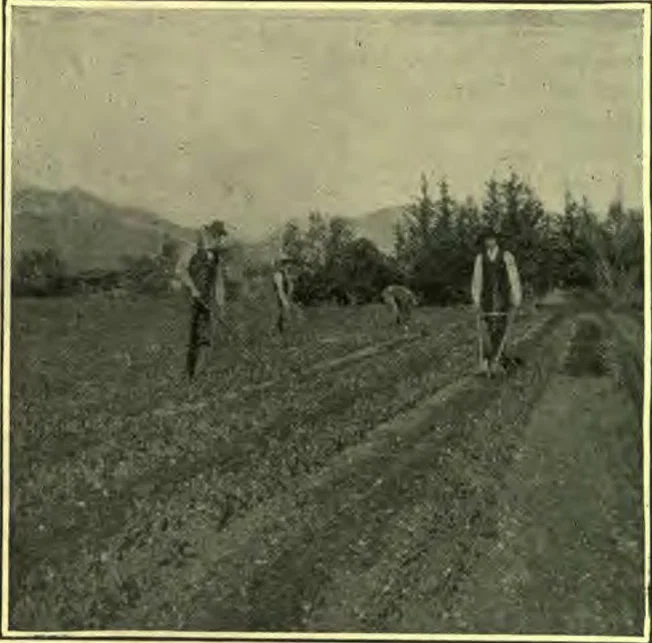
WE enclose a photograph of the missionary acre planted by the members of the Young People's Society of Fernando College.
We hope this will be of interest to the readers of the INSTRUCTOR, and will stimulate a desire among other Societies to take up a similar work.
Early in November of last year we secured permission of a gentleman living in Los Angeles to use a vacant lot of his located near the college campus.
Nearly two weeks were consumed in clearing, irrigating, and in other ways getting the ground in condition to be plowed. The young men of our Society did this work after the regular college industrial period, and, when necessary, at night, two whole nights being put in.
Upon the advice of our college business manager, we planted peas, spinach, and lettuce; the spinach and lettuce being set between the rows of peas.
The young lady members volunteered to help us gather our crop. So far we have marketed about two hundred fifty pounds of peas; the bulk of our crop is to come later.
We feel that the Lord has greatly blessed us in this our first effort of the kind, and we hope to realize a generous sum to send to the needy Southern field. Perhaps we may be able to tell you how much later on.
E. M. ADAMS, President, T. W. WALTERS, Corresponding Secretary.
Continue reading: A New Celebration of Memorial Day