The church is not the bride. There is a certain pleasing glamour hovering over the expression, “The church, the bride of Christ,” which the popular mind at once accepts as the truth in the matter, and thus places itself at a point of view from which the prophecies touching the case become a tissue of confusion; for prophecy has a determinative bearing upon this question, as upon many others.
There is, in the work and experience of Christ, an event which is not merely illustrated by marriage, but which is called his marriage; and the relation of his people to that event is clearly pointed out; but it is not that of the bride.
At that supreme moment when the first consciousness of redemption thrills through the hearts of the overcomers, John says: “I heard as it were the voice of a great multitude, and as the voice of many waters, and as the voice of mighty thunderings, saying, Alleluia: for the Lord God omnipotent reigneth. Let us be glad and rejoice, and give honor to him: for the marriage of the Lamb is come, and his wife hath made herself ready.” Rev. 19 : 6, 7.
Here is a definite, specific event brought to view, which is called “the marriage of the Lamb.” It is still future. It comes only when redemption comes, and is inseparably connected with the commencement of the reign, the establishment of the kingdom, of our Lord Jesus Christ.
But if the church is not the bride, it may be asked how she could make herself ready. But on the other hand, it may also be asked how the church could be said to make herself ready, even if she were the bride. Whatever preparation the church makes, she makes it here, not there; now, not then. Christ enjoins upon his people to buy of him the white raiment now (Rev. 3 : 18); and if they fail to do this, they will never participate in the scene of Rev. 19 : 6, 7.
This point, that the marriage of the Lamb is a future definite event, is important, as it shows that every text that is referred to, to prove that the church is the bride, if it has its application previous to that time, is misapplied. Thus the Lord says of Israel when he brought them out of Egypt, that he “was an husband unto them.” But did the marriage of the Lamb take place away back there?—Certainly not. The expression in this, as in some other scriptures, is used only to show the Lord’s care over, affection for, and union with, his people, which are illustrated better by the union between a properly married couple than by any other figure. But the fact that this figure is used to set forth the union between the Lord and his people should not mislead any one to suppose that the church is the bride in the great prophetic event called the “marriage of the Lamb.”
So Paul says (2 Cor. 11 : 2), “I have espoused you to one husband, that I may present you as a chaste virgin to Christ.” But was the marriage of the Lamb going on in Paul’s day?—By no means. He simply uses the figure of marriage to set forth the bonds of love with which they were joined to Christ. In 1 Cor. 4 : 15, he uses another figure. He says, “In Christ Jesus I have begotten you through the gospel.” If the first text proves that the church is the bride, this proves that the church has Paul for her father.
Again: the Lord says, in Jer. 3 : 14: “Turn, O backsliding children, saith the Lord; for I am married unto you.” Here, as before, we ask, Had the marriage of the Lamb taken place then?—Surely not. But the Lord only uses that figure to show his relation of love and union toward them; not to intimate that they (the church) constituted the bride, the Lamb’s wife.
Paul presents still more forcibly the close relation between the Lord and his people by the same figure in Eph. 5 : 25–33. He sets forth the fact that the husband and wife are one flesh; that this is a great mystery, but that he speaks concerning Christ and the church. Then he says that no man hateth his own flesh, “but nourisheth and cherisheth it, even as the Lord the church.” This sufficiently explains the intent of the illustration,—to show Christ’s care for, and union with, his people, not to prove that the church is the bride of Christ, or that the marriage of the Lamb had come, or that it was taking place all along as converts were brought into the faith.
But we are not left without direct testimony on this question. In Rev. 21 : 2 John says: “And I John saw the holy city, New Jerusalem, coming down from God out of heaven, prepared as a bride adorned for her husband.” No reader of the REVIEW, certainly, will claim that this holy city, the New Jerusalem, is the church. Hear, then, what John further says of it in verses 9, 10: “And there came unto me one of the seven angels which had the seven vials full of the seven last plagues, and talked with me, saying, Come hither, I will show thee the bride, the Lamb’s wife. And he carried me away in the spirit to a great and high mountain, and showed me that great city, the holy Jerusalem, descending out of heaven from God.”
Here John was given to understand, as plainly as words and actions could do it, that the bride, the Lamb’s wife, is the city of God, the New Jerusalem; not the church, but the heavenly city. And unless the angel deliberately deceived the holy seer, the bride of Christ is not the church, but it is the holy city.
But, says one, I can see no consistency in calling a city the bride. Very well, suppose you do not see any consistency in it; there are the words of the angel, and there is what he showed to the prophet, as corresponding thereto; and you will, of course, accept that testimony. As to the supposed inconsistency, that will disappear, or rather will shift sides, when we look at other prophecies bearing on the subject of the marriage of the Lamb.
All the figures which the Bible uses applying to the same subject must be consistent with one another. It is so here. Thus in a prophecy of Christ we read: “His name shall be called, Wonderful, Counselor, The Mighty God, The Everlasting Father, The Prince of Peace.” Isa. 9 : 6. Here Christ is represented as the Father of his people. We, then, are his children. Heb. 2 : 13. But the heavenly family consists of more than father and children. Somewhere the mother should have a place. Paul completes the picture when he says: “But Jerusalem which is above is free, which is the mother of us all.” Gal. 4 : 26. This is the same Jerusalem of which John speaks in Rev. 21 : 10. And now we see the consistency and harmony which all these writers maintain upon this subject. Isaiah says that Christ is the “Everlasting Father,” of whom, if we are Christ’s, we are children; John says that the New Jerusalem is the bride of Christ, the Lamb’s wife; and Paul completes the testimony by saying that this same Jerusalem, as would of course be the natural order of this relationship, is our mother. So we have father, mother, and children, with no disorder or confusion. But the moment we say that the church is the bride, we break up this natural order into the unheard of confusion of making the children to be the mother of themselves, and having the father marry his own offspring!
Why the New Jerusalem is called “the bride” and “the mother of us all,” is because it represents a system of divine grace which inspiration has seen fit to set forth under the figure of a woman. The two women of Gal. 4 : 21–31, Agar and Sarah, represent the two covenants, the old and the new. Agar answered to the earthly Jerusalem of Paul’s day, the old covenant, which, as soon as that covenant was superseded by the new, could only gender to bondage; while Sarah, the free woman, answered to the New Jerusalem above, which genders to freedom, of whom we all, through Christ, are children. And the bringing forth of gospel children through this new covenant was according to a prophecy in Isaiah 54, a portion of which Paul quotes: “Rejoice, thou barren that bearest not; break forth and cry, thou that travailest not: for the desolate hath many more children than she which hath an husband.” Verse 27. That is, while the old covenant was in force and was accomplishing its purposes, under the figure of a married wife, cherished and comforted by her husband, the new covenant, under the same figure, is represented as a woman desolate and childless, and not taken into family relation with her husband. But the Lord promised the coming of a time when she would be able to gather around her more children than the other. And as this is all allegorical, and refers to that gospel system the outward symbolism of which is the New Testament city, the New Jerusalem, the Lord says (Isa. 54 : 5): “For thy Maker is thine husband; the Lord of Hosts is his name.”
These promises are all prospective, looking forward to the time when the marriage of the Lamb shall have taken place; and then the redeemed appear upon the scene as children. Then is the time when the earth brings forth in a day, and a nation is born at once. Isa. 56 : 8. Then the results of the great plan of salvation appear. Then Christ sees the travail of his soul, and is satisfied. Isa. 53 : 11. Then he receives his kingdom. Then he takes his throne which he assumes with the metropolis of his kingdom, the New Jerusalem. And this grand investiture of power, with the results of his glorious redemptive work, then for the first time manifested in all their glory, may well be called “the marriage of the Lamb;” and the New Jerusalem, representative of that covenant through which this blessed work has been accomplished, may well be called “the bride.” There is no more incongruity in thus applying this figure to the city than there is in applying it to the great multitude of people which constitute the church. And the expression, “His wife hath made herself ready,” is only carrying out the figure; for through all the521years the covenant of God’s grace has been gathering out those who will constitute the company of the redeemed, who will be the adornment and glory of the holy city. “And to her was granted that she should be arrayed in fine linen, clean and white: for the fine linen is the righteousness of saints.” Rev. 19 : 8.
Finally, the saints are exhorted to have their loins girded about, and their lights burning, and to be in waiting for their Lord when he shall return from the wedding. Then the wedding takes place, not here, where the church is, but above, in the presence of God, where Christ receives the kingdom, which is the marriage. Luke 19 : 12; Dan. 7 : 13, 14. The saints are not with Christ when this transaction takes place; that is, when the marriage occurs; but they are here on the earth, waiting for the Lord when he shall return from the wedding. Then the church cannot be the bride, for the bride must be present certainly at the marriage ceremony. It sometimes occurs that the bridegroom is suddenly missing at a proposed marriage, which occasions no little embarrassment and excitement; but the bride is usually there. After the wedding has taken place,—that is, after Christ has received his kingdom,—then he returns from the wedding, to take his people with him to the marriage supper. “Blessed are they which are called unto the marriage supper of the Lamb.” Rev. 19 : 9.
This view in no way detracts from the high position of the church in union with her Lord; but it does make harmonious the statements of the Scriptures on this subject. It gives a place for the parables of Christ, and furnishes a foundation for the prophecies which so happily present the great truth of the future position of our Lord as king. It does not confound mother and children in the family, nor bride and guests at the marriage supper. It is the overlooking of such points as these that has thrown the subject of prophecy, in the popular theological world, into ghostly eclipse. Let us not follow in the same channel. U. S.
CAMP-MEETING AT KENDALLVILLE, IND.
By G. C. T.
At the invitation of the president of the Indiana Conference, I spent the time from August 3-8 at the Kendallville camp-meeting. The meeting was held for the special benefit of the churches and scattered brethren in the northeast part of the State. The number of our people who attended was not large, probably little more than one hundred. As mentioned last week, the ground was a beautiful grove in a fair-ground enclosure, and was provided with ample buildings. Floored machinery pavilions, seated with chairs, served as meeting-places. Elders J. H. Morrison, W. B. White, D. H. Lamson, J. S. Shrock, B. G. Wilkinson, and the writer preached the word during the entire meeting or a portion of it. No business meetings claimed the time, the weather was about perfect, the program was not crowded, and quietness and peace pervaded the place day and night.
Some of those who attended were new in the faith. A large proportion were gray-haired pilgrims, though other ages, even the tender babes and infants of days, were not wanting. The people desired the sincere milk of the word. The Lord drew near at the first, and his blessing seemed to increase in measure to the close: Quite a number experienced hopeful conversion, and all received a deeper work of grace. The intervals between services were exceedingly pleasant and precious for Christian converse and quiet study and meditation. Seldom, in late years, has it been my privilege to enjoy so restful and profitable a season.
At first the meeting was regarded by the community with some degree of suspicion; but as it proceeded, the attendance increased, and the interest deepened, until at the close the truth was eagerly received by large and respectful audiences. Several openly acknowledged the truth; one man at least in the community accepted a pardoning Saviour's love; and there appears to be an excellent opportunity for extended work. It was unanimously voted to request that a similar meeting be held in that locality next year. Elder Lamson was twice called away to attend funerals, and quite a number had to leave the grounds on account of the sad death of a young woman loved and widely respected in a neighboring church. Those who had the benefits of the meeting thought it to be the best they had ever attended. Those who did not go missed a blessing. G. C. T.
THE AVONDALE, AUSTRALIA, SCHOOL.
By S. R. H.
The school at Cooranbong, New South Wales, Australia, called the “Avondale School for Christian Workers,” has now been in operation for two months. The first month was more of an institute. There were three Bible lessons daily, one in physiology, one in healthful cookery, and one in music; this included an early Bible class from 6:15 to 7:15. It opened with a few students; but they have continued to come until we have about seventy at the present time, including twenty-one in the primary.
The blessing of God has rested on the school from the first; everything connected with it is calculated to bring peace and harmony. There are about forty students in the home; this makes a nice little family. Professor Hughes is the principal, and teaches history from “Empires of the Bible.” Sister Hughes teaches grammar, elocution, reading, rhetoric, and one Bible class. Brother Lacey teaches arithmetic, geography, physiology, and music; while Sister Lacey has the primary department. Sister Haskell is matron, and has one Bible class, a verse-by-verse study on the book of Revelation; and the writer has lessons on the book of Daniel daily, besides a general study at the opening of the school. Besides these, there is a practical cooking-class which meets once a week. The Bible is made the foundation of all the studies.
The location of the school could not be more desirable; it is in the woods, where the heart can listen to the voice of God in nature. The laughing-jackasses and other birds, with the flying foxes, make music; so it cannot be lonesome. Opossums, the koala, or native bear, the iguana, and the wallaby are the animals found in the woods. The large eucalyptus-trees can be seen in every direction; they present every conceivable shape and appearance, from the stately, limbless tree, to the most crooked I ever beheld. The hardness of the timber, when it is dry, represents the wood before the flood; it will strike fire, when dry, in the planer, and holes have to be bored in which to drive nails. Everything in Christian experience is represented by what the eye beholds from the doorsteps and veranda. There are two school buildings; one is used as the girls’ dormitory and will accommodate thirty-two; it is all complete, and is two stories high, and well adapted for the purpose for which it is designed; in another building near by are the kitchen and the dining-room; the second story is for the boys. It also leaves a room seating one hundred, in which the school meets every morning for exercises. There are sixteen lodgers in the building, although it is unfinished. The rooms at present are all occupied, and the buildings are crowded to the utmost capacity. There are no buildings in the immediate vicinity that could be rented for students, if so desired. This makes it an absolute necessity for the main building to be built immediately, and also a meeting-house for the church.
A short distance on the left side of the school buildings, as you approach them from the front, is Sandy Creek; here is a stream of water that never dries; it flows into the Avondale River, which passes the grounds on the right side of the buildings, just below the sawmill. The Avondale River is navigable for small steamboats to the sawmill. It is one of the most beautiful winding streams that the eye ever beheld; for about two miles, to Dora Creek station, the trees upon the banks and the small houses and orange orchards, as we pass down the river, are reflected in it as distinctly as though one was beholding his face in a glass. We have never seen a stream of water where this feature was as marked as it is here. All the scenery connected with the surroundings is as attractive as the heart could desire.
The daily program of the school is something as follows: The rising-bell is at 5:45 A. M.; prayers, 6:15; breakfast at 7; school opens at 8:45; regular class-work begins at 9:15, continuing until 1:15 P. M.; and dinner is at 1:30. Then comes three hours of labor. The work of the boys has been the clearing of the land and the building of the roads; and as the season of planting vegetables comes on, they will be engaged in cultivating the soil. On each Sunday afternoon, the boys, girls, and teachers engage in preparing the front yard for flowers of every description that will grow in this climate, and all seem happy in this work. I have seen the opening of several of our schools in America, and I think there has been no better class of students than is found here; they are conscientious and God-fearing and desire to do right; they have come here for an education, and manifest more than an ordinary desire to have it. All, from the youngest to the oldest, both teachers and students, appreciate the light given through the gift of prophecy respecting our schools, and are anxious in every particular to make an application of the same. Sister White takes a great interest in the school, and her instruction is highly appreciated. S. R. H.
ROYALTIES
By G. C. T.
The term “royalty” is used to indicate the money paid to the owner or author of an article by the party that undertakes to develop the article and to place it on the market. One who invents some useful object frequently makes an arrangement with a manufacturer by which the latter shall manufacture the article, sell the same, and pay to the patentee a certain per cent. of the proceeds, which payment is called a royalty. In writing a book it is usual for the author either to sell to a publisher the manuscript with the right to publish the book, or to agree with the publisher to receive a per cent. on the sales of the book, and this per cent. is a royalty. As the522question of the payment of book royalties is a live one with our publishing houses, and one in which the friends of these houses are interested, it will not be out of place to tell our readers how the matter is regarded in this Office, and, as far as we know, in all our offices; And what is being done in the way of paying royalties.
Upon the point of propriety there will be no dispute. It is perfectly evident to all that a book produced by a writer is his property as much as any other object is the property of the one who produces it. An author not only puts into his book the time and labor of writing and preparing it for the press, but a well-written book represents an amount of labor of which the work of actual writing bears but a small part. Years of study and of experience, and much costly knowledge, are contained in most books.
The author necessarily assumes a risk in the production of a book, for he cannot well judge of the reception which it may meet, and his best judgment will often be seriously at fault. Past experience shows that it generally errs on the costly side. It is easy for an author to see more in his book than the average reader can see in it.
The books issued by our publishing houses do not, as a general rule, meet with a very extensive sale, for reasons that are apparent to all. They are not written in the popular strain. They are not sensational; and in many cases the truths they teach are not congenial to the average reader. Our writers have not the object to tickle the public ear, or to gain popular favor. They write on the lines of truth that are needed in a time like this, and leave the matter to find its way to candid readers, here and there, who are searching for something upon which their souls can feed. For this cause neither writers nor publishers find our work as profitable in money matters as many other classes of writers and publishers find theirs to be. We all reckon that this is a work with which sacrifice, in a worldly sense, is associated. Consequently, as a general thing our workers have been called upon to work for less considerations than the world holds out for the same class of talent.
Though in some cases authors and publishers have agreed upon a price for the manuscript, yet the way generally preferred by both is the royalty plan. The amount paid is never large as compared with that paid in other lines of literature. The amount varies with circumstances. Where the book is certain of a wide sale, the matter is more easily adjusted, as both parties are likely to be remunerated for their work. But where the sale is destined to be limited, neither the author nor the publisher can hope for a satisfactory result, if financial success be the only thing aimed at. From five to twenty per cent. is therefore paid in royalties, and though the latter figure is seldom reached, yet, in rare instances, it has exceeded that.
Perhaps there is no writer among us in whose royalties our readers will take more interest than in those of Mrs. E. G. White. Though the arrangement is necessarily an entirely private one, and we have not had any opportunity to consult her in reference to making it known, nor received any permission from her to do so, it seems not out of place to allude to it. The royalties paid to Mrs. White vary with different books. On those books that are sold by the trade exclusively, and have but a limited circulation, the royalty paid is ten per cent.; on her other books, those sold extensively and by canvassers, an average of about five per cent. is paid; so that the average would be not more than six or seven per cent. But in the case of Sister White the author is to the expense of thoroughly preparing the matter for the printer, setting the type, and making the plates, as well as providing illustrations, so that her books are prepared for the press at the expense of the writer (an unusual thing), and this large expense must be met before the writer receives any benefit financially. When this is taken into consideration, it will be seen that the royalty is exceedingly small, and that the financial burden is almost exclusively borne by the writer. There is almost no risk assumed by the publishers, who simply furnish the material, and do the mechanical work on the books as fast as there is a demand for them. This is substantially the arrangement that has stood for several years, so that previously she has not received more than now.
That none of our authors are waxing rich through their literary work is so apparent that it hardly needs to be said. As to whether an author should receive a royalty while he is at the same time receiving a salary for his time, depends upon several considerations. Where a person sells his time for the purpose of writing a book, then his work is the property of his employer. Where a person takes the time for writing his book from the time for which he is paid, and the writing of the book detracts that much from the quality or quantity of his work, then he is in that degree wronging his employer. The same is true of any other business. A man who is employed to conduct business for another, and neglects his employer’s work for his own interests, wrongs his employer. But in a case where an individual does faithfully and well the work assigned him and expected of him, and in addition gives to the world a book, the writing of which does not interfere with the discharge of his duties, and the material of which he does not draw from his employers, but from his own resources, then the case is different. The employer can have no claim on a book thus written. And it is thus that many of our books are written. Our laborers gather up the material, study their subjects, and ponder the matter for years before the book appears. They work at its production often when other people are at rest, and their own quota of other work is more than done. Who will, under such circumstances, deny to them the little pittance their work shall bring them?
Taking the case which we have already referred to for an illustration, let us look at the circumstances. It is true that Mrs. White receives an ordinary salary from the General Conference. But who will say that her place is that of a sinecure? Who does not know something of the intensity of her labors? And yet how few there are who really understand how heavy they are! The Lord has placed upon his servant a burden in connection with every feature of this work; and in addition to this are innumerable personal matters for which she gives her time and the strength that, in a remarkable manner, is given her day by day. In addition to this, her books are written. How they are written is the wonder, but we know that word by word her own pen traces those volumes. She does not write by dictation, but with her own hands; and in those writings no changes more than those of a verbal nature are made by the copyist and editor.
In a letter to the publishers of her works, just received, Sister White says: “The means I hoped to receive has not answered my expectation, and yet I must do all I possibly can to help in various ways the cause in this missionary field. I have hired (for the benefit of the cause here) and am paying interest upon one thousand pounds from one, one hundred pounds from another source (over $5000), and have loaned the conference one hundred pounds without interest. I wish to use that money at once in building a meeting-house. I wish to invest all that I possibly can in the advancement of the work in this country. What is done should go forward without delay. I do not want my brethren to feel that in crowding down the royalties on books issued from the offices over which they preside that they are doing God service. I am straining every nerve to advance the work in this country, that God may be glorified. I am not seeking to hoard money or to live extravagantly; and I call on those in responsible places to co-operate with me all that they possibly can to make the work God has given me to do a success.
“How soon these large sums of money will be called for I know not. I have to pay my workers to prepare my books and pay for the publishing, and I want no more than is fair and right. But I do not want my brethren to think that they must be sharp with Sister White, and that the end justifies the means. All that kind of sharpness robs destitute fields. These will have all that she can receive from the sale of her books. I am hoarding up nothing. No one could spread a more economical table, and yet supply nourishing food.”
This was not meant for publication; but coming from her own pen, it states in part what, from personal knowledge, we know to be the facts in the case. Sister White has a large heart, full of sympathy for the poor, as well as for the cause at large. Continually she is dispensing here and there of her means, even before it is actually received. She has not accumulated wealth, nor does she live with any such purpose.
In view of the circumstances, it seems proper that our people should have at least some understanding of a subject that has not been understood, but has in some cases been a source of perplexity. If on the part of any there has been a suspicion that these matters are not being conducted as they should be, it is our earnest hope that this statement of the case will be helpful to such.
G. C. T.
In the Question Chair.
By Uriah Smith
[Designed for the consideration of such questions as will be of interest and profit to the general reader. All correspondents should give their names and correct post-office address, that queries not replied to here may be answered by mail.]
789 — MAN — SATAN — ANGELS.
1. In what sense was man, as stated in Heb. 2:7, made a little lower than the angels? 2. Has Satan a right to this world? Could he have given it to Christ as he promised in Matt. 4:8, 9? or was he trying by falsehood to deceive? 3. How is Matt. 13:41 to be fulfilled? E. H. S.
Ans. — (1) The marginal reading of Heb. 2:7 is, “Thou madest him a little while inferior to the angels,” which doubtless gives the true idea. (2) Satan has gained possession of this world by wresting from Adam the dominion which God had given to him. This he did by deceiving Adam, and causing him to become his servant by yielding to him. Rom. 6:16. No one but Christ can wrest this usurped dominion out of the hands of Satan. Hence if Satan could have induced Christ to worship him, there would have been no one left to interfere with his title, and then Satan could have given it to him as he declared. But then Christ would have held his dominion under Satan, which would have been to give up the plan of salvation, and allow Satan to triumph. (3) Matt. 13:41 will be fulfilled, as stated, by the angels of God. They are the ones into whose charge he gives the judgments by which all the wicked will be destroyed. Thus four angels have charge of the four winds which are to blow upon and desolate the earth. Rev. 7:1-3. Seven angels have charge of the seven last plagues. Rev. 16:1. An angel stands in the sun, and calls all the fowls of heaven to the supper of the great God. Rev. 19:17; etc.
U. S.
BELIZE, BRITISH HONDURAS, CENTRAL AMERICA.
By F. J. Hutchins
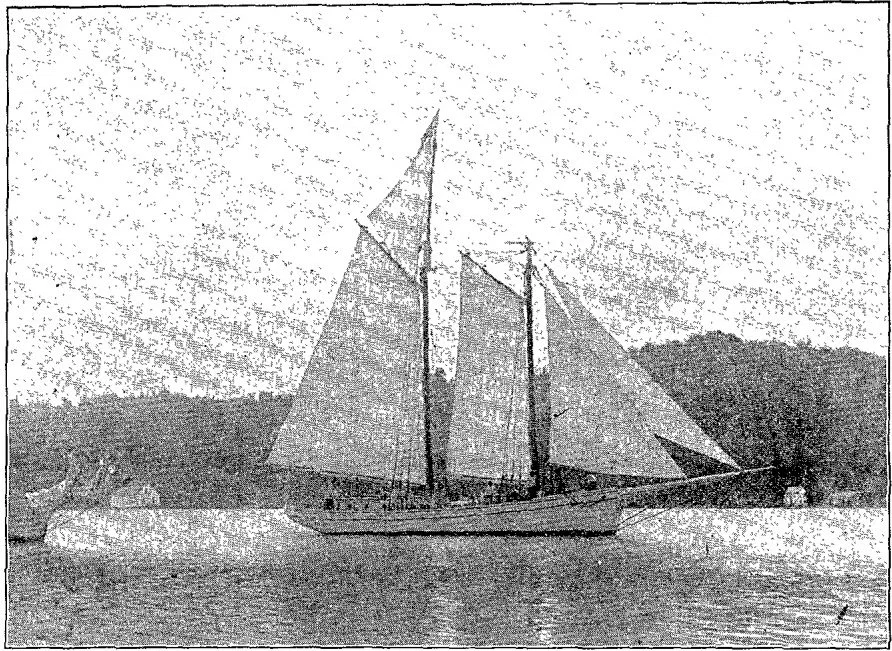
On the 9th of July the “Herald” (an illustration of which is given on this page), with her crew and outfit, made her first start on a mission trip. The day was delightful, and before evening we were anchored safely in the close little harbor at Carrib Point, Ruatan. We spent a pleasant Sabbath, having meeting on board with the few who are there. In the evening we had service on shore, at the house of Brother Schlief. Thus closed the first Sabbath on our trip. Sunday we reached Coxen Hole, and Monday the Island of Utilia, where we found Brother and Sister Morrow, who had been there about three weeks, holding meetings in the little new, unfinished church in that place. This house of worship will be neat and comfortable when completed. This is the fourth house of worship in the Central American mission field, with a total membership of one hundred. From Utilia we set sail for La Cerba, which we reached in a few hours. As soon as we could get permission to land, several prepared to go ashore to canvass. After a trial of about a day, we concluded that we would have to find a better harbor, as the sea-breeze set in, and made it almost impossible to land with books without getting them wet. We sold in all about thirty-seven dollars’ worth of books at that place.
Leaving there about the middle of the afternoon, we reached a little settlement before night, and two of the brethren tried to make a landing, but concluded that it was unsafe with the books. Consequently we pursued our journey to Puerto Cortez, the place where the late Honduran battle was fought. Elder Morrow and his wife have spent the last six months at this place, with the exception of the month they spent at Utilia. They returned with us, and here we made a few book sales and spent a pleasant Sabbath with the few who have embraced the truth. From this place we decided to sail direct to Belize. We had a most favorable passage, and made the one hundred miles in about fifteen hours. We have received here our books that we came for, and have been fitting up the boat a little better, and stocking with provisions for future work. We shall leave here for active service in the canvassing work next week. We expect to work all the coast as far as Bluefields.
Thinking that all our readers will be interested in taking a look at the new vessel for the Caribbean Sea, I send with this article a photograph that was taken as the “Herald” was coming to anchorage. The breeze was very moderate, and blowing from the camera toward the boat. The staysail is not set in this view. This sail, when set, extends from the topmast to the top of the foremast, and overlaps the top of the foresail. This sail adds greatly to the sailing in moderate weather, when it can be used. The sailing qualities of the schooner so far have been perfectly satisfactory, and we think we have a swift boat. She is surely comfortable, and is easy to handle in heavy weather, as we have found in each two trials of a few hours in a breeze that was little less than a gale. We lack experienced canvassers, but we try to make the best of our situation as it is. We ask the prayers of all the readers of the REVIEW for the success of this messenger of truth. We will give an account of the dedication when time permits.
July 29. F. J. HUTCHINS.
THE OHIO CAMP-MEETING.
By A. F. Ballenger
What promises to be the most successful camp-meeting ever held in Ohio had been in session six days when the writer left the meeting. Between five and six hundred campers were pleasantly located on a portion of the beautifully shaded fair-ground.
From the first there was an earnest seeking of the Lord. All seemed to realize that a great blessing was in store for the people of God, and sought it by humbling of heart and entire consecration. On the first Sabbath there was a revival service that heretofore would have encouraged the hearts of God's servants had it appeared on the last Sabbath of the meeting.
The outside attendance suggested the stirring days of the first message. The Star, a leading Springfield daily, speaks thus of the Sunday attendance: “There was no falling off in the attendance, but on the contrary the great tabernacle was taxed to its utmost capacity at each of the four services.” “At the meeting at 2:30 o'clock the huge tent would not begin to accommodate the people. Every available seat was taken, and chairs innumerable were brought from the tents to accommodate visitors. Probably a hundred carriages were drawn up about the north end of the tent, and fully three hundred people were standing, unable to procure seats.” Concerning the order maintained at these vast audiences, the same report says: “Perfect order reigned throughout the address, which was much appreciated by all.”
Among the distinguished listeners was “Mother Steward,” who shared, with Mrs. S. M. I. Henry, the struggles and victories of the early days of the W. C. T. U. movement. As she sat in a rocker near the front, and listened as Elder Van Horn pointed out the prophetic waymarks showing our nearness to the kingdom of glory, tears moistened her eyes, and a fervent “Amen” came from her lips. Mother Steward is eighty-one years of age, and has spent her life fighting against the rum traffic and for the drunkard and his family. In answer to the question, “Is intemperance on the increase?” she answered, “Yes, and only the second coming of Christ can destroy it.” Speaking of the “blessed hope,” this mother in Israel remarked, with tears in her tones, “O, why do not the ministers in the churches preach it!”
The only ministerial help outside the conference during the early part of the meeting was Elder Morrison and the writer. Elder A. T. Jones arrived Monday afternoon to remain till the close of the meeting. It was clear to ministers and people that the special message of justification by faith, which has been emphasized among us for the last few years, is God's special work to prepare his people to “receive the promise of the Spirit through faith” (Gal. 3:14), or the “latter rain” as a preparation for the giving of the loudest cry of the “loud cry.”
A spirit of liberality was manifest. Ninety-one subscribers were secured for the special twenty-five cent offer for the Sentinel, and nearly $85 was given for the work of the International Religious Liberty Association. A fuller report of the meeting will appear later.