Signs of the Times, Vol. 57, No. 26.

This Machine Madness

Signs of the Times

Jul 8, 1930

Pacific Press Publishing Association · Mountain View, California, U. S. A. · Jul 8, 1930

This Machine Madness
MERLIN L. NEFF
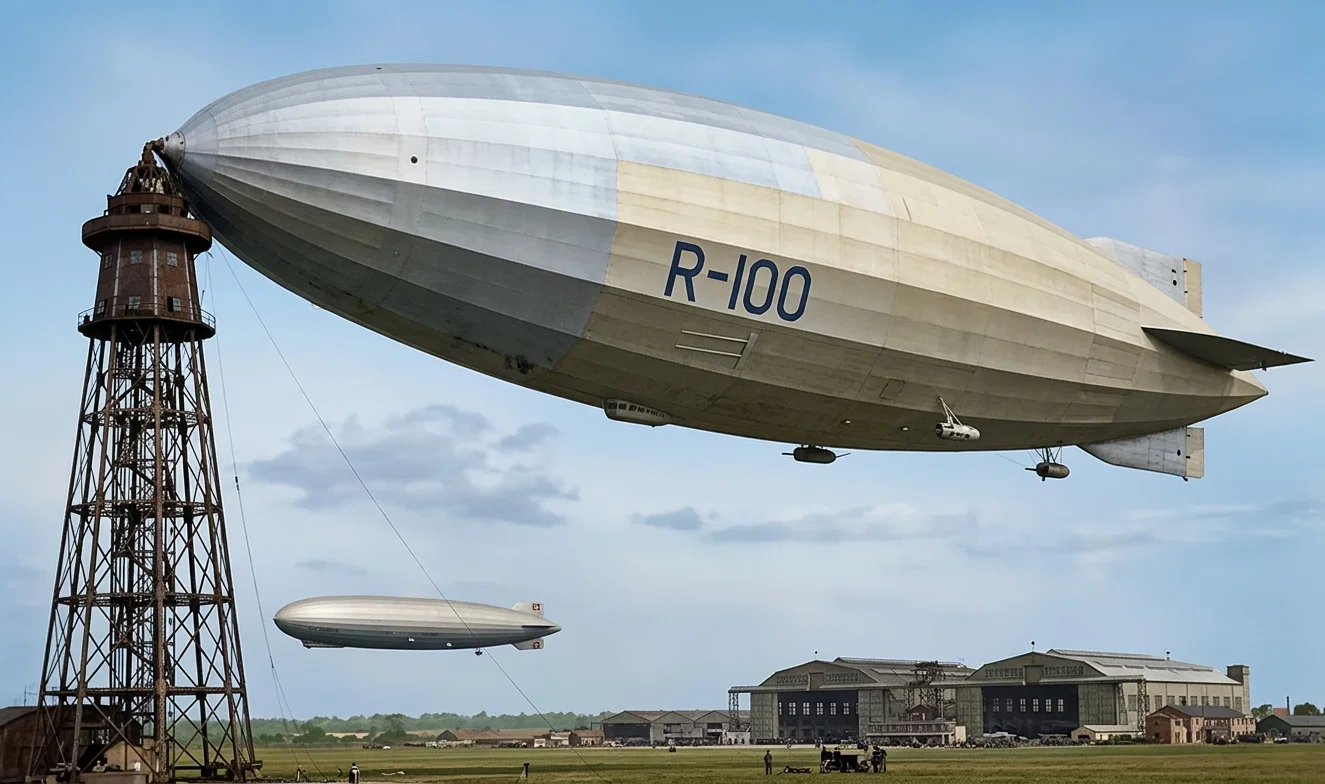
Two mighty machines of the air. In the distance is the “Graf Zeppelin,” as it flew over the airport at Cardington, England, on a recent trip and moored at the mast is the English dirigible, “R-100.”
A BILLION horses are doing the work of America to-day. Not flesh-and-blood animals, it is true, but machines that produce the horse power to turn our wheels of commerce, industry, and pleasure. Nations in the past have risen upon the power of conquest, money, trade, and slavery. Our modern civilization rests upon the power of the machine. It is the greatest influence on modern life, and no matter which way we may turn it affects us.
In the morning a mechanical contraption called an alarm clock awakens us. We press buttons and turn knobs to have light, heat, and boiling water to aid in our toilet. A hurried breakfast is prepared on some electrical appliances, and we are off to work. With thousands of others, we rush to street cars, trains, busses, or automobiles. But our speed is halted at times, for we must obey red and green flashing signals.
Eventually we arrive at the office, and our watch informs us that we are late by half a minute. At the desk we are the servant of the telephone and a half-dozen other office implements. At noon we partake of a bite of lunch from the automat or quick-lunch counter. The afternoon wears away, and we make our way home. The evening finds us reading the newspaper that has been turned forth from a giant press in a half-million-copy edition. While we read, we listen to the radio or phonograph with its mechanical music.
Such is the influence exerted by machines in the average city individual’s existence. In the country the farmer is not free from the machine. It has assisted him to a great degree. Twenty-five years ago he possessed two or three horses to help in the heavier work. To-day he has a forty-horse-power automobile and a powerful tractor, while gasoline or electric engines lighten his chores. The carpenter has a dozen machines to saw and plane where human hands once worked, and the doctor must always be adding new apparatus to his office to combat disease.
The ever-multiplying horde of mechanical inventions have lightened man’s work. They have given him an ease and a luxury that he has never previously enjoyed; but with the assets have also come serious liabilities. The machine age has given him prosperity, but very little more contentment. It has shortened the working hours of labor from twelve and fourteen hours a day to only eight, but it has occupied him with so many complexities that he finds no time for leisure or reflection. With all the swift strides forward in science and invention he has not grown in similar proportions in mental, moral, and spiritual powers.
A serious danger faces men who bear the responsibility of a billion horse power yet have not developed increasing spiritual and moral stamina to control this newborn Hercules. A man without regard for law and order is far more dangerous with a machine gun, tear gas, armored car, airplane, and speed boat, than he was with a six-shooter and a horse. We point with pride to the airplane skimming the clouds at two hundred miles an hour; but let us not forget that a fleet of five hundred such machines loaded with bombs might destroy the largest city on earth within a few hours. (This subject will be discussed more fully in a later article of this series.) America boasts of 25,000,000 motor cars, but she also faces the fact that 26,000 persons were killed by these machines in 1929.
Machines have provided speed; yet if this impetus forward is misdirected, what shall it avail? Why do people need cars that travel seventy or eighty miles an hour if they only hurry them to road houses or cabarets? Why have airplanes of such swift proportions if they carry groups of Londoners to Paris for an evening of gay revelry without sober thought or a worthy mission? With greater speed and power must come greater wisdom if such talents are to be used rightly. A recent Western football game drew some thirty thousand fans from a sister city five hundred miles away. A dozen special trains carried eight thousand persons, while automobiles, stages, and every available airplane carried excited crowds to the stadium to watch twenty-two men wrestle for an air-inflated pigskin. If machines are for no better and more worthy purpose than merely to popularize sport, we should seriously weigh the relative values of our age.
The radio is one of the marvels of man’s creation. To turn a dial controlling a few tubes using electrical energy and pick up the human voice thousands of miles distant is indeed a wonder. But if the material broadcast deals chiefly in popular songs of the cheapest vintage, foolish talk, and sordid advertising propaganda, are we worthy to use such a powerful machine? Again, if this machine takes so much of our spare time that we fail to improve our own talents of music, literature, and art, where shall we drift?

A GREATER RESPONSIBILITY

These questions are suggested that the reader may challenge the relative worth of our so-called age of enlightenment and science. A myriad machines have given us more time and ease; yet are we using this talent for a worthy cause? “It is hard,” said Emerson, “to carry a full cup.” The responsibility that is ours in the possession of time, power, and potential good, demands serious thought. “The trouble with New York to-day,” admits Prof. William Montague of the Philosophy Department of Columbia University, “is the wide misuse of sudden leisure.” And in his message to the National Recreation Congress held in 1929 in Louisville, President Herbert Hoover said: “This civilization is not going to depend on what we do when we work as what we do in our time off. We are organizing the production of leisure. We need better organization for its consumption.”
Having become overinfatuated with machines, we feel that we must use them constantly. When we are not at work, we are running over the highways in motor cars. It is estimated that one third of the population of the United States were in automobiles at one time last summer. Such a thing is not an evil in itself; but if it occupies our minds and energy to such a degree that we have little time or inclination for the spiritual values of life, it is a curse. The church complains that the automobile has ruined the spirit of worship, for people seldom attend services. Instead of listening to the word of God, the cry is, Speed! And on the highways the serious, sober realities of eternal value escape in our scurry hither and yon.
Distance has been condensed by rapid means of travel, until man is seldom alone to-day. Solitude is a forgotten blessing. Man alone with his thoughts is restless and miserable. The crowd continually presses in upon us. We follow the majority, lean upon their thinking and acting for our conduct. Religious life has been sadly neglected. Prayer and the family altar once found in almost every American home are almost obsolete. Intoxicated with the power and speed of to-day, we have forgotten God and gained overconfidence in self. “Certain machines,” declares Stuart Chase, “particularly the automobile, have tended to expand the ego, promote self-confidence.” The grind of machinery keeps men so occupied in their work that they seldom acknowledge a Creator. Solomon declares, “God hath made man upright; but they have sought out many inventions.”
“The world is too much with us.” We seldom break from the stress of life. We are burning the candle at both ends and reaping a tension of nerves that is unprecedented. Silas Bent, in an article, “The Machine,” in the Century Magazine warns us that “we are restless beyond precedent. . . . All of us are tense with a corroding effort to telescope the calendar.” From the time young America starts to school until he comes to the end of the way, he is in a hurry. Traffic must be speeded up. Speed limits are raised from thirty to forty or fifty miles an hour. Stop signs are a nuisance, for they retard our breakneck pace. Two minutes in a traffic blockade causes motor car horns to begin an impatient tattoo. Such madness is wearing down man’s physical endowments. A group of physicians recently discussed the medicine they most frequently prescribe. The result of their comparisons disclosed a unanimous verdict in remedy—it was a nerve sedative. If this is an index to our age, it is indeed a poor compliment.

LUXURIES HAVE MULTIPLIED

Mass production from machines in factories has brought a new problem in economic living. Hundreds of articles are placed before the public to-day in such a manner as to cause them to spend more money for luxuries. A hundred years ago it is estimated that there were some three dozen actual necessities in life and some ninety-seven luxuries. To-day we have a hundred necessities to common living and five hundred or more luxuries. A single mail order catalogue lists one hundred thousand separate articles to sell. Thus we spend so much time working to buy luxuries that we lack time to use and enjoy the luxuries, and thus we continue in a vicious circle.
Machines and scientific wonders are not injurious in themselves, but we can make them our god when we use them to the detriment and the disuse of the primary talents and necessities of right living. Machine madness is captivating. It is a rushing, pressing, hurrying, moving throng. But we cannot always mingle with the crowd in this age and keep our contact with God. Jesus Christ mingled with men. He healed the sick, He blessed the children, He fed the multitudes, and taught them words of life, but for His source of spiritual power and meditative thought He went into the quietness of the mountains, and was alone. “When He had sent the multitudes away, He went up into a mountain apart to pray: and when the evening was come, He was there alone.” Matthew 14:23.
The Christian dares not lose his hold on things spiritual if he is a successful follower of the Master. In the blare of the city, the congestion of the milling throng, he must step aside and with the sons of Korah heed the command, “Be still, and know that I am God.” Psalm 46:10.
When Israel turned away from God and
(Continued from page 2)
the word of the Lord, Isaiah was told to declare this remedy: “In returning and rest shall ye be saved; in quietness and in confidence shall be your strength: and ye would not.” Instead of serious thought and quiet contemplation, they took a course somewhat similar to our modern age. We read further, “But ye said, No; for we will flee upon horses; therefore shall ye flee: and, We will ride upon the swift; therefore shall they that pursue you be swift.” Isaiah 30:15, 16. Instead of horses of old, we can modernize the picture and find men fleeing from the ways of God in swift-moving machines of their invention. God’s decree remains unchanged: “Blessed are all they that wait for Him.” Verse 18.
While machines in factories and on the road depend upon motion and speed for their best service, the human being must find time for meditation and quietness. When the world is on wheels, Isaiah declares, “Their strength is to sit still.” Verse 7. Let us not become so infatuated with the whir of motors, the noise of motion, the speed of wings, or the magic of distance that we forget to look upward to God whence cometh our strength and blessing.
This danger of forgetting God in a time of power and leisure was well emphasized by Dr. John Grier Hibben of Princeton University, when he said, “We must all be on guard against allowing a sense of power to dull our sensibilities and to use prosperity as a means to unworthy ends. Nor must we allow a starvation of the soul. With the growth of wealth and expanding resources of increased power, there is the danger that the soul may become small and mean and debased. Finally, we must be careful not to let prosperity become alien to religious impulse and aspiration. We must remember that religious inspiration is just as necessary in times of prosperity as in adversity.”

BEWARE OF HASTY DEDUCTIONS

Miracles of the workshop and laboratory have caused men hastily to conclude that the Utopia is near on this earth. But let us beware of hasty deductions. Because of increased knowledge we may not also have acquired an increased amount of spiritual wisdom. The answer is not found in machines. Elijah did not find the answer to his soul’s longing in the blaze of fire, the mighty wind, or the earthquake. He found God in the “still small voice.” Let us beware of machine madness that infatuates men until they forget God and become so occupied with the material things of the world that their souls become dwarfed and ossified. “Thou wilt keep him in perfect peace, whose mind is stayed on Thee: because he trusteth in Thee.” Isaiah 26:3.

The Voyagers

HAZEL GREGOIRE
All of us alike are voyaging Through a dark and starless night, Silent, ever skyward watching For some guiding point of light.
Tired fishermen returning With their torn and broken net, Seek the harbor lights with yearning, Aching eyes that sleep forget.
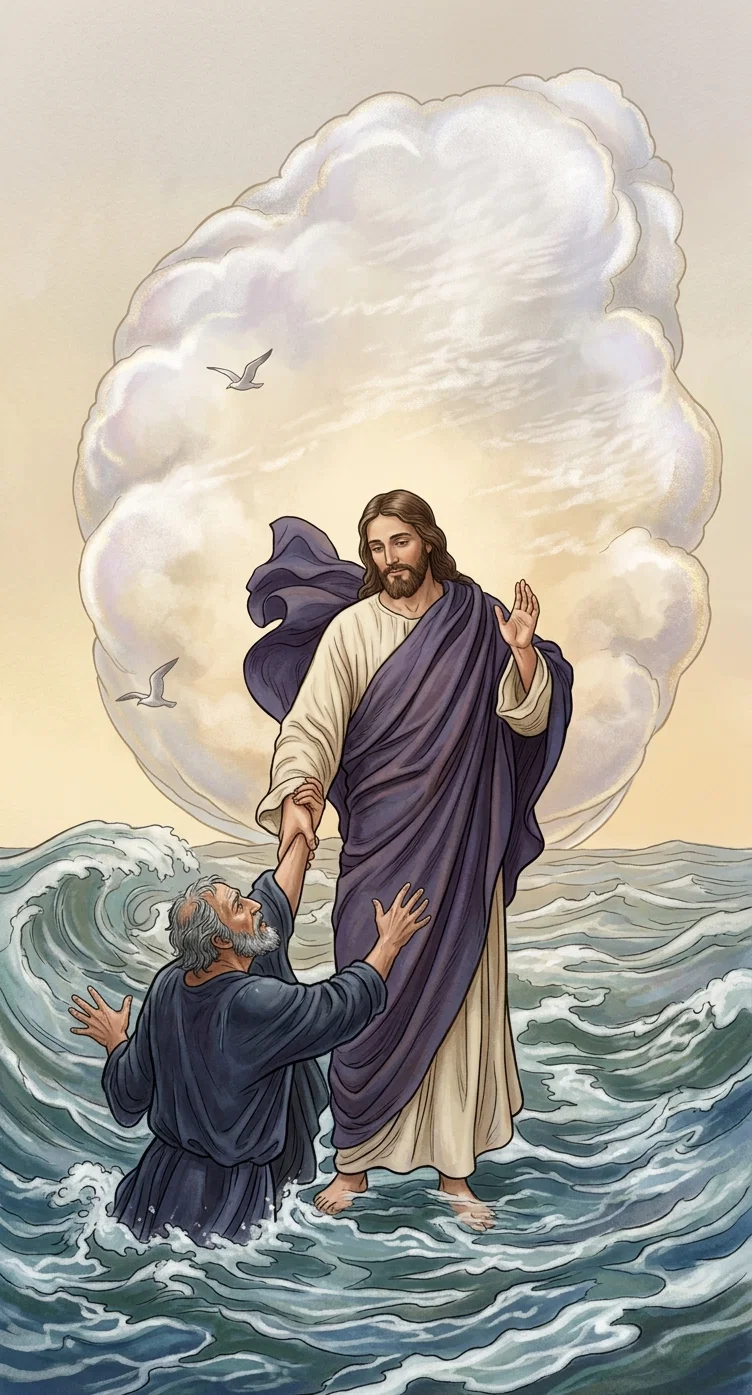
Like those loved disciples, steering Homeward o’er a boisterous deep, Through the tempest we are peering, In the storm our vigils keep.
We, like Peter, careworn, weary, See Thy face above the tide, And like him would leap to meet Thee, Thinking but to reach Thy side.
Though like his our feet may falter When we mark the heaving sea, Sinking ’neath the surging water, We reach pleading hands to Thee.
And as Thou didst stoop to Peter, Tender still Thine arm to save, Other walks could not be sweeter Than with Thee upon the wave.
On life’s moving, changing ocean, Where by dangers oft beset, ’Mid its restless, ceaseless motion Thou art Lord and Saviour yet.
Thou art there in very fashion We perceive through fog and chill— Saviour, speak in Thy compassion, Bid life’s troubled sea be still.

A Fundamentalist's Apologia

A personal interview with one of the most influential authors Fundamentalism has produced.
BERTHA M. HANGER
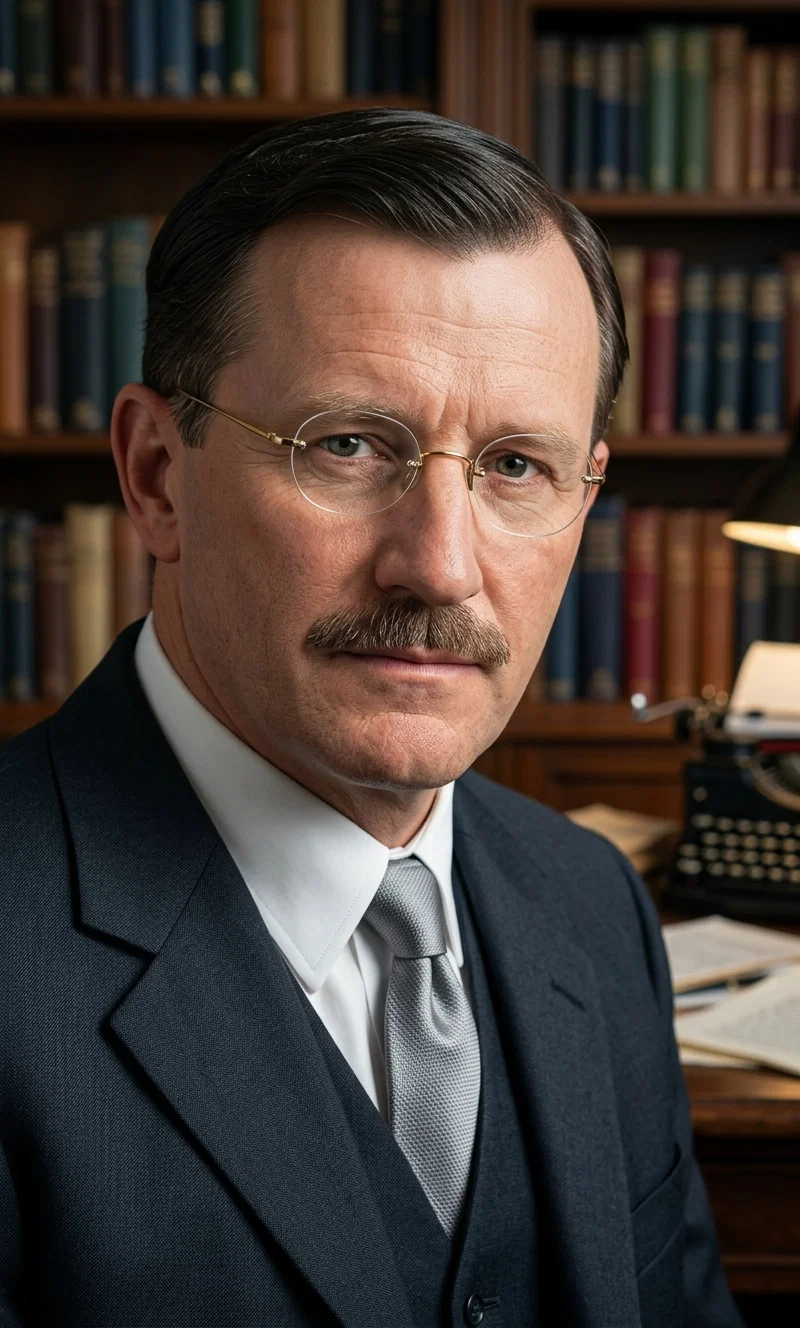
WE WERE sitting in his book-lined study facing each other across his workbench. A profusion of papers, a typewriter, and the manuscript of his latest book lay between us. As we chatted of his life and work as a scientist and author, Professor Price spoke modestly of his accomplishments.
George McCready Price is internationally known by his books, lectures, and contributions to magazines. He has written a dozen books on geology and evolution, is contributing editor to the Bible Champion magazine, and his articles have appeared in the Princeton Theological Review, the Review of Reviews (English), and other widely circulated periodicals. He is a member of the Victoria Institute, a London society in defense of the Bible, and won a medal from the society for an article—“Evolution and Revelation, Can They Be Harmonized?” While a resident of London, he also represented the Fundamentalists in public debates with Joseph McCabe, the noted rationalist. He has traveled widely in America and Europe, visiting all the noted museums and studying geological conditions. His latest book, “A History of Some Scientific Blunders,” is just off the press.
In answer to my query concerning how he became interested in the subject of evolution, he smilingly said:
“I was driven to a study of evolution by being confronted with its problem some thirty-five years ago, while I was principal of a high school in Eastern Canada. It is a long story. I had had a general scientific background, including chemistry, physics, botany, zoology, and also some mineralogy, before this time; though I had never studied geology until after I had spent some two years and a half of intensive consideration of evolutionary evidence and theory. During this time I read many books on the subject. In those days there were no books attempting to refute the evolutionist's arguments in the field of geology. As a result, I was convinced on two points—that geology was the key to the evolutionary problem, and that the methods of evolutionary geology were unscientific.”

GEOLOGY THE KEY

“In what way is geology the key to the evolutionary problem, professor?” I asked.
“The old Greeks believed in spontaneous generation, and they believed in a naturalistic development of animals and men without a real creation. But it is wrong to say that they were evolutionists because they had no knowledge of the fossil world; and, as Prof. Louis T. More has so clearly pointed out, there never could be a scheme of evolution until something like a geological background of supposedly real history has been constituted for it. Geology as ordinarily taught is supposed to give this real historical outline of successive groups of animals and plants. This is the last stronghold of the evolutionary theory. I have made it the business of a lifetime to examine this geological scheme, and have found that its alleged distinctions between different ages are absolutely unreliable and unscientific. If the various plants and animals found as fossils in the earth really lived contemporaneously in an older state of our world, then the whole scheme of organic evolution falls to pieces. And if all this is true, the evolutionary theory is a blunder, because it is founded upon a blundering interpretation of geology.”
George McCready Price, eminent Fundamentalist, who has in a series of books shown up the fallacies of the purported geologic evidences for evolution. Some of these volumes are advertised on page fifteen of this issue.
“But,” I reminded him, “the textbooks and later discussions of evolution no longer call it a theory; they declare it to be a scientific fact. Why do evolutionary scientists speak of their theory as a fact instead of as a mere theory?”

THEORY COMES FIRST

“Advocates of evolution are theorists first, and scientists afterwards. Many of them are antireligious fanatics. They have built up an evolutionary interpretation of geology, and with this as a base they prove the ‘fact’ of development from lower forms of life.”
“Granting that evolution is an error, why is it such a pertinent question in the Christian world? Why not leave its discussion to the scientific world? Why need we be concerned with it?” I continued.
“In all ages unbelievers have always tried to bring up what they claimed were facts against Christianity. Our age is an age of scientific discovery and progress, and unbelievers have seized on certain scientific discoveries which they think are against Christianity and for the evolutionary theory. Christians must face these facts, and must meet them intelligently, if they hope to do anything in influencing modern educated people for Christianity.
“Revelation 14:7 is a prophecy indicating that just before the coming of the Lord the worship of the Creator of the heaven and the earth would be one of the test questions. All modern scientific discoveries help us to understand the Creator. The question of how the world was made is certainly one of the live issues of to-day.
“The philosophical situation of the last days is pictured in the prophecy of 2 Peter 3. The text says that in the last days scoffers, or mockers, will come, saying, ‘Where is the promise of His coming?’ They scoff at the idea of any destruction of the world in the future, at the second coming of Christ, because they deny that any great calamity has overtaken the world in the past. Their language is, ‘Since the fathers fell asleep, all things continue as they were from the beginning of the creation.’ This is exactly the type of reasoning used by our modern evolutionists. They deny that a universal deluge ever occurred; they say that the present is the measure of the past, and the measure of all the past; and they declare that natural law, as we now know it, has always prevailed. Hence they say there never was any real creation in the beginning.
“The apostle Peter goes on to show that these modern uniformitarians have got into this frame of mind because they have grown accustomed to denying that there ever was a universal flood. This absolute denial of a universal deluge, in the interests of their scheme of geological uniformity, has been the real cause of the entire theory of organic evolution. There never would have been any scheme of evolution, except for the evolutionary geology which preceded it.”

THE OUTLOOK

“What is the outlook for the future, Professor Price?” I ventured to question.
“True religion will never be any more popular in the future than it has been in the past,” he continued. “Evolution has become a great modern form of antichristianity. We have no assurance in Bible prophecy that it will ever be discarded by the world as a whole. God does tell us that His people in the last days will believe His word rather than any theories of man.
“I am convinced from many years of study that these questions which gather around the subject of creation and the worship due to the Creator, involving the Sabbath and its counterfeit, are the very crux of all the testing problems of the last days. And it is well for every Christian to become intelligent regarding them, and then to decide intelligently in the light of eternity.”

What and Where Is Heaven?

In the historic days of ’76, a young Frenchman, the Marquis de Lafayette, valiantly aided the American colonists in their struggle for independence. Naturally, a place of love and honor was kept for him in the heart of every colonial American. In later years, Lafayette journeyed once more from the land of his birth to the new land of liberty. A triumphant procession awaited him; old soldiers saluted him; great generals received him. A royal welcome was accorded him; and waving banners and martial music escorted him to the great amphitheater at Castle Garden.
As the curtain was lifted, there appeared before the wondering gaze of the French general an exact reproduction of his boyhood home. Tender memories of the dearest friend on earth were linked with that hallowed spot, and Lafayette wept like a child.
When the veil of sin and sorrow is lifted from this world at the second coming of Jesus, our wondering eyes shall behold the heavenly Father, who loved us so much that He gave His only Son to die for us; we shall look upon the dazzling beauty of a glorified Christ, our elder Brother, our Redeemer, our Friend; we shall gaze upon the living green of our heavenly home, the eternal summer land, the celestial homeland; and all the bitter tears, the wasted years, the haunting fears, will be forgotten as we sing the glory song of redemption.
“When the battle is over, the victory won, When the trials are ended, the journey is done, I shall look on a splendor more bright than the sun, In my home in the Palace of Light.”
Some one has said that time is a little space between two eternities. Oftentimes our eyes grow weary with beholding things in this “little space” called time. There is sorrow and suffering, there are thorns and thistles, there are decay and death. The wasting and pestilence, the devouring scourge, cry out the story of the fall of man and the curse of sin. But, even now, in the beauty of nature, we may glimpse the perfection of our Eden home before the seeds of sin were sown and the harvest of death was reaped. What shall it be when the cruel reign of death is forever ended, when the blight of sin is forever removed, when the desert blossoms as a rose, and the lame, the halt, and the blind are clothed in the garments of eternal youth? What shall it be when the sun shall rise in splendor on the beauty of the hills and over a world that is beautified with the very presence of God?
In days of old there lived a man who delighted in obedience to God and who trusted in the promises of God. His was a life of abiding faith. At one time the Lord told Abraham to look to the north and to the south, to the east and to the west, and promised him the earth for an eternal inheritance. “To Abraham and his seed were the promises made.” Galatians 3:16. The fulfillment of the promise was made possible in the substitutionary death and the victorious life of the Lord Jesus. And the inheritance belongs to every child of faith.
“If ye be Christ’s, then are ye Abraham’s seed, and heirs according to the promise.” Galatians 3:29.
The promise to Abraham, “the father of the faithful,” has not been fulfilled and could not be fulfilled so long as the stain of sin is on the earth. In Acts 7:5 we read, “And He gave him none inheritance in it, no, not so much as to set his foot on: yet He promised that He would give it to him for a possession, and to his seed after him, when as yet he had no child.”
WITH OUR EVANGELIST
VARNER J. JOHNS
WITH OUR EVANGELIST VARNER J. JOHNS
Abraham did not expect an inheritance in a sorrow-filled, sin-cursed world. He looked beyond this vale of tears to the mountain peak of eternity. “For he looked for a city which hath foundations, whose Builder and Maker is God.” Hebrews 11:10.
The description of that city of light, the capital city of the new earth, is given to us in the last two chapters of the Bible. I have read of Babylon the beautiful, where the wealth of an empire was lavished on its hanging gardens and magnificent buildings. I have gazed upon the incomparable beauty of Rio de Janeiro, with its green-clad, cone-shaped hills overlooking the sparkling blue waters of a bay that is dotted with emerald isles, with the tropical sun shining upon the red-tiled roofs of pastel-colored mansions, with gilded domes and granite walls along avenues paved with marble blocks in mosaic patterns. And then I have read of the corruption of ancient Babylon, and I have looked upon poor suffering bits of humanity in Rio of the Southern Cross. Hideous tropical ulcers, extending from the foot to the knee and eating to the bone, feet that look like huge toadstools because of an incurable fungus growth, legs swollen to an enormous size from the bite of a mosquito, flesh rotting away from the dread plague of leprosy—all testify to the fact of sin; and as I have looked upon the marred beauty, I have understood the meaning of the words, “Though every prospect pleases, and only man is vile.”
In the New Jerusalem disease and degradation and death are not even memories; sadness and sorrow and suffering are all forgotten. The tree of life is there, and the leaves of the tree are for the healing of the nations; the river of life is there, and its sparkling water is always pure and clear. There are walls of jasper adorned with precious stones. There are foundations that reflect the beauty of the rainbow. There are gates of pearl and streets of gold. And there is no night there, for the glory of the Lord is its light.
Friends, I want to be there. My inheritance in that beautiful city was dearly bought with the precious blood of Jesus, and I would not barter it away for a mess of the bitter pottage of sin. My mansion is being built by nail-pierced hands, and I would not exchange my title for a thousand townships of the richest land in this world of sin. My crown is being fashioned by a King, and I would not exchange it for the jeweled coronets of the mightiest kingdoms of earth.
The temple of God is within the jasper walls of the New Jerusalem, and the throne of God is within the temple. It is to this capital city that we shall go up from our country homes, every Sabbath to worship before God, every month to partake of the fruit of the tree of life. “For as the new heavens and the new earth, which I will make, shall remain before Me, saith the Lord, so shall your seed and your name remain. And it shall come to pass, that from one new moon to another, and from one Sabbath to another, shall all flesh come to worship before Me, saith the Lord.” Isaiah 66:22, 23.
I can hear some one say, “Surely we shall not be real beings and have real homes in the new earth!” Banish the thought of spirit forms, and spirit harps, and spirit crowns—we shall be as real as we are to-day, but with all the marks of sin removed, and with the bloom of perennial youth upon us. We shall not work and toil and slave to build a little protecting home for our old age, only to have the mortgage foreclosed and our tottering feet walking the street in search of bread. We shall not plant and cultivate and reap, only to have some one come in and take the harvest. Listen to Isaiah 65:17, 21, 22:
“For, behold, I create new heavens and a new earth: and the former shall not be remembered, nor come into mind.” “And they shall build houses, and inhabit them; and they shall plant vineyards, and eat the fruit of them. They shall not build, and another inhabit; they shall not plant, and another eat: for as the days of a tree are the days of My people, and Mine elect shall long enjoy the work of their hands.”
It is a fundamental principle in redemption that all that was lost because of the disobedience of Adam will be restored because of the obedience of Christ. The Eden home shall be restored. The image of God that was marred in man shall be restored. The dominion that was lost to the enemy shall be restored to Christ, and to His cherished people. “And Thou, O tower of the flock, the stronghold of the daughter of Zion, unto Thee shall it come, even the first dominion; the kingdom shall come to the daughter of Jerusalem.” Micah 4:8.
“But I thought we all went to heaven,” some one says.
Yes, we do go to heaven when Jesus comes, but only for a thousand years. A millennium of happiness amid the wonders of God’s great universe, a thousand years of joy, meeting with the redeemed, visiting the unfallen worlds, and viewing the handiwork of God in the land of far distances is our privilege when Jesus comes. But at the close of the thousand years the New Jerusalem comes down to this earth, the earth itself is purified and beautified, and it becomes our eternal home. Said Jesus, “Blessed are the meek: for they shall inherit the earth.”

THIS WORLD HONORED

Though this earth is but a grain of sand upon the shore of the ocean of eternity, though the heaven of heavens has been from of old the dwelling place of the infinite God, yet this earth shall be honored above all the myriads of worlds. The temple of God shall be with men, “and He will dwell with them, . . . and God Himself shall be with them, and be their God.” Where stood the cross on Calvary’s hill will be the royal throne. On the plains of old Judea will be the royal city. Oh, the mystery of redeeming love that lifts fallen man from the depths of degradation and exalts him to reign with Jesus through eternity! Oh, the love, the wondrous love!
And there is an abundant entrance for all through the gates of pearl. Even the vilest sinner can be saved by grace, and enter in through the gates into the city. But God can never immortalize sin. Your cherished sins must be surrendered, your idols of gold and of pleasure must be broken down, your old habits must be abandoned. There will be no unlovely traits of character in the lives of the redeemed; no cruel, critical tongue, no harsh, unyielding, or selfish spirit can be there.
“The twelve gates were twelve pearls.” The history of the pearl is a history of suffering. Some foreign substance is introduced between the mantle of the mollusk and its shell. Because of the pain and the suffering, a substance is thrown out and about the stone, and the pearl is formed. The story of redemption is a story of suffering. Unutterable anguish pierced the heart of the Son of God as He bore the weight of the sins of the world to Calvary’s cross. He drank the bitter cup alone, and He died that we might live. And we, too, must suffer, if we would win. “Crucified with Christ” that we might be raised with Him to newness of life, suffering with Christ that we might reign with Him, is the secret of victory. Do you have trials and disappointments? Are you bowed down with infirmity or suffering? Is your heart torn with anguish? Remember this,

What and Where Is Heaven?

(Continued from page 5)
that it is through gates of pearl, through gates of suffering, that we enter into the palace of light. When we are tested and tried in the furnace of affliction, we shall come forth as gold, worthy to tread the streets of gold, worthy to enter the joys untold.
“Open ye the gates,” we shall hear the angels sing, “that the righteous nation which keepeth the truth may enter in.” The blind shall enter in with undimmed vision; the lame with unbroken strength. The deaf shall enter in with abundant hearing; the sick with never-ending health. Enter into peace; enter into perfection; enter into health; enter into happiness. The gate stands ajar; Jesus bids you enter. The gate may be strait and the way may be narrow, but the crown is worth the cost. Will you enter in?
I have gazed upon the incomparable beauty of Rio de Janeiro, with its green-clad, cone-shaped hills overlooking the sparkling blue waters of a bay that is dotted with emerald isles.
Continue reading: OUR BIBLE STUDY