“Poor Jim!” half sobbed Helen as she stood watching the glowing sun sink behind the crimson clouds. “Poor brother Jim! No, I mustn’t say that; he’s happier than we are. The preacher says he’s enjoying the pleasures of heaven now.”
These words, wrung from her broken heart, happened to be overheard by her husband as he entered the room. “That’s right, Helen,” he said, “sometimes I almost wish it were I instead of Jim. Think of the misery of this old world. He won’t have to suffer any more.”
Supper over and the dishes finished, Helen seated herself by the table with her Bible in her hands. For a while she sat gazing off into space, thinking of her brother’s funeral the day before. Half unconsciously, she opened her Bible and began to read.
Suddenly, with an audible gasp, she roused herself.
“What’s wrong?” questioned her husband.
“Listen to this: ‘The living know that they shall die: but the dead know not anything, neither have they any more a reward; for the memory of them is forgotten. Also their love, and their hatred, and their envy, is now perished; neither have they any more a portion forever in anything that is done under the sun.’ That’s in Ecclesiastes 9:5, 6. Can that be true? If it is, Jim isn’t in heaven. He couldn’t be!”
“Rather sounds that way. You’d better ask the preacher, though. He knows the Bible better than we.”
Helen read on, pausing now and then to look up a few references; but, still unsatisfied and puzzled, she resolved that early the next day she would call on the Reverend Mr. Sullivan and talk the matter over.
DEAD NOT IN HEAVEN
The visit next day proved to be a failure. The text still remained puzzling. On returning home, Mrs. South, her nearest neighbor, called to her. “We have had the queerest letter from John’s cousin Harry,” she said. “I wish you’d look at it. He has a whole list of texts that say the dead don’t go to heaven.”
“Don’t go to heaven! Well, that is strange!” replied Helen.
“That’s what I thought. I haven’t studied the subject much. Suppose you folks come over sometime, and we’ll study it together. I want to know more about it. Don’t you?”
“Why,” exclaimed Helen, “I’ve been puzzled over this very question. We’ll come over to-night.”
“I’m really anxious to hear about this,” remarked Helen when they were seated in the South home. “It seems so different; but really I believe Jim would be better off unconscious than in heaven. His wife and children are going to suffer many hardships, and it would pain him to know of it.”
“Well,” ventured Mr. South, “it does seem that way; but I hope mother is in heaven.”
“Now, John,” broke in his wife, “she’d be worried to death over the way some of the children have turned out. But why wait? Let’s start our study. Here’s the first text, First Thessalonians chapter five and verse twenty-three. Helen, you read.”
“The very God of peace sanctify you wholly; and I pray God your whole spirit and soul and body be preserved blameless unto the coming of our Lord Jesus Christ,” read Helen.
“It seems there are three parts to a person, and not just the soul and body, as the preacher said,” added her husband.
“Yes, I read last night in Ecclesiastes the twelfth chapter and verse seven that it is the spirit that goes back to God,” remarked Helen.
“It mentions that here,” put in Mrs. South. “But the chapter refers to all men, both good and bad. And, after all, that’s not the soul. Psalm one hundred four and verse twenty-nine says it is the breath that God takes away. So the spirit and the breath are often spoken of as being the same. But we’re interested in the soul. Let’s see what happens to that. I’ll read Ezekiel the eighteenth chapter and verse four, the last part.”
“The soul that sinneth, it shall die,” Mrs. South read. “And it says here in the letter that Psalm eighty-nine, verse forty-eight, shows that the soul goes to the grave.”
The United States Government is sending groups of “gold star” mothers to France this summer to visit the graves of their sons killed in the World War. Here is a mother from Cincinnati kneeling at the grave of her son, killed twelve years ago, and buried in Suresnes Cemetery.
“The soul doesn’t go to heaven, then, does it?” questioned Mr. South. “Oh, look here, Genesis the second chapter and verse seven says ‘man became a living soul’ by the union of the breath and the body. So the soul isn’t a separate part after all.”
“I read only to-day,” remarked Helen, “in Acts the second chapter and verses twenty-nine and thirty-four that the good man David didn’t go to heaven. That seems to fit with that text in Psalms and also with the one in the ninth chapter of Ecclesiastes, doesn’t it?”
“What is death, then?” queried Helen’s husband.
“Right here is your answer,” began Mrs. South. “John, the eleventh chapter, tells of Lazarus. Jesus said he was ‘asleep,’ in verse eleven; but in verses thirteen and fourteen. He tells the disciples that he is dead. This letter says Jesus called Lazarus ‘forth,’ and not down from heaven.”
ASLEEP IN JESUS
“Asleep,” thought Helen aloud, “that’s like the song they sang at Jim’s funeral, ‘Asleep in Jesus, blessed sleep.’ Say, I never thought of that. Jim couldn’t be asleep and awake at the same time, that’s certain.”
“Well, that’s the Bible all right,” began Mr. South; “but don’t people ever go to heaven?”
“Let’s see,” said Mrs. South, looking over the list. “Here is First Thessalonians the fourth chapter and verses sixteen and seventeen. Let’s read that.”
“ ‘The Lord Himself shall descend from heaven with a shout, with the voice of the Archangel, and with the trump of God: and the dead in Christ shall rise first: then we which are alive and remain shall be caught up together with them in the clouds, to meet the Lord in the air: and so shall we ever be with the Lord,’ read Helen. “Say, Jim will be there then.”
“Now, I can see that’s the best way after all. Mother is just sleeping, and if I’m ready, she and I can go to heaven at the same time,” Mr. South said slowly.
“There’s another side to it too,” added Helen’s husband. “Old Mr. Brown surely was a sinner. He killed his mother, his wife, and his children. But according to most people, Cain, the first murderer, gets six thousand years more punishment than Brown. But according to what the Bible says, they begin together.”
“Well, this certainly is a new thought to me; but after all the problem now is so to live that we can meet our loved ones when Jesus comes. Something to strive for, isn’t it?” concluded Mrs. South.
EXPLORING YOUR BIBLE
By Miss ROSE E. BOOSE
with the guidance of an expert Bible teacher
Miss ROSE E. BOOSE
God's Old Testament Dwelling Place
MAY I ask you once more to take your Bibles and seek a quiet place, and we will continue to study the unfolding of the wonderful plan of redemption as revealed in the Old Testament.
From Eden to the Exodus the service by which the people approached unto God was very simple, consisting of the offering of a lamb for sin, upon an altar made of rough stones. The father of each family acted as the priest, or mediator, between his family and God.
When God led Israel out of Egypt, He asked them to make a sanctuary, or dwelling place, for Him. He desired to dwell with them in order to reveal more fully His great love. In Exodus 25:1-8 we read in part: “Speak unto the children of Israel, that they bring Me an offering: of every man that giveth it willingly with his heart ye shall take My offering. And let them make Me a sanctuary; that I may dwell among them.” Explicit instructions were given as to the manner of its construction, which are found in Exodus, chapters 25-27, 30, 35-40.
HAD TWO APARTMENTS
The sanctuary was a portable structure, consisting of two apartments, which were separated by a beautiful curtain; and the entire structure was surrounded by a court. In the court was the altar of burnt offering and the laver. The first apartment was called the holy place, in which were the table of shewbread, the golden candlestick, and the altar of incense. Beyond the veil was the inner or most holy place. This contained the ark, which had for a covering the mercy seat, with the two cherubim, all made of pure gold. The cherubim were placed one at each end, and their wings overshadowed the mercy seat.
In the ark was the law of God. We read in Deuteronomy 10:1-5: “At that time the Lord said unto me, Hew thee two tables of stone like unto the first, and come up unto Me into the mount. . . . And I will write on the tables the words that were in the first tables which thou brakest, and thou shalt put them in the ark. And I made an ark, . . . and hewed two tables of stone like unto the first, and went up into the mount. . . . And He wrote on the tables . . . the Ten Commandments. . . . And I turned myself and came down from the mount, and put the tables in the ark which I had made; and there they be, as the Lord commanded me.”
THE HOLY SHEKINAH
When the sanctuary was completed, “the glory of the Lord filled the tabernacle” (Exodus 40:34) and the visible presence of God settled in the most holy place, between the cherubim, above the mercy seat, the place designated by God to be His dwelling place. (Exodus 25:22; Psalm 99:1.) The Hebrews spoke of this visible glory as the Holy Shekinah, which means the Divine Presence.
The sanctuary would be meaningless without the priesthood, and God Himself chose the one best qualified to serve in that capacity. Moses was commanded, “Take thou unto thee Aaron thy brother, and his sons with him.” “And thou shalt . . . anoint them, and consecrate them, and sanctify them, that they may minister unto Me in the priest’s office.” Exodus 28:1, 41. After their consecration, which lasted seven days, and is fully described in Exodus 29 and Leviticus 8, God publicly accepted them by sending fire to consume the first offering made by Aaron for the people in the capacity of their high priest. (Leviticus 9:2-6, 22-24.) From this time Aaron was the earthly mediator appointed of God to minister between Him and the people.
There was a daily round of service conducted in the sanctuary, which is described in Exodus 29:38-46. It consisted of the offering of two lambs daily, one in the morning and one in the evening. At the same time incense was offered in the first apartment, and the entire congregation met at the entrance of the court for prayers. (Luke 1:8-10.)
FAITH IN CHRIST
The morning and evening offering offered for the congregation at the time of prayers was a daily reminder to them of the sacrifice of Christ, and that only through His death could they have access to God. Romans 5:10 tells us: “We were reconciled to God by the death of His Son,” the Lamb of reconciliation; and again, we are “saved by His life,” of which the fragrant incense was a beautiful type, for we read that the Father was “well pleased” with the life of Christ. (Matthew 3:17; Hebrews 1:9; Ephesians 5:2.)
This daily service was for the whole congregation, and did not deal with the individual sins; nor was it a direct means of manifesting individual faith in the Lamb of God, who was represented by these offerings. In Leviticus the fourth chapter we learn of the manner in which this individual approach was effected. The need for the sin offering is presented thus: “If a soul shall sin through ignorance against any of the commandments of the Lord concerning things which ought not to be done, and shall do against any of them;” “if his sin, wherein he hath sinned, come to his knowledge; he shall bring his offering.” Leviticus 4:2, 23. Again, in Leviticus 5:3-5 it is clearly stated that the guilt is charged when the transgression comes to one’s knowledge. “When he knoweth of it, then shall he be guilty. . . . And it shall be, when he shall be guilty in one of these things, that he shall confess that he hath sinned in that thing.”
The tabernacle in the wilderness
The congregation was divided into four groups: the priests, the congregation, the rulers, and the common people. The manner for the priests to present their individual sin offerings was this: “If the priest that is anointed do sin; . . . then let him bring for his sin, which he hath sinned, a young bullock without blemish unto the Lord for a sin offering. And he shall bring the bullock unto the door of the tabernacle of the congregation before the Lord; and shall lay his hand upon the bullock’s head, and kill the bullock before the Lord. And the priest that is anointed shall take of the bullock’s blood, . . . and sprinkle of the blood seven times before the Lord, before the veil of the sanctuary.” Leviticus 4:3-12. When the priest placed his hand upon the head of the bullock, he confessed his sins and in figure transferred his sins to the innocent victim. The bullock was slain. He died instead of the priest who had sinned, and the blood was presented to the Lord for an atonement. We read: “The life of the flesh is in the blood: it is the blood that maketh an atonement for the soul.” Leviticus 17:11.
The offering for the congregation is recorded in Leviticus 4:13-21. This also required a bullock for an offering. The elders, who represented the people, confessed the sin, and the sins were transferred to the sanctuary by the sprinkling of the blood, in the same manner as that of the priests.
The offering for the rulers is given in12verses 22-26, and for the common people in verses 27-35. The only difference in these offerings is this: the rulers brought a male goat and the common people a female. “When a ruler hath sinned, . . . if his sin . . . come to his knowledge; he shall bring his offering, a kid of the goats, a male without blemish.” He then confessed his sin on the goat and slew it. The blood of this offering was poured at the bottom of the altar of burnt offering. According to Leviticus 6:25-30 the priest who offered this sin offering was to eat part of the flesh, thus voluntarily taking the sins of the people upon himself, and the “priest shall make an atonement for him as concerning his sin, and it shall be forgiven him.” Leviticus 4:26. Here we see that not only was the lamb a type of Christ, as our sin offering; but the priest typifies Christ, when he takes upon himself, through the eating of the sinful flesh, the infirmities of the people and enters into the presence of God in their behalf. It is said of Christ, “He hath made Him to be sin for us, who knew no sin; that we might be made the righteousness of God in Him.” 2 Corinthians 5:21. And when He ascended on high, He was “set on the right hand of the throne of the Majesty in the heavens,” there “to appear in the presence of God for us.” Hebrews 8:1; 9:24.
In this manner all the sins that were confessed were transferred, or registered, in the sanctuary. Those of the priests and congregation were taken by the sprinkled blood before the veil; and the priest carried the sins of the rulers and the common people in his own body to make an atonement for them.
These sins were not to be kept on record, as it were, indefinitely, but God graciously provided means whereby they were removed from the sanctuary, never again to be remembered. The service in which this was accomplished was ordained for the tenth day of the seventh month, and was called the day of atonement. This subject will be considered in our next study.
Objects Exploded
By FRANCIS D. NICHOL
DECALOGUE
FRANCIS D. NICHOL
OBJECTION: By preaching the law you endeavor to deprive us of the glorious liberty of the gospel.
CHRIST declared: “Every one that committeth a sin is the bondservant of sin.” John 8:34, A. R. V. And what is sin? The Bible says: “Sin is the transgression of the law.” 1 John 3:4. Therefore it is the man whose life is not in obedience to the law of God who is deprived of liberty. The righteous man willingly obeys God’s law, and finds happiness in such obedience. Law and liberty are not opposite words. You need not surrender one in order to have the other. True, there are men who stand up at street corners and declare that the only way to have real liberty is to abolish all laws. But as good citizens we do not take such talk very seriously. Instead, we know that laws well made and well kept provide the only sure foundation for liberty in any country. In fact, some one has aptly remarked that “obedience to law is liberty.” And this trite phrase is often found inscribed on public buildings in this liberty-loving land of ours.
In any country the ones who find in law a curtailing of their liberty are those whose habits of life are in opposition to the law. The man who is accustomed to steal or to murder finds that the law checks the freedom of his actions very greatly.
Of course, it is sometimes true that an unjust law is passed, which does strike at the liberty of good citizens. But that simply proves that the lawmakers in that particular instance have passed a bad law, and not that laws in general are all bad and should be abolished by a liberty-loving people.
The same applies to law in the kingdom of God. If as citizens of this world we find liberty in obedience to law, why, as citizens of the heavenly world, should anyone believe that all law must be abolished in order to have liberty? Is it because the laws of heaven are unjust and deprive us of the freedom that ought rightfully to be ours? It were blasphemy to utter the thought.
The law of God prohibits making or worshiping idols. No man who calls himself a Christian can feel deprived of liberty by such a prohibition. The law also commands us not to take God’s name in vain or to desecrate His holy Sabbath day. Does the child of God want to be freed from these statutes? Likewise the law commands respect for parents and prohibits killing, adultery, stealing, lying, and coveting. Certainly no follower of Christ will feel that these precepts deprive him of liberty.
Indeed, the Bible definitely speaks of God’s holy law as “the law of liberty.” See James 2:10–12. True, if the law be preached to men apart from the gospel,—the saving power of God,—the result will be only a feeling of condemnation on the part of the hearers. They will simply be brought to a realization of how guilty they are. But when the high code of Heaven is presented in terms of God’s promise to give us of His divine Spirit to carry out the law’s holy requirements, then the hearers can find happiness and liberty in such preaching; for “Where the Spirit of the Lord is, there is liberty.” 2 Corinthians 3:17.
God Broke Our Years
By George Klingle
God broke our years to hours and days,
That hour by hour, and day by day,
Just going on a little way,
We might be able all along to keep quite strong.
Should all the weight of life
Be laid across our shoulders, and the future rife
With woe and struggle meet us face to face
At just one place,
We could not go;
Our feet would stop; and so
God lays a little on us every day,
And never, I believe, on all the way
Will burdens bear so deep,
Or pathways lie so threatening and so steep,
But we can go, if by God's power
We only bear the burden of the hour.
—George Klingle.
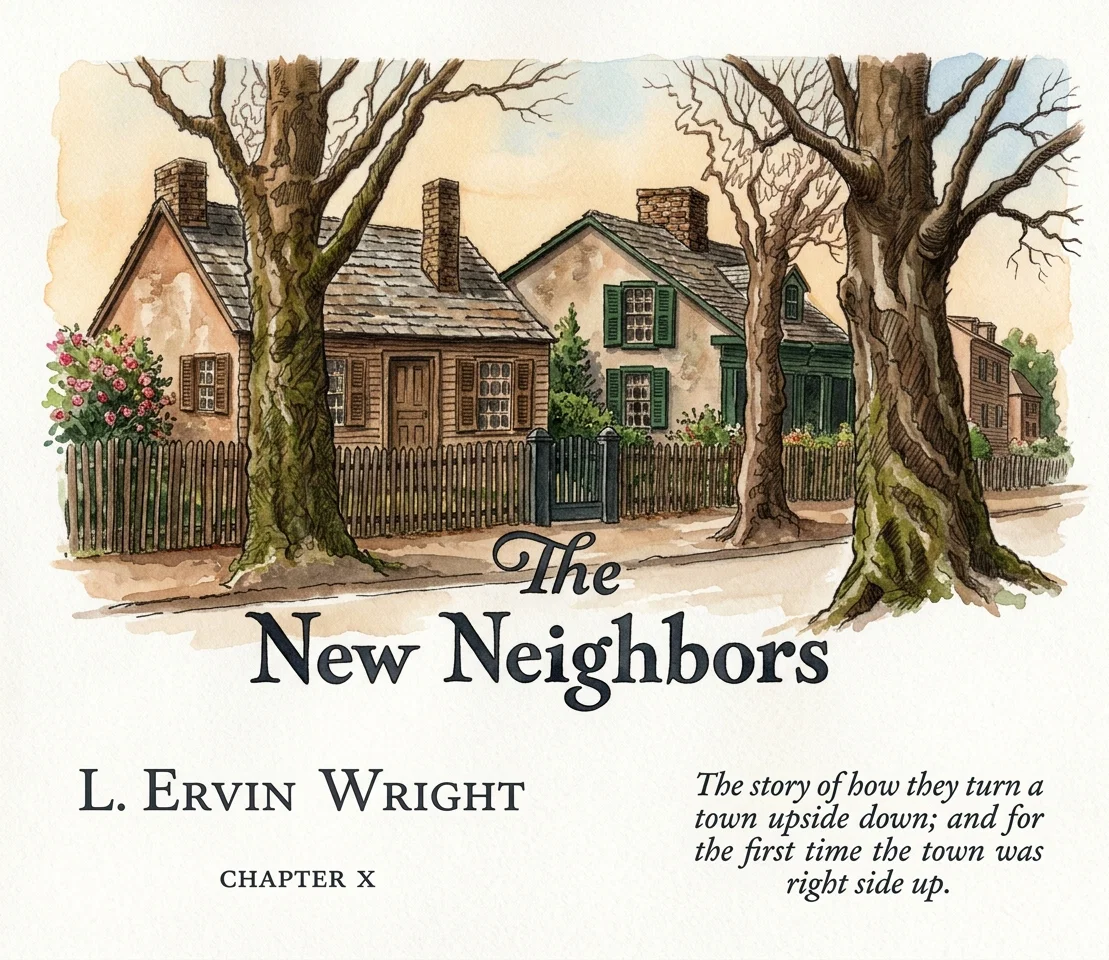
The story of how they turn a town upside down; and for the first time the town was right side up.
The New Neighbors
By L. Ervin Wright
L. Ervin Wright
CHAPTER X
THE STORY THUS FAR: Mrs. Winters, her son, Dale, and daughter, Theresa, newcomers to the town of Fairdale, begin an active missionary program. They are the first Seventh-day Adventists ever to live in Fairdale. Mrs. Helman, a very prominent woman, becomes interested in the teachings of the Adventists. She asks Dale Winters to hold Bible studies in her home, to which she invites several of her friends. In visiting the Reverend Mr. Dodson, pastor of the church, Dale is accused of belonging to a cult, and being a proselyter. Dale stands his ground in a Christian manner.
Starting a Sunday School
I AM going to start a Sunday school,” announced Theresa Winters at the noon hour a few days after Dale had visited Pastor Dodson.
“You mean a Sabbath school,” corrected her mother.
“No; I mean a Sunday school. There are just lots of folks in Fairdale who don’t go to a church of any kind. They don’t work on Sunday in a regular way, and yet they don’t attempt to keep it as a Sabbath either. In the section of Fairdale where I have been distributing the SIGNS OF THE TIMES for the past eight weeks and have been doing my home nursing, I have met some lovely people, although many of them do not go to church as a regular thing. Their children do not go to Sunday school, either; but I have the promise of more than twenty children from these homes that if I would start a Sunday school they would come. We can teach them the truth of the Bible on Sunday just as well as on the Sabbath, and we shall get a better attendance, for those who wouldn’t come to Sabbath school would come to Sunday school. All I lack is a church or hall or some place to hold my school.”
“Well, sis, I think you are a real genius, for that is certainly a capital idea. If I can secure a hall or something, will you agree to let me share your glory in this Sunday school idea?” asked Dale, from across the table.
“Of course, Dale. But do you think that we can secure some place?” questioned his sister, rather excitedly.
“I am sure we can. You know that this is not our work only. This is God’s work also; and if we ask Him, He will answer our prayer if it is His will.”
That afternoon Dale searched for a hall that might be donated for a Sunday school or even rented for a nominal price. But as every hall was either not available or an exorbitant rental was asked, Dale felt somewhat discouraged. But noticing the Fairdale Daily Times sign over the shop of Fairdale’s only newspaper, Dale felt an inner prompting to visit the Times office. Upon entering the shop, he met Edith Helman.
“How do you do, Miss Helman,” smiled Dale, in response to Miss Helman’s salutation.
## A BUDDING EDITOR
“Didn’t you like my write-ups of your Bible studies at our home, Mr. Winters?”
“Did you write those news stories?”
“Certainly, I did. I want to be a society editor on a big daily some day, and I have a job of reporter this summer with the Times. I am writing up everything and everybody. I may be asking you for your life story one of these days.”
“Well, I wish you all the success in the world. I think your write-ups were splendid. I might give you a news tip, if I thought you could help me with a problem I have.”
“Help you?”
“Yes; I want a hall or a church free of charge if possible.”
“Going to start some Bible lectures?”
“No; not now. Theresa wants some place to start a Sunday school.”
“But you are Seventh-day Adventists!”
Then Dale explained their plan.
“I am sure that father can help you, Mr. Winters,” said Edith Helman. “Father has returned from the Bankers’ Convention, and
he wants to meet you. This will be a good time to see him.”
Samuel A. Helman, president of the Fairdale National Bank, was a kindly-appearing man of fifty. There were already touches of gray in his hair, but his face was young. The two found Mr. Helman in his private office at the bank. Introductions over, his daughter explained Dale’s wants.
“Well, Mr. Winters, you may have the clubhouse maintained by the Chamber of Commerce down on Second Street, if my influence in Fairdale means anything. As president of the Chamber of Commerce, I will see that you folks have the hall without costing you a cent. All we ask is that you leave the building in as good condition as you find it.”
Theresa was overjoyed with the news that Dale brought home that evening, and plans were immediately formulated for the organization of a Sunday school.
“Mother will be pianist; I will be superintendent,” announced Theresa; “and you, Dale, will be chorister. I am expecting some boys to attend, and you may have the boys’ class also. Mother’s hearing will prevent her from teaching, so she may act as secretary also, and give out the papers and cards. And I will teach the girls’ class. I can hardly wait for Sunday to come.”
The next morning the Winters visited the clubhouse. There were plenty of chairs, several tables, and a piano. The main floor was amply large enough to seat five hundred people. Then there were smaller rooms in which classes could be held.
In the Saturday’s issue of the Times, a clever write-up by Edith Helman telling about the new Sunday school appeared. The prospect of an “Advent Sunday School,” as Cyrus Moore expressed it, created no small sensation at Butterfield’s grocery store Saturday evening. In fact, it became the topic of discussion throughout Fairdale.
## THE SUNDAY SCHOOL OPENS
At nine o’clock Sunday morning, the Winters opened the doors of the clubhouse. Sunday school had been announced for nine-thirty, but they had come early in order to put up charts and maps and devices. It was necessary to arrange the chairs and the piano, as there had been a dance in the hall the night before.
At nine-twenty the children began to saunter in. Theresa met them at the door with a cheery, “Good morning.” At nine-thirty twenty-four boys and girls from the age of four to fourteen had gathered in the hall. Dale had his hands full in keeping order and maintaining a minimum of noise. By starting an early song service, decorum was saved.
But the surprising feature was that within five minutes after the opening song half as many adults filed into the hall as children. And before the close of the second song more than thirty adults were gathered in the hall.
“Friends,” smiled Theresa in her winning way, after all were seated, “I welcome you to your Sunday school. I recognize some of you, and some of you I do not. However, I trust that I shall become acquainted with each of you. And I hope to see you all back here next Sunday morning.” She then explained the purpose of the Sunday school.14
Following this, Dale played a violin solo. Mrs. Winters then told a story of missionary endeavor in Africa.
“This morning we shall have only two classes. I shall teach the class of boys and girls, and Mr. Winters will teach the class of adults,” announced Theresa.
A few minutes later Dale found himself looking into the faces of thirty-three men and women. Most of these Dale recognized as being those to whom he had given copies of the SIGNS OF THE TIMES. Ezra Peters, Cyrus Moore, and Silas Hewitt, whom he had met at Butterfield’s, were among the number. Mrs. Gilroy and Mrs. Perkins, who had attended the Bible studies at Mrs. Helman’s home, were also present. And just before Dale began to conduct his class, Mr. Helman and his daughter entered and took a back seat.
“Friends,” Dale addressed his class, “we are handicapped this morning for lack of Lesson Quarterlies, but I wonder how many Bibles we have with us.”
Eight Bibles were held up.
“That is fine. But I wonder if we couldn’t adopt a slogan like this: ‘Every member with a Bible every Sunday.’ We are going to study about what the Bible says about itself this morning. Will some one please read 2 Timothy 3:16?”
“‘All Scripture is given by inspiration of God,’” read a man to Dale’s left.
“In the Greek,” commented Dale, “the thought is that all Scripture is ‘God-breathed.’ That is, the Bible was not primarily the production of man, but God was the author. Some one read 2 Peter 1:21 for further confirmation of this.”
“‘For the prophecy came not in old time by the will of man: but holy men of God spake as they were moved by the Holy Ghost,’” was read.
“The Holy Spirit, as it is translated in the American Revised Version, was the prime mover of the Bible writers. Mrs. Gilroy, I see that you have a Bible, will you read for us 2 Samuel 23:2?”
“‘The Spirit of the Lord spake by me, and His word was in my tongue,’” read Mrs. Gilroy.
“Who is the person here speaking, Mrs. Gilroy?”
“It was David.”
“Did David write any of the Bible?”
“Yes; the Psalms or most of them.”
“Mr. Moore, I believe that you have a Bible. Will you read Romans 15:4?”
Cyrus Moore arose and read: “For whatsoever things were written aforetime were written for our learning, that we through patience and comfort of the Scriptures might have hope.”
“Who wrote that?”
“The apostle Paul.”
“Whom does he mean by ‘our’ and ‘we’ in this text?”
“The Christians.”
“But what writings was he referring to here that were written for the learning of the Christians?”
Moore hesitated.
“It appears to me, Mr. Winters,” spoke up Ezra Peters, “that Paul was referrin’ to the Old Testament.”
“That is right, Mr. Peters. Now will some one read 2 Timothy 3:16, 17?”
A woman unknown to Dale then read: “All scripture is given by inspiration of God, and is profitable for doctrine, for reproof, for correction, for instruction in righteousness: that the man of God may be perfect, thoroughly furnished unto all good works.”
“‘All Scripture,’ means literally all that is written, hence Paul includes both the Old and New Testaments as being profitable to the Christian. It is unfortunate to find Christians who have no use for the Old Testament because they think it was for the Jews only. The Scriptures the noble Bereans searched daily, when Paul preached Christ to them, were the Old Testament Scriptures, for the New Testament Scriptures were then unwritten. We would do well to follow the example of the Bereans. Mrs. Perkins, will you read Acts 17:11?”
She read: “‘These were more noble than those in Thessalonica, in that they received the word with all readiness of mind, and searched the Scriptures daily, whether those things were so.’”
(To be continued)
The Seventh Day Is the Sabbath
The prophets spoke and taught not in terms of a first-day sabbath but in terms of a seventh-day Sabbath. Christ kept, taught, and perpetuated not the sabbath of the first day of the week, but the Sabbath of the commandment.
There are no other authorities for a true Sabbath than these, God, the prophets, and Christ. There are no other possibilities for the necessary broken cycle to establish Sunday as the true Sabbath. There are no other available immutable sources to lend argument to either side than these sources. We can then with sureness draw this conclusion—Sunday is not the true Sabbath, but the seventh day, commonly called Saturday, is.
Literature Wanted
The following persons desire late, clean copies of Review and Herald, Youth's Instructor, Present Truth, Watchman, and SIGNS OF THE TIMES, for free distribution:
O. Glass, Sulphur, Oklahoma.
L. J. Caldwell, 150 Ford St., Oakland, California.
C. E. Bolton, 1006 Bellefontain St., Indianapolis, Indiana.
Mrs. G. E. Reid, 2311 Norton Ave., Everett, Washington.