ON the eleventh of December, the 36,000 parishes of the Catholic Church in France will lose 40,000 church buildings, cathedrals, and chapels. Such is the positive and final decision of Pius X.
My last letter ended with the alarm and amazement of hundreds of intelligent Catholics, as expressed in a letter to the pope himself, in which they ask for some good reasons for his strange attitude.
This radical policy on the part of the pope does not seem to be fully appreciated even among the cardinals. Says a Catholic writer in a correspondence from Rome:
"There is a profound dissatisfaction among the old cardinals regarding the direction given to pontifical politics; especially in those questions which concern France, the pope seems to them to betray a complete ignorance of the situation. They now recognize the mistake they have made in raising to the pontificate a cardinal with whose ideas they were not fully acquainted, and upon whose diplomatic ability they were more or less mistaken." The same writer adds that another cause of discontent is the fact that the older cardinals have very little to say in the Vatican, where the leading influence belongs to two cardinals, one of whom is the young Spanish secretary of state, Merry del Val.
Civil War or Surrender.
What is the pope's plan? For a plan he must have in taking the dangerous step that he has, despite the misgivings of many bishops and cardinals. The scheme is unveiled by one of the leaders of the clerical party in France, Count Albert de Mun. Here are his words in the Catholic paper La Croix:
"Since there are no church associations, the 40,000 churches of France will have to be closed. Yes, that is the law. "But who will dare, who will be able to close them, if the Catholics are not willing? Who will dare, who will be able to drive them out if they have resolved to remain? "This is the question before France. The story of the inventories may suggest the answer. The 'flock' is on the lookout; the wolves can not take it by surprise. I do not believe that it will allow the churches to be closed."
In short, the plan of the pope and of the French clericals is to compel the government to enter violently into 40,000 churches to drive out the worshippers. The French Government is thus brought to face the following dilemma: Civil war or surrender. If it surrenders, well. The church will have gained the day in its determined struggle with its enemies. But if the government plunges headlong into those 40,000 conflicts with fanaticism, it is hoped that the confusion, blows, and bloodshed which will result, will so disgust the country against the liberal parties that it will vomit them out and give the power to the clericals and, possibly, to the monarchy.
After the second council of the French Episcopate, one of the bishops confessed to a Catholic writer, M. de Narfon, his regret at the decision taken, and his deep concern at the prospects before the country and the church. He said:
"We have voted the civil war with raised hands. We have voted like so many officers of Nicholas II. I signed like the rest, or, rather, I shall sign to-morrow with the rest, but with tears in my eyes and death in my soul. . . . It will be war, since we enter into open rebellion with the law. It will be war, unless the government gives up the idea of enforcing the law. . . . The decisions of the council mean not only war, but to us ruin, the loss of faith on the part of a great many souls, and France wiped out from the map of the world as a Catholic nation."
How the Monarchists and Anti-Clericals Feel.
While the bishops, in a circular letter to their flocks, say: "We will still hope that civil war will be spared to our country," the fanatical, monarchial papers are exulting at the prospect. Says The Libre Parole:
"Now has come the time for French Catholics to do their duty. They see what a degree of humiliation they have reached by yielding all the time and not resisting on time. The awakening will take place. On the day when the sacred asylum of conscience of all will be invaded, the sectarians will find themselves facing unexpected resistance. The inventories are there to show that there are still beings capable of denying themselves and of dying for a faith which was the faith of France for fourteen hundred years."
The anti-clerical papers are more violent and rabid still. So La Lanterne:
"In principle it's war! "Republicans and free-thinkers, let us hope that it will soon exist as a fact. "Rome defies us; Rome threatens us; not in vain will she have thrown the gauntlet. "Since the abject band of impostors and pick-pockets, which still levies the tribute of lie upon the fools of the two worlds, dares, through its foreign chief, to defy the French Republic, let the punishment follow the insult quickly, and let it be severe and final."
A New Party.
But now, while extreme parties are preparing for the worst, a new party is entering into line. Its name is the 'French Catholic League.' Its object is to secure the church buildings by organizing the very associations provided for by the law and forbidden by the pope. Of course, the bishops are denouncing the league and excommunicating those organizing or entering into church associations. Some twenty of them have already been organized. At the head of the league stands a brilliant journalist, Henri des Haux, who was formerly editor-in-chief of the leading French organ of the Vatican at Rome. He is boldly denouncing the pride and grandeur of the Papacy as being contrary to the Gospel of Jesus. Other voices are being heard now, even from profane lips, calling for a purer religion. May God help His children in France to answer these calls!
Spain and the Vatican.
Has somebody been praying for Spain? At any rate, the handful of news which comes from the country of Torquemada and Loyola is very interesting. Only two years ago, as I had occasion to relate in one of my letters, an agreement, a convenis, was passed between the Spanish Senate and the pope. This agreement was for the purpose of tightening the grasp of the Papacy over this gentil nation. And now we see the government of young Alfonso XIII. marching toward liberty with astounding strides.
First comes a royal edict wrestling the marriage institution from the despotic control of Rome. Next comes the intention of the government denouncing the convenio of 1904. Thirdly, a bill restricting the power of the monks. Fourthly, the expressed intention to repeal the Spanish Concordat with the pope, signed in 1851.
The bishop of Tuy and the archbishop of Valence could not refrain from giving vent to their indignation at the establishment of civil marriage, which they termed undecorous. But the government took up the matter so promptly and so seriously, that the good bishops had to make proper amends.
Dealing with the Orders.
There are now in Spain over 50,000 monks. The proposed law is said to declare unlawful all monastical orders which by perpetual vows abandon such rights and liberties as are granted to every citizen by the Constitution. All civil and judicial authorities will have the right of entering into convents without asking the permission of the directors of these establishments. Many orders will be dissolved; none will be allowed to teach; all orders devoted to commerce or industry will have to pay taxes; and the salaries of some high church dignitaries, like the archbishop of Toledo, who gets 45,000 francs a year, will probably be reduced.
To any one who knows something of the history of Spain and its present condition under the crushing rule of Romanism, this is indeed a sign of the times. God's mills grind slowly, but surely. Now at last has Spain's turn come also when she may have another opportunity to think and act according to the dictates of her own conscience! For this hope and prospect let us pray, and thank the Giver of every good and perfect gift!
JEAN VUILLEUMIER.
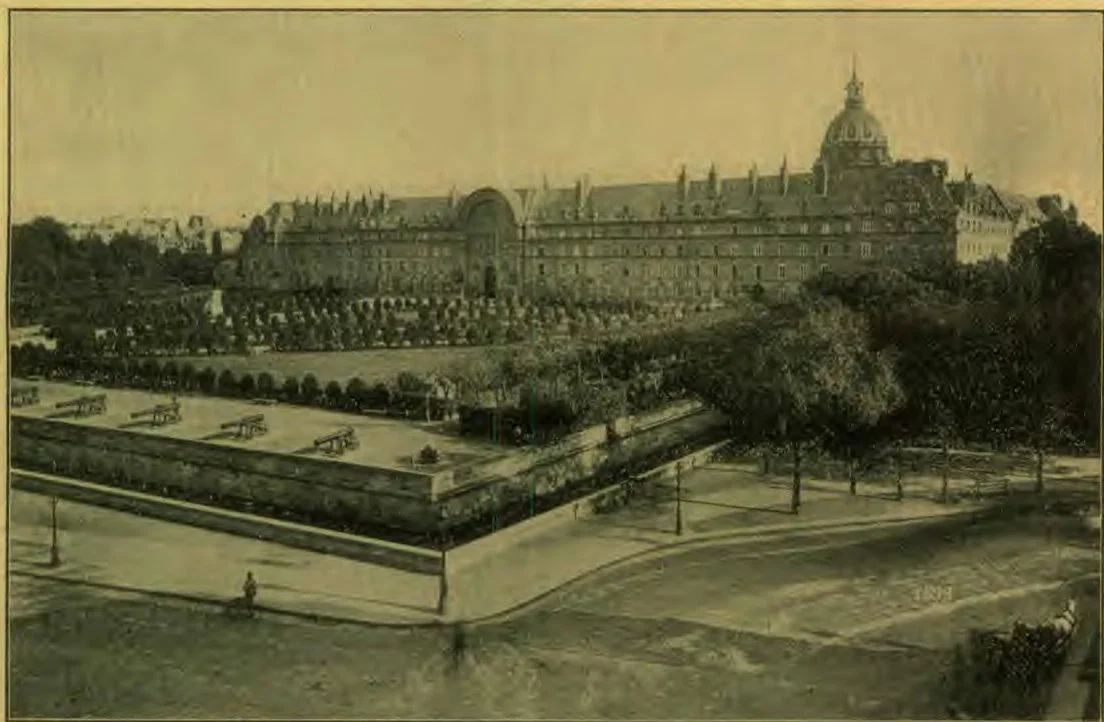
The Hotel of the Invalides, Paris, really an old veteran's home, in which are exhibited many of the trophies which French military prowess have won, and in the rear of which is the tomb of Napoleon.
Japan’s Naval Expansion and Hawaiian Islands
Official notice has been given that a Japanese naval squadron, composed of one battle-ship and two armored cruisers, is about to make a voyage around the world, and will call at San15Francisco next spring. In connection with this it may also be said that report is that of the Japanese which are coming into the Hawaiian Islands are old experienced army and navy officers, and with them are coming thousands of others. Upon this doubtless is based the report that Japan sooner or later intends to seize the Hawaiian Islands, as she does also the Philippines.
FRANCE AND THE ROMAN CATHOLIC CHURCHES.
THE following from the Independent will set before our readers a very clear picture of the condition of things in France as between the government and the Vatican:
"Premier Clémenceau has again given proof of his executive ability in successfully carrying out the law providing that inventories be made of all the church property before the complete separation of church and state. A few months ago, and under the former Premier Sarrien, the attempt to inventory the contents of the churches was met by such opposition on the part of devout Catholics, who considered it sacrilege, that the government was obliged to abandon the effort.
There remained 3,605 churches to be inventoried before December 11, the date on which the Separation Law takes effect. All of these have been inventoried within the last week by the use of force in a diplomatic way on the part of the government. No warning was given of the day when the church would be inventoried, so the faithful had no chance to assemble and barricade it as they had done before. The army was used freely. In many cases
two or three hundred soldiers were assigned as a guard to the officers of the law in fulfilling this duty, and little opposition was attempted. Usually the priest entered a formal protest against the invasion of the sacred edifice and the doors were locked, so that it was necessary for the officers to break them in. The act was a mere formality, as most of the movable property of the churches had been sequestrated.
"At Pigin, in the Department of Herault, a new form of resistance was used. Burning sulphur was shoveled into the church from the vestry and the roof, repeatedly driving the soldiers out of the building into the street, where they were attacked by stones and flower-pots thrown by men and women from the neighboring houses. Finally the church was set on fire by the burning sulphur, and when the firemen attempted to put it out, it was found that the water mains were plugged to prevent the use of the hose in dispersing the crowd.
"In various parts of Bombav, mobs of peasants attempted to defend the churches, and had to be dispersed by charges of cavalry, but, as a whole, disorder was very slight compared with that of a few months ago. Less than twenty persons were arrested altogether, and of these only a few sentenced. Two clergymen were imprisoned for three days and a month, respectively, for resisting the officers of the law. Prefects who showed a disinclination to carry out the work of inventorying were removed from office. Captain Magniez, of the Eighth Infantry, who refused to obey orders to carry out inventories, was replaced by a lieutenant, and ordered to appear
before the Council of War for disobedience. Formerly when attempt was made to carry out the law, Catholic officers who had conscientious scruples against obeying these orders were acquitted by the courts-martial of their fellow officers.
"M. Briand has given as his interpretation of the Separation Law that after December 11, 1906, church property could be handed over to the local authorities, but, according to the law, must be given to them after Dec. 11, 1907.
"The Socialists and Radicals on the left of the Chamber have announced strong opposition to the government for this postponement of the strict enforcement of the law. In many places cultural associations have been formed by Catholic priests and laymen in accordance with the law, and these may receive the church buildings in next month.
"The bishops have issued warnings that any persons concerned in the formation of these associations contrary to the will of the pope shall be excommunicated and excluded from the sacraments, and, in the event of death, from burial in holy ground. Cardinal Lecot, Archbishop of Bordeaux, has been forming diocesan associations, as he claims, under the law of 1901, but M. Briand, Minister of Public Worship, declares they are legal cultural associations in the meaning of the law, and, therefore, under the ban of the pope.""
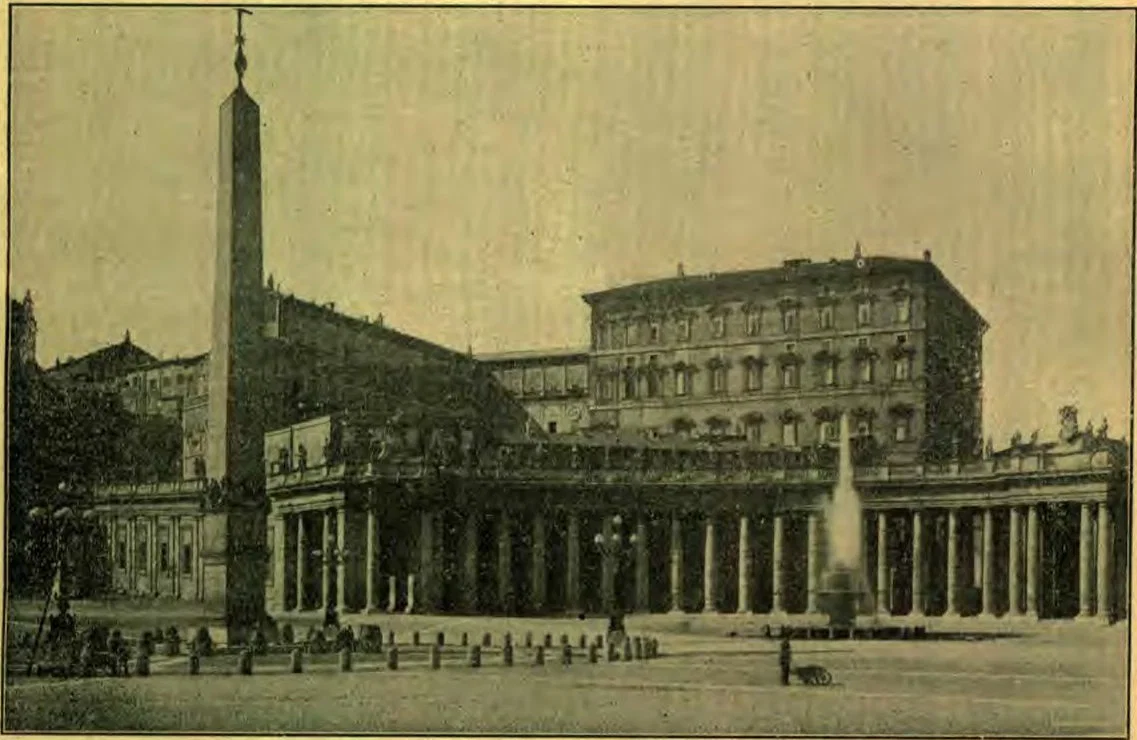
Rome, Palace of the Vatican.
FRANCE AND THE VATICAN.
CONFIRMATIVE of what is said in another column from our European correspondent, is the following from a Rome despatch of November 10, appearing in the New York World. After stating that the Vatican delay had been with the hope that the French officials would at last come to terms with the church authorities regarding the situation of the church in France, “Pius X. has finally decided to continue his policy of resistance and to make the French church absolutely independent from the state, and supported entirely by its own resources.” That certainly is good news if it is undertaken as a principle and not as antagonistic to the French Government, but on the very face of it the latter is the case. The only true Gospel way is for the church to be absolutely free from the state in all countries, at all times, and under all circumstances, at whatever cost. The law of separation passed by the French parliament is to be absolutely ignored, and yet the priests who are entitled to pensions and allowances from the government will be permitted to accept them as long as the French Government consents to pay. Wherever bishops or priests have not acted in full harmony with the Vatican, they will be dealt with. Several French bishops, it is said, have been asked to resign and forward to Rome their resignations, because of their failure to comply strictly with the orders of the pope in the present crisis of the church in France. Pius X. designs to make the church in France perfectly submissive, and thinks by this that he will be able to bring the French Government to terms.
"LET US BE THANKFUL."
UNDER the above heading, the Oakland Enquirer, just before Thanksgiving, thus expressed itself; and who can say, looking at it from an earthly view-point, that it is far out of the way:
"Let us be thankful the lumber combine has not made another cinch rate.
"Let us be thankful that the milk combine boosted the price only 26 per cent.
"Let us be thankful that the coal combine gouges us no more than $3.00 a ton.
"Let us be thankful that the shipping combine is tacking on rates to raise only 33 1-3 per cent. annual interest.
"Let us be thankful that the water monopoly has increased its capitalization to only $20,000,000.
"Let us be thankful that the price of butter is only 75 cents a square.
"Let us be thankful that eggs are no more than five cents a piece.
"Let us be thankful that potatoes are not more precious than gold nuggets.
"Let us be thankful that turkeys are no higher than 30 cents a pound.
"Let us be thankful that cranberries do not cost more than 15 cents a quart.
"All these things might be worse if the people had any more money that the 'combinations' could squeeze out of their pockets.
"Let us be thankful that we are permitted to live and labor and turn our earnings over to the various trusts and combines that control everything but the air and sunlight.
"Let us thank God that no combine has yet got a corner on these bounties of nature."
Panama Canal Labor
The President favors the employment of Japanese and colored laborers on the Panama Canal, and intimates that they are better laborers than most others there employed. He scouts the idea that there should be an eight-hour day there. The circumstances and all connected with it clearly show that the case is not at all parallel with conditions in this country.
Japan and America
Japan and America.—The action of shutting the Japanese out of the public schools of San Francisco is still causing a great deal of talk, and some see in it even war between the two nations. The contention of the San Francisco people is that no action has been taken detrimental to the Japanese, that the majority of those who wish to enter the primary schools of San Francisco are twenty to thirty years of age, and that in such cases even white men would be shut out from the primary schools. The message of the President to Congress has spoken very decidedly upon the question. He asks for fair treatment for the Japanese, as fair as for Germans, Swedes, Frenchmen, and Italians. We take the following from his message: "I recommend to the Congress that an act be passed specifically providing for the naturalization of Japanese who come here intending to become American citizens. One of the great embarrassments attending the performance of our international obligations is the fact that the statutes of the United States are entirely inadequate. They fail to give to the national government sufficiently ample power through United States courts and by the use of the army and navy, to protect aliens in the rights secured to them under solemn treaties which are the law of the land. I therefore earnestly recommend that the criminal and civil statutes of the United States be so amended and added to as to enable the President, acting for the United States Government, which is responsible in our international relations, to enforce the rights of aliens under treaties. "Even as the law now is, something can be done by the Federal Government toward this end, and in the matter now before me affecting the Japanese, everything that it is in my power to do will be done, and all of the forces, military and civil, of the United States which I may lawfully employ will be so employed." This position has caused more or less discussion and not a little criticism, especially on the part of the anti-Japanese. We hope for an amicable settlement of the difficulty.
Office Notices and Week of Prayer
We send no papers from this office to individuals without pay in advance. When persons receive copies without ordering them, they are sent by other parties, and we can give no information in regard to them. Persons thus receiving copies of the "Signs" are not indebted to the office, and will not be called upon to pay for them. Please read the papers you may receive, and hand them to your friends to read.
We are issuing an eight-page extra SIGNS for California, packed full of important matter on Sunday laws. While relating directly to the issues here, it is good for circulation everywhere. One to 75, two cents a copy; 100 or over at the rate of $1.50 per 100.
Every longing, unfulfilled desire on the part of humanity is met in Jesus Christ.
The man who condemns another is in duty bound to do better than the one he condemns.
The Week of Prayer.—The period set apart for that purpose this year by the General Conference Committee is December 15 to 22. The readings for the special services are printed in the Review and Herald of November 22. They are as follows: "The Ministry of the Holy Spirit," by A. G. Daniels; "The Spirit of Prophecy," by G. A. Irwin; "The Baptism of the Holy Spirit for Service," by E. W. Farnsworth; "God's Mystery to Be Quickly Finished," by L. R. Conradi; "The Former and the Latter Rain," by W. W. Prescott; "Spiritual Finance," by I. H. Evans; "The Holy Spirit at Work in Mission Fields," by W. A. Spicer; "Even at the Door," by Mrs. E. G. White. There are also outlines for children's meetings. At the close of such a year, this season ought to be of great interest and profit. God grant that thus it may be, and that church officers shall plan for this end.
What Do You Think About It?—We have much to say in this number, we have had much to say in numbers of the recent past, we shall have much to say in the future, on the matter of the world-wide Sunday-law movement, and the union-of-church-and-state tendencies manifest in every quarter. We could have filled this whole issue with current news upon this subject. The outlook is fearfully alarming to every lover of civil and religious liberty. What do you think about it, reader? Are you an American? You have boasted of American liberty and rejoiced in it. Do you know that it is in danger? Do you know that potentially the recrudescence of the Dark Ages is in this Sunday-law movement? Do you know that the Dark Ages began in even milder measures than are advocated by the mistaken supporters of the Sunday-law movement? Are you a Christian? You have doubtless thanked God for the privilege of worshiping Him according to your own conscience, with none to molest or make afraid. Would you support any movement which takes that liberty from the other man? Do you believe in religious liberty only for yourself? Do you admit, reader, that the Sunday-law may be wrong, but think it will prove harmless? Do not be deceived. It is the nose of the camel in the tent; it is the first strand of the spider's web around its victim. The first evil principle inevitably leads on to others, and necessitates further steps, till slavery has usurped the place of liberty. In the destruction of religious liberty in the smallest degree is involved the loss of civil liberty and the ruin of the government. The SIGNS OF THE TIMES is one of the very, very few papers which presents the facts and underlying principles of this departure from primitive Americanism and primitive Christianity. Your neighbors ought to read it in the year to come. Help them to do this and so become acquainted with the imminent danger confronting this nation.
December 25.—To those who do what they can to relieve distress and bring joy to the lonely homes and wretched worse-than-homes on that day of any other, we bid Godspeed; but in this work so much is sometimes paid out for ostentation and trimmings that but little good is done for the amount invested. If Christians would really remember Him who became poor that we might be made rich, let them remember the neglected, bleeding, suffering cause of Christ, in the homeless, houseless, joyless dwellings of the poor, in the rayless, sin-sick heathen all around, into whose souls the light of the Gospel never broke. In other words, let Christians be partakers with Christ in self-sacrifice for others, and thus carry the glad tidings of—
> "Glory to God in the highest,
> On earth peace
> And good-will to men."
Let every day be a day in which Jesus in all His glorious work shall be remembered, and then indeed will there be joy because of His birth. Such a happy, joyous Christian life we wish all our readers.
WILLIAM NEWTON GLENN,
ASSOCIATE editor of this paper, died of pneumonia, at his home in this town, December 1, at the age of sixty-nine years, seven months, and eight days. He was sick but a week.
His birthplace was Mercer, Pa. There he received a common school and academic education. When quite young he went West to Kansas and Nebraska, the then frontier. Here he kept frontier store, learned the printer's trade, and followed generally the strenuous life of a frontiersman. He related to the writer how at one time he ran the entire distance of twenty miles one night to intercept a band of Indians who had planned the plunder of his store. When they reached it, to their surprise, they found him in charge, and left crestfallen.
In a few years he followed the westward wave of progress as far as Carson City, Nev., where he worked for a time at the printer's trade, moving on to the Golden State at the time of the Civil War.
To the last call but one for volunteers by President Lincoln, he responded, enlisting for three years or the close of the war. He did not see active service, as his regiment was stationed at the important post of San Francisco, quartered at the Presidio. During his two or more years in the army, he taught school, kept the commissary's books, and learned the art and rules of war.
Soon after his discharge, he attended a religious revival in Stockton, was converted, and joined the Baptist Church.
Here also he was married to Miss Victoria Elizabeth Tripp, July 10, 1866, who survives him. The fruits of this union were nine children, five of whom are living, and were present at his funeral.
In Stockton he was connected in a journalistic capacity with the Stockton Independent and Stockton Herald, serving on the latter's staff several years.
His health failing, he spent one year on a farm, where he learned present truth. When he became a Christian, he enlisted for life, and when the Captain gave further orders, he followed them.
In February, 1876, he connected with the Pacific Press, then in Oakland, and remained with the company till death, a period of nearly thirty years, being the oldest employee in connection with the publishing house. During this time he has acted as proof-reader, foreman of the type-room, manager, editor. For twelve years he was editor of Our Little Friend, and for many years has been connected with the SIGNS OF THE TIMES as associate editor, a most willing worker and genial companion. It mattered not what it was he was asked to do, if it came within his power at all, he was ever willing.
He was also ordained as a minister, acting for many years in official capacity in Oakland and Alameda churches, but his burden lay in connection with the office of publication. The readers of the SIGNS will remember him best by his trenchant articles on religious liberty. He understood the principles of it most thoroughly, and wrote not only for our own publications, but for secular journals as well. He was also the author of several tracts and the book, "Things Foretold."
He was taken with a severe chill Sabbath, November 24, just before going to church, where he was acting as leading elder. This rapidly developed into pneumonia. At the end of one week the power of the disease seemed to have been broken, and his temperature fell to normal, but his heart was too weak to throw off the poisons engendered by the disease, and acute jaundice set in. He died Sabbath, December 1, in the closing hours of the day.
From the first he seemed to feel that the disease would prove fatal, and so expressed himself to others. The writer saw him about an hour before his death. He was hopeful in God, knowing that he was going to die. It was a privilege to kneel by his bedside in prayer, to clasp the hand, and to hear the response from one with whom he had held so many seasons of pleading with God, and had labored so long. He fell, so to speak, in the harness, none more faithful to his work than he, none more willing to do. The Pacific Press, and especially the writer, will feel the loss, but we do not mourn for him. He rests in the Lord, and we are sure he will come forth when the Master shall call, in the first resurrection.
The funeral was held from the Baptist church, and he was interred in Oakland, where others of his loved ones rest. The following resolution was passed by the Board of Directors of the Pacific Press, at a special meeting called after his death:
"Whereas, The hand of death has been laid upon one of our faithful burden bearers and fellow laborers, Brother William Newton Glenn, the oldest employee of the office, serving as foreman, proof-reader, manager, director, and for many years editor of Our Little Friend and associate editor of the SIGNS OF THE TIMES, who fell asleep Sabbath, December 1, in his seventieth year; therefore,
"Resolved, That we, the Board of Directors of the Pacific Press, hereby express our unqualified appreciation of his faithful labors and genial companionship, and Christian brotherhood, and that we express to his bereaved widow and children our heartfelt sympathy in this their great loss;
"Resolved, That the office be closed at the time of the funeral; and further,
"Resolved, That this resolution be spread upon our minutes, and that a copy be placed in the hands of our sorrowing sister, Mrs. Glenn."