The Youth’s Instructor, Vol. 37, No. 37.

THE AMERICAN INDIAN

The Youth’s Instructor

Sep 11, 1889

S. D. A. Publishing Association · Battle Creek, Mich. · Sep 11, 1889

THE AMERICAN INDIAN.

PART IV.—BURIAL OF THE DEAD, AND CAMP SCENES.
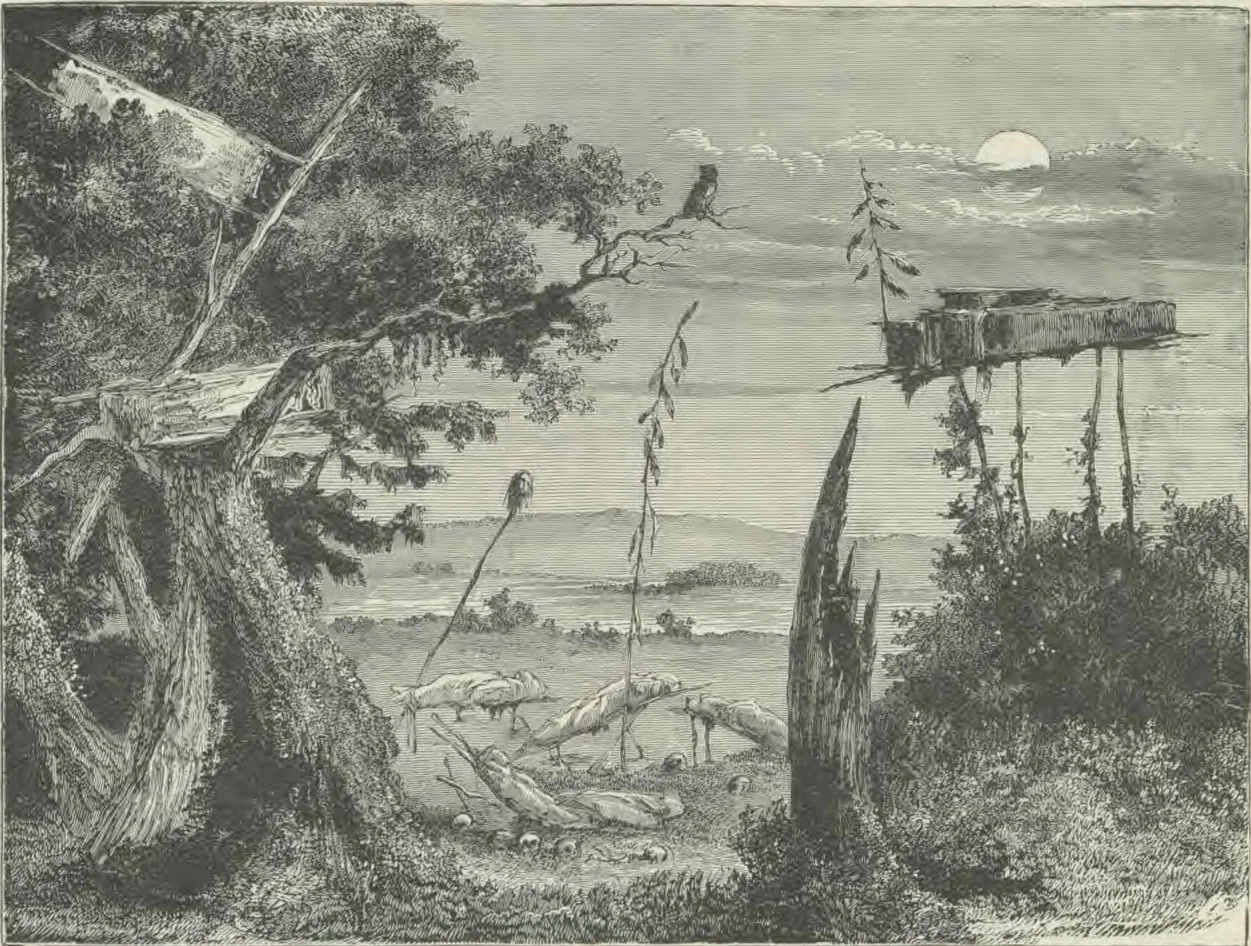
INDIANS vary greatly in their treatment of the dead, and it makes much difference whether a death occurs in winter, when the Indians are in permanent camp, or when on the march. A death in camp is an event of great importance, and is really hailed with joy, since it breaks the monotony of camp life. The warrior is then buried with all the pomp peculiar to the tribe. If the same person should die on the march, instead of in camp, the body would be tumbled without ceremony into the first convenient crevice in the rocks.
Formerly, the Indians of the plains deposited their dead in the tops of trees, making rude caskets of poles, and covering them securely with buffalo hides; but now most all Indians bury their dead. Among the Utes, great secrecy is observed, and no one knows what becomes of the body except those who have charge of it; while after the funeral everything left by the dead chief, and not specially willed to individuals, is utterly destroyed.
The “teepe” is the habitation of the Indian when at home. It is tent-shaped, like a cone at the bottom, making a circle from twelve to eighteen feet in diameter, and is about twelve feet high. It is supported by peeled poles. A squaw ties three together near the top, and thrusting them inside the buffalo skins or cotton cloth of which the teepe is made, raises it up, and spreads the lower ends out. Other poles are then carried in and thrust through the opening at the top, the lower ends extended in a circle, stretching the covering tightly. Two active squaws will pitch, or take down and pack up, a teepe inside of five minutes. A teepe is rarely overturned by the wind or storms, and can be kept comfortably warm even in very cold weather. An Indian is very susceptible to cold; hence he contrives this for a winter home.
In camp, the oldest squaw, or the one least in favor, does the cooking. Meat is put to boil in a kettle over the fire, and when done, or whenever the chief or some other member of the family feels hungry, the kettle is placed in the middle of the lodge, and each one helps himself. On the war-path, where squaws do not accompany the party, each warrior cooks for himself, broiling the meat on the coals, or roasting it on a stick before the fire.
The buffalo was formerly the sole dependence of the Indian. Sixty years ago the buffalo roamed from Texas to the British Possessions, and from the Missouri and Upper Mississippi rivers to the eastern slope of the Rocky Mountains, in countless herds, going north in the spring and south in the fall. Now scarcely a buffalo can be met with, so ruthless and criminal has been their slaughter. With the disappearance of the buffalo went the freedom of the Indian, the animal being his daily food, and furnishing him with clothing, a home, fuel, and most of the articles needed by him. Losing the buffalo, the Indian of the plains lost his chief means of subsistence, and was compelled to submit to the white man’s terms.
In the spring, the buffaloes were thin, and wandered north in large droves, dividing, as they advanced, into smaller and smaller herds. In October, when the animals were fat, and in prime condition, the hunting began. Runners scoured the country to learn the location of the buffalo, and then selected a convenient camp near them. When everything was in readiness to secure and preserve the carcasses, a herd was selected that from its position would not alarm others in being slaughtered; and being surrounded, the animals, with a yell and a rush, were suddenly dispatched. Then the squaws skinned and dressed the animals, drying the flesh. In this way, herd after herd was surrounded, until the winter’s supply of meat was obtained. In places not favorable to surrounding the herds, the Indians, mounted on ponies, dashed in upon them, killing what they could. The Sioux used to kill immense numbers by stampeding them over a precipice, the buffalo being a very stupid animal, and easily frightened and stampeded.
W. S. C.

DORA'S GIFT.

“You don’t mean me to believe, Emily, that all these tall girls are yours? One, two, three, four,—my! what a lot!”
“We pass for Mrs. Brown’s ‘boys and girls,’ Uncle Phil. You see, we have to attend to her business, escort her round, and do what there are no boys here to do.”
“And what sort of business can you attend to, I’d like to know?” asked Uncle Phil, with all a man’s scorn of a woman’s business head.
“Em is my man of business,” said the gentle, lady-terms. Like mother. “No, not the tallest; that is Julia. She is our member of society; she entertains our company, and is to the family what a drawing-room is to a house.”
“She is our decorative art society, too,” added Emily. “She paints and embroiders, and sings in the choir.”
“They are just slandering me, Uncle Phil!” cried Julia. “Look at my forefinger, and you will see who is the seamstress of the family.”
“What is the matter with Daisy’s fingers?” asked Uncle Phil, who, by the way, had been abroad while these girls were growing up, and had now come back to make a home for himself.
“Oh! I’m the housekeeper, and I’ve just been preserving strawberries; that’s where my finger-tips get their rosy color. You’d better speak me fair, uncle, if you want your bread buttered on both sides while you are here.”
Uncle Phil leaned back in his chair, and surveyed the party with admiring eyes. Without being particularly handsome, they were delightful-looking girls. Erect, vigorous, graceful, blooming, and full of fun, they gave proof of being a well-raised, healthy, charming quartet of daughters.
“Well, Sister Emily,” he said presently, “jump them now, and say what you will take for them. I’ll give a fair price for the lot.”
“Koh-i-noors as thick as hail-stones couldn’t buy one of them,” said the proud mother.
“But you haven’t told me what this small woman is good for,” said Uncle Phil, pinching the pink tip of Dora’s ear.
“Good for nothing,” answered the small woman herself, rescuing the persecuted ear.
“Dora? What is Dora’s forte? Why, I don’t know; but we couldn’t do anything without Dora!”
And the girls looked at their uncle as if they feared he might be weak minded, to ask such a question.
“There!” said merry Dora. “I told you I didn’t have any gifts. I can’t sing, nor paint, nor embroider, nor even entertain company.”
“But she can always be the dearest dear of a Dora that ever was,” said the sister on the other side of Dora, giving her a troublesome squeeze. And Dora seemed highly satisfied with this explanation.
But of course the weather in this family was not all summer weather. Uncle Phil found, after he had been living with them awhile, that they had their ups and downs like other people; they disagreed with one another, and felt cross about it; they tried to do things, and failed sometimes; jellies wouldn’t always jell; dresses wouldn’t always fit,—in short, “the briars besetting every path” pricked the feet of these sweet lasses in their turn, as they do the feet of all earth-travelers.
And then Uncle Phil found out what was Dora’s gift. It had been dawning on him for some time; but one rainy day he startled the family by saying, “Sister Emily, Dora is the most gifted child you’ve got.”
It was, as I said, a rainy day. “Of course it had to rain,” Julia had said grimly, as they gathered into the breakfast-room. “As I wanted to go to ride on horseback with uncle, I might have known it would rain.”
“It is well you have an escort who will wait till a clear day,” said Dora, who was busy pulling up the blinds to the top pane, that they might get all the light there was to be had.
“Ah, what a nice little blaze!” said Uncle Phil, limping round to the grate; “which of you knew that I had rheumatism this morning?”
“Dora always keeps a little pile of wood and shavings hid away for a morning like this,” Julia said, leaving the window, and coming to warm her cold nose by the cheerful glow.
The mother entered with a cloud on her usually placid brow.
“Bridget is sick, girls, not able to get out of bed.”
“How lucky that it rains!” cried Dora; “no visitors, no going out; we can be busy bees to-day without molestation. Sit down, and keep Uncle Phil from getting cross, mother, while we go and scratch up a little breakfast.”
In a very short time a comfortable breakfast was on the table, everybody chatting pleasantly, and not a frown to be seen. It was at this moment that Uncle Phil announced his discovery that Dora was the most gifted child in the family.
“Proof positive; I have made a bit of toast without scorching the edges,” said Dora, with a mocking little bow.
“No,” said Uncle Phil, gravely, in answer to the questioning eyes fixed upon him all around the table, “but Dora has that rare treasure, the gift of pleasantness; of being pleasant herself, and making other people feel so, no matter what is going on. I am sure that was the kind of woman the Apostle Peter was thinking of when he said it didn’t matter about plaiting the hair and putting on gold ornaments, if a woman had that sweet, bright, quiet, unselfish spirit that the Lord thought so much of.”
And then all eyes fixed upon the speaker filled up suddenly with loving tears, and everybody seemed trying to kiss blushing Dora first.
“Yes,” said the mother softly, “pleasantness—that is just my Dora’s gift!”—Elizabeth P. Allan.

The Best Monuments of the Good

THE best monuments of the good are their actions.

LIVE AT YOUR BEST.

Do not deem that it matters not How you live your life below; It matters much to the heedless crowd That you see go to and fro; For all that is noble, high, and good Has an influence on the rest, And the world is better for every one Who is living at his best.
O for a life without reproach, For a heart of earnestness! For self forgotten, for meanness slain, For hands well used to bless!
God, raise us far from little things, And make us meet to be Skilled workers here in the place we fill, And servants unto thee!
—Marianne Farningham.

COALS OF FIRE.

Two men living in the southern part of Africa had a quarrel, and became bitter enemies to each other. Soon after, one of them found a little girl belonging to his enemy, in the woods at some distance from her father's house. He seized her, and cut off two of her fingers; and as he sent her home screaming with her bleeding hands, he cried, “I have had my revenge.”
Years passed away. The little girl had grown up to be almost a young woman. One day there came to her father's door a poor, worn-out, gray-headed old man, who asked for something to eat. She knew him at once as the cruel man who had cut off her fingers. She went into the hut, and ordered the servant to take him bread and milk, as much as he could eat, and then she sat down and watched him eat it. When he had finished, she dropped the covering that hid her hands from view, and holding them up before him, she said, “I have had my revenge.”
The man was overwhelmed with surprise. The secret of the girl's conduct was that in the meantime she had become a Christian, and had learned the meaning of the verse: “If thine enemy hunger, feed him; if he thirst, give him drink; for in so doing, thou shalt heap coals of fire on his head.”—Sel.

FOUR LITTLE THINGS.

Because we are little, it is no reason why we should not be wise. In the eyes of the world many things look small and insignificant, which, in the eyes of God, are great and wise. Solomon was a great and wise man, and he, by the help of God’s Spirit, saw wisdom in a great many little things; so he writes about some of them for our encouragement. See what he says in Prov. 30:24: “There are four things which are little upon the earth, but they are exceeding wise.” He evidently wants us to learn a lesson from them, that we, too, who are little may also be wise. Now let us see what they are.
First, the ants. Says he, “The ants are a people not strong, yet they prepare their meat in summer.” Perhaps you have seen them doing so. You, no doubt, on some warm summer morning, have seen a long stream of ants crossing the path. What a desperate hurry some seem to be in! They are carrying sticks, and grubs, and all kinds of little bits of stuff. Now they are preparing their meat. That is, they are laying up a good store of provisions for the future, so that when a cold day or winter comes, they will have something to eat. That is why they are so wise.
Now we want to be as wise as the ants are, and lay up something for the future. What shall it be? Let Jesus answer: “Lay up for yourselves treasures in heaven.” We want our store there, laying up for ourselves a good foundation against the time to come. 1 Tim. 6:19.
Second are the conies. Says Solomon, “The conies are but a feeble folk, yet they make their houses in the rocks.” A coney is a little fellow something like a small rabbit. There are lots of them in the Western States. They are very timid and weak; if you were to hit one with a little stick, you would kill it. But when the conies see you coming, they cry out “coney,” and all scamper off to their holes in the rocks. There they are perfectly safe, and no one can hurt them. So you see how they are wise.
Now we must be as wise as the conies. We must make our house in the Rock, and fly there for safety. You know, do you not, who that Rock is? Jesus himself in a parable tells about two men; one was wise, the other foolish. One built his house on the sand, and when the storms came, down came the house. The other built upon the rock, and his house stood; and Jesus says he is a wise man, and the man who hears his words is like him. In this way we want to be wise like the conies.
Third are the locusts. “The locusts have no king, yet they go forth all of them in bands.” God’s children are to be as wise as the locusts, because they are to have no king on this earth. Jesus tells us to call no man Lord or Master. The Israelites once cried to have a king like the nations around them, but they were very unwise, and got into a great deal of trouble. We are to have no king but Jesus. Then we must be as wise as the locusts, in going forth in bands together. We must all be in unity and harmony, and go forth together, like so many little armies.
The fourth and last is the spider. “Dear me,” says one, “I don’t want to be compared to a spider. I don’t like spiders.” But let us see what Solomon says; perhaps the spider is the best of all. “The spider taketh hold with her hands, and is in king’s palaces.” A king’s palace is full of gold and jewels, and pomp and display; but the spider doesn’t care for those things. She lays hold with her hands to her little gossamer web, and with her back to the gilded saloon, she quietly goes on with her work.
Now that is how we are to be in this world. The gold and the noise and the glitter are to have no attractions for us; but we are to lay hold with our hands, by faith, on things above, the unseen things of God. Thus we will in our own little corner go quietly about our work,—in the world, but not of it.
FRANK HOPE.

THE WELL-REGULATED MACHINE.

In one of the large factories at Lowell, there is a machine for the purpose of uniting a number of fine threads into one larger; there are more than a hundred spools from which the thread is winding off upon another spool. One girl tends this machine, and it is her business to tie the threads whenever one is broken. Such is the wonderful mechanism of this instrument, that the instant one of those fine threads is broken, the whole machine is suddenly stopped. It is curious to stand by it, and notice the regular movement as each spool is in motion, and the instantaneous pause when a single thread is snapped. I never saw a machine that seemed so intelligent—so like a living thing.
I could not help saying, as I saw it stop, “There, it knows it has done wrong; it will not go on till that error is corrected.” The thread tied and the machine started again, it went on as before. Children know that a machine made out of wood and iron does not understand anything, and does nothing of its own accord, but only performs what it is made to perform. But it seemed to me as if the thing was alive, and had a soul. It seemed to know when a thread broke, and to perceive that its work would be spoiled if it did not stop to have the injury repaired.
Children know another thing,—that they are not machines; that they can think, and reason, and remember, and wish. They are not machines, or they could not love or be loved; but I could not help thinking, as I stood there, what a good thing it would be if every child would act just as this machine did; if every child would instantly stop, as soon as anything wrong had been done, and not do anything else until that was set right. When one who begins to do wrong goes on in his action, he is only making a bad thing worse.
And then I said to myself, “God, who made us, has put within us all something like this, but even still more sensitive than this machine; something that notices when we have done wrong, and calls upon us to stop and repent of the sin before we do anything more. If we do not yield to such a direction of our consciences, the machine seems wiser than we are.”
If, then, a single thread breaks which binds us to virtue and to God, or which holds us back from sin, let us learn not to keep on and increase the wrong, but stop, and by repentance and a better purpose, mend the thread, and prepare to go forward with the blessing of God.—Selected.

MEMORY

LIARS need good memories, but often have poor ones. If a man wants to make his memory strong, he should tell the truth, and stick to it. He should not yield to prejudice, or give the reins of fancy, or aim to relate a big story, or tell just what will make for his own advantage. He should not be afraid to speak well of his enemies, nor should he feel bound to approve his friends; but he should tell the truth. Such a man needs no oath to make him speak truthfully, and no bond to compel him to perform his agreement. He “walketh uprightly, and worketh righteousness, and speaketh the truth in his heart.”
In speaking, he tells out what God has placed within him. Out of the abundance of the heart flow forth words of truth and soberness.
Of all things to be deprecated and avoided, deception, falsehood, and lies occupy most prominent places. Falsehood rots out the moral fiber of a man. He can never be what he should be until truth is enthroned in his heart. What is a liar good for in this world? Surely the Lord will have no use for him in the world to come; for, “all liars shall have their part in the lake that burneth with fire and brimstone.”—Little Christian.

HIS TO LAY ASIDE.

A LITTLE tool am I, just one within His hand; Just his to choose, And his to use, Shaped out at his command.
If he should lay me down, perhaps I might be sad, And wonder why He put me by, And nevermore be glad.
Yet I would surely know, whatever he might do, However choose His tools to use, His love was strong and true.
Just looking in his face, although my heart would break, I could but know He loved me so There could be no mistake. —Geo. Kringle.

AVA'S HUMMING-BIRD.

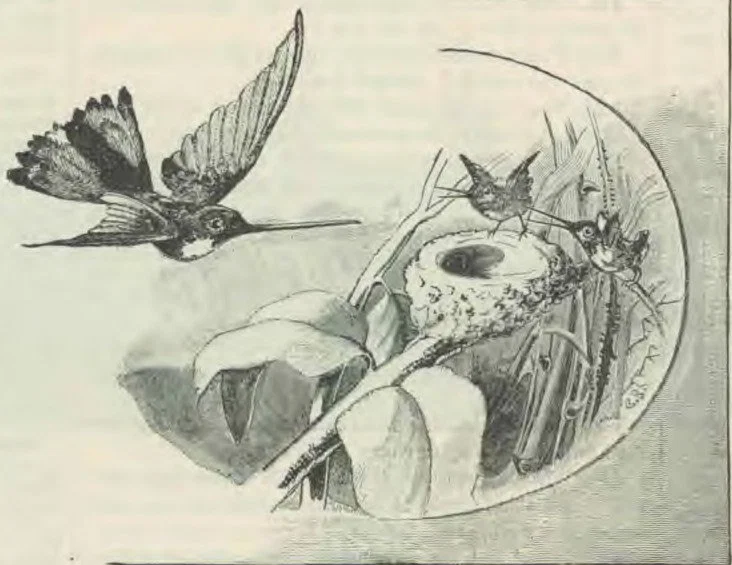
Ava sat by the open window, looking out at a honeysuckle that was clambering up over the door. It was loaded with sweet-scented flowers. While she was wishing she could have a bunch of blossoms that grew just out of reach, she caught sight of a bright speck of color, like a flash of light, hovering in the blossoms over her head. It was a little bird. The tiny wings moving so rapidly looked like gauze, and the bronze-green and red and purple and gold on the head and tail were more beautiful than anything she had ever dreamed of.
A quick-drawn “oh!” of delight from Ava brought her mamma to the window.
“It is a humming-bird,” she said, in answer to a questioning look from Ava.
While they were watching its swift motions, the tiny visitor made a dart at the window, and fell to the ground, stunned by the force of the blow he had given himself.
Ava ran out to pick him up. “Is he dead?” she asked, laying him down on her mamma’s work-table.
“No, I do not think so,” her mamma replied; “he is only stunned, and will probably come to himself in a few minutes.”
“O see!” cried Ava, “he opened one eye the leastest little ways.”
“Yes,” said mamma, “now they are both open. Run and get a spoon with a little honey and water in it. May be he will eat some.”
Ava hurried back, half expecting to find the bird gone. But he lay just where she left him. She picked him up, and put him on her finger, offering him the sweetened water in the teaspoon. Unlike any other bird she had seen, he did not try to fly away; but he sat there quite contented, looking at Ava with his shining black eyes, and letting her admire his beautiful feathers and stroke his head.
“Humming-birds are a good deal like insects about one thing,” said her mamma; “they never seem afraid to fly into houses, or to let you catch and hold them in your hands.”
“How nice it would be to have a bird that lived on honey,” said Ava, who liked sweet things very well herself.
“But the humming-bird has to have something besides honey to live on,” said her mamma, smiling; “he would not thrive on honey alone any better than you would. Humming-birds eat a great many small insects, and if you should try to keep them without this part of their food, they would very soon die.”
“You see his wings are of a brownish color,” continued Ava’s mamma, spreading one of them out a little way. “I suppose the reason for this is that he moves them so rapidly when flying or poising before a flower that gay colors would not be seen. But the head and tail are beautifully decorated. Indeed, some kinds of humming-birds are too gay to be described. They are even more brilliant than the famous birds of paradise.”
“Are there very many kinds?” asked Ava.
“Yes,” replied her mamma, “but we do not see many around here. They live in the largest numbers in the warm portions of the Americas. You see they have to live where they can get honey from the flowers all the year; so they could not live in a country that had three or four months of winter.”
“A humming-bird’s nest is a very dainty affair,” mamma continued, noticing Ava’s interested look. “Some of them are not larger than a walnut. The nest is lined with the softest down, wool, or hair, and the outside is covered with tiny bits of bark, lichens, or moss, fastened to the nest itself with cobwebs. Whether the little builder adds this in an attempt to make the home look pretty, I do not know; it helps to conceal it from the bird’s enemies, at any rate.”
“Anybody would expect that such a tiny bird would be easily frightened when larger birds come near; but the humming-bird does not seem to know what it is to be afraid. He is very cross when other humming-birds come near the flowers he happens to be getting honey from, and he will dart at them savagely to drive them away. He has even been known to whip out such large birds as hawks.
“His family never numbers more than two, and he leaves all the care of their bringing up to his little wife. Indeed, there is a story afloat that he doesn’t show out the most pleasant disposition at home!”
When mamma said this, the little bird on Ava’s hand brightened up, gave a little twitch to his wings, and made a dart for the window; and after one or two trials to get through the glass, made his escape through the opening.
“I guess he does not like to have you say bad things about his family, and the way he treats them, mamma,” said Ava, as she watched him hover over the flowers a moment. Then he was gone.
W. E. L.

A GOLDEN TEXT.

“Bertha,” said Aunt Martha, as she came out of the house, drawing on her best gloves, “I told you yesterday to clean the bird’s cage, and put in fresh seed and water. Why didn’t you do it?”
“I forgot it,” answered Bertha, with a blush.
“That’s no excuse whatever,” said her aunt, as she walked toward the carriage that waited for her at the gate, “and it is one you make entirely too often. If I find, when I come home to-night, that you have neglected the bird again, I will punish you very severely.”
She drove off down the shady country road, and Bertha went on shelling peas, with a dark look on her pretty face. She didn’t like to be scolded, and it was doubly hard to be scolded before her sister, Rose; for she and Rose were angry at each other, and had not exchanged a word for two whole days.
Rose was scraping potatoes under a tree not far away. Of course she had heard every word Aunt Martha had said, and, no doubt, was glad there was a chance that her sister would be punished. Bertha was sure she saw a smile on her face.
The two little girls were orphans, and lived with their aunt on a farm. There was a great deal of work to be done every day, and they had to do their share of it. It was because Bertha had run off to the hay-field one morning, and left Rose to wash all the breakfast dishes, that there had been a quarrel. Bertha said she had been obliged to carry the ice-water to the hay-makers; but Rose said she had gone because she wanted to shirk the dish-washing. A great many hot and angry things had been said by both little girls, and they had not spoken to each other since. They no longer sat together to shell the peas or peel the potatoes, nor played at hide-and-seek in the hay, nor sat on the rustic seat after supper to read aloud to each other. And they both were very unhappy.
Bertha fully intended to see to the bird as soon as the peas were shelled; but before she had quite finished them, her cousin sent her to the barn to hunt for eggs; and as soon as she returned, she had to set the table for dinner. By the time dinner was over, she had forgotten all about the bird, and went off to the brook, to play there with her dolls.
Just before supper time, Rose went into the shed chamber to get a book she had left there the day before, and she found the cage untouched and the poor canary drooping on its perch.
“Now,” she thought, “Bertha will get whipped, and I’m glad of it. She deserves it for running off and leaving me to wash the dishes day before yesterday.”
She went to the window to see if her aunt was coming, and while she stood there looking down the road, she remembered a text which hung in the Sabbath-school room just over the place where she always sat, “Do good for evil.” She seemed to see the big gold letters now, dancing before her eyes. She had often thought, while reading it on the Sabbath, that she would like to do good for evil if the chance ever offered, and now the chance had come.
But it was harder to do good for evil than she had imagined; and she had to struggle a long time with the evil spirit in her heart before she conquered it. Then she hastened to take out the bird, brought a small tub of water and cleaned the cage, washed the perches, and put in fresh water and seed.
When it was done, she felt strangely happy, and went singing down-stairs, just as Aunt Martha drove into the yard, tired out, and evidently very cross.
The first thing she did, after taking off her bonnet, was to go to the shed chamber to look at the bird. Bertha did not remember, until then, the charge she had received; and she turned pale when she heard her aunt coming down-stairs.
But Aunt Martha smiled on her kindly. “The cage looks very nice indeed, Bertha,” she said.
Bertha looked bewildered. She asked the cook in a whisper if she knew who had cleaned the cage.
“It must have been Rose,” answered the cook. “I saw her in there with a tub of water.”
Rose was sitting on the rustic bench in the garden, mending her straw hat. She did not see Bertha come out of the house, or know she was near, until Bertha came behind her, and threw both arms around her.
“Rose, I am sorry I acted so mean about the dishes,” she said; “I never will do so again. You were so good to fix the cage, and—” Then she broke down and began to cry, and Rose kissed her, and in two minutes they were as good friends as ever.
Rose thought it all over after she went to bed that night, and came to the conclusion that a great deal of happiness could be got out of doing good for evil.—Young Reaper.

FOLLOWING MAMMA.

ONE time Flora’s and May’s papa, Mr. Brown, went with their uncle to Kansas to find a new home; and when he had found it, he meant to come back and take them all to it. Their papa was gone all summer, making the new home, so mamma and brother had to do the work.
They lived near a small river which flowed through a pretty valley between some high hills. My little prairie girls might think they were mountains, and feel, if they were between them, as May said she felt, when she afterwards made a visit to her old home,—as if she were in a big box, or as if the hills might shut down on her at any moment. These hills and valleys were covered with many kinds of trees, and one kind had a bark that the people gathered every year and sold.
One time their mamma and brother gathered a lot of this bark to take to market. They had to start before daylight, and they could not get back till after dark. The little girls were to stay at home with an older sister. Their papa had been gone a long time, and Flora and May did not understand why he did not come home. This seemed to make them afraid their mamma would not come back if she went away anywhere, and they did not want her to go out of their sight a minute.
When their mother and brother started off to sell their load of bark, Flora cried and wanted to go, and May, who wanted to do everything Flora did, cried too. Mamma could not take them; but she told them that if they would be good girls and not cry any more, they might ride as far as Ella’s house, and stay all day. Ella was their little schoolmate. She had no sisters or brothers, but she had lots of books, dollies, and pretty playthings.
The little girls thought this would be very nice; but when they got to Ella’s house, they cried and wanted to go on, although Ella had run out in her nightdress and little bare feet, so pleased to think she was going to have company. She brought out her dollies, but Flora didn’t want dollies just then. She wanted to go on with mamma.
So mamma said they might go about a mile farther, to their uncle’s, if they would promise to stay there when they got there. They promised they would; but I suspect they thought they could go all the way to town, if they cried every time their mamma wanted to leave them behind.
However, they were mistaken. Mrs. Brown told Uncle Peter to take them into the house and keep them there.
But Flora determined, in her naughty little head, that she would go. So she went out, intending to call to mamma to stop. But Mrs. Brown was already too far down the road, and was driving too fast, to notice the cries of the little runaways. As soon as their uncle saw them, he ran after them, calling to them to come back; but they only ran the faster and screamed the louder. After a chase of half a mile, he caught them and brought them home.
Uncle Peter told them they might get lost in the woods if they tried running away again. But they were already tired, and felt much ashamed when they remembered how hard their mamma and Uncle Peter and every one had tried to please them, and what naughty girls they had been.
I think these little girls were some like people that promise the Lord they will try to please him by doing better if he will give them certain things they ask for; and when he has given them what they ask, they are just the same. Can you think of a certain king who made the Lord just such promises, and broke them one after another, until the Lord destroyed him and his followers? You will find his history in Exodus, from the first to the fifteenth chapters. Don’t you think children would be happier if they remembered God’s command, “Obey your parents in all things”?
A. E. W.

"MIND MOTHER" SERMON.

This is to be a “mind mother” sermon. Of course you must mind father, too; but then he is away all day, and you are not old enough to help him much; so you are mother's right hand man or woman, and have to mind her most. There are two ways in which you ought to mind everything she says:—
Mind her instantly. The very first time she speaks. When mamma says, “Harry, please bring me some coal, or water, or run to the store,” don't answer, “In just a minute, mamma.” Little folks' minutes are a great deal longer than the ones the clock ticks off. When you say “yes” with your lips, say “yes” with your hands and feet. Don't say “yes” and act “no.” Saying, “Yes, in a minute,” is not obeying, but doing yes is.
Mind cheerfully. Don't scowl when you have to drop a book, or whine because you can't go to play with the other boys. You wouldn't own a dog that minded you with his ears laid back, growling and snapping. When Carlo comes to you at your whistle, you want him to come wagging his tail, and barking good-naturedly. A boy ought to mind a great deal better than a dog.
Suppose your mother should frown every time she gave you a doughnut? The doughnuts wouldn't taste half as sweet. Suppose father should snarl at you as he handed you a dime for candy? You wouldn't enjoy the candy one bit for thinking how unwillingly father gave the money. Don't you suppose mamma feels the same way when you obey her with a pout and a cry?—Our Children.

I'M SURE THE SAVIOUR SMILED.

Some one said, one day, that we do not read that our Saviour, when on earth, was ever seen to smile. A little girl heard this remark. “What!” she exclaimed, “didn't Jesus say to the little children, ‘Come unto me?’ and they never would have come unless he had smiled?”
I'm sure the Saviour smiled. Or else no little, trembling child Had ever dared to venture near; No darkening frown, no angry word, Was ever seen, or ever heard, While Jesus sojourned here.
I'm sure the Saviour smiled; And all the children's hearts beguiled By his heart-winning ways; His tender, welcome, loving voice Made little hearts in hope rejoice To meet his loving gaze.
I'm sure the Saviour smiled; He calmed the tempest, fierce and wild, Of sin and sorrow sore, And by his sweet, sad look of love, Charmed careless souls to heaven above, To worship and adore.
I'm sure the Saviour smiled; And though I'm but a little child, I dare to seek his love; I have no fear, I have no doubt, He will not, cannot cast me out, But welcome me above.
—The Word and Way.

RESULT OF BAD HABITS.

A LITTLE boy, who had fallen into the habit of falsehood, was made by his father to drive a nail into a post every time he had exaggerated or told a lie. At last the habit was conquered, and in several trials the boy had displayed complete truthfulness. Then his father allowed him to draw out some of the nails, and this was repeated till no nail was left in the post. The little fellow, so far from being proud when every nail was gone, exclaimed, “Alas, father, the holes are there, where the nails used to be!” Just so does evil leave its marks. However fully restored, the fallen professor seldom loses the memory of impurity, and does not easily regain his injured influence. He is always weak in those points which led to his former fall, and, for the most part, weaker all around.—Selected.
Continue reading: TITHES AND OFFERINGS