Pacific Press Publishing Company · New York · Feb 17, 1898
Scripture Text Claiming Sunday Sabbath Lacking
If only that missing Scripture text could be found which says that Sunday is the Sabbath, how much less state and national legislation would be needed to afford a basis for Sunday observance!
A Chimerical Project.
JESUS CHRIST refused to accept the kingdoms of this world.
Once the people came to take him and make him a king by force; but he departed and hid himself from them. John 6:15.
Upon another occasion the devil offered him all the kingdoms of the world if he would fall down and worship him.
Jesus did not deny that the devil had the control of these kingdoms as he claimed. In fact, at another time he acknowledged the truthfulness of the claim, by referring to Satan as “the prince of this world” John 14:30. But he refused the devil’s offer.
It is evident that if Christ had accepted this offer, he would have taken the kingdoms of the world under Satan. The devil would not have been destroyed, nor98his works. But it was to destroy the devil and his works that Jesus Christ came to earth as the Saviour of men. 1 John 3:8.
The works of the devil must be destroyed before Christ can accept the kingdoms of this earth. But so long as the devil lives, and wicked men exist upon the earth, the devil’s works will continue. For he is the spirit that “worketh in the children of disobedience.”
And there are only two possible ways in which the world can be freed of sinners. They can be destroyed, and they can be converted. If they refuse to be converted, then there remains but the one way of destruction.
And there is but one possible way in which sinners can be converted, and that is through faith, as revealed in the gospel.
It is therefore perfectly plain that no more chimerical project can be conceived than that of legislating the kingdoms of this earth, or any one of them, into the hands of Christ. He cannot accept them while the earth remains in its present state.
And it rests entirely with the Lord to remove sinners out of the earth, so that the works of the devil will be destroyed. His power alone can convert sinners, and to destroy sinners is his prerogative alone.
Now, in his love and forbearance, he is appealing to men by his Spirit to become converted and thus fitted for his eternal kingdom. But his Spirit will not always strive with man; and when its work is done,—when man’s probation shall have ended and the time of the appointed Judgment shall have come, then God will arise clad in the “garments of vengeance,” to do “his strange act,” of purging the earth of wickedness by the bolts of his wrath.
Then will be fulfilled the Apocalyptic prophecy (Rev. 11:15-18): “And the seventh angel sounded; and there were great voices in heaven, saying, The kingdoms of this world are become the kingdoms of our Lord and of his Christ; and he shall reign forever and ever. . . . And the nations were angry, and thy wrath is come, and the time of the dead, that they should be judged, and that thou . . . shouldest destroy them which destroy the earth.” Also that prophecy of the Psalms, in which God says to his Son, “Ask of me, and I shall give thee the heathen for thine inheritance, and the uttermost parts of the earth for thy possession. Thou shalt break them with a rod of iron; thou shalt dash them in pieces like a potter’s vessel.” Ps. 2:8, 9.
Yet notwithstanding the utterly chimerical nature of the project to legislate the kingdoms of earth into Christ’s hands, as made plain by the facts here considered, there are millions of people enrolled in religious societies in this land who are to-day calling upon Congress and the state legislatures for laws which will “regenerate society,” make this a “Christian nation,” and “enthrone Christ on Capitol Hill.”
Never by the remotest possibility can the movement succeed. It can never do any good; but it can—and will—do incalculable harm.
Christianity Intolerant Only of Sin
CHRISTIANITY is intolerant only of sin. It makes no account of crime, as such.
Rendering to God and to Caesar
HE who renders to God the things that are God’s, will not fail to give to Cæsar that which is Cæsar’s.
Rendering Unto God What Caesar Leaves
When Cæsar dictates what shall be rendered to God, the latter gets only that which Cæsar does not want for himself.
Lottery Legislation and Church Lotteries
The kind of legislation which debars the “Louisiana lottery” and sanctions church lotteries, will not benefit the country in the long run.
Reform Through the New Birth
THERE is no reform worth having that cannot be realized through that individual change of heart which is Scripturally described as being “born again.”
Union of Church and State Made the Papacy
THE papacy did not make the union of church and state; the union of church and state made the papacy. Such a union will make a papacy anywhere.
The Delusion of Moral Reform Through Politics
ONE of the greatest delusions of this day is that of moral reform through politics. Such reforms always manage to keep a little way ahead of the present realities.
Christianity Does Not Remove Temptation From Men
“It is not the office of Christianity to remove men from temptation, nor temptation from men.” And no legislation to secure either of these ends can be asked for in the name of Christianity.
Political Organizations in the Church Are Useless
NOTHING more utterly useless could be imagined than the forming of political organizations in the church with the object of trying to get the Lord to change his mind and accept the kingdoms of this world in its present state.
Militarism Has No Place in Christian Service
THE goal of military service is to destroy life; that of Christian service is to save life. And yet many people cannot see that militarism has no proper place in the Christian church, or in the Christian’s heart.
To Legislators.
WE would call the attention of legislators everywhere to the fact that there are many people in this country who would like to be good, if the legislators would only give them a chance.
They would like to be good, but the laws of the country are not so framed as to make it an easy thing to be good. Hence they go on in sin.
They are waiting for legislation to be enacted which will make it easy to be good, and difficult to be bad.
For example, there are many people who would like to close their shops on Sunday; but if they should do so, without a Sunday law, some other persons would keep their shops open; and how can one person keep his shop closed on Sunday when another person—a rival in business, perhaps—is keeping his shop open and taking in money?
How can it be expected that an individual can afford to sacrifice money—actual cash—for mere religious principle?
Some legislation must be had so that a person can be true to the dictates of conscience without making any sacrifice of a cash value.
As things are now there is a broad way which leads down to ruin, and multitudes are traveling in it; while only a narrow way leads to life, and this is traveled by the few. There must be legislation which will hedge up this broad way, so that it will be narrow and difficult, and at the same time enlarge and smooth down the narrow road to life, so that it will be the easy road, instead of the other.
What do you think, legislators, of the task marked out for you?
Do you think that it is really difficult to be good in this world without the help of state legislation, or that such legislation can make people any better than they are?
The Bible says that it is impossible for any person to be good, under any circumstances, without a change of mind from the carnal to the spiritual.
It says too that it is just as easy for a person to be good after his heart has been renewed by divine grace, under any circumstances, as it was for him to be bad before that work of grace had been done. The testimony is that “where sin abounded, grace did much more abound.” Rom. 5:20. Where sin abounded in the heart, before conversion, making the individual do that which is contrary to righteousness, now, after conversion, grace does “much more abound.” Certainly then it can be no less easy under the latter state to do right, than before it was to do wrong.
This is the testimony of Scripture; the Scriptural plan of doing right makes no account whatever of any aid from the arm of flesh.
It is always easy for God to do right; he cannot indeed do otherwise. And “Christ in you”—Christ, who is99God, in every one who believes—is the purpose of the gospel, and is the Scriptural and only way of changing from a life of sin to that of righteousness.
Bible Study with the “Christian Citizen.”
By A. T. J.
God brought his people out of Egypt. Forty years they wandered in the wilderness before they could enter the promised land. During this time, that people were “the church in the wilderness.” Acts 7:38. They were out of Egypt, but not yet in their own land; therefore they had no country where they were. They were only strangers and pilgrims there. Their only country was the one to which they were going.
Now of Christ, and in him of all Christians, it is written, “Out of Egypt have I called my son.” Matt. 2:15. Christ was out of Egypt, but he was not in his own land; therefore he had no country, no kingdom where he was: “My kingdom is not of this world.” He was a stranger and a pilgrim, between Egypt and the promised land.
Christians are the sons of God. John 1:12; 1 John 3:2. They are called out of Egypt; for “Out of Egypt have I called my son.” Christians are out of Egypt, but not yet in the promised land, not yet in their own land; therefore Christians have no country, no kingdom, where they are. Christians are “strangers and pilgrims on the earth.”
You may say, “Israel should not have remained in the wilderness all that time.” That is true. But they must necessarily be in the wilderness some portion of time; because the wilderness lay between them and the promised land, and they must needs pass through it to get to their own land. And being out of Egypt, and not yet in their own land, it is essentially true that in this interval they had no country and no kingdom where they were; but were strangers in that land, and pilgrims passing through to their own land.
It is true, however, that Israel of old, the ancient “church in the wilderness,” should not have remained in the wilderness forty years. They should not have wandered in the wilderness at all: they should have gone straight onward from Egypt, from the Red Sea, to the promised land. All this delay and wandering was solely because they “in their hearts turned back again into Egypt.” Acts 7:39. Bodily, outwardly, professedly, formally, they were out of Egypt. But in heart they were yet in Egypt. And being in heart yet in Egypt, they were ever longing to be there in the body also; the fleshpots of Egypt were the great object of their desire; and they were ever ready to cry, “Let us make us a captain and go back to Egypt.” It was their longing and their failure to be separated in heart as well as bodily from that country, that kept them forty years wandering in the wilderness.
Likewise it has been this same thing that has kept the professed Christian church wandering up and down and round and round in the wilderness of this world so long since the time when first “out of Egypt” God called these his sons. From the days of the apostles till this hour the great difficulty and lack in the lives of Christians has been that, though professing to be Christians, and in this professing to have come out of Egypt, they have yet in heart been ever inclined toward Egypt. The fleshpots of Egypt, the things of the country from which they profess to have “come out,” have ever had for them a stronger attraction than has the country to which they profess to be going.
These Christians in the United States profess to be “strangers and pilgrims on the earth,” merely passing through this country to that “better country.” Yet in practice they take just as much interest in trying to “run things” in this country as though this country was their own, and the only one they ever expect to see. Their profession and their practice do not in any sense agree. If a few of these same “Christian citizens” of the United States were to make a tour of Europe, where they would be strangers and pilgrims, they would not count themselves citizens of the countries through which they passed. And however important and agitating were the affairs of those countries to those who were citizens there, yet these tourists—these strangers and pilgrims—would not consider these affairs to be of sufficient concern to them to require more than a mere passing notice. And if these folks were really inconvenienced by some occurrences in the countries through which they were passing, they would bear it gracefully under the comfort that as they did not belong there, it could not last long for they would soon be out of it.
That is the way these “Christian citizens” would act and consider matters if they were to become for a little time “pilgrims and strangers in Europe.” Now they profess and proclaim, and sing, that they are “strangers and pilgrims on the earth.” Why then do they not act thus in this country on the earth, when they know full well that they would act precisely that way in any country in Europe? Is it not perfectly plain that a pilgrimage in Europe would be to them a much more real thing, than is pilgrimage on the earth which they profess and proclaim, and of which they sing?
But any “Christian” to whom earthly things are more real than are heavenly things—even his Christianity is not real. Any “Christian” to whom a pilgrimage in Europe would be more substantial and practical, than is his pilgrimage on the earth, is not in fact a pilgrim on the earth at all. His professing it, his proclaiming it, and his singing it, are all a fraud.
“Out of Egypt have I called my Son.” Christians are the sons of God. They are therefore out of Egypt. But, though out of Egypt, they are not yet in “their own land.” Therefore they are strangers and pilgrims on the earth, they are without a country in this world, and are active citizens nowhere but in heaven. “Our citizenship is in heaven.” A. T. J.
Some Early History of God's Kingdom.
By J. O. C.
The earthly portion of God's kingdom was given to man. Ps. 115:16. He was to rule in the earth as God's representative. Gen. 1:26. It matters not, at this stage of our study, just how that rule was to be conducted. It is enough to know here, that God is love, and that all his acts are therefore performed in love. Man, having been created in God's image, could have conducted the government entrusted to him on no other principle than that of love. But this state of things was not destined to continue long. In an unguarded moment, earth's deputy governor was betrayed into the transference of his fealty from God to another, whose character was exactly opposite to that of Him in whose kingdom man was installed as a prominent factor.
This was a transference also of ruling power to the captor. Instead of being what God had made him, a free being, man was brought under the bondage of sin, and hence became an agent of Satan. 2 Peter 2:19. Hitherto he had been in condition to rule after God's pattern, but after having adopted Satan's methods, his system of government came to be in accord with his new master's will, and his own assimilated likeness of Satan's character.
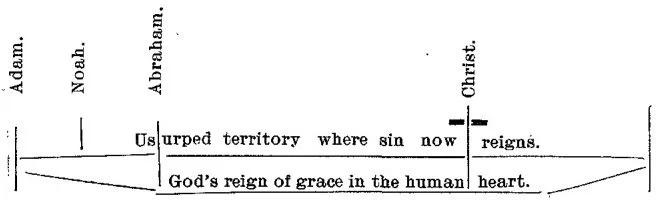
But as shown by the diagram here reproduced, although God's original kingdom was thus dismembered by man's disloyalty, the traitor was not cast off by his former Master and Benefactor. True, God cannot receive a rebel into his favor, but he could and did provide a method by which every one who wills to do so, may again become members of his kingdom, though living in a territory and government hostile to the interests of the kingdom of God.
Let the upper horizontal line of the diagram represent the earth as first placed under man's dominion, but which fell under the rule of Satan, through his power over man. So long as Satan rules in the hearts of men, so long will that usurped territory be ruled under the suggestions of Satan. It will be useless for a few puny men to undertake to transfer back to God that of which Satan has gained possession. Human wisdom and might cannot possibly be equal to such a task. Only one—the Lord Jesus Christ—can do this, and the accomplishment of it will not be till he destroys him who has the power of death, that is, the devil. Heb. 2:14. Then, and not till then, will the kingdoms of this world become the kingdoms of our Lord and of his Christ. Rev. 11:15-18.
For this very reason, the Lord made provision to extend parallel with the history of earthly kingdoms, one by which man might show himself loyal to God and opposed to Satan. This arrangement is illustrated by the lower horizontal line of the diagram, springing from the original kingdom, at the fall of man, and being made to reach forward to the end, where it again merges into the earthly kingdom at its final cleansing from sin and the power of Satan.
Abraham walking through the promised land.
This is the kingdom of God's grace. As the gospel of the kingdom is preached in Satan's territory, men may, by refusing to acknowledge Satan's reign, be counted as citizens of the kingdom of grace. God does not ask that any of those in the earthly kingdoms shall be forced into his rule of grace, but “whosoever will” may come, and freely partake of its favors. Whoever does so must, however, be also willing to have his citizenship a wholly heavenly one, in order to be true to his King who is in heaven (Phil. 3:20), and be satisfied to count himself a stranger in the earth; for God and mammon cannot possibly be served at one and the same time. Matt. 6:24. It is therefore folly to think of forcing by civil laws one of earth's subjects to accept a grace that he cares nothing for, since that grace can never be bestowed by the laws of man, but by the will of God alone. James 1:18.
When a few hundred years had passed of man's misrule under the direction of Satan, a flood came and swept away all earthly governments, leaving but eight persons who were righteous before God. Gen. 6:5-8; 7:1. Had Noah and his posterity preserved their integrity upon coming out of the ark, Satan's rule over mankind would have been broken forever, and the kingdom of God would have been the rule in the earth, as it was designed to be from the beginning.
But the power of evil again took possession of men's101minds, until few regarded the kingdom of God's grace.
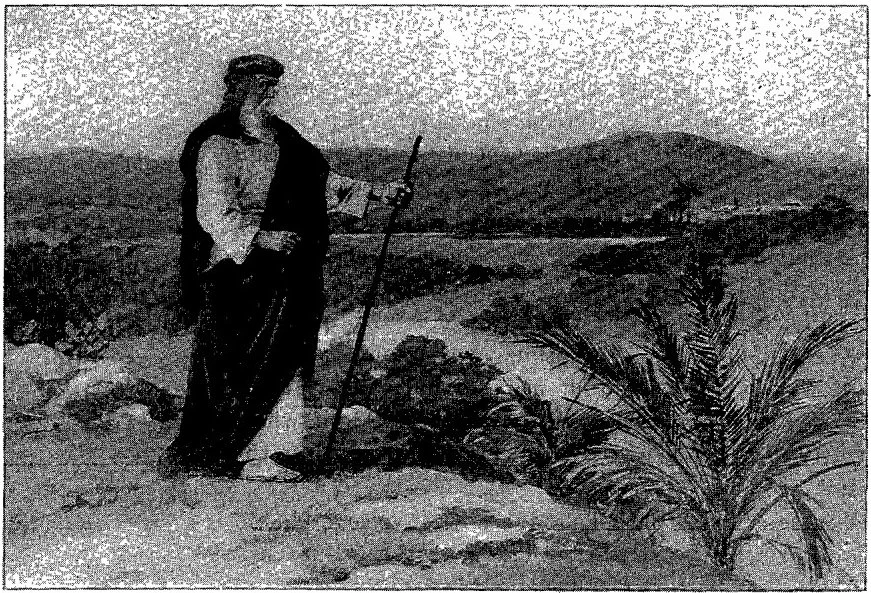
There was one, however, whom God chose to have represent him and his kingdom in the earth. But in calling Abraham as his servant, God did not again destroy the kingdoms of men, as he had before done in selecting Noah to be his representative in the earth. He did, however, select a portion of territory in which to plant his kingdom, and called Abraham out from the Chaldean country, telling him to get away from all his relatives, and go into the chosen land which would be shown him. Gen. 12:1.
It will be noticed how careful God was to have Abraham removed from the molding influence of human minds as he took up the work assigned him. About to become the head of God's kingdom on earth, and the father of all the faithful, God would not permit even Terah, the father of the patriarch, to accompany him to the country of which he was to be the heavenly representative. The father of Abraham being of doubtful character (Josh. 24:2), he could not be permitted to have an influence in the government of that nation which was to be developed from the seed of Abraham, “the friend of God.”
Notwithstanding these requirements of God, Abraham took his father with him, when he left Ur of the Chaldees. But his steps were turned aside from entering the promised land at once, and the whole company went to Haran where they remained until Terah's death. Gen. 11:31,32. This bar to the proper beginning of the kingdom being removed, Abraham received command to proceed to the country for which he had started some years previous. Gen. 12:4. Lot went along, however, and caused much anxiety to his uncle, until, through a quarrel between the herdsmen of the two men, the younger decided to separate from his uncle, and settle in the plains of Jordan, among a people more to his own liking. Gen. 13:5-11.
When this came about, and the last relative of Abraham was separated from him, then the Lord spoke to him, saying, “Lift up now thine eyes, and look from the place where thou art northward, and southward, and eastward, and westward; for all the land which thou seest, to thee will I give it, and to thy seed forever. And I will make thy seed as the dust of the earth; so that if a man can number the dust of the earth, then shall thy seed also be numbered. Arise, walk through the land in the length of it, and in the breadth of it; for I will give it unto thee.” Verses 14-17.
There is more in this promise than one sees at the first glance. God had actually promised to the representative of his kingdom in the earth, territory claimed by another. Satan had conquered its first deputy-governor, and held it by right of conquest. He now saw that God intended to take it from him again and give it as a prize to those who would renounce the power of evil, and so restore all the component parts of the original kingdom. Here was another opportunity to charge God with arbitrariness. Was not the earthly territory his, fairly won from man, whose dominion it had once been? What right had God to bestow by promise upon Abraham and his seed that which he himself claimed the privilege of giving to whomsoever he would? Luke 4:6.
From this time forward we may look for a fierce contest to be waged by Satan against the seed of Abraham, lest the promise of God shall be fulfilled to them, and the territory pass from under his control. Having command of the powers of earth, we may expect him to marshal their governments, at every step of the way, to oppose the growth of Abraham's seed, and so prevent them from possessing the domain which he considers his lawful prey. Just when he began that work, and how he has since carried it on, are points to be reserved for another paper.
J. O. C.
Separation.
By E. P. Marvin
BY E. P. MARVIN.
“BE ye not unequally yoked together with unbelievers: for what fellowship hath righteousness with unrighteousness? and what communion hath light with darkness?
“And what concord hath Christ with Belial? or what part hath he that believeth with an infidel?
“And what agreement hath the temple of God with idols? for ye are the temple of the living God; as God hath said, I will dwell in them, and walk in them; and I will be their God, and they shall be my people.
“Wherefore come out from among them, and be ye separate, saith the Lord, and touch not the unclean thing; and I will receive you.
“And will be a Father unto you, and ye shall be my sons and daughters, saith the Lord Almighty.”—2 Cor. 6:14–18.
Salvation is through separation unto Christ. The world with all its wisdom, philosophy, science, civilization and progress is a moral ruin, and if any are saved it must be by coming out of it.
Sin separates from God, and we can only get back to God by separating from sin. This began to be very distinctly taught in the calling of Abraham (Gen. 12), and was constantly taught in the ceremonials of the Mosaic dispensation. In general, this is the separation which Christ exemplified in his earthly life. We are to imitate him. We are in the world but not of the world, in its affections and desires, objects and aims, hopes and anticipations. By the world in this connection is meant the system of men and things most common around us, which is evil, under control of Satan the usurper, and opposed to God and his gospel. Gal. 1:4. This system has many departments—social, political, commercial, and religious, through which Satan works. This world is unchangeably evil, opposed to God, and bound over with its head to “the judgment of the Great Day.” From this we must be separated or we cannot be saved. 2 Cor. 6:17, 18. All who are loyal to the Word and willing to study it may take the following lesson respecting—
1. We must be separated from the world’s SOCIAL YOKE for fellowship with Christ. “Society” is hydriotical,102hollow-hearted, proud, carnal, godless, and increasingly immoral. All Christians should renounce its claims. The early Christians regarded its objects and aims, its conversation and amusements, its spirits and attire as utterly unchristian and they utterly renounced it. Indeed, the early Christians would not be admitted into modern “society,” nor would they seek admission. No person can be truly loyal to Christ and at the same time to Mrs. Grundy. Her dominion is earthly, sensual, devilish. Her polished manners and esthetical sense are only the veneering and foil of the flesh. 1 John 2:15–17; James 4:4; 1 Tim. 2:9–10; 1 Peter 4:3–5. Of course this principle will keep Christians out of all brotherhoods, or call them out as soon as their eyes are opened, if they walk closely with God. Man-made societies naturally adopt a man-made and Christless religion.
2. We must be separated from the MARRIAGE YOKE with unbelievers in order to live in holy wedlock with our Heavenly Bridegroom. God’s people from the outcalling of Abraham, have been forbidden to marry unbelievers. Such intermarriages brought in the antedeluvian apostasy. Gen. 6:2–5. Paul declares that Christians should marry only in the Lord. 1 Cor. 7:39. Yoke a sheep and a goat together, and the goat will usually lead the sheep. This is not God’s way of saving souls. Lot’s daughters, Ishmael, Samson, Ahab, Jereboam, and many others in Bible history were injured or ruined by these unholy alliances. The first blasphemer stoned was the son of an Egyptian, married to an Israelitish woman. Lev. 24. The rebellious Absalom was the son of a Pagan woman. Even Solomon was led astray and perhaps lost through alliance with outlandish women. Samson’s parents expostulated with him against his marriage outside of Israel, Judges 14:3. Some one says, “Well, well, if you marry a child of the devil, you may expect to have trouble with your father in-law.” Deut. 7:3–4; Josh. 23:12–13; Ezra 9:2; Rom. 8:5; Luke 16:18.
3. We should renounce the BUSINESS YOKE with unbelievers in order to be free to do our Master’s business. In a business firm it is unsafe to commit yourself to the action of others who are unconverted. The ethics of the world and Christ are widely different. Deut. 22:10. We are to do all for the glory of God; they nothing. 1 Cor. 10:31. We do all in his name; they nothing. Col. 3:17. We are not to love money; they do. 1 Tim. 6:10. We are crucified unto the world and alive to Christ; they are alive to the world and dead to Christ. Gal. 2:20. Mark the results of such business alliances in 2nd Chronicles, 18th and 20th chapters; also in many examples of modern times.
4. We should renounce the POLITICAL YOKE imposed by bosses, and discharge first of all the duties of our heavenly citizenship. Satan, the usurper, offered the kingdoms of this world to Christ, for a bow. Matt. 4:9. Since the crown rights of our true covenant king have been and still are rejected by all nations during these times of the Gentiles, it is vain for us to expect to reign, rule and run the world. Our mission is to run people out of it for refuge in Christ. Heb. 6:18–20. In all countries we are pilgrims and strangers who refuse to be naturalized. Phil. 3:20.
“We’ve no abiding city here;
Then let us live as pilgrims do.”
(Col. 3:1–3; Heb. 11:13.)
We advocate the crown rights of an absent Prince and wait for a rejected dynasty to be restored. Titus 2:11–15. There is no “Christian State” on earth, and there never will be one until the Christ of God shall come to erect it and reign over it. The old prophets were indeed statesmen, under a theocracy, but the apostles were not, under Gentile rule. Good citizenship under the theocracy was very different from good citizenship under man’s government. Ours is a pilgrim life like that of the father of the faithful and the friend of God. We have a higher citizenship and a loftier patriotism. No instructions are given us in the New Testament for Christians to work in politics or hold office during our Lord’s rejection and these times of the Gentiles. We are ambassadors. Four duties only are enjoined:—
4. Pray for rulers. 1 Tim. 2:1–3. Christ and the apostles instruct us in the duties of husband and wife, parents and children, elders and deacons, but not in those of the magistrate. If we have other duties to the state, it must be by inference only; there is no express command.
5. We must renounce the vain and formal RELIGIOUS YOKE of the world for the blessed and spiritual yoke of Christ. Matt. 11:28:30. The religiousness of worldly societies among us is no better before God than paganism. Nothing is farther from the religion of Christ. Two prominent characteristics of the present time are unprecedented and phenomenal:—the multiplication of societies, and the production of ecclesiastical amusements for mixed saints and sinners. It is a fact to startle thought, that although these two devices are often carried on to help the church to reach the “masses,” and attract them to the church, the masses are further away than before they were invented.
What then must we conclude concerning the wisdom and scriptural character of these methods?
Let us declare and testify with divine assurance, that if the great power of God should come upon us, it would annihilate both these devices.
“Ecclesiastical Amusements” would vanish like a delusive dream before the earnest work of rescuing lost souls, and these “societies” with their “amusement industry” would merge their spiritual individuality and energy in the promise and potency of the consolidated Church of God, the sacred Bride of Christ.
The Church of God, in its original constitution, was not a confederation of man-made and half-breed societies, with the clatter of machinery and the clamor of methods, but a compact and consolidated body. Eph. 4:15, 16.
Christ ordained no “auxiliaries” nor “annexes” for his church, and if she is faithful she needs none.
But the unfaithfulness of the church occasions their existence, and as some of these societies are doing good, though not in the best way, we cannot absolutely condemn them.
Indeed we work with some of them, and pray God’s blessing upon them.
But what a pity that the church should need so much and such help, leading so largely to the “Amusement Heresy and Cooking-stove Apostasy.”
We have contact but not fellowship with the world. We should have fellowship only with assemblies of persons who give evidence of being saved persons. 2 Tim. 3:1–5. The alliance in law of “Church and Society,” with “Secular Trustees,” is marriage with the world—“Pergamos.” Godly deacons managed the property of the early church. In Rev. 17:3, the harlot rides on the beast, but in Cant. 8:5, the true Bride leans on the arm of her Beloved. All yokes with “associate members,” or lobby members, are utterly unchristian. There was no fellowship between those inside and outside of the ark. They were absolutely and eternally separated, as the saved and the lost. No auxiliary pleasure yachts were provided to hover around the ark with “associate members.” Keep out of mixed flocks of sheep and goats. The line of demarkation should be distinct. These alliances are efforts of the church to “plow with ox and ass,” and the crop will be thorns and thistles for the burning.
In short, we are to be like Christ, Isa. 53:3, despised; Matt. 10:24, rejected; John 5:41, no position; John 18:36, strangers; Heb. 3:1–14, pilgrims; 2 Tim. 2:12, suffering; Titus 2:11–15, self-denying, sober, righteous, godly, watching, pure, peculiar, and unpopular. This is Christianity according to Christ, and the only gospel that saves.
In all ages the policy of conformity to the world has shorn the church of her strength, destroyed her usefulness in the world, and dishonored Christ. She has always been most powerful, honored and triumphant, when most separated and holy.
Then in the face of soft theology, pulpit blandishments, and all worldly policy, let us ring out the clarion call for complete separation from the world and complete consecration to Christ.
If all Christians would live like Christ they would soon turn the world upside down.
Religious Societies and the Limits of Civil Power
By Editor
WE have no objection to the Christian Endeavors, or to the members of any other religious society.
We have no objection to any religious organization, as such. In their legitimate field of work, the Christian Endeavor Society, the Epworth League and kindred organizations are capable of achieving magnificent results in the way of uplifting fallen humanity.
In this line of work they have done much, and their work is worthy of all commendation. We cease to approve, and object, only when they enter upon work which is outside their legitimate sphere of action.
We object, in other words, when a religious organization steps over the line between that which is religious and that which is civil, making use of civil power to enforce religious beliefs or observances.
The Christian Endeavor Society is a truly magnificent body of earnest, devoted, and well-meaning young men and women; and the same is true of the Epworth League. They have power, influence, enthusiasm, consecration.
But for this very reason it is all the more essential that they should not make the false moves which they are now being led to make. That which is capable of accomplishing vast good is also capable of doing incalculable damage. It is only a question of whether it is used for its legitimate purpose, or is perverted to something else.
We believe the Christian Endeavor Society, joined with the Epworth League and kindred organizations, while capable of immense good in religious work because of their numbers, zeal, and devotion, are also, for that very reason, capable of plunging this whole country into ruin, under mistaken ideas of right and duty.
There is nothing else but ruin for this country in a union of church and state.
Lucifer, before his fall, was one of the highest angels in heaven; and for this very reason, when the goodness that was in him became perverted, he became the prince of evil.
Too great caution cannot be exercised in guiding organizations within which lie such vast possibilities for good or evil.
Why Is It?
THE greatest power in the universe is the power of God.
The greatest power is capable of accomplishing greater results than any lesser power.
In the direction of reform, therefore, the greatest results will be accomplished by the power of God.
“The power of God for the reformation of man is manifested in the gospel, and in that alone. The gospel is the power of God unto salvation to every one that believeth.” Rom. 1:16.
There is now a great call made for moral reform and the regeneration of society.
Yet those who are sounding this call and organizing movements for its accomplishment, do not propose to make use of this power of God which is by faith, but of another power—the ballot.
Why do they propose to use the ballot in the place of the power of God? Why do they pass by the greatest power in the universe and select a power which is infinitely inferior to it?