Your ShelfYour Projects

Signs of the Times, Vol. 38, No. 10.

Important Articles in This Number

Signs of the Times

Mar 7, 1911

Pacific Press Publishing Association · Mountain View, California · Mar 7, 1911

Important Articles in This Number

The Nature of Man as to Life and Death . . . 4 George W. Rine (A Study of the Thief on the Cross, and Other Passages)
Christ and the Law, Mrs. E. G. White . . . 3
Revising the Decalogue: What It Means . . . 10
The Redeemed Host (Revelation Series) . . . 6
The Earthly and Heavenly Sanctuaries . . . 8 O. E. Jones
Righteousness and Life (Bible Reading) . . . 9
Does Motherhood Pay?—A Great Mother . . . 12 Helen Adair
Enduring the Test . . . . . . 14
Who Is the Elijah of Mal. 4:5? . . . 2
(For full Table of Contents see last page)

"IF YE WILL INQUIRE, INQUIRE YE."

This Inquirers' Department is conducted for the purpose of helping those who are studying the Bible. The answers are oftentimes only suggestive. They are never to be considered infallible, only as they agree with the infallible Word. The writer who may answer them does not consider that his opinion is infallible. He will simply give the best that he has, and plead with the inquirer to search the Word. Such questions only will be answered as, to the editors, seem to minister to the good of the readers and to the mission of the paper. We can not answer repeatedly in the same volume questions upon the same scripture. The name and address must accompany question, not for publication, but as an evidence of good faith, and that answer may be made by letter if deemed advisable. No letters are answered which do not contain the name of the writer. It is well always to enclose stamp for reply.

3366.—Doing Jury Service

What should a Christian Sabbath-keeper do who is summoned to act on a jury in a county court in the State of Washington? Do they adjourn for the seventh day in this State? A READER.
First, he should tell the sheriff the circumstances who serves the summons and ask to be excused. If the sheriff refuses, as he generally would acting under the instruction of the court, the man summoned should then state to the court or judge who has jurisdiction candidly, kindly, that it would be impossible for him to serve on the Sabbath day. Nine hundred and ninety-nine judges in a thousand, we believe, would excuse a juror from acting, and the thousandth ought to excuse him. If the judge should insist on service, the true commandment-keeper would have to refuse to attend unless he were compelled so to do by officers of the law. That of course would be practical imprisonment; and like any other prisoner, he should still wisely, kindly, faithfully witness for God, and keep himself in an attitude of true worship. He should not resist by any violence or try to evade the working out of the law through its proper officers. This does not mean, however, that he should break the Sabbath at their direction. Whatever he did in this respect, the responsibility must rest upon them. They might compel him to sit in a jury-box; they could not prevent worship and prayer to God.
—★—

3367.—Who Is the Elijah of Mal. 4:5?

"Behold, I will send you Elijah the prophet before the coming of the great and dreadful day of the Lord." Mal. 4:5. Who or what is this Elijah? D. A. E.
This Elijah is a twofold type of a work of reformation which in God's plan precedes His first and His second advent. The first phase was fulfilled in John the Baptist and his message, who was Christ's forerunner at His first advent; and its second phase in God's message and people who precede the Lord's second coming. Jesus declared that John fulfilled that type of Elijah in his day. Matt. 11:7-14. But John expressly declared that he was not the personal Elijah. John 1:21. These two scriptures, that John was the Elijah which was to come, and John's statement that he was not the personal Elijah returned, are perfectly harmonized by the language of the angel concerning John in Luke 1:17, "He [John] shall go before Him [Christ] in the spirit and power of Elijah." This scripture is also the key to the fullest understanding of Malachi's prophecy. The great and dreadful day of the Lord did not come at our Lord's first advent, nor does the angel mention it in his prophecy of John in Luke 1:17. That day will come in connection with our Lord's second advent, and then a people will go forth in the spirit and power of Elijah, not to one land but to all the lands of earth, bearing God's warning message, God's great restoring message of reform, to prepare a people for their Lord. That message is found in Rev. 14:9-11. And the people who give that message and who are developed by it are described in verse 12: "Here is the patience of the saints: here are they that keep the commandments of God, and the faith of Jesus." That is a message of unity in God through Christ. It is now going to all the world.
—★—

3368.—Abraham's Birth, Egyptian Bondage

Please harmonize the following texts: Gal. 3:17; Gen. 15:13; Ex. 12:40; Acts 7:6. Give the dates of Abraham's birth and the Egyptian bondage and the giving of the law. O. T.
"Usher's Chronology" gives the birth of Abraham at B.C. 1996, his call at 1921 B.C., when he was 75. Gen. 12:4. From that call to the giving of the law was 430 years and extending to B.C. 1491. See Gal. 3:17. The Egyptian bondage began about 1706 and lasted about 215 years. The 430 years dates from B.C. 1921; the 400 years of Acts 7:6 and Gen. 15:13, from B.C. 1890, when the clear distinction was made between the true seed Isaac and the human seed Ishmael. Ex. 12:40 may be better understood if we read it as in the Samaritan and Septuagint versions: "Now the time of the sojourning of the children of Israel and of their fathers which they had dwelt in the land of Canaan and Egypt was 430 years." (Boothroyd's Translation.) This makes harmony throughout.
—★—

3369.—Joining Societies

Is it right for Sabbath-keeping Christians to join various societies, unions, etc.? A READER.
We have not named the organizations which our querist named; for we have not space to name all, and we wish to draw no invidious distinctions. There are great principles which ought to guide us in all our relationships with God and with our fellow men. 1. The Christian belongs to God, and has acknowledged God's ownership. He is Christ's bought bond-slave, and the bond which binds him to Christ is love. His life, his service, his all belongs to Christ. 2. The organization which Christ is using in this world to save men is His church, which inspiration calls "His body, the fulness of Him that filleth all in all." Upon that church Christ has bestowed the fulness of every gift necessary for successful work for Him. 3. Why should the Christian seek for extra-church organizations for help spiritual or mental? Of course there may be places where it would be well for the Christian to unite and coöperate with his fellows, as for instance in a school district, in road building, and various ways which do not involve moral principle, and where he would not be a partner in wrong-doing. His guidance in this respect is well set forth in 2 Cor. 6:14-18: "Be ye not unequally yoked together with unbelievers." Nothing which would separate from Christ, which would compromise principle, which would make one a party in evil-doing, can be permitted to come into the life of a Christian without great loss to him, and eternal loss if the unchristian things remain in his life. 4. This is not judging the men of the world who form these organizations. They are acting logically. They do not know Christ and they have not acknowledged Him as master. We may and should show them the better way; but we may not judge them, that belongs to God. It is a poor way for us to attempt to reveal to others the better way by joining with them in the wrong way, and many of them know it.
—★—

3370.—The State of the Dead

I am bewildered over your teaching concerning the state of the dead, especially in view of Jesus' word to the penitent thief. F. F.
Our correspondent will find help in reading the articles by Professor Rine on the subjects of "Man as Created," in the SIGNS of two weeks ago; "Man in Death," in last week's issue; and "The Nature of Man as to Life and Death," in the current issue.
—★—

3371.—Kingdoms of Daniel 7

Have any of the four kingdoms mentioned in Daniel 7 come to their end as yet? J. Y.
Yes; Babylon as a kingdom has long been extinct, but her principles have permeated and molded every subsequent power. A shadow of Medo-Persia exists in the little State of Persia, as does the little Macedonian empire in the State of Greece. Imperial Rome has passed away. That empire exists in its divided state.
—★—

3372.—The Soul at Death

Does the soul go to heaven when it dies? J. P.
See articles in this and last week's issues, by Prof. G. W. Rine. These will make the matter clear.
OUR BIBLE BAND
OUR BIBLE BAND

Schedule for Week Ending March 18, 1911

Sunday | March 12 | Deuteronomy 18-21 Monday | " 13 | " 22-26 Tuesday | " 14 | " 27, 28 Wednesday | " 15 | " 29-31 Thursday | " 16 | " 32-34 Friday | " 17 | Psalms 1-6 Sabbath | " 18 | " 7-11
—★—
CHAPTERS 18 to 26 of Deuteronomy are filled with special instruction, various directions given by Moses, great principles by which questions are to be decided; and various laws are repeated for the government of Israel, regulation of their worship, etc. It is not possible for us to detail them in the space at our disposal. It may be worth while to mention the prophecy of our Lord Jesus Christ found in Deut. 18:15-18, as referred to by Peter in the third chapter of Acts. In Deuteronomy 27 and 28 are given the blessings and the curses which should come upon God's children if they were faithful to God or disobedient. A wonderful prophecy is that of Deuteronomy 28. Predictions again and again had been given of events which had come upon the Jews and which had been literally fulfilled. It also tells for the truth of the Scriptures. Here were prophecies which were given against the very people who recorded them and cared for them, yet their regard for that Word led them to keep it intact through all the centuries as the record which God left by Moses. Of course it condemned them and made all the more forcible the truth which the Lord uttered through them. Two excellent poems are given us in chapters 32 and 33; chapter 32 the song that Moses taught Israel to help them to remember God and His wonderful works and promises to them, and chapter 33 Moses' prophecy concerning the various tribes. Chapter 34 was doubtless added by Joshua in giving an account of Moses' death.
—★—
AS AN interlude in our historic and legal readings we bring in the first book of Psalms. The Psalms are generally mentioned as one book, but in reality they compose four books, the first book from Psalm 1 to 41 inclusive. We have two days of reading the Psalms this week, including Psalms 1 to 11. Some of these are very precious indeed. In fact, not one single phase of human experience which this old world proffers but we have something in the Psalms which is in harmony with it, scriptures which will help the soul in discouragement, strengthen him in time of trial, give him solid comfort in times of grief, point out dangers of sin, warn of transgression. Ever do they point to a God who is able and willing and anxious to save. We wish that all our readers who could memorize at all would learn the first Psalm. It is well to keep it with us constantly. The second Psalm is a prophecy of our Lord Jesus Christ's crucifixion and resurrection from the dead, the power of righteousness triumphing over all the powers of darkness. Many of the sentiments of Psalm 5 are often sung in the old hymn beginning, "Lord, in the morning Thou shalt hear my voice ascending high." Note how many of the Psalms begin with an expression of a sense of great need and end with triumph and confidence in God.

Christ and the Law

By Mrs. E. G. White
THE law of God is changeless. For this reason, Christ died, taking upon Himself the guilt of the transgressor, and making it possible for every penitent, repenting sinner to take hold of His strength, and through Him to make peace with the offended Law-giver.
"Sin is the transgression of the law;" and "the wages of sin is death." It was sin that brought death into the world. Had there been no sin, there would have been no death. Christ died as the sinner's substitute, to save him from the penalty of his disobedience. Could the law of God have been changed or abolished, Christ need not have died; for death was not necessary in order to abolish the law. The fact that God spared not His own sinless, beloved Son from the penalty He pledged Himself to bear as the sinner's substitute, is the most telling argument that could be produced to show that the claims of His law will not be released, even in the slightest degree, to save the transgressor. So in the death of Christ we have evidence, not only of God's love for sinful man, but of the changeless character of His law. The law could not be abolished; one precept could not be altered to save the sinner and meet man in his fallen condition; but God so loved the world that He gave His Son to suffer the penalty of its transgression in the sinner's stead.
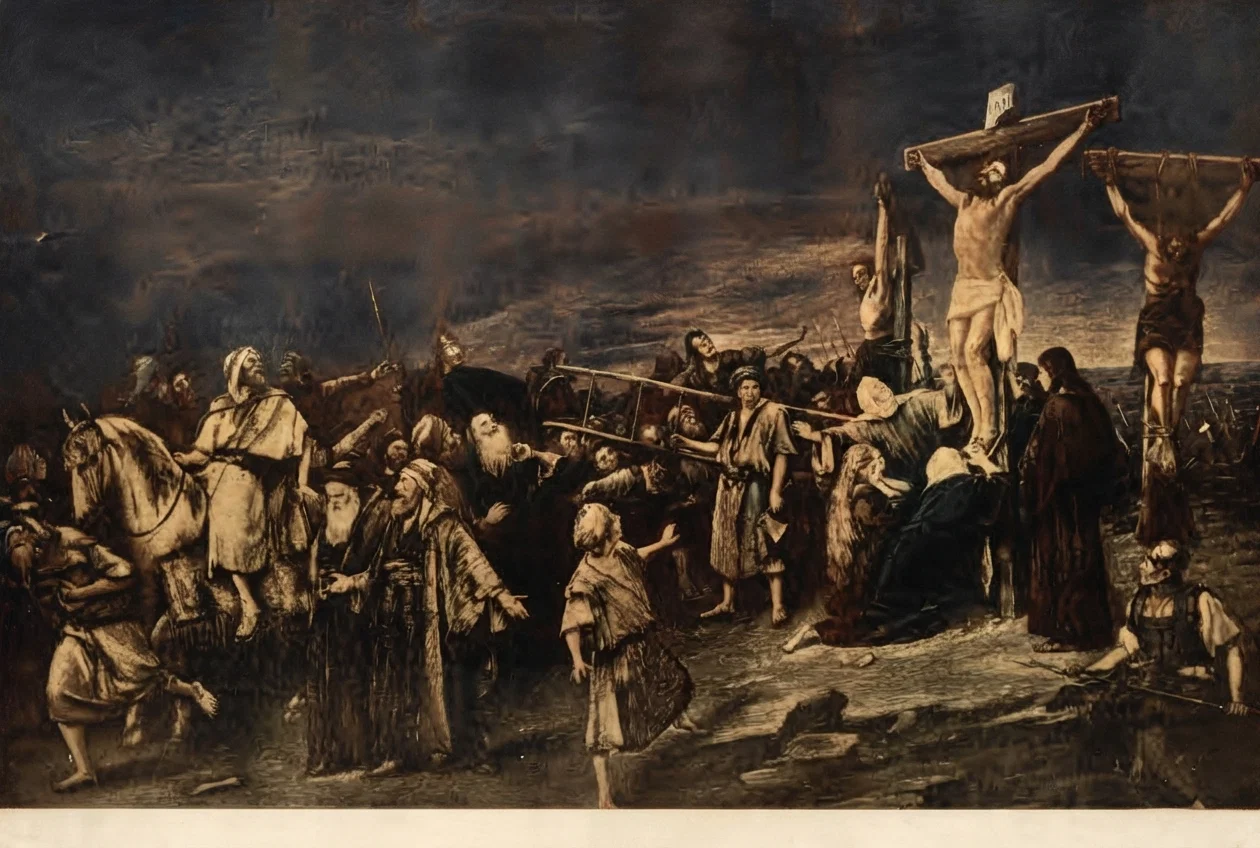
THE CRUCIFIXION OF OUR LORD

Saved by Grace

It is by grace that the sinner is saved, being justified freely by the blood of Christ. But Christ did not die to save the sinner in his sins. The whole world is condemned as guilty before God, for they are transgressors of His holy law; and they will certainly perish unless they repent, turn from their disobedience, and through faith in Christ claim the merits of His precious blood. The sin of Adam and Eve lost holy Eden for themselves and their posterity, and those who continue to live in the transgression of God's law will never regain the lost Paradise. But through the grace of Christ man may render acceptable obedience, and gain a home in the beautiful Eden restored.
There are some who do not understand the plan of redemption, but make the death of Christ an argument to prove that the law of God is abolished. Men who claim to be teachers of the people, blind the eyes of the ignorant by blending the moral law with the ceremonial, and using the texts which speak of the ceremonial law to prove that the moral law has been abolished. This is a perversion of the Scriptures. There are two distinct laws brought to view. One is the law of types and shadows, which reached to the time of Christ, and ceased when type met antitype in His death. The other is the law of Jehovah, and is as abiding and changeless as His eternal throne. After the crucifixion, it was a denial of Christ for the Jews to continue to offer the burnt offerings and sacrifices which were typical of His death. It was saying to the world that they looked for a Redeemer to come, and had no faith in Him who had given His life for the sins of the world. Hence the ceremonial law ceased to be of force at the death of Christ.

Given by Christ

The Gospel of Christ reflects glory upon the Jewish age. It sheds light upon the whole Jewish economy, and gives significance to the ceremonial law. The tabernacle, or temple, of God on earth was a pattern of the original in heaven. All the ceremonies of the Jewish law were prophetic, typical of mysteries in the plan of redemption. The rites and ceremonies of the law were given by Christ Himself, who, enshrouded in a pillar of cloud by day and a pillar of fire by night, was the leader of the hosts of Israel; and this law should be treated with great respect, for it is sacred.
Christ came to teach men the way of salvation; and we might expect that when the shadowy service was no longer of any value, if the law of Ten Commandments were no longer binding, He would declare its abrogation. If the Old Testament Scriptures were no longer to be regarded as a guide for Christians, He would make known the fact. But this was not the work of Him who came to seek and to save that which was lost. In His memorable sermon on the mount, in which He announced to His followers the object of His mission, He expressly declared the perpetuity of the moral law. His solemn warnings to the neglecters and despisers of the law of God, echo down even to our time in the words: 'Think not that I am come to destroy the law, or the prophets: I am not come to destroy, but to fulfil. For verily I say unto you, Till heaven and earth pass, one jot or one tittle shall in no wise pass from the law, till all be fulfilled. Whosoever therefore shall break one of these least commandments, and shall teach men so, he shall be called the least in the kingdom of heaven.'

An Honorable Law

These are the words of the great Teacher; but they are often perverted, and made to mean something altogether different from the lesson He designed to give to His disciples, and through them to all who should believe on His name. He came to fulfil the demands of the law, to magnify and make it honorable, to show to all that God will not remit the penalty of its transgression. The Most High will fulfil His word; it shall not return unto Him void.
After His resurrection, when Jesus revealed Himself to the two disciples who were on the way to Emmaus, and to those assembled in Jerusalem, He did not point to the mighty works which He had done, to revive their faith in Him as the promised Messiah; but He went back to Moses and the prophets, and explained the Scriptures concerning Himself. Holy prophets had foretold the manner of His birth, the events of His life, His mission, and His death and resurrection; and Jesus impressed upon His disciples the fact that in His life and death these prophecies had met their fulfilment. Hope revived in the hearts of the disciples, as for them the words of the prophets were clothed with new life and power, and they were ready to accept Jesus of Nazareth as the Son of God, the long-expected Messiah.

Harmony between Them

There is no discord between the Old Testament and the New. In the Old Testament we find the Gospel of a coming Saviour; in the New Testament we have the Gospel of a Saviour revealed as the prophecies had foretold. While the Old Testament is constantly pointing forward to the true offering, the New Testament shows that the Saviour prefigured by the typical offerings has come. The dim glory of the Jewish age has been succeeded by the brighter, clearer glory of the Christian age. But not once has Christ stated that His coming destroyed the claims of God's law. On the contrary, in the very last message to His church, by way of Patmos, He pronounces a benediction upon those who keep His Father's law: 'Blessed are they that do His commandments, that they may have right to the Tree of Life, and may enter in through the gates into the city.'
The world is full of evidences of the greatness, majesty, and benevolence of God; but the strongest evidence of His love for fallen man is contained in the gift of His Son, who took the nature of man, descended to the office of a servant, tasted life's bitterest pain, and even died a terrible and ignominious death, that through Him we might be restored to obedience and the favor of God, and gain eternal life. Christ, as our exemplar, kept His Father's law. As He overcame, so may we. And He has promised, 'To him that overcometh will I grant to sit with Me in My throne, even as I also overcame, and am set down with My Father in His throne.'

The Nature of Man as to Life and Death

Misconstrued Scripture Passages

IN the preceding article of this series it was shown, by copious citations from the Scriptures, that man in his present state is mortal, and that the dead ARE dead and "know not anything." No man can be both dead and alive at the same time, for the terms "death" and "life" are always used in the Bible as antithetical to each other, and therefore mutually exclusive. They are always set over against each other as hopelessly hostile contraries. The Scriptures assure us that when the spirit, or breath, or life principle, leaves the body the man dies, and would never live again were it not for the grace of God through a Redeemer; that the dead, both the just and the unjust, remain under the dominion of death till God shall again breathe into them the breath of life, when, as in the vision of dry bones (Ezekiel 37), they shall live again — the righteous in their spiritual and immortal bodies to live and reign forever with Christ; and the unjust to die again, the "second death," from which there is no restoration.
It is by the misconstruction of a few Bible passages, that the heathen dogma of original human immortality attempts to find support from Scripture; while the tenor of Scripture teaching from beginning to end contradicts it, and represents man as one undivided and indivisible personality, consisting of body, soul, and spirit, all of which are essential to his life, not only now but also in the life to come.

The Thief on the Cross

One of these inspired passages is the record of the conversation that took place between our Lord on the cross and the penitent thief. The dying malefactor, recognizing Jesus as the Saviour of sinners, looked into His face, and prayed, "Lord, remember me when Thou comest in [wrongly translated into] Thy kingdom." The Lord's answer to this penitential prayer was, "Verily I say unto thee to-day, Thou shalt be with Me in Paradise." This promise to the dyingthief is yet to be fulfilled, for it is only the false punctuation that makes it read as tho he should be in Paradise that day. The marks of punctuation are not a part of the original Scriptures, and hence were not inserted by divine inspiration. The comma was first used about 1490. By placing the comma after "to-day," the sense of the original is expressed in harmony with the whole tenor of the Scriptures. The adverb "to-day" is thus made to qualify the verb "say," which fact gives it special significance. At the very time that our Lord made this momentous promise, He was apparently at the mercy of His implacable foe, the devil. His enemies were passing by, wagging their heads, and mocking Him. He was about to bow His head in death. Men and devils believed that they had finally and forever disposed of Him. Even His disciples were utterly disheartened, and anxiously asked one another whether their beloved Master was after all the One "who was to come" — the long-promised Messiah. That day was to the Redeemer a day of apparent defeat, of ignominy, of death. All the sinister powers of earth and hell were arrayed against Him. It was to Him a day of blackness and thick darkness, of horror and agony. All the circumstances of that day conspired to spell DEFEAT and HOPELESSNESS. How wondrously significant, therefore, is the Saviour's use of the adverb "to-day" in His answer to the penitent culprit's prayer! It was equivalent to saying that "tho to-day I am apparently helpless under the powers of death, My promises of a coming kingdom seemingly belied, and My hopes apparently crushed, yet to-day, even on this day of blackness and agony and death — TO-DAY I say unto you, Thou shalt be with ME in Paradise."
After His resurrection Jesus in unqualified terms declared to Mary that He had not yet ascended to His Father. John 20: 17. Hence He could not have been in Paradise since His crucifixion, inasmuch as the Father's throne is in the midst of Paradise. Compare Rev. 2: 7 and 22: 1, 2. However, the Master's promise to the conscience-stricken sinner on the cross will be gloriously fulfilled in that day when He shall say to those on His right, "Come, ye blessed of My Father, inherit the kingdom prepared for you from the foundation of the world." Matt. 25: 34.

The Transfiguration

The inspired story of our Lord's transfiguration on the mount is often cited in corroboration of Plato's dictum, "There is no death." The record affirms that Moses and Elijah appeared with Christ on the mount. Hence the champions of the theory of human deathlessness contend that at least Moses must have appeared there as a disembodied spirit, since the Scriptures explicitly inform us of the death and burial of Moses. But they overlook the fact that the Lord Himself declared the transfiguration scene to have been a vision, which usually means an unreal appearance. Even if it were to be considered real as to Moses and Elijah, it must be remembered that the latter never passed through the ordeal of death, but was translated to heaven, and that the Scriptures clearly intimate that Moses had been raised to life. In the ninth verse of Jude it is stated that Michael the Archangel, at some time, contended with the devil respecting the body of Moses. Now, by comparing Daniel 12: 1 with 1 Thess. 4: 16 it will be seen that "Michael the Archangel" is one of the several titles of Christ. Christ "is the resurrection and the life." Satan is the author and ruler of death. Heb. 2: 14. Hence if Christ had a dispute or contention with the devil regarding the body of Moses, it must have been caused by the Lord's reclaiming the body of Moses from the power of death, by a resurrection. Satan, claiming the dominion of death as peculiarly his own, would naturally dispute the right of Jesus to rescue His servant Moses from that dominion. Of course it is inconceivable that Christ should ever suffer defeat in any contest with Satan. Hence the conclusion that the Master had His way is inescapable — and Moses was raised to life and immortality. Even Dr. Adam Clarke, who held the dogma of inherent immortality, admits that Moses was probably raised from the dead.
All Bible Christians are agreed that the transfiguration scene constituted a miniature picture or representation of the coming kingdom of Christ. How appropriate, then, that Elijah should be there as the representative of those who, without tasting death, shall be translated to that kingdom at the coming of the Lord, and that Moses should appear there as the representative of all those who shall be raised to glory and immortality at the second appearing of our Lord. See 2 Peter 1: 16-18.

Proof of a Resurrection

Another Bible passage often given a forced construction in order to make it do service in support of the hoary heathen theory of death in life, is found in Matt. 22: 23-32, and in Luke 20: 27-38. The party of the Sadducees, in the time of Christ, believed in no future life at all. Death was to them the end of all being. In verse 23 of Matthew 22, it is expressly declared respecting the Sadducees that they "say that there is no resurrection." They well knew that Christ taught the doctrine of a final resurrection from the dead. That they might perplex and confound Jesus in respect to His position on this doctrine, they brought to Him the supposed case of a woman, who, after marrying seven brothers in succession, died at last herself; and asked Him, "Therefore in the resurrection whose wife shall she be of the seven? for they all had her." The reply of Christ is deserving of special study in its bearing on the question in hand. He first asserts: "Ye do err, not knowing the Scriptures, nor the power of God. For in the resurrection they neither marry, nor are given in marriage, but are as the angels of God in heaven."
But He still further replies, as recorded in Luke: "Now that the dead are raised, even Moses showed at the bush, when he calleth the Lord the God of Abraham, and the God of Isaac, and the God of Jacob. For He is not a God of the dead, but of the living."
It should be noted here that Christ says nothing regarding the state of the dead, for in respect to this question He and the Sadducees are in perfect agreement. But as the text clearly shows, His object was to refute their teaching to the effect that there is no resurrection. They professed to believe the writings of Moses. Christ reminds them that Moses wrote that God is the God of Abraham, Isaac, and Jacob; and that He is not the God of the dead, but of the living. But they all (Christ and the Sadducees) knew that these patriarchs had long been dead. Hence if God is the God of the living, He must, in order to be the God of Abraham, Isaac, and Jacob, RAISE THEM FROM THE DEAD. Thus Jesus proved incontestably that there must be a resurrection of the dead.
That both the Pharisees and Sadducees understood the reply of our Lord as meeting the point the Sadducees had raised, "as touching the resurrection of the dead," is evident from the sequel; for it is said, "After that they [Sadducees] durst not ask Him any question at all." "But when the Pharisees had heard that He had put the Sadducees to silence, they were gathered together," etc. Christ's argument in proof of a resurrection of the dead may be expressed thus: God is declared to be the God of Abraham, Isaac, and Jacob, and He is also the God of the living. Since these patriarchs are dead, God, in order to be their God and yet the God of the living, must sometime raise them from the dead. Hence there will be a resurrection.

The Spirit Returns to God Who Gave It

Speaking of the dissolution of man in death, Solomon says, "Then shall the dust return to the earth as it was: and the spirit shall return unto God who gave it." Eccl. 12: 7. It should first be noted that what the wise man here predicates of man he predicates of every man, the unrighteous as well as the righteous. The "spirit" of every man returns at death to God. If the spirit here spoken of is a conscious personality independently of the body, and as such returns to God at the death of the body, then evil as well as good spirits go to God. This of course proves too much. But let us catch Solomon's meaning, which is of course the obvious meaning. He is describing dissolution of man by tracing back the steps taken in the creation of man, as set forth in Gen. 2: 7. Thus: "The Lord God formed man of the dust of the ground, and breathed into his nostrils the breath of life; and man became a living soul." How simple is Solomon's thought when placed by the side of this citation. In the simplest of words he tells us that at death man's body goes back to the elements of which it was originally formed, and that the spirit, or life-giving breath, originally imparted to the body by God, returns to God, the Giver. Observe please that what returns to God, is what God originally "gave" to man. Did God, in the creation of man, breathe into his inanimate body a rational, conscious intelligence? We all instinctively answer, No. Then it is precisely what God breathed into man's nostrils that returns to Him at the death of the individual. The "spirit" that returns to God is simply the "breath of life" breathed into man by his Creator. We all know that the "breath of life" never came from the dust of the ground as did the body, and hence can not, in the very nature of things, return to dust.
We thus find that the Scriptures are beautifully consistent throughout. They contain no ambiguity, no contradiction. They contain nothing at variance with the declaration found in Ps. 146: 3, 4, to the effect that when a human soul dies, in "that very day his thoughts perish." But let us thank God for His unspeakable gift, the Lord Jesus Christ, who is to every believer "the RESURRECTION and the LIFE."

Many Shall Turn Away

By Lephia Bryant Larson
A DERELICT drifting, drifting, Tossed by each wind that blows; Water-logged, sodden and heavy, Careth not whither it goes. So is the soul unmindful Of the chart and compass God shows.
He has made the way plain for His people— The way that will give us rest; A yoke neither heavy nor grievous Is to keep His commandments, the test.
Aberdeen, Washington.

The Corrupting Power of Evil Thoughts

EVIL thoughts, if cherished, blight virtue, destroy purity, and undermine the stablest foundations of character. They are very much like rot in timber, like rust in iron. They eat into the man. And when the process has gone on for a while, and there comes the stress of an outward temptation, down they go into a mass of ruins.—Christian Herald.

— —

— —
Continue reading: The Redeemed Host