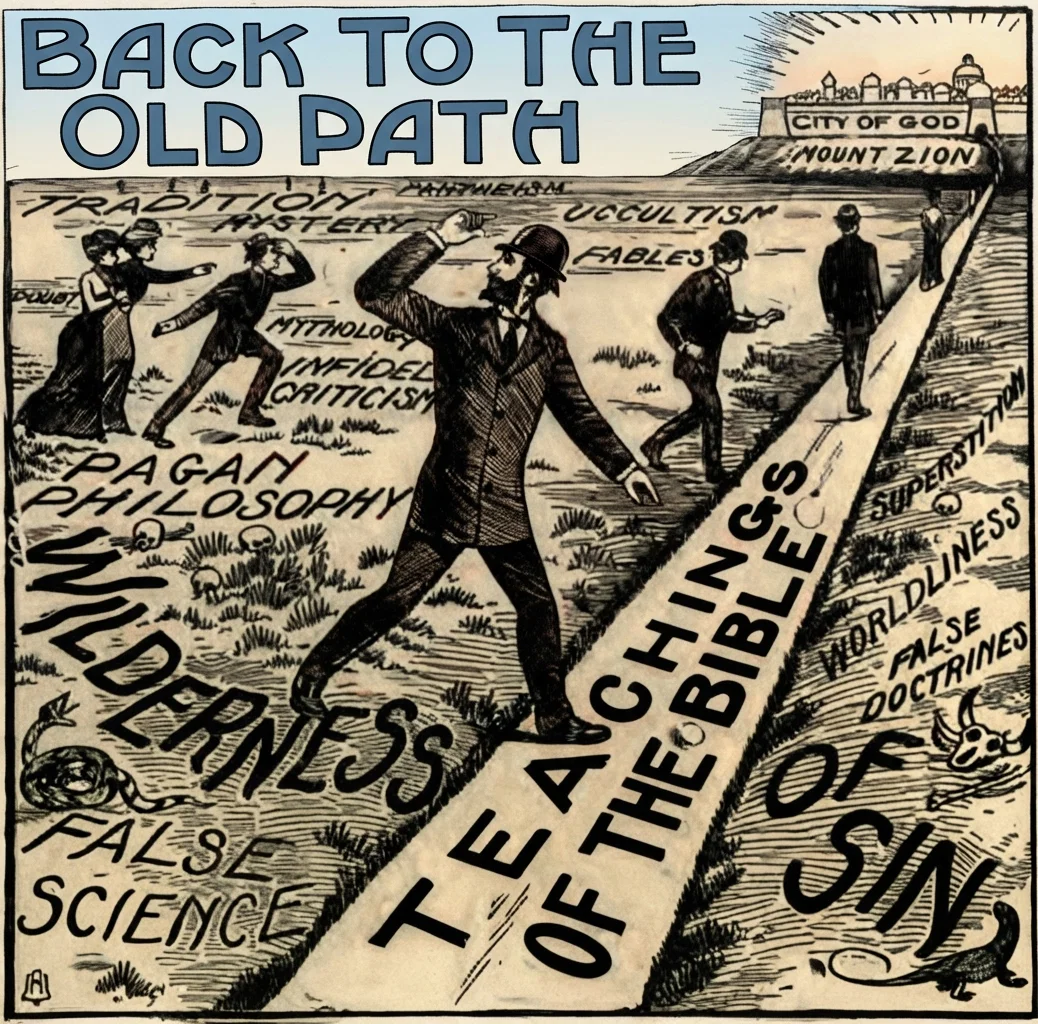
THAT is what a Michigan prelate, Bishop Williams of the American Episcopal Church, proposes. Here is his revised code as given in a news despatch, dated Detroit, February 18:
1 — Thou shalt not have any other gods before Me.
2 — Thou shalt not make unto thyself any graven image, nor the likeness of anything that is in the heavens above nor in the earth beneath nor in the waters under the earth; thou shalt not bow down to them nor worship them.
3 — Thou shalt not take the name of the Lord in vain.
4 — Remember that thou keep holy the Sabbath day.
5, 6, 7, 8, 9 — Unchanged.
10 — Thou shalt not covet.
And here are his reasons stated in the same despatch:
"I don't believe there is any person nowadays who believes the Lord created the heavens and earth in six days," said the bishop, "and that is my reason for favoring an abridgment of the fourth commandment. If the American Episcopal Church should take up the matter of abridging the Decalogue, I would be in favor of abridging the first, second, third, fourth, and tenth commandments. The others are short enough."
In the first place, the fourth commandment does not say, "In six days the Lord CREATED the heavens and the earth," but, "In six days the Lord MADE the heavens and the earth." It is well to hold to the exact terms, yet the word implies creative force,—energy and power. From chaos God called in six days the cosmos of a finished world, and peopled it with life. In reference to its very masterpiece it is recorded that "God CREATED man in His own image, in the image of God CREATED He him; male and female CREATED He them." Gen. 1:27. The devil does not care if men worship something called God; they may worship many gods if they desire. The devil will help them to multiply conceptions of God; but the arch-enemy of man has ever tried to hide from earth's masses, groping for light, God the Creator. The devil will say to his apostles: "Let the dying soul believe in the god of evolution, the god of pantheism, the god of a thousand philosophies. Teach them of great Marduk, of a hundred Baals, of Jupiter, and his father Saturn, of Bacchus, of Venus, of Mars, of Apollo, of Plutus, of Mammon, of the whole world's pantheon. Teach them there is no sin. Say to them, 'Ye shall not die; ye shall be as God.' But by every device, every hypothesis, every theory of science, philosophy, and theology, hide from them God, the Creator."
How well the prince of demons has accomplished his task among the lovers of sin and death! But the saddest of all is that he, the devil, is finding his strongest spokesmen, teachers, heralds, apostles, among the professed children of the living God who creates. The hypothesis — it is only that — of evolution, held as hallowed creed of human exaltation, has made it necessary to eliminate God the Creator from the first chapter of Genesis, to eliminate Genesis itself, to eliminate the moral law, because the moral law knows, nay, it came from, the living God, the Creator. Deuteronomy teaches the same thing; therefore Deuteronomy must go, notwithstanding that it was endorsed three several times by our Lord Jesus Christ on the Mount of Temptation. Isaiah speaks of Him who "created the heavens, the God that formed the earth and made it," that "created man upon it." In unparalleled sublimity of thought he directs our eyes to the star-sprinkled vault of heaven with its countless wheeling, whirling, shining orbs, and exalts the Holy One "who hath created these, that bringeth out their host by number," "the everlasting God, Jehovah, the Creator of the ends of the earth." Therefore Isaiah must go.
THE SPIRIT OF HIGHER CRITICISM: And what remains of the Bible, Beloved, is divinely inspired.
Why the devil's enmity to God's creative power? why the efforts of his emissaries to take the thought of God's creatorship from the world, and exalt the wisdom of man? — It is all answered in one sentence: Lost man's only hope is in God's creative power. Evolution at its best promises hope only in the long, indefinite ages, and slow, toilsome change, often downward. The Gospel of the living God proclaims a Saviour who can create and re-create, generate and regenerate, form and reform. "The Gospel . . . is the POWER OF GOD UNTO SALVATION." Jeremiah appeals to the idolatrous, sin-loving Israelite to turn to "the true God," "the living God," "an everlasting King," who "made the earth by His power," and "established the world by His wisdom, and by His understanding hath He stretched out the heavens." See Jer. 10: 10-12. God, through Isaiah, would comfort His people by placing man's glory in the dust and exalting "the everlasting God, Jehovah, the Creator of the ends of the earth." He "fainteth not, neither is weary; there is no searching of His understanding. He giveth power to the faint; and to him that hath no might He increaseth strength." Would Paul turn the Lycaonians from the false gods they worshiped to the true? — He points them to the "living God, who made the heaven and the earth and the sea, and all that in them is," as the hope of salvation. Acts 14:15. When at Athens, the center of earth's great pantheon of gods, the great apostle preached the "God that made the world and all things therein," the "Lord of heaven and earth," who "is not far from each one of us." See Acts 17: 24-27. God's last great threefold message for these days, now going to the world, has for its great positive proclamation "the everlasting Gospel" with its needed burden for these times of infidelity: "Fear God, and give Him glory; for the hour of His judgment is come: and worship HIM that MADE THE HEAVEN AND THE EARTH and sea and fountains of waters." Rev. 14: 6, 7.
Why? — Because creative power alone can save the soul. "If any man is in Christ, he is a new creature [margin, "there is a new CREATION"]." 2 Cor. 5: 17. He is "CREATED in Christ Jesus for good works." Eph. 2: 10. He has "put on the new man, that after God hath been CREATED in righteousness and holiness of truth." Eph. 4: 24.
Thus the great truth permeates the entire Book. Rejected in Exodus, it must be rejected in Ephesians; rejected in Genesis, it must be rejected in the Revelation. It means the rejection of the Bible and the rejection of its Gospel. It takes away the last hope of the wretched. It sends the sinner dying with his leprosy of iniquity to a heathen philosophy which never saved or comforted.
Therefore the fourth commandment is set aside, and therefore God's Sabbath, by which His "wonderful works" are "to be remembered" (Ps. 111: 4), God's Sabbath, the SIGN of His eternal CREATORSHIP (Ex. 20: 8-11), the PLEDGE of His POWER to SAVE (Eze. 20: 12, 20), is set aside, and in its place has been erected a human sabbath, supported by human law.
O friend, God is Creator and Re-creator. He can touch your leprosy of sin, and cleanse you as of old "immediately." He can speak to the sin-deadened powers within you, and by His life they will live. Worship Him, hope in Him.
— ✕ —
— ✕ —
Postal Figures Worth Noting
Postal Figures Worth Noting.—The following from Wilmer Atkinson's Farm Journal is worth considering just now when there is talk of raising the postage on second-class matter:
In 1906 there was a gain in weight of second-class matter of 41,674,086 pounds; in that year the deficit was $10,516,999.
In 1907 there was a gain in weight of 52,616,336 pounds,—11,000,000 pounds more than in 1906; the deficit was reduced to $6,653,283.
In 1908 there was a loss instead of gain in weight of second-class matter of 18,079,292 pounds; the deficit went up to $16,873,223, an increase over the year before of more than $10,000,000.
In 1909 there was only a slight gain in weight of 28,367,298 pounds; the deficit went up to $17,441,719.
In 1910 there was a gain in weight of 94,865,884 pounds, the largest ever known; and the deficit dropped to $5,848,566.88.
From 1906 to 1910 there were 198,863,387 pounds increase in the weight of second-class matter; the deficit was $4,668,432.12 less in 1910 than in 1906.
Newspaper despatches say that George J. Gould is to relinquish the presidency of the Missouri Pacific Railroad, and that Rockefeller and Kuhn, Loeb & Company interests will enter the board and appoint his successor. This bankers' syndicate will control, in addition to the Southern and Union Pacific systems and one half of the San Pedro, Los Angeles and Salt Lake road, commonly known as the Harriman system, the Missouri Pacific, or Gould system, which consists of the Missouri Pacific proper, St. Louis, Iron Mountain and Southern, Denver and Rio Grande, one half of the Colorado Midland, and the new Western Pacific.
It is reported that friendly relations will cease between Russia and China, and that war will follow the latter's failure to comply with six demands made by Russia in regard to a treaty made in 1881. The vital questions involved are free trade in Mongolia, the extraterritorial rights of Russians in China, and the establishment of a Russian consulate at Kobdo, Mongolia. The powers have been notified that Russia will make an armed demonstration on the frontier if China's attitude is persisted in. United States may offer to mediate, or suggest the reference of the questions at issue to The Hague peace tribunal.
Some scientists believe that the day will come when enormous wireless generating stations will be erected that will supply electric power and light for the whole world. At the present time too much electrical energy is lost in lighting by wireless to make such a system practicable. But according to a wireless expert, Thorne Baker, "recent experiments on the neon light suggest enormous possibilities in the future lighting of the world. The neon light is simply a long vacuum into which is passed a little neon, a very rare, colorless gas. When an electric current of sufficiently high voltage is passed through the tube it becomes luminous, emitting a rich light." Another scientist states: "When the secret of transmitting electrical energy by wireless is discovered the neon lamp will probably be used for lighting. A neon tube will glow quite brightly when placed within several yards of a wireless mast when messages are being sent."
Among the things not easy to understand, says the Independent, is this,—why none of our religious teachers who are so much pleased that in this country Church and State are separated, should grieve when separation is decreed on the continent of Europe. Thus The Catholic World in its December issue, describing very fairly the changes in Portugal, says: "Other measures are proposed which in no way deserve the name of reforms: Church and State are to be separated," etc. We would like to be told why what is so much valued here would not be a reform there.
"The Western Watchman" of January 19 uses half a page of space to list the prominent converts of the Catholic Church in 1910. In one month in Philadelphia more than 300 converts were confirmed. One writer estimates 3,000 in the entire country. England leads the United States. In one church there were the pastor and 100 converts. St. Paul's is spoken of as a "nursing mother of converts." The cause of this defection from Protestantism—if these converts ever were Protestants—is lack of instruction in the Word.
Consolidations.—According to a recent press despatch a recent meeting in Chicago of the book committee of the Methodist Episcopal Church has decided to incorporate under the name "The Methodist Book Concern" the publishing houses in New York, Cincinnati, and Chicago. This is in accordance with the instructions of the last general conference in Baltimore in 1908.
Those who are dissatisfied with wages and hours may find a negative comfort in reading of the laundry workers, in McClure's for March. The wages run from $12 a week to $4.50; and the hours in some laundries from 7 in the morning till 2 the next morning, and much of this work is done standing, and in the operation of dangerous machines. It is an unequal world.
More than 3000 men are engaged in boring a new nine-mile tunnel through the Alps. The temperature is appreciably affected by the hot rocks encountered in digging. In the two miles that have already been tunneled, fifty-five lives have been lost and many men have been injured. Several ambulances are always inside the tunnel waiting for calls.
One of the most ingenious uses to which electricity was ever put was in the wrecking of a bridge over the Wabash River in Indiana, when it was desired that the piers remain uninjured, and that the spans be removed by a given time. The bridge was burned through in various places simultaneously.
Five million persons are declared by the Rockefeller commission to be affected by the dread "hook worm." It is constantly spreading, and the miners who go from place to place are said to be chiefly instrumental in carrying the parasite. Proper sanitation and cleanliness are its greatest foes.
Dr. George F. Reinhardt, president of the Berkeley, California, Board of Health, declares that the death of fifty-two infants in that city last year was due directly or indirectly to unclean milk. A more rigid ordinance is now under consideration.
Ferry's "Seed Annual" for 1911 comes duly to hand. The firm of D. M. Ferry & Co., of Detroit, Michigan, is well known as among the old and always reliable seed houses of the country. Its one aim is to furnish "standard" flower and vegetable seeds, the very best that can be sown or planted.
A Des Moines newspaper suggests that Andrew Carnegie, who seems hungry for world-wide peace, might well devote a few of his millions to the promotion of industrial peace at home. In the last eleven years the United Mine Workers of America have paid out in strike benefits over $8,000,000.
The latest development in the typewriter is a machine that prints syllables of two and three letters by a single pressure of the key. The machine possesses a pawl and escapement wheel so arranged that when a syllable key is struck the carriage jumps the space equal to the letters in the syllable.
The Senate has passed the army appropriation, which carries $93,678,582, and which provides for a corps of army dentists. Both houses have passed a bill appropriating $2,000,000 for the erection of a suitable monument in Washington to the memory of Abraham Lincoln.
Mrs. Lucie Owens, a woman who was born, it is said, when the Revolutionary War broke out, and who at the age of three years saw George Washington, is dying at the remarkable age of 136 years at the home of her daughter, a centenarian, at Longview, Texas.
Prince Ito and the Japanese prime minister assume a remarkably friendly attitude toward the evangelization of Korea. A revival has been in progress in Korea for some time. The natives seem to have a deep interest in the work, and spend hours in prayer.
A New York paper informs us that the officials arrested as being responsible for the awful explosion we noted last week were promptly released on bail. Several who suffered from the explosion and were wanted as witnesses were imprisoned.
Russian workmen on the Manchurian Railroad, numbering 8,000, have struck, and demand to be sent home on account of the plague. The plague at Harbin continues to spread, and Pekin is being deserted by its foreign population.
Governor-elect Hoke Smith of Georgia gave out a letter he received exposing the details of a plan to project a plague by distributing boll weevils throughout the cotton-raising districts of Georgia and South Carolina.
A Russian boat with twenty-four of her crew went down when the bark was wrecked on a reef off Cossack. One soldier who had been lashed to a spar for forty-eight hours was the sole survivor.
It is announced that the Union Pacific and the Southern Pacific railroads are to be double tracked through from the Missouri River to San Francisco at a cost of $75,000,000.
The Danville (Illinois) Grand Jury, in Joseph G. Cannon's district, have found true bills of indictment to the number of 216 against fraud and perjury in political matters.
In addition to the 4,600 delegates, it is expected that 30,000 visitors will attend the International Sunday School Convention at San Francisco, June 20 to 27, 1911.
On February 13, Aviator Busson made a new record for speed in a monoplane with a passenger. At Reims, France, he flew nearly sixty-two miles in sixty-one minutes.
Two hundred thousand miners in portions of Ohio, Pennsylvania, and West Virginia threaten to strike unless there is an increase in wages.
Nine bodies have been found of the fourteen presumably killed by a coal-mine explosion near Trinidad, Colorado.
A new submarine cruiser for the United States navy has been launched.
Suicides
By Editor
According to the Key West Advertiser, 13,000 persons committed suicide in this country last year. The editorial says that these figures would "about equal the total number of deaths caused by war and revolution last year in the whole world, and this is all the more suggestive when one remembers that there were outbreaks in Portugal, Brazil, China, Mexico, and Central America, to say nothing of other places." The writer attributes the cause of half of these self-murders to fast living and despondency. He says: "Americans are supposed to be a happy, cheerful people, optimistic in the extreme. The conditions of life are probably better than in any other country, and yet the sad fact stands out that 6,673 people committed suicide last year because of despondency."
The article continues: "It is not possible, of course, to know what in all cases led to that despondency, but not unlikely it was the too rapid rate of life most people follow. It has been well said that 'it is not the miles we travel, but the pace, that kills.' In the mad rush for wealth by some people, and the equally mad rush for pleasures by others, there is that which is bound sooner or later to produce the reaction revealed by jaded life, unsatisfaction, and shattered nerves, and then, too frequently comes the pistol-shot or poison."
We believe all this is true, and that nearly all of the 13,000 unfortunates might yet have been living had their life been one of calm, simple, and implicit faith in Jesus Christ.
Does Motherhood Pay?
By Helen Adair
By Helen Adair
HE eternal sacrifice of motherhood" was never more fully exemplified, nor the inevitable law of compensation more gloriously vindicated, than in the life of Susanna Wesley. She was a lady both by birth and breeding, and was not only beautiful, but accomplished, a woman of rare judgment and sterling piety; yet she cheerfully poured out her youth, beauty, comfort, health, accomplishments, her wisdom, and her life, before the altar of childhood.
In the midst of poverty and misfortune, during a period of riot and outrage, she gave birth to nineteen children. Sacrifices for them, however, did not cease with their birth. During the long, trying years of infancy, childhood, and youth, she personally attended to their creature comforts, and to their mental and moral education. On, into mature life, she carried them each on her heart, saving them from false moves, and encouraging them in right paths, by her prudent and loving counsel.
The training of her children began with their birth. They were dressed and undressed, fed and rocked to sleep, at set times. When only a year old, they had a wholesome fear of the rod, and learned to cry softly, so that, altho the house was full of children, it was no more noisy than many a home where there is only one. She insisted on perfect obedience, believing that this was the foundation of all true education, and the corner-stone of all true happiness. She believed in sowing the soil of their heart gardens with good seed before the enemy had opportunity to sow tares. When they were not yet old enough to speak or to know how to kneel, she taught them to be quiet at family prayers; and, as soon as they could talk, every morning and evening, they learned to lisp the sweetest Name in prayer and praise. When they knew how to use a knife and fork, they were allowed to sit at the table with their parents, asking softly for what they wanted, and eating thankfully whatever was prepared for the family. Since they were never allowed to eat between meals, this last was not a very difficult thing to do. "Early to bed" was another maxim to which Mrs. Wesley firmly adhered in the training of her children. First came family prayers, then supper, and by seven o'clock she was ready to wash and undress the children, beginning with the youngest, and ending with the eldest. At eight o'clock, all were tucked in for the night, and a blessed season remained for the sweet communion and quiet enjoyment of the weary father and mother.
Crying never won anything in the Epworth parsonage. In sickness and in health the children were expected to be obedient, polite, and unselfish. One result was, the most unpleasant medicine could be given without any difficulty. Much of the clamor and hostility incident to childhood was also banished by the invariable rule that no promise was allowed to be broken, no gift reclaimed, and no brother's or sister's belongings taken. Temptations to falsehood were almost entirely eliminated by the habit of never punishing them for a naughtiness confessed.
As soon as one of her children was five years old, she became its schoolmistress. Samuel Wesley, her grandson, says that "she had the happy talent of inducing a child's mind with every kind of useful knowledge in such a way as to stamp it indelibly on the memory." No talking or playing was allowed in school hours, and no lesson was ever left until it was perfectly learned. At the close of the morning session, all that had been learned that morning was repeated; and at the close of the afternoon session, all that had been learned during the day was repeated. The progress made under such a teacher and such methods was "almost incredible."
When their house was burned, her children were kindly received into several different families, and were, therefore, separated from their mother for a time, and allowed to mingle with good and bad children, and grow up more as children usually do. When she was at last able to gather her family together again, she had a difficult task to bring them back to the good old reverent and obedient ways. They had had a taste of the "tree of knowledge of good and evil." But "she set herself bravely to recover the lost ground. Several new features were now introduced into the training," says John Telford. "Psalms were sung both at the opening and close of school. . . . The habit of general retirement at five o'clock . . . was then entered upon. The oldest child took the youngest that could speak, the second the next, and thus all the children formed themselves into pairs to read over the Evening Psalms, with a chapter from the New Testament. Before breakfast the Morning Psalms and a chapter of the Old Testament were read in the same way." In addition to all this, she read to her children and servants, and explained spiritual things to them so interestingly and effectively that one boy told his parents, and they asked permission to attend. Then others joined, until, at one time, two hundred persons were present, and many more unable to enter because of lack of room. Besides this, she set apart, every evening, a little time to talk privately with her children, each child taking his turn on certain evenings. Thus her children breathed in an earnest and spiritual atmosphere from their earliest infancy.
THE LARGEST SHIP YET—THE EUROPA (From the "Scientific American")
Some thought that she was unnecessarily active in spiritual matters, and inexcusably strict with her children. Her life certainly was swallowed up in the life of her children to a degree that few mothers knew anything about. Her sacrifice was complete. What about the compensation? Did it pay?
"Such was the effect of her training that his father admitted John to the communion when he was only eight years old."
When he was a young man and Fellow of Lincoln, he wrote to his mother: "If you can spare me only that little part of Thursday evening which you formerly bestowed upon me in another manner, I doubt not but it would be as useful now for correcting my heart, as it was then in forming my judgment."
In later life, both John and Charles continued the habit of general retirement at five o'clock, and the love for religious music that grew out of their early morning and evening devotions finally bore rich sheaves of sacred song.
When sixteen, John's scholarly brother, Samuel, writes of him to his father: "Jack is with me, and a brave boy, learning Hebrew as fast as he can." Later on John and Charles formed the habit of conversing in Latin. At twenty-one, John is described as "the very sensible and acute collegian, baffling every man by the subtleties of logic, and laughing at them for being so easily routed; a young fellow of the finest classical taste, of the most liberal and manly sentiments, his writing showing the gentleman and the scholar." An extract from one of his letters to Samuel at this time shows how he regarded his mother: "The two things which I most wished for of almost anything in the world were to see my mother and Westminster once again."
We are told that John had some minor back-slidings for a time after leaving home; but the old habits prevailed, and he was finally thoroughly and gloriously converted. From that time on, his path was a bright and shining light that shone more and more to its setting, and has continued to send up an afterglow that time itself can never quench.
He was temperate, exceedingly careful in the choice of his friends, generous and kind, and so unselfish that he would go without common necessities in order to help the unfortunate. "When he had an income of thirty pounds a year, he lived on twenty-eight, and gave away two. Next year he received sixty pounds, and gave thirty-two in charity. By limiting his expenses to the same sum, he was able to give away sixty-two pounds the third year, and ninety-two the fourth."
For sixty years, he rose at four o'clock in the morning, and was in the habit of not wasting one moment of time during the eighteen working hours. He read his history, poetry, and philosophy on horseback, while going from one appointment to another; and during his thousands of miles of such traveling, through dangers manifold, his piety was so sincere that he knew what it was to have God heal and protect him, and even his horses, in times of need.
Like Daniel, John Wesley dared to stand alone and trust the consequences with God. He feared neither single rioters nor mobs, but moved steadily on doing the work to which he was called, and oft-times found that his Master caused even his enemies to be at peace with him. Shut out from the churches, he resorted to the fields, and, in the midst of "formalism, sensualism, and infidelity," lifted up Christ and His righteousness, demonstrating afresh the promise, "And I, if I be lifted up, . . . will draw."
"During his half century of itinerant life, he traveled a quarter of a million miles, and delivered more than forty thousand sermons." He crossed the Atlantic twice, paid three visits to the continent, and sailed forty-two times across the Irish Channel. "His service to popular literature entitles him to a distinguished place among the benefactors of the eighteenth century. Most of his writings and his brother's hymns were published at prices that put them within the reach of all. Many were in the form of penny tracts, so that even the poorest could purchase them." "His twelve rules for a helper are still cherished as the guiding principles of a Methodist13preacher. One original hymn of his, a paraphrase of the Lord's Prayer in three parts, will be found in the present Wesleyan Hymn Book." There may be others, but it is not certain which are his and which are his brother's.
Mrs. Wesley died at last, and her funeral sermon was preached by her beloved John; but "the mother lived on in her sons and in the glorious work which they were doing for God and their country. Her name has become one of the household names of the world. Isaac Taylor says, with great justice, 'The Wesleys' mother was the mother of Methodism in a religious and moral sense; for her courage, her submissiveness to authority, the high tone of her mind, its independence, and its self-control, the warmth of her devotional feelings, and the practical direction given to them, came up and were visibly repeated in the character and conduct of her sons.'" Besides her nineteen children, millions of others have arisen to call her blessed, some, doubtless, during the ceaseless ages of eternity. At the conference before John Wesley died, there were 71,463 members in his Societies in the Old World, 48,610 in the New. The Methodist family throughout the world now numbers over five and a half million members. If the Sunday-school scholars and attendants on public worship be added, the number would reach over twenty-five millions.
"Except a corn of wheat fall into the ground and die, it abideth alone: but if it DIE, it bringeth forth much fruit."
A Boon to the Housewife
If you want to wash easy, read the following from a minister's wife:
Dear Brother: Enclosed find 50c, for which please send me E-Z Washing Tablets. I have used these now for several months, and would not want to be without them. They are certainly a boon to the overworked housewife on wash-day.
Sincerely yours,
MRS. ASA SMITH,
Crawford, Neb.
A package sufficient for nine large washings mailed on receipt of 25c. Address Alfred Mallett, 721 H Street, Sacramento, Cal.
50-Acre Home for Sale on Payments
By D. Jones
I own several thousand acres of Northeast Texas farm and fruit land. Will cut up in 50-acre blocks and set out new orchard of figs, peaches, pears, apples, and grapes, for worthy families. Will fence, and build new houses, and accept payments either monthly or yearly, and we will care for same until parties can move.
This plan to deliver good homes to worthy families on their terms of payment.
We raise corn, cotton, sweet potatoes, Irish potatoes, melons, peas, peanuts, grasses. Good water and plenty of timber. Fine dairy land. Healthy. Mild winters. Sandy loam, clay subsoil. Well located. Bank references furnished and required.
D. JONES,
Jefferson, Marion County, Texas.
The Ten Commandments
By Editor
The Ten Commandments.—We have a beautiful four-page folder, tastily printed in blue and gold on tinted cardboard, giving the Commandments as found in the Authorized Version. This attractive little folder makes a very desirable gift for birthday or Sabbath-school class. Price, post-paid, 5 cents. Address this office.
Questions and Answers
By Editor
A NEW BOOK
It isn't very often that we give something for nothing, but in order to increase greatly the circulation and usefulness of the weekly SIGNS OF THE TIMES we are actually offering to give a copy of this new book absolutely free. The book contains 256 pages and is handsomely bound in cloth. It answers hundreds of those questions which have perplexed Sabbath-school teachers, and other exponents and students of the Word.
Here is one of the Contents pages
FREE
HOW OBTAINED
"Questions and Answers" will be sent free (postage prepaid) to new and old subscribers who subscribe to the weekly SIGNS OF THE TIMES for two years at the regular subscription price of $1.75 a year; or we will accept two subscriptions at $1.75 each, provided one or both are new subscribers.
The only other way in which the book may be obtained is with single yearly subscriptions to this same journal at $2.00.
If your subscription does not expire for some months, we will accept your renewal now, add the time to the unexpired subscription, and send you the book at once.
Some idea of our liberality may be seen when we explain that the book if sold alone would cost $1.25. We will not sell it at any price, however, as it was published exclusively as a premium to the SIGNS OF THE TIMES. Don't ask us to give a copy at club rates or on short-time subscriptions. We could not afford to do so.
Send orders through your tract society, taking care to make it clear that you wish the SIGNS premium "Questions and Answers."