SUNDAY, June 11, I left Washington, D. C., to attend camp-meetings in the Central West. Tuesday, June 13, I reached Woonsocket, S. D., where the South Dakota Conference was holding its annual camp-meeting and conference. I met Elder R. A. Underwood, president of the Northern Union Conference, on my arrival at the station. The camp-ground was located in the city park, only a few steps from the depot, right in the city, and, to add to the beauty of the location, was a beautiful lake which is supplied by water from an artesian well, for which that section of South Dakota is noted.
The use of the beautiful ground on which the camp was located was donated by the city, also the water, lights, and two hundred and fifty dollars, as a result of a successful series of meetings which had been held in Woonsocket by Elders Harter and Clark.
The meetings were well attended by both our people and the citizens of the place, and the power of God was manifested in the services. Sixty-eight souls were baptized.
The last night of the meeting, the Methodist and Presbyterian pastors, with their congregations, were present when we spoke on the subject “Why Seventh-day Adventists Oppose Sunday Laws.” Among other prominent persons of the city who were in attendance at this last service was a judge, the mayor, and an attorney, besides members of the city council.
It was voted to hold the camp-meeting there again next year.
Elder C. A. Burman was re-elected president.
Maple Plain (Minn.) Camp-Meeting
This meeting was located in a beautiful grove about twenty-five miles from the city of Minneapolis. The outside attendance was small, but there was an excellent attendance of our people. Notwithstanding the conference had heavy local responsibilities, the meeting was characterized by much of the Holy Spirit’s presence.
One of the special features which engaged the attention of the conference was the question of constructing a suitable building in which to continue their industrial school, which has been so nicely started on their farm at Maple Grove. The school will be known as the Maple Grove Academy.
There was an unusually heavy fall of rain during the meeting, so much so that the ground was wet and muddy, but even through it all the Lord preserved his people from any unusual sickness, as there were only one or two who were afflicted, and, too, there was no murmuring concerning the weather.
Elder J. N. Anderson, of China; Elder J. W. Westphal, of South America; Elder Smith Sharp, of Tennessee; and Dr. W. A. George, of College View, Neb., were present, and were all given an opportunity to present their respective lines of work.
Elder H. S. Shaw was unanimously re-elected president of the Minnesota Conference for the ensuing year.
A commendable missionary spirit was shown by the conference in pledging to support a worker in another field, notwithstanding its increasing local financial burden. I am informed that in some instances whole churches have left Minnesota for California in order to enjoy a warmer climate, etc. Thus it will be seen that with such a decrease in her membership, the resources would correspondingly decrease.
The conference is planning for aggressive work during the summer’s campaign.
Monday, June 26, I had the pleasure of spending a few hours at the pleasant home of Elder R. A. Underwood in Minneapolis, Minn.
Escanaba (Northern Mich.) Camp-Meeting
Escanaba, where this meeting was held, is a city of some twelve thousand inhabitants.
This was a local meeting, and consequently there was not a large attendance of our people. The president of the conference, Elder S. E. Wight, and the local conference laborers, were present. Laborers in attendance from outside the conference were Brethren J. B. Blosser and F. C. Gilbert, and the writer.
There was a good attendance from the city at most of the evening services. The daily paper of the city gave us over a column of space nearly every day.
Special revival services were held, and nearly all present gave their hearts anew to the Lord.
At all of these camp-meetings there was a spirit of loyalty shown toward the third angel’s message, and we feel assured that new life and power will be seen.
I shall return to Washington via Buffalo, N. Y.
K. C. RUSSELL.
First Camp-Meeting in New York City
By W. A. S.
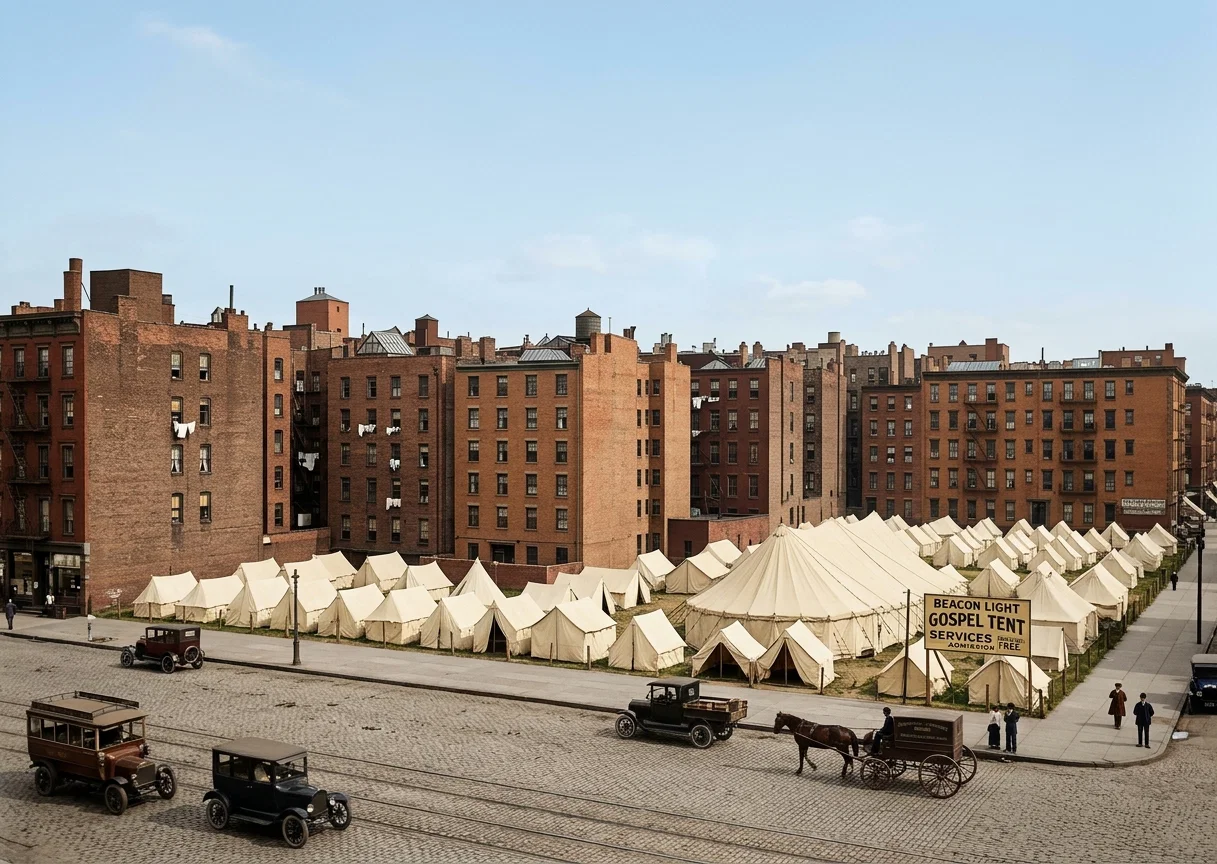
THE Greater New York Conference held its first camp-meeting June 27 to July 4. The encampment was in the very heart of the city, on 109th Street, near the upper end of Central Park.
There were none of the rural surroundings that we usually associate with camp-meeting blessings. But it was a blessed meeting. Nearly all the conference workers camped on the grounds, with a number of others, and the Lord met with these workers as daily they sought him for power for the great work before them, and for unity of aim and action. It is good to seek God amid the quiet of the country, but somehow it seemed very appropriate to have this camp-meeting on the very battle-field, surrounded by all the surging, noisy life of the great city.
On the Sabbath the camp was crowded with those who came in from the various churches. On this day, in the general assembly, as in the smaller daily meetings, God's Spirit bore witness to his acceptance of the consecration of the body of believers in New York City to a united forward movement for the salvation of souls in their vast field. It was a day of victory and of release for many hearts, and of inspiration for all.
While this conference has the smallest area of all our conferences, it has the largest population of any in this country. Truly, if any conference needs the blessing and special power of God, this one needs it. And the blessings of this first camp-meeting brought added assurance that the little band of workers and people are united, and that God has set his seal to a strong, progressive work in their territory.
One interesting experience was that of a lady who came to the meeting for the first time on Thursday. She found in it what her heart had longed for, and was ready to join in keeping the following Sabbath. There was an encouraging attendance of interested hearers at the evening and Sunday services. The novelty of a camp-meeting in the great city drew the passing attention of the papers, and many thousands who use the elevated trains had a pretty view of the little encampment amid the blocks of apartment-houses that are rapidly filling every available space in all the region.
But the problem of drawing the attention of the vast population to be reached in Greater New York is a great one. Five millions of souls are crowded within the territory of this conference, made up literally of all nations and peoples. All through this mass are the souls waiting for this truth, and our workers are seeking God to be led to these waiting ones. They are of good courage, for the Lord has been blessing them, and they are learning how to do the house-to-house work which has been so difficult. The people are shut away in the great apartment-houses, which stand like high-walled fortresses to keep the workers from entering.
By faith these Jericho walls are coming down. Brother Geo. A. King, who has labored so long in New York City, has been using the Signs with good effect as a pioneer agency. These must first be given out freely, as any regular canvassing in the apartment-houses is generally out of the question. Later, yearly subscriptions are taken, and then, as people are interested, comes the opportunity for Bible work and for the sale of literature. During the camp-meeting the workers and people encamped devoted a number of mornings to visiting the people with papers and giving out invitations to the meetings.
A VIEW OF THE CAMP IN NEW YORK CITY
The Lord can make ways, where there are no ways, and he is showing our friends in this city of apartment-houses the way to get to the people. It is a matter of the utmost importance, for face-to-face and house-to-house effort is the work in which all the believers can join.
It would be a blessing, indeed, if somebody had a few hundred dollars, or even a thousand, for this conference to use in a special campaign with the Signs, to be followed by systematic effort with other literature and Bible work. Somehow this truth is to go right through these long-barred gates, and the workers are full of faith that the time has come, and that they have found the way of victory. Pray for the workers and believers in New York City. They are attacking the very citadel, and doing everything in their power to push the work forward.
They will run seven tents this summer. Brother Edwards continues meetings in the large camp-meeting tent. Brother Humphrey and others in the work for the colored people will have a tent in the Fifty-ninth Street district, among the many thousands of their race. Over in Brooklyn, Brethren Andreason and Nord are working for the Scandinavians, Brethren Reinke and Voth for the Germans, while another tent for the English is operated by Brethren Proctor and Wood. At Fishkill-on-the-Hudson a tent effort is planned by Brethren Robinson and Roggenkamp, while at Middletown, in New York State (five counties in the Hudson River Valley being included in the Greater New York territory), Brethren Kennedy and Hennessy have another tent.
No one could have been with the brethren and sisters at this meeting without having confidence renewed and strengthened in the work in this vast field. Oklahoma is providing help for the German work. By the help of Kansas, an Italian brother is taking up work for the many, many thousands of Italians in the city. The conference itself is rallying with new courage to increase its efforts. There is unity, and this general gathering of all the churches helped to strengthen the bonds between all the churches and all the nationalities in the one common work.
Of workers outside our conference, Elder A. E. Place attended the first part of the meeting, and I the latter part, while Elders Daniells and Wakeham spent a little time with us before sailing for Europe. Again, pray for the work in Greater New York, one of the most needy and difficult fields in the world.
W. A. S.
Eastern Pennsylvania Camp-Meeting
By W. J. Fitzgerald
ACCORDING to appointment, this meeting was held in the city of Lancaster, June 15-25. We were favored with delightful weather. This was the first regular camp-meeting held by the Eastern Pennsylvania Conference since its formation by the division of the Pennsylvania Conference in June, 1903. During the first part of the meeting about one hundred and fifty were in attendance. This number was increased to over two hundred for the closing days. While small, this attendance was almost as large as the attendance at camp-meetings held in Pennsylvania before the State was divided into two conferences.
All seemed to come to the meeting for the purpose of spiritual revival and refreshing. Generally, this hope was fulfilled. The faithful were inspired with greater courage; the lukewarm were aroused from spiritual torpor; and a considerable number made a profession of Christ and the message for the first time. Twenty-two persons, whose ages range from ten to eighty years, followed the example of the Lord Jesus, and were "buried by baptism into his death." May they truly live the new life in harmony with Christ's resurrection.
The ministers from outside our conference were Elders A. G. Daniells, W. A. Spicer, A. E. Place, and G. B. Thompson. The word of God was17preached with great freedom and power. We all felt that God's message was accomplishing that whereunto it was sent. Elder Daniells was with us the first part of the meeting, from Friday until Monday. Though much worn by the long strain under which he had labored, before, during, and following the General Conference, he rendered valuable and much-appreciated service to our meeting in preaching the word and counseling regarding the work. Elder Thompson was with us from the first service until the following Wednesday, and delivered timely discourses which inspired and strengthened the hearts of all for more faithful service in the conflict with evil.
All were pleased that Elder Place could be with us from the first Friday until the close of the meeting. The line of thought he presented, in a connected way, proved strong spiritual food for all who hungered for the living bread. Elder Spicer brought inspiration, courage, and strength to the camp for the closing days. The last Sabbath, including Friday evening service, was a day very full of spiritual manifestations. A revival atmosphere pervaded the camp, which was not of man's creation. All were conscious that the Holy Spirit was brooding over us.
Brother F. E. Painter was present to represent the general interests of our book work. A considerable number of young persons decided to enter the canvassing work at the close of the camp-meeting.
Sister Robinson spoke twice upon the needs of India, calling particular attention to the work our people are doing for children in that country. About seventy-six dollars in cash and pledges was contributed to that work.
It was gratifying to see the large percentage of bright, earnest young people in attendance. Special services were held for the young people daily. At the last service held, a unanimous desire was expressed to assist in some way in carrying forward the message.
A review of the conference year ending March 31, showed an encouraging growth. One hundred and twelve souls were baptized and united with the churches during that period. Between March 31 and the time of the camp-meeting, about fifty other persons were baptized. A new church was organized in the city of Lancaster. This congregation has purchased a comfortable meeting-house well located. The church in the western section of Philadelphia is erecting a beautiful house of worship, which will accommodate an audience of about four hundred.
The conference officers elected for the ensuing year are the same as those of last year. Credentials were renewed to six ordained ministers. Ministerial licenses were granted to two brethren for the first time. Six persons were voted missionary credentials. The force of workers for the summer, including tent masters, is nineteen. This conference territory presents a very promising outlook for earnest, faithful evangelistic effort. Of its thirty-six counties, thirteen of the most rich and fertile have not been entered at all by Seventh-day Adventist ministers.
When the camp-meeting closed, it was the determination of all to make the coming year one of active service in practical missionary undertakings. We are hopeful for the winning of many souls to accept the message. Five tent companies will be in the field. We trust that many new believers will be in camp-meeting with us next year.
W. J. FITZGERALD, Conf. Pres.
The Origin and Purpose of the Self-Denial Boxes
By C. P. Bollman
THE self-denial box plan was suggested in January, 1904, by Sister White. At that time, in an appeal addressed to “My brethren and sisters everywhere,” she said:—
“Will you not put in a prominent place in your home a box with the inscription, ‘For the work among the colored people of the South?’ Will you not ask your children to put into this box the money they would otherwise spend for candy and other needless things?”
At the General Conference Council in College View, September, 1904, Sister White told how the suggestion came to her. She said:—
“One night as I was praying for this needy field, a scene was presented to me which I will describe. I saw a company of men working, and asked what they were doing. One of them replied, ‘We are making little boxes to be placed in the homes of every family that is willing to practise self-denial, and to send of their means to help the work among the colored people of the South.’
“I have written concerning these boxes, and the self-denial they will encourage, and I now ask if you will not respect the light that God has given his people?”
“Let the work of these self-denial boxes be carried on more than it has yet been. And do not become weary of their use.”
Again at the General Conference in Washington, Sister White said, as reported in the REVIEW AND HERALD of June 22:—
“A good work has been done with these self-denial boxes, and let no one lift a finger to hinder this work. Let no one speak a discouraging word regarding it; for it is God’s plan, and thus he has said that help should be sent to the work for the colored people.”
Now what we want is to secure the active co-operation of every Sabbath-keeper in the United States in the work of putting one of these little boxes into every family of believers in present truth.
Nor need our efforts be confined to our own people. We have been told that others will become interested in this plan, and that they will assist by giving of their means. Our young people especially can do much to help in supporting our colored mission schools.
Why can not the Young People’s Societies take up this matter, and not only place these boxes, but follow up the work and see that the boxes are used, and the money properly forwarded at least once a quarter?
The Southern Missionary Society has sent out quite a number of boxes, but unless the work is carefully followed up, it will amount to but little.
This work for the colored people can not be done by the believers in the South alone. We have been told that it belongs alike to our brethren and sisters all over the United States. The burden has been laid upon the North as well as the South. Brethren, do not become weary in well-doing. Eight millions of colored people must have the third angel’s message in this generation. Those who are on the ground are doing what they can to give it to them, but the work is beset with difficulties. Teachers must be trained, schoolhouses must be built and furnished, workers must be supported. This can be done very economically. The cost of establishing and maintaining a mission school is comparatively small; but for every one we now have, there should be a hundred such schools. Brethren and sisters, shall we not have your earnest, prayerful, and self-denying co-operation?
If you already have these boxes, use them as the Lord has said they should be used. If a box comes to you through the mail, or is given to you by a member of the Young People’s Society, welcome it. If you have been passed by or have not yet been reached by this work, drop us a card, and we will see that you are supplied. We want you to help the work.
C. P. BOLLMAN,Sec. Southern Missionary Society.Edgefield, Tenn.
Escanaba (Mich.) Camp-Meeting
By S. E. WIGHT.
At one time it looked to human eyes as if this meeting must be postponed. The tents and fixtures were delivered to the dock, in Petoskey, for shipment, and it is evident that the Lord held the freight. The boat that should have taken the tents was three hours late, and the captain would not wait for our goods. When the boat was only a few hours out of port, it burned to the water’s edge. The passengers were all saved, but they lost all personal effects. The tents were sent by express, and the meeting began at the time appointed, Friday evening, June 23.
All who were present consider this the best meeting they have attended for years. Elder F. C. Gilbert was with us throughout the meeting, Elders W. S. Hyatt and K. C. Russell during a portion of the time.
These servants of God gave the trumpet a certain sound, and the Spirit of God accompanied the message borne. It was decided by those present to put forth an effort to give the third angel’s message to the Jewish people in our conference.
All hearts were stirred as Elder Hyatt presented the needs of darkest Africa, and the opening providence of God in opening the way to spread the truth. We were encouraged to learn that the way is now prepared to complete the work of carrying the third angel’s message to all Africa in this generation.
The last Friday and Sabbath were days long to be remembered. The Spirit of the Lord was present in great power. Nearly all in the encampment gave themselves anew or for the first time to the service of God. Six were baptized, and others will be at their home churches. Hundreds of people from the city attended the evening services. The interest was such that the tents were left standing, and a full corps of workers and some of our people remained to continue the effort. S. E. WIGHT.
One of “This Generation”
By Otey, James
HAVING noticed a few weeks ago an invitation in the REVIEW to those who witnessed the falling stars in 1833 to contribute a personal experience, I take this opportunity to bear my testimony.
I was born in Botetourt County, Va., Dec. 8, 1813. My early Christian experience was in the Campbellite Church, to which I adhered until 1843. At this time I heard the prophecies of the soon coming of Christ preached by a man (his name I do not recall) who was making a hurried trip through the country, giving prophetic lectures from house to house. This was in Wabash County, Ind. The clearness with which he presented his message convinced me of its truthfulness, and I with many thousands of others accepted it.
I was living in Hendricks County, Ind., when the stars fell in 1833, and was twenty years old. It was one of the most remarkable sights ever witnessed in this world, and was seen by thousands throughout the Western world. About three o'clock in the morning of that event, I was awakened by a young man who was boarding at our house. We stayed up until daylight, watching it. It appeared as if all the stars in the heavens were falling. Some of them would leave long streaks behind them when they shot off, similar to a bright rainbow, and the streaks would draw up after a few seconds, resembling large serpents. Millions upon millions fell during the time I witnessed the event.
It was a frosty morning, and not a cloud to be seen, and even after sunrise this phenomenon was visible, resembling large flakes of snow falling in the sunlight.
Great excitement prevailed during this time. People ran from house to house, confessing their sins to one another and imploring forgiveness. Some fell upon their faces and implored God for mercy. Others ran into the house, jumped into bed, and covered their faces to keep from seeing it. That sight is just as vivid in my mind to-day as it was that frosty morning of Nov. 13, 1833.
It was not until my return from the gold-fields in California in 1854, that I first heard of the health reform principles taught by our people. I had been using tobacco, tea and coffee, and pork ever since I was fifteen years old, but I immediately discontinued their use, and have tried to live according to the rules of health ever since. These health principles worked a marvelous change in my appearance. In 1854 I was quite gray, and appeared to be an old man at forty-one. After five years of right living, an old acquaintance of mine, upon stopping at my house one evening, took me to be one of the boys instead of the “old man.” My hair gradually came in black again, and the strength and vigor of youth seemed to return. To-day, at the age of ninety-two, I am no grayer than I was in 1854 at the age of forty-one. My general health is good. I have a good appetite and sleep usually well. Rheumatism has taken hold of me, and my hearing is failing fast, but my eyes continue to do me an average amount of service. I never fail to read the REVIEW, each week, which I have done ever since it appeared, also the Signs and Good Health.
OTEY JAMES, AGED 92
It was in the spring of 1860 that I heard the Sabbath truth preached for the first time. This was in a debate held in Knoxville, Iowa, between Moses Hull and a Presbyterian minister by the name of Presley. This debate lasted two weeks. My wife and I attended it, and were both convinced of the Sabbath truth, and began its observance at the close of the discussion.
This decision on our part led all our children to accept the truth, all of whom are still living and rejoicing in this message. Of my six children, four have been elders of churches. Of these four, one is a missionary and one a minister. One of my grandsons and his wife are missionaries in India, and one is a minister and president of a conference. All my children and many of my grandchildren have at some time been actively engaged in spreading this message.
Thus God has been merciful to me in continuing my life more than the allotted threescore and ten years. My courage is good, and my hope was never brighter. I long to see the King in all his beauty and behold a better world than this. My hope shall not be long deferred. This generation shall not all pass till these things be fulfilled; and while it may be God's will to let me rest before that time, yet I know that that glad day cometh, and cometh quickly. “He that endureth unto the end the same shall be saved.”
OTEY, JAMES.
Lytton, Iowa.
Keene (Tex.) Industrial Academy
By T. T. Stevenson
We give below a financial statement of the Keene Industrial Academy, for the year ending April 30, 1905. For the benefit of those who are interested in this school, I will add a few items of interest concerning the progress of the institution during the last few years.
At the beginning of the work with “Christ’s Object Lessons” our indebtedness was $14,634.38. This did not include the General Conference debt which was originally $3,000, but afterward was reduced to about $1,500, leaving our total indebtedness about $16,000. One year ago, what is known as the Post-office Bond debt of $2,000 was added to this, making, in round numbers, $18,000. I am very glad to say that with strict economy, hard work, and the blessing of God, we have succeeded in reducing this indebtedness to about $1,300. We have $647 on hand to be applied on the debt which will reduce it to $653.
During this time we have made repairs and improvements as follows: painted the academy, repainted the assembly hall, and repaired it generally, canvassed and re-papered the Home throughout, fenced the campus, bought new bake-oven for the kitchen, new windmill, two new pianos, and three organs, washing-machines, boilers, steam cookers, etc., etc.
The farm, under the faithful management of Brother Etcheson, is in good condition—fences repaired, the orchards and berry patches cleaned, and everything about the farm in better condition than it has ever been.19
The laborers have all been settled with to date, and everything is in good shape for the beginning of the next school year.
I have been connected with this institution most of the time since its beginning, and now, as I sever this connection, and go to another climate, because I think my health demands it, I wish to say that I shall always feel a deep interest in the work I leave in Texas. I also wish to thank my brethren here for their co-operation with me in this work, and for their kindness and forbearance. My prayers shall always be that God may bless and prosper the Keene Industrial Academy.
Financial Statement of the Keene Industrial Academy, April 30, 1905
RESOURCES
Accounts receivable ........$ 2,182 89
Bills receivable ........... 645 50
Inventories ............... 31,224 55
Cash on hand .............. 1,147 00
Total .....................$35,199 94
LIABILITIES
Bills payable .............$ 300 00
Accounts payable in tuition . 47 87
Sundry accounts owing by academy ........ 22 56
Deposit accounts .......... 589 00
Keene Academy’s present worth .......... 34,240 51
Total .....................$35,199 94
Net stock account, June 30, 1904, $31,674.88; total gains, April 30, 1905, $4,809.13; total losses, $2,243.50; net gain for the year, $2,565.63; present worth, $34,240.51.
T. T. STEVENSON, Manager.
Hurried Results Are Worse Than None
By George Macdonald
HURRIED results are worse than none. We must force nothing, but be partakers of the divine patience.—George Macdonald.
A Word From Mexico
By A. ALLEN JOHN
THE REVIEW of the eleventh of May, containing President Daniells's address, and other important matter, has reached us. We regret the loss which all sustain who were not permitted personally to share the blessings of the conference in the way of wise reproofs, timely admonitions, and true encouragement. Yet it is a cause of gratitude that the REVIEW has been so wisely chosen to bear so many of these blessings to us, and that each can examine himself and apply that which will satisfy the longings of the soul. Thus doubly welcome is the REVIEW, and doubly blessed those who read it with profit.
“While meditating, this morning, as to the “word in season,” which I fain would speak to those who are burdened for the perishing, and desire to have this message, so solemn, so grand, so urgent, encircle the world in this generation, the one word which flashed before me and still remains was, “Go!” A familiar word, is it not? A business word, too! Victory for some one! “Go!” dear brother, sister, “Go!” “So run that ye may obtain.”
For self-supporting workers there are numberless openings. Missionary farmers, tradesmen, merchants, lawyers, teachers, nurses, and physicians are needed. The world is not large. Heaven is near all. The blessed dead of Europe, Asia, Africa, Australia, and the surging ocean, will hear the Archangel's voice at the same instant as those who sleep on the American continent. That He may then say, “Come!” he now says, “Go!”
A. ALLEN JOHN
Mexico City, Mexico.
Religious Liberty Notes
By W. A. COLCORD
THE movement for Sunday enforcement is making great headway all over the country.
“About nine times out of ten when a person is arrested for working on Sunday, the act is more the result of spleen on the part of the one complaining, than a desire to have a quiet day,” says the Muncie (Ind.) Press.
One subject discussed at the recent international Christian Endeavor convention held at Baltimore, was, “Shall the Sabbath Be Sacred or Secular?” If it is sought to be upheld and enforced by secular law, it will pretty surely become secular.
During the recent agitation over Sunday legislation in Honolulu, H. I., the Federation of Catholic Societies at that place, adopted a resolution stating that they were in favor of “allowing all recreations and amusements on Sunday consistent with the due observance of the day.”
A crusade against “all classes of stores that keep open on Sunday” was recently inaugurated at McKeesport, Pa. The first prosecution under the crusade was that of John Smith, who was sued for violating the Sunday laws, by Philip Zenn, “a wealthy and prominent member of the Coursin Street Methodist Episcopal Church.” Imagine Christ prosecuting a man for failing to comply with his religious views! Imagine him, moreover, suing a man for failing to keep a day he had never commanded him to keep! “What would Jesus do?” would be a good motto for the Sunday crusaders to consider and adopt.
A writer in the Union Republican, of Winston, N. C., says: “To undertake to interfere with Mr. Hege, with all the seven-day workers and traders in full blast, looks like persecution, and the straining at a gnat and swallowing a camel. Let Tom alone. He is hurting no one, and not doing enough business to make any one notice him. Cast out the beams, and then go hunt for the motes.”
A brother writes: “You will be interested to learn that Congressman ——, of ——, sent letters to five hundred of his constituents who signed the petition against the District of Columbia Sunday bill, announcing that the bill did not pass.” After reading this, who will say that the petition work made no impression upon Congress, or that God has not his agents in legislative assemblies as well as outside of them? This congressman, we are informed, moreover, is very friendly to Seventh-day Adventists.
Because “the city authorities had had trouble with Tom Hege for Sunday selling,” the Winston, N. C., board of aldermen, on July 6, repealed the ordinance permitting the sale of any goods whatsoever on Sunday, which means that all cigar stores, news stands, soda fountains, and the like, in Winston, must cease doing business on that day. The Board saw the inconsistency of permitting some to sell, and fining and imprisoning others for doing the same thing. The vote of the eight aldermen, however, was a tie, the mayor casting the deciding vote.
As announced in last week’s REVIEW, our brethren who have been imprisoned in Turkey for nearly a year have been released. Under date of June 18, Elder L. R. Conradi writes: “Just before I left Hamburg, I received a letter from Dr. George, in which he states that he had a telegram from Brother Baharian, announcing that they all had been freed.” There were five in all imprisoned. No details of the case have yet been received, but it is possible that our recent overtures to the Turkish minister in Washington in their behalf had something to do with their release.
While admitting that for the officers of the law at Winston, N. C., to fine and imprison Tom C. Hege, a Sabbathkeeper, for selling goods on Sunday, and at the same time pass by hundreds of other violators of the Sunday law, is “nothing short of officious persecution,” still the editor of Everything, a journal published at Greensboro, N. C., says: “It becomes a matter of the majority of the citizens to agree upon a day and observe it. If Tom wants to close up on Saturday, generally the best day for tradespeople, he shows his absolute sincerity in his religious belief; but being in the minority, he should not attempt to engender strife and bitterness by opposing the majority of the people among whom he lives; . . . he must not aid in breeding strife; he must not engender bitter feelings. He must remember that he is in Rome, and do as the Romans do.” Like all other arguments upholding the Sunday and enforced Sunday observance, this sounds very much like “Rome.” W. A. COLCORD.
Field Notes
ELDER B. F. STUREMAN reports the recent baptism of seven persons at Sanilac Center, Mich.
BROTHER P. C. HAYWOOD reports the baptism of fourteen persons at Prattville, Mich., June 11.
THE church at Oolitic, Ind., has been strengthened by the recent baptism of five persons at that place.
MEETINGS are now being held in Indiana at Franklin, Eaton, New London, and Royal Center.
A CHURCH of twenty-one members has been organized at Senjen, Minn., seventeen of whom recently received baptism.
THREE persons recently joined the Bunker Hill, Mich., church by baptism, and three others expect to join soon on receiving baptism.
ELDER CHARLES THOMPSON reports the baptism of four persons at Noble, Ill., in connection with the last quarterly meeting of the Noble church.
IN Minnesota tent-meetings are in progress or planned for at Stillwater, Detroit, Herman, and Minneapolis. At the latter place two tents are pitched, in one of which the services are in the Scandinavian language.
A CHURCH of twenty-two members has been organized at Medaryville, Ind., eleven of whom were former members of the Mt. Vernon church, the remaining eleven never having been identified with a Seventh-day Adventist church.
ELDER S. S. SHROCK reports from Pennsylvania that regular Sabbath meetings have been established at Carbondale, Shavertown, and Wyoming, and midweek meetings at West Pittston and Honesdale. It is expected that a tent effort will be conducted this summer in the vicinity of Shavertown.
BROTHER E. J. DRYER says in a report of tent work in West Pennsylvania: “It is too early to report anything definite concerning tent work in this conference, but we are glad to report a good interest in each place. A letter from Brother Schwartz reports a most favorable beginning at Sixmile Run in the southeastern part of the conference. Also a letter from Elder C. F. McVagh reports a very encouraging opening at Roulette, Potter County. Elder Watt, Brother Ned Ashton, and the writer began our effort in Erie last Sunday evening, and we had a most attentive audience.”
IN Oklahoma City, O. T., the truth is being proclaimed by preaching services in the church Sunday evenings, and by Bible readings and cottage meetings through the week. A report from Elder A. E. Field says: “As a result of the combined efforts of all the workers, there are usually at our meetings several who are interested in the truth. Four have united with the church in the last month, and others will soon follow. There are several to be baptized, but it has been put off on account of the muddy condition of the river. At present there are several in the valley of decision.”