In these days of strange and unaccountable happenings, the people have almost ceased to wonder at the most marvelous of them. During late years there has been, to all appearance, but little advance in Spiritualism; but those who are alive to its workings are not blind to the fact that it is rapidly honeycombing the whole religious world, and the people are fast being prepared for that great final deception the prophet declares will come upon all the world. Every now and then remarkable occurrences are recorded in the daily press, credited to the workings of Spiritualism. One of the latest of these comes from Westfield, S. Dak. It seems, as the account runs, that in that place live John Small and his wife, who are well along in years. He is a well-to-do farmer, and a short time ago his only son, the last of a large family, died of consumption. The old people were for a time inconsolable. They were Spiritualists, however, and soon began to tell their friends that they had received visits from their dead son, who had told them that his absence was only temporary, and that he would be with them in only a few weeks.
Among the lad’s companions had been a Scandinavian named Nels Larsen, a boy some seventeen or eighteen years old, whom Mr. Small had in the past employed to some extent on his farm. Young Larsen is an orphan, and has no near relatives living. A few days ago he told Mr. Small that he had seen the dead boy’s spirit in a dream, and that as his own death would make little difference to any one except himself, he had consented to withdraw from his body in favor of his comrade, in order that the latter might be near his parents. The change, he said, would be made the following night. The next day, when he appeared, he actually seemed to possess not only the voice and the manner, but all the characteristics, of the dead boy. His body, alone, remained unchanged. The old couple are reported as being at once convinced of the genuineness of the transformation, and immediately took the young man into their home as their son; and while they do not consider it necessary, except to satisfy any point of law which might arise regarding a division of property, it is said they will formally adopt him, and make him heir to their property. The remarkable feature in this case is that while young Small was well educated, and Larsen had received little or no schooling and spoke very broken English, the latter seems, since the alleged transfer of souls, to be possessed of all Small’s acquirements. He speaks good English, and shows none of the marks of the Scandinavian’s former habits. This latter statement is put down as a fact, and is wholly unaccounted for, even by the incredulous friends who maintain that the whole thing is a clever ruse to secure a good home and the ultimate possession of Small’s acres.
CRIME INCREASES.
ONE who in these days raises a question as to whether the world is really on the high road to the glorious millennium, is thereby liable to gain for himself the reputation of a sour cynic. The majority of people are so impressed with the idea of the rapid upward progress of humankind that any one who scouts that idea is regarded as a “troubler in Israel,” a disturber of dreams. But disagreeable as is the task, the truth should be made known.
With the great increase of light which this generation enjoys, it ought to be far and away better than all its predecessors. Sin, or moral laxness, is far more culpable now than in former generations. But instead of decreasing, crime is rapidly on the increase, with a fiendishness hitherto unknown. The current papers are giving us some statistics in this matter. The Chicago Evening Post of February 3 says that murders in this country in 1890 numbered 4290. Last year the number was 10,500. Suicides in 1890 were 2040. In 1895, they numbered 5750. There were 171 lynching cases last year, which is nineteen less than the year before. As for burglaries, robberies, embezzlements, etc., they are almost daily occurrences in every city. And the reason why they are not even more common is that so few people dare to carry money or to have it in their houses. A man with a hundred dollars in his pocket could not walk the streets in safety, if it were known that he had the money.
United States District Judge Isaac C. Parker, at Fort Smith, Ark., has sentenced more than one hundred and fifty murderers in his judicial career. In charging the Federal Grand Jury last week, he said that the number of persons who have been murdered in the United States in the last five years is six times larger than the Continental army at the close of the Revolution, and that the number murdered last year is greater than our standing army at the outbreak of the civil war. “The issue before the country,” he declared, “is not money or tariff, but whether or not we are able to guarantee proper protection to life. The people should demand of the courts that they discountenance intrigue and hair-splitting distinctions in favor of the criminal.”
INEXCUSABLE DISCRIMINATION.
By Editor
The shameful incident mentioned in our news columns last week of Bishop Arnett, of Ohio, being shut out of three Boston hotels on account of his color, cannot be too strongly reprehended. He is a man of eminent ability, loved and honored by many thousands of Christians, white and black. He attends a convention in Boston, the city that has been the home of many defenders of a downtrodden race. But now that slavery is past, and the colored race are struggling to obtain their rightful place among men, one of the foremost of that race, a man in every good sense of the word, is spurned from the hostelries of freedom-loving Boston, as unfit to occupy the same building with white men.
It is no excuse that the patronage of the houses would suffer, that some of their guests would leave. If such people would forever leave off their silly and wicked pride, it would be a credit to humanity at large, as well as to themselves. That such a thing should occur in a Southern city need not perhaps occasion remark. But that it should happen in Boston is even disgraceful. We are glad to know that the action is deprecated by the better people of that city.
Not long since application was made at the Battle Creek College for the admission of a young colored woman of culture, with the query as to whether board could be obtained with a respectable colored family, for it was supposed that the young lady would not be permitted to board at the dormitory with white young women. It was a pleasure to assure her friends that she would be as welcome to our school home as any young lady, and treated in just the same manner. There are, we are happy to say, several colored students of both sexes already in this school, and they conduct themselves in a way that reflects no discredit to them or to those they represent.
A WILD RAID.
WE are in receipt of some Cape Town papers giving detailed particulars of the dash of Doctor Jameson into the Transvaal, and of its sudden extinguishment before the point of destination was reached. The general features of the rash movement have been freely published and commented upon here, so that it will not be necessary to rehearse them. The ostensible excuse for the raid was the relief of the uitlanders, or foreigners, especially the English residents of Johannesburg, who, though in a majority, were not allowed the privileges of citizenship. There is but little room for doubt that the real object was to bring the valuable territory of the South African Republic under the control of the South African Chartered Company, of which Cecil Rhodes was head and Doctor Jameson governor and agent.
The doughty doctor gathered seven hundred men, many of whom supposed they were going against a native chief until they were under way, when the leader called a halt, made a speech in which he told them where they were going, and gave those who chose to do so an opportunity to return. None of them accepted the chance, but pressed forward, and with the exception of seventy or eighty dead and many others wounded, soon found themselves in the Transvaal indeed. Those whom they relied upon to rally to help them, failed to respond.
A GIGANTIC MONOPOLY.
ANOTHER gigantic figure is arising in the field of avaricious extortion, who promises to be a worthy successor of Jay Gould, and even to outstrip him and the other colossal speculators whose grip squeezes money and blood from the poor. This man is J. Pierpont Morgan, who, with his syndicate of bankers, has had his hands on Uncle Sam’s purse for some time.
The latest move is the formation of a monstrous combination of capital, amounting, it is said, to two billion dollars, to control the production and sale of coal. Forty-six million tons of anthracite coal were sold last year at an average wholesale price of $3.08 a ton. This monopoly proposes to manipulate that now, and will raise the price to $4. But this means more than one dollar’s rise to the consumer. In order to accomplish this, it is necessary to reduce the production. And to accomplish this, mines are to be closed, and the miners thrown out of employment. Already twenty thousand in the western Pennsylvania district have been thrown out of work. Many thousands will follow. Then, by the proposed rise in price, a direct tax of at least forty million dollars, and probably more, will be placed upon consumers of coal in this country, to enrich the coffers of this already wealthy syndicate. This monopoly is one of the grandest grabs for wealth ever yet planned in commercial circles; but we have no hope it will be the last.
Weather Prophets and Their Astrological Predictions
By T.
Weather Prophets.—Here is a sample of the stuff put out by this class of cranks:—
“Two eclipses fall in February this year,—the eclipses of the sun-falls in Aquarius, the sign ruling Russia and Arabia, and in square to the malefics, Herschel and Saturn, in the sign Scorpio, which rules Syria, Cappadocia, and Armenia. The eclipse of the moon falls in Virgo, the ruling sign of the Turkish dominion, and also of the West Indies. A lunar eclipse occurring as this one does causes ‘diseases to kings and sedition and discord amongst men,’ strongly exciting the masses, and inciting to murders and crimes. From these teachings, it is apprehended that we have not yet seen the end of the dreadful slaughters that have been going on in Armenia, and there is reason to conclude that countries of both Europe and Asia will ‘beat to arms,’ and become generally involved in the turmoil from the disorders in Turkey. The figure for the solar eclipse for this country indicates that the United States will yet be compelled to make such a naval demonstration as has not yet been considered necessary to insure a proper respect for our flag or our citizenship. . . . Some bad explosions and accidents in underground places, or from falling buildings or timbers, are indicated, and superintendents or others in charge of such works should see that every precaution is taken against harm.”
Say as much as they please, the weather still has a way of doing as it has a mind to when the time comes. T.
THE SMELTING-WORKS OF THE PHARAOHS.
By M. B. C.
Until very recently it has been supposed that the ancient Egyptians knew nothing about iron, or, if they knew of it, made very little use of their knowledge. The reason scientists have supposed this, is because so few iron tools have been found among the remains of the ancient civilization. But iron is susceptible to atmospheric influences, and this fact seems to have been overlooked. The best-preserved of the few iron implements which have been found, are those which were taken from comparatively air-tight tombs, and even these were badly corroded. In some instances, where iron has been found during the excavations of ruins, it has crumbled into dust at the touch. This ought to have suggested to archeologists that the land of the Pharaohs and the Ptolemies might have been red at night with smelting-furnaces, and yet the iron have been oxidized into nothingness millenniums ago. That there were vast iron-works, where doubtless the ancient Egyptian slaves toiled under cruel task-masters, has been proved by recent archeological research, as will be seen by the following from the London Industries and Iron:—
“Long before the remote period when Moses compared Egypt to an ‘iron furnace,’ there is proof that the inhabitants of that country were well tutored in the school of Tubal-cain, who was described as the ‘instructor of every artificer in brass and iron;’ and the decayed remains of what had once been well-finished iron implements, and the débris of vast iron-works in the valley of the Nile, show that the iron industry was as important as any other which engaged the attention of the Egyptian artisan thirty-five hundred years ago. In the neighborhood of Wady Mokatteb (the written valley) enormous quantities of partially buried slag recently attracted the attention of a body of scientific explorers, who, upon a close investigation, found that the whole district bore very clearly-defined traces of collapsed iron mines and smelting-furnaces. These, which must have given employment to many thousands of men, and are said to be as extensive as any now in the north of England, were in full working order before the days of the Ptolemies.”
M. B. C.
HOME DECORATIONS PROPER.
By M. E. Steward
M. E. STEWARD.
(Battle Creek, Mich.)
WE come now to home decorations proper. House plants, for those who can take good care of them, are very enjoyable. They are not only pleasing, but they are continual reminders of the love of the One who made them, and thus they exert the best of influence in the family. This can be true, however, only when the plants are clean and thrifty. One pretty plant is worth fifty poor ones; indeed, the poor ones are not decorative at all, and would much better be dispensed with, as they do not add any to the beauty of the home.
A good picture is a treasure. By “a good picture,” I do not mean necessarily a costly one; there are very pretty chromos, lithographs, and half tones which are comparatively inexpensive. Never should a daub or a meaningless picture be hung upon the wall. A pleasing landscape, or such a face as the one purporting to be that of Jesus Christ, has a sanctifying influence. One can never look at this face of Christ without feeling hushed, and more of a desire to be gentle, patient, and kind.
Where one is not able to buy good pictures, very attractive ones may be constructed out of crude materials. Cut flowers from a floral catalogue, and arrange them on a large sheet of fine thick paper. Fasten thin, narrow strips of wood at the top and bottom, on the back side of the paper of course; put in some tacks, and it is ready to hang. Pretty and instructive scenes may, with a little ingenuity, be arranged from the multitude of pictures which flood the land. Cut neatly, and be careful to get all the white off. Lay them as you wish them; use a thin paste, and but little of it; then press them down smoothly. When done, pass a warm flat-iron over them, or place them under a heavy weight. This is interesting work for children. See that they work carefully. Help them at first to plan, and then leave them more and more to their own resources. Finish each one neatly, and make some use of the work. Hang the pictures in their rooms or in their corner of the sitting-room, to be replaced soon by something else. Or, what is better, let the children give the pictures to some one less fortunate than themselves; let them do this when they have been particularly successful, that they may learn to set a high value on missionary work, and become careful and faithful in all they do.
For variety, these pictures may be pasted on a scarf made of paper cambric, if no better cloth is at hand. Cut the lower end for a fringe, and fasten the top to a little strip of wood, and hang it on the wall.
Press autumn leaves, and group them together with a few dried twigs of oak having acorn-cups on them. Glue the acorns into some of these cups, fasten them to a piece of pretty wood, and varnish the whole; when dry, cover the place where the twigs cross with a bow of ribbon, and hang on the wall. Pressed fern leaves and flowers like the elargoniums, or geraniums, which retain their colors when pressed, make pretty combinations.
A group of graded shelves may be made quite ornamental. Have the lowest one perhaps two feet long, and then make each shelf smaller than the one next below. Bore holes through the four corners, through which pass picture-hanging cords, tying knots beneath each shelf, on which it may rest. Triangular shelves, to fit87a corner of the room, may be made in the same way. These shelves may be finished in the usual way, or with an edging of pine cones. Pick the cones to pieces, after which soak them in water. They can then be easily sewed on to pasteboard in any desired shape. Tack this on the edge of the shelves.
Many pretty things, which require but little time and labor in the making, may be made with rice. If shells are to be used with the rice, glue them on first. Then spread quite thick paste where you wish the rice to be, and sprinkle the rice thickly over it—the grain sold as broken rice is prettier than the whole kernels. Give this time to dry. Melt some rosin, put into it a small piece of beeswax; add vermilion to dye it scarlet. With this preparation paint the rice. White lead may be substituted for the paste, and small fragments of broken glass for the rice. This needs no painting with the rosin.
MODERN MILLING.
By T.
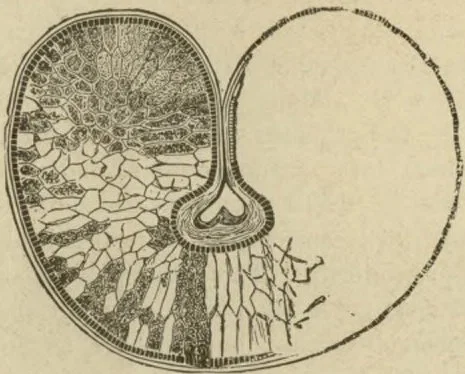
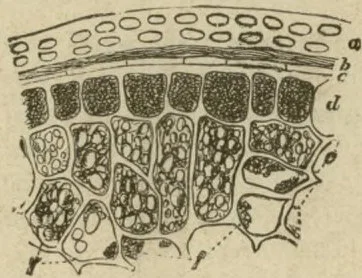
In two brief chapters we have spoken of primitive methods of flour manufacture. But in our times milling has been reduced to an accurate science. The wheat kernel is carefully dissected, and separated into its constituent parts with as much care as could be taken by a chemist were he to analyze each kernel by itself. It might be well for us to analyze a kernel by hand and microscope, before we see how it is now done by machinery.
The accompanying diagrams are used by the courtesy of the author of the “Home Hand-Book of Hygiene and Medicine,” J. H. Kellogg, M. D. The first gives a transverse view of a wheat kernel, showing in one section the formation of the kernel; and the other cut gives the formation of a small portion of the kernel magnified. Outside (a) is a woody fiber, or bran; (b) the next layer is woody, but contains also rich nitrogenous matter and “salts,” or mineral elements; (c) and (d) form the envelope of the inner portion, and the most valuable portion of the grain, rich in albuminous substance; (e), (f), and (g) are the starchy portions, which constitute “superfine” flour, the very white flour sought for pastry.
Instead of one crushing or grinding process between massive stones, the modern idea is to disintegrate the wheat by a very gradual process, by means of more or less complicated machinery. In the first place it is necessary thoroughly to cleanse the wheat, and sometimes to toughen the bran. Then, by slightly crushing the kernel between horizontal rollers, the bran is removed. This bran is treated with great care, to remove everything from it except the woody husk. The bran manufactured from our great mills is now comparatively worthless for feed. The material separated from the bran enters into the best grades of flour. The berry separated from its husk is again and again run through the rollers, each time removing some of its outer coat, in the form of middlings. These are run through purifiers, which carry away the dusty, starchy parts, leaving the middlings as clean, sharp particles of meal, at first quite coarse, but with each operation becoming finer.
The best grades of flour are made from these purified middlings and the part that comes from the bran. At last nothing is left but the starchy center. This, with the last grades of middlings and the portions that are dusted out, forms the cheaper, whiter grades of flour.
The better grades of flour are of a yellowish cast, and are granular to the touch. That is, the flour will run out of the hand, and does not pack as solid as the starchy flour. Such flour is rich in gluten and nitrogenous matter. For some stomachs it is better than the Graham flour or meal. The purified middlings are excellent for porridge and gems.
From Charles A. Pillsbury, one of the great Minneapolis millers, whose mills grind twenty million bushels of wheat, or four million barrels of flour, a year, we lately received the following interesting sketch of the milling process:—
“After the wheat is received in the mills, it is passed through separators, where all stub straw, oats, cockle, wild buckwheat, and all weed and grass seeds and shriveled wheat are extracted. It is then put through scouring and polishing machines, to remove fuzz and dirt. If the wheat is exceptionally dirty, it is carefully washed, rinsed, and dried. Before it starts out on the grinding process, it is tempered by water and steam heat, to make the cuticle tough, so that the bran will not pulverize, and mix with the product from which the flour is to be made. As the wheat passes through the first break, it is slightly pressed, the same as if it had received a light tap with a hammer, the object being to free the flour-making material from the cuticle, with the least abrasion possible. From this break the material is conveyed to scalpers, or sieves, where all the middlings, which have been freed by the operation of grinding, are separated. The residue passes alternately through grinding and scalping, the middlings, or best flour-making material, being separated and collected each time, until the cuticle has been divested of every particle fit for first-grade flour. The middlings are made as coarse as possible (resembling coarse corn-meal), so that all lighter particles of dust and dirt can be drawn out by air suction, when they pass through the middlings purifiers. After gradation and purification, which require great care on the part of the millers, the best middlings are ground into patent flour. Lower grades of flour are made from inferior middlings, and “tailings” from bolts and separators. The handling and grinding of wheat may appear very simple to the uninitiated, yet one hundred and seventy-five separations are made in milling, from the time the wheat is received at the mills until the flour is ready for market.” T.
FAITH, OBEDIENCE, MEEKNESS, AND GRACE.
By Mrs. L. E. Merrow
BY MRS. L. E. MERROW.
(Osakis Center, Minn.)
“ALL we like sheep have gone astray; we have turned every one to his own way.” It is not good for us to follow our own ways. “The meek will he guide in judgment; and the meek will he teach his way.” Let us be meek, and take his yoke upon us, and learn of him who is meek and lowly of heart, and we shall find rest to our souls. To learn to obey is the hardest lesson a child can learn. One of the first things told us of Jesus is that he was subject to his parents, and he grew in wisdom and in favor with God and man.
“Thee and thy seed,” “you and your children,” “me and my house,”—such are the expressions found in the Old Testament. The family is one in God’s sight. To you and to your children is the promise, and the secret of a godly education is to bring the children up in the faith. It is the continual leading of the Spirit which is essential to a true Christian life. The promise of the Spirit is to you. As you live and walk in the Spirit, will you receive it for your children, too?
Your life, your daily influence, is the channel through which His sanctifying grace will reach them. Dear fellow parents, let us look upon ourselves as divinely appointed by the Holy Spirit, to teach our children Christ, and to bring them under the influence of the Holy Spirit. Let us have trustful faith in God for ourselves and our children, counting on the promise. God is faithful to do as he has promised.
Erratum on The Woman Behind the Mill
ERRATUM.—At the close of the article entitled, “The Woman Behind the Mill,” in the REVIEW of January 28, please read “the sole material for bread” instead of “the souls material.”
UNFERMENTED BREAD.
By Mrs. D. A. Fitch
BY MRS. D. A. FITCH.
(Sanitarium Cooking-School.)
There is said to be “religion in a loaf of good bread.” This is true; but it seems that in most bread there is something besides, for it is found that the yeast germ of fermented bread causes trouble with the digestion of many people. The unfermented breads, if properly prepared, are tender; but, being more firm in texture, they are more difficult of mastication. This is just the reason why they should be used; for the starch which is so abundant in them must be thoroughly mingled with saliva in order that the process of digestion may be complete. They are sweeter, because the sweet material has not been used by the yeast germ. This, too, is a reason why they are more nutritive; for in the process of fermentation about one seventh of the nourishment is made use of by the yeast germ.
As for all other breads, the flour used for unfermented bread should be that which contains as nearly as possible all parts of the wheat kernel. (White flour is lacking in the important element,—gluten,—and most Graham flour has been robbed of its due proportion of starch.) The liquid used for mixing the dough may be water, milk, thin cream, nut meal and water, nut butter and water, or egg yolk and water. All material should be as cold as practicable, and the room as cool as will be comfortable, so that the air which is incorporated with the dough will be cold, and thus will expand as it comes in contact with the heat of the oven, and increase the lightness of the bread.
If the first two liquids named are used, the bread will be sweet, but not as tender as though made of something containing more fat. I will give you one recipe this week, and will quote from “Science in the Kitchen” next time.
Water Breads with Eggs.— Beat together, until all in a foam, the yolk of one egg and one-half cupful of very cold water. Slowly, by a beating process, incorporate into this enough flour (preferably “seconds”) to make a dough which will readily clear the board, but which will not be so stiff that it will be difficult to form it into the required shapes. Work it so thoroughly, by beating with a mallet, pulling, stretching, picking, wringing, or twisting, that breaking off a piece will cause a sharp, snapping sound. Cut in uniform pieces about twice as large as an English walnut, and knead the same as for raised biscuits. Make an opening through the center of each by pressing the thumb and finger together, so as to meet in the interior. They will then resemble small doughnuts ready for the kettle of fat. Place these on a perforated tin, at least one inch apart, and bake from forty-five minutes to one hour in an oven whose temperature is right for raised bread. They should not be taken from the oven while soft enough to yield readily to pressure.
The dough may be formed into rolls or sticks if preferred. A very excellent crisp may be made by rolling the dough to the thickness of a knife-blade, pricking it closely with a fork to prevent blistering, cutting in squares, and baking until “done to a crisp”; but it should not be so brown as to lose its palatability. Left thicker and baked longer, it makes a good cracker.
Roll the dough into cracker thickness, trim off the edges, so the pieces will be either square or rectangular, and prick well. Spread on half of the dough some chopped dates or figs, fold the other half over it, press lightly together with the rolling-pin, perforate again, cut in squares, and bake on the perforated tins or wire roll-baker; and you have what we call fruit crackers. The children enjoy them with their school lunches.
Graham flour will do very nicely for these breads, but not for the biscuits.
HEART FAILURE FROM OVER-EATING.
THE heart is about as perfect an organ as any in the body, and one that rarely shirks its duty. It commences its labors in the earliest infancy, and goes on until the last moment of life,—without intermission for seventy-five years or more. At every beat it propels two ounces of blood through its structure. At seventy-five pulsations a minute, 9 pounds of blood are sucked in and pumped out; every hour, 540 pounds; every day, 12,960 pounds; every year, 4,730,400 pounds; every hundred years, 473,040,000 pounds. Now the heart has for a neighbor an organ, the stomach, very fond of self-indulgence. The stomach lies directly under the heart, with only the diaphragm between; and when the stomach fills with gas, it is like a small balloon, and lifts up until it interferes directly with the heart's action. The stomach never generates gas; but when it is filled with undigested food, fermentation takes place, and gas is formed, and the interference depends upon the amount of gas in the stomach. To overcome this obstruction, the heart has to exert itself in proportion to the interference; more blood is sent to the brain, and the following symptoms are the result: A dizzy head, a flushed face, loss of sight, spots or blurs before the eyes, flashes of light, zigzag lines or chains, etc., often followed by the most severe headache. These symptoms are relieved when the gas is expelled from the stomach. Now, when this upward pressure upon the heart becomes excessive, more dangerous symptoms supervene, a large quantity of blood is sent to the brain, some vessel ruptures, and a blood clot on the brain is the result; and the person dies of apoplexy, or, if he lives, is a cripple for life. When a sick person, or an old one, or one with feeble digestion, sleeps, digestion is nearly or quite suspended; but fermentation goes on, and gas is generated, as before stated.
A man is found dead in bed, and the physician pronounces it the result of heart failure. Now the man was out late, may be; partook of a large dinner of roast beef, turkey, chicken, lobster, oysters, mince pie, plum-pudding, ice-cream, cake, an orange, nuts and raisins, coffee, etc.; went home at midnight; and died of heart failure before morning. The heart failed from overwork, just as a horse might do. Again, a man is sick with typhoid fever or pneumonia, or almost any other disease, and dies of heart failure; but what has his diet been during the sickness? At present it is very fashionable to begin at once with what might well be called the stuffing process—iced milk, which is so cool and grateful to the patient, from three pints to one gallon during the day and night. How unwise! Moral: If you don't want to have your heart fail, don't abuse it; don't overload it.—The Journal of Hygiene.
NEW DRESSES OUT OF OLD ONES.
By Myrta B. Castle
BY MYRTA B. CASTLE.
(Battle Creek, Mich.)
Economy is a virtue, and among people who practise this virtue, the remodeling of gowns is often a perplexing question. One way of economizing in the children's clothing is to buy dresses alike for two little girls, when they are near the same size. Then when the waists wear out, take the skirt of one to make a new waist for the other. If the dress is cut over and trimmed in a new way, a child will not feel that she is condemned to the wearing of cast-off-clothing of which she has long felt tired; but, in its freshened form, she will feel as if she had an almost new gown. Of course this plan of economizing cannot,—or, at least, should not,—ever be tried where the children are unlike in their looks. A mother should find great pleasure in studying the looks of her children when she plans their dresses. Think how ill a dark child looks in blue, while that same blue will make a fair haired, blue-eyed little girl look beautiful! The “hateful” blue makes the dark one shrink, if her soul be sensitive,—and what child's is not?—at the bare reflection of her face in the glass. She dreads the glances she meets on the street, and grows to envy her dainty sister. She even feels as if God had been unkind in making her such a fright. A dress may permanently shock or soothe the moral nature of a child. Dress the dark girl in reds, and see how quickly her sallow complexion will light up, and how brilliant her black eyes will become. She is a better child, because a happier one. She loses that wretched self-consciousness which is so ungraceful in manner and so humiliating in character. She feels that now God and her friends love her.
Another way to make “new dresses out of old ones,” is to color old goods. This may seem like an intolerable task, and may bring up visions of a disordered household and “spoiled” hands; but coloring need not necessarily be even unpleasant. Buy some one of the excellent dyes now sold for a few cents at any drug store, and follow the directions. You can get dyes for cotton, wool, or silk fabrics, and if you use reasonable care, no one need know, by the looks, that your material has been dyed. Any goods that the mother may have worn till it is faded in streaks or worn out in places, may be made to look like new in a child's gown. Make up the material healthfully, and as artistically as possible. Children should look as bright, fresh, and sweet as flowers, and when they do look so, all but the extremely unruly ones will act so exemplary that the extra time you spend in planning, coloring, and sewing will more than offset the worry of correcting bad manners and ungentle dispositions.
Uncle Silas on Envy and Counting Blessings
By Uncle Silas
WHEN we begin to look at the things our neighbors have and we haven’t, we always pick out just the things we want. They live in a nice house, we say, and we have only a little one. They have money, and we need to count every penny. They have an easy life, and we have to work. We never say: They had the typhoid fever, but it did not come near us. They have a son in the insane asylum, but our brains are sound. Staggering feet go into their grand door, but nothing worse than tired ones come home to ours at night. You see, when we begin to call Providence to account for the things that don’t come to us, it’s only fair to take in all kinds of things.—Uncle Silas.
—“Whoso is walking in a perfect way, he serveth me; he dwelleth not in my house who is working deceit; whoso is speaking lies is not established before mine eyes.”—Young’s translation of Ps. 101: 6, 7.