The Youth’s Instructor, Vol. 30, No. 6.

THE TORN KITE

The Youth’s Instructor

Feb 8, 1882

S. D. A. Publishing Association · Battle Creek, Mich. · Feb 8, 1882

THE TORN KITE.
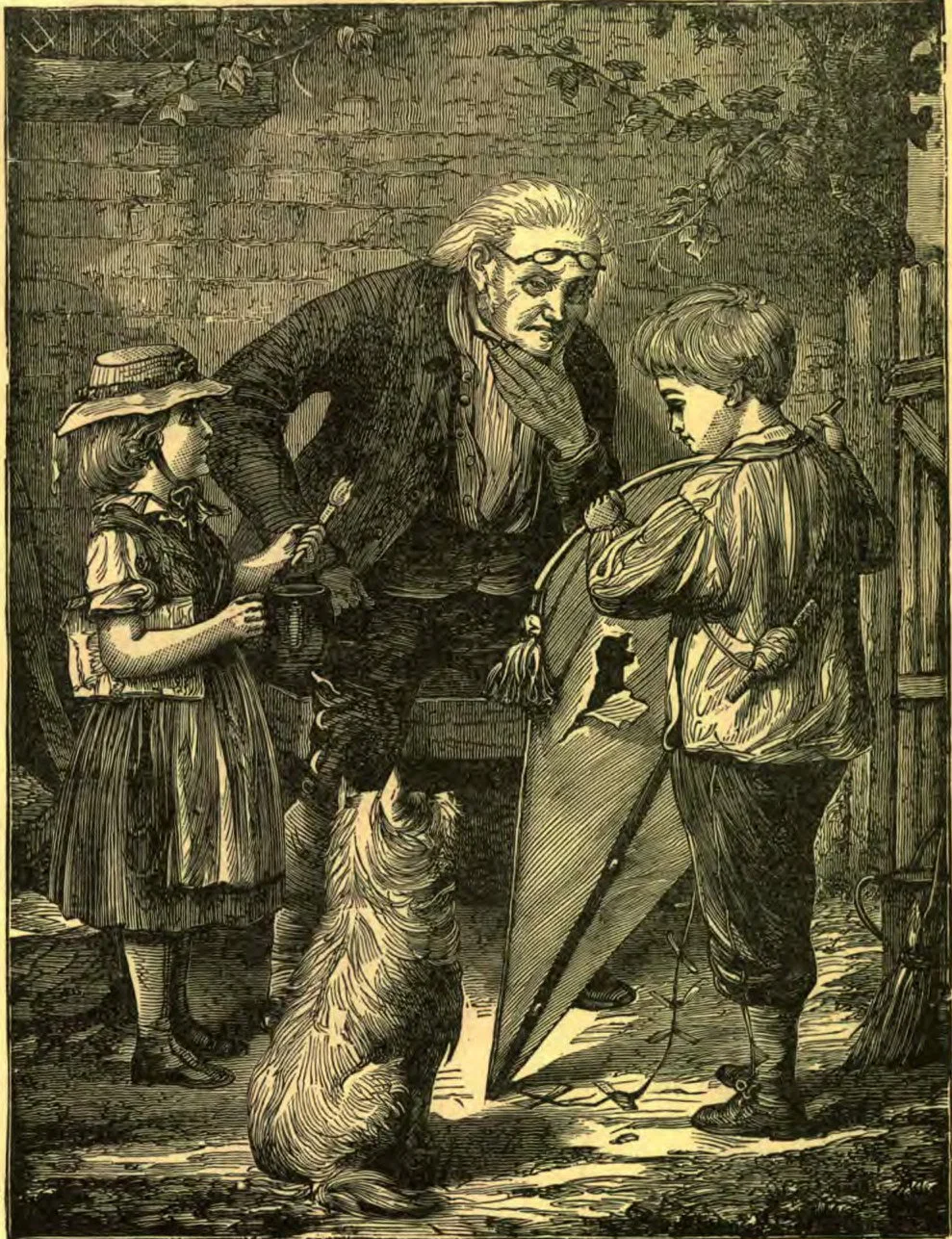
THE was such a fine kite this morning, grandpa, with her bright tags and pretty tassels, and flew up in the air, oh, so beautifully, just as if she was a great wing—up—up—till she looked like a speck on the sky; then I pulled her in a little, and she came fluttering down all zigzag at first, and one of the boughs of the elm-tree went right through her, and held her fast. I climbed the tree to take her down, and here is this great hole torn, and the paper in tatters! Oh, I am so sorry! What can I do? What can I do?" There was a little quiver in Charlie's voice, and if he had not been a boy, I should say that a tear or two fell upon the torn kite, which he hastily brushed away. "I'll tell you what we can do, Charlie," said little sister Betty; "we made the kite, and we can mend it. Come round by the garden-gate with the kite, and I'll bring some papers and my pot of paste, and we'll make it as good as new. Please, grandpa, come too, and tell us if we fix it right." So "Busy Betty," as grandpa called her, ran to the house and found papers and paste, while Charlie with the torn kite slowly followed grandpa through the garden-gate. The old man seated himself upon the stone bench outside the cottage door, took off his hat, and pushing his spectacles up, sat watching Busy Betty's fingers repairing the rents, making it as good as new, "though not quite as handsome," she said. Spitzbergen, too, the fine Pomeranian dog, sat by, looking a great deal, if he could not say it.
"Charlie," said grandpa, "I should not wonder if Busy Betty, and you and I, and Spitz too, might learn something from the torn kite. It is talking to me."
"What does it say, grandpa?" asked Busy Betty, as she pasted on a fresh piece of paper with her dear little hand.
"I did not know as my kite had any story, grandpa," said Charlie; "only that she is made of paper and sticks, and the first time I let her fly she got into trouble."
"One thing is," said grandpa, "that we must keep a good lookout. There are dangers and difficulties in every undertaking, which make it necessary to exercise caution and care and prudence, and he is a wise boy who calculates the chances that are against him as well as those for him."
"That's so," said Charlie. "I ought to have looked out for that tree, certain."
"Another is, my boy, that falls are damaging," said grandpa.
"And with all our patching and mending, our poor kite will never be a perfect kite again."
"Yes, I see that," said Charlie.
"But it will be as good as new," cried his sister cheerfully.
"Ah, there is nothing like having a little comforter ," said grandpa. "‘A friend in need is a friend indeed.’ It is in misfortunes that we need helping hands and sympathizing hearts."
"Yes, grandpa," said Charlie pleasantly, my sister is—is—splendid."
"In other words, a handy, helpful little girl, which is far better," said the old man, looking kindly on the little folks.—Child's Paper.

LITTLE BY LITTLE.

WHEN the new years come, and the old years go, How, little by little, all things grow! All things grow—and all decay— Little by little passing away. Little by little, on fertile plain, Ripen the harvests of golden grain, Waving and flashing in the sun When the summer days are done; Little by little they ripen so, As the new years come, and the old years go.
Low on the ground an acorn lies; Little by little it mounts to the skies, Shadow and shelter for wandering herds, Home for a hundred singing birds. Little by little the great rocks grew, Long, long ago, when the world was new: Slowly and silently, stately and free, Cities of coral under the sea Little by little are builded; while so The new years come, and the old years go.
Little by little old tasks are done; So are the crowns of the faithful won, So is Heaven in our hearts begun. With work and with weeping, with laughter and play, Little by little the longest day And the longest life are passing away, Passing without return; while so The new years come, and the old years go.
—Selected.

THE WEDDING GARMENT.

At the royal marriage of Sultan Mahmoud, a few years ago, every guest invited to the wedding, had made expressly for him, at the expense of the Sultan, a wedding garment. No one, however dignified his station, was permitted to enter into the presence-chamber of that sovereign without a change of raiment. This was formerly the universal custom in the East. But inasmuch as these garments were very costly, and some of the guests might plead poverty, and thus appear unclad in the guest-chamber of the king, the cost was defrayed at the Sultan Mahmoud's expense. To each guest was presented a suit of wedding garments. Had any, therefore, appeared before this absolute sovereign without the wedding garment, the Sultan would have deemed his dignity insulted, and his munificent gifts despised. The question, then, “Friend, how camest thou in hither not having on a wedding garment?” (Matt. 22:12) explains the speechless condition of the man. The wedding robe was ready, not at the expense of the invited one, but at the cost of the king. He had simply to obey the requirements of the Eastern State,—put on the garment, appear before the king, and do homage to him for his rich habit. His refusal to comply with this reasonable custom, and presuming, notwithstanding, to thrust himself into the presence of royalty, was an avowal that he denied his authority to rule over him, and despised his power. Hence he was bound hand and foot, and cast out.—Selected.

THE SILK-WORM.

The silk-worm, when full grown, is about three inches long, of a pale green color, with darker spots and a blackish head. It generally feeds on the leaves of the mulberry tree, of which it eats great quantities. The worm grows very rapidly, usually attaining its full size in about thirty days after it is hatched. Soon it begins spinning its cocoon. It is customary to supply the worms with a hollow roll of paper into which they may retire, or some convenient twig from which they may hang themselves before beginning to spin.
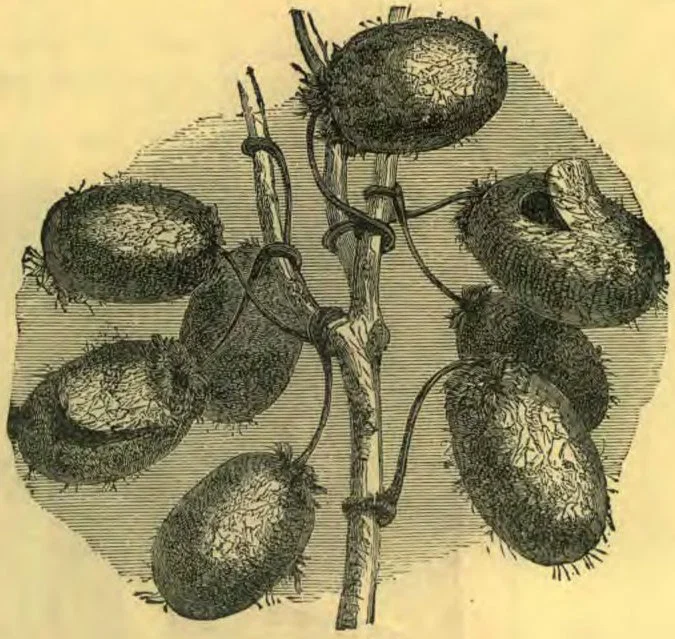
They first make an outer covering of floss-silk to keep off the rain; within this they spin fine silk, bending the head and body up and down, and crossing to every side, entirely surrounding themselves with a protection against wind and cold. Within this is a more delicate silk, glued firmly together for the inner chamber, and proof against both air and water. The cocoon, when finished, looks some like a pigeon’s egg, and is from an inch to an inch and a half long, and of a bright yellow color. In the picture we see several of these cocoons hanging from a twig. In from three to six weeks after the cocoon is finished, according to the warmth of the place where it is kept, the worm, now changed to a moth, bursts its prison, and makes its way into the world. Some of the cocoons in the picture you see are open at the side, which shows them to be empty.
By thus breaking through his wrappings, the moth of course cuts and spoils the threads of silk, thus making them unfit to be woven into cloth. So those who raise silk-worms for the silk do not wait for the cocoons to open of themselves, but a few days before the proper time for opening, they are either thrown into hot water or steamed, to soften the glue. When the silk is thus loosened, the threads are carefully unwound, and are then ready to be made into silk cloth or ribbons. When the cocoons are thrown into hot water, the moths within are killed; but when the glue is loosened by steaming, the little prisoners are allowed to come out alive. The latter way seems less cruel as well as more profitable for the silk-grower; for the escaped moth at once begins to lay eggs and prepare to raise more silk-worms.
Every time we wear anything made of silk, if no more than a bit of ribbon, and thus remember the curious little creature who gives his coat and even his house for our comfort, our minds should be led to Him who in his wisdom has fashioned all these wonderful things by which we are surrounded.
E. B.

Frost Pictures.

Standing at the window, On a winter’s day, Chattering like blackbirds; Wonder what they say.
Frost-king’s finest tracery, Clinging everywhere. Often I have studied, O’er these pictures fair.
And their very mystery Almost gave me pain. Will these child interpreters Make the matter plain!
“This is Grim the giant; Isn’t he so tall! It must hurt him badly, If he chanced to fall.”
“These are reindeer sledges. See the Esquimaux, Hidden by their fur coats, All but eyes and nose.”
“That is baby Moses In the little ark”— “Queer how all these came here, When it was so dark.”
“There two boys are—see them! Playing teeter-totter.” “Oh, I’ve found some ducklings, Swimming in the water.”
“This is Æsop’s satyr. See! blows hot and cold. If I hadn’t known him, Guess you couldn’t told.”
“Those are stars like heaven, And they twinkle—why, If you had your paints here, You could blue the sky.”
“See those lovely angels, Resting by the trees.” “Do you ’spect we’ll want to, When we’re made like these?”
Pass the hours so rapidly, While the sun’s bright beams, Sweep the mimic art gallery, Into tiny streams.
Now a small child’s standing, Wonder in his eyes, Vain regret commingling With the sad surprise.
“See! the window’s crying.” (Sage of five brief years) “All our pictures melted; Nothing left but tears.”
O my precious ones, ye bring to my mind, Bright scenes of the past I shall no more find. I once traced the frost-work as you have done, But it melted, and went as yours has gone.
As your youthful days go drifting away, Should your pictures melt as they do to-day, May the love of God shine through the years, Making a rainbow of all your tears.
When life’s journey is o’er, may we reach that home, Where hope cannot die, and no shadows come; Where the treasures we lose in the river of Time, Shall be ours for aye, in a changeless clime.
Mary Martin.

THE PERFECT PATTERN.

“Mamma, just see what a mistake I have made!” said Alice Stokes, as she held up a dress; “I have worked all the morning, that I might wear the dress this evening. It is too bad!” and the poor child burst into tears.
“I am sorry, Alice. How did you make such a mistake?” asked Mrs. Stokes, tenderly.
“I was not sufficiently careful in the pattern. You know the two were lying together, and I took the wrong one.”
“I see; but dry your eyes, child; it is possible that we can remedy it.”
“I wanted to wear it to-night, mother,” and again the tears burst forth.
“Provided you waste no time in weeping,” said the mother; “this can be done. I will leave my work, and help you arrange it.”
“And you are in such a hurry, mamma!” said Alice, as she tried to stop her tears.
“You have worked steadily, and I will help you so that you can wear your dress this evening. It is well that it is a mistake that can be rectified. It is possible for us to make a mistake that could not by any effort of ours be remedied.”
“How do you mean, mamma?”
“I was thinking of Christ as our pattern. If we should make a mistake, and follow another.”
“We could not, mamma,” exclaimed Alice.
“There are two patterns as there are two ways. The right of choice is ours. In telling me of your mistake, you said there were two patterns lying together, and you took the wrong one.”
“Yes, mamma.”
“Diligent as you were, your work was to no profit. You had a wrong pattern; fortunately it was but a dress, and by taking it out and cutting it over, we can remedy it. It will not be so with a life-work. We cannot go over the same ground.”
“Do you not see how necessary it is that we make sure that we have a correct pattern? Jesus Christ is the only perfect pattern. He took upon himself our nature, that we might have an example. He was tried more severely than human nature was ever tried,—hedged in with poverty, tempted, scourged, and spit upon,—still was he the perfect pattern in everything, showing us how we are to carry ourselves under adverse circumstances of life.”
“O mother, I never thought so much about Jesus as our exemplar. I hope I shall not make a mistake. I shall try harder than ever to imitate Christ, for now I see the necessity of having a perfect pattern.”—S. S. Times.

SCENES IN THE LIFE OF CHRIST.

LESSON 55.—THE TRANSFIGURATION.

A few days after the things happened that were spoken of in Lesson 53, Jesus took Peter and James and John up into a mountain to pray, and was there transfigured before them. This means that he was changed in appearance, and became glorious and beautiful, like heavenly beings. Matthew in describing it says, “His face did shine as the sun, and his raiment was white as the light.” For a time the disciples were so blinded that they could not look upon this glory, and their eyelids closed as though they were heavy with sleep. While they were in this condition, they heard two men talking with Jesus about his death, which was to take place at Jerusalem. After a little time they were able to look up, and they saw Moses and Elias, who were glorious in appearance, like their Master. Elias means the same as Elijah, and you will remember that he was translated. You will also remember that we had a very strange account of the death and burial of Moses. It is thought that God raised him from the dead and took him to Heaven. When our Lord comes in the clouds of heaven to claim his people, he will look as he did when he was transfigured before these disciples. All the good people that are then living will be translated as Elijah was, and the righteous dead will be raised as was Moses. They will all have bright and glorious bodies, and will be caught up to meet the Lord in the air. Thus we see that these disciples were shown just how it will be when the Lord shall come to take his kingdom, and so it may be said that they saw the kingdom of God.
Then Peter, speaking to Jesus, said, “Lord, it is good for us to be here. If thou wilt, let us make here three tabernacles; one for thee, and one for Moses, and one for Elias.” While he yet spake, behold a bright cloud overshadowed them; and a voice out of the cloud, which said, “This is my beloved son in whom I am well pleased; hear ye him.” And when the disciples heard it, they fell on their faces, and were sore afraid. And Jesus came and touched them, and said, “Arise, and be not afraid.” And when they had lifted up their eyes, they saw no man, save Jesus only. And as they came down from the mountain, Jesus charged them, saying, “Tell the vision to no man, until the Son of man be risen again from the dead.” And they kept that saying with themselves, questioning one with another what the rising of the dead should mean.
Now the Lord had promised by his prophet, that before the coming of the Messiah there should one be sent who should come in the spirit and power of Elijah. The disciples did not understand how Jesus could be the Messiah when no such prophet had appeared. But Jesus explained to them that John the Baptist was this prophet. The wicked Jews could not appreciate the goodness of this great man, and so they had allowed him to be shut up in prison, and finally beheaded. Jesus told his disciples that these wicked men would soon be as cruel to him as they had been to John the Baptist.

QUESTIONS

  1. What did Jesus do a few days after the things happened that are spoken of in Lesson 53? Matt. 17; Mark 9; Luke 9:27.
  2. What happened to Jesus as he was praying?
  3. What is meant by his being transfigured?
  4. What does Matthew say of it?
  5. What effect did this glory have upon the disciples at first?
  6. What did they hear while in this condition?
  7. On what subject were they talking with Jesus?
  8. As soon as they were able to look up, whom did they see with their Master?
  9. What is there strange and wonderful about the history of Elijah?
  10. Tell how Moses died, and how he was buried.
  11. Since he died and was buried, how could he now come with Elijah to Jesus?
  12. When our Lord comes in the clouds of heaven to claim his people, how will he look?
  13. What will happen to all the good people that are living at that time?
  14. What will happen to the righteous dead?
  15. What kind of bodies will all those have who are made immortal?
  16. Where will they meet their Lord?
  17. How may it be said that these disciples saw the kingdom of God?
  18. What did Peter say to his Master?
  19. What took place while he was speaking?
  20. What words did he hear from the cloud?
  21. How did these words affect the disciples?
  22. What did Jesus do for them?
  23. What did he say?
  24. When the disciples had lifted up their eyes, whom did they see?
  25. As they came down from the mountain, what charge did Jesus give them?
  26. What part of this remark troubled them?
  27. Who had the Lord said should come before the Messiah?
  28. Did the disciples know that any such prophet had come?
  29. How were they perplexed?
  30. How did Jesus explain this difficulty?
  31. Why had the Jews allowed John to be shut up in prison, and finally beheaded?
  32. How did Jesus tell his disciples that these wicked men would soon treat him?

LESSON 68.—JESUS AT THE FEAST OF DEDICATION.

One Sabbath day as Jesus was teaching in one of the Jewish synagogues, there was present a woman that had suffered from an infirmity eighteen years, “and was bowed together, and could in no wise lift up herself. And when Jesus saw her, he called her to him, and said unto her, Woman, thou art loosed from thine infirmity. And he laid his hands on her; and immediately she was made straight, and glorified God. And the ruler of the synagogue answered with indignation, because that Jesus had healed on the Sabbath day, and said unto the people, There are six days in which men ought to work; in them therefore come and be healed, and not on the Sabbath day. The Lord then answered him, and said, Thou hypocrite, doth not each one of you on the Sabbath loose his ox or his ass from the stall, and lead him away to watering? And ought not this woman, being a daughter of Abraham, whom Satan hath bound, lo, these eighteen years, be loosed from this bond on the Sabbath day? And when he had said these things, all his adversaries were ashamed; and all the people rejoiced for all the things that were done by him.”
“And it was at Jerusalem, the feast of the dedication, and it was winter. And Jesus walked in the temple, in Solomon’s porch. Then came the Jews round about him, and said unto him, How long dost thou make us to doubt? If thou be the Christ, tell us plainly. Jesus answered them, I told you, and ye believed not; the works that I do in my Father’s name, they bear witness of me. But ye believe not, because ye are not of my sheep, as I said unto you. My sheep hear my voice, and I know them, and they follow me; and I give unto them eternal life; and they shall never perish, neither shall any man pluck them out of my hand. My Father, which gave them me, is greater than all; and no man is able to pluck them out of my Father’s hand. I and my Father are one. Then the Jews took up stones again, to stone him. Jesus answered them, Many good works have I showed you from my Father; for which of those works do ye stone me? The Jews answered him, saying, For a good work we stone thee not; but for blasphemy; and because that thou, being a man, makest thyself God. Jesus answered them, Is it not written in your law, I said, Ye are gods? If he called them gods, unto whom the word of God came, and the scripture cannot be broken; say ye of him whom the Father hath sanctified, and sent into the world, Thou blasphemest; because I said, I am the Son of God? If I do not the works of my Father, believe me not. But if I do, though ye believe not me, believe the works: that ye may know, and believe, that the Father is in me, and I in him. Therefore they sought again to take him; but he escaped out of their hands, and went away again beyond Jordan, into the place where John at first baptized; and there he abode. And many resorted unto him, and said, John did no miracle; but all things that John spake of this man were true. And many believed on him there.”

QUESTIONS.

1. What unfortunate person was present one Sabbath day as Jesus was teaching in a Jewish synagogue? Luke 13: 11.
2. When Jesus had called this woman to him, what did he say to her?
3. What did he then do?
4. How did she show her gratitude?
5. How did this miracle please the ruler of the synagogue?
6. What did he say to the people?
7. How did our Lord answer him? Verses 15, 16.
8. What effect had this reply upon his adversaries?
9. How were the people affected?
10. At what time of year was the Feast of Dedication held? John 10: 22.
11. How did the Jews at this feast address Jesus as he was talking in Solomon’s porch?
12. How did Jesus answer them? Verse 25.
13. What did he say bore witness of him?
14. Why did not these Jews believe on Jesus?
15. Who is it that hear his voice, and follow him?
16. What will be their reward?
17. Why can no man pluck them out of their Saviour’s hand?
18. What did Jesus say about his unity with the Father?
19. How did the Jews then manifest their evil disposition?
20. What question did Jesus ask them? Verse 32.
21. How did the Jews answer him?
22. How did Jesus reply to them?
23. By what test was he willing to be tried? Verses 37, 38.
24. What then followed?
25. To what place did Jesus next go?
26. What did those say who resorted to him there?
27. What was the success of our Lord’s ministry in that place?

NOTES.

Ruler of the synagogue.—The charge of the Jewish synagogues was committed to two men. One had the care of the books of the law, led in the public worship, and performed other duties naturally belonging to a minister of the people. The other had charge of the building, and of the congregation during service, and often, during the week, acted as school-master to the town or village. His duties resembled those of a Christian deacon. Jairus was mentioned as “one of the rulers of the synagogue;” hence we conclude that this title was applied to either of the men just described. Owing to their position, they each had great influence with the people, and were often led by jealousy to falsely accuse Christ, and thus stir up the anger of the people against him.
The feast of the dedication.—Literally, the feast of the renewing, or of the renovation. When the temple and city were taken by Antiochus Epiphanes, in 167 B. C., this impious conqueror defiled the house of God with abominable sacrifices. But three years after, under the leadership of Judas Maccabaeus, the Jews regained possession of the city. They then purified the temple with ceremonies of great pomp and solemnity. At the same time they renewed certain portions of the structure that had suffered injury. Hence the feast celebrated yearly to commemorate this event, was called the feast of the dedication, or renovation. It was held at a time, corresponding to our fifteenth of December, and lasted eight days, the city being illuminated with lights, and the people indulging in continued demonstrations of joy throughout the feast.
Solomon’s porch.—On the inside of the temple wall were numbers of covered walks, called porches. They were built to furnish shade and protection to the people in hot or stormy weather. About twenty feet in width, paved with marble of different colors, and surmounted with flat roofs of costly cedar, which were supported by solid marble columns, so large that three men could scarcely stretch their arms so as to meet around them,—these porches were a favorite resort. The one most beautiful of all, was on the east side; it was the only remnant of Solomon’s work that remained in the second temple, and was therefore called by his name. As this feast was held in the winter, the unpleasant condition of the weather was the probable reason why Jesus walked in Solomon’s porch.
I said ye are gods.—See Psa. 82: 6. This was said of magistrates on account of the dignity and honor of their office, and it shows that the word translated “god” in that place might be applied to men. Such a use of the word is, however, rare.—Barnes.
If he called them gods, etc.—If those were termed gods who were only earthly magistrates, fallible mortals, and had no particular influence of the Divine Spirit (and that they are termed gods is evident from that Scripture which cannot be gainsayed), what greater reason, then, have I to say, I am the Son of God, and one with God, when, as Messiah, I have been consecrated, sent into the world, to instruct and save men; and when, as God, I have wrought miracles which could be performed by no power less than that of Omnipotence.—Clarke.

GOD IS LOVE.

CHILDREN, did you ever think how much God loves you? Perhaps you have sometimes felt that he was a stern God, and did not love you. If you have ever had those thoughts enter your mind, it was Satan, the great enemy of your souls, who put them there; for although God does not love sin, he loves the sinner. This love he has shown by giving his only Son to die for us, that through his death we might have eternal life. Oh, such wonderful love!
When you know that you have done those things that are displeasing in God’s sight, do not feel like giving up, but go to him, and ask him earnestly to pardon you. Perhaps this morning you started out with a firm determination to have a clean record for this day; but you found that the enemy was at work in every way to draw you from the right path. And to-night, in looking over your day’s record, you think perhaps that there is no use in your trying to do right. But do not feel so. Remember that God loves you, and wants you to love him. Then Jesus has been on this earth, and he knows just what trials we have to meet. If you are sincerely trying to serve him, he will help you in every time of need. “If any man sin, we have an advocate with the Father, Jesus Christ, the righteous.”
And now, will you not try to love God, and to believe that he loves you? If you love him really, you will love to obey him and keep his commandments . If we try to put away all sin from us, we shall by-and-by go to live where there is no sin, and there we can serve the Lord in the beauty of holiness. J. M. W.

A BOY'S LEISURE HOURS.

What a boy does with his leisure is most important; what he gets in school is mainly drill or exercises; it is a gymnasium to him; he must eat elsewhere. What he does with his spare hours determines his destiny. Suppose he reads history every day, or scientific books; in the course of a few years he becomes learned. It matters little what he undertakes; Latin, Greek, Hebrew, Sanskrit, all disappear if he uses spare time on them.
A boy was employed in a lawyer's office, and had the daily papers to amuse himself with. He commenced to study French, and at that little desk became a fluent reader and writer of the French language. He accomplished this by laying aside the newspaper, and taking up something not so amusing, but far more profitable.
A coachman was often obliged to wait long hours while his mistress made calls. He determined to improve the time; he found a small volume containing the Eclogues of Virgil, but could not read it, and so purchased a Latin Grammar. Day by day, he studied this, and finally mastered all its intricacies. His mistress came behind him one day, as he stood by the horses waiting for her, and asked him what he was so intently reading. “Only a bit of Virgil, my lady.” “What, do you read Latin?” “A little, my lady.” She mentioned this to her husband, who insisted that David should have a teacher to instruct him. In a few years he became a learned man, and was a useful and loved minister in Scotland.
A boy was hired to open and shut the gates to let the teams out of an iron mine. He sat on a log all day beside the gate. Sometimes an hour would pass before the teams came, and this he employed so well that there was scarcely any fact in history that escaped his attention. He began with a little book on English history that he found in the road; having learned that thoroughly, he borrowed of a minister, Goldsmith's History of Greece.
This good man became greatly interested in him, and loaned him books, and was often seen sitting by him on the log, conversing with him about the people of ancient times.
All of these examples go to show that in this country any one can learn who wants to. If he is at work, he still has three hours he can call his own. Let him use those wisely, and he can have his mind filled with stores of useful knowledge.—Scholar's Companion.

INTERRUPTING

Nobody likes to be interrupted by other people when talking. We like to say what we have to say, and finish it in peace. Some children allow themselves to form a rude and unmannerly habit of breaking in upon the conversation of older persons with questions and remarks of their own. It is very uncivil to do so. So, too, among your own brothers and sisters and schoolmates of your own age, let them speak without interrupting them. If one begins to tell a story, or bit of news, let him finish it; and if he makes mistakes that ought to be corrected, do it afterward. Don't be an interrupter.

“STILL WATERS”

Is the title of a newly published book of poems, by Eliza H. Morton, whose name has long been familiar to the readers of the INSTRUCTOR as the contributor of many excellent articles to its columns. All will doubtless be glad to hear of the publication of her poems in a permanent form. The book is a volume of 208 pages, neatly bound in cloth, with gilt lettering. Price $1.06. It may be obtained by addressing the author at Battle Creek., Mich., College.

TAKEN, NOT GIVEN.

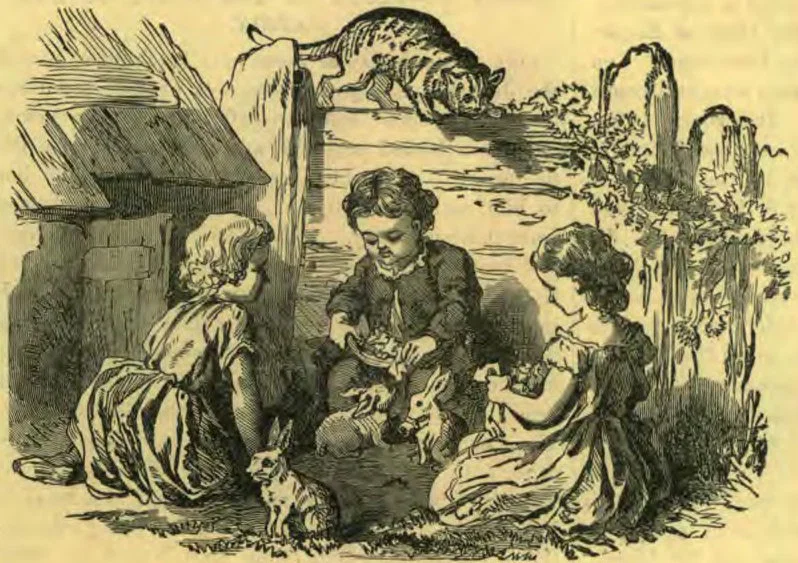
Do wish you would give Etta and me one of these rabbits," said Emma Bush to her cousin Nathan, as the three children crouched at the garden-gate with their laps full of cabbage-leaves, with which they were feeding the little creatures.
Now Nathan was a selfish boy, and he replied:—
“Oh, I can’t give away any of my rabbits. What do you girls want of living pets? You must go and play with your dolls.”
“Why, Nathan, we girls like living things, and we should enjoy the rabbits just as well as you do.”
“I don’t believe it.”
“I think you are unkind to say that you don’t believe it. And I am afraid you are selfish not to give us one, when, if you did, you would yet have two left to play with.”
“Well! you may say selfish, or whatever you please to say, I will not give up one of my rabbits.”
Just at this moment, the big tabby-cat, who had cautiously stolen on to the gate, back of the children, and had not been seen by them, sprang down over Nathan’s head, right upon the back of one of the poor rabbits, and setting her cruel teeth into its neck, laid it dead at Nathan’s feet.
All this was done so suddenly, and so unexpectedly to the children, that they had no opportunity to do anything to prevent it, and poor Nathan’s cry of distress over his lost treasure was really pitiful to hear. Emma did not say a word aloud, but her heart kept saying, “You would not give the rabbit up living, now you have to give it up dead.”
Nathan had the same thought, and it taught him a lesson. He has been more generous since; and whenever the inclination to selfishness comes strongly upon him, he remembers how the little rabbit was taken, and not given, and the thought cures his selfish feelings.—E. M. B.

Letter Budget.

Esther M. Richmond writes from Springfield, Mass. She says: “We have taken the Instructor a number of years, and are much interested in its teachings, and in the lessons. Mother says we will try to get some subscribers for it as soon as we can.”
Georgie A. Cole writes from Ekonk, Conn.: “I am twelve years old. I have read the Instructor a year, and like it very much. I have sent for it myself this year. I live with my grandparents, and I try to keep the Sabbath with them. My mother and my two little brothers also keep it. I hope you will think this worthy of printing.”
Ota B. Johnson, of Montezuma, Iowa, says: “I am twelve years old. I have two brothers and two sisters. One of my little brothers died this fall. He was a sweet baby, but God knew best, and we had to let him go. My pa and ma embraced the truth last fall when the tent elders, Bro. Fifield and Bro. Nicola, were here. We have a good Sabbath-school. There are not many of us, but God promises to be with us, though few. I want to be a good girl, and have a part in the first resurrection.”

MONKEY MOONSHINE.

LITTLE monkey moonshine, When the stars are bright, Swinging on the cornstacks In the dead of night;
Dancing o’er the meadows, Floating down the stream, Peeping through the windows To make the children dream;
Falling through the tree-tops, Tumbling o’er the lawn, Chasing bats and owlets Till the break of morn.
Then little monkey moonshine With the morning star Rides away to cloudland In a silver car. —Our Little Ones.

You have reached the end of this edition.

The Youth’s Instructor · Feb 8, 1882