The Youth’s Instructor, Vol. L, No. 17

Strive to Be Beautiful

The Youth’s Instructor

April 24, 1902

Review and Herald Publishing Company · Battle Creek, Mich. · April 24, 1902

Strive to Be Beautiful

HAVE you ever heard it said that “beauty is only skin deep”? Without doubt the idea has been brought to you in at least one of its many forms; for all over the world it has found those who are only too ready to act upon its suggestions.
But never was a greater falsehood foisted upon the world than the specious one that has taken so deep root as to become embodied in the household phrase that “beauty is only skin deep.” It is through a belief in, or at least a practical adoption of, this principle, that men, women, youth, and even children everywhere are led to go to such absurd lengths in their efforts at personal adornment. The paints and powders, the feathers and furbelows, the ribbons and ruffles, the rings and jewels, the trains and trinkets, the primping and curling, the extravagance and waste, shared in by all alike, are only the evidence that the world believes that beauty is all on the outside,—only skin deep.
Now this would not be so much to be wondered at if found only among savages; neither is it surprising that those who have never known Christ, and the beauty and charm of his life, should seek to find satisfaction in vanity and empty display. But it is amazing that professed followers of the Lord Jesus can turn, as so many do, to earth’s hollow show, and say by their lives that beauty is only superficial.
Perhaps it is not plain to you that those who adorn themselves to be seen of men do say that beauty is only a matter of the exterior. But consider for a moment. We act out what we really believe. Actions speak louder than words. The life describes the real belief. “By their fruits,” said Jesus, “ye shall know them.” If, then, a beautiful form covers a black, wicked heart; if the outside is polished and white, while the inside is filled with uncleanness, it is simply because the one who lives thus believes only in outside beauty.
This is not saying, however, that a beautiful face is necessarily a covering for wrong. If God has given any one a lovely countenance, let him thank the Lord that so much of the divine image has been preserved in him. We should recognize beauty as a gift, and forever keep it upon the altar of Christ, making it a continual glory to him. A beautiful face, like an exquisite flower, may constantly show forth the praises of him who reveals himself in his work.

What Is Beauty?

We speak of beauty. Do we truly know the meaning of the word? or, rather, are we so acquainted with the principle of beauty that we are able to recognize it whenever and wherever it may manifest itself? A little girl had seen the beauty, the charm, of the “golden rule;” and though, when asked to repeat it, she could not give the words, she said, “Don’t you do to some other little girl what you don’t want some other little girl to do to you.” She was in touch, practically, with the gold of the rule.
Nearly all young people have often heard repeated the quaint, homely, but strictly true expression, “Pretty is that pretty does.” This saying expresses a truth that should be kept ever before the mind. It teaches that beauty is a matter of character, and reaches to the inmost soul. It asserts positively that no beauty can be seen in the life of him who is barren of beautiful acts. It says in simple words exactly what each should ever know,—that the truest beauty is not that which appeals to the outward vision, but that which is discerned by the eye of the inner man.
The place in which God looks for beauty is the heart. How forcibly this truth was impressed upon the mind of Samuel when he was sent to anoint one of Jesse’s sons to be king over Israel! When Samuel saw Eliab, the eldest of the family, and noted his fine, manly form, he said, “Surely the Lord’s anointed is before him. But the Lord said unto Samuel, Look not on his countenance, or on the height of his stature; because I have refused him: for the Lord seeth not as man seeth; for man looketh on the outward appearance, but the Lord looketh on the heart.”

The Fairest among Ten Thousand

No one will doubt for a moment that of all the beautiful persons the world has ever seen, the one supremely lovely was Christ Jesus. And yet we know that even his beauty was of the life and heart. We read of him: “He shall grow up before him as a tender plant, and as a root out of a dry ground: he hath no form nor comeliness; and when we shall see him, there is no beauty that we should desire him.” Isa. 53:2. The world he came to save “knew him not;” for he was “a man of sorrows, and acquainted with grief.” And yet there were a few who saw, in the meekness and gentleness of his life, in his many acts of loving-kindness, in his long-suffering and mercy, in the sacrifice of himself for their good, the beauty of heaven. He “went about doing good, and healing all that were oppressed of the devil.” Beautiful deeds expressed his beautiful thoughts, and beautiful words flowed from his lips as a river of life, a healing stream.
Jesus is our example. His life is placed before us as the highest, the greatest, the best, the most charming. And so we are admonished to have our adorning not that “outward adorning of plaiting the hair, and of wearing of gold, or of putting on of apparel; but let it be the hidden man of the heart, in that which is not corruptible, even the ornament of a meek and quiet spirit, which is in the sight of God of great price.” 1 Peter 3:3, 4.

The Gift Is for All

Here is beauty which every one may aspire to obtain. The face may perhaps be ugly, the form bent, the mind slow, and even ignorant; but beneath the most uninviting exterior may be hidden the Christ life, which shall blossom in divine beauty. A noble purpose, manifesting itself in a straightforward, sincere, honorable life, makes its possessor appear even prepossessing, notwithstanding the freckles, scars, or wrinkles that may mar his countenance. There are many living to-day who will declare that “Sojourner Truth” had a beautiful face. Why?—Simply because of the work she sought to do for poor slaves. And few can look upon the likeness of Abraham Lincoln, and not see in those rugged, sad features something beautiful. Why?—Oh, the only answer that can be given is that in his face shines forth those principles of kindness and sympathy that endeared him to mankind while he lived.
Dear young friend, is it thus that you seek to be beautiful? Is your life adorned with the ornament of a meek and quiet spirit? Are you making within your soul temple those beautiful pictures that God and angels delight to behold? Is the gallery of your mind hung with pictures of pure thoughts, words, and deeds? Has the wisdom of the Lord Jesus been so wrought into your character that you reflect his image? The scripture says, “A man’s wisdom maketh his face to shine, and the boldness of his face shall be changed.” Forget not, then, that what you are constitutes the beauty or ugliness of your life. A fine complexion can never take the place of a noble character.
Innocence, purity, gentleness, courtesy, Kindness and love in the innermost shrine, Faithfulness, tenderness, prayerfulness, cheerfulness, All grace the life with a beauty divine. C. L. TAYLOR.

The Flying Squirrel

Down by the chimney's treacherous way A flying squirrel fell one day, And, terror-stricken, flew around, With scratching noise and bumping sound, Behind the pictures, chairs, and vases, In all obscure, protecting places.
And how persistently, with shout, And flapping cloth, and poker stout, We tried to drive the rascal out! There was the sunny world outside, And doors and windows open wide, Yet that poor beastie, foolish-wise, With quivering breast and frightened eyes, His little body one wild fear, He darted there and scuttled here, But shunned, the silly! o'er and o'er, The open windows and the door; Till last a nervous, lucky blow Worked the poor fool a happy woe,— Struck him to floor, a furry heap, And there he lay as if asleep. We took him up with tender care And bore him to the outer air, When suddenly his beady eyes Snapped open in a glad surprise; “Too good,” he thought it, “to be true, But yet I'll try,” and off he flew!
And so, dear human squirrels we, Caught where it is not best to be, By some mischance or likelier sin, The same wild, blundering course begin. We rave, we faint, we fly, we fall, We dash our heads against the wall, We scramble there, we scurry here, We palpitate in nameless fear, In stupid corners still we hide, And miss the windows, open wide, Till last, struck down by some stern blow That seems a climax to our woe, As there we lie in helplessness, God's great, strong hand of tenderness Closes around us, lifts us high, And bears us forth beneath the sky, And leaves us where we ought to be, Under blue heavens, glad and free.
—Amos R. Wells, in Well Spring.

Clematis Virginiana

Virgin’s-Bower, Traveler’s-Joy, Old-Man’s-Beard
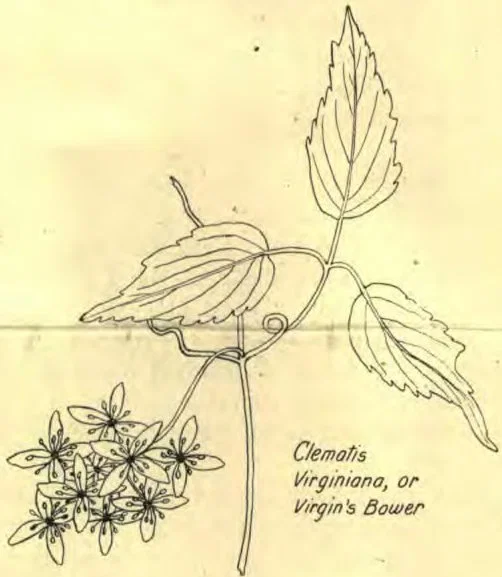
THE accompanying illustrations give a fairly good idea of the appearance of Virgin’s-bower. It will be noticed that the leaves are compound, consisting of three separate pieces known as “leaflets,” all having a common leaf-stalk by which they are attached to the stem.
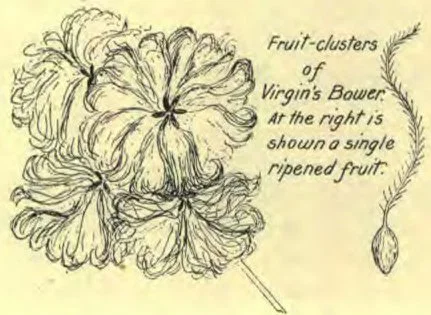
Fruit-clusters of Virgin's Bower. At the right is shown a single ripened fruit.
There are several kinds of compound leaves, some having all the leaflets attached to the tip of the leaf-stalk, while others have them attached along the sides. These will all be mentioned in future articles. Compound leaves having three leaflets, as is the case with the leaves of the Virgin’s-bower, are known as “ternate,” this word being derived from the Latin terni, meaning “by threes.”
The leaf-stalks, as will be seen from the illustration, are inserted opposite each other on the stem, and for this reason the leaves are said to be “opposite.”
If a number of different plants of Virgin’s-bower were examined, some would be found with flowers having stamens but no pistils, and others with flowers having pistils but no stamens. The former are staminate flowers, and the latter pistillate. Since the two kinds of flowers are borne on separate plants, they are described by botanists as dioecious (di-e’shus), meaning “of two households.” The flowers shown in the illustration are of the staminate sort.
The corolla is absent, but the calyx is present, consisting of four greenish-white sepals. It bears so close a resemblance to the corolla of other flowers that one unacquainted with the facts would think it a corolla instead of a calyx. The pistils are indefinite in number; that is, not of the same number in every flower.
In the lower figure is shown a single ripened fruit, or seed-vessel, of the Virgin’s-bower. The enlarged part containing the seed is the ovary, and the long, feathery appendage is the style. Ordinarily, when speaking of fruit, we refer to such edible products as apples, peaches, plums, grapes, berries, etc.; but in botanical language the term “fruit” is applied to the ripened ovary, together with other parts that are sometimes closely connected with it, such as the calyx, the style, and the receptacle. More will be said about the different kinds of fruits at another time.
The ovary of the Virgin’s-bower, when ripe, is a small, dry, one-seeded fruit, having very much the appearance of a naked seed. Fruits of this kind are called acheniums. The style may remain attached to the fruit, as is true of the plant under consideration, or it may fall off before maturity. When retained, it becomes elongated and feathery, thus aiding in scattering the seeds of the plant, as it enables them to be carried long distances through the air.
Clematis Virginiana, or Virgin’s Bower
Virgin’s-bower is one of the most common wild plants, growing nearly everywhere along the country roads, and in thickets and hedges, supporting itself by means of its bending or twisting leaf-stalks. Experiments regarding the movement of these leaf-stalks show that they make a complete circuit in about six hours, and that they follow the course of the sun. They revolve in as short a space of time as the tips of the morning-glory vine.
There is perhaps no other wild vine more beautiful than Virgin’s-bower as it hangs in graceful festoons from trees, climbs over shrubs and rocks, or covers fences and stone walls by the roadside, especially those roads that follow the river-courses. I have seen large numbers of these vines growing in Colorado along the mountain roads that follow the mountain streams. It flourishes even in extremely cold climates, will bear transplanting, and is excellent for decorating rustic fences.
In July and August it is covered with white blossoms, and a few weeks later the silvery plumes of the ripened fruits present a striking appearance, and have suggested the name, “Old-man’s-beard,” which is sometimes applied to it.
The different botanical terms mentioned in this article should be borne in mind, as we shall have occasion to use them again in future studies.
B. E. CRAWFORD.

In Search of the Mayflower

So much of April has to be taken up with rain and clouds that on a chilly, drizzling day we are apt to forget the hours of sweet, hot sunshine that are taking turns with the rain to melt the frost out of our hills and woods. But the moment the rain is over, or before,—a vigorous boy or girl is not going to be hurt by an April shower,—let us go out and look for the first spring flowers.
As far as I have seen, the race for first place in the spring pageant of flowers results in a tie. If you find a Mayflower just peeping open on the edge of a wood, you are pretty sure to see a nodding blue hepatica on the same day. The time of year varies, of course, as you go farther north, and with the particular season; but it is a good plan to be on the lookout for these two flowers, the leaders of the procession, as early as the first warm days in April.
The Mayflower (Epigaea repens), also called trailing arbutus and ground-laurel, belongs to the heath family, of which the rhododendron, the blueberry, and the English heather also are members. Every one knows its lovely, shell-like pink-and-white flowers, and its delicate fragrance, the first and most exquisite breath of the spring.
It is a little trailing plant with a tough, rusty stem and heart-shaped leaves very thickly netted, of a rather dull light-green. The flowers grow in clusters. They are gamopetalous; that is, instead of having five petals, as one would think, there is really but one petal—a slender tube opening out into five points. They vary from pure-white to a deep rose-pink.
Look first along the southern edge of a wood, on some bank or hillside facing the sun, and sheltered from all the cold north winds. You will be pretty sure at last to see a little white star, and then a cluster of pink buds.
A few days later you will find them blossoming thickly through the places that they like best of all,—fields of dead, dry grass, and brown, hummocky pastures. Here you will probably find the pinkest ones, usually one plant by itself, which for some reason has deep-rose colored flowers, while all its neighbors are in apple-blossom pink-and-white. The dark-pink Mayflowers are much prized, but they are hardly more beautiful than the pure-white ones, which blossom deep in the woods long after their sisters in the fields have withered. These Mayflowers growing in the woods have a character of their own: the plant is usually thin and straggling, not compact like those in the open field; the leaves are large and very green, and the large white flowers are apt to come singly instead of in thick clusters.
But, wherever you try to find Mayflowers, you must know how to look for them. When you see a flower, follow the stem carefully, and you will find that it brings up with it half a dozen pink clusters that were wholly hidden. Only sometimes after a warm spring rain the little flowers seem to come out to drink, and where the day before you could scarcely find one, you will see hundreds.
And a word about how to pick them. The stems are very tough. You try to break them, then to twist them; then you give a pull, and up the whole thing comes. Take two good things with you on your spring walks,—patience and a penknife; and, don't, because you like Mayflowers, destroy the little plants that might give so much pleasure to you and to other people year after year.—From the April St. Nicholas.

In April

SOFT on the hillside and on the plain Falls the sunshine of spring again. The snowdrifts vanish; the robins call Cheerily down from the maples tall; The grass shows green on the sunny slope, And the hearts of the flowers begin to hope.
MARY M. CURRIER.

Simple Means and Ordinary Qualities Bring Great Results

THE greatest results in life are usually attained by simple means and the exercise of ordinary qualities. The common life of every day, with its cares, necessities, and duties, affords ample opportunity for acquiring experience of the best kind; and its most beaten paths provide the true worker with abundant scope for effort and room for self-improvement. The great high-road of human welfare lies along the old highway of steadfast well-doing.—Smiles.

Big Ben

He is something of a paradox, is Big Ben; for in his case the part is greater than the whole. “The great clock at Westminster” is really the proper title of one of the largest and most accurate of the world’s public clocks. Popular sentiment, however; a feeling for the picturesque; coupled, perhaps, with the need of some shorter and less cumbrous name, all conspired to transfer the name of the bell on which the hours are struck to the clock itself.
As a matter of fact, Big Ben dates back considerably less than half a century; for he was placed in his present position only in 1859. Six or seven years before that, however, the decision had been reached that a clock should crown the palace at Westminster. That decision taken, the question arose: Who is to construct it? The leading maker of large clocks of the period was consulted; but he refused to consider its construction, as he did not believe that it would be possible for a clock to conform to the conditions laid down by the board of works, among them being the accuracy of the time which the clock should keep.
Under these circumstances the authorities turned to Mr. E. J. Dent, who had made the clock at the Royal Exchange, which was erected in 1845. It had run so well that it was believed its maker would be able satisfactorily to surmount the difficulties which the horologists feared.
Soon after the contract had been given, Mr. Dent died; and in consequence of much unworthy opposition on the part of rival firms, the authorities tried to break the contract, which his son, Mr. Frederick Dent, was prepared to carry out. Eventually, however, the contract was renewed. Even then more difficulties arose; for the clock tower was not ready for its reception, and the clock had to be kept going in the factory until 1859, when it was fixed in its present position.
The room in which the machinery of the clock is fixed is known as the clock-room. It is a large, bare chamber, reached by three hundred and seventy-four steps from the ground, and contains, in addition to the clock, merely a workbench, some ladders, and two benches on which the workmen and winders may rest. The clock is fifteen feet six inches long, four feet seven inches wide, and one foot seven inches deep.
Along the whole of its length, extending in a single line, is the following inscription:— “This clock was made in the year 1854, by Frederick Dent, of the Strand and the Royal Exchange, clockmaker to the Queen, from the designs of Edmund Beckett Denison, Q. C.,” while below it are the words: “Fixed here,” surmounting the date “1859.”
The arrangement of the machinery was almost a new departure from the old style of turret clock. Instead of being built perpendicularly, it is laid horizontally, so that any wheel may, if necessary, be taken out without disturbing the others. This is obviously a point of practical importance in a clock which it is necessary should be, and is, kept going with as few interruptions as possible. In the clock there are forty-four wheels, the largest of which is three feet four inches in diameter, and the smallest is six and three-fourths inches. The pendulum is thirteen feet one-half inch long, and weighs about seven hundred pounds, while the weight of the bob is about four hundredweight. Only a small portion of the pendulum can be seen in the clock-room, as it goes through the floor, and vibrates in a separate chamber below, in order to protect it from the wind.
In the body of the machinery of the clock are four small dials, by means of which the hands are set and the striking parts adjusted, so that all may go off simultaneously; for when the size of the hands is borne in mind, it is obvious that mechanical means must be devised in order that they may be moved and placed with absolute accuracy. In the machinery, too, is an electrical contact apparatus, by means of which twice every day, at twenty-two minutes to twelve and twenty-two minutes to one, the clock signals its time automatically to Greenwich Observatory; and Greenwich, by means of a galvanometer, gives its signal in the clock-room every hour.
How accurate Big Ben is may be judged from the fact that after its last cleaning it did not vary half a second a day for three weeks, while from March 28 to June 9, in a certain year for which the records were kept, its greatest variation was two seconds on one day; and, if fast or slow, it remained so for several days together, so that it practically did not vary at all. When it is remembered what weather we usually get in March and April, the claim that Big Ben is the most accurate public clock in the world can not be questioned.
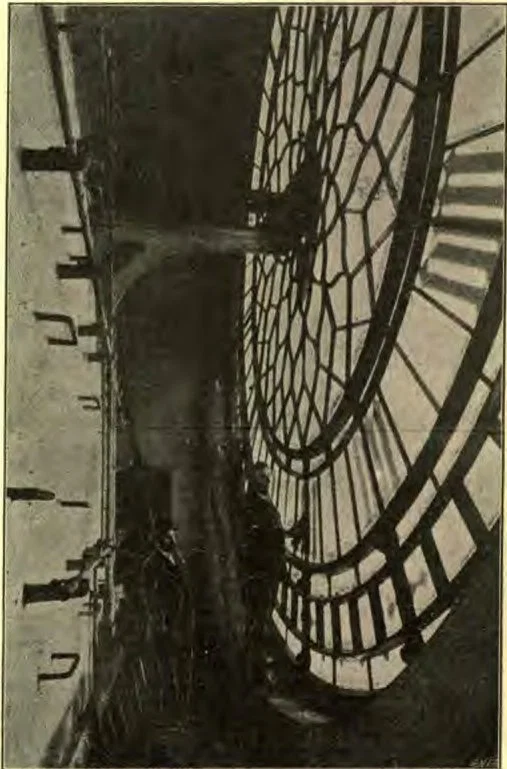
BEHIND THE FACE OF BIG BEN
To wind the clock two men are engaged three afternoons every week. The going part of the machinery is wound in twenty minutes, but it takes five hours to wind the striking. The winding of the strike is done by the turning of the handles of two winches connected with the barrels on which is wound the wire rope which carries the weight that drives the machinery, one hundred and twenty-five turns of the handle being necessary to get one turn of the barrel. As there are sixty turns of rope on each barrel, each man has to make considerably more than seven thousand turns of the handle to wind his part of the machinery.
As each quarter of an hour approaches, the winders are compelled to leave off, so that the machinery may be quiet for the clock to strike. The men need not, however, watch the time for this; for before it strikes, the clock itself always gives a special warning, one for the quarters and one for the hours.
When the strike goes off, one might be in a machine shop, in which a score of smiths were working with might and main. There is a rattle, rattle, rattle of machinery, a clanging and a clanking of steel on steel, making so much noise that it is impossible to hear one’s self speak in the room. The fans above the machinery whirl round and round, letting off the train of wheels which run at a certain speed under a weight of one ton five hundredweight for the quarters and of one ton for the hours. These weights pull down the ropes attached to the hammers of the bell; the hammers rise to a height of eleven inches in the case of the smaller bells, and to a height of fourteen inches for Big Ben, and, when allowed by the machinery to fall from that height, they strike. After the train of wheels working the strike is locked with a curious rattle of the machinery, there is another rattle as the fans themselves are in their turn locked, until the passage of another quarter of an hour releases them to start the striking again.
A short flight of nine steps leads from the clock-room into the dial-chamber, where one gets the first really appreciative view of the enormous size of the clock, whose proportions appear so ordinary when seen from the street. The chamber is merely a narrow space in which the four faces of the clock are fixed, with a special arrangement of nineteen or twenty jets arranged in five tiers by means of which the dial is illuminated at night. This room, whose walls are white-washed to reflect as much of the light as possible, furnishes, too, the first opportunity one gets for studying the enormous strength of the tower, the walls being about eighteen inches thick where the dial is fixed, while the corners are twice that depth. So firm and solid is the structure that, even when Big Ben himself strikes; no more vibration is to be felt than if one were in the street half a mile away.
Standing on the margin of the massive masonry into which the dial is fixed, the shoulder of a man of average height comes only just up to the level of the figures. Striking as this statement is, however, it is not wonderful when one is told that each dial, the center of which is one hundred and eighty feet from the ground, has a diameter of twenty-two feet six inches. The minute marks are each one foot long, separated by the distance of one foot, while the figures of the hours are two feet long. The minute-hands and counterpoise are fourteen feet in length, and weigh about two hundredweight each, in spite of the fact that they are hollow.
The first set of hands made were of gun-metal, but it was found that they were so heavy that no clock could drive them, so some lighter mode of design had to be sought; and copper, as being the most durable metal, was substituted for the alloy. The hour-hands, however, which, with their counterpoise, are eleven feet six inches long, are of gun-metal, and weigh about one hundredweight each.
From the clock-room, by means of forty-seven steps, the belfry is reached. In the middle stands Big Ben in all his glory of the largest bell to be seen in a public clock, with, at each angle of the belfry, one of the quarter-bells. Big Ben derives his name from his godfather, Sir Benjamin Hall, who was first commissioner of works at the time the clock was placed in the tower. Since then he has rarely stopped of his own accord, and has seldom been stopped for more than a few days at a time, in order to be cleaned.
Round Big Ben the following inscription may be read in the massive bronze: “This bell, weighing thirteen tons ten hundredweight three quarters fifteen pounds, was cast by George Mears, of Whitechapel, for the clock of the Houses of Parliament, under the direction of Edmund Beckett Denison, Q. C., in the twenty-first year of the reign of Queen Victoria, and in the year of our Lord MDCCCLVIII.”
Big Ben has a diameter of nine feet at the mouth, is struck with a hammer weighing seven hundredweight, and gives out the note E. The fourth quarter is struck on a bell six feet in diameter, weighing three tons eighteen hundredweight , its hammer being one hundred and seventy-five pounds, and its note E. This is the bell which is struck twice every quarter in order to make up the necessary notes for the chime. At one time when Big Ben was incapacitated, the hours were struck on it.
The second quarter bell is four feet in diameter, weighs one ton six hundredweight, has a hammer of sixty pounds, and F sharp for its note; while the first quarter is struck on the smallest bell, which is three feet nine inches in diameter, weighs one ton one hundredweight, has a hammer of fifty-six pounds, and G sharp for its note. The chimes of these bells when they sound the four quarters of the hour produce the air of the beautiful verse:—
“All through this hour, Lord, be my guide; And by thy power No foot shall slide.”
Most people know that Big Ben is really the second bell which was cast for the great clock. The first did not stand the tests which were instituted, and so was condemned. The same metal, however, was recast, and the result is Big Ben the second. He is not so perfect as he might be, in spite of his size and the sonority of his voice; for there is a crack in the metal. A platform has been built under the bells for the express purpose of catching the pieces in case the constant striking should ever cause the great bell to break. This, however, is scarcely likely to happen for a very long time to come, as on one occasion when the clock was stopped for the purpose of being cleaned, some fourteen years ago, Big Ben was shifted so that the hammer, which is very much lighter than the one originally intended to be used, does not strike it near the crack. In the platform a great hole has been cut, through which Big Ben’s clapper goes; but so far as can be learned, the bell has never been tolled.—The Strand Magazine.

Echoes from the Field

Mrs. L. V. Beach, Huron, South Dakota: “We have about fifteen church-school teachers and Bible workers, who will form a Society.”
Peter A. Nestle, Howard City, Michigan: “We have nine members in our Young People’s Society. We have given away about three hundred tracts and about two hundred papers. Have sold one copy of ‘Christ’s Object Lessons.’”
C. E. Peckover, Atchison, Kansas: “We have an earnest company of about twenty-five devoted young people who attend our meetings. We meet each Sabbath afternoon for Bible study. The young people’s work here is onward and upward to victory.”
Isabella B. Campbell, Sault Ste. Marie, Michigan: “We organized our Society eight weeks ago. We have ten members, all of them new in the truth; so we have been studying the message, that they may be able to give an intelligent reason for their hope. All are canvassing for ‘Christ’s Object Lessons,’ and some are also selling and loaning the Signs and tracts. We shall order a club of INSTRUCTORS soon.”
W. G. Dick, Topeka, Kansas: “Our Young People’s Society has been organized but a short time. Our numbers are few—we have but twelve members. There are not many young people in this church, and the church-members are scattered over a wide range of territory. We have some excellent workers in our Society, and others besides the members are taking an interest in the study. Our meetings are held on Sunday evening, and we are encouraged by the assurance that they have accomplished some good.”

JAMES BELLINGER

From the School at Anoka, Minnesota

WE have enjoyed reading the reports of other Societies, and thought they would be glad to know that there is a band of young people in Anoka who are trying to help give the message for this last generation. In January the school organized - a Society called “The Minnesota Union Conference Society.” Our purpose was to study the mission fields, distribute our literature from house to house, visit the people, and gain an experience in lines of practical missionary work, that would help us in the future. Since beginning we have held thirty-eight cottage meetings, and a number of the people are interested. We are glad that we can study the precious word of truth with them, and praise God for the many blessings received in so doing. Three meetings are held every Sabbath afternoon. We also have a meeting about a mile and a half in the country every Saturday afternoon, where we are taking up a study in the prophecies. The people manifest considerable interest, and we hope for good results.
Seven missionary visits have been made to the poor and aged.
Nearly seven hundred pages of tracts have been given away. The Spirit of the Lord tells us that our tracts should be scattered like the autumn leaves, and we are trying to do our part in this work. We have given away about two hundred and fifty papers. Several of the students are planning to canvass during the summer. We trust that when they go out into the field, they will hold the standard high, and show the world that our aim is to give “the advent message to the world in this generation.”

JAMES BELLINGER

ETHEL COCHRAN

From Provo City, Utah

The meetings of our Young People's Society are very interesting. We have an excellent leader, and the young people take a deep interest in the work. Our meetings are held on Sabbath afternoon. Since we first organized, our numbers have increased until we had to send for an additional supply of the Membership Cards. The studies in the INSTRUCTOR are used, and we find them very helpful.
We thought it would be a good plan to keep the reading-racks in our depots filled with all kinds of good, fresh reading. A committee of three was appointed to attend to this work, the rest of us helping as we can. I am glad to say that the plan has proved a success, and we hope that we may be able to keep it up. We also have the city districted, and persons assigned to each ward, to distribute tracts to each house in their territory. Our young people are also selling pamphlets. We are trying to do what the Lord wants us to do. We are praying that our work may continue to be successful, and prove a help to our young people and to the world.

ETHEL COCHRAN

RUTH SAXBY

From Charlotte, Michigan

WE organized a Young People's Society in our Charlotte church, with a membership of fifteen. The outlines in the INSTRUCTOR are used as the basis of our study. There is good interest, and our numbers are increasing. We are trying in several ways to help in giving the third angel's message to all the world.

RUTH SAXBY

Continue reading: Studies in the Message