HOW TO STUDY THESE LESSONS.— (1) Read the lesson story; (2) try to recall or find scriptures in proof of each statement; (3) study the texts; (4) see how many missing links you can supply; (5) give the lesson to some one else. You will keep only what you give away.
To know God is to have eternal life. Because God is love, he will never immortalize pain and sorrow. Whoever chooses to take the road to happiness, will have all eternity to be happy in. But whoever chooses the way to sorrow—the way of disobedience—thereby chooses death. Love has determined that sorrow shall be abolished. God warned our first parents that if they ate of the forbidden tree, they would surely die. Satan accused God of lying, and said, “Ye shall not surely die.” Man unreasonably chose to believe Satan’s lie. But Satan still tells the same old lie. He still claims that men do not really die. He says they only seem to die,—that the real man is “like God,” and can not die. But we can be glad that God tells the truth. In a little while there will be no wicked. No place will be found for them in earth or in heaven. They will be as if they had never been. Satan—the murderer—destroys men by getting them to believe his lies.
In a little while there will be no wicked. Ps. 37:10, 11.
There will be no place for the wicked. Vs. 10, 36; Dan. 2:35. Say it over and over, “For the wicked there will be no place,”—no place, thank God! no place of suffering through all eternity, neither in earth nor in heaven nor in hell.
We organized our Society some time before the holidays. At that time there was a good number, so we chose one of the older members of the church as president. With three other young people from our church, he soon went to Cedar Lake to attend school, and that left me to act as leader. We have five earnest workers, and we trust that the Lord will move upon the hearts of more to join. I am very thankful that we can have a part in giving the last message to the world. The scripture says that “the race is not to the swift, nor the battle to the strong;” and I believe that God can do a mighty work for the upbuilding of his cause and kingdom through so small a number as five, if we are truly consecrated to him.
The line of study taken up in our meetings has been largely from the YOUTH’S INSTRUCTOR, and has been greatly enjoyed. Our missionary work has been distributing papers, loaning books, reading to and visiting the sick, also selling “Christ’s Object Lessons,” etc. Our Society is in good running condition now; and as we take up the new studies on the different phases of the message, we hope for an increased interest.
ALBERT NUNAMAKER
The Good Book
By Elizabeth Rosser
I'm glad that the Bible was written for all.
The rich and the poor, the great and the small,
The joyous and sad, to that page may repair;
For whatever they need has been stored for them there.
Here the soldier may read of brave warriors bold,—
Of Joshua, Gideon, and Barak of old;
Of David, who silenced the enemy's boast;
Of Jesus, who marshals the heavenly host.
The children may read of a beautiful throng
Who with shouts of “Hosanna!” went trooping along;
The babe in the ark by the river-side laid;
The boy whose gay coat by his father was made;
The child who, when called, answered, “Lord, here am I;”
The lad who went home from the reapers to die;
And, sweetest and purest and best of them all,—
The Babe who was cradled in Bethlehem's stall.
And here may the mourner, with sorrow-rent robe,
Con o’er the afflictions and trials of Job;
Lament with King David o’er Absalom slain;
And weep o’er her son with the widow of Nain:
If over the grave of child, father, or friend, Bereft and heart-stricken, thou art called on to bend,
Repair to the cavern where Lazarus sleeps,
And learn that thy Saviour with mourning hearts weeps.
With stories for women how rich is this tome!
Here Ruth and Naomi go joyfully home;
Here Abigail journeys King David to meet,
And the daughter of Jephthah her father to greet;
And here grave Elizabeth, mother of John;
And Mary, the Princess, adoring her Son;
And Martha, who waited at Bethany's board;
And Mary, who sat at the feet of her Lord.
O, the sad and the happy, the high and the low,
The young and the old, to the Bible may go!
Here the fool may find wisdom; the wise find delight;
And the sinner be told how his heart may be white.
Here the homeless may read of his home in the sky;
The thirsty find springs that shall never be dry;
The naked find robes; the hungry find bread;
And grace here is poured on the penitent's head.
ELIZABETH ROSSER.
My Little Japanese Boy
By Fred Myron Colby
YASHITOMO is the name of a little Japanese boy that I know. Japan, the country where he lives, is a wonderful little empire of Asia, including a number of islands on the eastern coast not far from China. The Japanese belong to the same race, and somewhat resemble the Chinese in looks. They are handsomer, however, than their neighbors, and are very bright, active, and intelligent.
Tokyo, formerly called Yeddo, is the capital of Japan, and it is at Tokyo that Yashitomo lives. It is a fine, large city, with nearly as many inhabitants as New York. Here is the residence of the mikado, as the emperor of Japan is called. Its port is Yokohama, with which it is connected by a road, or street, seventeen miles long, lined on each side with tea-houses, gardens, and shops, in which are set out for sale all kinds of Japanese wares.
Yashitomo’s father owns one of these shops, and every day he may be seen there waiting on his customers, dressed in a cotton gown with short, wide sleeves, the under side being sewed together to serve as a pocket. He wears sandals made of plaited rice-straw, and does not wear a hat except in rainy weather, or when he goes away from home. Here sometimes Yashitomo himself may be seen helping his father, or flying his kite in front of the shop.
You may imagine a small, active, brown body clad in a tunic, or shirt-like garment, with arms and legs quite bare. His eyes are dark-brown, and set a little obliquely; his hair is black and thick, and shining from the use of oil. The kite that he has is quite as tall as himself, and resembles a human figure in a grotesque position. Every boy has a kite in Japan, and one may see them flying them everywhere at all times of day.
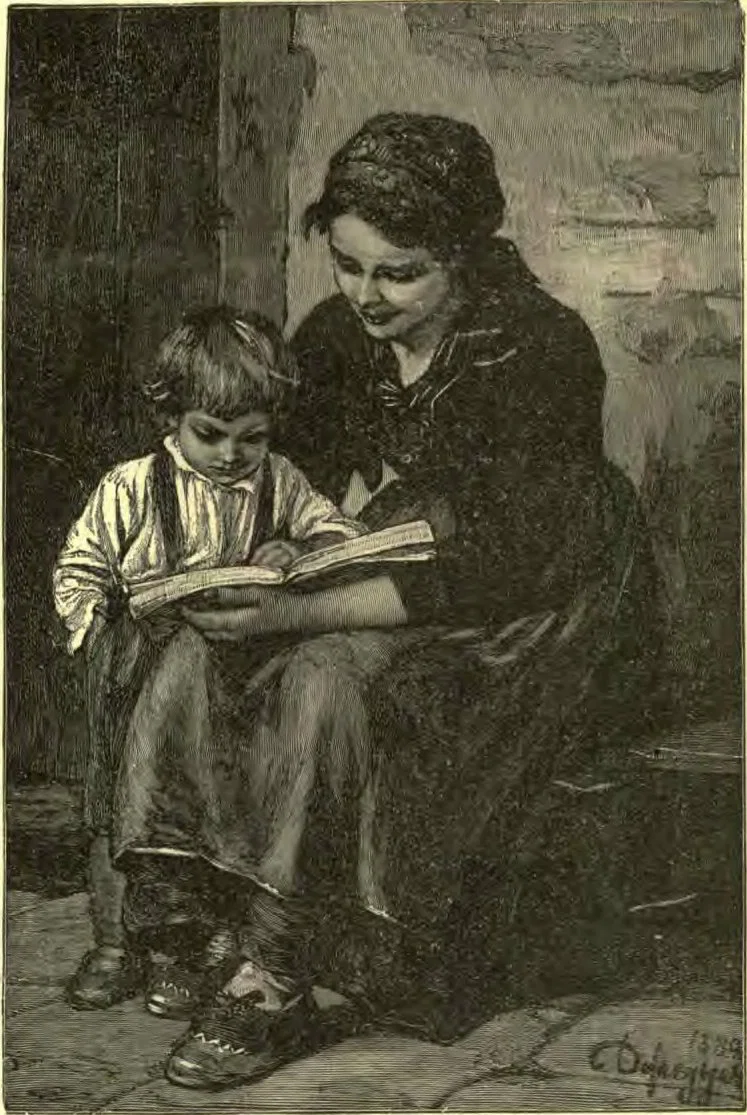
“THE CHILDREN MAY READ OF A BEAUTIFUL THRONG”
This shop of Yashitomo’s father is a quaint, curious enough building to our eyes. It is built of wood and cement, two stories high, and the roof is covered with rush mats three or four inches thick. It has no chimney. In cold weather the shop is warmed with charcoal in a copper stove. No chairs are to be seen. When the shopkeeper wishes to rest, he squats upon a straw mat. The doors of the shop are made of paper, and slide back and forth without the least noise. In this shop is a valuable collection of japanned ware. The Japanese are famous for their skill in manufacturing fine porcelain and lacquered ware. Japanese vases and bronze and wood carvings are much admired. Yashitomo’s father is not only a seller but a manufacturer of this beautiful japanned work. In making it the juice of the valuable varnish-tree is used. In the back part of his shop he has quite a number of artisans employed in the work. These manufactures he sells to residents and to many foreigners who visit Tokyo every year.
It is interesting to stand at the door of this shop and view the novel sights. Everything is different from what it is in this country. But Yashitomo would think everything strange here in America. There are the buildings, most of them low, with projecting roofs and large piazzas, resembling somewhat the old Dutch houses of New York. And there are the ever-changing, curious crowds. Armed officials of high rank, with trains of attendants, looking very gorgeous in their silken robes, jostle one another in this crowded thoroughfare. You can tell their rank by the number of swords they wear. When they meet, the one with the fewest number of swords has to bow the lowest. Some of the higher dignitaries have umbrellas borne over them. An umbrella is always an accompaniment of rank in Japan.
What will strike you as most curious is the different ways of traveling in Japan. Horses are almost as scarce as cows, and the average Japanese horse is scrawny, scraggy, and undersized. When used as a beast of burden, the driver usually walks beside the animal instead of riding him; and when hitched to a cart, he goes in front and leads him.
The greater number of conveyances are propelled by human hands. The most common carriage is the small, two-wheeled vehicle, called “jinrikisha.” These are in shape like a miniature gig, and as a rule drawn by a single coolie, though for rapid traveling two men are sometimes employed. Many are of sufficient size to carry two persons. There are ten thousand of these vehicles used in the city of Tokyo alone.
Then there are two kinds of palanquins in use,—the “norimono,” which is a large litter carried by several bearers, and principally used by persons of the better class; and the “kago,” a mere basket-work contrivance slung from a pole carried across the shoulders of two coolies. For the transportation of baggage or heavy goods, large two-wheeled carts are in use. These are pushed along by four or six coolies.
So the crowd comes and goes. In a jinrikisha ride two handsome ladies dressed in gay embroidered silks. Near by are two fishermen in strange costumes of straw. There comes a laborer, wearing a conical, broad-brimmed hat. He has a knife, a sickle, and a pair of large shears in his hands. He is a gardener, and is master of the art of dwarfing trees to the height of five feet or of seven inches, and can trim plants to the exact shape of any bird or beast. In the adjacent gardens you will see much of his work.
All at once there is a great movement and stir in the crowded thoroughfare. What does it mean?—An imperial mail-carrier, returning from one of the inland cities, is rushing through. He134is a stout, powerful person, and nearly naked. On his back is a pack that resembles a knapsack. He is running with all his might, and everybody gets out of his way. If any one should be unfortunate enough to impede his passage, he would be severely punished, and perhaps even lose his life.
Walking along the street, you will see other shops with all kinds of merchandise for sale. Many of the things are eatables, such as dried fishes, one-and-one-half inches long, impaled on sticks; sweetmeats composed of rice, flour, and a very little sugar; circular lumps of rice dough, called “mochi;” roots boiled in brine; a white jelly made from beans; also ropes, straw shoes for men and horses, straw cloaks, paper umbrellas, paper waterproofs, paper handkerchiefs, toothpicks, tobacco pipes, hairpins, and other trifles made of bamboo, straw, glass, and wood.
These goods are on stands, and in the room behind, open to the street, all the domestic avocations are going on, and the housewife is usually to be seen boiling water or sewing, with a baby tucked in the back of her dress. In some places you will see the people husking rice,—a laborious process, in which the grain is pounded in a mortar sunk in the floor by a flat-ended wooden pestle attached to a long, horizontal lever, which is worked by the feet of a man, invariably naked, who stands at the other end.
But about our Japanese boy. Does he ever go to school, like the boys of America?—Yes, Yashitomo goes to school, and a very good school it is. The “house of learning,” as the schoolhouse is called in Japan, is frequently the most imposing building in the village. There the little Japanese learns to read and write, and as he gets older, has some of the ancient Japanese works placed in his hands, such as the Manyashin, or “Collection of a Myriad Leaves,” or the Hiakuninshin, or “Collection of One Hundred Persons.” For reading of a general nature Yashitomo has little stories and histories. These books are all written after the Chinese style,—and you know the beginning of a Japanese book is where our volume ends.
Yashitomo has two pretty sisters, both younger than himself. The name of one is Sono Hara, that of the other Ume Tsuda. They live in greater seclusion than their brother. They will probably marry before they are sixteen. They will then have their teeth blackened, their eyebrows plucked out, and ugliness cultivated to the greatest extent. By that time Yashitomo will be a boy no longer. He, too, will marry, and will have a shop of his own; and I dare say if you should go to Tokyo, you might see our little Japanese boy, good-natured and courteous, dispensing his wares to his numerous buyers with that ease and urbanity that is natural only to the Oriental. We will hope, too, that by that time Yashitomo will be a Christian.—Fred Myron Colby.
Work Joyously
By Mary A. P. Stansbury
It is sorrowful, yet doubtless true, that twenty persons may be found who work faithfully, perseveringly, or skilfully, for one who works joyfully. Yet the joy of work to him who knows what it is, is one of the most exquisite of which he is capable.
To love the labor of one's trade, apart from any question of success or fame, is a precious secret; and only he who habitually relates his own small portion of labor to the general business of the universe, holds the key of it.
The laborer throwing up a railway embankment, is not—did he but understand—merely shoveling dirt, but making a highway for Christian civilization, and so helping to expedite God's errands. To the sooty-faced miner delving in the dark, has been assigned the honor of unlocking the divine storehouses filled, uncounted ages ago, for the uses of man. The accountant bending over his endless columns of figures must avail himself of those exact principles of mathematics by which the worlds are held in balance. Even the cook, toiling among her kettles, is only a minister of that Providence which nourishes all that it has created. There is no such thing as “common labor.” Every true worker may have a patent of nobility, for the claiming, with the right to call himself “helper to the King.”
The rewards of work are of two kinds,—those which come from without, and those which grow up from within. The first are not to be despised. Some portion of material wage, some degree of the appreciation of one's fellows, is the rightful due of honest accomplishment. But without the second, no labor, however remunerative in coin or fame, can be better than paid drudgery.
There is, then, no truer philosophy of words than that which names a man's trade or occupation his “calling.” Happy is he who can answer, “Here am I, with all that I possess of power of hand or brain, to be used with gladness.”
—Mary A. P. Stansbury.
THE INTERMEDIATE LESSON
V— The Sea and the Dry Land
(May 3) *
"And God said, Let the waters under the heaven be gathered together unto one place, and let the dry land appear: and it was so. And God called the dry land Earth; and the gathering together of the waters called he Seas: and God saw that it was good." Gen. 1:9, 10.
"Who laid the foundations of the earth, that it should not be removed forever. Thou coveredst it with the deep as with a garment: the waters stood above the mountains. At thy rebuke they fled; at the voice of thy thunder they hastened away. They go up by the mountains; they go down by the valleys unto the place which thou hast founded for them. Thou hast set a bound that they may not pass over; that they turn not again to cover the earth." Ps. 104:5-9.
He has "placed the sand for the bound of the sea by a perpetual decree, that it can not pass it: and though the waters thereof toss themselves, yet can they not prevail; though they roar, yet can they not pass over it?" Jer. 5:22.
"All the rivers run into the sea." Eccl. 1:7. "In him [Jesus] all things consist [“hold together,” margin, R. V.]." Col. 1:17.
(The Scripture texts are the lesson to be studied. Go over these carefully every day, until you know just what each one teaches. Then the following notes will help to a fuller understanding of the lesson. Read them carefully several times. Lastly go over all the questions, and be sure you can answer each one in the words of Scripture.)
How beautifully the story of the work of the third day of creation is told in the one hundred and fourth psalm! When the waters covered the earth, and stood above the tops of the highest mountains, at the command of God they fled and hastened away. What made the waters so quick to obey the word of God?—It was the Spirit of God that moved upon them. This was what sent them rushing to the place that he had founded for them, and it is this that keeps them there to-day.135
We have already learned that the Spirit of God is in the depths, and in the uttermost parts of the sea, and this is what rules the mighty waters so that they can not pass the command of God, and go beyond the bounds that he set for them when he said, "Here shall thy proud waves be stayed." The raging, tossing sea, which can tear the strongest ships in pieces, and destroy all the works of man, can not prevail against the word of God. He is mightier than the mighty waves of the sea.
We have the dry land to live and walk upon, only because the mighty Spirit of God is holding back the waters so that they shall not overflow the earth, and sweep us away. The living word of God is still speaking to the waters, and they hear and obey.
This is why the waters of the earth are all rushing toward the sea. They still go up by the mountains, and down by the valleys, to the place that God has founded for them. "All the rivers run into the sea" in obedience to the word of God, "Let the waters . . . be gathered together unto one place." And as they go, they refresh the thirsty land, and their constant motion keeps them pure and fresh, to give drink to man and bird and beast.
We look at the mighty ocean, and think what a great work God is doing to keep it in its place and to control its raging waters. But no less wonderful is his work of making and keeping the dry land under our feet. Have you learned to see his power working there also?
You have seen clouds of dust fly up into the air, but it has soon settled down upon the ground again. And you have thrown things up into the air, but instead of flying off into space, they have always come back to the earth. This is because there is a power in the earth that holds it together, and draws things toward it.
That power is Jesus, who fills all things by his Spirit. This is what holds the earth together, and keeps the solid ground under our feet. So we are all the time held up by the power of God, and resting on his word, whether we know it or not.
This is the power of God, and "God is love." So it is love that draws all things together, and keeps the earth from being dissolved, and scattered into atoms. The earth is filled with the mercy and love of God.
The Spirit of power which rules the sea is able to make you as quick as the waters to obey the word of God; to keep you from evil passions; to rule over your temper, and check the angry words that rise to your lips, and to give you peace. Will you not give yourself into his keeping?
The Spirit of God that holds the earth together fills you also, holding you in form, and giving you life. Will you not be drawn by his loving-kindness to give your heart to him? If you do, he will fill you with his own attractive power, and make you the means of drawing others to him.
Questions
What did God say to the waters?
What did he command to appear?
What took place as soon as he said this?
What did God call the dry land?
What did he call the gathering together of the waters?
What made the waters obey God's word?
How are they kept from covering the earth again?
What has God set for the bound of the sea?
What can not the waters do?
Why can not the mighty waters prevail over the word of God?
Where do all the rivers run?
Why do all the waters of the earth still run into the sea?
How is the earth held together?
How can we see God's power in the dry land, as well as in the sea?
What was done on the first day? The second?
Tell three ways in which we can see that the word which God spoke on the third day still lives and works.
How We Might Live
By Margaret E. Sangster
For any of us can there be on the road of life a sweeter fruition than to learn God’s will, and to dwell within it, as in a secure abode? Not to make exceptions, not to choose, not to murmur, not to strain at the leash, but to feel in every pore of being and in every conscious breath that God’s will is best, and that it is joy and gladness to be used as God pleases.
So living, we can never know defeat or disappointment. Failure on the earthly side may be success on the heavenly side. If we stumble, we are aware of a hand that was pierced swift to uplift us. If we sin, we repent, and begin again, sure that our infirmities are pardoned, and our sins blotted out. And the way, though steep and stony, is forever up, up, up, till we enter in the golden hereafter of an eternity in Immanuel’s land.—Margaret E. Sangster.
Braiding and Weaving Horsehair: Mexican Ornamental Craft
By J. Edgar Ross
Introduction
THE art of braiding and weaving horsehair, as practiced by the Mexicans, is an ornamental rather than useful one. Watch-chains, hatbands, whips, and riding-bridles made in this manner are often seen in the Western and Southwestern States as well as in Mexico. But even there a fine specimen of this work never fails to attract admiration from all who see it, and wonder from those who do not understand how it is made.
The writer has never seen this work in the East, nor has he ever met an Easterner who was familiar with it. From these facts he feels safe in assuming that articles of this kind, if well made, would find a ready sale throughout the Eastern States.
Any person of ordinary intelligence can obtain a practical knowledge of any mechanical art if he goes about it in the right way. The first thing necessary is to secure as an instructor one who is thoroughly familiar with all the details of the art he essays to teach. This done, one needs but to master each step of the operation from the time he begins to work with the raw materials until the completion of the article he undertakes to make. If he makes a mistake, it is the duty of his instructor to point it out; if at any point he finds himself unable to proceed with his work, the teacher can either direct him or take the work off his hands, and carry it over the difficult part.
No easy task confronts one who would write instructions for the making of any article. He must either foresee every mistake a beginner would be likely to make, and point out a remedy, or he must describe every step of the work so minutely that one who follows his instructions can make no mistake. The latter is the plan the writer has endeavored to follow in the preparation of these articles. How well he has succeeded must be judged by those who read them, and attempt to follow the directions given.
Hatbands are seldom worn except by Mexicans and cowboys, and for that reason the making of them will not be described. In these days, when bicycles and automobiles are so common, whips and riding-bridles are not in such demand as they used to be; but it will be a long time before the horse is entirely superseded; and while horses are driven, whips and bridles will be used. Therefore, these will be described. Watch-chains made of horsehair — unless black hair is used — are too heavy to please the taste of most people. But a watch-chain is the simplest thing that can be made in this manner, and instructions for making one will serve very well for an introduction to the art. Human hair may be substituted for horsehair in the making of watch-chains, and the result will be more pleasing to most people, and more in accordance with what is generally regarded good taste. Human hair, however, is much more difficult to work with than horsehair, and I would not advise my readers to try it till they are able to braid well with the latter.
Aside from the articles mentioned above, several others originated by the writer will in due time be described and illustrated. This will show the adaptability of the art, and perhaps suggest its application to the making of different and more useful things. J. EDGAR ROSS.
V—God’s Unspeakable Gift
(May 3)
MEMORY VERSE: “Being born again, not of corruptible seed, but of incorruptible, by the word of God, which liveth and abideth forever.” I Peter 1:23.
LESSON SCRIPTURES: Same as inserted in the Synopsis.
Synopsis
The message for this generation is “the everlasting gospel” (Rev. 14:6), the one only gospel (Gal. 1:8), the gospel to all nations, as declared to Abraham (Gal. 3:8), and all contained in the original promise of the gospel to our first parents (Gen. 3:15): “And I will put enmity between thee and the woman, and between thy seed and her seed; it shall bruise thy head, and thou shalt bruise his heel.” God made this announcement to Satan; but it was uttered in the hearing of our first parents, to whom it was a promise of the final triumph of the seed of the woman over the power of the great adversary.
Who is the seed of the woman?—Evidently the same as referred to in the gospel to Abraham. “Now to Abraham and his seed were the promises made,” says Paul; not “to seeds, as of many; but as of one. And to thy seed, which is Christ.” Let us study further concerning this Seed.
The Saviour says that “the seed is the word of God.” Luke 8:11. This is the source and origin of everything; without it was not anything made that was made. This word is Christ (John 1:14), and the seed is Christ. Paul says so in Gal. 3:16. Through this divine Seed all things came into existence. John 1:3. He was before all things (Col. 1:17), and by him all things were made, both in this world and in the entire universe. He made the angels, even Lucifer himself, and is the beginning of all life. Col. 1:16.
Just as a little grain of wheat contains all the essence of life which is afterward found in the full-grown wheat stock, so Christ, the divine seed, contains all the elements of life, as found in the whole creation; and by the word of his mouth, all things have been spoken into existence. Ps. 33:6.
When, therefore, he was begotten, or born, the very essence of every living thing was born in him. In him was the creative, or life-giving, principle (John 5:26), and the sustaining principle, by which all things consist, or hang together. Col. 1:17. As the original seed of all things, Christ was all this; but the most wonderful part is that he, the divine seed, became human. In giving the Son of God to humanity, the wonderful thing is not that he should be a seed; for this he has been from the beginning. Prov. 8:23. But that he should become the seed of the woman, the germ of a new humanity, is, even in the eyes of heaven, an unparalleled exhibition of love. John 3:16.
This is a mystery,—the mystery of godliness Paul calls it. I Tim. 3:16. It is God’s unspeakable gift in the person of his Son. 2 Cor. 9:15.
Questions
(As far as possible, let every question be answered in the direct words of the Bible.)
1. What is the message for this time? Where is it found?
2. Who emphatically denies that there is more than one gospel?
3. How extensively is this one and only gospel to be preached?
4. In what statement was this declared to Abraham?
5. In what simple promise is this complete gospel originally found?
6. To whom was it a promise? Who uttered it?
7. Whose triumph does this promise foretell?
8. In the promise to Abraham, what reference do we find to this seed?
9. Whom does Paul declare this seed to be?
10. What does the Saviour say of the seed?
11. Who is the Word of God?
12. How have all things come into existence?
13. Who was before all things?
14. Who made the angels, even Lucifer?
15. What comparison can be made between a little seed of wheat and Christ, the divine Seed?
16. When, therefore, Christ was born, how much was born in him?
*17. What is the great mystery concerning his life?
HERE is my work to do, to worry over. . . . “My work,” I say. But if I can know that it is not my work, but God’s, should I not cast away my restlessness, even while I worked on more faithfully and untiringly than ever?—Phillips Brooks.
Spiritual Growth Through Battle and Victory
We can make no step forward and upward in spiritual life but through battle, through victory over our old self. Something in self must die in every true gain we make in character. In the Revelation we read of certain great blessings which are offered to the followers of Christ, but every one of them waits beyond a line of battle. Only “to him that overcometh” are these prizes of character, these rewards of achievement, promised.—Well Spring.
Shorthand by Mail
YOUR spare time can be well improved by studying shorthand, and this can be done at small expense to you by taking a mail course at your home. We are using “The Rogers Compendium of the Graham System of Shorthand,” a method arranged especially for home study, and giving an epitome of a system of shorthand acknowledged to be the best, the briefest, and the most complete. The only presentation of Standard Phonography in which all shorthand outlines are written as first learned, thus greatly abbreviating the work on the part of the student. A complete course in thirty lessons, illustrated by facsimile notes, with key. The correction of all students’ papers given special attention by experts. Reasonable tuition rates. If interested, write for full particulars. Practicing stenographers wishing to prepare for rapid reporting work should secure the last twenty lessons.
Fireside Correspondence School, Battle Creek, Mich.
SOLID THROUGH TRAINS OF
WIDE VESTIBULE COACHES and PULLMAN SLEEPING CARS BETWEEN
Battle Creek and Chicago, Buffalo, New York, Philadelphia, Toronto, Montreal, Boston
Toronto, Montreal, Boston
For time-tables, descriptive matter, and information, apply to any representative of the company.
Bible Nature Studies
PROGRESSIVE Sabbath-school teachers and division officers will find in Prof. M. E. Cady's new book, “Bible Nature Studies,” very practical help in preparing the present quarter's lessons for the primary and intermediate divisions. In the second chapter, for example, on “Light and Heat,” are lessons on The Creation of Light, Different Kinds of Light, The Colors of Light, How Different Colors Are Made, The Looking-glass, God's Looking-glass, Bending of Light Rays, The Magnifying-glass, What We Owe to the Sun, What We Owe to the Sun of Righteousness, etc., etc.,—surely a chapter that will help every teacher in the preparation of illustrations to press home the truth of the lesson on the creation of light. And so with Chapter Three, which treats of “Air and Sound;” Chapter Four, which deals with “Water;” Chapter Five, which has nineteen subdivisions under “The Dry Land;” Chapter Six, which deals with “Plants,” in forty-six divisions; Chapter Seven, on “The Sun, Moon, and Stars;” Chapter Eight, on “The Water Animals;” Chapter Nine, on “The Air Animals;” and Chapter Ten, on “The Land Animals.” Chapter Eleven treats of “Man”—his creation, his relation to light, heat, air, and water; his duty in regard to exercise, diet, etc., etc. The five concluding chapters deal with “The Sabbath,” “The Fall,” “The Flood,” “The Earth's Final Destruction,” and “The New Earth.”
The book is just published by the Pacific Press Publishing Company. Five hundred and twelve pages. Price, in dark-green cloth, $1. Order direct of the publishers or of your tract society.
Prisoners' Number of the Life Boat
By Editor
It is never too late to say a word in behalf of a good thing; so although this is the last issue in April, we do not feel that it is out of place to speak again of the special Prisoners’ Number of the Life Boat. A varied and interesting table of contents, and two beautiful full-page half-tones illustrating the beauties of nature, make up a number that, for the object in view, has never been equaled. Copies of this number were sent to every State prison in the land. Any who wish to aid in defraying the expense involved in this work may still send their contributions to the publishers, at 28 Thirty-third Place, Chicago.
A Short Work
Of all the plans being carried out for the promulgation to all peoples of the truths we love, that of the sale of “Christ’s Object Lessons” for the relief of our educational institutions is certainly the one that should meet with the most cordial support and co-operation of every young person among us. In one sense the schools are peculiarly theirs; it is greatly to their interest and advantage that they should be free from debt. And the plan proposed is such a simple one, so easily carried out, if all will take hold of it with a will, that we shall certainly be without excuse if we fail to improve the opportunity that is ours at this moment.
In the report of this work from Wisconsin at the late Lake Union Conference, a letter was read from one sister who is an invalid. For some time she did not see how she could dispose of her books; but an encouraging letter set her thinking, and at last she sent her little child out with a book and a letter to an acquaintance. The book was soon sold, and the little one came back for another; and in this way the whole number was soon disposed of. What a lesson is there in this for all young people who are strong and well, yet who are putting off from day to day this work in which is so great a blessing, not only for those who sell the books, but for those who buy them!
Another, a young girl, greatly dreaded the thought of selling books. At last, however, after a severe struggle, she took a copy, and started out. In a little while it was sold, and then another, and another. After selling her quota, she kept on with the work; for the happiness it brought was so deep that she felt she could not give it up.
At the conference mentioned, as many of you know, it was decided to “press on with renewed energy until every book has been sold; and that we endeavor to complete the work by the first of June.”
Thus we see that little more than a month is left in which to lift from our schools the burden of debt that has so long hung over them. There are few so young that they may not have a part in this work; very few who can not find or make a way to engage in it if they really desire so to do. Shall we not, then, every one, take hold of this work at once,—take hold of it with both hands, earnestly, faithfully, and with a determination not to lay it down till success crowns our efforts?