Your ShelfYour Projects

Review and Herald, Vol. 67, No. 47.

WORKERS WITH CHRIST
Earlier text: INDIANA TRACT SOCIETY PROCEEDINGS

The Sabbath-School

“The entrance of thy words giveth light.”—Ps. 119:130.

OLD TESTAMENT HISTORY.

LESSON 11.—THE SIN OF REBELLION.

  • (Sabbath, Dec. 13.)
(Read “Patriarchs and Prophets,” chap. 61.)
1. How active did Saul show himself in behalf of Israel? 1 Sam. 14:47, 48.
2. How did he fulfill Samuel’s prediction made to the people when they desired a king? Verse 52.
3. What message did Samuel bring him from the Lord concerning Amalek? 1 Sam. 15:1–3.
4. What word of God was Saul thus to be the agent of fulfilling? Ex. 17:14.
5. How did Saul obey the message? 1 Sam. 15:4, 5, 7–9.
6. How did Samuel feel when told of Saul’s disobedience? Verses 10, 11.
7. How did Saul greet Samuel when they met? Verse 13.
8. With what words did Samuel convict him of disobedience? Verse 14.
9. How did Saul attempt to justify himself? Verse 15.
10. What did Samuel reply? Verses 16–19.
11. What attempt at self-justification did Saul again make? Verses 20, 21.
12. What did Samuel say that the Lord desires more than sacrifice? Verse 22.
13. Is the Lord richer for any so-called sacrifice that people make? Ps. 50:8–12.
14. Will the greatest sacrifice that a man can make atone for sin? Micah 6:6–8.
15. What is an acceptable sacrifice to God? Ps. 51:17; Rom. 12:1.
16. Since a sacrifice itself, no matter how costly, cannot atone for sin, what must be the case when the sacrifice itself is a sin?
17. What did Samuel say of rebellion and stubbornness? 1 Sam. 15:23.
18. What is witchcraft? (See note.)
19. Into whose power does one put himself when he rebels against God? John 8:44; 1 John 3:8.
20. Then whose working will surely be accepted by those who persist in going contrary to the commandments of God. 2 Thess. 2:9–12.

NOTE.

The following definitions from Webster’s Dictionary make sufficiently clear the meaning of witchcraft:—
“Witchcraft. 1. The practice of witches: sorcery; enchantments; intercourse with evil spirits.”
“Sorcery. Divination by the assistance, or supposed assistance, of evil spirits, or the power of commanding evil spirits; magic; enchantment; witchcraft.”
“Enchantment. 1. The art of producing certain wonderful effects by the invocation or aid of demons, or the agency of certain supposed spirits; the use of magic arts, spells, or charms; incantations.”
Another synonym is “necromancy,” which is thus defined:—
“The art of revealing future events by means of a pretended communication with the dead; the art of magic; conjuration; enchantment.”

NOTICE FOR ARKANSAS.

ALL business with the Tract and Missionary Society, such as orders, drafts, etc., should be addressed to “Arkansas Tract Society.”
D. NETTLETON, Pres.
A. J. BURNISON, Sec.

Travelers’ Guide.

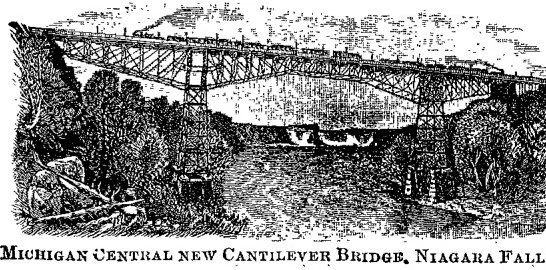
Michigan Central New Cantilever Bridge, Niagara Falls.

MICHIGAN CENTRAL

“The Niagara Falls Route.”
Corrected Nov. 30, 1890.
EAST. Stations — † Mail; † Day Express; N. Shore Limited; N. Y. Express; *Atl’ntic Express; † Eve’g Express; † Kal. Accom’n.
Chicago — am 7.05; am 9.00; pm 12.20; pm 3.10; pm 10.10; pm 9.25; pm 4.50. Michigan City — 9.10; 11.10; 1.56; 4.48; am 12.20; 11.25; 7.00. Niles — 10.2; pm 12.15; 2.53; 5.55; 1.45; am 12.40; 8.25. Kalamazoo — 11.50; 2.20; 3.58; 7.04; 3.55; am 2.17; 10.05. Battle Creek — pm 12.55; 3.03; 4.30; 7.37; 4.29; 3.04; 8.00. Jackson — 3.10; 4.30; 5.38; 8.52; 6.25; 4.45; 9.55. Ann Arbor — 4.45; 5.32; 6.29; 9.45; 7.50; 6.05; 11.00. Detroit — 6.15; 6.45; 7.30; 10.45; 9.20; 7.35; pm 12.10. Buffalo — am 8.25; am 8.25; am 3.25; am 6.25; pm 4.55; am 2.15; 8.00. Rochester — 6.00; 9.20; 8.00; 11.20. Syracuse — 8.00; 11.35; 10.20; 1.30. New York — pm 4.00; pm 8.50; am 7.20; 9.42. Boston — 6.00; 10.57; 9.35; pm 2.50.
WEST. Stations — † Mail; † Day Express; N. Shore Limited; Chicago Express; *Pacific Express; †Kal. Accom’n; †Eve’g Express.
Boston — am 8.30; pm 2.15; pm 3.00; pm 7.00. New York — 11.50; 4.50; 6.00; 10.00. Syracuse — pm 8.30; 11.55; am 2.10; am 8.00. Rochester — 10.40; am 1.42; 4.20; 10.45. Buffalo — pm 11.30; 11.30; 6.30; 11.50; am 8.45. S. Bend Bridge — am 12.28; am 12.28; 3.05; 6.25; pm 12.50. Detroit — 8.30; 7.50; 9.25; pm 1.20; 9.15; 4.45; pm 7.45. Ann Arbor — 9.45; 8.55; 10.15; 2.17; 10.30; 5.28; 8.58. Jackson — 11.25; 10.05; 11.18; 3.20; 11.50; 7.15; pm 10.20. Battle Creek — 12.55; 11.35; pm 12.22; 4.30; am 1.28; 8.47; 11.57. Kalamazoo — 2.17; pm 12.12; 12.59; 5.02; 2.17; pm 9.33; am 12.50. Niles — 4.10; 1.23; 2.05; 6.17; 4.05; 7.40; 3.10. Michigan City — 5.25; 2.31; 3.18; 7.20; 5.45; 8.55; 4.30. Chicago — 7.55; 4.35; 4.50; 9.00; 8.05; 11.20; 6.40.
*Daily. †Daily except Sunday. ‡Daily except Saturday.
Accommodation train for Jackson and all intermediate points leaves Battle Creek at 6.16 P. M., arriving at Jackson at 7.55 P. M., daily except Sunday.
Accommodation train for Niles and all intermediate points leaves Battle Creek at 8.00 a. m., arriving at Niles at 10.05 a. m., daily except Sunday.
Trains on Battle Creek Division depart at 8.03 a. m. and 4.35 p. m., and arrive at 12.40 p. m. and 7.00 p. m., daily except Sunday.
O. W. RUGGLES, General Pass. & Ticket Agent, Chicago.
GEO. J. SADLER, Ticket Agent, Battle Creek.

Chicago & Grand Trunk R. R.

Time Table, in Effect May 11, 1890.
GOING WEST. Stations. GOING EAST.
Boston; New York; Buffalo; Niagara Falls; Boston; Montreal; Toronto; Detroit.
Chl. Pass.; B. C. Pass.; Lmtd Exp.; Pacific Exp.; Pacific Exp.; Mail Exp. — Stations — Mail; Lmtd Exp.; Atltc Exp.; Day Exp.; Prt. II Pass.
Port Huron; Lapeer; Flint; Durand; Lansing; Charlotte; BATTLE CREEK; Vicksburg; Schoolcraft; Cassopolis; South Bend; Haskell’s; Valparaiso; Chicago.
Where no time is given, train does not stop. Trains run by Central Standard Time.
Valparaiso Accommodation, Battle Creek Passenger, Port Huron Passenger, and Mail trains, daily except Sunday. Parlor, Limited, Day, and Atlantic Expresses, daily. Sunday Passenger, Sunday only.
W. E. DAVIS, Gen. Pass. and Ticket Agt., Chicago.
A. S. PARKER, Ticket Agt., Battle Creek.
AFFORDS unrivaled facilities for transit between the most important cities and towns in Illinois, Iowa, Wisconsin, Northern Michigan, Minnesota, North and South Dakota, Nebraska, and Wyoming. The train service is carefully adjusted to meet the requirements of through and local travel, and includes

Fast VESTIBULED Trains

OF DINING CARS, SLEEPING CARS, and DAY COACHES,
Running Solid between CHICAGO and St. Paul, Minneapolis, Council Bluffs, Omaha, Denver, and Portland, Ore.
PULLMAN and WAGNER SLEEPERS | COLONIST · SLEEPERS, Chicago to San Francisco, Without Change. | Chicago to Portland, Ore., And San Francisco.
FREE RECLINING CHAIR CARS Chicago to Denver and Portland, Ore., via Council Bluffs and Omaha.
For time of trains, tickets and all information, apply to Station Agents of the Chicago & Northwestern Railway, or to the General Passenger Agent at Chicago.
W. H. NEWMAN, 3d Vice-Pres.
J. M. WHITMAN, Gen’l Manager.
E. P. WILSON, Gen’l Pass. Agt.

Stockholders’ Meeting

Appointments.

“And he said unto them, Go ye into all the world, and preach the gospel to every creature.”—Mark 16:15.
There will be a general meeting and canvassers’ institute at Villard, Minn., commencing Thursday evening, Dec. 11, and closing Monday evening, the 15th. We expect Elder Porter and Bro. F. L. Mead will be with us. We hope to see all from Northern Minnesota that are interested in the canvassing work. C. M. EVEREST.
There will be a general meeting and canvassers’ institute at Wells, Minn., Dec. 18–22. Meetings will commence Thursday evening and close Monday evening. We have the promise that Elder Porter and Bro. F. L. Mead will be present. We hope to see a general attendance. The brethren at Wells will gladly do all they can to care for those who come. C. M. EVEREST.

Stockholders’ Meeting.

Pursuant to the provisions of Act No. 304 of the Public Acts of 1887 of the State of Michigan, we hereby call a meeting of the stockholders of the Seventh-day Adventist Publishing Association, to convene at the Tabernacle in the city of Battle Creek, Mich., on Wednesday, Dec. 3, 1890, at 10 o’clock A. M., Standard Time, to decide upon the formation of a corporation successor to said association, and to transact such business relative thereto as is authorized by said Act.
Dated Aug. 23, 1890.
C. ELDRIDGE, U. SMITH, A. R. HENRY, F. E. BELDEN, H. LINDSAY, GEO. I. BUTLER, H. W. KELLOGG, Trustees.

BUSINESS NOTICES.

[Under this head, short business notices will be inserted at one dollar for each notice of four lines or less. Over four lines, twenty-five cents a line. Persons unknown to the managers of the REVIEW must give good references as to their standing and responsibility. Ten words constitute a line.]
WANTED.—A good coal-miner to lease my coal bank, and run it. Man with a family preferred. Must be a Sabbath-keeper. Address, T. S. Dean, Sr., Lowry City, St. Clair Co., Mo.

LABOR BUREAU.

WANTED.—I should be glad to correspond with some brother who would like a home where he can do light work for his board and clothes. W. H. Littlejohn, Box 1954, Battle Creek, Mich.

ADDRESS

THE P. O. address of Elder R. D. Hottel, till further notice, will be 24 Howland Street, Battle Creek, Mich.

Obituary Notices.

“Blessed are the dead which die in the Lord from henceforth.”—Rev. 14:13.
PEASE.—Austin Pease died Oct. 10, 1890, of old age, near Ridgeway, Osage Co., Kans., while visiting at a friend's. Bro. Pease, or “Grandpa,” as he was called, was born in Tolland, Berkshire Co., Mass., Jan. 23, 1805, his age at the time of his death being 85 years, 8 months, and 18 days. When he arose on the morning of his death, he complained of a pain in his stomach. At breakfast he ate heartily, and when through he leaned back in his chair, turned his eyes upward, and in two minutes was dead. Grandpa was married in 1828, and raised a large family, but all having died a number of years ago, he was left without a relative. Several years ago he had property enough to keep him through life, but by trusting it in the hands of others he lost it, and last year was partly kept by the Conference. He was a member of the Richland S. D. A. church, and an earnest Christian; and if we are faithful, I believe we will meet him in the first resurrection. S. C. OSBORNE.
CRUMB.—Died in Denver, Colo., Sept. 3, 1890, of typhoid fever, Minnie Crumb, in the thirteenth year of her age. She was the only daughter of sister McCanley, who is a member of the Denver church. Minnie was a regular attendant at the Sabbath-school, which she loved very much, and she took pleasure in getting her lessons well. She was a good child, and we have reason to believe that she sleeps in Jesus. The funeral services were conducted by the writer. G. W. ANGLEBARGER.

THE NEXT GENERAL CONFERENCE.

As our brethren throughout the world will be interested to know the time and the place for the next meeting of the General Conference, we will here submit the suggestions made by the General Conference Committee in the meeting last July:—
1. That the General Conference be held at Battle Creek, March 5–25, 1891.
2. That the General Conference Committee meet for counsel Feb. 18.
3. That the presidents of Conferences and tract societies be invited to meet for general counsel Feb. 25 to March 4; also that a meeting of the Committee on Consolidation of Publishing Interests, and the Foreign Mission Board, be held at the same time.
4. That a canvassers’ convention be held Feb. 22 to March 4.
In view of the many and important measures that must come before the next General Conference, and in order that these subjects may receive careful thought and consideration, the General Conference Committee thought it proper to invite presidents of Conferences, as suggested in paragraph No. 3, above.
O. A. OLSEN, Pres. Gen’l Conf.

Chicago Evening Post Ballot on Sunday World's Fair

☞ The ballot in regard to closing the World's Fair on Sunday, which was carried on in the Chicago Evening Post for about six weeks, closed Nov. 18, with the result standing thus:—
For opening on Sunday, 10,316.
Against opening on Sunday, 5,192.
The Post on this date contained six columns of solid matter upon the subject, divided into fifty-eight separate articles and items from an equal number of persons living in various States of the Union. The discussion carried on in it was probably as profitable and interesting as the voting, if not more so.

Cincinnati Work Progressing; Canvassing Work Specialty

Bro. W. H. Saxby writes us that the work in Cincinnati is progressing very encouragingly. The canvassing work will be made a specialty till after New Year's.

Baptist Convention in Brooklyn Considers Christ's Second Coming

The Syracuse Journal of Nov. 20, 1890, says: “A convention of Baptists is now in session in Brooklyn, to consider the probability of the imminent second coming of Christ.”

Protestants Silent on Romanism's Abuses

☞ Dr. Justin D. Fulton, in the Canadian Baptist of Nov. 6, says: “For years and years the Christian people in the United States and Canada have been silent concerning the monstrous abuses of Romanism.” True. And this means simply that professed Protestants have ceased to protest, and in reality are no longer Protestants.

Public Funds for Sectarian Uses Debated

The Canadian Baptist of Nov. 6, 1890, says: “The appropriation of public moneys to sectarian uses by State legislatures is exciting much and increasing discussion in the United States. Thoughtful and far-seeing citizens in the different States are coming to see more and more clearly that such use of the public funds is wrong in principle and pernicious in practice.”

Sabbath Truth Stirs Interest at Vancouver

We learn from papers sent us by Bro. V. H. Lucas, from Vancouver, B. C., that the presentation of the truths of the Sabbath question, and life through Christ, in that place, is arousing a great deal of investigation, and no little opposition. But he writes that the work is onward, and the Lord is giving them a continual increase in numbers. It was expected a church would be organized there Nov. 29.

Missouri Sabbathkeepers Indicted for Sunday Labor

Word has been received at this office from Missouri, that two of our brethren, William Fritz and Robert Gibb by name, living in Howard County, near Armstrong, Mo., have been indicted and arrested for performing common labor on their farms on Sunday, and that the cases are docketed for trial in the circuit court at Fayette, Mo., Tuesday, Dec. 2, 1890. We have no information as to particulars as yet, and can only say that if the information is correct, and such trials are to occur in Missouri, the Sunday watch-dogs of that State must be getting anxious for their prey, to begin prosecutions in this direction while in their State code there is a provision relating to the section touching “Sabbath-breaking,” reading as follows:—
“SECTION 3853. LAST SECTION CONSTRUED. The last section shall not extend to any person who is a member of a religious society by whom any other than the first day of the week is observed as a Sabbath, so that he observes such Sabbath.”

IN THE FACE OF SUNDAY-KEEPERS.

The Kalamazoo (Mich.) Gazette of Nov. 21, 1890, contained the following editorial note:—
“R. M. King, a Seventh-day Adventist residing at Nashville [should be Lane], Tenn., was arrested and confined for working on Sunday. A writ of habeas corpus was granted, and the case will be tried next Monday. Hon. Don M. Dickinson has been retained as counsel by the Adventists, who propose to make this a test case, taking it to the United States Supreme Court if necessary. Our sympathies are with Mr. King, for the reason that there is not a word in the Bible authorizing the first day of the week to be held sacred, while the command is imperative that the seventh day (Saturday) shall be a day of rest.”

NEW ENGLAND CONFERENCE PROCEEDINGS.

We have received from the printing-office at South Lancaster, Mass., a neatly printed pamphlet of thirty-two large pages, containing a report in full of the late session of the New England Conference, Tract and Missionary Society, Sabbath-school Association, Health and Temperance Association, and South Lancaster Academy, together with statistics of the churches, Sabbath-schools, and other societies, with a directory of the officers of the various organizations. It is a little Year Book, as it were, for the New England Conference. As the work of our different organizations becomes too extensive to be published in full in our papers, more of them doubtless will be published in this form. Those wishing a copy of this pamphlet can address the New England Tract and Missionary Society, South Lancaster, Mass.

SABBATH-SCHOOL LESSONS FOR 1891

LESSONS FOR SENIOR CLASSES.

Commencing with January, 1891, the Senior division will take up the study of the book of James. These lessons have been carefully examined by the Lesson Committee, and will be published in pamphlet form as No. 66 of the Bible Students’ Library.
Price, 5 cents, post-paid. Orders can be filled at any time. Address Pacific Press Publishing Co., or your State Tract Society.

LESSONS FOR THE INTERMEDIATE DIVISION.

A series of lessons on the book of James, covering the same ground as those for the Senior division, has been prepared for the Intermediate division of our Sabbath-schools. These lessons are especially adapted to the young, and will be published in the Youth’s Instructor, beginning with January, 1891. In small schools, if thought best, the Senior and Intermediate divisions can now unite in the general review exercises. Of course it is understood that it will be left optional with each school to use these lessons or continue with the lesson books the same as before.
C. H. JONES.

DISTINCTIONS BETWEEN CHURCH AND STATE.

The Rev. W. C. Peterborough, bishop of Peterborough, England, in the Fortnightly Review, in January, 1890, draws very distinctly the difference between the province and duties of the State and those of the Church. He says:— “The Church is not and cannot become the State; the State is not and cannot become the Church. These words stand for two wholly distinct and different societies, having different aims, different laws, and different methods of government. The State exists for the preservation of men’s bodies; the Church, for the salvation of their souls. The aim of the State, even put at its highest, is the welfare of its citizens in this world; the aim of the Church is their holiness here in order to their welfare hereafter. The duty of the Church is to eradicate sin; the duty of the State is to prevent or to punish crime. . . . When I assert, as I do, that the laws of Christ’s Church cannot safely or justly be all of them transferred to the statute-books of the State, I am as far as possible from asserting that Christianity has nothing to do with politics. On the contrary, I maintain that it has everything to do with them; not, however, directly, but indirectly; not by way of compelling men by law to observe its precepts, but by way of inspiring men with its spirit. . . . Christianity acts, not by filling the statute-books with Christian precepts, but by filling the hearts of legislators with Christian feelings and motives.”

A FUND FOR THE EMPLOYMENT OF COLPORTEURS IN THE SOUTHERN FIELD.

For the prosecution of this work, we ask for $2,000, in donations of ten dollars and upward. Those who feel an interest in reaching the people of the South with the truth, are earnestly requested to contribute promptly and liberally to this fund for the support of colporteurs in the Southern field.
(Previously reported, $1,428.)
Mrs. R. A. Shane - - - - $10 00
Mary J. Johnson - - - - $10 00
All contributions should be sent to W. H. Edwards, REVIEW AND HERALD, Battle Creek, Mich.

One Hundred Men Wanted to Pay Fifty Dollars Each

$5,000-FUND FOR RELIGIOUS LIBERTY WORK.

One Hundred Men Wanted to Pay Fifty Dollars Each.

WE whose names follow, agree to pay the amount set opposite, toward raising a fund of $5,000 for the circulation of Religious Liberty literature in States and Territories in the South and West where there are no local Conferences or State organizations:—
(Previously reported, $2,900.)
Mrs. Mary B. Gibson $50 00
Remittances to this fund should be sent to W. H. Edwards, REVIEW AND HERALD, Battle Creek, Mich.

You have reached the end of this edition.

Review and Herald · Dec 2, 1890