Pacific Press Publishing Company · New York · Feb 20, 1896
THE EASTERN QUESTION.
AFFAIRS in the vicinity of Constantinople and in Asia Minor are more pacific than they were a few weeks ago; but the Eastern Question is not settled, nor will it be until the Turk shall have been driven from Europe.
The real problem that demands solution is not, What shall be the fate of the Turkish Empire? That has long been a foregone conclusion. The Eastern Question is, in brief, To whose lot shall Constantinople and the control of the Dardanelles and the Bosphorous fall when the Turk is driven from Europe? Christendom long since decreed the utter destruction of Ottoman supremacy, and could the crowned heads of Europe agree among themselves as to the disposition of the territory of the Sultan, the Turkish Empire could not last a month. Ottoman autonomy exists to-day solely because of the mutual jealousies of the great powers of Europe.
In 1840, the Sultan, Abd-ul-Mejid, who had just come to the throne, finding himself unable to cope successfully with Mehemet Ali, the rebellious Pasha of Egypt, virtually surrendered his sovereignty into the hands of the powers of Europe by accepting their ultimatum in the Egyptian embroglio and transmitting it to the Pasha, who yielded, not to the Sultan but to the powers; since which time Turkey has existed merely by the sufferance of the other nations of Europe, and is well described by the sobriquet, “the Sick Man of the East.” (See on second page.)
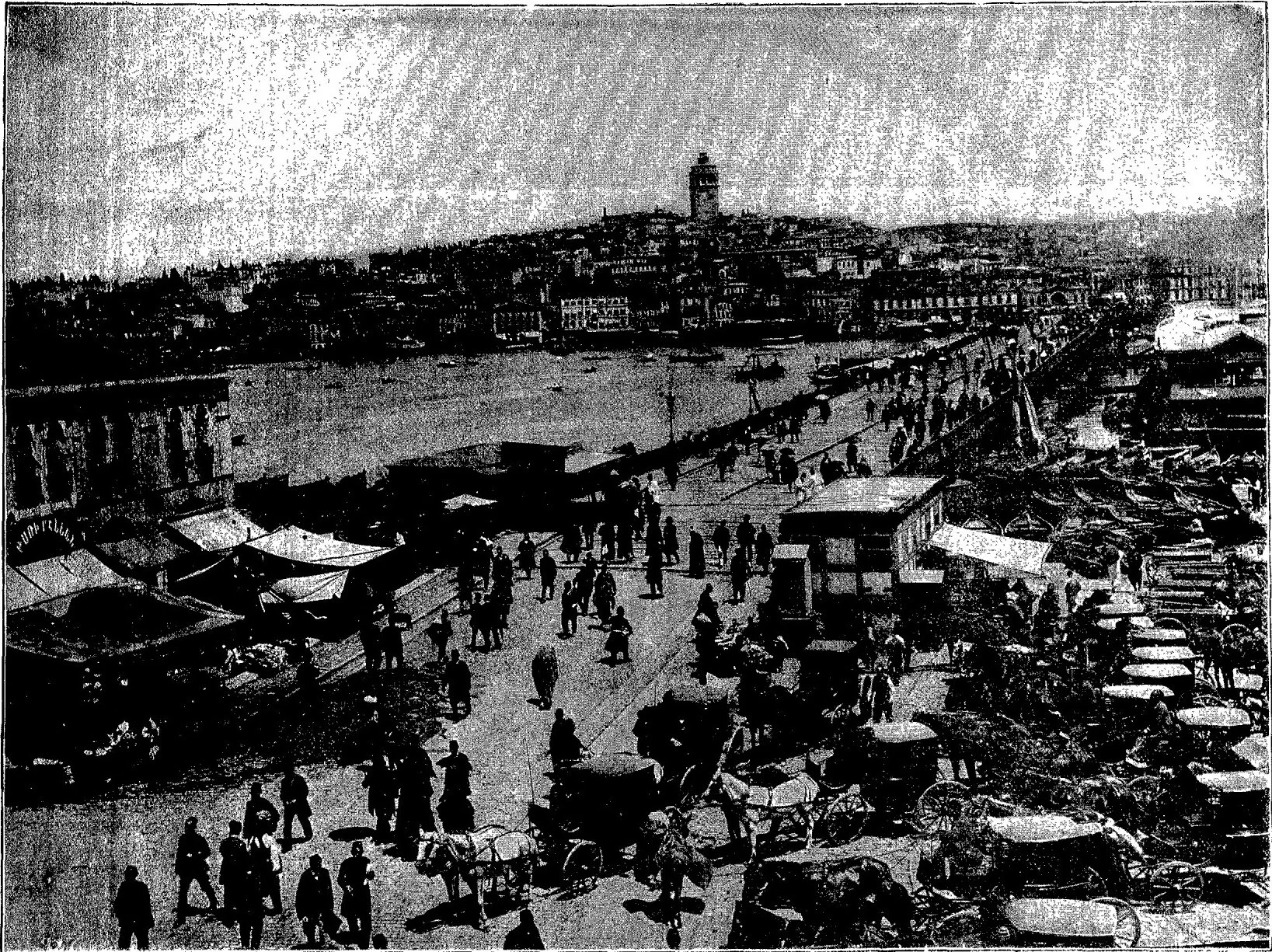
View of Constantinople from the Galata Bridge. From the Evangelist. By permission.
Every great power in Europe looks with covetous eyes upon the city of Constantinople. England, Austria, and Russia, especially have each cherished the hope of one day adding to58their possessions this busy mart of the Orient. But hitherto ambition has been restrained by the certain knowledge that the occupation of “Key of the East” by any one of the powers would be the signal for a general European war too awful in its probable consequences to be risked even for such a prize.
Nevertheless the conquest of Turkey, the possession of Constantinople, and the command of the passage between the Mediterranean and the Black Seas have long been the avowed purpose of Russia. Peter the Great cherished this ambition two centuries ago and left it as a sacred legacy to his successors. In his will, the great Czar said:—
Take every possible means of gaining Constantinople and the Indies (for he who rules there will be the true sovereign of the world); excite war continually in Turkey and Persia; establish fortresses in the Black Sea; get control of the sea by degrees, and also of the Baltic, which is a double point, necessary to the realization of our project; accelerate as much as possible the decay of Persia; penetrate to the Persian Gulf; reëstablish, if possible, by the way of Syria, the ancient commerce of the Levant; advance to the Indies, which are the great depôt of the world. Once there, we can do without the gold of England.
How undeviatingly this policy has been followed by the Czars will appear from an extract from Russian history:—
In 1696, Peter the Great wrested the Sea of Azov from the Turks, and kept it. Next, Catharine the Great won the Crimea. In 1812, by the peace of Bucharest, Alexander I. obtained Moldavia, and the prettily named province of Bessarabia, with its apples, peaches, and cherries. Then came the great Nicholas, who won the right of the free navigation of the Black Sea, the Dardanelles, and the Danube.
Great as were these advances Russian ambition was not satisfied; and in 1853 the Czar attempted to establish “a protectorate over all Christians in Turkey belonging to the Greek Church.” This claim not being allowed by the Porte, a Russian army entered the Danubian principalities. After ineffective negotiations war was declared by the Sultan on the 4th of October.
In this, the Crimean war, England and France allied themselves with Turkey; Russia was defeated and lost some territory previously gained; but, in 1870, when all Europe was intently watching the desperate conflict between France and Germany, the Czar announced to the powers that he would no longer be bound by the Treaty of Paris, made in 1856, which excluded his ships and arsenals from the Black Sea; and since that time the Euxine has been practically Russian territory.
But the long-cherished goal of Muscovite ambition had not been reached, and only a few years later eastern Europe was again darkened by an ominous war cloud. Russian intrigue was at work, and in 1875 Bosnia and Herzegovina revolted; and in a few months Bulgaria was involved in the rebellion. Servia and Montenegro also took up arms. The atrocities attending the efforts of the Turks to suppress rebellion were such as to excite the indignation of the civilized world. But the resources of European diplomacy were exhausted in fruitless attempts to gain from the Porte some real security for better government in the distracted provinces, and in April, 1877, Russia again declared war.
The neutrality of Austria had been secured by a secret agreement permitting that country to occupy Bosnia and Herzegovina, if Russia should extend its influence beyond the Balkans. England would doubtless have interfered but the Bulgarian massacres had excited such horror and indignation that Britain was forced to remain neutral. Lord Beaconsfield, then Prime Minister, stipulated, however, that Egypt should not become the scene of hostilities, and that the Russians should not occupy Constantinople, except temporarily. In this way Turkey was left without an active ally, and the following February the Russian army reached the suburbs of the coveted city; but the Czar, knowing that England would not permit him to reap the full fruits of his victory, concluded a treaty of peace with Turkey, March 3, 1878, and shortly withdrew his troops from Ottoman territory.
As a result of the war, several independent and semi-independent principalities were erected out of what had formerly been Turkish territory; and in these, Russian influence continued to manifest itself. They have been saved from Muscovite greed only by the influence of England and Austria, made potent by English cannon and Austrian columns.
Russia had gained the Black Sea, but could advance into Asia Minor only by aggressions in Armenia. To this end revolt was encouraged there, until a few months since open rebellion afforded pretext for Mohammedan hate to manifest itself in the massacre of those who bore the name of Christians. This doubtless was the cause of the atrocities which so horrified the world only a few weeks ago. From a human standpoint, only one thing prevented summary interference on the part of the “Christian” powers, and that was jealousy of each other. But God makes even the wrath of man to praise him, and the remainder of wrath he restrains. Universal war would greatly retard the progress of the gospel, and so God holds in check these warlike elements until his work is accomplished in the earth. How often during the past twenty years have men said, the final catastrophe can be averted only a few months at most, then universal, devastating war must come. But heavenly messengers restrain the armies of earth. “I saw four angels,” says the inspired penman, “standing on the four corners of the earth, holding the four winds of the earth, that the wind should not blow on the earth, nor on the sea, nor on any tree. And I saw another angel ascending from the east, having the seal of the living God; and he cried with a loud voice to the four angels, to whom it was given to hurt the earth and the sea, Saying, Hurt not the earth, neither the sea, nor the trees, till we have sealed the servants of our God in their foreheads.”
Many times the speedy dismemberment of Turkey has appeared to be inevitable. But though without friends or allies Turkey has received aid either directly or indirectly in every emergency, and has thus been preserved as a nation; but nobody doubts that the time will come, when, having filled up the cup of its iniquity, the Ottoman power will be swept from the face of the earth.
To the testimony of the unmistakable trend of political events is added the declarations of the Word of God. The prophecy declares plainly that notwithstanding the fact that the Turk has been supported more or less directly in the past by other powers, he will finally be driven from Europe. “He shall plant the tabernacles of his palace between the seas in the glorious holy mountain,” says the inspired Word, “yet he shall come to his end, and none shall help him.”
“Between the seas in the glorious holy mountain” refers unmistakably to Jerusalem, located between the Dead Sea and the Mediterranean. Palestine is Turkish territory, and the Mohammedan, equally with the Christian, regards Jerusalem as holy ground. And what is more natural than that driven from Europe and fired by religious fanaticism, the Turk should make the “City of David” his capital?
But such a transfer of the Ottoman seat of government will by no means settle the Eastern Question; it will only change its form. Turkish hate and fanaticism will beget like feelings in “Christian” breasts, and Christendom will demand the expulsion of the Turk from the “Holy City.” “He shall come to his end and none shall help him.” And what then? Let the prophecy answer: “And at that time shall Michael stand up, the great prince which standeth for the children of thy people: and there shall be a time of trouble, such as never was since there was a nation even to that same time: and at that time thy people shall be delivered, every one that shall be found written in the book. And many of them that sleep in the dust of the earth shall awake, some to everlasting life, and some to shame and everlasting contempt. And they that be wise shall shine as the brightness of the firmament; and they that turn many to righteousness as the stars for ever and ever. But thou, O Daniel, shut up the words, and seal the book, even to the time of the end: many shall run to and fro, and knowledge shall be increased.”
The seal of the book of Daniel has been broken. Knowledge of the Scriptures, as well as of the arts and sciences, has increased wonderfully, and in the light of the divine Word the present status of the Eastern Question points unmistakably to the soon coming of the “King of kings and Lord of lords” to claim the promise of the Father and to fulfill his word: “Ask of me, and I shall give thee the heathen for thine inheritance, and the uttermost parts of the earth for thy possession. Thou shalt break them with a rod of iron; thou shalt dash them in pieces like a potter’s vessel.” “And the kingdom and dominion, and the greatness of the kingdom under the whole heaven, shall be given to the people of the saints of the most High, whose kingdom is an everlasting kingdom, and all dominions shall serve and obey him.” And in these events only will be found the final settlement of the Eastern Question.
WHAT THEY WANT.
The “National Reform” conception of the State,—the conception upon which Sunday legislation is demanded of Congress and other law-making bodies,—is that the State is the creature of God, and therefore amenable to God’s moral law,—that law which says, “Thou shalt have no other gods before me,” “Remember the Sabbath day to keep it holy,” etc.
But the “National Reform” party do not purpose to abolish or change the form of this Government. They want it to be “Christian”—to be a government of God on earth, but they do not purpose to abolish the various offices which are now filled by the people’s representatives. They do not advocate a formal transfer of the government to God, by a general abdication of office in his favor. They are probably aware that the Almighty would take no notice of any such action; and moreover, it would seriously interfere with their59plans if he should do so. They would have the various functions and offices of government remain as they are; at least, they have given no hint of any purpose to the contrary.
The question then arises, In this government of God on earth, who would do the governing? We are told of course that God would govern; but how would this be done? He will not descend himself, nor send angels down from heaven, to take control of affairs. No; it will still remain for men to fill the quondam positions of public trust. But how is it to be known what men are suitable for these positions? How is the divine will to be made known in this respect? Where now is the pillar of cloud, from which God communicated with his people of old? Where is the visible shrine of his glory to which men may seek, or where the Urim and the Thummim, by which his will was wont to be made known? Where are the seers and prophets by whose anointing it may be manifest what men are chosen of God? There are none, must be the confession of the religious world. And still the necessity remains of selecting such men for public office as will make this a government of God.
How then can it be done? Will the choice be left to the people themselves? That would not do, for more than half the people of the land are not even professedly Christians. Hence they could not select the proper candidates for office. But the “reform” party are not unprepared for this emergency. They have a solution of the problem, and it has been already announced. It appeared in an article by Rev. W. F. Crafts, in the Christian Statesman of July 5, 1888. It was stated in one sentence, thus:—
The preachers are the successors of the prophets.
This throws a flood of light upon the whole situation. Anciently, the prophets made known the ones whom God had appointed to office; the same will now be done by the preachers. And obviously no preachers can so fittingly assume this task as those who have so long recognized and advocated its necessity!
And thus is seen the purpose of the demand for a “Christian” government: This must be a government of God; it must therefore be a government by Christian officials; the officials must therefore be chosen by the preachers. In short, if only this is made a government of God, we [the preachers] will do the governing! And that is what we want, and are determined to have!
And what the people will then have in place of their present free government, is set forth in the article, “Clerical Civil Government,” on page 60.
GOING TO THE ROOT OF THE MATTER.
REFERRING to the so-called Christian amendment, the Truth Seeker, of this city, says:—
Freethinkers go to the root of the matter by refusing to admit the existence of the being the Christians describe as God; by denying that civil government has any other source than the people who establish it, and by opposing all religious legislation as a fraud, a usurpation, and a tyranny. This ground is perfectly tenable under the Constitution and it is the only refuge from the tide of religious fanaticism and political hypocrisy that is floating the theocrats on to Washington.
This is a mistake. It is much easier to go to the root of the matter while acknowledging the being of God, and that rights have a higher source than the will of the people. “There is no power but of God,” and “the powers that be are ordained of God.” But, as we have many times shown, as God has ordained these powers, so he has limited them, and in this fact is our only security.
The Declaration of Independence, written by Thomas Jefferson, an avowed liberal, recognizes both the being of God, and that he is the author of rights, and consequently of government. “We hold these truths to be self-evident,” wrote Jefferson, “that all men are created equal; that they are endowed by their Creator with certain unalienable rights.” These words recognize the Creator and the divine origin of rights. If civil government had no other source than the people, then there could be no rights superior to the will of the people; and the pagan motto, “Whatever is, is right,” would be true in government as in everything else. But the Declaration of Independence distinctly affirms the divine origin of human rights and makes those rights superior to human government, because they are God-given.
Government is ordained of God to be “a terror to evil-doers and a praise to them that do well.” He has, therefore, ordained no invasion of the rights which he himself gave, and whatever liberty freethinkers enjoy to-day is due to the recognition by their fellowmen of the fact that they, equally with other men, are by their Creator endowed with certain unalienable rights; consequently they and they only go to the root of this matter who recognize God as the Creator, and who, acknowledging his right to command them, maintain their God-given right to worship him according to the dictates of their own consciences, and who also consistently maintain that every other man has the same God-given right not to worship if he so elects.
“PEACE, ORDER, AND GOOD GOVERNMENT” IN BROOKLYN.
On the evening of January 29, a large “mass meeting” was held in Dr. Meredith’s church, Brooklyn, for the purpose of securing a more rigid enforcement of the excise Sunday law in that city. Speeches were made and resolutions passed which were deemed appropriate to the occasion. The preamble and first resolution read thus:—
Recognizing the sacredness of our Christian institutions, and the obligations of all Christians to sustain the legislative enactments which minister to peace, order and good government; and,
WHEREAS, It is the conviction of this representative assembly of the city of Brooklyn that peace, order, and good government are discouraged, and, to a great degree, prostrated, by the partially unrestricted sale of intoxicating drinks on the day recognized by the majority of our citizens and by statute as our day of rest, quiet and public worship; therefore, be it
Resolved, First, That we pledge our united support to his honor, Mayor Wurster, in an impartial enforcement of that section of the excise law providing that no liquor be sold or offered for sale during the hours of Sunday in any saloon or store, and that he be urged to clothe the police force with all the authority provided by statute.
The introductory words, “Recognizing the sacredness of our Christian institutions,” are significant of the real purpose of the gathering. This recognized “sacredness” is to be given the benefit of legal enactments.
But is this recognition a proper reason for petitioning for a stricter enforcement of any statute? The laws are for all alike; but this “recognition” is altogether partial. Very many people in the land do not recognize the sacredness of Christian institutions, and some who do, do not recognize Sunday as one of them. Hence the recognition named affords at best only a ground for legislation which would be class legislation, and therefore partial and unjust.
The second clause of the preamble cites the “conviction of this representative assembly of the city of Brooklyn that peace, order, and good government are discouraged, and to a great degree prostrated, by the partially unrestricted sale of intoxicating drinks on the day recognized by the majority of our citizens and by statute as our day of rest, quiet, and public worship.” Undoubtedly this conviction states the truth, and Sunday liquor selling should be prohibited; but if “the partially unrestricted sale” of intoxicants on that day is destructive of public peace, order, and good government, what must be said of the wholly unrestricted sale of the same (except to minors) on all other days? In other words, if peace, order, and good government in Brooklyn is the real object sought at such mass-meetings, why is the partially unrestricted sale of intoxicants on Sunday a greater hindrance to the attainment of that end than is the unrestricted sale of intoxicants on other days of the week?
If peace, order, and good government are to be secured in a city, why not call for prohibition of the liquor traffic on every day alike? Can that object be secured by anything short of this?
It may be said that liquor selling cannot be stopped by laws prohibiting it. Very true; neither can stealing and murder be stopped by laws against them. Yet such laws are proper and necessary, and no one advocates their repeal, or the prohibition of such acts only on Sunday.
If liquor selling is just—not destructive of human rights—let it be allowed all the time. We have nothing to fear from what is right. No person can be unjustly hurt by that at any time. But if it be unjust—an invader of the rights of mankind—let it be prohibited as such; let it be outlawed like all other enemies of our rights. Let it be kept away from us all the time.
We do not believe in a kind of prohibition which allows an intoxicant to be sold six days in the week (thus enabling the consumer to have it in his possession on every day of the week and to become its victim and a perpetrator of crime upon every day), and really accomplishes only the exaltation of a religious institution.
SUNDAY STREET CARS FOR TORONTO.
[Christian Register, January 30.]
By the recent decision of a court of appeal in Canada it is decided that Toronto shall have the use of street cars on Sunday. This city has been Puritanically Sabbatarian, and the cars have been prohibited on the streets until after midnight Sunday. The inconsistency of such legislation is shown in the fact that, while the horse cars have been prohibited, carriages and bicycles have been allowed to run. People rich enough to own a carriage could therefore ride to church, and those having bicycles could ride in other directions. The great majority of church-goers were compelled to go on foot. For the young and healthy this is no hardship; for, what with elevators, street cars, and bicycles, we are losing the use of our legs. For the aged and infirm and for many others who want street cars for other purposes than church-going the sabbatarian law has been very inconvenient; and there is nothing to show that Toronto is any more religious than other cities for imposing this form of public inconvenience.
THE BARBER SUNDAY LAW.
RELIGIOUS legislation in the State of New York has been recently strengthened by a decision by Justice Ingraham, of the Appellate division of the State Supreme Court, affirming the constitutionality of the law requiring all the barber shops in the State to be closed on Sundays, except in the cities of New York and Saratoga, where they are permitted to be open on Sundays till 1 o’clock P. M. The language by which the Justice sought to sustain his decision is as follows:—
There is nothing in this act that attempts to provide that the appellant shall not carry on his particular trade or calling in any manner, or at any place that he pleases. He is simply prohibited from carrying on that trade on Sunday. An examination of the legislation of most of the States will show that that subject was regulated by statute prior to the adoption of the Federal Constitution and the constitution of the State, and that prohibition of work upon Sunday, more or less severe, was in force in all the States at that time, and the right of the legislature to regulate the observance of the sabbath has been recognized without exception by this and some of the other States since the formation of our Government.
The first two sentences of this opinion are simply contradictory to each other. Prohibition of one’s regular business on Sunday is a prohibition of that business in any place and in any manner, so long as it lasts; and prohibition at one time of any business or pursuit is justifiable only by the propriety of its prohibition at all times, save under emergencies which arise from extraordinary circumstances. In other words, the character of a thing is not determined by its length; a piece of rope is no less rope because it may be only one seventh as long as another piece of rope. And so with the prohibition of Sunday business; it is no less prohibition in toto because it is intermittent in character and only one seventh as long as if it were continued throughout the week.
It follows, also, that if the legislature can rightfully prohibit a business on one day of the week, it can rightfully prohibit it on all days of the week. The two pieces of legislation would be, in principle, precisely the same.
In the plea of unconstitutionality upon which the law was brought before the supreme court, the point was raised that it is class legislation, since it confers special privileges upon shops in New York and Saratoga. Concerning this the Justice said:—
We do not think that the act can be questioned on this ground. If the legislature has power to regulate the observance and prevent the desecration of the sabbath, it has power to say what acts in the different localities of the State it is necessary to prohibit to accomplish this purpose. It is quite conceivable that an act should be prohibited in one locality, thickly settled, which, in sparsely settled districts of the State, could be allowed; and for this reason an act might be objectionable in one district while not in another.
It will be noticed that this decision does not recognize the “civil sabbath” idea at all, but treats of the statute as one to “regulate the observance and prevent the desecration of the sabbath.” In other words, the statute is recognized as a piece of religious legislation. “Desecration” of the “sabbath” cannot mean any other kind of act than one pertaining to religion.
The point that the statute is class legislation is well taken. All religious legislation is class legislation in the interests of the class professing the religion thus “favored.” And this statute is further identified as class legislation by the reason alleged in the appeal. While it is no doubt true that under some circumstances “an act should be prohibited in one locality, thickly settled, which in sparsely settled districts of the State could be allowed,” this fact constitutes a very poor reason for forbidding the act in Brooklyn, Buffalo, Rochester, etc., and allowing it in Saratoga.
In conclusion, it may be said that the Justice’s appeal to the long-standing Sunday legislation of this country as a justification of such legislation now, is an appeal to a very bad source. Such legislation was wrong then, just as it is wrong now. Lapse of time does not make wrong right. Its pedigree is traceable directly back to the Old World legislation of Church and State times. It should have been repealed at the birth of this free Republic.